Over the course of the early modern period, parish, monastic, and pilgrimage churches across Catholic Europe and beyond eagerly sought to acquire the relics of ancient Roman martyrs excavated from the Eternal City's catacombs.Footnote 1 Demand for the “holy bodies” of these so-called catacomb saints grew quickly in the religiously divided territories north of the Alps, especially after the end of the Thirty Years’ War in 1648. At a translation ceremony in the small Bavarian town of Poxau in 1709, Capuchin friar Jordanus von Wasserburg observed that “almost all the churches and chapels of our pious German Fatherland demand to have a holy body from the catacombs.”Footnote 2 This was certainly true in Wasserburg's home region of Bavaria, which had welcomed almost 350 “holy bodies” to its soil between 1648 and 1803.Footnote 3
The distribution of these relics was a key component of an intellectual movement known as the paleo-Christian revival, in which scholars, located primarily in Rome, used historical and archeological evidence to prove a central thesis: the Catholic Church had been “ever the same” (semper eadem), unchanging across the centuries.Footnote 4 This had become an urgent task in the sixteenth century because the history and rituals of the early Christian church had become an important battlefield between Protestants and Catholics during the Reformation.Footnote 5 Both sides vigorously contested the history of the early Church by “professing complete identity between their own beliefs and practice and those of their earliest ancestors.”Footnote 6 Protestants of all denominations alleged that many contemporary Catholic doctrines, institutions, and practices—the papacy, the veneration of images and relics, and so on—lacked a basis in scripture and instead reflected accumulated human error and invention over the centuries.
In the eyes of Catholic scholars, catacomb saint remains provided material evidence that countered such claims. First, the relics came from a period of church history that was celebrated by Protestants themselves as untainted by corruption, and thus venerating them could not be seen as unorthodox. Furthermore, the significant number of holy bodies in the catacombs bolstered the case for the primacy of Rome as the true “cradle of Christianity.”Footnote 7 Finally, the assertion—made by important paleo-Christian scholars, like Cesare Baronio and Antonio Bosio—that all those buried in the labyrinthine passages were martyrs was especially resonant in an era of renewed religious violence and martyrdom. Catholic scholars connected the persecution of early Christians with the deaths of early modern martyrs as a way to illustrate the movement's key argument of continuity over time. From the earliest years of the church to the present day, they argued, martyrs had been willing to sacrifice their lives to defend their Catholic beliefs against tyrants and heretics.Footnote 8 The conviction that the bodies of catacomb saints “incorporated the [paleo-Christian revival's] key themes of antiquity, martyrdom and Roman provenance” underpinned the decision of the church in Rome to send the remains across Europe and the wider world.Footnote 9
While the significance of these “holy bodies” in the arc of Catholic sacred history might have been clear to church officials and scholars in Rome steeped in paleo-Christian scholarship, when the catacomb saints remains arrived, local communities were faced with the task of crafting an identity for the new patron using a box of jumbled bones and scarcely any information beyond the fact that the saint had been an ancient, Roman martyr. This article examines how early modern Bavarians—clergy and laypeople alike—worked to create both material bodies and written hagiographical narratives to communicate the catacombs saints’ origins and significance in Catholic sacred history. This involved an innovative, multistep process of identity creation that began with the material construction and costuming of a holy body and then progressed to the composition of written vitae.Footnote 10
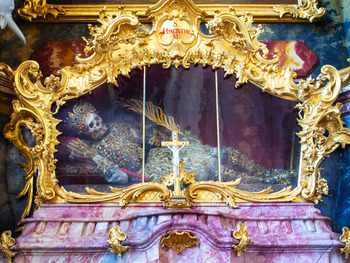
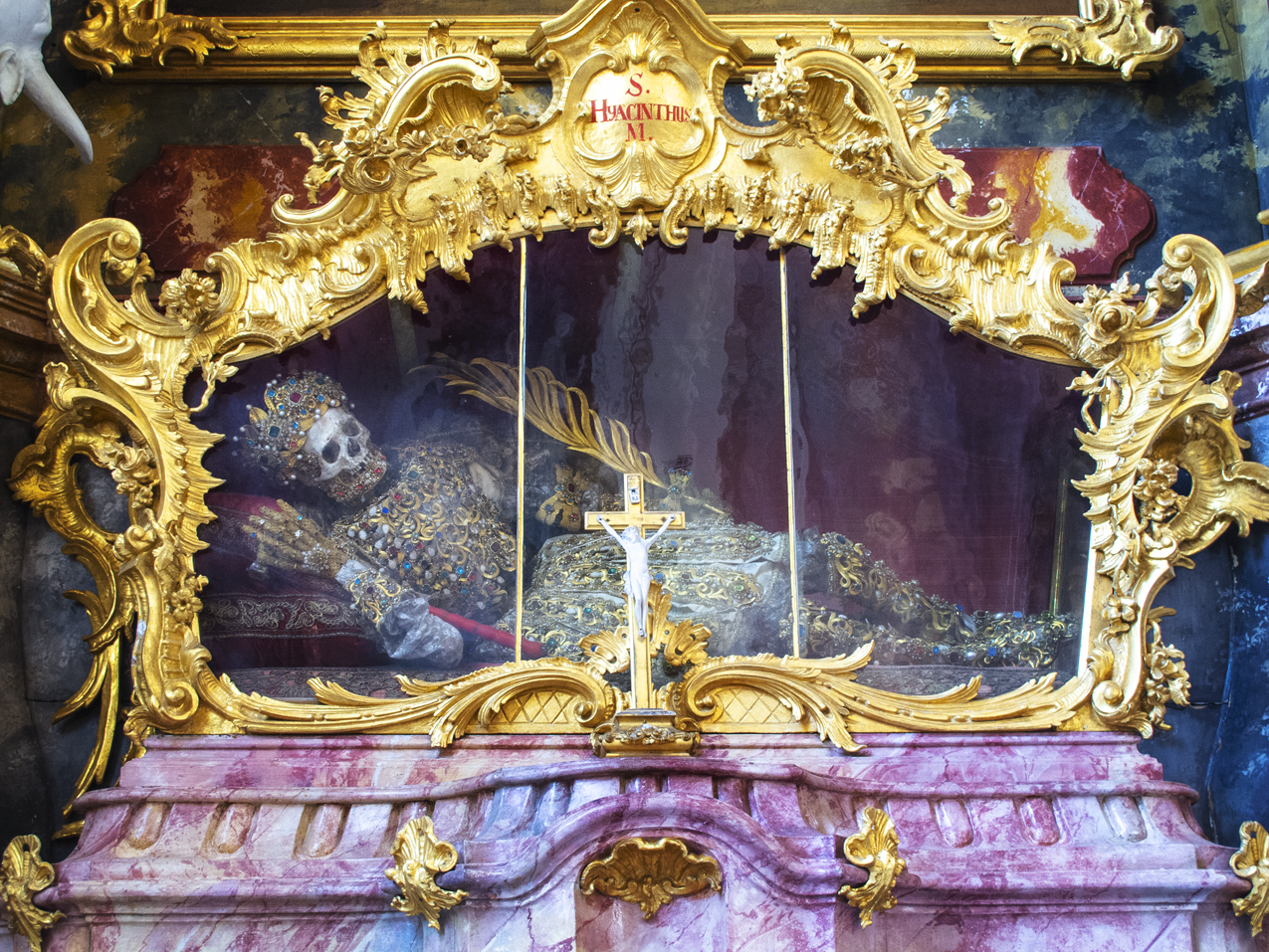
To start, Bavarian doctors, artists, craftsmen, and relic decorators forged the Roman relic fragments into seemingly complete skeletons covered in gleaming jewels (fig. 1). This creative relic presentation, developed in the Alpine region after 1648, was both time- and labor-intensive and represented a break from the common medieval practice of highlighting relic particles.Footnote 11 Despite the fact that catacomb saint relics were referred to as “holy bodies” by the Roman church, the remains sent to Bavaria were far from complete skeletons. The saints’ “bodies” were built using a complex combination of real bones, wooden replacement bones, and custom-built support structures.Footnote 12 Presenting the “holy bodies” in this manner enabled early modern Bavarians to communicate the antiquity, martyrdom, and Roman provenance of these relics far more effectively than smaller relics could. Housed in glass-walled shrines, the saints’ identities as antique, Roman martyrs were rendered legible through costume and symbolic attributes, such as gravestones, blood ampules, laurel wreaths, and more.
St. Hyacinth (1672). Klosterkirche Mariä Himmelfahrt, Fürstenfeldbruck, Germany. Photograph by author, 2012.
In addition to painstakingly restoring the body of the saint, clergy and laypeople in church communities also researched the lives of these martyrs to create hagiographies for their saints. The research was conducted using scholarly works produced as part of the paleo-Christian revival and more popular works, such as Roman pilgrimage guides. Undeterred by the seeming dearth of information about the saints’ individual lives and deaths, local clergymen used these sources to provide Bavarian congregations with an understanding not only of the life of the saint but also the historical context of early Christian persecutions and the physical environment and sacred meaning of the catacombs themselves. Just as they were willing to craft missing bones and long-decayed clothing, when the sources offered scant information, the clergy supplied the missing elements in the history of their saint.
In the last several decades, scholars like Simon Ditchfield, Giuseppe Guazzelli, and Ingo Herklotz have done much to deepen our understanding of the importance of the paleo-Christian revival, its manifestations in fields like Christian archeology and church history, and the research practices of its leading scholars.Footnote 13 This foundational work has focused on Rome and the elite, highly educated clergymen working within or in close concert with the institutional church to produce scholarly works on the history of the early church in the Eternal City. Others have investigated how European clergymen and church historians outside Rome—whom Ditchfield has called “local Baronios”—received these universalizing paleo-Christian texts and, in response, often worked to prove the antiquity and validity of local saints’ cults.Footnote 14
Less attention, however, has been paid to how the paleo-Christian movement and the scholarship it produced in Rome were received, understood, and then used by Catholic Europeans in everyday religious life.Footnote 15 Closely examining the construction and material presentation of Bavarian catacomb saints and the hagiographies written for them offers a new vantage point from which to consider the paleo-Christian revival. First, the display of a full body rather than fragmented relics foregrounds the importance of the saints’ bodies in the representation of Christian martyrdom as a historical reality and creates the opportunity to see the central importance of material culture in the dissemination of paleo-Christian ideas in the decoration of early modern churches outside Rome. Second, the local Catholic populations’ use of scholarly texts like Baronio's Annales ecclesiastici and Bosio's Roma sotterranea, often read north of the Alps in Paolo Aringhi's Latin translation, Roma subterranean novissima (1651), demonstrates the circulation and use of these works in a popular context. It also allows us to see that early modern Bavarians did not passively consume information from the paleo-Christian revival but participated in the intellectual project as practitioners and sometimes creative scholars in their own right.
This finding is particularly illuminating in relationship to the history of Catholicism in Bavaria. Traditionally, scholars have highlighted the role of the Wittelsbach ruling family in shaping religious life and culture of the state, emphasizing how the dukes actively sought to cultivate a Catholic confessional culture in their territory in line with Tridentine norms and to develop what Gerard Woeckel has called “a pietas Bavarica,” which included actively and publicly demonstrating the family's Catholic faith.Footnote 16 The arrival of the duchy's first two catacomb saints in 1590 provided one such opportunity, as the relics of saints Caius and Januarius were welcomed to Munich with a large procession.Footnote 17 Yet, while the Wittlesbachs were certainly interested in the history of the early Christian church being explored in Rome, they also focused a large amount of attention on researching—in partnership with the Jesuits—the paleo-Christian history of their own territory. Unlike many regions in Germany, Bavaria south of the Danube had been part of the Roman Empire in the first and second centuries. This meant the territory had its own history of Roman-era Christian missionaries and martyrs as well as a host of holy sites and relics associated with them. The ruling family was eager to use such figures and locations to cast the territory as an ancient terra sancta with an unbroken allegiance to the Catholic Church. Beginning in the 1570s, the Wittelsbach family and its agents revived ancient pilgrimage sites like Alötting, sponsored archeological digs in Regensburg to excavate traces of an ancient Roman past, and even “rescued” relics of ancient martyrs, like Saint Ursula, from Protestant regions.Footnote 18
These efforts to discover and highlight traces of ancient, Roman Christianity culminated in Maximilian I's commissioning of a four-volume sacred history of the territory, Bavaria sancta (1615–1628).Footnote 19 This “collective local hagiography,” written by Jesuit Matthäus Rader, included the vitae of 203 saints associated with the duchy as well as 142 engraved illustrations. In the opening pages of the text, Rader wrote: “If you examine all the corners of Bavaria, you will scarcely find one place where you do not stumble upon the glowing tracks of holiness and religion: cities, towns, villages, fields, forests, mountains and hills all breathe and exhibit the old Catholic faith in Bavaria. Everywhere one finds holy houses, fine monasteries, new schools, illustrious relics.”Footnote 20
Yet while the Wittelsbachs and the Jesuits certainly played a very important role in shaping the Bavarian sacred landscape and religious culture, the scholarship on Catholicism in early modern Bavaria has generally failed to account for the agency of local actors to shape their own religious environment and practices independent of the dictates of a central government. In the years between 1648 and 1803, Bavarians themselves—through the importation and decoration of hundreds of whole-body Roman catacomb saints—played a vital and heretofore overlooked role in the creation of the sacralized landscape first envisioned by their rulers. Investigating the local uses and interpretations of the Rome-driven paleo-Christian revival, as well as its material manifestations, provides new insights into the grassroots development of religious life in Bavaria and across early modern Europe.
I. Appearances: Building, Costuming, and Displaying Ancient Roman Martyrs
For early modern Bavarians, the first step in forging a Roman identity for newly acquired catacomb saints was to determine how to display the jumble of ancient relics that had arrived from across the Alps. Rather than fragmenting the remains and placing them in multiple reliquaries, as was common in the medieval period, local monastic and lay communities chose to present these “heilige Leiber” as seemingly intact bodies that lay, sat, or stood within glass-walled altar shrines. This type of relic presentation—which forcefully emphasized the whole rather than the part—provided a platform on which the identity of an ancient Roman martyr could begin to be constructed and was a departure from medieval relic display.
Building these “holy bodies” was far more complicated than simply arranging a box of remains into a skeleton. The first step was to inventory and articulate the available bones into their proper anatomical positions, a task usually performed by local artists or doctors. Since, in most cases, a significant number of each saint's bones were missing or damaged, local churches devised creative solutions to “complete” the body. Often, churches commissioned carpenters to create wooden replacements for the missing bones or—if only a few bones were available—to build wooden shells that resembled a torso and lower body to hold the remains.
Once the skeleton was complete, the process of decorating and clothing the saint in a manner that made them legible to early modern eyes as ancient Roman martyrs began. The attire chosen to convey two of these identifying characteristics—antiquity and Roman provenance—was the uniform of a Roman legionary soldier. The outfit usually consisted of a knee-length tunic over which waist-length body armor (lorica) was worn. The bottom of the tunic as well as the sleeves were often decorated with strips of cloth which hung over the tunic (pteruges). To complete the look, the soldiers wore sandals (caligae) and, in some cases, a cape or helmet. This outfit had become stylized in Western iconography in Roman sculpture and funerary monuments and was adopted into Christian art as both the typical garb of Roman soldiers was well as Roman soldier saints. Saint Hyacinth, translated to the Cistercian cloister at Fürstenfeld in 1674, provides a typical example of a male catacomb saint dressed as a Roman soldier (fig. 1). Lying on his side, the saint's chest is covered by sparkling “body armor” made using a decorative technique known as Klosterarbeit (cloister work), which was most often created by nuns and incorporated gilded or silvered wire, cloth, colored or clear-cut glass stones, and imitation pearls.Footnote 21 Beneath his armor, Hyacinth wears a skirt covered with pteruges and knee-high sandals, also made of Klosterarbeit. The pteruges are echoed once again on his sleeve caps.
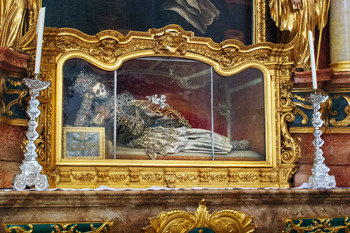
Dressing female martyrs as soldiers was a more difficult task. No costume for women was as recognizably “Roman” as the legionary garb. As a result, several elements of the legionnaires’ costumes were often borrowed and integrated in female catacomb saints’ attire to make the bodies legible as Roman. At Niederalteich, Saint Julia wears Klosterarbeit “body armor” on her chest and a full-length pink skirt, from which sandaled feet peek out (fig. 2). Over the long skirt is another shorter skirt that is almost identical to those worn by male catacomb saints. It is knee-length and has pteruges covered in Klosterarbeit embellishments. The epaulets on her sleeves echo those worn by Saint Hyacinth in Fürstenfeld.
St. Julia (1731). Kloster Niederalteich, Niederalteich, Germany. Photograph by author, 2013.

In the rare case that a church or cloister had evidence that a male catacomb saint might not have been a literal soldier, this information tended to be ignored. According to Capuchin preacher Josephus Münchner in Sankt Veit: “When [Lucius's] holy body was taken out of the grave, a piece of a Mass chasuble was found, which was probably a sign of his episcopal majesty.”Footnote 22 But instead of presenting the saint in bishop's garb, his body was dressed as a Roman soldier and a sculpture atop his shrine presented him as a youthful Roman warrior. Rather than dressing Lucius as a bishop—who could have hailed from any time or place in Catholic history—Bavarians chose to use the visual idiom that communicated the antiquity of the saint as well as his Roman provenance to onlookers. In this case, his antique Roman identity as well as his Christian warrior status took precedent over his clerical status.
Dressing catacomb saints—especially male catacomb saints—so they were readily identifiable as Roman soldiers also functioned on a more symbolic level. In sermons, they were consistently labeled as soldiers of Christ, brave knights and military heroes who prevailed over their pagan foes. In some cases, this was directly related to the vitae written for the saints by Bavarian clergy, in which they were depicted as soldiers in the Roman legion. More frequently, their representation as soldiers was more symbolic and illustrated their implied fight with and triumph over heretical beliefs—a narrative that could be directly tied to the Roman Church's dispute with Protestant “heretics.”
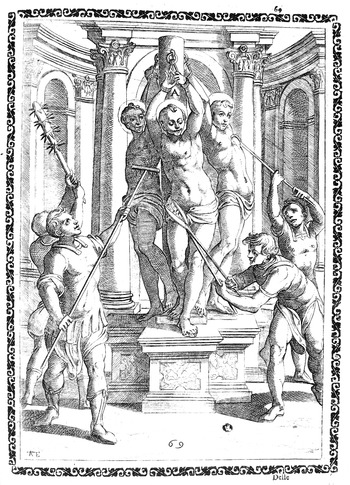
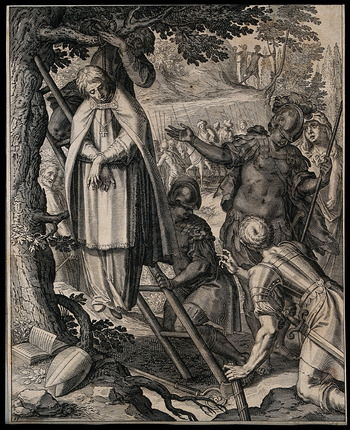
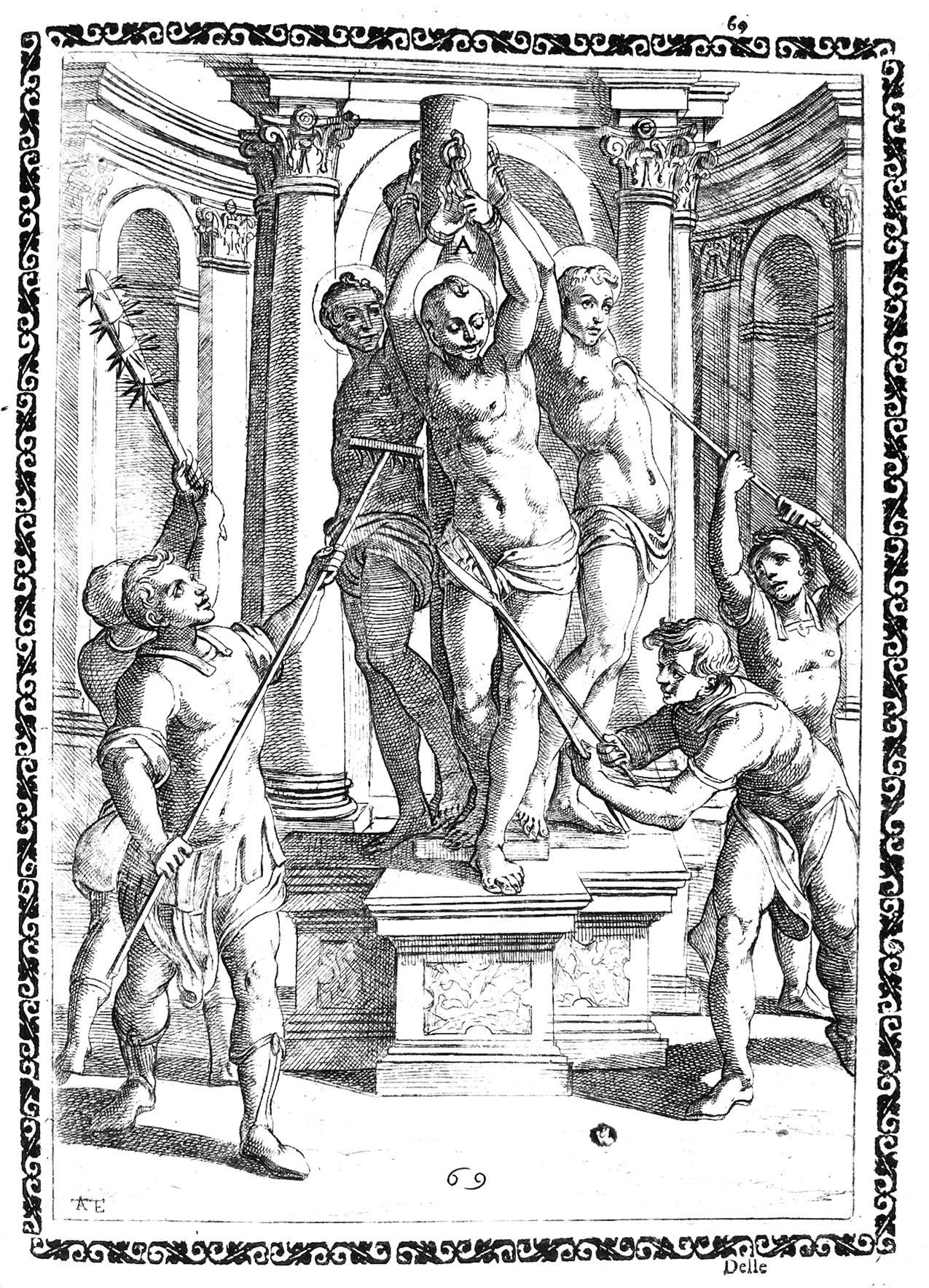
Yet the outfit of a Roman legionary soldier was not an unambiguous iconographical motif. After all, in many stories of early Christian martyrdom Roman soldiers acted as Christians’ persecutors. Legionary soldiers—wearing outfits almost identical to those adapted for catacomb saints—can be seen killing early Christians in paleo-Christian texts, such as Antonio Gallonio's Trattato degli instrumenti di martirio e delle varie maniere di martirizzare (1591) (fig. 3).Footnote 23 Roman soldiers in similar garb also appeared as persecutors of early Bavarian Christian martyr-saints Maximus and Maximilian in engravings for Bavaria sancta as well as in vitae and translation processions for catacomb saints who arrived in Bavaria in the seventeenth and eighteenth centuries (fig. 4).Footnote 24 Clearly, the figure of the ancient Roman soldier as persecutor did not disappear from early modern iconography or hagiography and was an integral part of the visual vocabulary early modern Catholic artists used to represent torment at the hands of a religious enemy.
Antonio Tempesta. Image of Roman soldier (left) wearing a legionary uniform while demonstrating the various tools used for de-fleshing martyrs in Antonio Gallonio's Trattato degli instrumenti di martirio e delle varie maniere di martirizzare (1591), 69. Image courtesy of Warburg Institute Library.
Raphael Sadeler, The Hanging of Saint Maximus, in Matthäus Rader, Bavaria Sancta, vol. 1 (1615), 38. Wellcome Collection. Accessed January 7, 2021, https://wellcomecollection.org/works/bpsnyyrk. Attribution 4.0 International (CC BY 4.0).

Despite these iconographical associations, in most cases the imperative of making saints’ temporal and geographical origins visually legible took precedent over the link between Roman soldiers and Christian persecution. The degree to which the outfit of the legionary soldier was identified with the Eternal City is evident in documents created in relation to the saints’ translation ceremonies. When planning these events, local parishes and churches eagerly sought out or created “Roman” clothing for participants who would accompany the remains of these ancient Roman martyrs into their towns and villages. Johann Chrysostom Hager, a monk at the Benedictine cloister Gars am Inn appointed to organize the translation festivities for Saint Felix, eagerly sought to borrow “Roman” clothing from the court in Munich. According to his Tagebuch, Hager wrote to the Elector and asked that the custodian of the royal Kleiderkammer allow the cloister to borrow “Roman” clothing for the event. After receiving no response, Hager traveled to Munich himself and was able to obtain the desired costumes to use in the translation procession in Gars.Footnote 25 Hager's determination to use “Roman clothing” in his cloister's translation procession was not unique. Similar “Roman” outfits were used at other Bavarian catacomb saint translation processions. At the translation for Saint Leo in 1685 to the Benedictine cloister at Kühbach, the lead rider in the procession was “dressed in the Roman fashion,”Footnote 26 as were riders and angels in the procession for four catacomb saints to the Angerkloster in Munich in 1738.Footnote 27
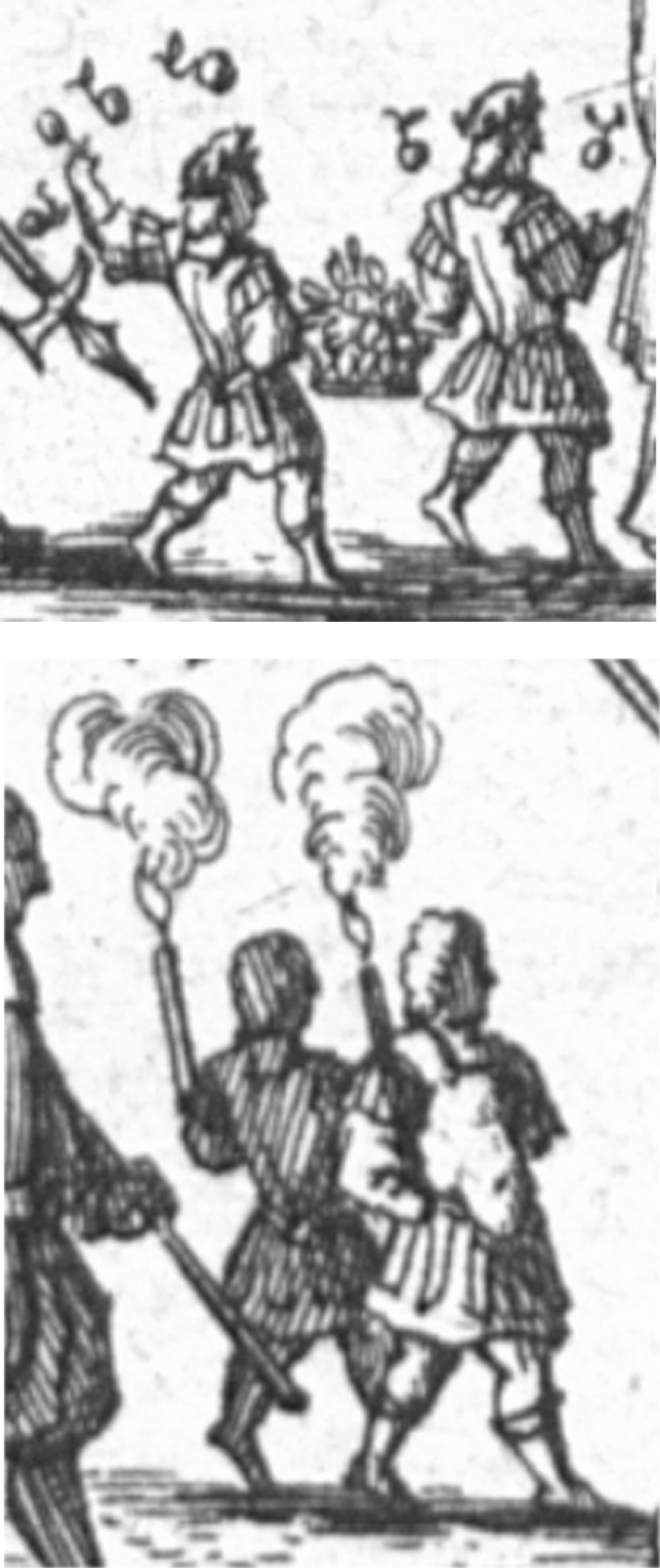
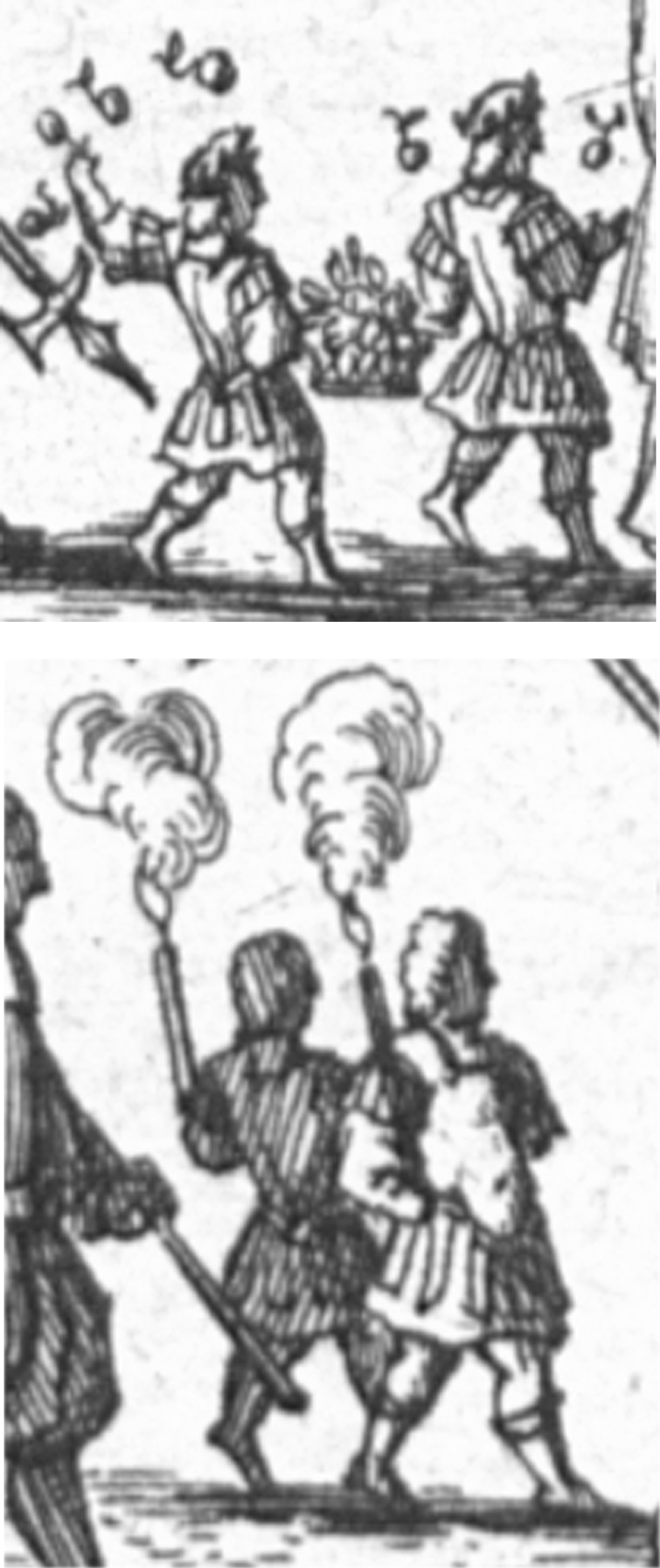
Surviving visual evidence demonstrates that “Roman clothing” or dressing “in the Roman fashion” in baroque Bavaria meant wearing the outfit of a legionary soldier. In an engraving of a transfer procession in Ranshofen in 1699, the numerical key identifies several pairs of young boys in “Roman costume” (figs. 5–6).Footnote 28 Each of the boys wears a short skirt with pteruges, tight body armor, sleeves with epaulets, and sandals. The fact that “Roman clothing” was largely identical to the costumes worn by catacomb saints further supports the argument that this particular clothing was chosen for the saints’ bodies to communicate their antique Roman origins. With little information to go on, using the iconography of a Roman soldier was an effective means of making clear that the newly arrived saints hailed from the purest period of the early Christian church; the outfit also underscored for onlookers the city's status as the center of the Roman Catholic Church and the font of innumerable relics.
Johann Christoph Haffner. Boys wearing “Roman clothing” in Ranshofen procession for the translation of saints Marius and Coelestinus in Achttägiger Jubel, oder Beschreibung der Festivitet, so wegen deß 8. Saeculi von Erbauung der dem heil. Pancratio gewidmeten Capellen [. . .] in dem stifft Ranßhoven begangen worden (Augsburg, 1702). Bayerische Staatsbibliothek München, Res/4 Bavar. 1583#Beibd.1, foldout after p. 20.
Still, if legionary dress could establish ancient Roman provenance, it was insufficient by itself to establish a saint's identity as a martyr. This required additional iconographical attributes and objects to indicate to viewers that the ancient Roman before them had sacrificed their life in the name of Christ. Once again, the form of the complete body as well as the large transparent shrines in which they were housed proved critical in the process of conveying the identity of these new relics. In addition to the legionnaires’ costume, relic decorators created laurel crowns and palm leaves—the traditional iconographical symbols of Christian martyrdom—with Klosterarbeit for the saints to wear and hold. At Fürstenfeld, Saint Hyacinth wears a laurel crown made of gilded wire, colored gemstones, and pearls on his head. In his left hand, he holds a large golden palm leaf, a symbol of his victory over death (fig. 1).Footnote 29 Each of these attributes is readily visible to the onlooker and clearly draws on a visual vocabulary familiar to contemporary Bavarians that this saint died a martyr. This fact is further underscored by the large hammer Hyacinth cradles in his right arm at the front of the shrine—a direct reference to his violent manner of death. Though the inclusion of an instrument of martyrdom in Bavarian catacomb saints’ shrines was fairly rare, the laurel wreath and palm leaf became standard parts of catacomb saint decoration. By deploying long-standing Christian iconographical symbols, early modern Bavarians were able to visually establish the saints’ identities as ancient Roman martyrs.
The martyrs’ attributes worn and held by Bavarian catacomb saints were not, however, the only indications that they had sacrificed their lives in the name of Christ. In some cases, grave goods found at the saints’ excavation sites in Rome were sent along with the relics to churches and cloisters in the duchy. These included gravestones as well as small glass vials, which purportedly contained the martyrs’ blood. It is in relation to these objects that we first see Bavarian reliance on—if not explicit citation of—information produced by scholars associated with “institutional” paleo-Christian scholarship in Rome. In Roma sotterranea (1635), the most influential and comprehensive book written on the catacombs until the nineteenth century, Bosio asserted that the glass and terracotta vases found in the catacombs had once contained the blood of martyrs.Footnote 30 This interpretation of the blood vases received official church sanction in 1668 when the newly founded Congregation for Indulgences and Relics determined that the blood ampules were one of the most certain signs of a martyrs death.Footnote 31 This position was further reiterated in the eighteenth century by representatives of the Roman Church, such as Marcantonio Boldetti, who served for decades as the Custodian of Sacred Relics. In 1720, he published Osservazioni sopra i cimiteri de’ santi martiri ed antichi chritiani di Roma as a handbook for the identification of relics and dedicated close to 100 pages of the tome to prove that the ampules found in the catacombs held nothing but martyrs’ blood.Footnote 32 Thus, the presence of the blood vial along with the saints’ relics was considered incontrovertible material proof that the saints had been persecuted and martyred.
Jesuit preacher Johannes Geppert used such sources to interpret the grave goods accompanying the holy bodies of saints Constantius and Clement to Amberg in 1753. In his translation sermon, Geppert told the assembled crowd that he did not know a single word about their holy lives, virtues, and heroic Christian deeds.Footnote 33 However, all was not lost. He assured the audience that the presence of the saints’ remains and the blood vials alone—rather than any hagiographical information—served as an “infallible sign” that the relics at hand belonged to martyrs.Footnote 34 Across Bavaria, preachers repeatedly emphasized probative properties of these grave goods—visible within saints’ shrines—as a way to verify that these new holy bodies were ancient Roman martyrs. At the Raitenhaslach cloister in 1698, Adam Plaichshirn, a Cistercian monk, recounted the martyrdom of saints Ausanius, Concordia, and Fortunata. He specifically drew the festival-goers’ attention to the blood the saints had spilled for their beliefs and referred to its physical presence in each shrine. He told the crowd that the lives of both saints had ended in martyrdom “with the spilling of their precious blood, which they show to you now in beautiful vessels as testimony and proof.”Footnote 35 The saints’ presentation as complete bodies in transparent shrines allowed the martyrs to proffer their own blood—a testament to their violent deaths—directly to viewers in a single reliquary. This not only confirmed the manner of each saint's death but also affirmed the certainty of their sanctity in concrete terms.
The gravestones that arrived from the catacombs along with the saints’ relics functioned in a similar manner to the blood ampule: material proof of martyrdom at the hands of ancient Roman persecutors. These slabs of stone were usually engraved with a saint's name, death date, and symbols such palm leaves, crosses, and Chi-Rhos. Catholic archeologists, most prominently Bosio, asserted that these symbols were signs of a martyrs’ grave.Footnote 36 In Roma sotterranea, Bosio wrote that the Chi-Rho symbol was one way a martyr's grave could be identified and provided illustrations of several versions of the symbol.Footnote 37
When describing the verification process for identifying martyrs’ graves in the catacombs, Geppert told his audience at the translation of two saints to Amberg that early Christians used the Chi-Rho as a “marker and martyr's sign.” These two letters, he continued, were an “infallible sign that desire[d] to say so much: that this or that person, whose bones rested in that grave, spilled his blood pro Christi or for Christ.”Footnote 38 The combination of these signs and the apparent antiquity of the stone itself gave further credence to the idea that Clemens and Constantius were early Christian martyrs and ones who hailed from Rome. Geppert's insistence that the Chi-Rho symbol was an “infallible sign” of a martyr's death demonstrates that knowledge produced and propagated by scholars in service of the paleo-Christian in Rome was known and used beyond Italy and was being marshaled by Bavarian clergy to inform the creation of hagiographies for the new and unknown saints.
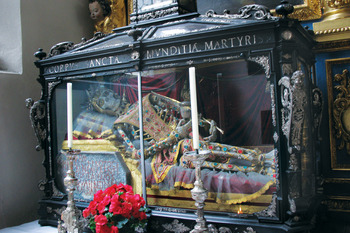
In some cases, the inclination of local clergymen to read these signs as proof of martyrdom relied on textual sources from Rome instead of the written text on the gravestone itself, an approach Ditchfield has characterized as “text before trowel.”Footnote 39 At Saint Peter's parish church in Munich, Saint Munditia's shrine contains a large gravestone with the Latin engraving: “To the pious memory of Munditia, a one-of-a-kind, well-deserving woman. She lived sixty years and died peacefully on November 17” (fig. 7).Footnote 40 Although Munditia's epitaph does not mention martyrdom, emphasizing her long life and peaceful death, she was still dressed and described as a martyr in her translation ceremonies and vita. She was considered a martyr, despite the fact that “no one [knew] in what year or in which persecution she was killed,” because her gravestone, in addition to its text, bore two engraved Chi-Rho symbols and because she had been identified as such by church authorities in Rome.Footnote 41
Shrine of St. Munditia with gravestone in bottom left corner (1675). Pfarrkirche St. Peter, Munich, Germany. Photograph by author, 2012.

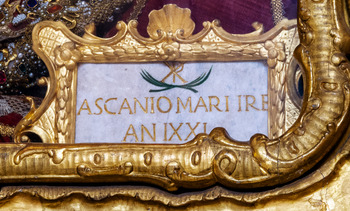
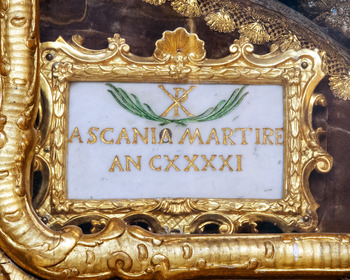
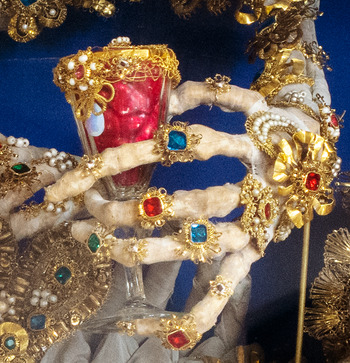
Though Munditia, Clemens, Constantius, and the vast majority of the 259 in situ saints were sent to their respective locations with grave goods, not all catacomb saints arrived in Bavaria with a gravestone and blood ampule.Footnote 42 If a blood ampule or gravestone did not arrive from Rome with the relics, these objects were created for them by local Bavarian artisans.Footnote 43 In 1724, the cloister at Neustift-Freising received the bodies of Ascanius and Ascania. Ascanius's gravestone, decorated with a Chi-Rho and palm leaves, lists his death date as “IXXI” (fig. 8). This is not a valid date in Roman numerals and indicates the gravestone's engraver was not familiar with this numerical system. The gravestone of Ascanius's fellow saint, Ascania, also features an error. The last letter of Ascania's name on the gravestone has been changed from an O to an A, again indicating that it probably was not commissioned at the time of the saint's death by someone who knew her (fig. 9).Footnote 44 The willingness to commission and install antique gravestones in catacomb saint shrines indicates that these physical markers—and the symbols they bore—had become essential in the process of creating an identifiable antique Roman martyr. A similar phenomenon existed in relation to blood ampules. At Kollbach, Saint Desiderius holds a glass in his hand—likely not antique—which has been painted bright red on the inside, presumably in an effort to make its contents—Desiderius's blood—unmistakable to viewers (fig. 10).
Gravestone of St. Ascanius with numerical error (IXXI) (1724). Pfarrkirche St. Peter und Paul, Neustift, Freising, Germany. Photograph by author, 2012.

Gravestone of St. Ascania (1724). Pfarrkirche St. Peter und Paul, Neustift, Freising, Germany. Photograph by author, 2012.

Blood vase from the shrine of catacomb St. Desiderius, Pfarrkirche St. Martin, Kollbach (1755). Photograph by author, 2013.

By using or creating missing archeological objects like gravestones and the blood vases, early modern Bavarians were able to make their new catacombs saints’ status as ancient Christian martyrs visible. Their understanding of these objects rested on assertions of archeologists who had never set foot in Raitenhaslach, Kollbach, or Amberg but whose ideas were consulted and deployed in a local context to help communities understand the significance of these ancient Christian grave goods. But this was only part of the story. The creative whole-body presentation of the saints enabled the identity of the saint to be illustrated—via costume, grave goods, and so on—in a way nearly impossible with bodily fragments alone. Just by looking at the body and the material objects that surrounded it, a viewer could draw conclusions about the saint's suffering, place of burial, and period of origin. This combination of local artistic invention and knowledge gained from institutional paleo-Christian sources demonstrates how relics, iconographies, and texts that came from the heart of the Catholic Church could be re-interpreted and re-formed into an entirely new form of local material religious expression.
II. Narratives: Researching and Writing Catacomb Saint Hagiographies
Once the saints’ bodies were fully decorated and ready to transfer into their new homes, early modern Bavarians turned their attention to constructing vitae for their new patrons. The church in Rome rarely provided much, if any, information about the lives of these saints. The printed authentication certificates that arrived from Rome along with the box of catacomb saint relics only revealed their name, the catacomb where the remains had been located, and a date of excavation. Left with few details and the desire to glean every possible piece of information about the saint, monks and clergy in communities across the duchy turned to textual sources to find information about ancient Roman history and the catacombs themselves. Using this raw material, they crafted hagiographies—of varying levels of specificity—for these ancient Roman martyrs to share at translation sermons and in printed vita and devotional texts.
To begin the process, clergymen consulted a range of textual sources, including those produced as part of the paleo-Christian revival and more popular works such as Roman pilgrimage guides and older passion narratives. Much of the information conveyed in these sources relied on what Ingo Herklotz has called “catacomb clichés,” hagiographical tropes established in the passions of the early martyrs and repeated for over a millennium.Footnote 45 These clichés included the idea that the Roman catacombs only contained the graves of Christians and that there were innumerable martyrs buried in the ancient underground graveyards. These beliefs about the catacombs and Rome as a hub of martyrdom were amplified and repeated by the likes of Bosio and Baronio in major works of the paleo-Christian revival, such as the Roman Matyrology, first published with the latter's historical notes in 1586, and Roma sotterranea. By hewing closely to established models of passion narratives and repeating common catacomb clichés to write the lives of the newly arrived saints, local Bavarian hagiographers used both genre and content to reinforce Baronio's claim that the church had been “ever the same.” The thread of martyrdom was especially effective as a means to collapse the time and space between seventeenth and eighteenth-century Bavaria and early Christian Rome and to demonstrate the continuity of church history.
A booklet produced for the arrival of catacomb saint Antoninus to the Cistercian convent of Seligenthal in Landshut in 1668 provides a prime example of how textual sources that relied upon catacomb clichés and the structure of ancient passion narratives could be used to provide a compelling identity for an unfamiliar saint. Despite knowing essentially nothing about the history of their new set of Roman remains, the convent managed to produce a sixty-three-page devotional booklet that included the saint's vita. The account states that Antoninus was a noble young Roman who lived during the reign of Emperor Gallianus in the third century. The author, citing Baronio's Annales ecclesiastici and later Oratorian Tommaso Bozio's Annales Antiquitatum (1637), explains that Gallianus was a tyrant who ruled in the year 262 CE and who, with his predecessors, was responsible for killing 30,000 Christians.Footnote 46 After witnessing the execution of several Christians, young Antoninus was so moved that he decided to convert to Christianity. Despite being offered many inducements by the emperor to return to the pagan faith, Antoninus refused and was then beheaded. On the night following his execution, Antoninus's fellow Christians
buried his body in the tombs of the graveyard of Saint Callisti by the church of Saint Sebastian, which is on the Appian Way outside the city of Rome. These tombs are made of carved vaults and small passages and were built by the Christians. They go on for two German miles. At night, the Christians gathered there because they were afraid of the [Roman] tyrants. Popes also said Mass and preached there to help strengthen the faith of the people. According to the Roman Guide, 174,000 martyrs are buried in these vaulted tombs.Footnote 47
In the space of a few sentences, this text provides a glimpse into how a Bavarian writer stitched together a variety of different sources to give the reader information about the saint's passion and his burial as well as pertinent details about the catacombs and the role they played in the early Christian church.
In the vita, the author cites a mixture of scholarly sources produced as part of the institutional paleo-Christian revival as well as popular texts. The writer mined both Baronio's Annales ecclesiastici and Roman Martyrology as well as Bozio's Annales Antiquitatem for information about the early Christian church and the severity of persecution under pagan emperors. German guidebooks produced for Roman pilgrims—which Antoninus's hagiographer refers to as the “Roman Guide”—were also consulted for raw material. Between 1620 and 1803, publishers printed nine different German-language guides to the city of Rome for pilgrims.Footnote 48 The Basilica of Saint Sebastian Outside the Walls, one of seven main pilgrimage churches in Rome and home to one of its most famous catacombs, was featured prominently in many of these guides. The guidebooks, which described the underground cemetery beneath the basilica, provided Bavarian writers with key information about the history and construction of the catacombs. The guidebooks also propagated the idea that thousands upon thousands of martyrs were buried in these passages. Most often quoted by catacomb saint hagiographers was the “fact” that 174,000 martyrs were buried in the catacombs of Saint Sebastian. During the sixteenth century, a plaque was posted over the entrance to these catacombs stating that there were 174,000 martyrs and forty-six popes buried in the catacombs below. Although not accurate, these figures—and often the entire Latin text of the plaque itself—were reproduced in most of the German-language guides to Rome printed in the seventeenth and eighteenth centuries.
As the years passed, the number of martyrs in the catacombs mentioned in translation sermons and devotional literature continued to rise, reinforcing the importance of Rome as the center of the church and home to countless precious relics. Priests, such as the Cistercian Hyacinth Frants at Raitenhaslach in 1698, cited passages from institutional paleo-Christian texts to back up claims about the number of holy bodies available in the Eternal City. During the celebration of the translation of saints Concordia, Ausanius, and Fortunata, Frants informed the thousands in attendance that, according to Bozio's Annales Antiquitatem, “the Catholic Church has eleven million martyrs . . . the city of Rome alone has 300,000 martyrs.”Footnote 49 By 1708, at a translation sermon for Saint Amantius to the parish church of Frontenhausen, Jordanus von Wasserburg did not even bother sharing numbers with the crowd; rather, he asserted that there were “no evildoers” buried in the catacombs and that “only the holy bones of martyrs” could be found there.Footnote 50 By the early eighteenth century, priests, preachers, and their audiences had become familiar with the idea that all those buried in the Roman catacombs—including the bodies recently translated to their churches—belonged to martyrs.
Writers relied not only on numbers to relate the scale of Christian persecution in ancient Rome but they also used information from paleo-Christian sources to bring the city to life, placing the martyred catacomb saints center stage in an ancient theater of cruelty. At Sandizell, on the occasion of the translation festivities for saints Clemens and Maximus, the preacher, Maximilian Emanuel Kurz, dramatically set the scene for his audience, telling them that “the ancient, world-conquering city of Rome will be the arena where [we] will pitch a blood-frothing stage.”Footnote 51 Shortly thereafter, he rhetorically “led” the congregation to the ancient city's gates and asked them to enter it with him. Together they knocked on the door of the city, and when the city gates were finally opened, he cried: “Oh horrible sights! O blood-frothing theater! Oh Rome! Alas! Close your blood-boiling theater! Stop these horrible scenes! It is not wild animals, but rather Christians among the wild animals who are bleeding and must fight to the death.”Footnote 52 With this dramatic rhetoric, Kurz placed the audience directly into the brutal persecution of Roman Christians, arguing that Sandizell's martyrs Maximus and Clemens had undergone such torture. They were, Kurz assured his listeners, not the only ones to endure such torture in Rome for their Christian faith. He then listed all the persecutions the audience “saw” on its trip to Rome based on his consultation of Bozio's Annales Antiquitatum. These attacks on Christians included Diocletian's murder of 17,000 Christians in one day, the martyrdoms of Peter and Paul, and the murder of 260 Christians at the Hippodrome by Claudius.Footnote 53 Kurz's extremely vivid presentation of the persecution of early Christians in Rome—and his inclusion of the catacomb saints Maximus and Clemens in this sacred drama—highlights the role of martyrs in the larger arc of Catholic sacred history and—using references from an important text of paleo-Christian history—makes clear the main stage for this history was the city of Rome.
In addition to translation sermons and printed devotional booklets, word of mouth could also spread paleo-Christian ideas about the importance of the Eternal City as the true home of the church and the innumerable martyrs buried there. In 1757, a wandering hermit—who had been on many pilgrimages, including one to Rome—donated the body of Saint Innocentius to the parish church in the small village of Oberaudorf in Upper Bavaria. Inspired by this hermit's actions, shoemaker Sebastian Pichler decided he would go to Rome in the next Jubilee year, 1775, to attempt to obtain another holy body for the town church. When the year finally arrived, Pichler, along with a friend and the local priest, set out for Rome. Pichler kept an extensive diary of the group's journey, which survives in manuscript form. In the diary, he described the group's descent into the catacombs beneath Saint Sebastian's basilica. He reported that the “catacombs have narrow passageways that only one person could pass through at a time, though sometimes they are a bit wider. The tunnels are not walled with brick, but carved out of hard earth. The holy bodies that still remain are in carved openings; this is where our holy body will be taken from.”Footnote 54
In addition to the physical description of the catacombs, Pichler recounted in his journal how popes and clergy held Mass in the subterranean spaces during persecutions, administering the sacraments as well as holding councils. Furthermore, he wrote that during these persecutions Christians lived in the underground chambers, surviving on food and drink sympathizers squeezed through holes in the ground. He also quoted the plaque above the entrance to the catacomb, noting the large number of martyrs buried below.Footnote 55 Here again, the familiar tropes about the catacombs were repeated, demonstrating that they had penetrated beyond the level of educated priests to devout lay pilgrims from a small rural town.
That a shoemaker living in Oberaudorf in the eighteenth century knew about the persecution of early Christians also illustrates the power of martyrs’ bodies to connect the church's ancient past with the present in a concrete manner. Augustinian preacher Joseph Angerer emphasized the enduring importance of martyrs in church history during the celebration of the arrival of Saint Coelestinus in Ranshofen in 1698. In a sermon, Angerer observed that the saint suffered a death by fire and noted: “Similar saints—some of the most noble and pleasing to God—were also burnt to death. These include Saint Lawrence, Saint Tiburtius, Saint Eustachius, Saint Polycarp, Saint Afra with her companions, the glorious Carolus Spinola from the Society of Jesus and many others who—just a few years ago—were also killed with fire in Japan.”Footnote 56 Here, Angerer made an explicit connection between well-known ancient Christian martyr-saints, newly arrived catacomb saints, and contemporary early modern martyrs. This kind of argument placed catacomb saints alongside much more prominent martyrs, equating their importance within church tradition, and drew a direct line between church practice from the remote past to the present. From the very beginning of the church until the present, Angerer argued, martyrs had been willing to sacrifice their lives to defend their Christian/Catholic beliefs against tyrants and heretics. At Raitenhaslach in 1698, Frants stated the connection more explicitly. Echoing Baronio's main thesis, the Cistercian preacher attributed the quality of “semper idem” to martyrs because they were “always united, always strong and always united.”Footnote 57 And now that Raitenhaslach had the bodies of such martyrs in its midst, the village was now a part of the unbroken history of the Catholic Church.
Sermons were not the only way to bridge the temporal and physical distance between ancient Rome and early modern Bavarian villages. A three-act play written by father Maurus Pfendtner and performed during the weeklong celebration of Saint Lucius's arrival in Sankt Veit connected these disparate periods and locales in a powerful and compelling performance. The first act of the play features Roman emperor Hemiarchus arresting, jailing, and then torturing Lucius for his refusal to sacrifice to the Roman gods. The play's action is then briefly interrupted by a ballet scene with dancing gladiators, after which Lucius is beheaded and welcomed to heaven by a choir of angels. Back on earth, the audience observes Lucius's burial and later transfer to the cloister. The last scenes depict the translation festival in Neumarkt, including a procession and supplications to the new patron, which had occurred just a few days prior to the play's debut.Footnote 58 Using a short, linear timeline, onlookers were transported from ancient Rome to present-day Sankt Veit with the same martyr whose bones now lay in their church center stage.
Rather than rely solely on catacomb or passion tropes, some church communities consulted additional sources published at the behest of the Catholic Church in the service of the paleo-Christian revival in search of more specific information about the “holy bodies” that had arrived in their midst. For example, when the bones of Saint Julius arrived in Indersdorf in 1712, it was observed that the saint's skull had been badly damaged. The monks at the cloister surmised that it was possible a head wound could have been his manner of martyrdom. They then consulted Baronio's Annales, combing it for references to a Saint Julius who had died in the same violent manner. Wasserburg, who gave the translation sermon, concluded that the saint who had come to the cloister was “a St. Julius, as one can see in the Annales of Baronio and in the very damaged skull of this holy martyr, that he was eventually crushed with clubs and cudgels.”Footnote 59 In this case, the monks used the remains of the saint as forensic evidence to push their research on his life beyond the more generic passion narrative to a specific time and place in church history.
Similarly, the monks at Gars—eager to learn more information about their new patron, Felix, than his authentication certificate could provide—turned to both material and written sources. According to the cloister's chronicle, Felix's tomb had included a blood ampule, and two glass images had been placed near the grave. One glass image showed a person in Roman clothing with a laurel wreath and palm frond in his hand. This was supposedly labeled with the name Saint Felix. The second image showed a man in priest's clothing and was labeled Saint Calixtus. A piece of Calixtus's bones supposedly also lay nearby. Based on this information, the chronicler made an interpretive leap: “By leaving the glass images, the Holy Father wanted to leave a clue, that Felix and Calixtus both suffered a martyr's death in Rome and were buried in the same place.”Footnote 60 With this information in hand—and a desire to learn more—the monks next consulted Baronio's revised Roman Martyrology to find a feast date that included both a Saint Calixtus and a Saint Felix. “In the Roman Martyrology, this saint is commemorated on December 29; therefore the feast day for St. Felix in Gars is also observed on this date.”Footnote 61 Although this particular information on Saint Felix helped fix a feast day for the Gars saint, the traits of another Saint Felix were also used to create the vita for the catacomb saint housed in the cloister to help flesh out his hagiography. Over the years, the saint came to be identified as one of the “Seven Brothers” who were supposedly the sons of Saint Felizitas and who were also buried in the Calixtus catacombs. The similarities between the Seven Brothers’ Felix, who had been buried in the same catacomb, killed at a young age, and martyred with a cudgel, led the brothers at Gars to adopt certain aspects of this other Felix for their own saint, effectively merging the lives of two separate saints into one.Footnote 62 In this particular case, the brothers at the cloister in Gars started with the objects and information given to them about Saint Felix by the church in Rome and then proceeded to use a mash-up of paleo-Christian written sources to form a more detailed hagiography for the saint.
This use of the sacred histories and martyrologies produced by Baronio, Bosio and others demonstrate the degree to which paleo-Christian sources had made it over the Alps and were being used at the local level as Bavarians sought to learn as much as possible about the lives and deaths of their new saints. These were “local Baronios” of another sort who were determined not to defend a longstanding medieval cult but to discover and then relate the history of an imported holy person. This, as we have seen, did not occur in exactly the way the church historians and archeologists might have expected when they were exploring the catacombs or plumbing the depths of the Vatican archives. Instead, early modern Bavarians, eager to learn about their new saints and their origins, creatively fused scholarly sources with older hagiographical traditions or popular tour guides in order to make these martyrs’ lives vivid and memorable to a population unfamiliar with their deeds.
III. Conclusion
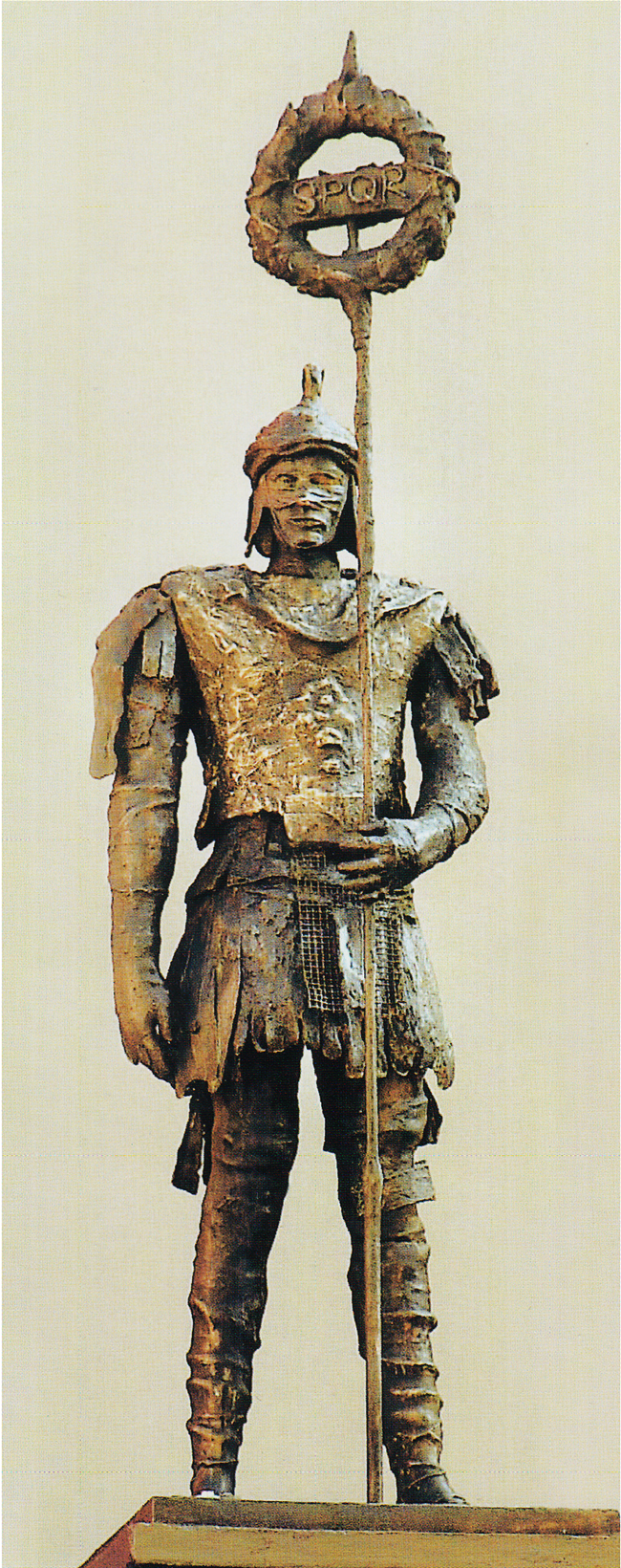
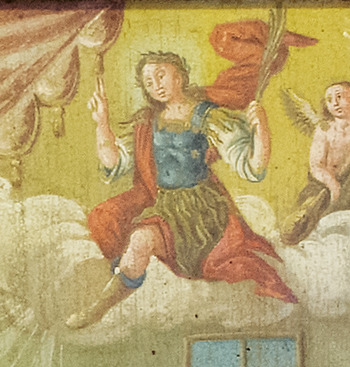
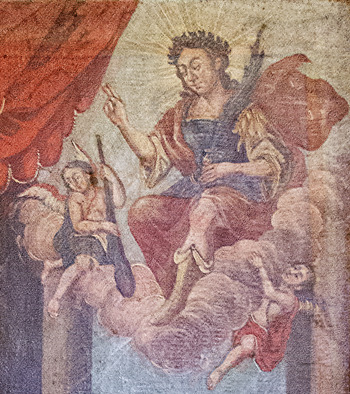
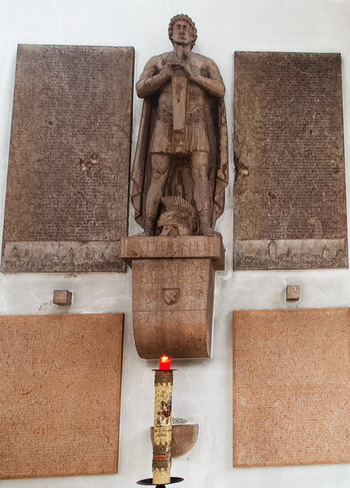
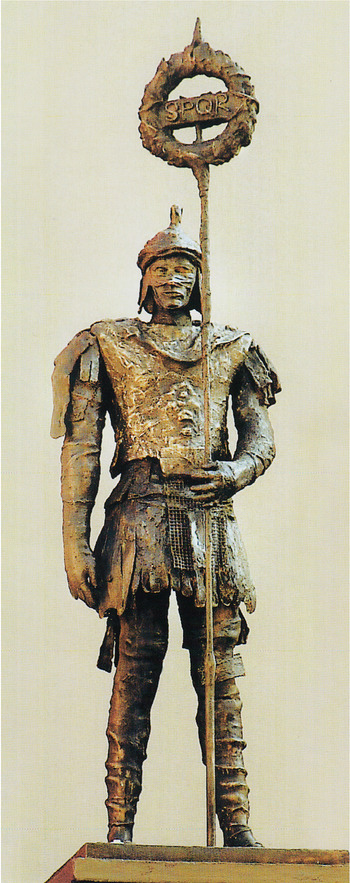
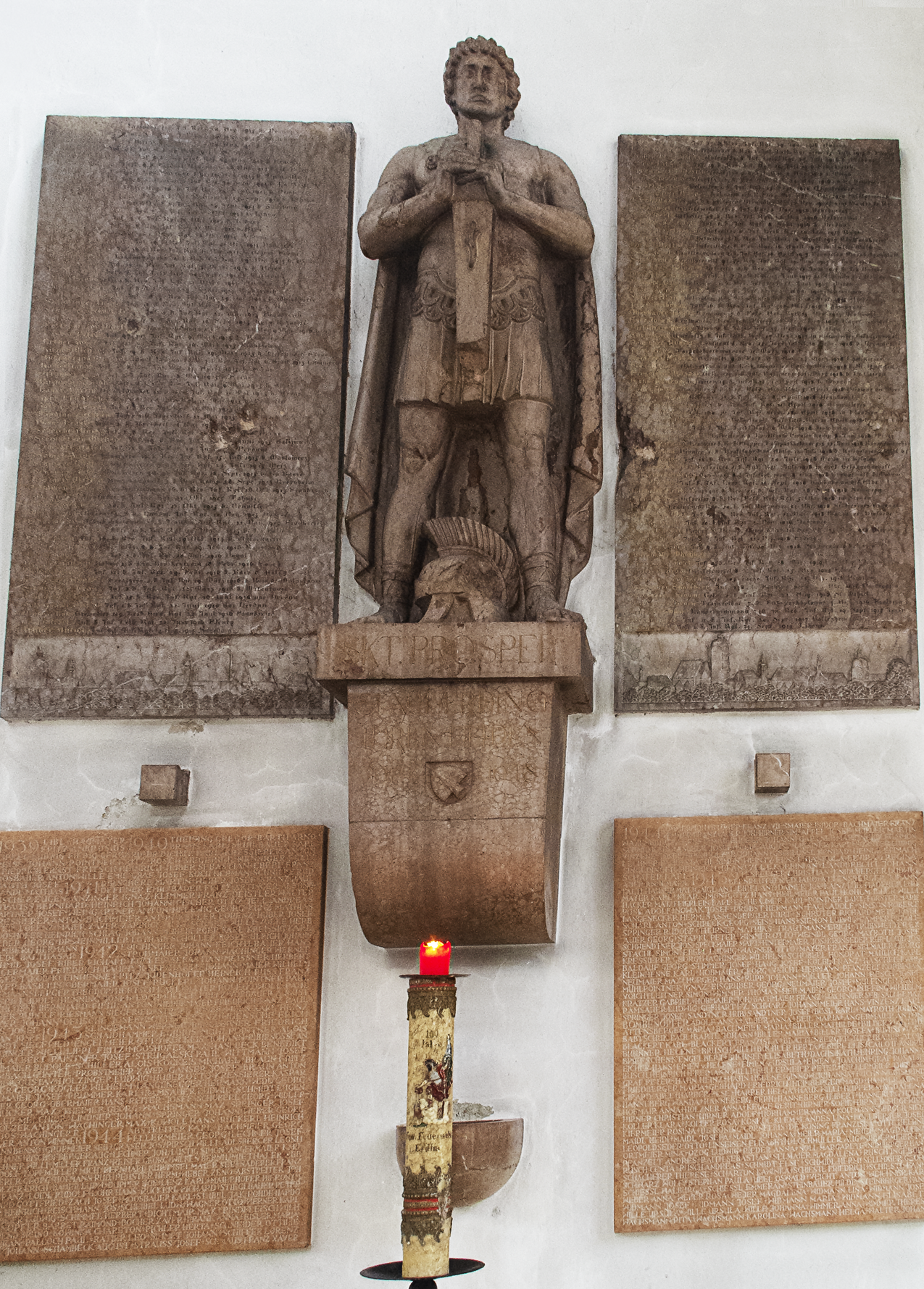
The immense work early modern Bavarian laypeople and clergymen did to build bodies, as well as research and write the vitae of Roman catacomb saints, successfully created long-lasting and memorable identities that have persisted into the twenty-first century. In Gars, Saint Felix still sits in a gilded altar in his eponymous chapel at the former cloister. One of the walls is covered in ex voto paintings left to thank the catacomb saint for his intercession. The panels date from 1675 to the early twentieth century and give thanks for everything from protecting the town from fire (1675) to alleviating toothaches (1890) to the safe return of local soldiers from battle (1861). In these images, Felix consistently appears in the garb of a Roman legionnaire wearing a crown of laurels and indicating that his identity as an ancient Roman martyr had been absorbed by local supplicants (figs. 11–12). Not far down the road at the parish church in Erding, Saint Prosper's role as an ancient Roman soldier and the city's protector has continued to resonate into the modern era. A statue of the saint features prominently in the city's memorial to the local men who died during World War I and World War II, and in 2007, the city erected a bronze statue of the saint near the center of town (figs. 13–14). Created by artist Rudolf L. Reiter, Prosper stands squarely atop a column in a legionnaire's uniform and helmet and carries a military standard bearing the SPQR of the Roman empire. Nearly 350 years after the saint's bones arrived in a wooden box from Rome with little identifying information, Prosper is still known today as an ancient, Roman warrior and martyr. This is a direct result of the effort by the town of Erding and its clergy to reconstruct both the body and the life of a saint who, prior to 1675, they had never encountered. By following the remains of catacomb saints over the Alps, it becomes clear that it was not just scholars or rulers who attempted to bring the early Christian church back to life. Rather than writing histories and martyrologies or replicating ancient Christian architecture, early modern Bavarians materialized the past in human form by constructing and costuming whole-body relics and composing hagiographies for the newly arrived saints.
St. Felix as Roman soldier in ex voto image (1790). Felixkapelle, Pfarr- und Klosterkirche Mariä Himmelfahrt und St. Radegundis, Gars am Inn, Germany. Photograph by author, 2012.

St. Felix as Roman soldier in ex voto image (1840). Felixkapelle, Pfarr- und Klosterkirche Mariä Himmelfahrt und St. Radegundis, Gars am Inn, Germany. Photograph by author, 2012.

Memorial for WWI and WWII soldiers from Erding with statue of St. Prosper in center (1918). Stadtpfarrkirche St. Johann, Erding, Germany. Photograph by author, 2013.
Rudolf L. Reiter, St. Prosper, (1999). Katharina-Fischer-Platz, Erding. Germany. Photo courtesy of Victoria Reiter.