Introduction
Italian production of organic vegetables covers an area of 17,000 ha1. Tomato is one of the most widespread crops, grown on 2013 ha, including both fresh market tomato and processed tomato, with a mean yield of about 55 tons per hectare1. In vegetable crop rotations, tomato is generally the most profitable crop.
In organic farming, any strategy to preserve soil fertility is particularly important. When animal husbandry is not included in the farming system, green manure is crucial to preserve or increase soil organic matter content and to ensure an adequate N availability to crops.
The amount of N supplied to the soil by cover crops is due to both the degradation of cover crop biomass and, in case of leguminous species, symbiotic N fixation. Since this amount is strongly affected by different factors, such as soil conditions and lignification level of crop residues, variable data may be found in the literatureReference Grignani, Bassanino, Sacco and Zavattaro2–Reference Tesi and Lenzi4. The management of cover crop biomass (destroyed and turned under or mowed and left on soil surface as a mulch) also plays an important role in determining the rate of N released into the soil and available for the following cash crops. In comparison with mulching, turning under generally decreases the exposure of biomass to air and atmospheric agents, while enhancing contact with microbial biomass. This would not only produce an initial slower mineralization of cover crop residues, but also a subsequent faster degradation of most lignified and carbon-rich tissues. Turning under may nevertheless improve soil organic matter mineralization, often also reducing soil moisture and the content of organic C and N in the first 20 cm depthReference Sainju, Bharat and Sidat5, Reference Creamer, Bennett, Stinner and Cardina6.
Among leguminous winter cover crops, pigeon bean, pea and common vetch, incorporated into the soil at the full flowering stage, have been reported to supply the highest amounts of NReference Guiducci, Stagnari and Bonciarelli7. About 30–50% of this N is released in the first season after green manure, while the rest is released over the following 2 yearsReference Costantini8. The peak of nitrate-N availability in the soil is normally detected in the first 2 months after green manure. For this reason, a tomato crop preceded by a leguminous cover crop can reach the same yield as that obtained when N fertilizers are usedReference Stivers and Shennan9, Reference Shennan10. On the other hand, in very fertile soils green manure may have poor beneficial effects.
The highest yields of marketable tomato fruits are obtained with N doses of 150–200 kg ha−1 and a fertilizer efficiency between 0.59 and 0.71Reference Tei, Benincasa and Guiducci11. It is possible to achieve amounts of total N between 229 and 295 kg ha−1 when pigeon bean is used as the green manure crop, depending on when it is turned underReference Guiducci, Stagnari and Bonciarelli7. Cover crops can also be used in addition to organic N fertilizers in tomato crop, allowing a reduction of their amounts to even one-halfReference Araki and Ito12, Reference Whitehead and Singh13. Furthermore, Piazza et al.Reference Piazza, Foutry and Reggiani14 and Kumar et al.Reference Kumar, Abdul-Baki, Anderson and Mattoo15 observed a positive interaction between green manure and the addition of N by compost or mineral fertilizer distribution.
Species other than legumes may also be used as cover crops, e.g. belonging to Graminaceae and Brassicaceae, especially when an allelopathic effectReference Madden, Mitchell, Lanini, Cahn, Herrero, Park, Temple and Van Horn16–Reference Masiunas, Weston and Weller18 and a biocide action are required in addition to the supply of N and organic matter in the soil.
The present research was carried out to investigate the effect of different green manure crops on the production of the tomato crop that followed. In particular, to verify whether an eventual effect could be especially related to N made available for the tomato crop, the influence of the different cover crop species on N dynamics in the soil was studied in detail.
Materials and Methods
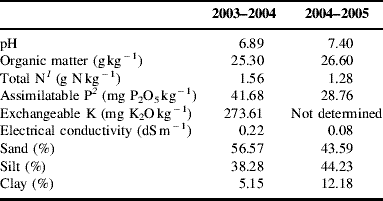
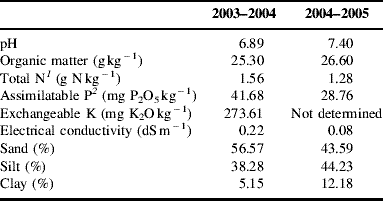
The research was carried out during the 2003–2004 and 2004–2005 growing seasons at the Bonamici Organic Farm, located in San Martino Ulmiano, Pisa, Italy (lat. 43°46′, long. 10°24′). Five cover crops [oats and barley mixture (Avena sativa L. and Hordeum vulgare L.), rye (Secale cereale L.), brown mustard (Brassica juncea L.), flax (Linum usitatissimum L.) and pigeon bean (Vicia faba L. var. minor)] plus a weedy no-cover crop control were compared and their effect on the following crop (tomato) was evaluated. Soil characteristics of the experimental fields used for the 2003–2004 trial and 2004–2005 trial, respectively, are reported in Table 1.
Soil characterization of the trial fields (0–30 cm soil depth).
1 Kjeldahl method.
2 Olsen method.
In both years, the experimental design was a randomized complete block with two replications (1 replication=1 plot). Plot size was 250 and 70 m2, respectively, in 2003–2004 and 2004–2005. Details on cover crop varieties, 1000-seed weight and seed rate are reported in Table 2.
Cover crop varieties, 1000-seed weight and seed rate.

In the two trials, cover crops were sown on October 7, 2003 and on November 19, 2004, respectively. Before and after the sowing, the soil was harrowed by a tine harrow. Neither irrigation water nor fertilizers were applied to the cover crops. Cover crops were cut up by a mulcher for stalks (April 23, 2004; May 9, 2005) and turned under by a disk harrow after 2 days. Before cutting, aboveground cover crop biomass production was estimated over three and over two sampling areas of 1 m2 in each plot in 2004 and 2005, respectively. Samples were oven-dried at 75°C until constant weight and biomass was expressed on a dry matter basis. Samples were then analyzed for total N concentration (Kjeldahl method). Only for 2005 samples, organic C concentration (Walkley and Black method) was also determined and C/N ratio calculated.
Tomato (Lycopersicon esculentum Mill.) cv. Palinuro, an F1 hybrid with cylindrical fruits suitable for both the fresh market and the processing industry, was transplanted on May 28, 2004 and on May 17, 2005 with a 1.30×0.35 m spacing on a soil mulched by a biodegradable Mater-bi® film. A perforated hose was placed under the mulching for drip irrigation. Weed control was performed by hand weeding. In order to protect the plants against cryptogamic diseases, copper sulfate was sprayed periodically during high atmospheric humidity condition. Tomato yield from four plants located in two sampling areas per plot was assessed at harvest time (on August 31, 2004 and on August 30, 2005). Fruits collected from the sampled plants were counted, weighed and sorted into three classes: marketable fruits (ripe fruits), green and turning fruits and discardable fruits. On two ripe fruits per plant, the following parameters were determined: fresh weight, dry weight (by oven-drying at 75°C until constant weight), firmness (measured by a penetrometer), juice soluble sugar concentration expressed as Brix values (measured with a refractometer) and, only for fruits harvested in 2005, juice acidity (measured by a pH meter). Crop residues (stems and leaves) of the sampling areas were also weighed and then oven-dried at 75°C until constant weight, in order to determine the biomass production on a dry matter basis. Finally, samples of ripe fruit and cultural residue dry biomass were analyzed for total N concentration (Kjeldahl method).
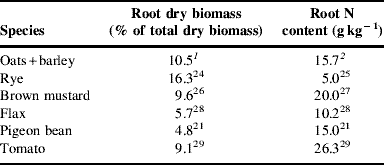
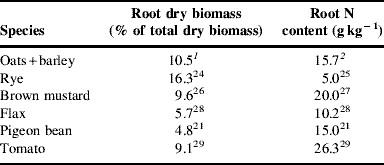
Recovery by tomato crop of N supplied by the different cover crops was calculated, according to WaggerReference Wagger19 and Schroeder et al.Reference Schröeder, Tenholte and Jansenn20, both as the difference (kg ha−1) between N removed by tomato crop following a cover crop and N removed by control tomato crop, and as percent ratio between this difference and N supplied by the cover crops. In order to better evaluate N recovery, the amount of N contained in the cover crop and tomato roots was also included in the calculation. Root dry matter production and root N content, which were not detected in our experiment, were taken from the literature (Table 3).
Root dry biomass and root N content considered for the calculation of N recovery.
1 Mean value between oatsReference Cazzato, Annese and Corleto21 and barleyReference Izaurralde, Juma, McGill, Chanasyk, Pawluk and Dudas22.
2 Mean value between oatsReference Cazzato, Annese and Corleto21 and barleyReference Vong, Piutti, Benizri, Slezack-Deschaumes, Robin and Guckert23.
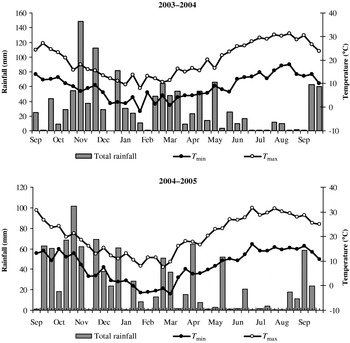
Soil NO3− concentration (ion chromatography; DIONEX) in the top 30 cm of the profile was determined on the following days: September 26, 2003 and April 23, May 26, June 16, July 9, July 28, August 20, September 24, 2004 (2003–2004 trial); November 18, 2004 and May 9, June 11, June 30, July 23, August 13, September 1, September 22, 2005 (2004–2005 trial). Note that on April 23, 2004 and on May 9, 2005 the cover crop cutting took place. Climatic conditions during the period of the trials in 2003−2004 and 2004–2005, respectively, are shown in Figure 1.
Climatic trend (rainfall and maximum and minimum temperature—values per 10 days) in San Martino Ulmiano (Pisa) during the 2003–2004 (top) and 2004–2005 (bottom) seasons.

For both the trials, experimental data were subjected to analysis of variance (ANOVA) according to a randomized block design with two replicates, and means were compared using the LSD test at P⩽0.01 and P⩽0.05 level of significance. The arc sine values of all percent data were previously calculated, except for N recovery, the data of which were converted into log10(x+30) or log10[(%/100)+1] depending on whether it was expressed as kg ha−1 or percent values. For N recovery mean data (averaged over the 2003–2004 and 2004–2005 data), a split plot experimental design was adopted, with year as the main factor and cover crop as the subplot factor.
Results and Discussion
Cover crops
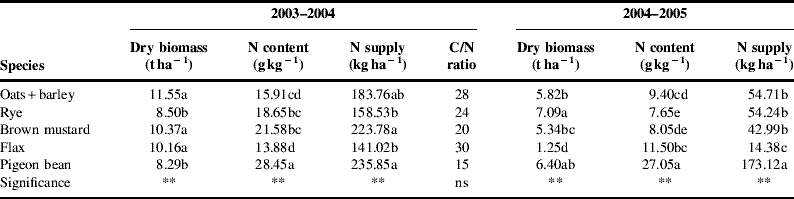
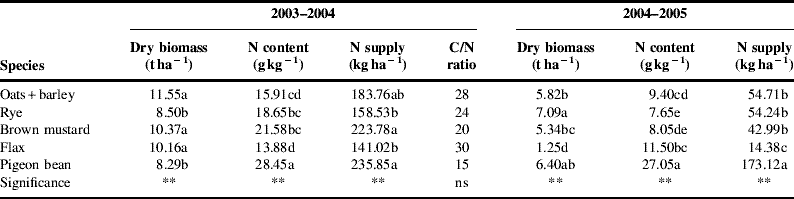
As shown in Table 4, in 2003–2004 cover crops produced considerable amounts of dry matter (9.77 t ha−1 on average for the five tested crops). This was ascribed to the excellent fertility of the soil (Table 1) as well as to the climatic conditions (Fig. 1) occurring both at sowing and during the spring, with temperature and rainfall favorable for cover crop growth (temperature falling below 0°C only in the last 10 days of January).
Cover crop dry biomass and its N content, N supply by cover crops and, only for 2003–2004 trial, cover crop C/N ratio.
In each column, means followed by the same letter are not significantly different at P⩽0.05 (*) and P⩽0.01 (**) (LSD test).
The oats and barley mixture showed the highest biomass production (11.55 t ha−1), although no statistically significant differences were detected in comparison with brown mustard and flax (10.37 and 10.16 t ha−1, respectively); rye and pigeon bean yields were instead significantly lower (8.50 and 8.29 t ha−1, respectively) (Table 4).
The tested cover crops differed also in biomass N concentration (Table 4): the minimum value was found in flax (13.88 g kg−1), while the maximum (28.45 g kg−1) was detected in pigeon bean, as expected on account of symbiotic N fixation. Owing to its high N content that compensated for the low biomass production, pigeon bean, although not significantly different from brown mustard and oats and barley mixture, showed a higher N supply than rye and flax (Table 4).
The cover crops showed different C/N ratios compared to those previously reported by ReevesReference Reeves, Hatfield and Stewart30, Quemada et al.Reference Quemada, Cabrera and Mccracken31, Uprety and MahalaxmiReference Uprety and Mahalaxmi26, GarmashReference Garmash32, Mazzoncini et al.Reference Mazzoncini, Barberi, Cerrai, Rinaudo and Belloni33; pigeon bean and brown mustard showed lower values than flax and cereals (Table 4).
In 2004–2005, cover crop biomass production (Table 4) was drastically lower than that of the previous year (−47% on average). The reasons are likely to be found in the characteristics of the experimental site: lower N and P soil content (Table 1; Figs. 2 and 3) and adverse climatic conditions (Fig. 1). The plentiful rainfall in autumn caused a delay in sowing and consequently in the emergency of cover crops. Besides, temperatures in January, February and March were very low (minimum temperature below 0°C). The delay of sowing not only caused a shortening of the cover crop cycle by almost 1 month in comparison with the previous year, but also exposed seeds to cold temperatures that partly compromised their germination. This was regular only for rye, while it was particularly poor for flax and nonhomogeneous for all the other species. Furthermore, the low temperatures and the poor rainfall occurring in the last phase of cover crop cycle also probably contributed to reduce their growth. Cover crop dry biomass at incorporation time into the soil reflected the situation observed at emergence: rye and pigeon bean were the most productive, while flax yield was the lowest (Table 4).
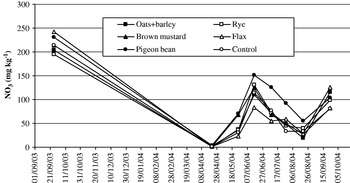
Soil NO3 in the field used in the 2003–2004 trial.

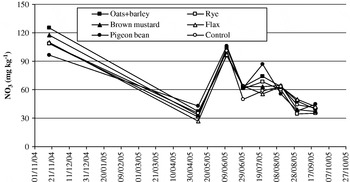
Soil NO3 in the field used in the 2004–2005 trial.

As observed in 2003–2004, pigeon bean N content (27.05 g kg−1) was higher than that of all the other cover crops, and also close to the value observed for the same species in the previous year (Table 4). Considering the average of all cover crops, the amount of N accumulated in the biomass was 35% less than that observed in 2003–2004 (Table 4), probably due to the lower content of readily available N in the soil (Figs. 2 and 3). In such conditions, the incidence of symbiotic N fixation was particularly decisive, emphasizing the differences in N accumulation between pigeon bean and the other cover crops (Table 4).
Soil nitrate
In 2003–2004, nitrate in the soil showed a similar trend for all the tested cover crops (Fig. 2). At cover crop sowing (October 7, 2003) soil average nitrate content was 217 mg kg−1. During cover crop growing, due to both plant absorption and leaching, soil nitrate decreased to an average value of 2 mg kg−1 soon before cover crops were turned under. A progressive increase of soil nitrate was observed from green manure incorporation into the soil (April 23, 2004) to the middle of June (54 days after), when all the treatments reached the highest level. The decrease that followed till the end of August can be ascribed to tomato crop absorption and to a slow down in the mineralization process, probably correlated with the poor rainfall that occurred in this period. On the contrary, the plentiful rainfall that followed tomato harvesting, together with high temperatures, may have reactivated mineralization, and this could explain the new increase in soil nitrate detected on September 24, 2004. Comparing the different cover crops it can be noticed that, after green manure incorporation into the soil and until tomato harvesting, the highest values of soil nitrate, with statistically significant differences for most of the survey dates, were found in the pigeon bean plots (Fig. 2); therefore, this species was the most effective in releasing mineral N to the soil.
The soil in the 2004–2005 trial was characterized by a lower starting content of nitrate (111 mg kg−1 on average at cover crop sowing, on November 19, 2004) and lower levels were reached after cover crops were turned under (Figs. 2 and 3). On the contrary, at the end of cover crop cycle (May 9, 2005) soil nitrate was higher (34 mg kg−1 as average value) than the year before (Figs. 2 and 3), as cover crops recovered a smaller amount of soil N due to their lower biomass production (Table 4). As a result of green manure incorporation into the soil, the nitrate peak was reached after 33 days (Fig. 3). No statistically significant differences in nitrate content were noticed among the treatments due to the different cover crops. Hence, in 2004–2005 the higher N content and N supply shown by pigeon bean (Table 3) did not correspond to a greater availability of soluble N for the crop immediately following green manure. This seems to confirm the findings of Dufault et al.Reference Dufault, Decoteau, Garrett, Batal, Granberry, Davis, Hoyt and Sanders34 and Sainju et al.Reference Sainju, Singh, Rahman and Reddy35, which showed how leguminous cover crops, despite their higher N supply to the soil and their capacity to improve N recovery of tomato, were not more effective than other cover crop species or chemical fertilizers in retaining nitrates in the soil profile, mainly due to the high mobility of nitrate ions.
Tomato crop
Yield and N uptake
Climatic conditions in the summer were quite favorable to tomato crop, with high temperatures (maximum temperature between 25 and 32°C) and poor rainfall in both the years (Fig. 1).
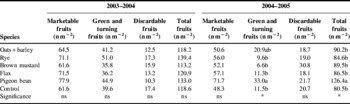
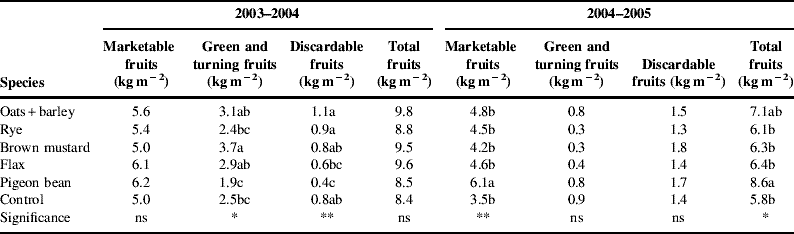
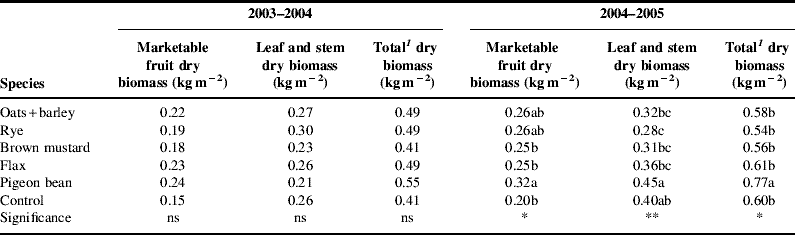
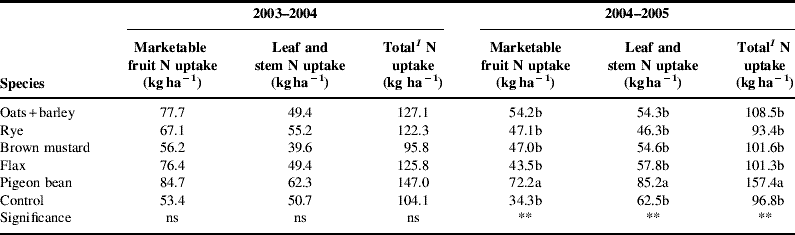
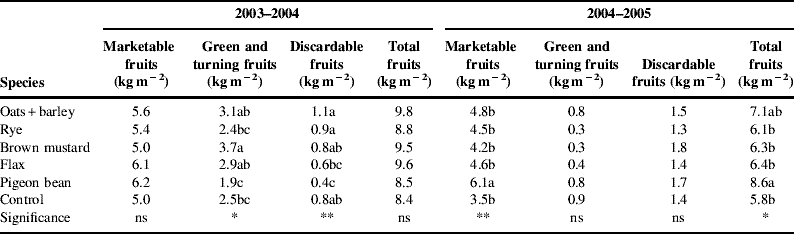
Some positive effects of the legume cover crop on tomato yield were noticeable. Tomato crops that followed pigeon bean gave a higher marketable fruit yield in both the years, although with statistically significant differences in comparison with the other treatments only for yield expressed as fruit amount (kg m−2) in the 2004–2005 growing season; in the same season the green and turning fruit yield (number of fruits m−2) and the total fruit yield (both number m−2 and kg m−2) were also significantly higher, while in 2003–2004 pigeon bean resulted in the lowest amount (kg m−2) of discardable fruits (Tables 5 and 6). Also tomato dry matter production and N uptake were positively affected by pigeon bean (Tables 7 and 8). In 2004–2005 growing season, the dry biomass of tomato marketable fruits, leaves and stems, and total, were significantly higher when this species was used as the cover crop, although for marketable fruit dry biomass production the difference was not statistically significant with respect to oats and barley mixture and rye (Table 7), while for tomato N uptake a significant superiority of the legume cover crop over all the other species and the control was detected (Table 8).
Fruit yield (number of fruits per m−2) obtained by tomato crop following the compared cover crops.

In each column, means followed by the same letter are not significantly different at P⩽0.05 (*) and P⩽0.01 (**) (LSD test).
Fruit yield obtained by tomato crop following the compared cover crops.
In each column, means followed by the same letter are not significantly different at P⩽0.05 (*) and P⩽0.01 (**) (LSD test).
Dry biomass obtained by tomato crop following the compared cover crops.
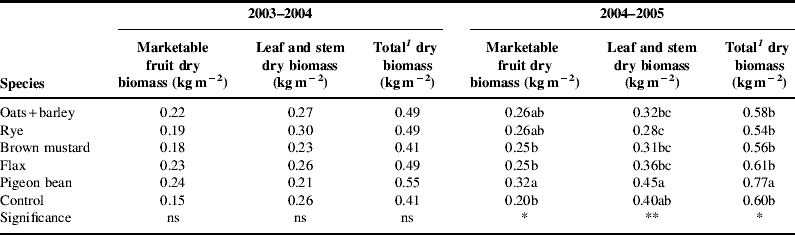
In each column, means followed by the same letter are not significantly different at P⩽0.05 (*) and P⩽0.01 (**) (LSD test).
1 Considering only the aerial part.
N uptake by tomato crop following the compared cover crops.
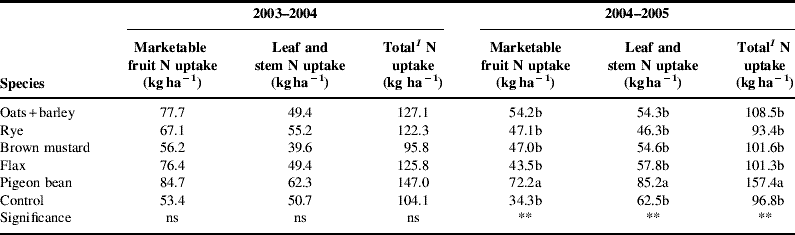
In each column, means followed by the same letter are not significantly different at P⩽0.05 (*) and P⩽0.01 (**) (LSD test).
1 Considering only the aerial part.
These results are in agreement with those of Sainju et al.Reference Sainju, Singh and Whitehead36, which showed the same ability of leguminous cover crops to sustain tomato yield, biomass production and N uptake as 90 and 180 kg ha−1 of N fertilizer. Wang et al.Reference Wang, Bryan, Klassen, Li, Codallo and Abdul-Baki37, Reference Wang, Klassen, Bryan, Li and Abdul-Baki38 and Abdul-Baki et al.Reference Abdul-Baki, Klassen, Bryan, Codallo, Hima, Wang, Li, Yao-chi and Handoo39 in different experiments conducted in South Florida with three legume cover crops [sunn hemp (Crotalaria juncea L.), cowpea (Vigna unguiculata Walp. ssp. unguiculata) and velvet bean (Mucuna deeringiana (Bort.) Merr.)] and one nonlegume cover crop [sorghum sudangrass (Sorghum bicolour×S. bicolour)] followed by tomato obtained variable results, but sunn hemp seemed to be the most favourable species.
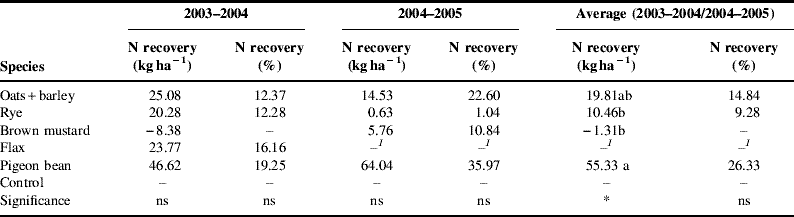
Recovery by tomato crop of N supplied by the different cover crops, considering the two trials separately, did not show statistically significant differences both when expressed as the difference (kg ha−1) between N removed by tomato crop following, respectively, a cover crop and the control, and when expressed as percent ratio between this difference and N supplied by the cover crop (Table 9). Nevertheless, it can be noticed that in both the trials N recovery values were clearly higher when pigeon bean was used as the cover crop. On the contrary, in 2003–2004 tomato following brown mustard assimilated a smaller N amount than control tomato crop (Table 9), a situation similar to that observed by Mazzoncini et al.Reference Mazzoncini, Barberi, Cerrai, Rinaudo and Belloni33 in sunflower. Although brown mustard residues showed a C/N ratio and a N content (Table 4) favorable to a rapid mineralization and consequent release of mineral NReference Whitmore40, Reference Fox, Myers and Vallis41, probably they also contained some compounds able to slow down their mineralization rateReference Cabrera, Kissel and Vigil42. For example, soluble polyphenols have such an effect as they form complexes with proteins, thus making them inaccessible to microorganismsReference Mafongoya, Nair and Dzowela43. In another species of Brassica (B. napus L.), Trinsoutrot et al.Reference Trinsoutrot, Recous, Bentz, Linères, Chèneby and Nicolardot44 found that the leaves, characterized by a low C/N ratio but also by a high concentration of soluble polyphenols, caused N immobilization at the start of decomposition, but net N mineralization occurred afterwards.
Recovery by tomato crop of N supplied by the compared cover crops.
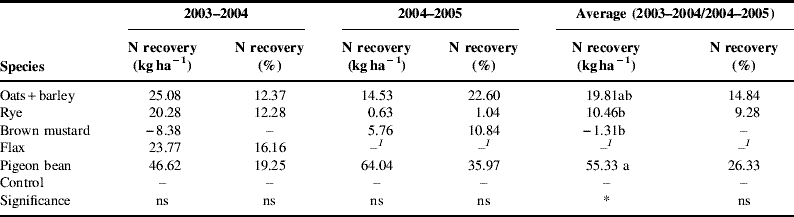
In each column, means followed by the same letter are not significantly different at P⩽0.05 (*) and P⩽0.01 (**) (LSD test).
1 Explanation in the text.
In our research, a very low value for N recovery, although not negative (0.63 kg ha−1 and 1.49%), was detected for rye in 2004–2005 (Table 9). In this year, N recovery by tomato crop following flax was not determined because of the very poor biomass produced by this species, responsible for a negligible N supply (Table 4). Indeed, the resulting N recovery percent value would have given the erroneous idea of a great efficiency of this species in supplying N to tomato.
Comparing N recovery detected in 2003–2004 with that of 2004–2005, it appears that in the second year, in conditions of N shortage in the soil, despite the poorer biomass production, N efficiency of most of the cover crops was higher, that is, tomato recovered a greater amount of N supplied by cover crops. N recovery percent values, with the exception of rye, were actually much higher than that in 2003–2004 (Table 9).
The average N recovery values between 2003–2004 and 2004–2005 are shown as they pointed out well the differences among the compared cover crops. Actually, in this case pigeon bean corresponded to a value (55.33 kg ha−1) significantly higher than rye and brown mustard (Table 9).
Fruit quality
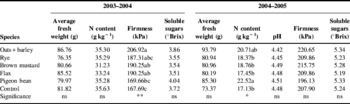
Average fresh weight, N content, pH, firmness and soluble sugar content (°Brix) were considered as fruit qualitative parameters (Table 10). Fruit average fresh weight and soluble sugar content did not show any statistically significant differences among the treatments in both the years; that result may indicate the predominance of the varietal factor over the cover crop effect in influencing these parameters. In 2003–2004, control fruits showed a lower firmness than fruits produced by tomato following oats and barley mixture, brown mustard and flax; a firmness value closer to that of control fruits was detected in tomatoes grown after pigeon bean, where the higher N supply may have influenced this parameter negatively. In fact, a high N application may reduce tomato fruit firmnessReference Kaniszewski and Rumpel45, Reference Wang, Huang, Liu and Jin46. Nevertheless, no differences in fruit N content were noticed. On the contrary, in 2004–2005 tomato fruits showed a significantly higher N content when pigeon bean was used as the cover crop. Finally, also for fruit pH, measured only in the second year, no differences among the treatments were detected.
Characteristics of marketable fruits produced by tomato crop following the compared cover crops.

In each column, means followed by the same letter are not significantly different at P⩽0.05 (*) and P⩽0.01 (**) (LSD test).
Conclusions
Cover crops can be useful in organic farming to reduce the dependence on external inputs, particularly chemical fertilizers, thanks to the significant amounts of ready-to-use N they provide cash crops with.
In the environmental conditions in which our research was conducted, the leguminous species (pigeon bean) proved to be the most efficient cover crop in supplying N to the soil, in spite of a low biomass production. The particular mineralization rate of pigeon bean residues, with a peak of N-NO3 1–2 months after green manure turning under, may satisfy the N requirement of a following cash crop, like tomato, in the vegetative growth stage and sustain production without any fertilizer addition. As for fertilizersReference Grignani, Bassanino, Sacco and Zavattaro2, it is likely that the beneficial effect of green manure on the cash crop is more evident in soils that are not very fertile.
Also in conventional or low-input farming the possibility of reducing the amount of chemical fertilizers, resulting from the use of cover crops, is advantageous, as it may lower the economicReference Kelly, Lu, Abdul-Baki and Teasdale47 and environmental costs of crop management.
Acknowledgements
This research was founded by ARSIA, Regione Toscana (Project ‘L'agricoltura biologica e biodinamica toscana relativa a sistemi finalizzati alle produzioni vegetali’—AGRIBIO). We thank all the staff of Bonamici Farm and of the Rottaia Experimental Station of DAGA in San Piero a Grado (Pisa) for their precious collaboration.