





What is already known on this topic
End-of-life health literacy influences communication and decision-making in palliative care, but validated tools for Spanish-speaking and Latin American populations are lacking.
What this study adds
This study validates the Spanish Subjective End-of-Life Health Literacy Scale in Argentina, showing good cultural validity, reliability, and a 3-factor structure, and demonstrates its usefulness in community-based settings.
How this study might affect research, practice, or policy
The scale enables assessment of end-of-life health literacy in Spanish-speaking populations and can support facilitated conversations to improve end-of-life communication and decision-making.
Introduction
In clinical practice, policy, and palliative care guidelines, end-of-life care increasingly emphasizes the importance of supporting individuals and families to understand, anticipate, and participate in decisions about care and treatment (Kuosmanen et al. Reference Kuosmanen, Hupli and Ahtiluoto2021). Within supportive and palliative care, meaningful engagement with end-of-life issues, including understanding information, participating in discussions, and making decisions about care, depends not only on the availability of services but also on people’s ability to access, understand, and use information (Nielsen-Bohlman et al. Reference Nielsen-Bohlman, Panzer and Kindig2004; Bernacki and Block Reference Bernacki and Block2014). Health literacy has therefore emerged as a critical determinant of communication quality, shared decision-making, and alignment between care received and individual values at the end of life (Kickbusch et al Reference Kickbusch, Pelikan, Apfel and Tsouros2013).
Health literacy extends beyond basic comprehension of medical information. Contemporary frameworks conceptualize health literacy as a multidimensional construct. This includes functional skills (understanding health-related information), interactive skills (communicating and engaging with health professionals and others), and critical skills (appraising information and applying it to personal circumstances) (Nutbeam Reference Nutbeam2000; Sørensen et al. Reference Sørensen, Van den Broucke and Fullam2012). In end-of-life contexts, these dimensions are particularly relevant. Individuals are often required to navigate complex terminology, engage in emotionally charged discussions, and make decisions under conditions of uncertainty, time pressure, and distress (van der Heide et al. Reference van der Heide, Deliens and Faisst2003; Becker et al. Reference Becker, Beck and Vincent2020). Limited end-of-life health literacy may contribute to reduced participation in advance care planning, difficulties in expressing preferences, and mismatches between desired and actual care (Meier et al. Reference Meier, Vilpert and Wieczorek2024).
Despite growing recognition of its importance, research on end-of-life health literacy remains unevenly distributed across regions, with relatively limited evidence from Latin America (Paiva et al. Reference Paiva, Bonilla-sierra and Tripodoro2023). This gap is particularly relevant in Latin America, where end-of-life care unfolds within diverse social and health system contexts across countries, with varying access to palliative care services and often strong family involvement in decision-making (Soto-Perez-de-Celis et al. Reference Soto-Perez-de-Celis, Chavarri-guerra and Pastrana2017). In Argentina, discussions about death and dying may be culturally sensitive and are sometimes deferred, while awareness of legal and practical aspects of advance care planning remains variable. At the same time, populations are heterogeneous with respect to educational background, familiarity with health systems, and access to health information. Within these diverse contexts, including Argentina, culturally adapted and context-sensitive tools may help to better assess end-of-life health literacy in ways that are meaningful, acceptable, and ethically appropriate.
The Subjective End-of-Life Health Literacy Scale (S-EOL-HLS) was recently developed to address these gaps by capturing individuals’ perceived abilities to understand end-of-life information, engage in discussions, and evaluate treatment preferences (Meier et al. Reference Meier, Vilpert and Wieczorek2023). Initial validation in a European context demonstrated a 3-factor structure (functional, interactive, and critical domains), good internal consistency, and satisfactory psychometric performance. However, its applicability to Spanish-speaking populations and to Latin American settings has not yet been established. Importantly, adapting such a tool requires more than linguistic translation; it necessitates careful consideration of cultural meanings, social practices, and the conditions under which end-of-life information is encountered and discussed. Community-based approaches offer a promising pathway for culturally adapting end-of-life research instruments. By embedding assessment within facilitated group settings, community workshops can provide safe spaces for reflection, dialogue, and shared learning, while also generating valuable insights into how questions are understood and experienced by participants (O.Nyumba et al. Reference O.Nyumba, Wilson and Derrick2018; Eidenskog et al. Reference Eidenskog, Andersson and Glad2024). Such approaches align closely with the principles of supportive and palliative care, which emphasize relational communication, respect for individual values, and sensitivity to social context (Engel et al. Reference Engel, Kars and Teunissen2023).
The aim of this study was therefore to culturally adapt and validate the Spanish version of the S-EOL-HLS using a community-based workshop approach in Argentina. Specifically, we sought to examine the scale’s factorial structure, reliability, and acceptability, while integrating qualitative feedback from workshop participants, cognitive interview participants, and expert panel members to ensure cultural relevance and contextual appropriateness. By doing so, this study aims to contribute a validated instrument for use in research, practice, and community engagement to support end-of-life communication and decision-making in Spanish-speaking populations.
Methods
Study design
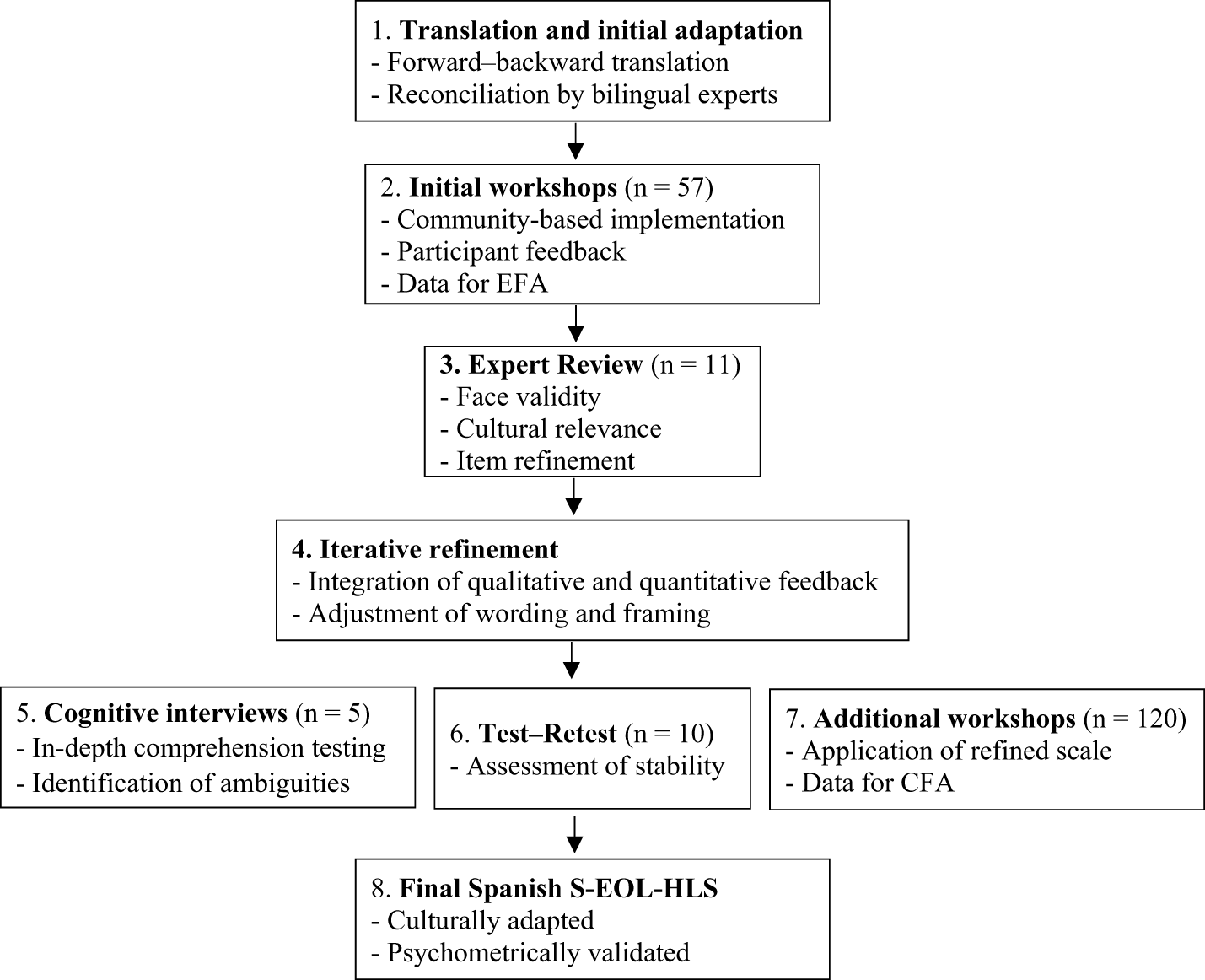
This study employed a sequential exploratory mixed-methods design to culturally adapt and validate the Spanish version of the S-EOL-HLS in Argentina, whereby qualitative findings from the cultural adaptation process informed subsequent quantitative psychometric validation (Figure 1). Integration between qualitative and quantitative components occurred iteratively. Qualitative feedback from expert review, workshops, and cognitive interviews informed item wording, structure, and contextual framing of the scale prior to psychometric testing. In turn, quantitative findings were interpreted in light of qualitative insights regarding item comprehension and perceived difficulty. Data were collected through a series of community-based workshops conducted between 2024 and 2025 across urban and rural settings.
Flowchart of the sequential process of cultural adaptation and validation of the Spanish S-EOL-HLS.

Figure 1 Long description
The flowchart outlines the sequential process for cultural adaptation and validation of the Spanish S-EOL-HLS. It begins with ′Translation and initial adaptation′ involving forward-backward translation and reconciliation by bilingual experts. Next, ′Initial workshops′ with 57 participants focus on community-based implementation, participant feedback and data for exploratory factor analysis. ′Expert Review′ with 11 experts assesses face validity, cultural relevance and item refinement. ′Iterative refinement′ integrates qualitative and quantitative feedback, adjusting wording and framing. ′Cognitive interviews′ with 5 participants involve in-depth comprehension testing and identification of ambiguities. ′Test–Retest′ with 10 participants assesses stability. ′Additional workshops′ with 120 participants apply the refined scale and gather data for confirmatory factor analysis. The process concludes with the ′Final Spanish S-EOL-HLS,′ which is culturally adapted and psychometrically validated.
Measures
The Spanish S-EOL-HLS consists of 18 items assessing subjective end-of-life health literacy across 3 domains: functional (6 items), interactive (7 items), and critical (5 items). Items are rated on ordinal response scales reflecting perceived ease or difficulty in understanding terminology, engaging in discussions, and expressing treatment preferences, with response options ranging from “very easy” to “very difficult.” Scores can be computed both as an overall measure of end-of-life health literacy and separately for each domain, allowing for the assessment of distinct dimensions of the construct. Workshop participants also completed a brief sociodemographic questionnaire capturing age, gender, and educational background.
Participants and recruitment
Workshop participants were adults aged 18 years and older recruited through community organizations, local networks, and outreach activities associated with the workshops. The workshops were conducted with people from diverse backgrounds and with different social and economic realities. Workshop participants included healthcare professionals, individuals outside the health sector, and retired people, as well as other community members. Participation was voluntary, and no exclusion criteria were applied beyond the ability to provide informed consent. In addition, no financial compensation was provided. Sample sizes for the different phases were determined pragmatically based on workshop capacity, participant availability, and the iterative nature of the study design, while ensuring sufficient data to support exploratory factor analysis (EFA) and confirmatory factor analysis (CFA) in applied research settings. The EFA was conducted using data from the initial 5 workshops (n = 57), while CFA was performed on data from a subsequent sample of 7 workshops (n = 120). To further assess comprehension and interpretation of the adapted instrument, cognitive interviews were conducted with 5 community participants using a think-aloud approach, while 10 additional community participants completed test–retest assessments to evaluate the stability of responses over time. Interviews were conducted by members of the research team experienced in end-of-life research and qualitative data collection. Participants were invited to verbalize their thoughts while answering each item, allowing the interviewers to identify potential ambiguities, misunderstandings, or culturally sensitive wording. Detailed notes were taken during the interviews and reviewed by the research team. Insights from the cognitive interviews informed minor refinements to the wording and contextual framing of the Spanish S-EOL-HLS.
Cultural adaptation process
The cultural adaptation followed established guidelines for cross-cultural instrument adaptation. The original S-EOL-HLS was translated into Spanish using a forward–backward translation procedure conducted by bilingual researchers with expertise in palliative care and health literacy. Discrepancies were discussed and resolved through consensus. Face and content validity, including relevance, clarity, comprehensiveness, and cultural appropriateness of items, were assessed by an expert panel of 11 professionals: 3 physicians, 1 nurse, 3 social workers, 1 psychologist, 2 anthropologists, and 1 legal expert, with experience in palliative care, social sciences, and community health. Their feedback informed refinements to item wording, structure, and introductory explanations to ensure conceptual equivalence and contextual appropriateness.
Community-based workshops
The adapted scale was implemented within facilitated community-based workshops designed to provide a supportive environment for discussing end-of-life topics. Workshops were held in diverse settings, including urban centers and smaller communities, and were moderated by trained facilitators. Workshops combined brief introductory discussions on end-of-life care with individual completion of the questionnaire, followed by a group discussion. Qualitative feedback was collected through the facilitated group discussions, and workshop participants were invited to reflect on item clarity, relevance, and emotional impact. These workshops served both as a data collection setting and as a mechanism for contextualizing the instrument, enabling workshop participants to engage with and interpret the items within a supported, real-life discussion environment. This format allowed workshop participants to ask questions and reflect on the items in a collective setting. Workshops were facilitated by members of the research team trained in moderating discussions on end-of-life topics. All sessions were audio-recorded with workshop participants’ informed consent and transcribed verbatim to enable qualitative analysis. While a more in-depth qualitative analysis of the workshop data will be reported in future studies, the present analysis focuses on discursive elements relevant to the cultural and contextual adaptation of the scale. Facilitators were trained to promote inclusive and respectful discussions, encouraging participation from all attendees and being attentive to potential power dynamics related to differences in socioeconomic or professional background.
Quantitative and qualitative analyses
Construct validity was assessed through EFA and CFA. EFA with Promax rotation was conducted on the initial sample to examine the underlying factor structure (Hadi et al. Reference Hadi, Abdullah and Sentosa2016; Shrestha Reference Shrestha2021). CFA was subsequently performed on the second sample to test the 3-factor model identified in the EFA (Brummel and Drasgow Reference Brummel and Drasgow2010). Analyses were conducted using available-case data, with no imputation applied given the low level of missingness and the exploratory nature of the study. Model fit was evaluated using multiple indices, including the Comparative Fit Index (CFI), Tucker–Lewis Index (TLI), Root Mean Square Error of Approximation (RMSEA), and Standardized Root Mean Square Residual (SRMR) (Hu and Bentler Reference Hu and Bentler1999; Schermelleh-Engel et al. Reference Schermelleh-Engel, Moosbrugger and Müller2003; Prudon Reference Prudon2015). Model fit indices were interpreted pragmatically, taking into account the ordinal nature of the data, the modest sample size, and the complexity of the construct. Internal consistency was assessed using Cronbach’s alpha (Ursachi et al. Reference Ursachi, Horodnic and Zait2015). Cronbach’s alpha was selected as a widely used measure of internal consistency for multi-item scales in applied research settings. Analyses accounted for the ordinal nature of the items. Qualitative data were analyzed using an iterative thematic approach, focusing on patterns related to item comprehension, clarity, and contextual relevance, and informing successive refinements of the instrument.
Ethical considerations
The study was conducted in accordance with ethical principles for research involving human participants. All participants received written and verbal information about the study and provided informed consent prior to participation. Participation was voluntary, and confidentiality was ensured by anonymizing all data prior to analysis. Given the sensitive nature of end-of-life topics, facilitators were trained to provide appropriate support and to ensure a respectful and safe environment during workshops. The study (377) has been approved by the Ethics Committee of the A. Lanari Institute of Medical Research, an institution belonging to the University of Buenos Aires (UBA)
Results
Qualitative findings from the cultural adaptation process
The results are presented following the sequential stages of the study, beginning with qualitative findings from the cultural adaptation process, followed by exploratory and confirmatory psychometric analyses. As shown in Figure 2, the cultural adaptation of the Spanish S-EOL-HLS followed an iterative, multistage process combining expert panel members’ input, workshop participants, and cognitive interview participants’ feedback.
Study steps and qualitative insights informing the cultural adaptation of the Spanish S-EOL-HLS.

Figure 2 Long description
A vertical infographic flowchart with three stacked sections connected by downward arrows. The sections are labeled, Expert panel, Cognitive interview participants and Workshop participants. Each section contains a text box with participant feedback about a survey. Expert panel section text:...an introduction, a presentation, is missing. It seems a bit abrupt to start like this, but rather a paragraph to clarify where this proposal fits in. (Expert Criterion: Anthropomorphic Female, 53.) It′s a very difficult survey to start from scratch... context is very important... the situation is not the same; a 90-year-old Mapuche person as a 90-year-old person living in a city... I understand that if there′s a facilitator... it can help. (Expert Criterion: Medical Female, 56.) Cognitive interview participants section text: The survey seemed fine to me... perhaps a simpler explanation could have been given at the beginning. (Think aloud, Female 47.) I found it easy to complete; some questions may be difficult. These are quite difficult topics, but it′s good to talk about them, both as a family and as a community. (Think aloud, Female 73.) Workshop participants section text: People who come from small towns... who have no education... or access to basic information... we′ve been able to complete the survey, but I don′t think they feel capable of completing it... the problem is this gap in information. (Female Workshop CBA) I managed to complete the survey without support because it was not so difficult, but I needed to be guided throughout. (Free comment, Male 50 SMY) Being able to chat and ask questions in a comfortable space helped me learn a lot. (Free comment, Female 21 Bari).
Expert panel findings
During the forward–backward translation phase, expert panel members emphasized the importance of providing contextual information before introducing the scale, noting that initiating the questionnaire without sufficient introduction could feel abrupt and challenging, particularly given the sensitive nature of end-of-life topics. Expert panel members highlighted the heterogeneity of older populations in Argentina, stressing that social, cultural, and geographical contexts, such as urban versus rural living conditions and Indigenous backgrounds, shape how end-of-life concepts are understood and discussed. This feedback informed refinements to the wording and contextual framing of the Spanish version to improve cultural relevance across diverse settings. The role of a facilitator was repeatedly identified as crucial to support comprehension and engagement. Consequently, the workshop format was maintained throughout the adaptation process, and facilitator guidance was incorporated into the implementation procedures.
Cognitive interview findings
Findings from the comprehension testing using a think-aloud approach indicated that cognitive interview participants generally found the questionnaire understandable and acceptable. Importantly, no major difficulties or misunderstandings were identified regarding the functional health literacy items assessing perceived understanding of end-of-life terminology, supporting the comprehensibility of these items in the Argentine context. Several cognitive interview participants also reported that, while some questions addressed difficult and emotionally charged topics, they valued the opportunity to reflect on these issues and considered such discussions beneficial within family and community settings. Suggestions focused primarily on the need for clearer introductory explanations rather than changes to specific items. These findings supported the retention of the overall item structure while prompting minor revisions to the questionnaire instructions and introductory explanations.
Community workshop feedback
Feedback collected during the initial community workshops and the subsequent application of the S-EOL-HLS in community workshops further underscored the importance of guided administration. Workshop participants noted that individuals with limited formal education or restricted access to health information were able to complete the questionnaire but often lacked confidence in their responses. The scale was perceived as generally clear; however, respondents emphasized that end-of-life topics remain insufficiently discussed in society and require supportive environments to facilitate meaningful engagement. Several workshop participants highlighted that the opportunity to ask questions and engage in dialogue within a safe and comfortable setting enhanced both understanding and learning. These findings reinforced the decision to preserve the contextual framing and supportive administration approach adopted during the adaptation process. Overall, qualitative findings informed refinements to the wording, structure, and contextualization of the Spanish S-EOL-HLS, strengthening its cultural relevance and acceptability for use in community-based settings.
Exploratory factor analysis
Building on these qualitative insights, we next examined the factorial structure of the instrument using EFA. EFA conducted on data from the initial community-based workshops (n = 57) supported a 3-factor structure of the Spanish S-EOL-HLS corresponding to functional, interactive, and critical dimensions of end-of-life health literacy (Table 1). The first factor, functional end-of-life health literacy, captured participants’ perceived understanding of specialized end-of-life terminology. All 6 items assessing comprehension of clinical concepts, including prognosis, intubation, palliative care, cardiopulmonary resuscitation, artificial nutrition, and sedation, loaded strongly on this factor, with factor loadings ranging from 0.74 to 0.89. The second factor, interactive end-of-life health literacy, reflected participants’ perceived comfort in engaging with end-of-life information and decision-making processes. Seven items loaded primarily on this factor, with loadings ranging from 0.31 to 0.91. The highest loadings were observed for items related to making decisions based on probabilities (0.91) and choosing treatment options in the context of terminal illness (0.80). Lower loadings were observed for items addressing comfort in defining overtreatment (0.31) and discussing end-of-life preferences (0.50).
Results of exploratory factor analysis with Promax rotation, community-based workshops, Argentina, 2024/2025, n = 57

Table 1 Long description
Exploratory factor analysis results report Promax-rotated loadings for three factors across functional, interactive, and critical end-of-life health literacy items. Functional health literacy items about understanding specialized terms load strongly on Factor 1, ranging from 0.74 for cardiopulmonary resuscitation to 0.89 for palliative care, with other terms between 0.76 and 0.86. Interactive health literacy items load on Factor 2, with the strongest loading for making decisions based on probabilities at 0.91 and choosing a treatment type if terminal disease at 0.80; other comfort items range from 0.31 for defining overtreatment to 0.64 for finding advance directive forms. Critical health literacy items about treatment preferences load on Factor 3, highest for blood transfusions at 0.91 and antibiotics at 0.89, followed by breathing machines at 0.80, cardiopulmonary resuscitation at 0.70, and artificial nutrition at 0.64. Overall, items cluster cleanly by domain, with the weakest association being comfort defining overtreatment on Factor 2. Loadings are presented without cross-loadings in the table, so interpretation should focus on the reported primary factor associations.
Rotated factor loadings for each component of the S-EOL-HLS.
The third factor, critical end-of-life health literacy, encompassed treatment preference items requiring appraisal and evaluation of life-sustaining interventions. Five items loaded on this factor, with factor loadings ranging from 0.64 to 0.91, including preferences regarding breathing machines, artificial nutrition, blood transfusions, antibiotics, and cardiopulmonary resuscitation. Overall, items demonstrated clear and conceptually coherent loading patterns, with each item loading primarily on its intended factor, supporting the multidimensional structure of the Spanish S-EOL-HLS.
CFA and internal consistency
The factor structure identified in the exploratory analysis was subsequently tested using CFA in an independent sample. CFA conducted on the second sample (n = 120) supported the 3-factor structure of the Spanish S-EOL-HLS identified in the exploratory analysis (Table 2). The model demonstrated acceptable overall fit to the data, with a CFI of 0.963 and a TLI of 0.957, indicating good comparative fit. Absolute fit indices showed an RMSEA of 0.091 and an SRMR of 0.105. Taken together, these indices suggest an overall acceptable model fit, consistent with adequate model specification given the ordinal nature of the items and the modest sample size. The pattern of results supports the robustness of the 3-dimensional structure encompassing functional, interactive, and critical end-of-life health literacy. Internal consistency of the full scale was high, with a Cronbach’s alpha of 0.89, indicating good reliability of the Spanish S-EOL-HLS in this sample.
Confirmatory factor analysis – goodness-of-fit and internal consistency

Table 2 Long description
Confirmatory factor analysis results summarize model fit and internal consistency for a three-factor measurement model. Fit indices were high for comparative fit index (0.963) and Tucker–Lewis index (0.957). Approximate fit indices were moderate, with root mean square error of approximation 0.091 and standardized root mean square residual 0.105. The narrative interpretation describes the overall fit as acceptable for the data. Reliability was reported as good, with Cronbach alpha 0.89 for the instrument. Interpretation notes that the items were ordinal and the sample size was modest at 120, which may influence fit statistics.
Distribution of responses across end-of-life health literacy domains
To complement the psychometric analyses, Figure 3 presents the distribution of responses across the 3 domains of the Spanish S-EOL-HLS among workshop participants (n = 120). For functional end-of-life health literacy, most respondents reported that understanding specialized end-of-life terminology was fairly easy or very easy. The highest levels of perceived ease were observed for terms such as prognosis and intubation, with more than half of workshop participants reporting these as very easy to understand. Understanding of cardiopulmonary resuscitation, artificial nutrition, and sedation was also reported as relatively high, although a small proportion of respondents rated these terms as fairly difficult or very difficult. Responses related to interactive end-of-life health literacy showed greater variability. While a majority of workshop participants reported feeling fairly easy or very easy about learning more about end-of-life treatments and talking about end-of-life preferences, higher proportions reported difficulty with tasks involving active engagement and decision-making. In particular, defining overtreatment, making decisions based on probabilities, and finding advance directive forms were more frequently rated as fairly difficult or very difficult. Choosing treatment types in the context of terminal illness also showed a broad distribution of responses, indicating heterogeneity in perceived comfort. For critical end-of-life health literacy, most respondents reported relative ease in expressing treatment preferences, particularly regarding antibiotics and blood transfusions. Preferences related to cardiopulmonary resuscitation were also commonly rated as fairly easy or very easy. In contrast, higher levels of difficulty were observed for preferences concerning breathing machines and artificial nutrition, where a greater proportion of respondents reported fairly difficult or very difficult responses. Overall, the distribution of responses highlights distinct patterns across the 3 domains, with higher perceived ease for understanding terminology and greater variability for interactive and evaluative tasks.
Spanish Subjective End-of-Life Health Literacy Scale (S-EOL-HLS), percentage of respondents per category, community-based workshops, Argentina, 2024/2025, n = 120.

Figure 3 Long description
A stacked horizontal bar graph with four response categories in a legend: Very difficult, Fairly difficult, Fairly easy, Very easy. The horizontal axis shows 0 to 100. The vertical axis lists items grouped under three headings. Heading, Understanding specialized vocabulary. Prognosis: 5.0, 40.0, 54.2. Cardiopulmonary resuscitation: 3.3, 18.3, 30.8, 47.5. Palliative care: 5.0, 19.2, 39.2, 36.7. Intubation: 5.0, 10.0, 32.5, 52.5. Artificial nutrition: 5.8, 16.7, 31.7, 45.8. Sedation: 6.7, 15.0, 34.2, 44.2. Heading, Learning more about end of life treatments. Learning more about end of life treatments: 0.8, 16.7, 51.7, 30.8. Talking about end of life preferences: 7.5, 13.3, 39.2, 40.0. Defining overtreatment: 8.3, 18.3, 60.0, 13.3. Making decisions based on probabilities: 9.2, 43.3, 29.2, 18.3. Defining conditions when to be left to die: 11.7, 23.3, 39.2, 25.8. Finding advance directive forms: 18.3, 53.3, 20.0, 8.3. Choosing treatment type if terminal disease: 19.2, 24.2, 35.0, 21.7. Heading, Treatment preference. Antibiotics: 0.8, 8.3, 29.2, 62.5. Blood transfusions: 0.8, 12.5, 30.9, 55.8. Cardiopulmonary resuscitation: 4.2, 15.8, 34.2, 45.8. Breathing machines: 10.8, 30.0, 33.3, 25.8. Artificial nutrition: 12.5, 25.0, 33.3, 29.2.
Discussion
This study culturally adapted the Spanish version of the S-EOL-HLS and provided initial evidence supporting its validity and reliability in an Argentine context. Qualitative findings from expert panel members, workshop participants, and cognitive interview participants highlighted the importance of contextual framing, facilitation, and cultural relevance in shaping how participants understood and engaged with the instrument. The findings support a 3-dimensional structure encompassing functional, interactive, and critical domains of end-of-life health literacy, consistent with contemporary health literacy frameworks and with the original version of the scale. Overall, the Spanish S-EOL-HLS demonstrated evidence of content validity, construct validity, good internal consistency, and strong cultural acceptability in the Argentine context.
Content validity
The present study provides evidence for the content validity of the Spanish S-EOL-HLS. Through expert panel review, cognitive interviews, and community workshops, we assessed the relevance, clarity, comprehensibility, and cultural appropriateness of the instrument within the Argentine context. Expert panel members emphasized the importance of contextual framing, cultural sensitivity, and facilitation when discussing end-of-life topics, leading to refinements in the introductory text, questionnaire wording, and implementation procedures. Cognitive interview participants generally interpreted the items as intended and identified only minor areas requiring clarification. Together, these findings suggest that the Spanish version adequately captures the intended domains of end-of-life health literacy while remaining understandable, acceptable, and culturally appropriate for use in community-based settings.
Model fit indices should be interpreted pragmatically rather than strictly according to conventional thresholds, given the ordinal nature of the data, the modest sample size, and the conceptual complexity of the construct. In this context, acceptable rather than optimal model fit supports the conceptual coherence and practical usefulness of the 3-factor structure. Importantly, the primary aim of this study was cultural adaptation and contextual validation rather than psychometric optimization in isolation. Emphasis was placed on conceptual equivalence, acceptability, and ecological validity, consistent with the relational nature of end-of-life communication and decision-making.
Construct validity
The study also provides evidence for construct validity. The EFA and CFA supported the 3-dimensional structure originally proposed for the S-EOL-HLS, encompassing functional, interactive, and critical dimensions of end-of-life health literacy. The consistency of this structure with the original validation study suggests that the underlying conceptual framework is applicable within the Argentine context and supports the use of both overall and domain-specific scores.
The EFA and CFA confirmed the conceptual coherence of the 3 domains. Notably, factor loadings varied across items, particularly within the interactive end-of-life health literacy domain. While several items demonstrated strong loadings, others, such as comfort in defining overtreatment, showed comparatively weaker associations with the underlying factor. Rather than indicating a problematic item, this pattern may reflect the inherently broad and context-dependent nature of interactive end-of-life health literacy. Concepts such as overtreatment are often influenced by personal values, prior experiences, cultural norms, and family dynamics, which may result in greater heterogeneity in how respondents interpret and evaluate these questions. In contrast, items related to making decisions based on probabilities or choosing treatment options may more directly capture the decision-making component of the construct and therefore demonstrate stronger associations with the latent factor. Importantly, despite some variability in factor loadings, all items loaded on their intended domains and contributed to the overall conceptual coherence of the scale.
Functional health literacy items, reflecting understanding of specialized end-of-life terminology, showed strong and consistent factor loadings, suggesting that workshop participants were generally able to assess their comprehension of clinical concepts such as prognosis, cardiopulmonary resuscitation, and palliative care. This finding aligns with previous research indicating that technical vocabulary is often encountered in healthcare settings, even when broader engagement in decision-making remains challenging (Gotlieb et al. Reference Gotlieb, Praska and Hendrickson2022; Noordman et al. Reference Noordman, Oosterveld-vlug and Rademakers2022). It should also be noted that the high proportion of “very easy” responses for functional items could partly reflect social desirability bias, particularly given the in-person workshop setting, where workshop participants may have perceived limited anonymity. This should be taken into account when interpreting these findings.
In contrast, items capturing interactive end-of-life health literacy showed greater variability in both factor loadings and response distributions. Tasks involving communication, navigation of information, and decision-making, such as defining overtreatment, making decisions based on probabilities, or locating advance directive forms, were perceived as more difficult by a substantial proportion of workshop participants. This pattern is consistent with evidence that interactive skills are particularly demanding in end-of-life contexts, where conversations are emotionally charged, time-limited, and embedded in complex family and clinical dynamics. The findings underscore that understanding information does not necessarily translate into confidence or comfort in using that information to engage with others or make decisions (Rademakers and Heijmans Reference Rademakers and Heijmans2018).
The critical health literacy domain, focusing on treatment preferences and evaluative judgment, also revealed important nuances. While many workshop participants reported relative ease in expressing preferences regarding certain treatments, greater difficulty was observed for interventions such as artificial nutrition and mechanical ventilation. These treatments often carry symbolic, moral, and emotional meanings that extend beyond clinical considerations, particularly in contexts where family involvement is central (Hira et al. Reference Hira, Palnati and Bhakta2025). These findings highlight that understanding end-of-life information does not necessarily translate into confidence or capacity to act upon it. Interactive and critical end-of-life health literacy appear particularly sensitive to social norms, emotional burden, family dynamics, and opportunities for supported dialogue, reinforcing the need to conceptualize health literacy as a relational rather than purely individual attribute.
Importantly, the qualitative findings provide insight into how the scale was experienced by workshop participants, cognitive interview participants, and expert panel members. Feedback consistently emphasized the need for contextual framing and facilitation, particularly for individuals with limited formal education or restricted access to health information. Although most participants were able to complete the questionnaire, some reported uncertainty about their responses, highlighting that perceived difficulty may reflect broader social and informational inequalities rather than individual deficits. This uncertainty has implications for the interpretation of S-EOL-HLS scores at the individual level, as it may indicate not only perceived difficulty but also limited confidence in applying end-of-life information in real-life contexts. In this sense, confidence in responding may be considered an integral aspect of end-of-life health literacy, particularly for interactive and critical dimensions that involve communication, judgment, and decision-making. The community workshop format appeared to mitigate some of these challenges by creating a supportive environment for reflection and dialogue, reinforcing the idea that the S-EOL-HLS functions not only as a measurement instrument but also as a conversational tool. While facilitated administration may enhance comprehension and engagement, the S-EOL-HLS can also be administered independently, including in self-administered or survey-based formats. However, the need for contextual support in some populations has implications for feasibility and scalability, particularly in large-scale or remote data collection settings, where levels of support may vary. These considerations suggest that responses may be influenced by the mode of administration and should be interpreted with attention to the context in which the instrument is used.
Implications for research and practice
These findings have several implications for supportive and palliative care. First, they suggest that end-of-life health literacy should be understood as a multidimensional and relational construct, shaped by social context and opportunities for communication. Second, they highlight the potential value of integrating assessment tools into facilitated settings, rather than relying solely on self-administered questionnaires. Finally, the results point to specific domains, particularly interactive and critical health literacy, where additional support may be needed to enable meaningful engagement in end-of-life discussions and decision-making. From a practice perspective, these findings suggest that the S-EOL-HLS scale may be particularly valuable when embedded within facilitated clinical or community-based encounters. Rather than functioning solely as a self-administered assessment tool, the scale may support structured conversations about end-of-life issues, help identify domains requiring additional support, and guide tailored communication in palliative care and advance care planning initiatives.
Strengths and limitations
A key strength of this study lies in its mixed-methods, community-based design, which combined psychometric validation with qualitative insights from workshop participants, cognitive interview participants, and expert panel members. The iterative adaptation process enhanced cultural relevance and acceptability, and the inclusion of both urban and rural settings captured diverse experiences. However, several limitations should be acknowledged. Sample sizes were modest, particularly for the EFA, and workshop participants were recruited through the community, which may limit generalizability. At the same time, this community-based recruitment strategy enhanced ecological validity and allowed the scale to be tested under conditions that closely resemble real-world end-of-life conversations. Additionally, while the present study provides evidence for content validity, construct validity, and internal consistency reliability, other aspects of validity remain to be established. In particular, future research should examine convergent validity, criterion validity, and predictive validity, as well as associations between S-EOL-HLS scores and end-of-life knowledge, communication behaviors, advance care planning, and care outcomes.
In addition, we did not assess workshop participants’ prior experiences with end-of-life care, which may influence how individuals interpret and respond to the items; future research should examine the role of such experiences in shaping end-of-life health literacy.
Conclusion
The Spanish version of the S-EOL-HLS demonstrates initial evidence of content validity, construct validity, internal consistency, and conceptual coherence in an Argentine context. The findings provide preliminary support for its use as a multidimensional measure capturing functional, interactive, and critical aspects of end-of-life health literacy. Beyond its psychometric properties, the scale shows promise as a tool to facilitate reflection and dialogue when embedded within supportive, community-based settings. The S-EOL-HLS may therefore contribute to research, practice, and community engagement aimed at strengthening communication and decision-making around end-of-life care in Spanish-speaking populations.
Acknowledgments
We sincerely thank all community members who participated in the workshops and generously shared their time, reflections, and perspectives on end-of-life issues. We are grateful to the facilitators, local organizations, and volunteers who supported the organization and implementation of the community-based workshops across participating settings. We also thank the expert panel members for their valuable feedback and guidance during the cultural adaptation process of the scale. In addition, during the preparation of this work, the author(s) used OpenAI’s ChatGPT and Grammarly to assist with grammatical refinement and language clarity. After using these tools, the author(s) reviewed and edited the content as needed and take full responsibility for the content of the publication.
Author contributions
V.V., C.M., and V.T. designed the study. V.V. and C.M. conducted the analysis and drafted the manuscript. All authors discussed the interpretation of findings and provided critical revision of the manuscript for important intellectual content.
Funding
The work is funded by a Young Scholar Grant awarded to the first author by the Swiss Centre of Expertise in Life Course Research (LIVES Centre).
Competing interests
The author(s) declare(s) that there is no conflict of interest.
Ethical approval
The study was conducted in accordance with ethical principles for research involving human participants. All participants received written and verbal information about the study and provided informed consent prior to participation. Participation was voluntary, and confidentiality was ensured by anonymizing all data prior to analysis. Given the sensitive nature of end-of-life topics, facilitators were trained to provide appropriate support and to ensure a respectful and safe environment during workshops. The study (approval no. 377) has been approved by the Ethics Committee of the A. Lanari Institute of Medical Research, an institution belonging to the University of Buenos Aires (UBA).


 Open access

