The establishment of financial public management systems in central and local governments ensure greater public capability to provide oversight and transparency. Furthermore, if migrated into a larger integrated public management system, this mechanism can help tackle corruption. Nevertheless, this system may involve an expensive and continuing improvement project for sustainability. The Bolivian experience presents us with many lessons. In August 1997, pursuing the creation of an effective financial public management system within public sector entities, Bolivia's Ministry of Finance signed a loan agreement with the World Bank. The loan was for US$15 million and was executed through the “Financial Decentralization and Accountability Project.” The project involved the design of and construction of a new administrative system beginning in January 1998: “The new Bolivian Integrated Management System and Administrative Modernization” (SIGMA for its acronym in Spanish: Sistema Integrado de Gestión y Modernización Administrativa). SIGMA was designed to include subsystems for budgeting, accountability, treasure, public credit, procurement, contracting, and personnel administration within public institutions (i.e., central government, decentralized entities, prefectures, and municipalities) with the participation of nonfinancial public enterprises, nonbanking financial entities, and banks. SIGMA began operating in September 2000 and has been established within a number of public institutions, including decentralized entities. It has not yet been established, however, in municipalities (327 in total). Despite these implementation deficiencies, the World Bank's Report 28380 of June 2003 highlights informatics achievements of the project such as automatization of financial administrative procedures. However, a more significant impact on government accountability and transparency was expected through SIGMA implementation (especially taking into account that Laws 1178, 1654, and 1551 require an effective system for more accountability and transparency in government, not just the development of a modern informatics system). Furthermore, the “social control” concept established by the new Bolivian Constitution critically affects the original conceptualization of public management systems, including principally SIGMA. This article analyzes financial public management systems within the context of bureaucratic control and oversight mechanisms, the conception and implementation of SIGMA in Bolivia, as well as the challenges that threaten its sustainability and future development. The article suggests possible solutions and next steps that can be applied to other countries.
CONTROL AND OVERSIGHT MECHANISMS AND THE USE OF FINANCIAL PUBLIC MANAGEMENT SYSTEMS
Bureaucratic control mechanisms can ensure that public officials conduct themselves ethically in the most effective and efficient manner (Zimmerman Reference Zimmerman1994). These control mechanisms may be internal or external. The former refer more to accounting evaluation, that is, checking the accuracy and reliability of accounting data (Evans, Lewis, and Patton Reference Evans, Lewis, Patton, Mckinney and Johnston1986) and are usually conducted by an audit unit of the target agency. External control mechanisms refer more to investigations of activities and have been formally operated by legislatively created offices such as auditors, inspectors, independent counsels, and ombudsmen. Both corruption and fraud, however, have been seriously challenging these control mechanisms. Indeed, these activities remain critical problems for public administration (Anechiarico Reference Anechiarico1996) by undermining citizens' confidence and even destroying the legitimacy of the political system. Hence, control and oversight mechanisms need to be strengthened and improved through the design and establishment of new tools such as effective financial public management systems. These tools can ensure greater control and oversight.
On one hand, many scholars support the creation and strengthening of either internal or external oversight mechanisms (Bhargava and Bolongaita Reference Bhargava and Bolongaita2004; Caiden, Dwivedi and Jabbra Reference Caiden, Dwivedi and Jabbra2001; Fantaye Reference Fantaye2004; Johnston Reference Johnston2005; Klitgaard Reference Klitgaard1988; Mckinney and Johnston Reference Mckinney and Johnston1986; Nelson Reference Nelson1982; Rose-Ackerman Reference Rose-Ackerman1999; Thompson Reference Thompson1987; Zimmerman Reference Zimmerman1994). They point out that public officials' behavior should be “scrutinized” (Thompson Reference Thompson1987, 7) and “monitored” (Bhargava and Bolongaita Reference Bhargava and Bolongaita2004). Moreover, White (Reference White1950) and Wilson (Reference Wilson1887, 197) argue that efficient public administration could not be ensured without fighting corruption, and so they support the idea of having corruption controls to assure integrity.Footnote 1 This is “a constant challenge” for all governments (Nelson Reference Nelson1982, 120).
On the other hand, several scholars fear that control mechanisms may create more bureaucratic problems (Downs Reference Downs1967) or “resistance to accomplishing goals” (Wilson Reference Wilson1989); or a system that causes a “decrease in citizens' confidence in public agencies” (Breyer Reference Breyer1993, 50); or a system that may violate fundamental precepts of democratic administration (e.g., discretion) (Gruber Reference Gruber1988; Kaufman Reference Kaufman1977, 25; Kelman Reference Kelman1990, 1; Ostrom Reference Ostrom1989); or a system that may create “bureaucratic pathology” and red tape (Anechiarico Reference Anechiarico1995, 143; Fesler and Kettl Reference Fesler and Kettl1991). Thus, some scholars suggest that public management should be flexible (Osborne and Gaebler Reference Osborne and Gaebler1992) and final decisions should not take a long time or require multiple approvals. They argue that too many controls make government inefficient and may not reduce corruption and fraud. Others have gone even further arguing that corruption is sometimes efficient.
Systematic and empirical evidence, which shows that bureaucratic oversight mechanisms are ineffective, is lacking. Finding corruption and fraud cases is not difficult; however, we lack systematic explanations of why oversight mechanisms are not working or why they are ineffective. Although corruption and fraud are challenging and will probably continue in some manner, oversight mechanisms may diminish their effects. The challenge is to both evaluate and enhance the accountability and effectiveness of these mechanisms (Apaza Reference Apaza2011; Moore Reference Moore1995, 183; Rose-Ackerman Reference Rose-Ackerman, Heidenheimer, Johnston and LeVine1989, 816).
From the implementation of SIGMA in Bolivia we have learned that the effective implementation of an integrated financial management system can help fight corruption, accounting for social and political issues, such as a new Constitution and the establishment of the “social control” concept. An analysis of the conception and implementation of the SIGMA follows.
CONCEPTION AND IMPLEMENTATION OF SIGMA
Working since January 2, 2001, SIGMA is a public administration tool aimed at substituting the flow of computerized information for the flow of papers. It was created to implement mandates established by Law 1178 (Administration and Government Control Act—known as Law SAFCO), Law 1654 (Administrative Decentralization Act), and Law 1551 (Popular Participation Act). SIGMA's technical tools include norms, policies, principles, technical procedures, information technology, and other resources that are necessary to plan, manage, and control public resources. Hence, SIGMA can generate, in real time, diverse computerized information on budgeting, accounting, and public investment. To do that, SIGMA uses a unique treasury account, the principles of integrated government accountability, and an electronic signature to authorize transactions (identifying the public servant who made the authorization). In addition, SIGMA contains a subsystem for personnel, resources, and services management.Footnote 2 As such, SIGMA makes public financial management transparent; generates opportune and reliable information for the public policy decision process; promotes economy, efficiency, and effectiveness of public management; and interrelates the financial administration systems with the internal and external control systems.Footnote 3
SIGMA has its origins in the Financial Decentralization and Accountability Project (known as ILACO II—Agreement N° 033-BO) signed between the government of Bolivia and the World Bank on August 19, 1997. The project aimed at increasing the capacity of decentralized governments and the administration of resources allocated by the central government. In this sense, the project had two main objectives: first, to implement a process of self-management in financial administration (which would enable Bolivia not only to preserve existing procedures, but also to cover newly decentralized sectors and municipalities); and second, to build up a strong public auditing function (which would include implementation of uniform accounting and auditing standards across the public sector, auditing operations of decentralized regional governments and municipalities, development and execution of anti-corruption audits, and quality control of private sector audit standards).Footnote 4 To meet these goals, the project was originally designed to consolidate the implementation of the integrated financial information system (SIIF for its acronym in Spanish), to extend the SIIF to the decentralized entities and municipalities, and to support the strengthening of the public sector auditing function. Thus, the project initially focused on the establishment of SIIF in a certain number of public entities (i.e., prefectures, decentralized entities, and municipalities). Almost 90% of public resources administered in the country were to be included in the system.Footnote 5
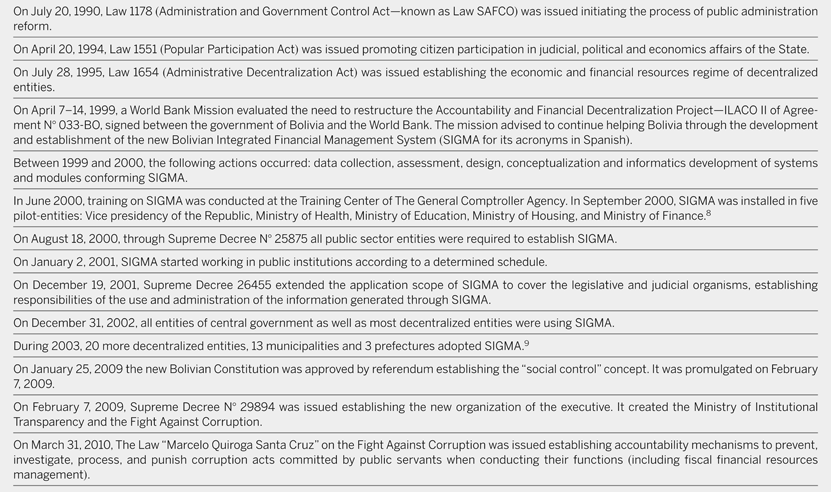
However, technical difficulties of the SIIF (i.e., limited functionality, limited reliability of the information generated, limited user friendliness, insufficient system capacity; vulnerable security mechanisms; and costly technical and capacity upgrades every three months) required a redesign of the project. The objectives were revised and replacing the SIFF with another system was considered.Footnote 6 Thus, in December 1998, the Ministry of Finance hired a consultant to evaluate the SIIF. The consultant's report concluded that the project had been converted into an informatics project, instead of fulfilling the SAFCO Law objectives related to the modernization of the financial administrative systems to make public management more efficient.Footnote 7 As a result, in April 1999, a World Bank Mission evaluated the restructuration of the project. Hence, in coordination with the Ministry of Finance, the World Bank considered developing a new Integrated Financial Management System (SIGMA for its acronyms in Spanish). See table 1 for the project timeline.
Project Timeline

Source: Authors elaboration based on documents, norms and laws related to the Financial Decentralization and Accountability Project (known as ILACO II—Agreement N° 033-BO) signed between the government of Bolivia and the World Bank.
Project Implementation
SIGMA was established by D.S. N° 25875 issued on August 18, 2000. The norm required all public sector entities to establish SIGMA within their systems according to Article 3 of Law N° 1178.Footnote 10 Supreme Decree N° 26455 issued on December 19, 2001, established the responsibilities and administrative use of the information generated by SIGMA. It also extended the scope of SIGMA to cover the legislative and judicial areas and established responsibilities for the use and administration of the information generated through SIGMA.Footnote 11 According to the SAFCO Law (Law N° 1178) the Accountant General's Office (AG) within the Ministry of Finance was assigned as the SIGMA system administrator with the mandate to develop, operate, maintain, and ensure system integrity.
SIGMA was developed as part of the Financial Decentralization and Accountability Project (i.e., ILACO II). As mentioned previously, the ILACO II project was intended to support the translation of budget regulations into workable administrative procedures, the institutionalization of operating procedures for treasury transactions, and the implementation of financial accounting norms, as required under the SAFCO law. In October 2000, the ILACO II project was modified establishing a new objective: “the establishment of integrated financial management systems in the public sector.”Footnote 12 As a result, the original components of the project were also adjusted to the new project objective.
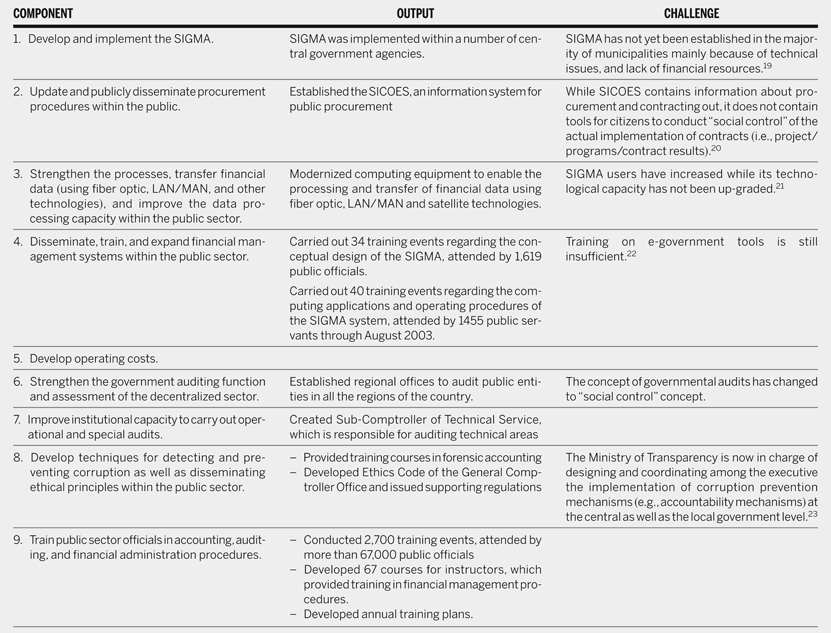
Nine components of the ILACO II project were revised:
1. Develop and implement SIGMA.
2. Update and publicly disseminate procurement procedures within the public sector.
3. Strengthen processes and transfer financial data (using fiber optic, LAN/MAN, and other technologies) and improve the data processing capacity within the public sector.
4. Disseminate, train, and expand financial management systems within the public sector.
5. Develop actual operating costs, including the project coordination unit's operating costs such as administrative and management staff, intracountry travel, dissemination of materials and publications, and equipment support.
6. Strengthen the government auditing function and assessment of the decentralized sector.
7. Improve institutional capacity to carry out operational and special audits.
8. Develop techniques for detecting and preventing corruption as well as disseminating ethical principles within the public sector.
9. Train public sector officials in accounting, auditing, and financial administration procedures.Footnote 13
Project Outputs and Challenges at Project Completion
According to World Bank Report 28380, at the end of the project approximately 56% of government expenditures, 100% of the central government budget, and nearly 47% of all public sector expenditures (including local government and decentralized entities) were being processed by the SIGMA system. Thus, according to the Bank, SIGMA had the following impacts: (a) standardized and simplified administrative procedures for budget commitments, accruals, and payments; (b) encouraged the use of results-based practices in the management of financial information; (c) increased efficiency, timeliness, and reliability of financial information generated by the public sector; (d) required public institutions to increase institutional capacity to implement and maintain the SIGMA system within their respective entities; (e) increased the level of transparency and efficiency in the use of public funds; and (f) significantly reduced discretional decisions with respect to payments.Footnote 14
In 2003, the World Bank identified five technical and political issues at project completion:
1. The control function had not been sufficiently institutionalized and did not appear to be a strong priority in government.
2. Training activities, especially in regard to the enforcement of ethics violations, were not sufficiently supported.
3. The government did not demonstrate sufficient commitment with respect to project execution, leading to implementation delays and reduced project activity.
4. Frequent changes in the government's organizational structure due to the creation of new entities and the merging or closing of entities resulted in reliability and validity issues of some of the reports produced.
5. The project budget did not include a proper project design considering budgetary space for SIGMA's constant improvement of its different modules, as well as system technological changes and upgrades.Footnote 15
Currently, the institutional and political issues identified by the World Bank are resolved. For instance, the control function (issue 1) has not only been ratified as a strong priority in government but it has been constitutionalized by Article 241 of the new Bolivian Constitution.Footnote 16 Training activities on ethics (issue 2) have not only been strengthened but these activities are now an executive function conducted by the Ministry of Institutional Transparency and the Fight Against Corruption created by Supreme Decree N° 29894 issued on February 7, 2009.Footnote 17 Government commitment to execute Financial Decentralization and Accountability Project (issue 3) has turned into a priority. The new Ministry of Autonomies is leading a strong decentralization in the country including the fiscal finance decentralization process among prefectures and municipalities.Footnote 18 Frequent changes in the government's structure (issue 4) have been solved by Supreme Decree N° 29894, which has restructured the executive branch according to the new Bolivian Constitution. However, the technical issues continue. For instance, because project design did not consider budgetary space for SIGMA's constant system improvement and upgrades, SIGMA has not been implemented in the majority of municipalities. Furthermore, the system frequently crashes due to technical support issues.
Several political issues, especially the issue of the new Bolivian Constitution in 2009, have created many challenges for SIGMA's continuity. SIGMA needs to extend its components or migrate to a more comprehensive and integrated system to accomplish constitutional mandates such as the “social control” concept. Article 241 of the new Bolivian Constitution establishes “social control” giving citizens the power to oversee government activities. Thus, according to Article 241, citizens, through civil society organizations, shall participate in the design of public policies; shall conduct social control of public management, on all state levels, to public institutions and enterprises administering fiscal resources; and shall conduct social control to public service quality. This “social control” concept requires an expansion of SIGMA's scope or the creation of a new integrated administrative system that allows citizens to actually exercise this control. See table 2Footnote 19Footnote 20Footnote 21Footnote 22Footnote 23 and the discussion that follows.
Financial Decentralization & Accountability Project (ILACO II) Components, Outputs and Challenges

Source: Author's elaboration based on World Bank Project Report No: 28380 and related documents.
Challenges Threatening SIGMA's Continuity and Future Development
As mentioned earlier the “social control” concept established in the new Bolivian Constitution requires a largely expanded scope for SIGMA or the creation of a new integrated administrative system that allows citizens to actually exercise “social control.” In this sense, despite the SAFCO Law (Law N° 1178 of governmental administration and control—issued on July 20, 1990), which requires all public institutions to use systems to register all public financial information, the system (in this case SIGMA) is insufficient to actually perform the “social control” as established in the Constitution. To adequately change SIGMA to meet the “social control” concept is a big challenge because it would require overcoming at least three main issues as described in the following text.
First, according to Article 241 of the new Bolivian Constitution, SIGMA should be accessible to all Bolivians. It would mean that SIGMA should be established in all municipalities and should be accessible to all citizens. But SIGMA has not yet been established in the majority of municipalities.Footnote 24 Second, to understand basic budgeting and financial management information contained in the SIGMA modules, citizens need to be adequately trained on basic knowledge of information technology as well as on public finance. Third, most modules of the SIGMA work in an Intranet environment, which does not make it accessible to the public via Internet. This situation may have prevented citizens from performing social control of information contained in the SIGMA. For instance, Fundación Etica y Democracia from Bolivia reported to the Committee of Experts of the Mechanism for Follow-Up on the Implementation of the Inter-American Convention against Corruption (MESICIC), that actual citizen participation in public financial management established by Law 1551 is absent or not significant.Footnote 25 In contrast to this situation, since 2007, the government, through the Ministry of Institutional Transparency and the Fight Against Corruption, has been implementing a transparency program. This program encourages civil society participation in formulating public policies and plans. The program was successfully implemented in five public institutions, and currently, about 50 public entities participate.Footnote 26
POSSIBLE SOLUTIONS AND NEXT STEPS TO IMPROVE SIGMA EFFECTIVENESS
As detailed earlier the “social control” concept established in the new Bolivian Constitution affects the conceptualization of the Bolivian public management systems, including SIGMA. Thus, current systems should be reconceptualized and redesigned to allow citizens to actually exercise “social control.” In this sense, there are several possible solutions.
First, expand SIGMA modules to include citizen participation mechanisms that would allow them to perform “social control” as conceptualized in the new Bolivian Constitution. New modules would include project management results as well as performance management assessment indicators. Second, design and provide citizens with training on information technology so that they can understand information technology systems and tools provided by SIGMA, SICOES, and other related public management systems. Then, citizens would be better prepared to exercise “social control” by using and analyzing valuable information contained in public management systems. Third, establish SIGMA in all municipalities, promoting, at the same time, citizen participation in financial public management oversight. The Ministry of Institutional Transparency and Fight Against Corruption should continue to promote citizen participation searching for more public management accountability.
Based on these challenges, a better solution may be the migration of SIGMA into a larger integrated public management system, which would include information on all public investment projects and program results management as well as performance management indicators. To do this, a global e-government strategy for Bolivia needs to be designed that would consider the design and allocation of sufficient resources to build a national center for information technology management. This strategy would lead to the integration of public investment project management systems actually existing within public sector entities including municipalities.
Countries developing a national strategy for more accountability and transparency should consider the design and implementation of an integrated public management system that can effectively perform financial public management, personnel management, performance management, public investment management, and procurement management.
In brief, the effective implementation of an integrated public management system, including subsystems for budgeting, accountability, treasure, personnel administration, public credit, public investment projects, procurement, contracting out, program results management as well as performance management indicators within public institutions (i.e., central government, decentralized entities, and local governments) can ensure greater public oversight and transparency in government.