Introduction
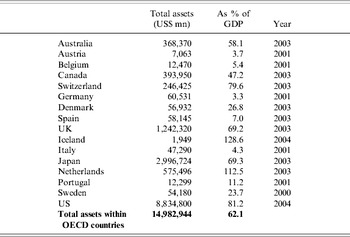
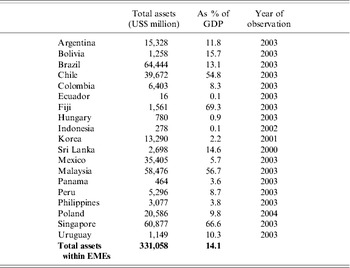
The current global demographic shift toward population ageing, largely reflecting rising life expectancy and declining fertility (Munnell, Reference Munnell2004) has led many countries across the world to re-evaluate their pension systems. Typically, they switch wholly or partially from unfunded systems, e.g. pay-as-you-go (PAYG) to funded systems, with reform in Emerging Market Economies (EMEs) often supported by World Bank finance (Holzmann and Hinz, Reference Holzmann and Hinz2005). Given the funded nature of many new pension schemes, pension fund assets have increased across many countries; current levels are given in Tables 1 and 2.
Total assets of pension funds within selected advanced OECD countries

Source: Hu (Reference Hu2005a).
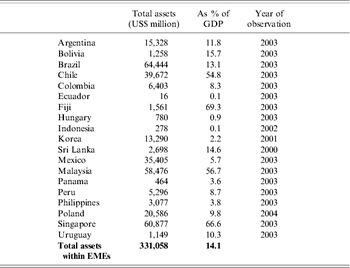
Given demographic trends and the structure of funded schemes, it is virtually certain that pension funds will continue rapid expansion during the coming decades. In this context, a key issue in pension reform is whether such a shift from PAYG to funding is largely a matter of reallocation of the burden of ageing (with the risk of a generation paying twice), or whether funding improves economic performance sufficiently to generate at least some of the additional resources required to meet the needs of an ageing population. There are several aspects to this question. One is whether funding leads to an increase in saving which permits higher capital formation. A second is whether, independently of the impact on saving, there are favourable effects of funding on capital and labour markets, for example via acceleration of financial development, generating in turn a more efficient allocation of capital. A third is whether, following these effects, a direct impact of funding on growth can be discerned. Whereas there is quite extensive work on funding's effect on saving and on financial development (see references in Hu, Reference Hu2005a; Davis and Hu, Reference Davis, Hu and Clark2006; Davis, Reference Davis2005), the direct role of pension funds in economic growth has been little examined. Is pension fund growth positively associated with economic growthFootnote 1? In this paper, we seek to provide insight into these questions with both a theoretical model and related empirical work for most OECD countries and selected EMEs.
The paper is structured as follows. Section 1 provides a brief literature review on the issue of whether and how pension fund growth may impact on economic growth (measured by increases in economic output (GDP) produced per head). Section 2 deals with the model specification, which is derived from the Cobb–Douglas production function, and views pension fund assets as a shift factor, an idea developed from McCoskey and Kao (Reference Kao1999) and Arestis et al. (Reference Arestis, Luintel and Luitel2004). In Section 3, data are introduced and tested for stationarity. We find variables to be I(1), implying a need to allow for cointegration. In Section 4, our first econometric work is conducted with the help of cointegrating dynamic OLS (DOLS) model, which we consider most appropriate for the question in hand. Complementing this, in Section 5, we follow the dynamic heterogeneous estimation procedures designed by Pesaran and Smith (Reference Pesaran and Smith1995) to look at the average long-run relations and allow for cross-country heterogeneity. In Section 6, we move to country-by-country co-integration tests, investigating whether there is a long-run relationship between pension funds and economic growth and again allowing for cross-country heterogeneity. Impulse responses of output per head to pension assets in the related Vector Error Correction Models (VECM) are calculated as well as variance decompositions. In each case, we assess results with and without a time trend, which may capture other influences on the production relation such as structural reform.
1. Literature review
1.1 Empirical work on the pension funds-growth nexus
Looking at the existing literature, empirical work that investigates the direct link between pension fund growth and economic growth at a transnational level is quite scarce, and uses widely varying summary measures of economic performance. Besides GDP growth or GDP per worker/head of population, these include Total Factor Productivity (TFP), investment, and average productivity of capital. Davis (Reference Davis2002), for example, with a dataset covering both pension funds and life insurance companies, looked at the relation between institutionalization (measured by the share of institutional investors' equity holdings in corporate equity as a whole) and economic performance at the macro level, measured by TFP and GDP growth. Although his results are consistent with higher TFP as institutions' share of equity rises, he finds no direct effect of the proportion of equity held by life insurers and pension funds on GDP growth. Again, Davis (Reference Davis and Goodhart2004) using a dataset of 16 OECD countries and a standard Levine–Zervos (Reference Levine and Zervos1998) specification for finance and growth does not find a positive direct link between institutionalization (rising life insurance and pension assets/GDP) and GDP growth. On the other hand, using the technique developed by Hurlin and Venet (Reference Hurlin and Venet2003) and Hurlin (Reference Hurlin2005), Hu (Reference Hu2005b) shows that Panel Granger Causality tests do indicate homogeneous causality from pension assets to GDP growth in 38 countries as well as in the subgroups OECD (18 countries) and EMEs (19 countries). Reverse causality is weaker, and notably for emerging markets there is no strong evidence that GDP growth homogenously causes pension assets.
Looking at national studies of the direct link of pension reform to growth, most extant studies have focused on Chile. Holzmann (Reference Holzmann1997) found a positive relationship between pension reform and economic growth. With the simple Solow residual specification of TFP, it was found that improving financial market conditions following the pension reform significantly positively affected TFP. But this model suffers from low ‘t’ values, which might result from multicollinearity between independent variables, e.g. the unemployment rate and stock market index. Meanwhile, Schmidt-Hebbel (Reference Schmidt-Hebbel1999) reached the conclusion that pension reform in Chile boosted private investment, the average productivity of capital, and TFP. One single regression was estimated to obtain the coefficients of parameters, then these coefficients are used to calculate the rise of each variable attributed respectively to structural reform, (e.g. tax reform) and pension reform. In all, he concluded that pension reform in Chile had a positive impact on the private investment rate, average productivity of capital, and the TFP growth rate.Footnote 2
A promising methodology that has not yet been applied in the pensions/growth nexus is a generalized Cobb–Douglas production function, with relevant additional variables, such as urbanization rates or the nature of the financial system, set as shift factors into the standard function. Arestis et al. (Reference Arestis, Luintel and Luitel2004) and McCoskey and Kao (Reference Kao1999), among others, use a similar specification to test whether owing to better resource allocation, incentives etc., urbanization or aspects of the financial structure make the capital stock more productive in terms of output per capita. We adapt this work for pension funds in the current paper.
As further background to our work, and to trace the channels whereby pension fund growth could affect economic growth, we now briefly survey the wider literature on the macroeconomic impacts of pension reform, focusing on capital market development, improved corporate governance, labour market efficiency, and household and national savings.
1.2 Pension funds and economic efficiency
Pension funds can positively affect growth via improved economic efficiency and resource allocation, effectively making the capital stock more productive. Economic efficiency and resource allocation can in turn be improved by financial development. The link between pension funds and capital market development has been widely analysed in the recent literature, as reviewed in Davis and Hu (Reference Davis, Hu and Clark2006). Both prices and quantities of long-term financing may be favourably affected, which may in turn raise productive investment and improve resource allocation. For example, focusing on emerging market economies (EMEs), Walker and Lefort (Reference Walker and Lefort2002) argue that pension funds can decrease the cost of capital via three channels. The first channel is a more developed capital market resulting from pension reforms, thus making the issuing of securities cheaper. Secondly, even allowing for short-term performance evaluation (Davis and Steil, Reference Davis and Steil2001), the expected investment time horizon of pension funds is longer than that of individuals and firms, thus reducing the ‘term premium’. Third, the equity risk premium is reduced due to pension funds' pooling and professional management. Both the term premium and risk premium's reduction might lead to a decrease in the average cost of capital, which spurs productive investment. In addition, they give some evidence that pension funds reduce security price volatility, implying a lower risk premium for their panel of emerging market economies, although an opposite result is found by Davis (Reference Davis and Goodhart2004) for G-7 countries, and Hu (Reference Hu2006) for 16 OECD countries and eight EMEs.
Turning from prices to quantities, Catalan et al. (Reference Catalan, Impavido and Musalem2000) give evidence that contractual saving institutions, e.g. pension funds, positively Granger-cause equity market capitalization as well as value traded, while Impavido et al. (Reference Impavido, Musalem and Tressel2003) and Hu (Reference Hu2005a) find a positive relationship between contractual saving assets and bond market capitalization/GDP. In sum, the current literature suggests a positive relation between pension fund growth and financial development. Given it is widely considered that financial development is positively associated with economic growth (Levine and Zervos, Reference Levine and Zervos1998; Beck and Levine, Reference Beck and Levine2004), then pension funds might enhance economic growth via their impact on financial development, independently of an effect on national saving (discussed below).
Pension funds may also boost economic growth via improved corporate governance, improving the way capital is managed. Clark and Hebb (Reference Clark and Hebb2003) note that one factor facilitating pension funds' corporate engagement is the widespread use of indexation techniques in the pension funds industry, which hinders ‘exit’ via sale of shares in underperforming companies that are in the index. A second is the increasing demand by owners for more transparency and accountability, particularly after the Enron, Worldcom, and Parmalat scandals. Third, there is pension funds' pressure to undertake socially responsible investing (SRI). Fourth, pressures to ‘humanize’ capital with social, moral, and political objectives extend pension funds' simple concerns for rate of return.
A positive impact of pension fund activism on corporate performance at the firm level is well documented at least in the US.Footnote 3 But our concern in this paper is whether pension fund growth is a potential engine of economic growth via its effect on corporate performance at the macro level, an issue ignored or dismissed by most current pensions' research. An exception is Davis (Reference Davis2002, Reference Davis and Goodhart2004) who argues that effects of governance initiatives from institutional investors may go wider than the ‘target firms’ to the whole economy. This is because unaffected firms have natural incentives to improve their performance so as to avoid the threat from pension fund activism in the future (Marsh, Reference Marsh1990). Therefore, if a significant proportion of firms, whether directly or indirectly affected by pension fund activism, tend to improve their performance, the overall effect might be higher economic growth, via making the capital stock more productive. Consistent with this, Davis found inter alia that a higher institutional holding of total corporate equity boosts Total Factor Productivity (TFP) and R and D in seven major countries.
Turning to the labour market, it is well known that due to the weak link between pension contributions and benefits under defined-benefit PAYG systems, there is a tendency towards earlier retirement and job immobility, and this is apparent in EU labour markets (Disney, Reference Disney2002). One contributing factor was the disincentives imbedded in public pension systems (Blondal and Scarpetta, Reference Blondal and Scarpetta1998). In addition to the pension system's impact on labour supply, Disney (Reference Disney2003) argues that the distortionary ‘tax component’ of public pension contributions can also affect labour demand if the employee can pass through the burden of pension contribution to consumers, for example via product prices, because product demand falls and producers might consider reducing the demand for labour. In view of such problems, James (Reference James, Nancy, Carol and Richard1998) suggests that ‘the close linkage between benefits and contributions, in a defined-contribution plan is designed to reduce labour market distortions’. In consequence, economic growth might be increased, for example due to more efficient allocation of labour to its most remunerative uses after pension reform to funded defined-contribution plans. Such effects might be smaller where defined-benefit funded schemes predominate. Moreover, some of the labour market benefits can also be obtained by PAYG defined-contribution plans as in Sweden and Poland (Holzmann and Hinz, Reference Holzmann and Hinz2005).
1.3 Pension funds and saving
A final aspect is a possible effect of funding on saving, which given the link of saving to investment in a closed economyFootnote 4 may boost growth directly by raising the capital stock. Whereas there is some evidence of a small positive effect of pension funding on household saving (Kohl and O'Brien, Reference Kohl and O'Brien1998), the relevant variable for economic growth is national saving, which largely determines investment, as would be predicted by a standard Solow (Reference Solow2000) growth model. James (Reference James, Nancy, Carol and Richard1998) argues that one main advantage of the World Bank multi-pillar model of pension reform is that national saving as well as personal saving could be boosted. But any positive effect of pension fund growth on personal saving could be offset at the level of national saving by the impact on public finances of the costs involved in the transition to a privately funded system (Holzmann, Reference Holzmann1997), as well as the costs of tax subsidies to personal saving. A key aspect of this issue is hence how pension-reforming governments finance existing social security obligations. If the government tries to finance the implicit pension debts by public debts, then public savings would decrease, so the overall national saving rate might be unchanged or even fall.
There is conflicting empirical evidence on this point. Schmidt-Hebbel (Reference Schmidt-Hebbel1999) estimated that pension reform in Chile raised the national saving rate. Given the difficulty of pinning down how the pension reform was financed in Chile, he considered three cases, i.e. fiscal contraction-based financing of pension reform at the levels of 100%, 75%, and 50%. On balance, he suggests that between 10% and 45% of the rise in national saving could be explained by pension reform, with the remaining being explained by structural reform, e.g. tax reform etc. Lopez-Murphy and Musalem (Reference Murphy and Musalem2004) study 50 countries and find that national saving is boosted where pension funds are the result of a mandatory pension programme, but not when they are voluntary. On the other hand, Samwick (Reference Samwick1999), working with a panel of countries, found that no countries except Chile experienced an increase in gross national saving rates after pension reform towards non-PAYG systems. He included control variables such as the log of per capita income, per capita income growth, the private credit to income ratio, demographic indicators, and the urbanization rate to avoid omitted variables bias. Furthermore, Bosworth and Burtless (Reference Bosworth and Burtless2004) found that OECD countries that seek to prefund social security obligations such as Japan and the US incur offsetting increases in government borrowing that again offset any difference in national saving.
Taking into account the above literature review, this paper seeks to contribute to the current growth and pensions literature in three areas. First, in the light of work by Arestis et al. (Reference Arestis, Luintel and Luitel2004) and McCoskey and Kao (Reference Kao1999) we design a modified Cobb–Douglas production function with the inclusion of pension assets as a shift factor, which, since it focuses on the efficient use of the capital stock, can capture benefits of pension fund growth independent of the above-mentioned disputed evidence on saving. Second, we employ a set of appropriate panel econometric methods to test the model on data for up to 38 countries. Third, we directly link pension assets to economic growth in a co-integration relationship on a country-by-country basis and investigate the extent to which they are correlated in the long run as well as the impulse responses and variance decomposition in the related VECM.Footnote 5
2. Model specification
The Cobb–Douglas production function shown in (1) is widely used in the economic literature

where A is technology, K is the capital stock, and L is the labour force. In this study, we modify (1) slightly so as to facilitate our analysis of the implication of pension fund assets for output Q. In addition, in view of our panel analysis, we use a double subscript on its variables

where I is the time series dimension, t the cross-section dimension, Q aggregate output proxied by GDP, A state of technology, P pension funds proxied by pension fund assets/GDP, K capital stock,Footnote 6L labour supply proxied by total population; λ is the elasticity of aggregate output with respect to pension fund assets, and β is the elasticity of aggregate output with respect to the capital stock. Equation (2) suggests that aggregate output is affected both by technology A and pension fund assets P, which act as shift factors, as well as capital K and labour L. Note again that the model does not assume pension fund growth raises saving – trends in national saving will be captured by the capital stock variable, to the extent external balance is maintained. In effect, we test whether owing to better resource allocation, incentives etc., pension fund growth makes the capital stock more productive. Arestis et al. (Reference Arestis, Luintel and Luitel2004) and McCoskey and Kao (Reference Kao1999), among others, use the similar specification, i.e. a generalized Cobb–Douglas production function with relevant additional variables such as urbanization rates or the nature of the financial system set as shift factors into the standard function. Technology may then be specified as follows

This specification is in line with McCoskey and Kao (Reference Kao1999), where α is the intercept, t is the time trend, and ε is the residual term. Specifying the state of technology in this way assigns each of our country sample with the country-specific intercept and time trend (allowing for heterogeneity across countries that might relate to factors such as structural reform) and also introduces a stochastic element, i.e. ε into the model as indicated in Equation (5) below. Replacing technology A in Equation (2) by its expression in terms of t as shown in Equation (3) gives

Then, normalizing by L i,t and taking logs from both sides in Equation (4), we have



where


where Q* j,t is output per unit labour and K i,t* is capital per unit labour. The model shown in Equation (5) is the standard formulation of Swamy's Random Coefficient Model (RCM) (Swamy and Tavlas, Reference Swamy and Tavlas1995), where we can allow for heterogeneity across countries in terms of time trend (t), pension fund assets (Ln P) and capital per unit labour (Ln K*). We view this model as appropriate in that pension fund assets' impact on output might show marked differentials across countries. Following this model, and proxying the labour supply by total population, we regress capital per head (Ln K*) and pension fund assets/GDP (Ln P) on output per head (Ln Q*) (which proxies for economic growth in this paper), using various econometric techniques. We estimate with and without the time trend (t), which may capture other influences on production relations such as structural reforms. Following Arestis et al. (Reference Arestis, Luintel and Luitel2004) we do not include some of the standard variables typically entered in cross-sectional cross-country growth regressions such as years of schooling, as well as corruption, social capital, inequality, and rule of law. On the one hand, it would not have been feasible to build an annual time series for these variables. Furthermore, we consider that a generalized production function estimation is the appropriate specification for the issue in hand and using panel data with fixed effects and a time trend (in some specifications) will capture any relevant differences in growth performance across countries.
3. Data and stationarity tests
Before describing estimation, we outline issues in data construction and unit root tests. Regarding the calculations of Q* and K* we use standard macro-economic data from the World Development Indicators, 2003 (WDI) database. As noted, in line with Arestis et al. (Reference Arestis, Luintel and Luitel2004) we proxy the labour force in measures of output per unit labour and capital per unit labour by the total population, since consistent series on labour force do not exist for most of the sample countries. The capital stock is derived by the perpetual inventory method. Consistent with Luintel and Khan (Reference Luintel and Khan1999), we used an 8% depreciation rate and averaged the first three-year growth rate to obtain the initial capital stock.
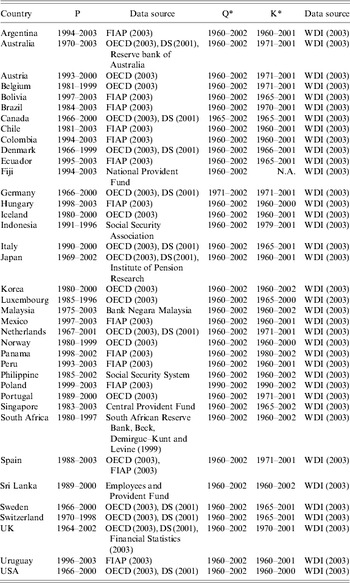
Pension fund asset data were collected from a variety of sources as set out in the Appendix. Regarding the data observation period, in general for capital per head and output per head we have data for years between 1960 and 2002. But pension data are typically shorter; for OECD countries, e.g. the UK and the US, we have data ranging from 1960s to 2002, while for many EMEs, e.g. Brazil, the data available are relatively limited.
Before proceeding to formal panel regression analysis, the first step is to examine our data's stationarity. There are a number of ways to test panel data's stationarity (Maddala and Wu, Reference Maddala and Wu1999; Baltagi, Reference Baltagi2001). In this study, in order to check our results' robustness, we use three different but commonly quoted tests, i.e. one designed by Levin, Lin, and Chu (Reference Levin, Lin and Chu2002) (hereafter LLC), one by Im, Pesaran, and Shin (Reference Im, Pesaran and Shin2003) (hereafter IPS), and the last one by Hadri (Reference Hadri2000). Consider the following model

where y is our variable of interest; X is a vector of exogenous variables, including fixed effects and/or a time trend, or simply a constant, based on the modelers' assumptions. εi,t are i.i.d.  . As customary, t proxies time, while i proxies country. The principal difference between LLC and IPS is the assumption made on ρi. LLC proposes that ρi=ρ, implying the coefficient of the lagged dependent variable in Equation (6) is the same across countries, while, under IPS, ρi is allowed to vary across countries. Given that in our sample, both OECD countries and EMEs are included, we put more emphasis on the latter test, i.e. Im, Pesaran and Shin (2003), in that there might be heterogeneity across countries. Both LLC and IPS tests are extended versions of time series' Augmented Dickey–Fuller test (ADF) into the context of panel data. The formulation is as follows

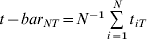
LLC tests the null hypothesis of β=0, while IPS is testing that of βi=0 for all i. In addition, for the IPS test, t-bar statistics is used, which are formed as a simple average of the individual t statistics for testing βi=0 in Equation (7), namely
Both LLC and IPS are commonly used in the current empirical literature for panel data. It has been argued, however, that they both suffer from the lack of power (Hadri, Reference Hadri2000). In other words, the null hypothesis of a unit root tends to be accepted or not rejected unless there is strong evidence to the alternative, one form of type II error (Davidson and MacKinnon, Reference Davidson and J.1993; Greene, Reference Greene2003). Therefore, it is suggested to test a null of stationarity as well as a null of a unit root. One well-known test for the null of no unit root is that proposed by Hadri (Reference Hadri2000). Hadri testing is a residual-based Lagrange multiplier (LM) test. Consider the model

where  , a random walk. The LM statistic is formulated as follows
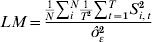
where

 is the estimated residual from Equation (9), S i,t is the partial sum of residuals, while
 is the estimate of the error variance. Hadri's residual-based LM test for the null of stationarity is promising in that it increases the power of testing for the null of a unit root. One problem associated with Hadri (Reference Hadri2000), however, is that, like LLC (Reference Levin, Lin and Chu2003), it assumes the homogeneity of coefficients of ρi=ρ in Equation (6). As we mentioned earlier, in our study, we use a dataset covering both OECD countries and EMEs; therefore, an assumption that ρ varies across sections might be more appropriate.
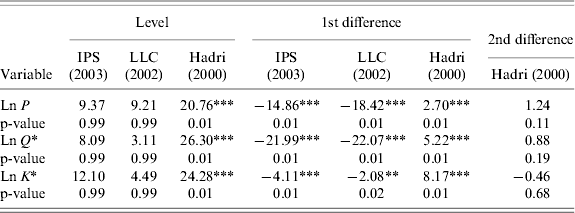
Table 3 presents the results of the panel unit root tests. For the log of the pension assets to GDP ratio (Ln P) our results, under all three testing approaches, are in favour of non-stationarity in levels, and stationarity in first differences, implying that Ln P is an I(1) variable. Regarding the log-levels of output per head (Ln Q*) and capital per head (Ln K*), under IPS and LLC, the null hypothesis of non-stationarity could not be rejected for this panel of 38 countries. But after first differencing, the null hypothesis of non-stationarity is rejected and the alternative hypothesis of stationarity be accepted. This is consistent with our assumption that Ln Q* and Ln K* are also I(1) series. By employing the Hadri (Reference Hadri2000) test, however, we could reject the hypothesis of no unit root under both levels and first differences. After second differencing, Ln Q* and Ln K* become stationary, as the null of stationarity could not be rejected. This is intriguing and implies that Ln Q* and Ln K* are I(2) variables if only based on Hadri. But, it is worth noting again that Hadri (Reference Hadri2000) assumes a common unit root process, which, as we have motioned earlier, is less relevant in this study. Therefore, together with other two testing procedures, we believe Ln P, Ln Q*, and Ln K* are all non-stationary and I(1) variables.
Panel unit root test (38 countries, 20EMEs+18OECD)
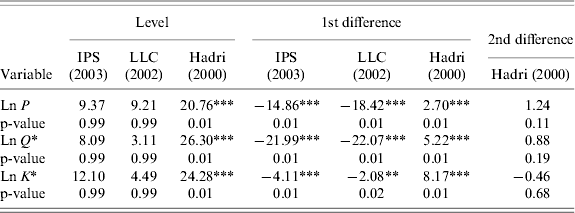
Notes: Ln P: log of pension fund assets/GDP. Ln Q*: log of output per head. Ln K*: capital stock per head. Panel unit root tests are based on Im, Pesaran, and Shin (Reference Im, Pesaran and Shin2003), Levin, Lin, and Chu (Reference Levin, Lin and Chu2002) and Hadri (Reference Hadri2000). The null hypothesis of IPS and LLC is non-stationarity, while that of Hadri is stationarity. *** significant at 1%. ** significant at 5%.
4. Dynamic OLS estimation
If variables are non-stationary, particularly in the case of time series data, but the common residual terms are stationary, i.e. I(0), then we say these variables are co-integrated and economic theory as set out in Section 2 suggests forces which tend to keep such series together, and do not let them drift too far apart (Banerjee et al., Reference Banerjee, Dolado, Galbraith and Hendry1993). In addition, if variables are co-integrated, our estimates are super-consistent. In other words, our estimates are not only consistent, but also converge to their true values more quickly than normal (Davidson and MacKinnon, Reference Davidson and J.1993).
In this section, we seek to identify the cointegrating relation between pension assets and output in the context of our theoretical model on a panel basis by using the dynamic OLS (DOLS) cointegrating panel estimator. In panel data, Kao (Reference Kao1999) finds that the ordinary least squares (OLS) estimator is biased, in that the t-statistics diverge, so the inference is not reliable. The fully modified OLS (FMOLS) estimator is argued to be able to correct such bias in certain cases. The FMOLS was first proposed by Philips and Hansen (Reference Philips and Hansen1990), and extended to the context of heterogeneous panels by Pedroni (Reference Pedroni1997), and then developed further in Philips and Moon (Reference Philips and Moon1999). Based on the simulation results from the Monte Carlo experiments, Kao and Chiang (Reference Kao and Chiang2000), however, prove that under both contexts of homogeneous and heterogeneous panels, dynamic OLS (DOLS) is superior to fully modified OLS (FMOLS) and other OLS estimators. The advantages of DOLS over FMOLS are no requirement for initial conditions and non-parametric correction.Footnote 7 The DOLS model, used in our paper and following Stock and Watson (Reference Stock and Watson1993) is as follows

where i and t are country and time indices respectively, as is conventional. Y i,t is the dependent variable, i.e. log output per head (Ln Q*). X i,t is a vector of explanatory variables, i.e. log pension fund assets/GDP, and log capital per head (Ln K*). ΔX i,t is the first difference of X i,t, thereby introducing dynamic structure into the equation. The coefficients of X i,t give the accumulative/total effects. In addition, the length of leads and lags for ΔX i,t has to be defined. The inclusion of these nuisance parameters in Equation (11) means we can obtain coefficient estimates with satisfactory limiting distribution properties (Kao and Chiang, Reference Kao and Chiang2000; Kao et al., Reference Kao, Chiang and Chen1999). As mentioned by Kao and Chiang, however, it is difficult to choose the optimal length of leads and lags, which is a major drawback of the DOLS estimator. But, the practice is to use one and/or two leads and lags.
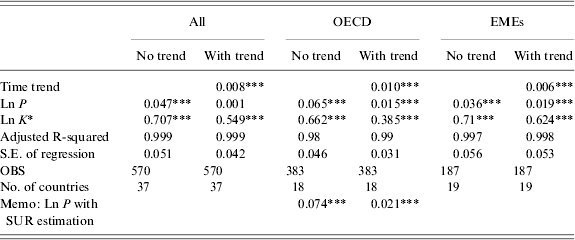
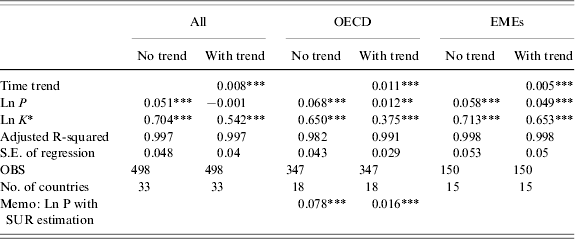
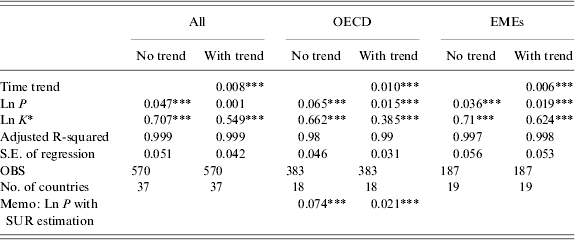
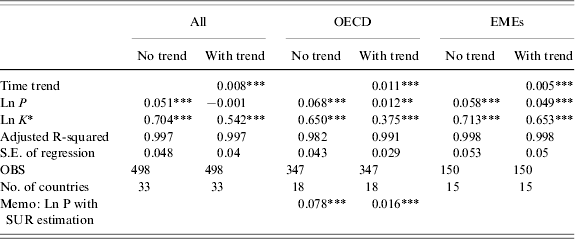
Results are given in Tables 4a and Table 4b, where our main focus is on the sign, size, and significance of the variable Ln P, the log of the pension fund assets/GDP ratio, which indicates the shift in the production function. As noted above, it is arbitrary to choose the length of leads and lags in the DOLS model, but the practice is to use one or two leads/lags (Mark and Sul, Reference Mark and Sul2002; Kao et al., Reference Kao, Chiang and Chen1999). In this paper, in order to check the robustness of DOLS model as in Pelgrin et al. (Reference Pelgrin, Schich and de Serres2002), we used both one lead/lag and two leads/lags. We split our dataset according to two dimensions, i.e. OECD/EMEs, and with trend/no trend. Use of a trend is consistent with McCoskey and Kao (Reference Kao1999) where they use a time trend to identify the potential beneficial effect of technological advances on growth over time, as well as structural reform not related to pensions. In addition, as we have noted earlier, the variable capital per head (Ln K*) is not stationary even after first differencing based on Hadri test, which might be due to the presence of a deterministic trend. Therefore, the specification with a trend utilized here might be able to deal with this issue. In order to allow for our data to have a deterministic trend as well as to allow for the potential effect of technological advances, we specified a model with a trend as well as without both in this section and for the Mean-Group and Johansen results reported below.
Estimates from dynamic OLS (DOLS) estimations (1 lead and 1 lag). Dependent variable – Ln Q* (37 countries)
Estimated by panel fixed effects GLS with cross section weights.
Notes: Ln P: log of pension fund assets/GDP. Ln Q*: log of output per head. Ln K*: capital stock per head. ***, significant at 1%; **, significant at 5%; *, significant at 10%. OBS, number of observations.
Estimates from dynamic OLS (DOLS) estimations (2 leads and 2 lags). Dependent variable – Ln Q* (33 countries)
Estimated by panel fixed effects GLS with cross section weights.
Notes: Ln P: log of pension fund assets/GDP. Ln Q*: log of output per head. Ln K*: capital stock per head. ***, significant at 1%; **, significant at 5%; *, significant at 10%. OBS, number of observations.
As regards the coefficient of Ln P, in Table 4a where we used one lead/lag of the dynamic terms, five out of six estimates are significant and positive as expected, covering all three country groups. In Table 4b where we used two leads/lags, results are similar. In each case, for the All-countries estimation, the estimate without the trend is positive and statistically significant, while the estimate with the trend is insignificant, suggesting heterogeneity, which is manifest when the time trend is included. All the EME and OECD estimates are positive and significant. Meanwhile, the time trend term tends to be positive and significant under all cases. It implies that technological advances and structural reforms over time improve the relation of capital and labour to output. Its inclusion means the pension variable is not proxying an omitted trend. The estimates for Ln K* are very satisfactory, in that all are statistically significant at 1%, and positive at the range of 0.3–0.8. Finally, the adjusted R-square ratios are quite high in all cases. Note that differences in the size of the coefficients between the one and two lead/lag specification may relate largely to the difference in country composition, where the former uses data from 37 countries, the latter from 33.
As regards the size of the Ln P coefficients, they are in each case smaller when the time trend is included, implying that there are technical and structural changes that the trend is capturing, which is otherwise incorporated in the pension assets variable. But as noted, for OECD and EME groups and for each lag specification, the coefficients are significant and positive with the trend as well as without it. This parameter measures the total or cumulative effect of pension assets/GDP on output per capita. Therefore, it implies that a 1% increase in Ln P raises Ln Q* (i.e. economic growth) by a minimum 0.012% under the case of OECD with trend, and a maximum 0.068% under the OECD no trend as in Table 4b. The OECD pension variable tends to be larger when the trend is omitted but smaller than in EMEs when the trend is included, where the latter results are more plausible. One would expect larger coefficients for EMEs, as is generally the case throughout our results. Such a finding is consistent with economic convergence theory (Sala-I-Martin, 1996) – i.e. poor countries are expected to grow faster than rich countries – as well as with recent empirical results by Beck and Levine (Reference Beck and Levine2004) and Beck et al. (Reference Beck, Levine and Loayza2000), implying financial development is more beneficial to growth in EMEs.
The basic results are estimated by unbalanced-panel GLS with fixed effects and cross-section weights. To check robustness, we sought to re-estimate with the Seemingly-Unrelated Regression (SUR) technique, which allows for correlations in the error terms. This was not feasible for the All or the EME group, because many of the observation series were too short. However, as shown in Tables 4a and 4b, it is apparent that for the OECD group, using SUR does not change the parameter estimates for Ln P markedly, implying that our result of a clear ‘shift effect’ in the production function from pension funding is a robust one.
5. Dynamic heterogeneous models
In view of the possibility that the impact of pension funds on economic growth may vary across countries, and also consistent with the suggestion of McCoskey and Kao (Reference Kao1999), we in this section seek to look further at the long-run relationship by employing dynamic heterogeneous models. Pesaran and Smith (Reference Pesaran and Smith1995) present a number of different estimation procedures for estimating a dynamic panel data model across heterogeneous countries, namely the mean-group estimator, aggregate time-series estimator, pooled mean-group estimator and cross-section estimator. Due to other approaches' limitationsFootnote 8 as well as data availability, we use only the mean-group estimator in this section. The dynamic model we use in this section is specified as follows

Equation (12) is the standard formulation of a dynamic heterogeneous panel model, consistent with Pesaran and Smith's (Reference Pesaran and Smith1995) specification. However, with the consideration of saving degree of freedom, we include only one lag of the dependent variable on the right-hand side of the function rather than adding one lag of all independent variables like the autoregressive distributed lag (ARDL) estimation used by Pesaran and Smith (Reference Pesaran and Smith1995). Pesaran (Reference Pesaran1997) and Pesaran and Smith (1995) argue that the use of the ARDL estimation procedure has advantages over the fully modified (FM) OLS estimator designed by Philips and Hansen (PH) (Reference Philips and Hansen1990) for time series co-integration relations, e.g. in that the tests based on PH method have a clear tendency to over-reject in small samples and also show larger bias.
Based on the mean-group estimation procedure, we ran regressions for each individual country, then averaged across countries using two methods to obtain the average long-run coefficients. According to the first method, the long-run elasticities of Ln Q* with respect to Ln P and Ln K* can be calculated using the formula,  and
 respectively.
 ,
 , and
 are the estimated values of the corresponding parameters in Equation (Reference Clark and Hebb12). Then the average long-run coefficients in terms of Ln P and Ln K* can be computed as
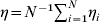 and
 respectively.
The second method, as presented by Pesaran and Smith (Reference Pesaran and Smith1995), maintains that the average long-run coefficients can also be calculated using the means of short-term coefficients, namely

where

The significance levels or t-values of ηi and ξi were calculated by following the formulas,  and
 respectively, where the standard errors were computed as the square root of the variance of
 and
 divided by the number of groups (Smith and Fuertes, Reference Smith and Fuertes2004).
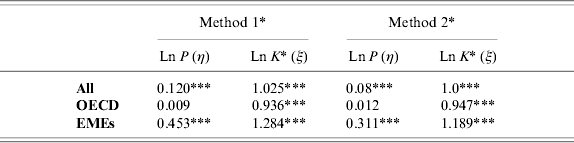
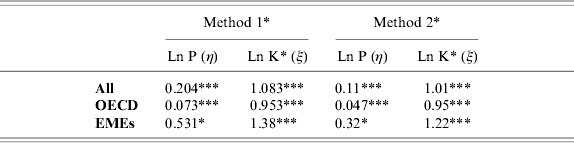
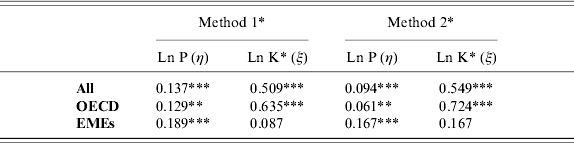
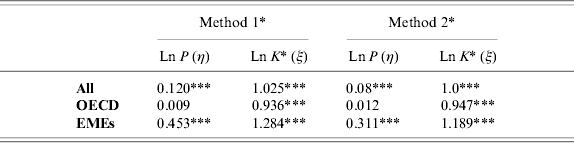
Results,Footnote 9 according to the mean-group estimators using Methods 1 and 2 are summarized in Tables 5a, 5b, and 5c. As in Section 4, we ran three separate regressions by country groupings, i.e. all 16 countries, 11 OECD countries, and five EMEs. Table 5a presents results for the ARDL with time trend, based on all 16 countries, while Table 5b is based on ten countries, excluding Canada, Japan, Malaysia, South Africa, Sweden, and Switzerland. We dropped those countries since most of coefficient estimates (at least three out of four estimates) for those countries are not significant. Therefore, their presence might distort our results from the mean-group estimators. One of the reasons pension assets ratios are insignificant in those countries might be the simple ARDL model we specified. However, in order to keep the specification consistent across countries, and to follow the methodology by Pesaran and Smith (Reference Pesaran and Smith1995), we retain it in this section. Finally, in Table 5c we show results for all 16 countries without a time trend.
Heterogeneous panel estimates of mean long run output per head (Ln Q*) elasticities. (16 countries, 11OECD+5EMEs), with trend
Notes: See Table 3. Method 1 is the average of long run elasticities across countries, while Method 2 derives long runs from means of short run elasticities. Both methods are based on Pesaran and Smith (Reference Pesaran and Smith1995), calculation of t values based on Smith and Fuertes (Reference Smith and Fuertes2004). See Section 5 in text for details.
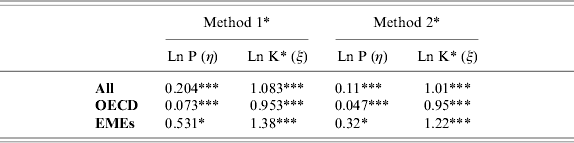
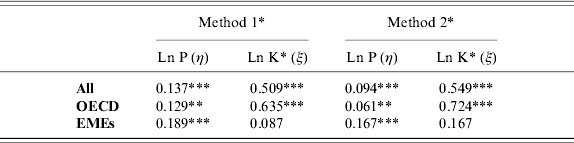
Results in Table 5a are satisfactory and encouraging, as all estimates under the two methods and three groups are positive, indicating a positive average long-run relationship between pension assets/GDP, capital stock per head and output per head (i.e. economic growth). For example, for OECD countries, a 1% increase in the capital stock raises output by 0.936% under method 1 and 0.947% under method 2. These two estimates are quite close to each other. In fact, it is this estimation robustness that leads us to use the simplified model compared with Pesaran and Smith (Reference Pesaran and Smith1995). Concerning the log of pension assets/GDP, we find that All countries and EMEs have highly significant coefficients, with the long-run effect being around three times larger in EMEs than in the All country average. Note, however, that this is strongly affected by the result for Chile, without which the EME result would be similar to that from DOLS set out in Section 4. Whereas the estimates for OECD countries under both methods in Table 5a are not significant, as noted above, some country-by-country results feature largely insignificant coefficients. In order to address this problem, we excluded those countries, and the subsequent results are presented in Table 5b. We still have the expected signs and all the Ln P variables are now significant and positive. The effect is, unsurprisingly, larger for EMEs than OECD countries, and All countries. The third set of results in Table 5c are for the equations without the trend. Here we find that for all 16 countries, there is a significant and positive effect of Ln P, thus supporting the result with trend. The coefficients are larger than with the time trend for OECD countries, but, reflecting the result for Chile, they are smaller for All countries and EMEs. The EME coefficients are again consistently larger than for OECD countries.
6. Country-by-country Johansen cointegration test
As noted in Section 3, pension fund assets/GDP, capital per head and output per head are all I(1) variables, so, besides panel work, we may be interested in whether there exists a long-run cointegrating relationship between them on a country-by-country basis to allow for heterogeneity. In this section we employ the VAR-based Johansen cointegration test (Vector Error Correction Model) using the methodology developed by Johansen (Reference Johansen1991 and Reference Johansen1995). The specification is as follows

where  , y t is a k-vector of I(1) variables, i.e. Ln Q*, Ln K*, and Ln P in this paper. L is the lag operator, and the lag order is selected based on a range of information criteria, i.e. AIC (Akaike information criterion) and SC (Schwarz information criterion). Generally, the suggested lag order is two years, although in some cases it extended to three years. If Equation (13) is written in VAR format, then we have

where  and
 or
 Here α is the speed of adjustment from short-run deviation to long-run equilibrium, and β′ is the cointegrating vector, which thus represents the long-run coefficients. Based on Granger's representation theorem, the Johansen VAR-based cointegration test is to first estimate the Π matrix from an unrestricted VAR and then test whether the restriction suggested by the reduced rank of Π – the number of cointegrating relations – is rejected.
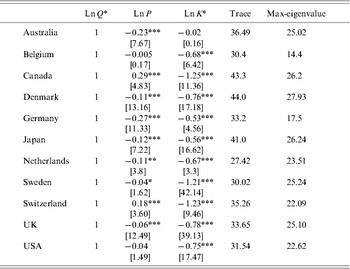
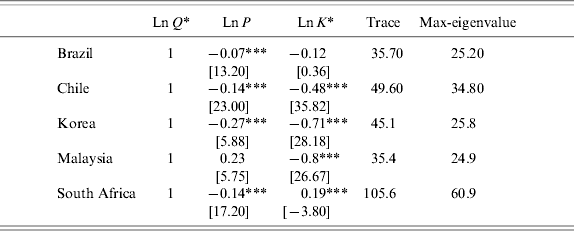
Again, we consider two slightly different specifications, i.e. one without a trend and the other with trend. We group our sample into OECD countries and EMEs. Tables 6a and 6b give results of our first specification, i.e. without a trend. In most cases, the Trace and Maximum-Eigenvalue statistics indicate a co-integrating relationship between our variables, and the null hypothesis of non-cointegration is rejected at either the 5% or 10% level. Note that the signs of coefficients are opposite to those of the impact of the variable on Ln Q* because the equations are normalized in the form 0=Ln Q* – a 1 Ln P – a 2 Ln K*.
Co–integrating coefficients vector without trend; normalised on Ln Q*. OECD countries
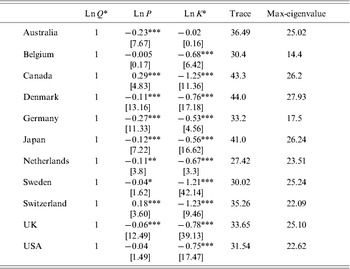
Notes: See Table 3. Co-integration estimation is based on Johansen methodology (1991 and 1995). T values are under estimates of corresponding coefficients. Lag length is selected based on a range of criteria statistics, e.g. AIC (Akaike information criterion) and SC (Schwarz information criterion). T-values are in square brackets. Under both Trace and Max-eigenvalue statistics, all countries indicate a co-integration relationship at 5% or 10% level; the only exceptions are Belgium and Germany under Max-eigenvalue statistics.
As shown in Table 6a, in nine of the 11 OECD countriesFootnote 10 the sign of Ln P is negative, as expected. For almost all of these countries, pension fund growth thus has a statistically significant and positive relationship with output per head, the extent of which varies from 0.04 for Sweden to 0.27 for Germany. The small size of the positive effect in Sweden could also be due to the restrictions in the Swedish ATP scheme in equity investment and to state management of the fund. Regarding Ln K* (capital per head), our estimates are satisfactory, as all coefficients are negative, implying a positive linkage between economic output and the capital stock across OECD countries. In addition, the estimates of coefficients of Ln K* are quite close to each other; for seven out of 11 countries, it is between 0.55–0.80, implying a comparable production function relationship among developed OECD countries. All estimates except in Canada, Sweden, and Switzerland, are less than 1, consistent with our model in Section 2, which suggests that the β-elasticity of aggregate output with respect to capital should not be greater than 1.
Results for EMEs are given in Table 6b. All coefficient estimates for Ln P except for Malaysia are negative, implying a beneficial effect of pensions on growth. For example, for Chile, a 1% increase in pension assets can contribute to economic growth by 0.14%; this complements findings by Schmidt-Hebbel (Reference Schmidt-Hebbel1999), who shows that 0.1–0.4% of the 1.5% increase in total factor productivity (TFP) in Chile in the 1980s and 1990s was attributed to pension reform. As for Ln K*, for four countries the sign is negative, consistent with our findings earlier. In other words, in these countries, growth in the capital/labour ratio accompanies a rise in economy-wide productivity.
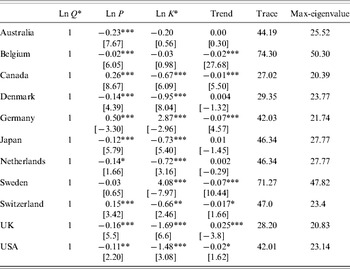
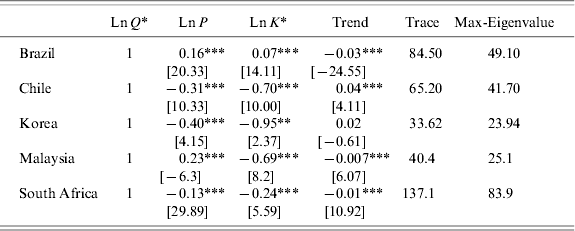
Tables 7a and 7b show the comparable results for the cointegrating vector with trend. Virtually all of the Trace and Maximum Eigenvalue tests show cointegration. The results are broadly comparable: in Table 7a we have eight out of 11 results showing a positive effect of Ln P on output per capita, while for Ln K* it is nine out of 11. In Table 7b we have three out of five with a positive effect of pension fund assets on output per head, and in four out of five cases for Ln K*. Note that even where the cointegrating vector has a ‘wrong’ sign, the dynamics may be such as to generate a long-term positive effect of pension assets on output per head. As regards the trend, among 11 OECD countries, six show a negative coefficient, which implies (given normalization) that technological advances over time enhance economic growth. The same finding is obtained by McCoskey and Kao (Reference Kao1999), where six out of eight OECD countries are identified to have a positive and significant trend. Similar results are found for EMEs (Table 7b) where three out of five countries show significant trends enhancing economic growth.
Co-integrating coefficients vector without trend; normalised on Ln Q*. Emerging market economies (EMEs)
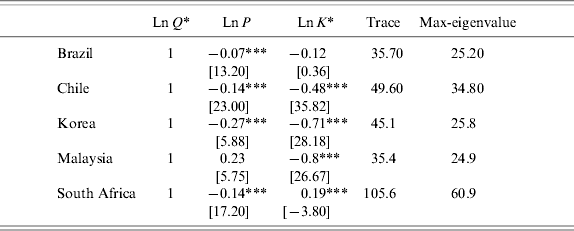
Notes: See Table 3. Under both Trace and Max–Eigenvalue statistics, all countries indicate a co–integration relationship at 5% or 10% level.
Co-integrating coefficients vector with trend; normalized on Ln Q*; OECD countries

Notes: See Table 3. Under both Trace and Max-eigenvalue statistics, all countries indicate a co-integration relationship at 5% or 10% level; the only exception is Germany under Max-eigenvalue statistics.
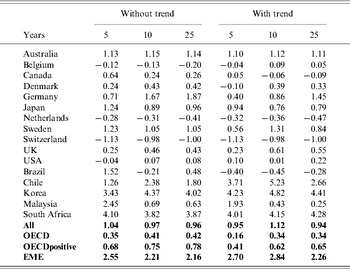
We now move on to impulse response tests derived from the Vector-Error-Correction Model underlying the Johansen results. The underlying rationale behind impulse responses is that a shock to one variable not only directly affects the variable itself, but also is transmitted to all of other endogenous variables through the dynamic structure of the VECM. In our example, it implies that pension fund assets/GDP can directly impact on output per head, but it might also affect capital per head (e.g. by boosting saving), which in turn induces improvement on output. Results are based on the Pesaran and Shin (Reference Pesaran and Shin1998) generalized response approach. Technically, it constructs an orthogonal set of innovations that does not depend on the VAR ordering. The generalized impulse responses from an innovation to the jth variable are derived by applying a variable specific Cholesky factor computed with the jth variable at the top of the Cholesky ordering. It avoids the arbitrariness of the Cholesky ordering.
We specify a 25-year window, given that it is expected that pension fund assets have a relatively long-period effect on both Ln Q* and Ln K*, and hence a shorter period, e.g. ten years might not be long enough to capture the long-run effect of Ln P. The results are summarized in Table 8. It can be seen that the results are virtually all positive over five-, ten-, and 25-year horizons. Among OECD countries, the exceptions are Belgium, the Netherlands, Switzerland, and small open economies, growth in which is more dependent on external factors. Also, pension funds in those countries tend to be defined benefit, which may reduce the beneficial effect on labour markets of pension funding. Only in Switzerland is the negative effect sizeable, however. With the trend we also find a negative effect for Brazil, which again is characterized by defined-benefit funds. Note that in Malaysia, Germany, and Canada, the positive impact arises despite a negative implied effect of pension assets in the cointegrating vector, and the opposite for the Netherlands and Belgium. This illustrates that the dynamics of the VECM can be such as to offset the sign of the long-run effect for protracted periods.
Co-integrating coefficients vector with trend; normalised on Ln Q*; Emerging market economies (EMEs)
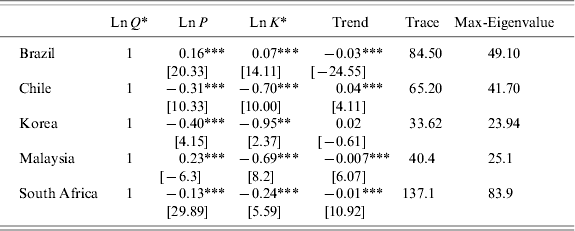
Notes: See Table 3. * Under both Trace and Max-eigenvalue statistics, all countries indicate a co-integration relationship at 5% or 10% level.
Looking at the summary results at the bottom of the table, we see that, consistent with the various parameter estimates in Sections 4, 5, and 6, there is on average a positive effect of pension fund growth on economic growth (as proxied by output per head in this paper), and this is significantly larger in EMEs than in OECD countries, even when the three OECD countries with a negative effect are excluded. As regards time patterns, OECD country impulse responses tend to be smoother than those of EMEs. This may link to economic vulnerability, and greater sensitivity to external factors, such as currency crises and policy shifts.
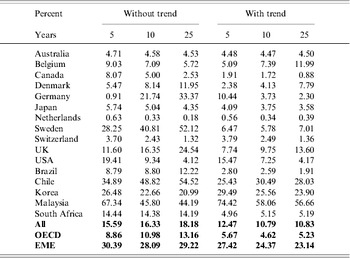
Turning to variance decompositions (Table 9), we see that the variance of pension fund assets explains a considerable proportion of the variance of output per head in many of the countries concerned. There is a considerably higher proportion explained in EMEs than in OECD countries, suggestive of a greater potential contribution pension reform can have on the wider economy in these countries. Furthermore, whereas inclusion of a time trend in the VECM reduces the contribution of pension assets both in OECD countries and EMEs, the reduction is proportionately much larger for the former (from around 10% to 5%) than in the latter (from 30% to 25%).
Summary of impulse responses of log output per head to log pension assets/GDP
Percent response to one standard deviation change.
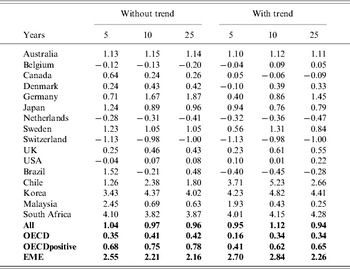
Note: Based on Pesaran and Shin (Reference Pesaran and Shin1998) generalized response approach. See text for details.
Variance decomposition: log pension fund assets/GDP on log output per head

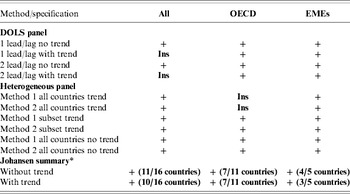
Summary of significant effects of log pension assets/GDP on log output per head

Notes: Ins=insignificant * shows frequency of significant positive effect of Ln P on Ln Q*.
8. Conclusion
Pension funds have been expanding and will continue such a trend in coming decades given the rapidly ageing population and the transition from unfunded systems to funded systems such as the World Bank multi-pillar model. Research on the direct link between pension funds growth and economic growth, however, is quite scarce. In this paper, we sought to fill this gap. By employing a modified Cobb–Douglas production function and a variety of econometric specifications, we found that pension assets/GDP positively and significantly affects output per head, consistently for both the OECD countries and EMEs, while effects are consistently larger for EMEs than for OECD countries. This finding contributes to the existing literature and provided new empirical evidence on the debate regarding linkage between pension growth and economic growth.
The overall policy implication of this research favours pension funding as a response to the challenge of ageing, as it indeed appears to offer an additional benefit to the economy in terms of productive efficiency, even if saving is not boosted at the same time. As noted, emerging market countries benefit more than advanced countries from these benefits. That said, it should be cautioned that not all countries have the necessary administrative and organizational infrastructure to develop successful pension funds (Holzmann and Hinz, Reference Holzmann and Hinz2005) so careful preparation and attention to preconditions is necessary before launching such a pension reform.
Despite the above-mentioned contributions, this paper still has some caveats that justify further research in the future. First, the number of observations is relatively small when the heterogeneous panel and Johansen co-integration tests were conducted, which is particularly relevant for the EMEs regressions. Therefore, more data could be used to improve statistical robustness of those results (it does not apply strongly to the DOLS results). Second, structural effects were not directly addressed in this paper. However, major structural changes (such as financial liberalization) have taken place in some countries (but not in others) which impact on economic growth, or at least have implication for the trajectory of economic development. Hence, future research could be conducted to tackle this issue. We maintain, however, that these points are unlikely to controvert our main results, that pension reform boosts economic growth, given the DOLS results are less affected by data limitations, and the positive effect is consistent in country-by-country estimation. Meanwhile, the paper has not addressed the issue of how long the positive impact of funding on growth may persist, which is also an issue of considerable interest.
Appendix: Variables, data sources and observation period

Notes: P: Pension fund assets/GDP. Q*: Output per head. K*: Capital stock per head. DS: Davis and Steil (Reference Davis and Steil2001).