1. Introduction
Shift, a pattern in which a segmental or prosodic feature moves from one position to another, is common cross-linguistically and has been studied in terms of empirical generalizations, phonetic and morphological grounding, and using rule- and constraint-based approaches (see Alderete Reference Alderete1999; Yip Reference Yip2002; Hyman Reference Hyman, Riggle and Alan2011; Walker Reference Walker2011 for recent overviews). Shifting raises important questions of formal theory: Is shift an independent operation or a combination of other operations? What are the constraints responsible for shift? Are different kinds of shift (tone, segmental, stress) fundamentally different?
This paper looks at shifting in Harmonic Serialism (HS). HS combines the derivational properties of rule-based grammars with the typological insight of Optimality Theory (OT). As such, HS is well-suited to examining shift derivationally and typologically.
Shift in HS can be derived in multiple steps. The two most common situations are: (i) spreading and subsequent delinking from the donor segment, and (ii) delinking of the associated feature and subsequent linking to a different segment (McCarthy Reference McCarthy, Baković, Ito and McCarthy2006; McCarthy, Mullin & Smith Reference McCarthy, Mullin, Smith, Botma and Noske2012b). In this paper, however, we argue that shifting must also be a single Gen operation, which we call Flop (Alderete Reference Alderete1999).
We adopt McCarthy’s (Reference McCarthy2010c) criteria for what constitutes an operation in HS. First, the mapping must be attested in some language. A review of the literature shows that shift is widely attested in the world’s languages. We also analyze tone shift in Kibondei and segmental shift in Halkomelem. Second, the alternative analyses lead to contradictions. We demonstrate that spreading and floating features may capture the forms with shift in the two languages, but make incorrect predictions about the other forms. The spreading analysis in Kibondei, for instance, can achieve shifting in phrases, but not in isolated words. Third, no additional constraint (or modification of a set of constraints, Con) can save the analysis. Based on the challenges of the spreading and floating feature analyses, we consider several additional constraints, but they in turn lead to additional contradictions. We corroborate these arguments by comparing factorial typologies and show that several attested patterns are only predicted if we assume Flop is possible. All our claims are tested computationally using the typology calculator software OT-Help 2.0 (Staubs et al. Reference Staubs, Becker, Potts, Pratt, McCarthy and Pater2010). The simulation files are available as supplementary material to this paper.
2. Shift
Shift has been recognized as one of the cross-linguistically common patterns affecting tone (Goldsmith Reference Goldsmith1976, Reference Goldsmith1990; Yip Reference Yip2002; Kisseberth & Odden Reference Kisseberth, Odden, Nurse and Philippson2003). Rule-based implementations of tone shift typically describe shift as a single rule, which can be represented using autosegmental notation in (1). This rule delinks a feature from one root node (or Tone Bearing Unit, TBU) and links it to another root node.

The rule in (1) presents local, progressive shift. Non-local shift, in which several segments are skipped, and regressive shift are also attested. The template in (1) can be easily adjusted to capture those parameters.
The analyses of individual shifting patterns typically involve a single rule; an example is Goldsmith’s (Reference Goldsmith1990: 17) analysis of High tone shift in Sukuma. However, an apparent shifting pattern can also arise as a result of other rules. One such situation involves association rules that apply to underlyingly unassociated tones. Consider Kikuyu, which has the same number of tones and syllables: the tones appear to shift one syllable to the right, with the initial tone linked to two syllables and the last two tones linked to the final syllable. Clements (Reference Clements, Clements and Goldsmith1984) analyzes this pattern using underlyingly unassociated tones, with the initial shifting rule merely associating the leftmost tone with the second syllable. The remaining tones are linked by association convention rules. We return to Kikuyu in Section 3.3.
The rule in (1) is a complex operation that involves two association lines: one that is removed and another that is added. This raises the question whether shift is formally a combination of two or more simpler and independently needed operations. In (2) two situations come to mind. On the one hand, shift could involve spreading to a nearby root node followed by delinking of the underlying association line (a). This analysis relates shift to assimilation. On the other hand, shift can also happen as a combination of a deleted association line in the first step, followed by reassociation to another root node in the subsequent step (b). This situation requires the feature to be unassociated/floating at an intermediate step. We use different notation hereafter to make individual steps more apparent.

These two ways to obtain shift each consist of two operations that are independently attested and present the basic operations in any autosegmental account (Myers Reference Myers1997). Shift can arise due to other operations, but these often involve additional complexities that muddy the issue at hand. In Kikuyu, mentioned above, the additional complexity is whether a rule that associates a tone to the peninitial syllable is preferred over initial association and a shifting rule along the lines of (1). Another example is Phuthi reduplication in which the tone is removed from the base but retained in the reduplicant, giving the impression that tone shifts from the base to the reduplicant (Donnelly Reference Donnelly2007). Because reduplication works differently depending on the framework used (McCarthy & Prince Reference McCarthy, Prince, Beckman, Walsh and Urbanczyk1995; McCarthy, Kimper & Mullin Reference McCarthy, Kimper and Mullin2012a), it obscures the mechanics of shift.
This paper asks whether shift can always be analyzed as a multiple-step operation. This question, however, is difficult to answer using rule-based accounts. The practice in the rule-based autosegmental literature is to analyze shift using a single rule unless there is independent evidence for the intermediate step. Parallel OT does not refer to intermediate forms so it is unable to even address the question at hand (see Myers Reference Myers1997; Yip Reference Yip2002). The OT literature does use a faithfulness constraint against shift, NoFlop (Alderete Reference Alderete1999), perhaps suggesting that shift is similar to other operations such as linking and delinking. In the serial versions of OT—such as HS—the question of intermediate representations becomes relevant once more. As we will see below, the HS architecture intrinsically disfavours one-step shift over multiple-step shift.
HS is a variant of OT that combines constraint ranking with serial derivations (McCarthy Reference McCarthy2010a, Reference McCarthyb, Reference McCarthy, McCarthy and Pater2016). Gen in HS generates only those candidates that differ from the input by a single operation. The winning candidate is then returned back to Gen as an input for another round of evaluation until the derivation converges on the same output (i.e. Eval prefers the faithful candidate).
HS has advantages both over classic rule-based accounts and parallel OT. Unlike rule-based accounts, HS makes explicit typological predictions, and compared to parallel OT, HS can capture phonological generalizations that apply over intermediate forms between input and output. Consider how HS can capture the onset–coda asymmetry. Cross-linguistically, medial consonant clusters simplify by deleting the first consonant /VpkV/
 $ \to $
[VkV], never by deleting the second *[VpV] (Wilson Reference Wilson2000; Steriade Reference Steriade, Hume and Johnson2001, Reference Steriade, Hanson and Inkelas2008). McCarthy (Reference McCarthy2007, Reference McCarthy2008a) proposes a solution to this problem within HS, by postulating that deletion of the consonant is a two-step process, which is harmonically improving only in codas, never in onsets. HS can crucially capture patterns that require reference to an intermediate step. In Makushi Carib, footing is followed by unstressed vowel deletion, resulting in monosyllabic feet. As McCarthy (Reference McCarthy2008b, Reference McCarthy, McCarthy and Pater2016) shows, the pattern cannot be generated in parallel OT because there is no way to determine which vowels need to be deleted without first building feet. HS also predicts opaque interactions involving allomorph selection, while parallel OT cannot model opacity without introducing additional mechanisms (Hall, Jurgec & Kawahara Reference Hall, Jurgec and Kawahara2018). Finally, HS makes better predictions than parallel OT when it comes to variation. In parallel OT, variation is always assessed globally (that is, where all loci of violation within a form covary), whereas HS also predicts local variation (where each locus may vary independently). Both types of variation are attested (Kimper Reference Kimper2011b).
What exactly constitutes a single operation in HS has been one of the central issues of the research agenda, and shift has been the subject of previous research within the HS framework. McCarthy (Reference McCarthy, Baković, Ito and McCarthy2006) proposes that shift is a two-step process, mirroring the autosegmental analysis in (2): spreading and delinking (or delinking and linking). His argument for this two-step analysis is threefold. First, two-step shift is more parsimonious as no shift-specific operation is required. Second, a two-step analysis appears to be sufficient to analyze segmental (and tone) shift in most languages. Third, shift is similar to spreading when comparing related languages (e.g. while one language has spreading, the other exhibits shift) and in terms of locality. This reasoning is adopted in subsequent analyses of shift in HS, including McCarthy, Mullin & Smith (Reference McCarthy, Mullin, Smith, Botma and Noske2012b) and Breteler (Reference Breteler2017a, Reference Bretelerb).
McCarthy, Mullin & Smith (Reference McCarthy, Mullin, Smith, Botma and Noske2012b) acknowledge that shift could be a single operation, but ultimately reject that option as unnecessary. In this paper, we demonstrate that such a single step operation must be available. Our approach is parallel to other lines of research in HS. For instance, the evidence suggests that consonant deletion is a two-step process (McCarthy Reference McCarthy2007, Reference McCarthy2008a): removal of all place features, followed by deletion of the root node. It is easy to imagine other options that would be equally representationally grounded, such as removal of each feature (or feature node) at a separate step, or deletion of a segment and its feature content in one step, but this has not been explored in detail. Another example of this kind of research concerns footing, for which adding a foot, including its head, is a single step (Pruitt Reference Pruitt2010, Reference Pruitt2012).
We argue that the specific claims about shift in HS warrant a closer examination. In what follows, we argue that shift can be a single operation, as in (3). We term this HS operation Flop to distinguish it from shift, which is a pattern that can be derived by any number of operations.

In more formal terms, Flop is an operation in which a feature F is linked to one root node in the input, but solely to another root node in the output. To make the scope of this paper manageable, we limit our discussion of Flop in several ways. First, we do not address the possibility of root nodes switching places; this is not considered Flop under our definition. Second, we do not consider cases in which a feature is linked to more than one root node in the input. Third, we consider only cases in which the root nodes or tone bearing units (TBUs) are tier-adjacent. A vowel feature may flop from a vowel to a vowel in the preceding or following syllable, whereas a tone feature may flop to an adjacent TBU. The last two limitations allow us to focus exclusively on local shift. Locality is one of the key issues in both parallel OT and HS. This can be seen in the literature on locality of spreading (e.g. Gafos [1996] Reference Gafos1999; Bessell Reference Bessell1998; Ní Chiosáin & Padgett Reference Ní Chiosáin, Padgett and Lombardi2001; Nevins Reference Nevins2010; Kimper Reference Kimper2011a; Walker Reference Walker2014). Within HS, it has been proposed that spreading must be strictly local (McCarthy Reference McCarthy, Baković, Ito and McCarthy2006, Reference McCarthy, Goldsmith, Hume and Wetzels2011), although this is not always accepted (Kimper Reference Kimper2012). When non-local spreading is permitted, it is challenging to define the constraints that are penalized by non-adjacent segments or features. Alignment constraints are one such example (see Hyde Reference Hyde2012a; Jurgec Reference Jurgec2011 for further discussion). These complex issues will need to be studied in subsequent work. We thus present a narrow definition of Flop in order to illustrate its necessity, but subsequent research might reveal that it needs to be expanded.
Shift poses a look-ahead problem for serial grammars (Adler & Zymet Reference Adler and Zymet2021) and we argue that Gen must be broadened to include Flop as a one-step operation that properly captures the phenomena. We follow McCarthy (Reference McCarthy2010c) regarding the criteria for including operations in Gen. In the case where a particular mapping A
 $ \to $
C is attested, it is essential that the mapping A
 $ \to $
B
 $ \to $
C is not possible. This could be, for instance, because B is not harmonically improving, but there are other possible situations. Adapting McCarthy’s (Reference McCarthy2010c) criteria, three conditions need to be satisfied in order for Flop to be a Gen operation, as shown in (4).

We argue that the three conditions are indeed met. First, shift is robustly attested across languages, including a varied sample of segmental shift patterns (Appendix B). Second, we demonstrate that in two selected languages, the alternative analyses are either impossible (not harmonically improving) or make incorrect predictions about other forms in the languages. In Kibondei (Section 3), tone shift is driven by alignment and limited by high-ranked NonFinality, which spreading cannot satisfy. The alternative based on floating tones also makes incorrect predictions about stems with underlying tones. In Halkomelem (Section 4), vowel lowering in the stressed position is driven by a constraint against unstressed low vowels. The spreading analysis crucially relies on an additional constraint that refers to the stressed position, but this leads to contradictions. Floating features followed by delinking, alternatively, are harmonically improving in some words, but predict a surface form with a floating feature retained. Third, we show that considering additional constraints in these languages does not resolve the pathologies. In Kibondei, adding an additional alignment constraint resolves the challenges of the spreading analysis in some words, but leads to further contradictions in others. In Halkomelem, adding a constraint on stressed non-low vowels incorrectly predicts spreading in words where reduction fails to apply.
We consider all commonly used types of constraints for tonal and segmental patterns that we analyze. We extend our argumentation that is based on two languages to an investigation of factorial typologies (Section 5). We find that the grammars with Flop make better typological predictions than grammars without Flop. In particular, Flop predicts additional attested patterns, including languages with shift from the final syllable. We thus conclude that Flop is a possible Gen operation, thus adding to the set of operations that refer to association lines (linking, delinking).
3. Tone shift in Kibondei
Tone shift is a common cross-linguistic phenomenon that has been analyzed using many different approaches (Goldsmith Reference Goldsmith1976, Reference Goldsmith1990; Clements & Ford Reference Clements and Ford1979; Clements Reference Clements, Clements and Goldsmith1984; Downing Reference Downing1990; Cassimjee & Kisseberth Reference Cassimjee and Kisseberth1992, Reference Cassimjee, Kisseberth, Hyman and Kisseberth1998; Roberts Reference Roberts1992; Myers Reference Myers1997, Reference Myers1999; Yip Reference Yip2002 among many others). In this section we examine tone shift in Kibondei, in which tone shifts to the penultimate syllable, except when blocked by an underlying final High tone. In phrases, the word-final tone shifts to the following word-initial syllable. We adopt an autosegmental approach in HS. We show that the analysis with Flop is possible (Section 3.1), while the alternative analyses fail. In particular, shift is driven by NonFinality and alignment, which Flop can satisfy better than other options. Without Flop, a spreading analysis fails because no path leads from spreading to shift in words with just one tone (Section 3.2), whereas a floating analysis incorrectly predicts deletion of the final tone (Section 3.3). This leads us to conclude that Flop is essential to capture Kibondei tone shift.
3.1 Analysis with Flop
In Kibondei, tone shift is dependent on the position of underlying tones within words and phrases. High tone from a prefix shifts to the penultimate syllable of a toneless verb (5-a), but the prefix High tone surfaces faithfully when the verb stem has an underlying tone (5-b).Footnote 2

Toneless stems surface with the pattern in (5-a) regardless of the context. Verbs with an underlying tone, however, have a different distribution of tone depending on the following word. When the verb is phrase-final, the final tone is phonetically deleted, but there is phonological evidence that the tone is still present (Lee & Lee Reference Lee and Lee2002). When the following word is toneless, however, the rightmost High tone shifts to that following word, as in (6).

In our analysis of Kibondei tone shift, we closely follow the parallel OT analysis of Lee & Lee (Reference Lee and Lee2002). Tone shift in Kibondei is motivated by two constraints, the first of which is NonFinality as in (7) (Prince & Smolensky [1993] Reference Prince and Smolensky2004; Myers Reference Myers1999; Hyde Reference Hyde2007; Selkirk Reference Selkirk, Goldsmith, Riggle and Alan2011).

In verbal stems without tone, a prefix High tone shifts rightwards to the penult. Directional asymmetries of this sort can be captured by alignment constraints (McCarthy & Prince Reference McCarthy, Prince, Booij and van Marle1993; McCarthy Reference McCarthy1997, Reference McCarthy2003; Archangeli & Pulleyblank Reference Archangeli and Pulleyblank2002; Martínez-Paricio & Kager Reference Martínez-Paricio and Kager2015). As we will see, the Kibondei pattern requires more formal explicitness than the classic alignment template allows. This is because precedence relations are complex when it comes to autosegmental representations spanning domain boundaries (Hyde Reference Hyde2012b). Here we adopt the definition first proposed by Hyde (Reference Hyde2012a). The constraint Align-R is defined in (8). We furthermore simplify the definition such that it refers to precedence by referencing syllables and preceding words; for a full formal implementation see Jurgec (Reference Jurgec2011). In this definition and as established in Autosegmental Phonology, a syllable that is associated with a High tone is synchronous with it. Note that while the definition in (8) departs from classic alignment, the predictions of the two types of constraints are identical in the vast majority of candidates we consider; when the predictions are different, our alignment favours losing candidates when compared to classic alignment. We elaborate below how our Align-R is evaluated when it comes to the crucial candidates with two words.

Shift violates several low-ranked constraints, including Ident, but what is not attested in Kibondei is High tone deletion. This can be attributed to top-ranked Max(H) (McCarthy & Prince Reference McCarthy, Prince, Beckman, Walsh and Urbanczyk1995; Zec Reference Zec1999) in (9). High tone is never deleted in Kibondei, so Max(H) is ranked at the top of the hierarchy (Lee & Lee Reference Lee and Lee2002).

Kibondei also does not allow adjacent High tones, which would violate the Obligatory Contour Principle (Leben Reference Leben1973; McCarthy Reference McCarthy1986; Odden Reference Odden1988; Yip Reference Yip1988), formalized as the constraint OCP (Myers Reference Myers1997; Itô & Mester Reference Itô and Mester1998; Fukazawa Reference Fukazawa1999) shown in (10).

The first part of our argument is to show that the analysis with Flop is possible. We start by looking at stems with an underlying tone (11). These forms surface faithfully. The fully faithful candidate (a) violates NonFin, but the competing candidates with tone deletion (b) and regressive tone shift (c) are ruled out by top-ranked constraints Max(H) and OCP, respectively. The derivation converges at the first step. The ranking NonFin
 $ \gg $
Align-R will be shown in (15).

Next we consider toneless verb stems, which show shift from the prefix to the penultimate syllable. Flop allows the tone to shift in a single step. To capture this preference over spreading, we make use of the constraint NoLongTone (adapted from Myers Reference Myers1997: 876; Yip Reference Yip2002: 83; Kula & Bickmore Reference Kula and Bickmore2015: 165), as defined in (12).

At step 1, the prefix High tone shifts to the first syllable of the toneless stem (13-a). Spreading (b) violates NoLongT, the ranking of which cannot be determined given the data. The faithful candidate (c) violates Align-R once more than the winning candidate; tone deletion (d) is dispreferred by Max(H). At step 2, the derivation converges. High-ranked NonFin assures that shifting to the final syllable will not be harmonically improving at any step of the derivation.

The final piece of the analysis with Flop is the phrases. Phrases combine some of the properties of isolated words: in words with two underlying High tones, the second one shifts to the following word, but the first tone stays in place. The current ranking has no way of preventing the first tone from shifting to the penultimate syllable, along the lines of (13), which presents a challenge for the analysis. To capture this difference between isolated words and phrases, we employ the constraint Base-Identity (14), which favours that tonal associations of bases and derived phrases be identical. The constraint was first proposed by Kenstowicz (Reference Kenstowicz, Durand and Laks1996) and is essentially an output-to-output correspondence constraint (Benua Reference Benua1997). This constraint is adapted from Lee & Lee (Reference Lee and Lee2002) who evaluate the base as the word in isolation by using the formulation of Morén ([1999] Reference Morén2001) and Blaho (Reference Blaho2008).

The constraint in (14) is a MaxLink-OO constraint specific to High tone (for further discussion of MaxLink constraints see Itô, Mester & Padgett Reference Itô, Mester and Padgett1995; Myers Reference Myers1997; Lombardi Reference Lombardi1998; Morén [1999] Reference Morén2001; Archangeli & Pulleyblank Reference Archangeli and Pulleyblank2002 among many others). This constraint is penalized for each High tone of the base that does not have a correspondent High tone on the same TBU in the derived form. Shifting or deleting the base High tone incurs a violation mark of Base-Ident. The effect of this constraint can be seen when a stem with an underlying tone is followed by a toneless word (15). At step 1, tone shifts one syllable to the right, as in candidate (a). This is the only way to satisfy high-ranked Max(H), NonFin and OCP, even though this incurs an additional violation of Align-R because the shifted High tone is now one syllable away from the right edge of the second word. The spreading High tone in candidate (b) satisfies Align-R because it is associated with the rightmost syllable of the first prosodic word; the fact that it is also associated with the initial syllable of the second word does not create an additional violation per the definition in (8).Footnote 3 The spreading candidate (b) crucially violates top-ranked NonFin. The spreading candidate is further harmonically bounded by the faithful candidate (c) given our constraint set; this fact will play a key role in our argument against the alternative analysis based on spreading in Section 3.2.

At step 2 in (16), the derivation converges. Base-Ident is crucial here and makes sure that the initial tone does not shift, as in candidate (b). This differs from the situation in isolated words where a tone shifts when there is no other tone within the same word.

We have now shown that an analysis of Kibondei with Flop is possible. Next we move to the alternative analyses without Flop (spreading and floating features).
3.2 Analysis with spreading fails
In this section we demonstrate that a spreading alternative in a grammar without Flop is not possible. This boils down to the fact that spreading does not improve on neither Align-R nor NonFin. To illustrate, consider stems with underlying High tone when followed by a toneless word (17). Because flopping candidates are ruled out, the set of candidates is smaller. The crucial comparison is between the spreading candidate (a), which is the intended winner, and the fully faithful candidate (b). Both candidates fare equally on NonFin and Align-R. However, the spreading candidate (a) fatally violates NoLongT, even though this constraint is ranked the lowest.Footnote 4

The main challenge of the spreading analysis is that no constraint used so far prefers spreading over other available options, in particular over the faithful candidate (17-b). Perhaps a more useful alternative would be to re-characterize the motivation behind spreading. Spreading to the following word should intuitively improve on some alignment constraint. As pointed out by Jurgec (Reference Jurgec2011), our definition of alignment has some characteristics of licensing: spreading across word boundaries effectively satisfies alignment to either direction. We already considered Align-R above, but adding the mirror constraint Align-L provides the motivation for spreading (18). Align-L is violated by the faithful candidate (b), but not by the spreading candidate (a), because both High tones are leftmost in a prosodic word. Finally, Align-L must outrank NoLongT, otherwise the faithful candidate (b) would incorrectly win. At step 2, the tone delinks under the pressure of NonFin, and derivation converges at step 3 in a manner similar to the Flop analysis (16).

The grammar without Flop seems to be able to capture the Kibondei pattern with two tones. The problem is that the same grammar leads to paradoxes involving toneless verbs in isolation. This is shown in (19). At step 1, spreading (a) is correctly predicted over no change (b) and delinking (c).

The problem arises at step 2, where the derivation incorrectly converges on the spreading candidate (20). This is because the spreading candidate satisfies Align-L, which is violated by the intended shifted candidate. The derivation is stuck at spreading, and delinking is blocked by the ranking. We have seen above in that Align-L must be ranked above NoLongT, but here the opposite ranking is required. We can conclude that the spreading grammar without Flop results in a ranking paradox.

We have shown that in Kibondei spreading does not harmonically improve in the ranking which should ultimately result in shift. This is true even if we consider additional constraints, such as Align-L, in which case delinking (after spreading) is not harmonically improving. The problem stems from the fact that spreading does not satisfy constraints driving shift, such as NonFin and Align-R. In order for the analysis to work, it would have to look ahead to the next step in which the association line is delinked. Because HS has no lookahead, this analysis is unavailable. Flop as an operation can bypass this challenge and result in satisfaction of both constraints in one step.
3.3 Analysis with floating tones fails
Another way to achieve tone shift is via floating tones: the tone first delinks and the links to another TBU (2-b). We will see that while floating tones can capture the main pattern, they eventually lead to contradictions, similar to the spreading analysis. In particular, the problem lies in the inability of the floating tone analysis to distinguish isolated words and phrases. In the phrasal context, delinking is motivated by NonFin, and relinking to the following initial syllable happens because of a lower ranked constraint against floating tones. This ranking, however, incorrectly predicts delinking of word-final High tones in isolated words.
In the floating tone analysis, one constraint will play a crucial role in reassociation of the feature: *Float. This constraint can be tracked back to Goldsmith’s (Reference Goldsmith1976) Well-Formedness Condition and is standardly used in autosegmental accounts of tone patterns in OT (e.g. Myers Reference Myers1997; Yip Reference Yip2002; McCarthy, Mullin & Smith Reference McCarthy, Mullin, Smith, Botma and Noske2012b). Floating tones violate the constraint in (21).

We begin by showing in (22) that floating tones can capture the Kibondei phrases with two underlying tones. At step 1, the tone on the final syllable of the first word is delinked, which creates a violation of *Float. This constraint is outranked by OCP and NonFin, which rule out most of the other candidates. Notice that candidate (22-e) with tone deletion satisfies *Float but violates top-ranked Max(H). At step 2 (omitted), the floating High tone reassociates to the first syllable of the second word, thus satisfying *Float, at the expense of the additional violation of Base-Ident and Align-R. At step 3, the derivation converges.

The floating tone alternative thus appears to work for the Kibondei pattern with two tones. The analysis relies on the fact that *Float has to be ranked below NonFin. The problem is that this ranking also favours the same results in isolated words. At step 1, the final High tone delinks, exactly as we saw in (22). This is an incorrect prediction, as the output should be faithful, as in (22-c). At step 2, however, the derivation unexpectedly converges on an unattested candidate (23-b). Note that this paradox does not arise in the Flop analysis (11) because *Float is ranked above NonFin in that grammar, which makes sure that the High tone never floats.

We conclude that this analysis incorrectly predicts a surface floating tone in stems with an underlying tone. This concludes our analysis of Kibondei tone shift. We have argued that Flop is a necessary Gen operation because it is the only way to capture the full extent of the data. We considered two alternatives without Flop—spreading and floating tones—which both fail.
Before we continue to the analysis of segmental shift, let us address an assumption that is crucial for our argument. We followed previous literature on Kibondei in positing High tones that are underlyingly associated with specific TBUs rather than floating. This is not a trivial assumption and goes against some of the previous HS literature. The most explicit claim of this type is found in McCarthy et al. (Reference McCarthy, Mullin, Smith, Botma and Noske2012b) and is related to Kikuyu tone patterns mentioned earlier in Section 2 of this paper. Recall that the main Kikuyu pattern involves an initial tone linked to two syllables, while the remaining tones distribute from left to right, resulting in a contour tone at the right edge. McCarthy, Mullin & Smith (Reference McCarthy, Mullin, Smith, Botma and Noske2012b) follow Clements (Reference Clements, Clements and Goldsmith1984) in analyzing the pattern with underlying floating tones that are associated in a step-wise left-to-right manner in HS. So why does this data involve shift at all? McCarthy, Mullin & Smith (Reference McCarthy, Mullin, Smith, Botma and Noske2012b) argue that the Richness of the Base requires that underlyingly linked tones map to valid Kikuyu forms. Thus, the initial tone spreads to the following syllable, while the remaining tones shift one syllable to the right. The crux of their argument relies on the contour tone which arises in the middle of the derivation. Since no constraint prefers incremental movement of the contour tone towards the end of word (regardless of whether we permit Flop), they conclude that tones can never be underlyingly linked in HS.
To the best of our knowledge, this analysis of Kikuyu presents the strongest piece of evidence against underlyingly associated tones in HS. The argument relies exclusively on the inability of underlyingly associated tones to generate a shifting pattern even with Flop. In Appendix A we demonstrate that alignment constraints, a well-established family of OT constraints, do in fact correctly predict the shifting pattern for Kikuyu. Thus, McCarthy et al.’s argument no longer holds, which also means that their conclusion that it is necessary to restrict the Richness of the Base in HS to exclude underlying association lines linked to tones has no empirical support.
McCarthy & Pruitt (Reference McCarthy, Pruitt, Broekhuis and Vogel2013) extend the Richness of the Base restriction to prosody in general: they argue that underlying prosodic structures like feet and syllables lead to problematic predictions in HS. Our arguments about underlying association lines and Flop are specific to tone, as it is well-recognized in the literature that tone differs considerably from other prosodic properties, such as stress (Hyman Reference Hyman, Riggle and Alan2011). Empirically, stress never assimilates: that is, in no language does stress spread from one syllable to another. This is also acknowledged in the literature that tries to establish stronger parallels between stress and tone, such as Hagberg (Reference Hagberg2006). Formally, stress is represented differently than tone. HS analyses use foot-based representations, which make favourable predictions when compared to metrical grids (Pruitt Reference Pruitt2010, Reference Pruitt2012; Torres-Tamarit & Jurgec Reference Torres-Tamarit and Jurgec2015). Because feet generally cannot move once they are built, this presents a separate set of issues not involved in feature shift. For these reasons, stress shift needs to be treated differently than tone shift in HS. This conclusion has a long tradition in the pre-OT literature. In an approach based on metrical grids (Liberman Reference Liberman1975; Liberman & Prince Reference Liberman and Prince1977; Prince Reference Prince1983), stress shift is typically considered a single operation rather than a combination of stress doubling and clash resolution—parallel to (2-a)—or destressing and stress assignment—parallel to (2-b). We conclude that stress shift is irrelevant to the present investigation of Flop.
To summarize, attempts to capture the Kibondei pattern in HS without Flop fail. The reasoning follows McCarthy’s (Reference McCarthy2010c) criteria for HS operations. The alternative analyses are impossible either because intermediate steps are not harmonically improving—in line with (4-b-i)—or they lead to contradictions (4-b-ii). Furthermore, introducing additional constraints could not resolve these paradoxes (4-c). The Kibondei data therefore motivates the inclusion of Flop as an operation in Gen. In the following section, we extend the same reasoning to segmental shift, further strengthening the argument for Flop.
4. Segmental shift in Halkomelem
This section examines segmental shift. Compared to tone, shift of segmental features has received relatively little attention in the phonological literature, perhaps overlooked due to its perceived rarity or heterogeneity of features involved. Yet upon a general survey of the literature, we found languages displaying 20 different patterns of segmental shift. These patterns involve a specific segmental feature that is underlying on one segment and surfaces on a different segment. While our survey is in no way complete and systematic, we nevertheless identified typologically varied patterns of segmental shift—including height features, rounding, consonant place, nasality, retroflexion, and laryngeal features—across many unrelated languages. Appendix B provides the list of these processes.
We look at an interaction of lowering and reduction in Halkomelem and demonstrate that it requires Flop as an operation. Halkomelem involves three key generalizations. First, unstressed low vowels reduce but the [low] feature cannot delete and instead docks onto the stressed vowel, resulting in an apparent shift. Reduction can be blocked by an adjacent glottal stop, in which case the stressed vowel does not lower. Finally, unstressed vowels reduce even when the stressed vowel is underlyingly low. Parallel to tone shift in Kibondei, we first show that the flop analysis is possible (Section 4.1) as it can achieve reduction and preservation of the feature [+low] at the same time. Next we show that the alternative with spreading (Section 4.2) and floating features (Section 4.3) cannot account for other forms in the language. Spreading fails because it requires an additional constraint against stressed non-low vowels, but this constraint incorrectly predicts spreading to the stressed syllable when reduction is blocked next to a glottal stop. The floating feature analysis fails because it predicts a surface distinction between forms with and without floating [+low], but only when the stressed vowel is low, for which there does not seem to be any language-internal evidence, nor compelling theoretical argument.
4.1. Analysis with Flop
Halkomelem, a Coast Salish language of south-western British Columbia, displays an interaction of a segmental process affecting stressed syllables and vowel reduction. Our data comes primarily from the Hul’q’umi’num’ dialect spoken on Vancouver Island by about 30-40 first language speakers and several hundred second language speakers and learners. We rely on the data in the literature (Hukari & Peter Reference Hukari and Peter1995; Gerdts & Hinkson Reference Gerdts and Hinkson2003; Suttles Reference Suttles2004) but we corroborated the key forms with native speaker consultants. The process involves an unstressed /a/ that is reduced in to schwa, while the feature [+low] is preserved on the stressed /e/ which surfaces as [a]. The mappings are shown in (24).Footnote 5

We posit that in Halkomelem the mapping /e/
 $ \to $
[a] involves the feature [low].Footnote
6 Halkomelem seemingly involves spreading that targets the stressed vowel, followed by delinking of [+low] as reduction of the triggering vowel. Under our proposal, however, this spreading and delinking can be crucially analyzed as Flop. The constraint driving shift is the reduction constraint *Unstressed/a (Crosswhite Reference Crosswhite2001; de Lacy Reference De Lacy2006), as in (25).

The reduction constraint is motivated by the cross-linguistic preference for more sonorous vowels to attract stress. In Halkomelem, primary stress generally occurs on the leftmost underlying full vowel /a, e, i, u/. However, only the stressed vowel can surface faithfully, and unstressed full vowels generally reduce to schwa. We do not attempt to capture the stress pattern in this paper (but see Bianco Reference Bianco1998); in HS, Halkomelem stress assignment must precede segmental alternations.
The feature [+low] is preserved because of the faithfulness constraint Max[+low]—parallel to Max(H) in (9).Footnote
7 Like in Kibondei, the autosegmental representations necessitate a distinction between deleting a feature entirely as opposed to changing the featural specification of a segment. In Halkomelem [+low] is preserved via Flop, which suggests the ranking Max[+low]
 $ \gg $
Ident (26). The winning candidate violates only the low-ranked Ident. In contrast, candidate (d) with reduction violates higher ranked Max[+low]. The spreading candidate (b) and the faithful candidate (c) fatally violate the reduction constraint *Unstressed/a. The ranking *Unstressed/a
 $ \gg $
Max[+low] assures that reduction is not blocked in words with two underlying /a/’s—see (39) below. The derivation converges at step 2 (omitted).

We have now seen that the Flop analysis of Halkomelem is not only possible but quite simple, relying only on three constraints. In what we follows, we demonstrate that this ranking makes favourable predictions even when additional data are considered and new constraints are included.
4.2. Analysis with spreading fails
In the Flop analysis, no constraint requires that the stressed syllable be linked to [+low]; instead shifting is enforced by the reduction constraint alone. This is not a possible solution in a grammar without Flop, in which the pattern is analyzed as spreading and subsequent delinking/reduction in line with the established interpretation of the Halkomelem pattern. This analysis requires a separate constraint that prefers spreading. We make use of the constraint *Stressed/[−low] (based on Kenstowicz Reference Kenstowicz1997; de Lacy Reference De Lacy2006; Walker Reference Walker2011) in (27).

The constraint *Stressed/[−low] is essential to rule out the faithful candidate and motivate spreading, which is shown in (28). In order for spreading to occur before reduction, *Stressed/[−low] must be ranked above the other constraints. This allows the desired spreading candidate (a) to win at step 1 over the faithful candidate (b) and candidate (c) with reduction. Max[+low] plays no role here since *Stressed/[−low] already takes care of eliminating the reduction candidate (c).

To motivate delinking at step 2, *Unstressed/a must also be ranked above Ident (29). The derivation converges at step 3 (omitted).

Therefore in most words with harmony, the grammar without Flop converges on the correct output. However, this cannot account for the data where reduction is blocked which we review next. Halkomelem does not allow schwa to surface before a tautosyllabic glottal stop, without exception. The unreduced [a] can surface in such positions even if not stressed. Furthermore, there is evidence from stress distribution that the underlying /ə/ lowers to [a] before a glottal stop.Footnote 8
We attribute the restriction on schwa-glottal stop sequences to the constraint *əʔ (30).

What is intriguing about this pattern is that an unreduced or lowered [a], in (31), does not trigger shift.Footnote 9

These data, whether analyzed as being derived from an underlying /a/ or /ə/ present a challenge for the analysis without Flop, as shown in (32). The faithful candidate (b), the actual surface form, violates *Stressed/[−low], which is satisfied by the spreading candidate (a). At the next step, the derivation converges on the spreading candidate.Footnote 10

The problem lies in the ranking *Stressed/[−low]
 $ \gg $
Ident. This ranking is necessary so that spreading is preferred at step 1 in words with reduction (28), but the opposite ranking is required in in the words without reduction (32). We have thus arrived at a ranking paradox. This paradox is limited to the grammar without Flop; the grammar with Flop has the ranking Ident
 $ \gg $
*Stressed/[−low], which is consistent with the both types of words. Put differently, lowering in the stressed position is favoured only as a result of shifting. Alternative analyses without Flop based on various kinds of Licence (Walker Reference Walker2001, Reference Walker2011; McCarthy Reference McCarthy, Baković, Ito and McCarthy2006; McCarthy, Mullin & Smith Reference McCarthy, Mullin, Smith, Botma and Noske2012b) and alignment constraints fail for the same reason.
4.3. Analysis with floating features fails
The second possible grammar without Flop is the one with a floating feature. In this grammar, the unstressed vowel first reduces, leaving behind a floating [+low], which is anchored to the stressed syllable at the following step.
As we have seen in the spreading grammar, the key ingredient to a successful account of both types of words is that Ident outranks *Stressed/[−low] (which we omit henceforth). Together with top-ranked *Unstressed/a and Max[+low], this ranking is in fact sufficient to account for both reducing and non-reducing words. We start with the former as shown in (33). At step 1, [+low] delinks (a) under the pressure of the reduction constraint *Unstressed/a; the deletion of the feature (d) fatally violates the dominant Max[+low] constraint.

At step 2, the floating feature correctly docks onto the stressed syllable, shown in (34). Crucially, the floating [+low] (b) is disfavoured by *Float, which assures association with the stressed syllable. The derivation converges at step 3.

Because *Stressed/[−low] is ranked below Ident, floating features have no problem accounting for the non-reducing forms with the glottal stop (35-a), crucially ruling out the spreading candidate (b) which was problematic in the spreading analysis in (32). The derivation converges at step 1.

The floating feature analysis thus appears to make the correct predictions for words with and without reduction. The ranking prefers delinking followed by subsequent linking; when delinking is blocked, nothing happens. This analysis crucially relies on the fact that the [+low] feature is never deleted. However, this becomes a liability once we consider inputs with multiple underlying /a/’s when not followed by a [ʔ]. Consider the data in (36), in which the unstressed /a/’s show reduction, while the stressed /a/’s surface faithfully.

In (37) at step 1, [+low] correctly delinks. Note that this is directly parallel to the analysis of Kibondei tone, as seen in (22). In Kibondei the problem is much more serious because the delinking leads to incorrect convergence in isolated words.

In (38) at step 2, the derivation converges. This is surprising as we would expect [+low] to delete rather than surface floating. However, deletion would violate top-ranked Max[+low], as seen in candidate (b). The paradox lies in the ranking Max[+low]
 $ \gg $
*Float. This ranking is required so that a floating [+low] docks to the stressed syllable in (33) and (34).Footnote
11

The output floating feature is a serious problem because it creates a surface contrast that is based on a floating feature alone. As observed by McCarthy, Mullin & Smith (Reference McCarthy, Mullin, Smith, Botma and Noske2012b), such surface forms are phonologically distinct (having a floating feature is phonologically distinct from not having one), but are phonetically neutralized (floating features are not pronounced). A hypothetical input /pájθət/—without the second underlying [+low]—should neutralize with /pájθat/ in (38), yet their surface representations are phonologically distinct according to the floating feature analysis.
While phonological theory allows for situations where the same phonetic reality can be represented phonologically in different ways, this should generally be avoided unless there is a compelling reason for such representations. For floating tones, one proposal is that they can be used to represent downstep (Tadejeu Reference Tadejeu1974; Pulleyblank Reference Pulleyblank1986; Stewart Reference Stewart, van der Hulst and Snider1993; Snider Reference Snider1999). However, this is not without controversy. Odden (Reference Odden1986), for example, argues against floating tones in Kishambaa on a language-specific basis (there is no independent evidence for floating tones) as well as on a universal one (i.e. the distinction between OCP versus spreading is sufficient to capture the contrast).
These arguments can be extended to Halkomelem: empirically, there is no evidence to stipulate a surface distinction between a floating [+low] and its absence. Moreover, the Halkomelem analysis involves a floating segmental (rather than tone) feature, and we are not familiar with any proposal that capitalizes on floating segmental features in the output.
Based on these arguments we reject the floating feature analysis. The key problem in the paradoxical ranking of Max[+low] and *Float is that the former needs to be ranked above the latter for the basic shift pattern to work, but the opposite ranking is required in words with multiple /a/’s. In the grammar with Flop, there is no such paradox, as shown in (39). The top-ranked *Float rules out candidate (b) with the floating [+low]. Candidate (a) with [+low] deleted from the unstressed position wins as expected.

As a reviewer notes, our argument here is specific to Halkomelem as it pertains to shift. Put differently, grammars with Flop cannot completely rule out surface floating feature distinctions, because those rely on other constraints and their interactions. Our point here is simply that a floating feature analysis of Halkomelem results in spurious contrasts, while the Flop analysis does not. This allows us to conclude that Flop is required to analyze the Halkomelem vowel patterns and that the alternative analyses without Flop lead to contradictions.
Finally, we ask why Halkomelem provides the best argument for segmental patterns displaying Flop. While segmental shift has not received as much attention as tone shift, there are reported cases that appear very similar to Halkomelem. In Esimbi (Hyman Reference Hyman1988; Clements Reference Clements1991), vowel height transfer has been analyzed as spreading and delinking from stem vowels to a prefix. McCarthy (Reference McCarthy, Baković, Ito and McCarthy2006) and McCarthy, Mullin & Smith (Reference McCarthy, Mullin, Smith, Botma and Noske2012b) provide an analysis using spreading and delinking in HS. However, this analysis cannot be extended to Halkomelem due to the way reduction works. In Esimbi, reduction and shift are inherently linked, that is, shift applies only when reduction does too, and vice versa. Moreover, the target vowels are not contrastive. In Halkomelem, though, vowel reduction is a condition for shift, but not vice versa, and the target vowels can be contrastive (both /á/ and /é/ can surface faithfully). The implicational relationship between reduction and shift is what sets apart Halkomelem from other segmental shifting processes and makes it a case for Flop. Halkomelem also resembles Kibondei tone shift in Section 3. In Kibondei, Flop is the only operation that can satisfy NonFin and Align-R, which are the two constraints driving shift in the language. In Halkomelem, Flop is similarly required to achieve featural shift with reduction, without requiring an intermediate step.
5. Factorial typology
In this section, we provide an additional argument for Flop by examining the typological predictions. We will show that given the constraint set used for the analyses in the paper, the grammars without Flop cannot generate attested patterns which grammars with Flop can.
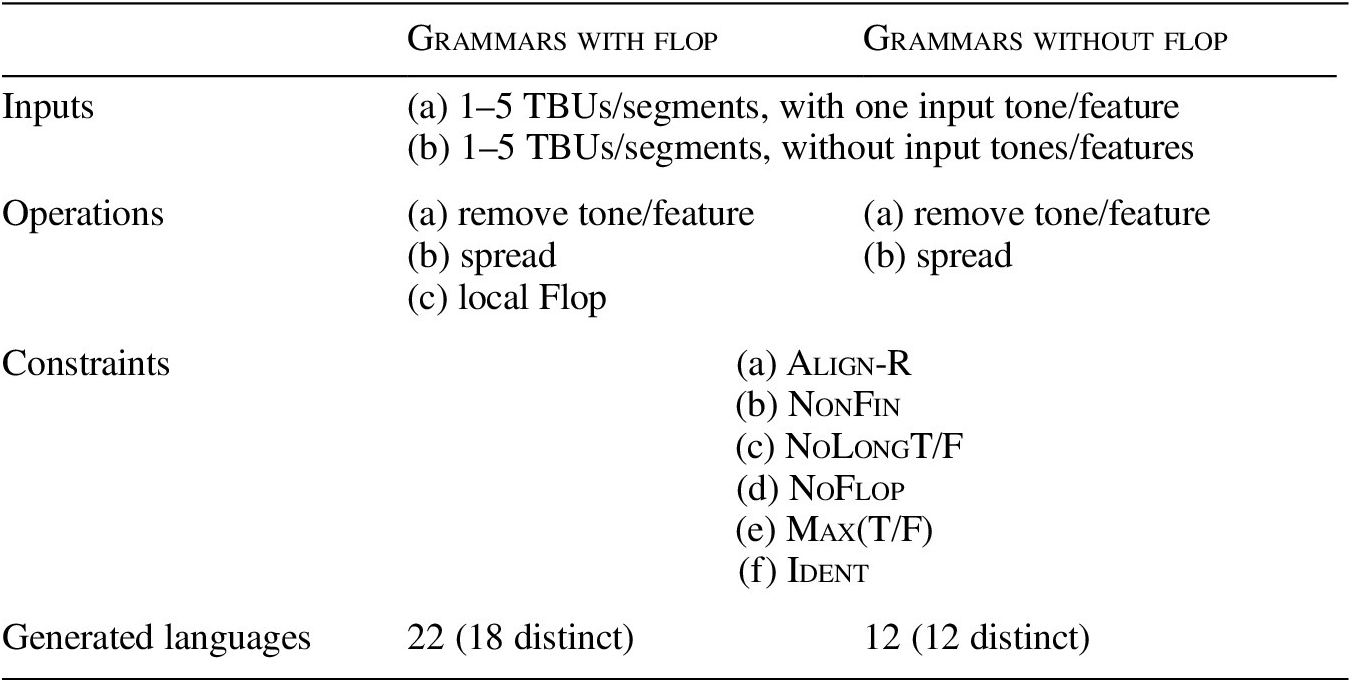
To study the typological predictions of the two types of grammars, we made use of OT-Help 2.0, a tool that generates typologies in HS and parallel OT (Staubs et al. Reference Staubs, Becker, Potts, Pratt, McCarthy and Pater2010). OT-Help requires a set of inputs, HS operations, and constraints. To make the parallels between tone and segments clear, we used similar inputs, operations, and constraints to the best extent possible. The files are available as supplementary material to this paper and are detailed in Appendix C.
Our inputs were unified into a single set, containing from 1 to 5 units; these can be different units depending on the type of shift (TBUs for tone, segments for features) but can also overlap (vowels can be TBUs and targets of vowel-related processes). To limit the number of generated grammars, we considered only inputs with at most one underlying tone/feature. With 5 toneless inputs (1–5 units long) and 15 inputs with one input tone each, this meant we derived 20 forms for each grammar.
We considered two possible operations shared by both types of grammars: deletion of a tone/feature together with its association line, and spreading. The distinguishing operation is Flop. As mentioned in Section 2, non-local shifting and spreading are not universally accepted and will need to be examined separately. More importantly, non-local spreading in particular requires a much more explicit definition of alignment constraints, and this would detract from our main goal (although see Jurgec Reference Jurgec2011 for further discussion of alignment and autosegmental representations). Similarly, we did not allow floating features; our typology is thus a subset of possible languages where *Float is top-ranked.
To limit the typology to a sensible number of grammars, we chose a limited set of constraints. As we will show, these constraints sufficiently demonstrate the typological differences between grammars with and without Flop. We used three markedness and three faithfulness constraints with both kinds of grammars. The three markedness constraints were: the alignment constraint Align-R (8) which drives spreading and flopping, NonFin (7), and a constraint against spreading—NoLongF/T (12). We chose a combination of Align-R and NonFin for two reasons. First, we aimed to test two constraints in a directional conflict, parallel to the constraints in the analyses of Kibondei and Halkomelem. Align-R motivates association with the final TBU/segment, while NonFin prefers no such association. Second, the inclusion of mirror variants Align-L and NonInitiality exploded the typology without adding additional distinct predictions, so we did not include them here. The three faithfulness constraints were: the constraint against flopping NoFlop,Footnote 12 the constraint that retains underlying tones or features Max(T/F) (9), and Ident.
The software generated 22 languages for grammars with Flop (of which 18 were distinct), and 12 distinct languages for grammars without Flop.Footnote 13 The parameters and number of generated languages are summarized in Table 1.
Simulation variables for grammars with and without Flop.

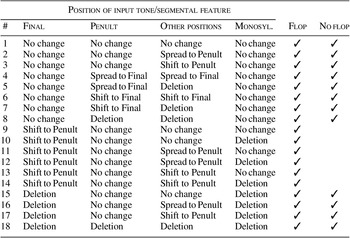
Let us now examine these 18 distinct languages in detail, shown in Table 2. For ease of reading, we categorized the languages depending on the location of the underlying tone or feature: final, penultimate or preceding syllables. This fleshes out the alignment and non-finality effects. Monosyllables were a separate category.
Generated patterns.

The 12 languages generated in grammars without Flop are a strict subset of the 18 languages generated in grammars with Flop. The common languages generated by both types of grammars are widely attested. We illustrate these common languages for tone, but a similar parallel can be made for segmental features. The first eight languages preserve the tone on the final TBU faithfully, but show various alternations in other positions. These changes only appear outside the last two syllables in languages 1–3. Language 1 is fully faithful, which is correctly predicted by top-ranked Ident. An example of such a language is Andoque, where tone is contrastive on any vowel of the word (Landaburu Reference Landaburu1979, Reference Landaburu2000). Language 2 has rightward spreading to the penultimate TBU. The north-western dialect of Northern Sotho is such a language: High tone spreads to the penultimate syllable, but surfaces faithfully on the final and penultimate syllable (Zerbian Reference Zerbian, Mugane, Hutchison and Worman2006). Language 3 prefers shifting instead. Shifting to the penultimate syllable is well attested in Bantu, such as in Digo (Kisseberth Reference Kisseberth, Clements and Goldsmith1984) and Chizigula, to be discussed below. Next we turn to languages that also exhibit changes in the penultimate position. Language 4 spreads tone to the final TBU. While most cases of spreading target the penultimate TBU, it is likely that spreading to the final TBU is attested. Spreading to all available targets is well attested in nasal and vowel harmony. Language 5 also spreads tone to the final TBU, but only from the penultimate TBU, whereas tone is deleted from other TBUs. This resembles languages with local (non-iterative) spreading, with the tone only being licensed in the last two syllables. Non-iterative spreading is attested in Ikorovere Makhuwa (Kisseberth & Odden Reference Kisseberth, Odden, Nurse and Philippson2003). Languages 6 and 7 are identical to preceding pairs of languages, except that shifting is found instead of spreading, whereas language 8 retains High tone only on the final TBU but deletes it elsewhere. These three patterns limit the tonal contrast to the final syllable, which is attested in Chicahuaxtla Triqui (Longachre Reference Longachre1959; Elliott, Edmondson & Sandoval Cruz Reference Elliott, Edmondson and Cruz2016).
Compared to the languages discussed so far, the last four languages in Table 2 are also common to grammars with and without Flop but show deletion on the final TBU. Language 15 retains tone faithfully on all but the final TBU. Slovenian, as described by Toporišič ([1976] Reference Toporišič2000) fits this description: Low tone cannot appear on the final mora of the word but can occur in all other positions. Language 16 has spreading to the penultimate TBU, as found in Tsonga (Kisseberth Reference Kisseberth, Cole and Kisseberth1994). Language 17 shows shifting, and will be discussed below. Finally, language 18 has deletion in all forms, effectively resulting in a non-tonal language.
We now turn to the languages predicted by Flop only. It is immediately clear from Table 2 that these languages all exhibit shifting to the penultimate syllable. This is a widely attested pattern that grammars without Flop do not predict. These six languages vary in two respects: what happens in the positions before the penultimate TBU and what happens in monosyllables. As regards the latter, monosyllables pattern differently from longer words in languages 10, 12 and 14. The exceptionality of monosyllables might seem pathological, but is actually well attested. Word-minimality requirements might rule out such words entirely, or limit them to a subset of words (lexically or morphologically determined). Torres-Tamarit & Jurgec (Reference Torres-Tamarit and Jurgec2015) discuss cases in which monosyllables are not footed, but longer words are. Beyond stress patterns, initial syllable faithfulness (Beckman Reference Beckman1997) singles out monosyllables when compared to longer words. Thus, we can conclude that these exceptional monosyllabic patterns are likely not pathologies per se.
We are thus left with three key languages that are correctly predicted only by Flop grammars: 9, 11, and 13. Language 9 has regressive shift from the final to the penultimate syllable (but no progressive shift). Like Kibondei in Section 3, this is a language where shifting is motivated by NonFin. In a grammar without flop, the only way to achieve shift is via spreading, which NonFin does not favour. An example of language 9 is Chichewa: a single High tone generally surfaces faithfully (except in verbs). Phrase-finally, the High tone retracts to the penultimate syllable (Kanerva Reference Kanerva1990; Myers Reference Myers1998). In Nyakore, another example of language 9, High tone shifts from the final syllable to the penult in the prepausal position (Poletto Reference Poletto1998).
Language 11 also has regressive shift from the final to the penultimate syllable—but progressive spreading to the penultimate syllable. A language with a similar pattern of progressive tone spreading and regressive shift is Lamba (Bickmore Reference Bickmore1995). Lamba is complicated by interactions with morphology and stress, but in the simplest of terms it displays progressive spreading of High tone to one or more (non-adjacent) syllables, which are underlined in (40-a). However, when a non-initial stressed syllable has an underlying High tone, regressive shift is observed instead as in (b). In Lamba, the shift is motivated by the need to resolve stress clash, but it mirrors language 11 in requiring tone not to occur in a specific position. A grammar without Flop cannot account for this type of language.

Language 13 has shift to the penultimate syllable. The shift is thus both progressive and regressive; put differently, tone is licensed to the penultimate syllable only. Halkomelem corresponds to language 12, as it shows licensing of [+low] to the stressed syllable. Similar tone languages are also attested, but the data is often deficient. For instance, Chizigula (Kenstowicz & Kisseberth Reference Kenstowicz, Kisseberth, Inkelas and Zec1990) displays High tone shift rightwards to the penultimate syllable in (41).

Chizigula is representative of many other languages with shifting to the penultimate syllable. An extensive search of the literature revealed no answers to what happens when tone is underlyingly High on the final TBU. However, since no forms with final High tones are provided, we need to assume that given the Richness of the Base, forms with High tone on the penultimate syllable can either show tone deletion or regressive shift, which are both consistent with the Chizigula surface patterns. The Flop grammars predict both options. Another language with this pattern is Uspanteko, where High tone can only appear on the penultimate mora, which means that it shifts to the penultimate vowel when the final vowel is short (Bennett & Henderson Reference Bennett and Henderson2013).
We can conclude that grammars with Flop crucially predict more attested languages than grammars without Flop. This strengthens our argument from the previous sections: Flop must be a Gen operation because it is the only way to capture some attested patterns with shift.
6. Conclusions
In this paper, we examined shift in Harmonic Serialism. We asked whether shift should be its own Gen operation, Flop. The case studies and the typological evidence led us to conclude so.
To determine whether shift is an operation, we made use of the indicators first proposed by McCarthy (Reference McCarthy2010c). We first established that shift is an attested pattern, encompassing tone and segmental patterns. Next, we presented two case studies and attempted to analyze them using other operations, such as spreading and delinking or delinking and linking. The analyses failed to capture the full range of the data. In Kibondei, the spreading analysis correctly predicted tone shift in most instances, but incorrectly predicted spreading in toneless verbs. The floating tone analysis, however, incorrectly predicted deletion of tone in stems with an underlying tone. In Halkomelem, the spreading analysis correctly predicted reduction and lowering of the stressed vowel, but incorrectly predicted spreading in words without reduction. The floating feature analysis, however, showed a surface contrast based on floating features as a function of the number of input low vowels. A similar method for comparing operations within HS has been more recently proposed by Adler & Zymet (Reference Adler and Zymet2021).
Our analysis relies on two attested patterns that are documented in the literature. In this sense, we hope to shift the argumentation from negative to positive evidence. In fact, much of the argumentation in the HS literature relies on the perceived impossibility of specific patterns. An example of this kind involves one of the predictions of positional faithfulness in parallel OT. The typical effect of positional faithfulness is that a contrast is preserved in a prominent position but neutralized elsewhere (Beckman Reference Beckman1997, Reference Beckman1998), which happens when positional faithfulness is ranked below the constraints that refer to prosody. The opposite pattern, in which prominence is shifted to another position to neutralize a marked structure, has been thought to be unattested. Based on this fact, Jesney (Reference Jesney, Lima, Mullin and Smith2011) proposed a solution in HS that defines prominent positions in the input (rather than output) of the current step in the derivation. This means that shifting a prominent position would nevertheless violate positional faithfulness and hence rule out the supposedly unattested pattern. However, Becker & Jurgec (Reference Becker and Jurgec2020) report a pattern in which stress shifts to avoid marked vowels so that they are neutralized in the newly unstressed position. Hence, the positional faithfulness argument for HS is no longer valid. We hope that relying on positive rather than negative evidence will lead to greater durability of our argument (see Blaho & Rice Reference Blaho, Rice, Durand, Kristoffersen and Laks2014 for a more general version of this reasoning).
We complemented our findings by examining the full range of typological predictions of both types of grammars. We found that only grammars in which shift is a possible one-step operation can fully predict some widely attested languages, and in particular languages in which shifting targets the penultimate vowel. This adds to the literature that uses software-generated factorial typologies in HS to explore predictions of specific constraints or constraint sets (McCarthy Reference McCarthy, Goldsmith, Hume and Wetzels2011; Pruitt Reference Pruitt2012; Torres-Tamarit & Jurgec Reference Torres-Tamarit and Jurgec2015). In this paper, we extend the same reasoning to Gen operations by comparing grammars with and without a particular operation using the same constraint set.
We conclude that the cross-linguistic and typological evidence suggest that shift must be a possible one-step operation in Harmonic Serialism. More broadly speaking, this study illustrates how careful examination of sound patterns can lead us to address fundamental questions about the architecture of grammar.
Supplementary Materials
To view supplementary material for this article, please visit http://doi.org/10.1017/S0022226722000032.