INTRODUCTION
Studies of geographical variation of social behaviour can provide insight into the mechanisms underlying the evolution of the behaviour. In contrast with the terrestrial animals (Wiltenmuth & Nishikawa, Reference Wiltenmuth and Nishikawa1998; Pröhl et al., Reference Pröhl, Koshy, Mueller, Rand and Ryan2006; Bloch & Irschick, Reference Bloch and Irschlick2006; Etges et al., Reference Etges, Over, Oliveira and Richie2006; Delgado, Reference Delgado2007), there have been few studies of geographical variation of social behaviour in marine invertebrates (Salmon & Atsaides, Reference Salmon and Atsaides1968).
Ilyoplax pusilla (de Haan) is a small dotillid crab (maximum carapace width: ~12 mm) that is common on intertidal sandy-mud flats along the Japanese coast. This species exhibits a unique territorial behaviour, barricade building, in which an earthen barrier is built close to a neighbour's burrow, using nearby surface sediment (Wada, Reference Wada1984). Barricade-building is unique to the genus Ilyoplax, occurring in only I. dentimerosa (Wada, Reference Wada1994), I. ningpoensis (Wada et al., Reference Wada, Kosuge and Trong1998), and I. serrata (Kitaura et al., Reference Kitaura, Wada and Nishida1998) as well as in I. pusilla. It is currently unknown whether this unique behaviour varies among different populations of the same species.
To better understand why barricade-building has evolved in barricade-building species, Ohata & Wada (Reference Ohata and Wada2005) compared the responses to artificial barriers of I. pusilla and another two species, Scopimera globosa and I. deschampsi, of the same family, that do not build barricades. Ilyoplax pusilla broke the artificial barrier less often than did S. globosa and avoided it more often than did I. deschampsi. These findings show that the barricade-building species is more disposed to avoid the barrier than the non-building species. If the difference in behavioural propensity against the earthen barrier is correlated with difference on whether or not to build the barricade, we could expect that populations of I. pusilla with different frequency of barricade-building also show similar difference in behavioural propensity against the earthen barrier. However, there has been no work on such population variation of behavioural propensity.
In this study, the frequency of barricade-building was compared among different populations across the geographical range of I. pusilla. When a regional difference in barricade-building frequency was found, the response of crabs to the artificial barricade was compared between the two populations, in order to clarify whether the tendency of barricade-building is correlated with the individual propensity to avoid the earthen barrier.
MATERIALS AND METHODS
Geographical variation in frequency of barricade building
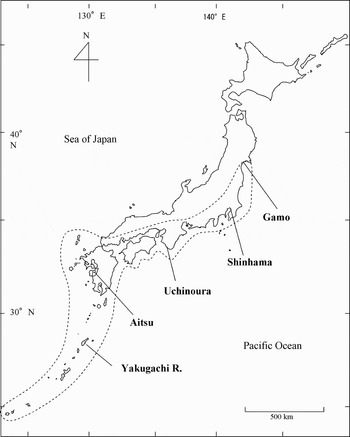
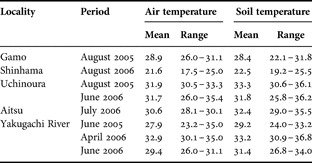
The frequency of barricade-building was examined at 5 localities (Figure 1) across the range of Ilyoplax pusilla in Japan: Gamo, Sendai City, Miyagi Prefecture (38°16′N 141°1′E), Shinhama, Ichikawa City, Chiba Prefecture (35°43′N 139°55′E), Uchinoura, Tanabe City, Wakayama Prefecture (33°41′N 135°24′E), Aitsu, Kamiamakusa City, Kumamoto Prefecture (32°31′N 130°25′E) and Yakugachi River, Amami-Ohshima Island, Kagoshima Prefecture (2°15′N 129°25′E). Observations were made for 5–7 days around spring tide in the spring or summer within the breeding season of each local population: 4–9 August 2005 in Gamo, 5–11 August 2006 in Shinhama, 17–24 August 2005 and 9–14 June 2006 in Uchinoura, 10–12 July 2006 in Aitsu, and 19–23 June 2005, 10–16 April 2006 and 13–29 June 2006 in Yakugachi River. Air and soil surface temperatures at daytime low tide during the study period were similar among localities, except for April in Yakugachi River (Table 1).
Geographical distribution of Ilyoplax pusilla in Japan (broken line) from Wada et al. (1992), and 5 localities for the study (Gamo, Shinhama, Uchinoura, Aitsu and Yakugachi River).

Air and soil temperatures (°C) during the study period in each locality.

In each locality, burrows and barricades were counted during 3 hours of the daytime low tide on each day. We randomly set 8 quadrats (25 m × 25 m) on areas where I. pusilla was abundant and counted the number of open burrows, barricades and barricade builders within it. In order to sample the crab density and population structure, 3–8 quadrats, each measuring 25 m × 25 m, were set. All crabs within each quadrat were captured by excavating the mud down to about 15 m depth. Captured crabs were sexed, measured for their carapace widths, and whether the females carried eggs or not was noted. Brachyuran crabs of other species collected in the quadrats together with I. pusilla were also identified and the number of individuals was counted. Substratum of the study area was well drained sandy-mud in all the 5 localities.
The number of open burrows per 625 cm2, the number of barricades per burrow and the number of barricade-builders per burrow were averaged on each day and their daily values during the study period were compared among localities and study periods with ANOVA. When the ANOVA resulted in significant difference, Tukey–Kramer's HSD test was used to detect significant differences between pairs. The significance level was set at 0.05.
Experiment on response to artificial barricade
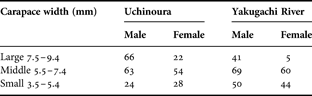
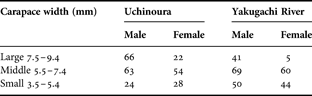
In order to know whether crab responses to earthen barriers differed between populations of Uchinoura and Yakugachi River, which differed in frequency of barricade-building (see Results), artificial barricades of average size for Ilyoplax pusilla (16.5 mm in length, 8.5 mm in width and 9.5 mm in height) were made from surface substrate of each study locality and were placed at the burrow entrance of resident crabs. After those crabs emerged, we observed their activities for 10 minutes, recorded where they moved and noted whether the artificial barricades were destroyed. After the observation, the crabs were captured by excavating, their carapace widths were measured and their sex recorded. Examined crabs were selected without size or sex bias, totaling 257 in Uchinoura and 269 in Yakugachi River (Table 2). Examined crabs were classified into three size-groups of 3.5–5.4 mm CW, 5.5–7.4 mm CW and 7.5–9.4 mm CW for each sex. For each size-group of each sex, we obtained two measures of the crabs' responses to the artificial barricade: the proportion of crabs that broke the artificial barricade, and the proportion of crabs that did not cross the artificial barricade from those that did not break it. To compare these measures between the two local populations, we analysed the effects of locality, sex and size on the proportion of barricade-breaking or avoidance, using logistic regression. The significance level was set at 0.05.
RESULTS
Crab size and density of local populations and co-occurring brachyuran crabs
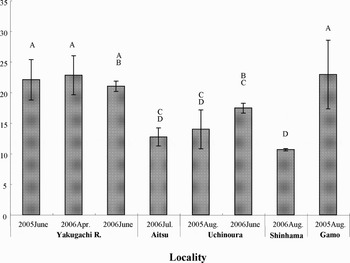
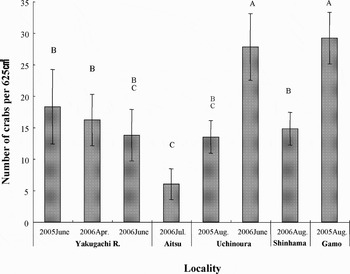
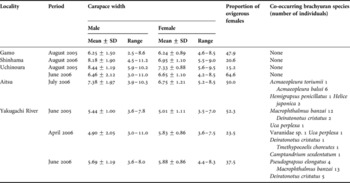
The mean carapace width ranged from 4.9 mm (Yakugachi River) to 8.4 mm (Uchinoura) in males and from 5.0 mm (Yakugachi River) to 7.3 mm (Uchinoura) in females (Table 3). Ovigerous females occurred in all the study periods of all the study localities with the proportion ranging from 15.2% in August at Uchinoura to 78.9% in June at Yakugachi River (Table 3). The number of burrows per 625 cm2 differed among study localities (ANOVA, P < 0.0001), being significantly higher at Yakugachi River and at Gamo than at other study localities, but no significant difference was found between different study periods at the same locality (Figure 2). The number of crabs per 625 cm2 also differed among study localities (ANOVA, P < 0.0001), being significantly higher at Uchinoura in June 2006 and at Gamo than at other localities. Within the same locality, there was no significant difference between different periods at Yakugachi River, but at Uchinoura June 2006 showed significantly higher values than August 2005 (Figure 3). Other brachyuran species that co-occurred with Ilyoplax pusilla were collected only at Aitsu (4 species) and Yakugachi River (11 species) (Table 3).
Mean number of open burrows per 625 cm2 in each locality, with bar showing SD. The same alphabetical letter indicates no significant difference (P > 0.05) by Tukey's test.

Mean number of crabs of Ilyoplax pusilla per 625 cm2 in each locality, with bar showing SD. The same alphabetical letter indicates no significant difference (P > 0.05) by Tukey's test.

The number of test crabs examined for response to artificial barricades in Uchinoura and Yakugachi River.
Body size (carapace width) and proportion of ovigerous females in each local population of Ilyoplax pusilla, with co-occurring brachyuran species.

Geographical variation in frequency of barricade building
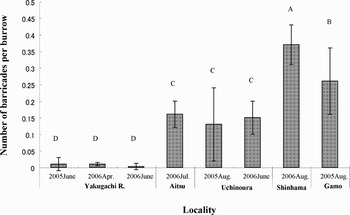
The number of barricades per burrow differed among study localities (ANOVA, P < 0.0001), being highest at Shinhama and lowest at Yakugachi River, with the tendency to increase at more northern localities (Figure 4). Within the same study locality, there was no significant difference between different periods, as found in Yakugachi River and Uchinoura (Figure 4).
Mean number of barricades per burrow in each locality, with bar showing SD. The same alphabetical letter indicates no significant difference (P > 0.05) by Tukey's test.

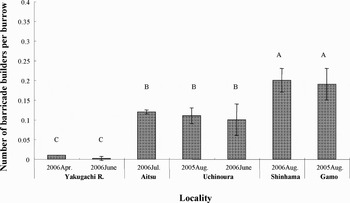
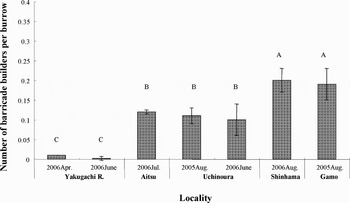
The number of barricade-builders per burrow also differed among study localities (ANOVA, P < 0.0001), being highest at Shinhama and lowest at Yakugachi River, with the tendency to increase at more northern localities (Figure 5). Within the same study locality, there was no significant difference between different periods, as found at Yakugachi River and at Uchinoura.
Mean number of barricade-builders per burrow in each locality, with bar showing SD. The same alphabetical letter indicates no significant difference (P > 0.05) by Tukey's test. ND, no data.
Response to artificial barricade
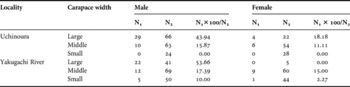
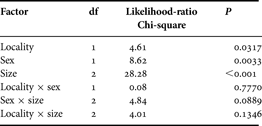
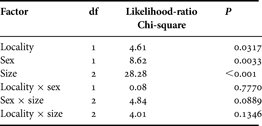
Crabs that broke the artificial barricade: the proportion of crabs that broke the artificial barricade (Table 4) differed significantly among localities, between sexes and among size-groups (logistic regression, Table 5). The artificial barricade was broken more often by male crabs than by female crabs, and more often by larger crabs than by smaller crabs in either population. Between the two local populations, the artificial barricade was broken more often by crabs at Yakugachi River than by crabs at Uchinoura, except for the large females at Yakugachi River, of which only 5 were observed (Table 4).
The number (N1) and percentage of crabs (total =N2) which broke the artifical barricade during 10 minutes. Data are shown separately for three size-groups of males and females in each locality.

Result of logistic regression analysis for proportion of barricade breaking in populations of Uchinoura and Yakugachi River.
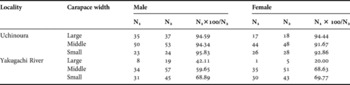
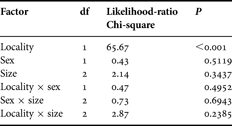
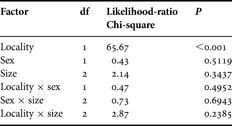
Crabs that avoided the artificial barricade: the proportion of crabs that avoided the barricade (Table 6) differed significantly among localities, but not between sexes or among size-groups (logistic regression, Table 7). The artificial barricade was thus, avoided more often by crabs of Uchinoura than by crabs of Yakugachi River (Table 6).
The number (N1) and percentage of crabs (total = N2) which avoided the artifical barricade during 10 minutes. Data are shown separately for three size-groups of males and females in each locality.

Result of logistic regression analysis for proportion of barricade avoiding in populations of Uchinoura and Yakugachi River.
DISCUSSION
Geographical variation of frequency of barricade-building
Barricade-builders and barricades were least abundant at the southernmost locality of Yakugachi River, and increased toward northern localities. Within the same locality, the frequency of barricade-building has been known to be higher in the breeding season than in the non-breeding season (Ishihara, unpublished). Ovigerous females occurred in all the study periods at all localities. Hence we recorded the frequency of barricade-building during the breeding season at each locality when barricade-building is most common. Furthermore, the frequency of barricade-building at the same locality did not differ between different study periods in either Yakugachi River or Uchinoura. Thus, our data on the frequency of barricade-building can be taken as characteristic of each local population in the breeding season.
The barricades of Ilyoplax pusilla play to control an aggressive interaction between conspecific neighbours when their territories overlap (Wada, Reference Wada1984). Therefore, the frequency of barricade-building may be influenced by conspecific burrow or crab density. However, the frequency of barricade-building was not correlated with the burrow density or the crab density. For example, the frequency of barricade-building was lowest at Yakugachi River and highest at Gamo, yet burrow density was high at both localities. Within the same locality, no correlation was found between the barricade frequency and the burrow density (Ishihara, unpublished). Thus, geographical variation of barricade frequency is not attributable to the difference in conspecific crab density among local populations.
Local difference in frequency of barricade-building may be caused by local difference in males' tendency to repel other males to acquire females. The barricade is expected to be more frequently built where male to male competition is intense. The breeding period of I. pusilla is shorter in northern localities, as is known in Chiba (May–August) (Furota unpublished), Wakayama (April–August) (Yoshimura & Wada, Reference Yoshimura and Wada1992), Fukuoka (May–September) (Henmi & Kaneto, Reference Henmi and Kaneto1989) and Kumamoto (April–September) (Takayama, Reference Takayama1996). If the males in northern populations are disposed to repel other males because of a limited breeding period, they would defend their territory more vigorously with more frequent barricading. But there is no evidence that male to male competition increases in more northern populations.
The occurrence of other brachyuran species may be responsible for the local difference in barricade frequency. Since the barricade is ineffective against other species, as shown in Scopimera globosa and Ilyoplax deschampsi by Ohata & Wada (Reference Ohata and Wada2005), the tendency to build a barricade might be reduced where other species co-occur because building these structures would often waste time or energy. Our data support this interpretation. The two southern localities with low barricade frequency had co-occurring brachyuran species in the I. pusilla habitat, whereas other localities with high barricade frequency had no co-occurring species.
Response to artificial barricade
Comparison of responses to artificial barricades between the population of Yakugachi River with a low frequency of barricade-building and the population of Uchinoura with a high frequency of barricades has revealed that crabs at the former location more often break the artificial barrier and less often avoid it. Hence there is a difference in the propensity of crabs to stay away from earthen barriers between these populations of Ilyoplax pusilla. If the propensity is low, barricade-building is likely to be ineffective and costly. As expected, our data showed that the population with the high propensity often built barricades. A similar finding has been known from comparison between I. pusilla and another two species, Scopimera globosa and Ilyoplax deschampsi, of the same family, that do not build barricades (Ohata & Wada, Reference Ohata and Wada2005). Ilyoplax pusilla less often broke the artificial barrier than did S. globosa and more often avoided it than I. deschampsi. The interpopulation variation in the frequency of barricade-building of I. pusilla is also correlated with the difference in behavioural propensity against the earthen barrier, as in the interspecific difference in occurrence of barricade-building behaviour.
The present study has found that the barricade-building behaviour of I. pusilla exhibits geographical variation in the frequency and the variation is correlated with the individual propensity to avoid the earthen barrier, indicating that the unique territorial behaviour has evolved concurrently with behavioural propensity to avoid vertical structure.
Acknowledgements
We express our gratitude to Dr Y. Yusa and members of the laboratory of Animal Ecology at Nara Women's University for their valuable advice and suggestions. We thank Gyotoku Bird Sanctuary for permission to work in their protected area. The laboratory of Animal Ecology of Tohoku University, the laboratory of Marine Biology of Toho University, Seto Marine Biological Laboratory of Kyoto University, Aitsu Marine Station of Kumamoto University and Harano Agricultural Museum of Amami Cultural Foundation also provided us with diverse support in our field study. Reviewing the early draft of the manuscript by Dr J. Christy is acknowledged. This work was partly supported by Grants-in-Aid for Scientific Research from the Japan Society for the Promotion of Science to K.W.