




No CrossRef data available.
MAYA BLUE AND PALYGORSKITE: A second possible pre-Columbian source
Published online by Cambridge University Press: 19 July 2005
Abstract
Maya Blue is an unusual blue pigment used on pottery, sculpture, and murals from the Preclassic to the Colonial period. Until the late 1960s, its composition was unknown, but chemists working in Spain, Belgium, Mexico, and the United States identified Maya Blue as a combination of indigo and the unusual clay mineral palygorskite (also called attapulgite). A source of palygorskite in the Maya area was unknown for years; then ethnoarchaeological research in the mid-1960s demonstrated that the contemporary Maya recognized the unique physical properties of palygorskite and used it as an additive for pottery temper and for curing certain types of illnesses. Because of its importance in Maya Blue, pre-Hispanic sources of the mineral were then suggested based on ethnoarchaeological data. One of these sources was the cenote in the town of Sacalum, Yucatan. This paper briefly reviews the history of the Maya Blue research from an anthropological perspective and presents evidence of a second possible pre-Hispanic mining site for palygorskite at Yo' Sah Kab near Ticul, Yucatan. Archaeological and technological approaches have demonstrated the use, distribution, composition, and characteristics of Maya Blue, but ethnoarchaeology has related it to Maya language and culture and to possible pre-Hispanic sources of one of its constituents, palygorskite.
Information
- Type
- Research Article
- Information
- Copyright
- © 2005 Cambridge University Press
Maya Blue has stimulated the interest of archaeologists, chemists, and material scientists for more than 75 years, since it was first identified by H. E. Merwin (1931) on the murals of the Temple of the Warriors at Chichen Itza. A unique pigment that differs from any blue identified on paintings from Europe or Asia, Maya Blue is not based on copper, ground lapis lazuli, or azurite (José-Yacamán et al. 1996. Rather, it consists of a clay-organic complex of palygorskite and/or sepiolite and indigo (Cabrera Garrido 1969; Gettens 1955, 1962:563; Hubbard et al. 2003; José-Yacamán et al. 1996; Kleber et al. 1967:44–46). The pigment is resistant to diluted mineral acids, alkalis, solvents, oxidants, reducing agents, moderate heat, and biocorrosion, and it shows little evidence of color deterioration over time, even after centuries of the harsh tropical conditions of southern Mexico and Guatemala (Gettens 1962; José-Yacamán et al. 1996). In 1984, for example, traces of Maya Blue were still visible on the panels of the Venus Platform and on the columns in the front of the Temple of the Warriors at Chichen Itza, more than 800 years after it was placed there. Maya Blue has such unique qualities that the Mexican chemist Constantino Reyes-Valerio (1993:26), asserted: “estas particularidades bastan para asentar que no hay otro material colorido preparado por el hombre que tenga propiedades semejantes a las que posee esta sustancia extraordinaria.”
Maya Blue was applied to pottery, sculpture, and murals and had a wide distribution from northern Yucatan to highland Guatemala and central Mexico (Cabrera Garrido 1969; Gettens 1962; Reyes-Valerio 1993). Its greatest use occurred during the Classic and Postclassic periods, with some use in Colonial and modern times (Cabrera Garrido 1969; Gettens 1962:560; José-Yacamán et al. 1996; Reyes-Valerio 1993; Torres 1988).
The color blue had exceptional ceremonial significance for the Maya and seems to be the color of offerings and/or sacrifice. Bishop Landa's classic description of sixteenth-century Yucatan (Tozzer 1941:117–119) reported that human sacrificial victims and the stone altars upon which they were laid were painted blue before the victim's beating heart was cut out. In his notes on the Landa document, Tozzer (1941:117–119) says that blue seemed to be associated with sacrifice and cited other evidence of the use of blue in religious rituals. Tozzer believed that the ceremonial blue color was indigo, but it now appears more likely that the blue pigment was Maya Blue because it has been identified on a sherd, in a small ball from the Cenote of Sacrifice, and on the murals and columns of the Temple of the Warriors at Chichen Itza where the sacrifices of which Landa speaks took place (Shepard and Gottlieb 1962:15).
Blue was also associated with the ancient gods of rain. In the database of the Madrid Codex (Vail 2002), blue is associated with themes of offering, rain, and the Maya rain god Chaak, among others. It was used for ceremonies dedicated to Chaak, the rain god in Yucatan (Reyes-Valerio 1993:86), and to Huitzilopochtli (Tlaloc), the rain god in central Mexico (Reyes-Valerio 1993:88). This symbolism would, of course, explain the use of the pigment on the Temple Mayor in Tenochtitlan, on offerings thrown into the sacred cenote, and on victims sacrificed on the Chac Mool in the Temple of the Warriors at Chichen Itza.
The use of the Maya Blue in ceremonial contexts implies a certain scarcity of the pigment. These contexts, combined with the unusual character of palygorskite, suggest that Maya Blue (or the palygorskite used to produce it) came from restricted sources.
This paper reviews some of the Maya Blue research, with a focus on the anthropological issues that relate the pigment to Maya culture. The paper then presents evidence of a second possible pre-Columbian source of palygorskite at Yo' Sah Kab near Ticul, Yucatan.
A HISTORICAL PERSPECTIVE ON MAYA BLUE RESEARCH
Several key breakthroughs have occurred in the history of the Maya Blue research. The first of these was the identification of palygorskite (also called attapulgite, but priority is given to the name “palygorskite”; Bailey et al. 1971:131) and/or sepiolite in the pigment using X-ray diffraction (Cabrera Garrido 1969; Reyes-Valerio 1993; Shepard and Gottlieb 1962). While palygorskite (a hydrated magnesium aluminum silicate) is classed as a clay mineral and is plastic, it does not have a platy morphology like other clay minerals. Rather, like sepiolite, palygorskite consists of a fibrous or needle-like structure (Grim 1968:44–45; Shepard 1971). The second significant breakthrough was the discovery that the colorant in Maya Blue was indigo using infrared absorption spectrometry (Cabrera Garrido 1969; Kleber et al. 1967). Combining the effectiveness of both techniques and the lessons learned from his own research on Maya Blue, José María Cabrera Garrido (1969) proposed an analytical procedure for the analysis of the pigment.
The composition of Maya Blue captured the imagination of chemists and physical scientists who wanted to know about the exact nature of the pigment. Anna Shepard and Hans Gottlieb (Shepard 1962; Shepard and Gottlieb 1962) had suggested that the pigment could be a clay-organic complex, and H. Van Olphen (1966) supported that hypothesis by developing two methods for preparing a Maya Blue-like pigment in the laboratory and showing that heat was necessary. Cabrera Garrido (1969) suggested that Maya Blue could be produced ritually by heating indigo and palygorskite with copal incense, based on his analysis of the pigment from an incense burner at the Aztec site of Tlatelolco in the Valley of Mexico. This explanation is consistent with the occurrence of Maya Blue on balls of copal in Tikal.
In 1980, Edwin R. Littmann rekindled interest in Maya Blue, challenging previous research and suggesting that at least some Maya Blue was a blue montmorillonite (Littmann 1980). Unfortunately, Littmann did not follow Cabrera Garrido's procedure of using X-ray diffraction and infrared absorption spectrometry to analyze the pigment.
The Problem with Littmann's Analyses
One of the significant problems with Littmann's analyses was that his samples were improperly prepared to identify clay minerals unambiguously using X-ray diffraction. Littmann (1980:95) used the bulk-powder method to analyze his samples by X-ray diffraction. This method can create difficulties in differentiating clay minerals because of their random orientation, very small particle size, and their mixture with non-clay minerals. Littmann removed the calcite and dolomite in his samples with HCl, but he did not remove other non-clay minerals. So if a non-clay mineral in the sample shares a refractive peak with the clay mineral in the sample, the non-clay mineral may mask the peaks of the clay mineral completely unless the clay mineral is separated from the non-clay minerals in the analysis.
The way to avoid these problems is to (1) separate the clay from the non-clay mineral component of the sample; (2) orient the minerals in the clay fraction to provide enough thickness to obtain an X-ray pattern; and (3) use a wide range of angles for X-ray diffraction to resolve any ambiguities with co-occurring peaks. The first two procedures can be accomplished by dispersing (and deflocculating) samples in water using ultrasound. In this procedure, the non-clay minerals will sink to the bottom of the container, and the clay minerals will remain in suspension. The waterborne dispersions of clay minerals are then drawn from the suspension using a pipette and carefully deposited on at least three glass slides so that the surface tension does not allow the suspension to run off the slide. The slides are then carefully dried, leaving a thin layer of oriented clay particles. Then one slide is heated; ethylene glycol is added to the second; and a third is left untreated.
The three slides for each sample are analyzed using an X-ray diffractometer, and the peaks at the various angles of incidence are compared among the untreated, heated, and glycolated samples. The heating drives off any interlayer water in the sample; as a result, the clay layers may collapse in some clay minerals (such as montmorillonite), a change that will be evident in the shift in intensity and location of the X-ray peaks from the peaks of the unheated samples. For the glycolated samples, glycol is taken up between the clay layers in some clay minerals (such as montmorillonite), a change that also produces a shift in the X-ray peaks. These procedures thus enable an analyst to differentiate a sample containing montmorillonite from that containing palygorskite or some other clay mineral (Carroll 1970:26–27; Moore and Reynolds 1997:241–243).
According to Bruce F. Bohor, a clay mineralogist formerly with the Illinois State Geological Survey and the U.S. Geological Survey, palygorskite should be easily distinguished from montmorillonite. Montmorillonite has a diagnostic peak of 6.2° 2-theta (Carroll 1970:27; Moore and Reynolds 1997:242), and palygorskite (attapulgite) has a diagnostic peak at 8.5° 2-theta (Moore and Reynolds 1997:244). Neither peak occurred in Littmann's X-ray data, even though he listed other peaks for each mineral (Littmann 1980:99). Consequently, it appears that Littmann's improper preparation of samples and failure to use the full range of diffraction angles significantly affected his interpretation of Maya Blue.
The Contrary Evidence
The weight of the analytical evidence from more than 10 years before Littmann's work (Cabrera Garrido 1969; Gettens 1962; Kleber et al. 1967; Shepard 1971) had already demonstrated, using X-ray diffraction and infrared absorption spectrometry, that Maya Blue was composed of palygorskite and/or sepiolite and indigo. Furthermore, Van Olphen (1966) showed experimentally that a Maya Blue-like pigment could be produced in the laboratory using palygorskite and indigo. Even so, Littmann claimed, “Yet in no case has the presence of indigo in Maya Blue been confirmed by any acceptable technical procedures” (Littmann 1980:93; emphasis in the original). In a subsequent paper, Littmann (1982) revisited the indigo/attapulgite and blue montmorillonite hypotheses with several scenarios of preparation and distribution.
The Littmann diversion toward the “blue montmorillonite hypothesis” was unfortunate and distracted some archaeologists away from previously published analyses that had already established that Maya Blue was a combination of indigo and palygorskite and/or sepiolite. Linda Roundhill and colleagues (1989) wrote a paper to clarify the situation. Nevertheless, Littmann's alternative syntheses of indigo and palygorskite (Littmann 1982) provided important options for how the Maya might have produced the pigment, a topic followed up six years later by Luis Torres (1988) and more recently by Reyes-Valerio (1993). Unfortunately, Littmann's articles are the “last word” on Maya Blue in a major archeological journal, and uncertainty about the composition of Maya Blue still occurs, even though its components were known more than 35 years ago.
The most recent major work on Maya Blue is probably Reyes-Valerio's 1993 book. Richly illustrated with color photographs, the book summarizes much of the history of the research on the pigment and distills the information about dyeing and indigo use from the early Colonial documents. Chemists still find Maya Blue fascinating and are learning more about the unique chemical bonding that makes the pigment unique (Hubbard et al. 2003; José-Yacamán et al. 1996).
THE CONSTITUENTS OF MAYA BLUE: THE SCIENTIFIC PERSPECTIVE
Maya Blue and Indigo
Indigo is a blue dye that comes from several species of the genus Indigofera (from the Latin “Indigo-bearing”) in the Leguminosae family. A search of the botanical literature to the mid-1960s (Arnold 1987) found that botanists have classified approximately 350 species of the genus throughout the world; 50 of those species occur in the New World and are distributed from the southeastern United States to Argentina (Arnold 1987). Botanical surveys in the Americas have been uneven, and variations in classification may exist, but 23 species of Indigofera occur in Mexico, with the most species occurring in the states of Guerrero (N = 10), Oaxaca (N = 9), and Michoacan (N = 8).
In the New World, indigo from comes from three cultivated species: Indigofera tinctoria, Indigofera suffruticosa, and Indigofera guatemalensis. Indigo production was more important in the past than it is today, since the introduction of modern synthetic dyes (Arnold 1987). Indigo was an important export from some areas of the New World during the Colonial period (Reyes-Valerio 1993).
The Old World I. tinctoria (a native of south India) was introduced in some locations, but its distribution from botanical surveys is limited to the circum-Caribbean area (Arnold 1987:58). Indigofera suffruticosa, however, is found in areas from the southeastern United States (where it was introduced for cultivation in 1742) to Argentina, and I. guatemalensis occurs in Guatemala, El Salvador, Ecuador, Peru, and the West Indies (Arnold 1987:59). All of these data suggest that Indigofera species are widely distributed and, except for I. tinctoria, are pre-Conquest in origin. Those species from Mexico have the greatest time depth. Certainly, the Mexican species of Indigofera could have been the source for the indigo used in Maya Blue.
Maya Blue and Palygorskite
Until 1967, no reports of palygorskite deposits in the Maya area had been published. After Bohor of the Illinois Geological Survey found palygorskite in a sample of sak lu'um and in pottery temper that I collected in Yucatan in 1965, I returned to Yucatan to collect more samples. Bohor found palygorskite in 53 samples of pottery temper and raw materials used for preparing that temper (Arnold 1967, 1971). Since then, palygorskite has been reported from several locations in the Maya area. William Folan (1969) said that it had been found in a sample that he collected in the Sacalum Cenote in 1962, and Bohor and I found a number of palygorskite deposits in the northern portion of the Yucatan Peninsula in or near Ticul, Mama, Sacalum, and Maxcanu, and near the archaeological site of Uxmal. Bohor also identified palygorskite from two samples I collected near Lake Izabal, Guatemala, in 1970. Shepard reported palygorskite in three samples of pottery materials (from Ticul, Mama, and Becal) that Raymond Thompson had collected in 1951 (Shepard 1971; Shepard and Pollock 1971), and Wayne Isphording reported finding several palygorskite deposits in Yucatan (letter cited in Littmann 1982:404).
Except for the deposits near Ticul and in Sacalum, all of the palygorskite deposits are located in road and railroad cuts (Bohor 1975) or are either quite small or were inaccessible to the ancient Maya. The exposure of palygorskite deposits in a topography altered by roads and railroads does not indicate that the ancient Maya had access to these deposits, because they lacked metal tools, heavy earth-moving equipment, and explosives. In other words, geological occurrence of palygorskite in the Maya area does not necessarily mean that the mineral was accessible and available to the ancient Maya. Sources of palygorskite need to be understood in relationship to the ancient Maya landscape rather than a landscape altered by modern technology.
MAYA BLUE AND MAYA CULTURE
Technological studies of Maya Blue are important. The distribution of indigo species and the geological sources of palygorskite do suggest possibilities for the technical choices of the ancient Maya. Such approaches, however, do not really tell us much about the relationship of Maya Blue to Maya culture and to other issues of interest to Maya archaeologists. Maya Blue was obviously an important religious symbol, but relating it and its components to Maya culture can provide a deeper meaning of its significance and provide new hypotheses for testing.
Indigo
The most widespread use of indigo is dyeing, but many of the New World species of Indigofera had other indigenous uses in Mesoamerica (Arnold 1987). The most widely known, named and used species of Indigofera is I. suffruticosa, which has a variety of medicinal uses. In Mexico, it is used as a febrifuge and for uses that exploit its vulnerary, antispasmodic, diuretic and stomachic properties (summarized in Arnold 1987:70).
Ch'oh (choh in some orthographies) is the Yucatec Maya word for I. suffruticosa. According to Ralph Roys (1931:80), choh was a treatment for convulsions. The modern Maya (Redfield and Redfield 1940:71) also used ch'oh for “curing the wind of epilepsy” and for x-tatac-moo-ik (not translated).
Although the Spanish word añil is used for I. suffruticosa, the most common Indian word for this species is jiquilite, or sometimes quilitl, which appears to be derived from the Aztec (Nahuatl) word xiuhtic (xiuhquílitl; Reyes-Valerio 1993:45–47). The use of this word and its derivatives occur almost exclusively in Mexico and Central America (Arnold 1987:68–69; Reyes-Valerio 1993:45–49:58–59). The Aztecs used the plant to treat urinary diseases and ulcers; they also used it as a remedy for syphilis and applied it as a poultice to the head to reduce fever (Arnold 1987:68–69).
Palygorskite
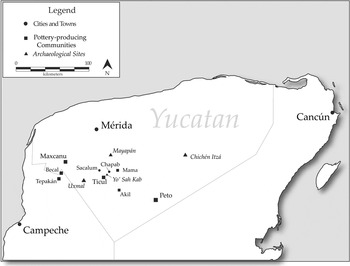
The cultural link between palygorskite and Maya culture was first established by my ethnographic work in Yucatan during 1965 and 1966 (Arnold 1967, 1971). When Bohor found attapulgite (now called palygorskite) in my sample of sak lu'um (white earth) and in pottery temper from Ticul, Yucatan (Figure 1), in the fall of 1965, I told Don Lathrap about it. Lathrap mentioned that the mineral also had been found in Maya Blue (Shepard 1962; Shepard and Gottlieb 1962). It seemed unbelievable that the contemporary Maya were still using one of its constituents in the twentieth century. If they were, I wanted to be certain that I could verify that link. After all, the inclusion of palygorskite in “white earth” and pottery temper simply might be coincidental, with no awareness among the Maya of its presence and no cultural significance.

Map of the State of Yucatan and adjacent areas of the State of Campeche showing cities, towns, and archaeological sites mentioned in the text.
I returned to Yucatan in January 1966 to test the link. Three questions guided my research. First, was the occurrence of palygorskite merely coincidental in Ticul pottery temper, or was there truly a cultural reason for its inclusion? Second, did all of the materials that contained sak lu'um contain palygorskite? Third, and conversely, did all of the materials that did not contain sak lu'um not contain palygorskite? The crucial issue was not merely the occurrence of palygorskite in Yucatan, but whether the Maya recognized its properties, deliberately selected it for these properties, and used it for cultural ends.
To test the possible relationship between sak lu'um and palygorskite, I carefully designed several comparisons using different types of ethnographic and mineralogical data (Arnold 1967, 1971). My research design focused on collecting samples of those semantic and behavioral categories that the Yucatec Maya of Ticul actually recognized and used. Said differently, selecting these materials did not involve geological sampling based on scientific criteria; they were the result of the technical choices of raw-material categories (Lemonnier 1993) and their alternatives that the potters actually made in the way that they perceived and utilized their environment. The results revealed that sak lu'um was entirely different from the rocks (tuunich) and clay (k'at) of the area. Analyses of sak lu'um revealed that it was pure palygorskite (then called attapulgite). The rocks consisted of calcites and dolomites, and the clays were either pure montmorillonite or a mixture of halloysite and partially dehydrated halloysite (Arnold 1967, 1971). Later, Bohor concurred with L. G. Schultz and colleagues (1971) that the halloysite mixture was, in reality, a combination of montmorillonite and a randomly mixed layering of kaolinite and montmorillonite (Bahor 1975:118).
The Yucatec Maya category of sah kab was more complicated. Often referred to using the hispanicized term sascab, this material occurs throughout Yucatan and is translated as “white powder” by Maya informants. Ticul potters, however, recognize two major classes and several subtypes of each class (Arnold 1967, 1971). One subtype consists of a naturally occurring marl that is ubiquitous in Yucatan; occurs in a 1- to 2-m bed, approximately 1 m to 2 m below the cap rock in Yucatan; and is used in construction as mortars, plasters, and surfacing. The other class of sah kab is pottery temper in Ticul and is a deliberate cultural mixture of freshly mined nooy from shallow mines and the tailings from previous temper preparations (called ta'achach) that are crushed and screened (Arnold 1967, 1971). This class of sah kab is linguistically homophonous with the constructional sascab but must contain sak lu'um and comes from a unique location called Yo' Sah Kab (discussed later).
Both types of sascab are mixtures of clay and calcite and dolomite. Sah kab for construction is a natural mixture of montmorillonite and calcite and dolomite (Arnold 1967, 1971). Sah kab temper, however, is a non-natural, carefully prepared cultural mixture of palygorskite and calcite and dolomite, occasionally with montmorillonite mixed with it. Since montmorillonite in the temper causes vessels to sag and crack, potters have devised tests to distinguish good temper that contains sak lu'um (palygorskite) from those materials that do not contain sak lu'um and contain montmorillonite (Arnold 1967, 1971). The presence of sak lu'um in temper is thus cultural in that potters and miners deliberately select it for inclusion in the temper; it is clearly a semantic and behavioral choice of the potters.
The second comparison of ethnographic and mineralogical categories brought awareness that Ticul potters' practical knowledge of the properties of sak lu'um corresponded to the known scientific properties of palygorskite (Arnold 1967, 1971). First, in contrast to that of other materials, potters' practical knowledge of sak lu'um matched the physical properties of palygorskite. Second, all potters and miners used as informants affirmed that sah kab temper should contain sak lu'um, and all samples of this temper from 97% (N = 28/29) of the potters' households in Ticul contained palygorskite (Arnold 1971). Third, potters recognized that sah kab for construction was different from sah kab temper; sah kab for construction should not contain sak lu'um, and none of the samples of this class of sah kab contained palygorskite. Fourth, samples of temper constituents from the temper mines that contained sak lu'um contained palygorskite. Finally, some samples of temper constituents from the temper mines did not contain sak lu'um; they often did contain palygorskite because the perception of the lack of sak lu'um was based not on the lack of palygorskite in the samples but, rather, on the physical properties of montmorillonite (Arnold 1967, 1971).
Since my original ethnographic work in Yucatan in 1965 and 1966, I have returned to do research in Ticul for eight visits. During field work in 1984, 1988, 1994, and 1997, ethnographic work has validated and reinforced the importance of sak lu'um in pottery temper in Ticul. With the emergence of full-time temper-mining specialists who were not potters, the quality of pottery temper has become variable. As a result, some potters accumulated piles of sak lu'um in their house lots to crush and mix with their temper to improve its quality.
Medicinal Use of Palygorskite
Besides its use in pottery temper, “white earth” is regarded as having excellent qualities for treating certain kinds of medical conditions (Arnold 1967:35). To treat some infections, it is moistened and spread over the infected area. One potter said that the Maya would “make an atole” with white earth, place it on a cloth, and put the cloth on the infected area to draw out the infection. For infections of the throat, white earth is eaten or sucked. It is also used to treat bad burns and goiter (papera), and is moistened and spread topically on the affected area. It may also be taken internally for such maladies. It is consumed by pregnant women and given to children who have the habit (vicio) of eating dirt (geophagy). Local informants also report that people use it to alleviate stomach trouble.
Does palygorskite have medical efficacy? It does, indeed. The fibers of palygorskite and sepiolite consist of channels that give both minerals properties that are useful in the treatment of certain kinds of illnesses, particularly diarrhea. One of these properties is the adsorption of water, but another is believed to be its ability to adsorb the causative agent (e.g., bacteria) of diarrhea and remove it from the body (U.S. National Library of Medicine 2004). For this purpose, palygorskite is marketed in the United States under a variety of trade names, such as Kaopectate Advanced Formula and Diasorb (DuPont et al. 1990; U.S. National Library of Medicine 2004).
Finally, it is not likely that the link between the medical value of palygorskite and indigo and their use in Maya Blue went unnoticed by the ancient Maya. While the symbolism of the color is undoubtedly very important, its use in ritual may also have been related to the physical healing produced by both components of Maya Blue.
Some authors have noted that some of the Maya Blue samples are in reality green, and others grade from blue to green (e.g., Reyes-Valerio 1993:23; Shepard 1971). Although interesting to the chemist, the blue/green variability of Maya Blue was probably not significant to the ancient Maya because the Maya languages—and Yucatec Maya, in particular—do not distinguish “blue” from “green” linguistically or semantically, labeling both colors ‘ya'ash’ (Berlin and Kay 1969:31). Indeed, the Maya languages are examples of what Brent Berlin and Paul Kay (1969:31) call Stage Four languages that include five basic color terms (black, white, red, yellow, and blue-green). In Yucatec Maya, all five color terms can be applied to geological raw materials, but in Ticul, ya'ash (blue-green), is the rarest descriptive color and only one clay was ever found that informants described using this term.
PRE-COLUMBIAN SOURCES OF PALYGORSKITE
How widespread is the cultural awareness of palygorskite? The association of palygorskite with the Maya category sak lu'um in Ticul led me to consider whether the mineral occurred in other pottery-making communities and whether the potters in these communities recognized its unique properties. In 1967, I visited Sacalum again and traveled to the potterymaking communities in Becal, Ticul, Mama, Maxcanu, and Tepakan (Figure 1). There were no longer any potters in Becal, but I collected samples and talked to the potters in Ticul, Mama, Maxcanu, and Tepakan. In 1968, Bohor joined me, and we visited the same communities but added Ak'il and Peto. We visited sources, talked to potters, and collected samples from potters and from sources. In the analysis of approximately 400 samples from 1965, 1966, 1967, and 1968, the only existence of palygorskite outside of Ticul and Sacalum occurred in pottery-making materials from Mama, but potters there did not recognize the unique physical characteristics of palygorskite and did not know the category sak lu'um. I returned to Ak'il, Tepakan, and Mama in 1994 and collected more samples for another project (Arnold et al. 1999), but none of the samples looked like palygorskite or were recognized by my Ticul informant as sak lu'um.
Ticul and Sacalum were the only places where a semantic category matched the unique properties of the mineral category of palygorskite, and the inhabitants of these towns appear to be the only populations that use the linguistic label sak lu'um (white earth) to signify this category. These facts suggested a historical association between palygorskite and the two towns. They also suggested that Ticul and Sacalum were likely pre-Columbian sources of the mineral used by the ancient Maya to make Maya Blue (Arnold 1967:35–38; Arnold and Bohor 1975, 1976).
Sacalum
The word Sacalum is a hispanicized form of the Yucatec Maya expression for sak lu'um (white earth). The material that gave the town its name comes from the cenote in the town's plaza, where, informants reported, it had been mined for medical purposes for many years (Arnold 1967:35–38). From reconnaissance of the cenote in the 1960s by Arnold (1967), Arnold and Bohor (1975, 1976), and Folan (1969), at least two ancient sources of palygorskite occurred there. The first consisted of the thin bands of sak lu'um on the cenote wall that Folan (1969) observed being mined in 1962. The second source consisted of a large, mined-out cavity adjacent to the bottom of the cenote that was the result of mining a 1 m layer of palygorskite. The mine covered an area of 307 m2 (Arnold and Bohor 1975, 1976) and at one time was probably exposed along the northwestern wall of the cenote. If so, by 1968 the Maya had excavated a total of 589 m3 of palygorskite from the deposit.
The mine has continued as an important palygorskite source since the 1960s. In 1997, an informant who was a schoolteacher in Sacalum said that he had dug some sak lu'um in the mine in 1995. The people in Sacalum, he said, still sold “white earth” in Peto for 15 pesos a bag.
Ethnohistoric evidence suggests that palygorskite was mined in Sacalum before the Conquest. Folan (1969) mentions the existence of the name Zacluum-cheen (lit., “sak lu'um cenote”) in the Book of Chilam Balam of Chumayel, a pre-Conquest narrative that came to light after the Conquest. This narrative tells of the migration of the Itza Maya from the east coast of the Yucatan Peninsula to Chichen Itza, and Folan relates five towns in the narrative to the use of sak lu'um (Roys 1933:70–73). At Ppoole (Pole or Xcaret), the Itza married, took the local women “as their mothers,” and increased their numbers (Folan 1969:183). At Kikil, they contracted dysentery, and at Ticul, Zacluum-cheen (Sacalum), and Tixtohilcheen (Xtohil), the Itza “recovered their health” (Folan 1969:183).
Although Folan says that the narrative tends to force association between the actions of the Itza and the meaning of the Maya settlement through which they passed, he argues that the Itza obtained sak lu'um at Zacluum-cheen and Ticul, enabling them to recover from the dysentery contracted in Kikil and to satisfy their pregnant wives' craving to eat chalky substances (Folan 1969:183). Both of these uses are consonant with ethnographic data from the inhabitants of Sacalum (Arnold 1967) that the Maya came from great distances to obtain sak lu'um to cure diseases and that it is eaten by pregnant women. Folan (1969) suggested that Tixtohilcheen (Xtohil) was another possible source of sak lu'um or something else of medicinal value. Folan found sherds dating to the Terminal Classic period in the interior of the Sacalum cenote and suggested that the cenote might have used as a source of sak lu'um at that time (Folan 1969:183).
Sacalum might also have been a production center for Maya Blue (Arnold 1967:37–38) or a center for mining the palygorskite used to make it. This suggestion is consistent with Shepard's (1962) and Shepard and Gottlieb's (1962) belief that Maya Blue was widely traded from a source on the Yucatan Peninsula, because its copious use on pottery intended for household ritual at Mayapan indicates a local source. Since Sacalum is only 20 km from Mayapan, Sacalum could easily be the source of palygorskite for the Maya Blue of Mayapan and still be the source for the pigment used farther away in temple frescoes such as those at Chichen Itza and in the Peten. Littmann (1982) has challenged this interpretation; he believes that technical knowledge of how to make the pigment moved rather than its constituents. Unfortunately, no other known deposits of palygorskite are large enough to supply the 589 m3 of palygorskite mined in the Sacalum cenote up to 1968 or to supply the thousands of metric tons of palygorskite mined during the past 40 years at, and near, Yo' Sah Kab (Arnold 2003), another possible pre-Columbian source of palygorskite.
Yo' Sah Kab
The second possible pre-Columbian mining site for palygorskite is located at Yo' Sah Kab (Figure 1). Before the site is described, however, some background information about the place name Yo' Sah Kab will help understand the site within its cultural context.
Yo' Sah Kab, an area of approximately 10 ha (.1 km2), is located along the road to Chapab, 3.3–3.6 km from the corner of Calle 24 and 13 in Ticul. Yo' Sah Kab literally means ‘over sah kab.’
If, as described earlier, sah kab is ubiquitous in Yucatan, why is there a special place called “over sah kab”? First, this location is the source of sah kab temper in Ticul and is parallel with the place name for the source of clay, Yo' K'at (over clay). Until recently, both have been the sources for raw materials for making pottery in Ticul (Arnold 2000). Thompson (1958:66) argued that, because Yo' K'at has a unique place name related to the material obtained from it, the mine there had great antiquity and probably existed before the Spanish Conquest. Indeed, a sherd from a Terminal Classic bolster-rim basin was found sealed in a collapsed mine tunnel deep in the Yo' K'at mine in 1968 (Arnold and Bohor 1977). The combination of unique and parallel place names for sources of clay and temper named for the pottery raw materials in Ticul and the great antiquity of the Yo' K'at clay source raises the possibility that Yo' Sah Kab was also an ancient mining site for pottery temper, a point that will be explored later.
A second reason for this place name is that the material mined at Yo' Sah Kab is not just any sah kab. Potters' oral history and descriptions by others have indicated that Yo' Sah Kab has been the only source of temper for Ticul Potters during most of the twentieth century (Barrera Vázquez 1937:164; Brainerd 1958; Rendón 1947; Thompson 1958:69). Until the late 1980s (Arnold 2000), it was the only location at which sah kab temper could be mined and prepared because it was the only location where sak lu'um occurred in the immediate area of Ticul. The unique place of Yo' Sah Kab is thus based on the distinction between the constructional sah kab and the linguistically homophonous sah kab temper that are semantically different depending on the context.
This distinction and the importance of Yo' Sah Kab is lost on most non-potters, locals and scholars alike. Local people who are not potters do not recognize the distinction between sah kab for pottery temper and sah kab for construction.
The failure to recognize this distinction was graphically demonstrated to me when I visited Yo' Sah Kab in July 1967. A dump truck had been backed up to one of the preparation areas, and several workmen were shoveling the discarded screenings (ta'achach) of the temper preparation process into a truck and then using them to surface the nearby road to Chapab.
When I returned on the following day, the entrance road to the mining and preparation area was blocked by a large pile of brush. Only one member of the road crew was working, and he was only placing rocks on the roadbed.
What had happened? The road crew's action to take sah kab from the temper-preparation areas had incensed the potters. During the previous evening, all of potters were told that the highway crew was exploiting their resources, and they organized a mass protest. Since the temper-preparation areas being used were on communal ejido land, a group of potters (that included a representative from each family) approached the president of the ejido and asked him to stop the road crew from obtaining materials from Yo' Sah Kab.
The next day, the potters appealed to the president of the nearby village of Chapab (which was apparently the source of the road crew), then went to the temper mines themselves to stop the road crew from removing material from the preparation area. By the time I arrived, the potters' protest had been successful.
Had the road workers known about the distinction between the two types of sah kab, they could have avoided the conflict with the potters. First, the road crew knew that sah kab was used as a surfacing material, and they apparently thought that there was no difference between the sah kab at Yo' Sah Kab and that mined elsewhere. The variety found at Yo' Sah Kab occurs nowhere else, however, and it contains sak lu'um, the critical ingredient for sah kab temper in Ticul. So while the sah kab at the temper mines may have looked like sah kab for construction, it was not to be used in that way. To the potters, the sah kab for pottery temper was much too scarce to be used for surfacing the road. The conflict between the potters and the road crew thus dramatically demonstrates the differences that potters recognize between the naturally occurring marl for building called sah kab and the cultural mixture of materials, also called sah kab, that potters use for pottery temper. In this light, one can understand the potters' protest.
Perhaps the most revealing demonstration of the socially embedded knowledge of the properties of palygorskite and its predictive value for selecting the proper temper occurred when an additional temper source was opened 5 km from Yo' Sah Kab and closer to Chapab. In the 1980s, potters said that Yo' Sah Kab was becoming heavily exploited, and the difficulty of mining temper increased. About 1983, one of the men who transported temper to Ticul (the late Don Yoy Canto) told one of the miners that he had found sak lu'um on his land near Chapab and asked the miner to verify it. The miner confirmed that “white earth” was indeed present, and by 1988 Canto and some of his kinsmen from Chapab were mining and preparing temper there and selling it to Ticul potters. Although temper mining continued at Yo' Sah Kab, mining intensified at the Chapab source so that by 1997, most the temper used in Ticul came from the new source. Visits to the source in 1994 and 1997 revealed that sak lu'um was mined from a thick (1–2 m) layer, and temper was prepared in the same way as in Yo' Sah Kab. Temper preparation continued at Yo' Sah Kab but at a greatly diminished rate.
The Yo' Sah Kab Site
During a visit to Yo' Sah Kab in July 1967, I was told by informants about an archaeological site on the public ejido land just north of the Ticul–Chapab road across from the active temper mines. At the time, the site was a fenced pasture. A reconnaissance of the site was relatively unhindered by forest vegetation. I had no permit for formal survey but did walk over the site, made some notes, and collected some surface pottery. This collection was taken to Mérida, photographed at the Instituto Inter-universitario de Investigaciones de Yucatan, and then left there. The institute's property was eventually turned over to the University of Yucatan and became its School of Anthropology. Presumably, the collection of pottery from the site ended up in the archive collection of the Instituto Nacional de Antropología e Historia.
The archaeological site contributed to the sense of “place” of Yo' Sah Kab for potters because its oral history and the religious beliefs associated with it were sufficient to keep temper mining away from it until the last quarter of the twentieth century. In the late 1960s, potters reported that the older generation of potters was afraid to mine temper near the site. This fear was reinforced by local folklore. In the early 1900s, potters said, the people from Chapab came to Yo' Sah Kab to obtain sak lu'um for medicinal purposes. They said that it was the place of many snakes; one informant's father had been bitten twice by snakes there. When these potters reportedly encountered a large snake that blew air and had a beard and hair on both sides of its head, they were afraid to return. Potters thus feared the location, and only one person returned to mine temper but gave offerings of posole every Friday to placate the serpent.
The structures on the site consisted mostly of low mounds less than .5 m in height, with one mound having a height of 2–3 m. An occasional chultun occurred within the site, and informants reported that there were two more along the south edge of the road. Cut stone was rare, but some occurred near one mound and on the top of the larger mound. Informants reported, however, that all of the cut stone had been removed from the site when the road from Ticul to Chapab was built. The small amount of cut stone that remained was similar to that used in Terminal Classic sites such as Uxmal and the site of San Francisco north of Ticul.
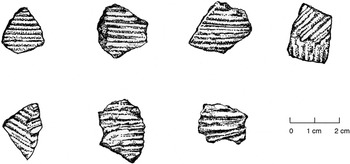
Sherds from the Terminal Classic period (a.d. 800–1100) occurred on the surface. All were fragmentary and greatly weathered, with no traces of a slip or painted decoration on any of them. Those with recognizable decoration consisted of parallel incised lines (Figure 2) on a paste with crystalline inclusions that corresponded to George Brainerd's Florescent Unslipped Ware (Brainerd 1958:52, Figures 38–39) and Robert Smith's Puuc Unslipped Ware (Smith 1971:145–148) of the Ceh Pech Complex. The separation of the zones of oblique incisions (Figure 1) is consistent with Brainerd's statement that the decoration of Unslipped Puuc jars consists of horizontal zones of diagonal incisions (Brainerd 1958:186, Figure 38).

Sample of Puuc Unslipped ware from the surface of the Yo' Sah Kab site collected in 1967 showing the striations characteristic of this ware. Sherds of this ware had crystalline inclusions that were probably ground crystalline calcite temper (Arnold 1971:33–34; Thompson 1958:69–71) like that formerly used in tempering cooking pottery in Ticul.
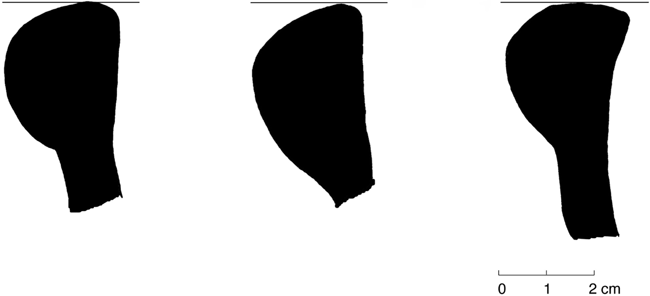
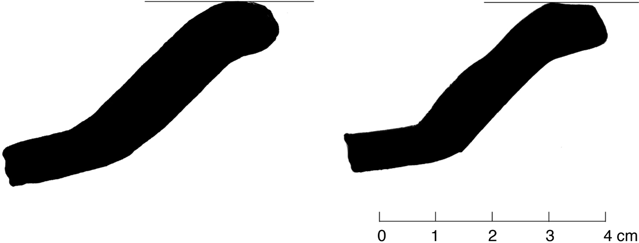
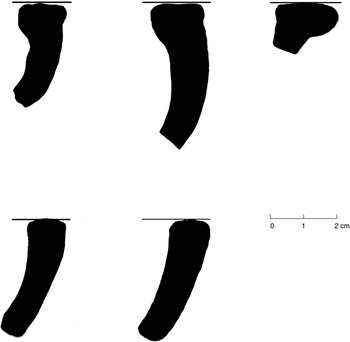
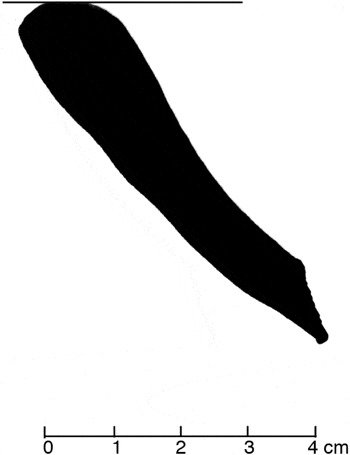
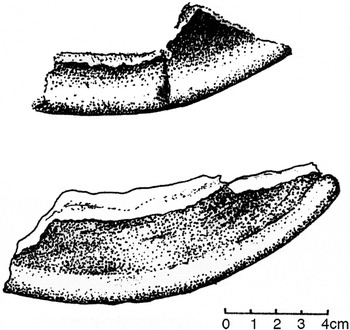
Rim sherds of bolster-rim basins (Figure 3), basal break bowls (Figure 4), and some undefined bowl (Figures 5 and 6) and jar forms (Figure 7) were also found. The bolster-rim basins are probably Puuc Slate Ware (Smith 1971:28, 148–153) because these basins are characteristic of this ware (Brainerd 1958:174–175, 196–199; Smith 1971:149–151).

Rim profiles of a sample of bolster-rim basins found at Yo' Sah Kab. Rims of bolster-rim basins and Puuc Unslipped ware (Figure 2) made up the majority of the identifiable surface collection.

Rim profiles of a sample of basal break bowls found at Yo' Sah Kab.

Rim profiles of a sample of undefined bowls from the surface of the Yo' Sah Kab site.

Rim profile of what appears to be a small food bowl from the surface of Yo' Sah Kab.

Basal view of two rim sherds from the surface of Yo' Sah Kab. These sherds could be from a modern vessel.
Although the site was close to the active temper mines in 1967, the area north of the road had not been used for mining temper. No evidence of the mining and preparation areas existed near the mounds similar to those areas that were being mined in the 1960s; the closest were approximately 100 m away. There was, however, a large hole approximately 4 m in diameter within a few meters of the ruined structures of the site. The hole was approximately 2 m deep, and it was filled with brush. Other than this feature, no evidence of any mining existed in the archaeological site on the north side of the road.
The hole in the site was probably a Terminal Classic mine used to obtain palygorskite. This inference is supported by two kinds of evidence. First, this site occurred directly over a palygorskite layer that was eventually mined for pottery temper. Between 1967 and 1984, fear of snakes and religious associations no longer kept miners from expanding their mining into the site; temper miners were no longer potters and may not have known about this folklore. As a result, by 1984 the area that had been the archaeological site was pockmarked with the mines and preparation areas that had characterized the preparation areas across the road to the south, and the site was completely destroyed. All of the remaining cut stone reportedly had been taken to Ticul, and no evidence of the site remained. When I asked about the site in 1984, my informant told me that he did not know where it was. When I asked whether we could search for it, he said that the forest was too thick, and we had no machete to cut through the vegetation. Furthermore, I had no permission to do an archaeological survey. I asked about the site again in 1994 during a visit to Yo' Sah Kab, but an informant reiterated that it had been totally destroyed.
The co-occurrence of a Terminal Classic settlement directly over a palygorskite deposit suggested that a small Terminal Classic population had deliberately established a presence for the purpose of mining the sak lu'um beneath it. Although the hole was not cleared or investigated, the mining activity that eventually destroyed the site indicated that the hole was dug directly into the palygorskite layer. The bolster-rim basins found at the site may have been used to transport the palygorskite in the same way that E. Wyllys Andrews (1970:15, 61) suggested for transporting clay and temper out of Balankanche Cave near Chichen Itza.
Although the antiquity of palygorskite mining is not as direct and definite as one would prefer, a second line of indirect evidence of its antiquity derives from the geological and cultural uniqueness of Yo' Sah Kab. Potters said that sak lu'um only comes from Yo' Sah Kab. Indeed, from 1965 until a new source opened in the late 1980s nearer Chapab, Yo' Sah Kab served as the sole source of sah kab temper and sak lu'um in the immediate area of Ticul. This uniqueness is borne out by geological reconnaissance. In 1968, Bohor and I surveyed many sah kab mines and former clay sources around Ticul, and none of them contained any palygorskite. Since the Yo' Sah Kab site dates to the Terminal Classic period, and there is no other apparent explanation for the location of the site or for the large hole there, it is probable that the exploitation of palygorskite at Yo' Sah Kab also dates to that time.
On the south side of the road, an informant-directed reconnaissance revealed other archaeological remains that also dated to the Terminal Classic period. In one rather isolated location, an oval outline of uncut stones appeared to be the remains of a structure. Sherds of Puuc Unslipped Ware from the Terminal Classic period covered the surface around the stones, and these sherds were identical to those found at the archaeological site across the road.
A temper-mining and -preparation area occurred around the structure. Like the current areas of temper mining, this area consisted of a depression with both open and collapsed mines that extended 5–6 m horizontally underground. Adjacent to this depression and at an oblique angle from it, there was a small area covered with tailings from the temper-preparation process. Sherds of Puuc Unslipped Ware occurred in the preparation area but were very fragmentary. Miners apparently had mixed and crushed the sherds with the tailings, and informants reported that miners had found ancient vessels buried within these tailings. To the north of the mining area away from the structure, two large, broken rectangular stone bowls were found. It thus appeared that modern miners were reusing a mining and temper-preparation area that had been used in the Terminal Classic period.
The antiquity of Yo' Sah Kab is also suggested by the ancient pottery that miners found when they were preparing temper. Potters said that during the first half of the twentieth century, Don Pilo Tzum found an apaste and red pitcher (jarra) in the tailings for temper preparation. More recently, another miner said that he had found ancient pottery on the surface when he was clearing a new preparation area to the north of the Chapab road in what had been the archaeological site; one sherd, he said, was the red rim of ancient vessel. Although the details of this pottery are not known, its presence suggests that at least some of the mining areas were located in an archaeological site.
The Yo' Sah Kab site also provided one datum that the ancient Maya recognized the distinction between sah kab for construction purposes and sah kab temper as early as the Terminal Classic period. When I visited Yo' Sah Kab in 1967, I collected one small sample of eroding mortar from a structure on the archaeological site there. The mortar sample was analyzed by X-ray diffraction by Bohor and contained calcite, dolomite, and a small amount of montmorillonite. It was qualitatively identical to the modern sah kab for construction (Arnold 1971). The existence of a plaster containing no palygorskite directly over the palygorskite deposit suggested that during the Terminal Classic period, the site's inhabitants had already distinguished the two types of sah kab: a palygorskite-containing calcareous mixture that was being mined nearby for pottery temper and a montmorillonite-containing calcareous marl that was used for mortars and plasters. Given the availability of both materials under and near the site, they could be easily confused. Apparently the Maya living at this Terminal Classic site had already found that montmorillonite-containing sah kab had certain advantages for mortars and plasters, such as its bonding ability and its case-hardening structure (Arnold 1971); had used it for mortars and plasters at the site; and had rejected the palygorskite-containing sah kab underneath the site for that purpose.
DISCUSSION
Isphording and E. M. Wilson (1974:484–485) claimed that both Ticul pottery clay (a random mixed layering of kaolinite and montmorillonite) and palygorskite are common in Yucatan. But if this is true, why are there place names that imply the materials obtained from them are associated only with three locations: Yo' K'at (the Ticul pottery clay), Yo' Sah Kab (palygorskite and temper), and Sacalum (palygorskite)? Why, if the mineral was so common, did the Maya reportedly come from great distances to obtain the sak lu'um (palygorskite) from the Sacalum cenote, and why was it transported and sold elsewhere in Yucatan? Further, why is Terminal Classic pottery associated with all of these locations? It seems not only that these three locations were important sources of these materials, but that the Maya recognized an important sense of place for each of them that transcended their utilitarian use. All were associated with religious beliefs: San Pedro was the patron saint of Yo' K'at (Arnold 1971); a bearded serpent was associated with Yo' Sah Kab; and a unique vision of the Virgin Mary was associated with the cenote at Sacalum. All of these associations reinforce the probable importance of these places to the contemporary Maya and underscore their uniqueness and probable importance to the ancient Maya, as well.
CONCLUSION
In the 1960s, the composition of Maya Blue was established as a clay-organic complex of indigo and palygorskite and/or sepiolite. Since then chemists and geologists have provided interpretations based on experimentation, field surveys, and laboratory analyses and unlocked many of the mysteries of this very unusual material. For archaeologists, however, the real importance of the Maya Blue lies in the relationship of the pigment and its constituents to Maya technology and culture. Although palygorskite occurs in many places in the Maya area, most of these deposits probably were not accessible to the ancient Maya in the quantities necessary to extract palygorskite for the treatment of illness and to produce Maya Blue. Only Ticul and Sacalum have the link between palygorskite and Maya culture to make them credible ancient sources of palygorskite, if not of Maya Blue itself.
While the symbolism of the color blue was undoubtedly very important to the ancient Maya, the medicinal uses of both of the ingredients of Maya blue, palygorskite and indigo, suggest that the symbolism of the pigment went beyond sacrifice. The ritual combination of these constituents into Maya Blue during the burning of incense may have linked the medicinal qualities of indigo and palygorskite into a powerful symbol of healing as well as sacrifice.
Ethnoarchaeology has related the palygorskite in Maya Blue to palygorskite mining in contemporary Maya culture in Ticul and Sacalum and has suggested two probable mining sites for the mineral. The first of these was the cenote at Sacalum. The second source lies at Yo' Sah Kab near Ticul, where a Terminal Classic site lay atop a palygorskite deposit. Unfortunately, the site was in such a critical location that, when temper mining intensified and expanded, the site was completely destroyed.
Rather than let chemists, geologists, and material scientists define the problems and drive the conclusions about Maya Blue, an ethnoarchaeological approach to its constituents provides a cultural context for it and relates it to Maya knowledge about raw materials, landscape, and technology. While the technical analyses of Maya Blue are important, and chemists and material scientists have unlocked the secrets of the composition (and perhaps the preparation) of Maya Blue, archaeologists should not lose sight of the fact that Maya Blue and its production (like all technology) is socially embedded and needs to be understood within its cultural context.
RESUMEN
Este artículo presenta un resumen de las investigaciones asociadas con el color azul maya además de los datos de otra posible fuente precolombina del mineral palygorskita, uno de los componentes principales del azul maya.
El azul maya es un pigmento antiguo visto en cerámicas, esculturas, murales y bolitas de copal, todos producidos durante las épocas clásica y postclásica en varias áreas de Mesoamérica, desde la península de Yucatan hasta Guatemala y la meseta central de México. Descubierto en 1931 por Merwin en los murales de Chichen Itza, el azul maya es un color resistente que no exhibe deterioración ni daños procedentes de ácidos, solventes, temperaturas moderadas, ni de corrosión climáctica. La composición del azul maya no se supo hasta el 1962, cuando Gettens publicó análisis de refracción rayos-X, los cuales revelaron que el pigmento contiene el mineral arcilloso “palygorskita” (éste se denominaba “atapulguita” en aquella época). A fines de los 1960, químicos belgas y españoles descubrieron que el azul maya también contiene el pigmento de añil. Uno de estos investigadores sugirió un método para la producción de un pigmento semejante al color antiguo. En esta misma época, una investigación etnográfica en el Yucatan realizada por Arnold, descubrió que el sak lu'um (la tierra blanca) usada para elaborar cerámicas en el pueblo de Ticul, y también con propósitos medicinales en la comunidad de Sacalúm, en efecto corresponde al mineral palygorskita. En Ticul, los alfareros usan el sak lu'um como ingrediente principal de temperante mezclada con barro para fabricar vasijas, alcancías, maceteros y otros artefactos. En Sacalúm, se usa el sak lu'um como medicina para tratar una variedad de enfermedades: se lo administra a mujeres embarazadas y a niños con el vicio de comer tierra.
Estos datos etnográficos sugirieron que las fuentes de palygorskita en Sacalúm y Ticul quizá serían fuentes importantes del mineral usado por los mayas antiguas para elaborar el azul maya. Los datos etnográficos presentados por Folan tanto como los artefactos encontrados en el cenote de Sacalúm, indican que Sacalúm existe desde hace la época precolombina. Datos del Libro de Chilam Balam de Chumayel indican que los Itzáes ecuperaban la salud en Sacalúm y Ticul; quizás ingerían el sak lu'um para recuperarse.
Una segunda fuente precolombina de palygorskita se encuentra en Yo' Sah Kab, a unos 3.5 km de Ticul, en un yacimiento subterráneo de palygorskita. En este lugar se encuentra un sitio arqueológico del período clásico-terminal; su ubicación encima del yacimiento indica palygorskita de los mayas antiguos. Que además de Sacalúm, Yo' Sah K'ab era probablemente otra fuente de polygorskita de los mayas antiguos.
Por razón de que científicos como químicos y geólogos han interpretado las fuentes del palygorskita y del azul maya desde la perspectiva de su propias disciplinas, este artículo concluye que tales interpretaciones necesitan tomar en cuenta el punto de vista de la cultura maya, además de las realidades de la topografía antigua antes de su modificación posterior por ferrocarriles y carreteras.
ACKNOWLEDGMENTS
A number of individuals and organizations have made this research possible. The Illinois Geological Survey, the University of Illinois Research Board, the Department of Anthropology of the University of Illinois, the Research Office of the College of Liberal Arts of the Pennsylvania State University, and an American Republics Research Grant under the Fulbright program provided funds for much of the research for this paper. A National Endowment for the Humanities grant (RK 20191-95) provided 2 years of support for the analysis and writeup of data of which this article is a small part. This grant, a grant from the Wenner-Gren Foundation for Anthropological Research, and the Wheaton College Alumni Association supported research in Yucatan in 1997. The Wheaton College Norris Aldeen Fund provided funding to prepare the illustrations for publication. Michelle Arnold made the sherd drawings, and George Pierce produced the map. The now defunct Interuniversity Project for Behavioral Science Training in Yucatan and its former director, the late Herman Konrad, provided housing and field-support facilities in Yucatan between 1965 and 1968. I am also grateful for the inspiration and encouragement of the late Don W. Lathrap, who first alerted me to the relationship of my field research to Maya Blue when palygorskite was first discovered in my samples of sak lu'um from Yucatan. Luis Torres and Alejandro Huerta (of the Paul Coremans Institute of Fine Arts of the Instituto Nacional de Antropología e Historia) both encouraged and corrected me in the early years of this research and shared much information with me about the research on Maya Blue done by Mexican chemists. Christine Kepner of the Department of Foreign Languages, Wheaton College, aided in the writing of the Spanish resumen. Linda S. Roundhill made many helpful comments on the manuscript, and Jeffery Greenberg provided documentation about X-ray diffraction.
References
REFERENCES
Andrews, E. Wyllys, IV
1970
Balankanche, Throne of the Tiger Priest.
Middle American Research Institute Publication 32.
Tulane University,
New Orleans.
Arnold, Dean E.
1967
Sak lu'um in Maya Culture and Its Possible Relationship to Maya
Blue.
Department of Anthropology Research Reports No. 2.
University of Illinois,
Urbana.
Arnold, Dean E.
1971
Ethnomineralogy of Ticul, Yucatán Potters: Etics and
Emics.
American Antiquity
36:20–40.Google Scholar
Arnold, Dean E.
1987
The Evidence for Pre-Columbian Indigo in the New World.
Antropología y Técnica
2:53–84.Google Scholar
Arnold, Dean E.
2000
Does the Standardization of Ceramic Pastes Really Mean
Specialization?
Journal of Archaeological Method and Theory
7:333–375.Google Scholar
Arnold, Dean E.
2003
What Does Pottery Tell Us about Social Change? Ms. on file,
Department of Sociology/Anthropology, Wheaton College, Wheaton, IL.
Arnold, Dean E., and
Bruce F. Bohor
1975
Attapulgite and Maya Blue: An Ancient Mine Comes to Light.
Archaeology
28:23–29.Google Scholar
Arnold, Dean E., and
Bruce F. Bohor
1976
An Ancient Attapulgite Mine in Yucatán.
Katunob
8(4):25–34.Google Scholar
Arnold, Dean E., and
Bruce F. Bohor
1977
The Ancient Clay Mine at Yo' K'at, Yucatán.
American Antiquity
42:575–582.Google Scholar
Arnold, Dean E.,
Hector Neff,
Ronald L. Bishop, and
Michael D. Glascock
1999
Testing Interpretive Assumptions of Neutron Activation Analysis:
Contemporary Pottery in Yucatán, 1964–1994. In
Material Meanings: Critical Approaches to the Analysis of
Style, edited by
Elizabeth Chilton, pp.
61–84.
University of Utah Press,
Salt Lake City.
Bailey, S.W.,
G.W. Brindley,
W.D. Johns,
R.T. Martin, and
M. Ross
1971
Summary of National and International Recommendations on Clay
Mineral Nomenclature: 1969–70 CMS Nomenclature Committee.
Clays and Clay Minerals
19:129–132.Google Scholar
Barrera Vázquez, Alfredo
1937
Cerámica Maya.
Obre, Órgano de la Universidad Nacional del Sureste de
México
1(3):162–164.Google Scholar
Berlin, Brent, and
Paul Kay
1969
Basic Color Terms: Their Universality and Evolution.
University of California Press,
Berkeley.
Bohor, Bruce F.
1975
Attapulgite in Yucatán. In
Guidebook to Field Trip No. 4, pp.
95–125.
International Clay Conference, Mexico City.
Geological Society of America,
Boulder, CO.
Brainerd, George W.
1958
The Archaeological Ceramics of Yucatán.
Anthropological Records Vol. 19.
University of California,
Berkeley.
Cabrera Garrido, José
María
1969
El ‘Azul Maya’. Informes y Trabajos del Instituto
de Conservación y Restauración de Obras de Arte,
Arqueología y Etnología 8. Madrid.
Carroll, Dorothy
1970
Clay Minerals: A Guide to Their X-Ray Identification.
Geological Society of America Special Paper No.
126.
DuPont, H.L.,
D.D. Ericsson,
M.W. DuPont,
A.C. Luna, and
J.J. Mathewson
1990
A Randomized, Open-Label Comparison of Nonprescription Loperamide
and Attapulgite in the Symptomatic Treatment of Acute Diarrhea.
American Journal of Medicine 88(Supplement
6A):20S–23S.
Folan, William J.
1969
Sacalum, Yucatán: A Pre-Hispanic and Contemporary Source of
Attapulgite.
American Antiquity
34:182–183.Google Scholar
Gettens, Rutherford J.
1955
Identification of Pigments of Mural Paintings from Bonampak,
Chiapas, Mexico. In
Bonampak, Chiapas, Mexico, edited by Karl Ruppert, J. Eric S.
Thompson, and Tatiana Proskouriakoff, p. 67. Carnegie Institution of
Washington Publication 602.
Carnegie Institution of Washington,
Washington, DC.
Gettens, Rutherford J.
1962
Maya Blue: An Unsolved Problem in Ancient Pigments.
American Antiquity
27:557–564.Google Scholar
Grim, Ralph E.
1968
Clay Mineralogy,
2nd ed. McGraw-Hill, New York.
Hubbard, B.,
C. Detellier,
W. Juang,
A. Moser, and
G.A. Facey
2003
Structural Study of Maya Blue: Textural, Thermal and Solid-state
Multinuclear Magnetic Resonance Characterization of the
Palygorskite-Indigo and Sepiolite-Indigo Adducts.
Clays and Clay Minerals
51:318–326.Google Scholar
Isphording, Wayne C.
1974
Combined Thermal and X-ray Diffraction Technique for Identification
of Ceramicware Temper and Paste Minerals.
American Antiquity
39:477–488.Google Scholar
Isphording, Wayne C., and
E.M. Wilson
1974
The Relationship of “Volcanic Ash” Sak
Lu'um, and Palygorskite in Northern Yucatán Maya
Ceramics.
American Antiquity
39:483–488.Google Scholar
José-Yacamán, M.L.
Rendón,
J. Arenas, and
M.C. Serra Puche
1996
Maya Blue Paint: An Ancient Nanostructured Material.
Science
273:223–225.Google Scholar
Kleber, R.,
L. Masschelein-Kleiner, and
J. Thissen
1967
Étude et Identification du “Bleu Maya.”
Studies in Conservation
12:41–56.Google Scholar
Lemonnier, Pierre
1993
Introduction. In
Technological Choices: Transformation in Material Cultures since the
Neolithic, edited by
Pierre Lemonnier, pp.
1–35.
Routledge,
London.
Littmann, Edwin R.
1982
Maya Blue—Further Perspectives and the Possible Use of Indigo
as the Colorant.
American Antiquity
47:404–408.Google Scholar
Merwin, H.E.
1931
Chemical Analysis of Pigments. In
The Temple of the Warriors at Chicken Itzá,
Yucatán, edited by
E.H. Morris,
J. Charlot, and
A.A. Morris.
Carnegie Institution of Washington Publication 606.
Carnegie Institution of Washington,
Washington, DC.
Moore, Duane M., and
Robert C. Reynolds, Jr.
1997
X-Ray Diffraction and the Identification and Analysis of Clay
Minerals,
2nd ed.
Oxford University Press,
Oxford.
Redfield, Robert, and
Margaret Park Redfield
1940
Disease and Its Treatment in Dzitás, Yucatán.
Carnegie Institution of Washington Publication 523.
Carnegie Institution of Washington,
Washington, DC.
Rendón, Silvia
1947
Notas sobre la Alfarería Indígena de la Peninsula de
Yucatán.
Revista Mexicana de Estudios Antropológicos
9:107–123.Google Scholar
Reyes-Valerio, Constantino
1993
De Bonampak al Templo Mayor: El Azul Maya en Mesoamerica.
Siglo XXI,
Mexico City.
Roundhill, Linda S.,
Dorie Regents-Bidet,
Patrick McGovern, and
Rudolph Michael
1989
Maya Blue: A Fresh Look at an Old Controversy.
Seventh Palenque Round Table, 1989, Vol. IX, edited by
M.G. Robertson and
V.M. Fields, pp.
253–256.
Pre-Columbian Research Institute,
San Francisco.
Roys, Ralph L.
1931
The Ethnobotany of the Maya.
Middle American Research Series Publication 2.
Tulane University,
New Orleans.
Roys, Ralph L.
1933
The Book of Chilam Balam of Chumayel.
Carnegie Institution of Washington Publication 438,
Carnegie Institution of Washington, Washington, DC.
Schultz, L.G.,
A.O. Shepard,
P.D. Blackmon, and
H.C. Starkey
1971
Mixed-Layer Kaolinite–Montmorillonite from the Yucatán
Peninsula, Mexico.
Clays and Clay Minerals
19:137–150.Google Scholar
Shepard, Anna O.
1962
Maya Blue: Alternative Hypotheses.
American Antiquity
27:565–566.Google Scholar
Shepard, Anna O.
1971
Ceramic Analysis: The Interrelations of Methods; the Relations of
Analysts and Archaeologists. In
Science and Archaeology, edited by
Robert H. Brill, pp.
55–63.
MIT Press,
Cambridge, MA.
Shepard, Anna O., and
Hans B. Gottlieb
1962
Maya Blue: Alternative Hypotheses.
Notes from a Ceramic Laboratory No. 1.
Carnegie Institution of Washington,
Washington, DC.
Shepard, Anna O., and
Harry E.D. Pollock
1971
Maya Blue: An Updated Record.
Notes from a Ceramic Laboratory No. 4.
Carnegie Institution of Washington,
Washington DC.
Smith, Robert E.
1971
The Pottery of Mayapán.
Papers of the Peabody Museum of Archaeology and Ethnology, Vol.
66, Parts I and II.
Harvard University,
Cambridge, MA.
Thompson, Raymond H.
1958
Modern Yucatecan Maya Pottery Making.
Memoirs of the Society for American Archaeology No. 15.
Salt Lake City,
UT.
Torres, Luis M.
1988
Maya Blue: How the Mayas Could Have Made the Pigment.
Materials Issues in Art and Archaeology, Proceedings of the
Materials Research Society
123:123–128.Google Scholar
Tozzer, Alfred M.
1941
Landa's Relación de los Cosas de Yucatán: A
Translation.
Papers of the Peabody Museum of Archaeology and Ethnology, Vol.
18.
Harvard University,
Cambridge, MA.
U.S. National Library of Medicine
2004
Attapulgite (Oral). Electronic document. MedlinePlus, National
Institutes of Health. Available at:
www.nlm.hih.gov/medlineplus/druginfo. Accessed 20 July
2004.
Vail, Gabrielle
2002
The Madrid Codex: A Maya Hieroglyphic Book, Version 1.0.
Electronic document. Available at: http://www.doaks.org/codex.
Map of the State of Yucatan and adjacent areas of the State of Campeche showing cities, towns, and archaeological sites mentioned in the text.
Sample of Puuc Unslipped ware from the surface of the Yo' Sah Kab site collected in 1967 showing the striations characteristic of this ware. Sherds of this ware had crystalline inclusions that were probably ground crystalline calcite temper (Arnold 1971:33–34; Thompson 1958:69–71) like that formerly used in tempering cooking pottery in Ticul.
Rim profiles of a sample of bolster-rim basins found at Yo' Sah Kab. Rims of bolster-rim basins and Puuc Unslipped ware (Figure 2) made up the majority of the identifiable surface collection.
Rim profiles of a sample of basal break bowls found at Yo' Sah Kab.
Rim profiles of a sample of undefined bowls from the surface of the Yo' Sah Kab site.
Rim profile of what appears to be a small food bowl from the surface of Yo' Sah Kab.
Basal view of two rim sherds from the surface of Yo' Sah Kab. These sherds could be from a modern vessel.
 You have
Access
- 54
- Cited by