


Introduction
Hookworms of the genus Uncinaria Frölich, 1789 (Nematoda: Ancylostomatidae) have been widely reported to parasitize pinniped pups from various geographical regions worldwide, and they are sometimes associated with pup mortality (Castinel et al., Reference Castinel2006; Nadler et al., Reference Nadler2013). Despite their high potential pathogenicity, little is known about their diversity and impact on wildlife populations (Seguel and Gottdenker, Reference Seguel and Gottdenker2017). Currently, four species of Uncinaria are recognized in pinniped pups: Uncinaria lucasi Stiles, 1901, which is found in northern fur seals (Callorhinus ursinus), Uncinaria hamiltoni Baylis, 1933, which is found in South American sea lions (Otaria flavescens), Uncinaria sanguinis Marcus et al., 2014, which is found in Australian sea lions (Neophoca cineria), and Uncinaria lyonsi Kuzmina & Kuzmin, 2015, which is found in Californian sea lions (Zalophus californianus).
Taxa that cannot readily be distinguished morphologically, but for which there is evidence that they are different evolutionary units, are commonly named cryptic species (Struck et al., Reference Struck2018). In the last decade, the number of publications referring to cryptic species has increased dramatically due to the increased use of molecular markers (e.g. Sepúlveda and González, Reference Sepúlveda and González2014; Halnet et al., Reference Halnet, Schmidt and Bolek2015). Morphological (mainly morphometric) differences have often been reported between Uncinaria specimens collected from different pinniped species, but it is unclear whether these are interspecific differences or whether they correspond to intraspecific morphometric variations associated either with host geography and/or host–species identity (George-Nascimento et al., Reference George-Nascimento, Lima and Ortiz1992; Nadler et al., Reference Nadler2000, Reference Nadler2013; Castinel et al., Reference Castinel2006; Ramos et al., Reference Ramos2013).
A comprehensive phylogenetic molecular analysis of Uncinaria spp. from pinnipeds demonstrated seven independent evolutionary lineages (Nadler et al., Reference Nadler2013). Five of these species were associated with specific hosts: one species (currently named U. lyonsi) parasitizes the Californian sea lion (Z. californianus), and the remaining undescribed species parasitize the New Zealand sea lion (Phocarctos hookeri), Australian fur seal (Arctocephallus pusillus doriferus), southern elephant seal (Mirounga leonina), and Mediterranean monk seal (Monachus monachus). Additionally, Nadler et al. (Reference Nadler2013) demonstrated that U. lucasi parasitizes C. ursinus and Eumetopias jubatus, whereas U. hamiltoni parasitizes the South American fur seal (Arctocephallus australis) and South American sea lion (O. flavescens). However, Uncinaria specimens from A. australis and O. flavescens from the south-eastern Pacific (SEP) coast have not been examined previously, so the identity of Uncinaria parasitizing pinniped populations from SEP remains unknown, in addition to the geographical range of U. hamiltoni along the South American coast.
The South American pinnipeds (A. australis and O. flavescens) are distributed from the Peruvian coasts (SEP) to the Brazilian coasts (South Atlantic). However, A. australis is absent along 2300 km of the Chilean coastline (SEP), from the Antofagasta coast (23°S) to Chiloe Island (43°S) (Pavés, Reference Pavés2008; Túnez et al., Reference Túnez2013). Moreover, based on genetic and morphological differences, it has been postulated that A. australis colonies from the Peruvian, southern Chilean, and Atlantic coasts are subspecies (Oliveira et al., Reference Oliveira2008; Berta and Churchill, Reference Berta and Churchill2012). It is therefore possible that these SEP otariids harbour a species of Uncinaria that is distinct from U. hamiltoni.
In this study, we present morphometric and molecular analyses of Uncinaria populations based on partial sequences of nuclear ribosomal DNA (internal transcribed spacer (ITS) rDNA and the D2/D3 region of the large subunit (LSU) rDNA) and mitochondrial DNA (cytochrome c oxidase subunit I (COI)). In addition, using developed theoretical models that combine species phylogenies and gene genealogies via ancestral coalescent processes (Pons et al., Reference Pons2006; Monaghan et al., Reference Monaghan2009; Powell et al., Reference Powell2011), ITS rDNA sequence data were used in a species delimitation analysis.
Materials and methods
Sampling areas and collection of hookworms
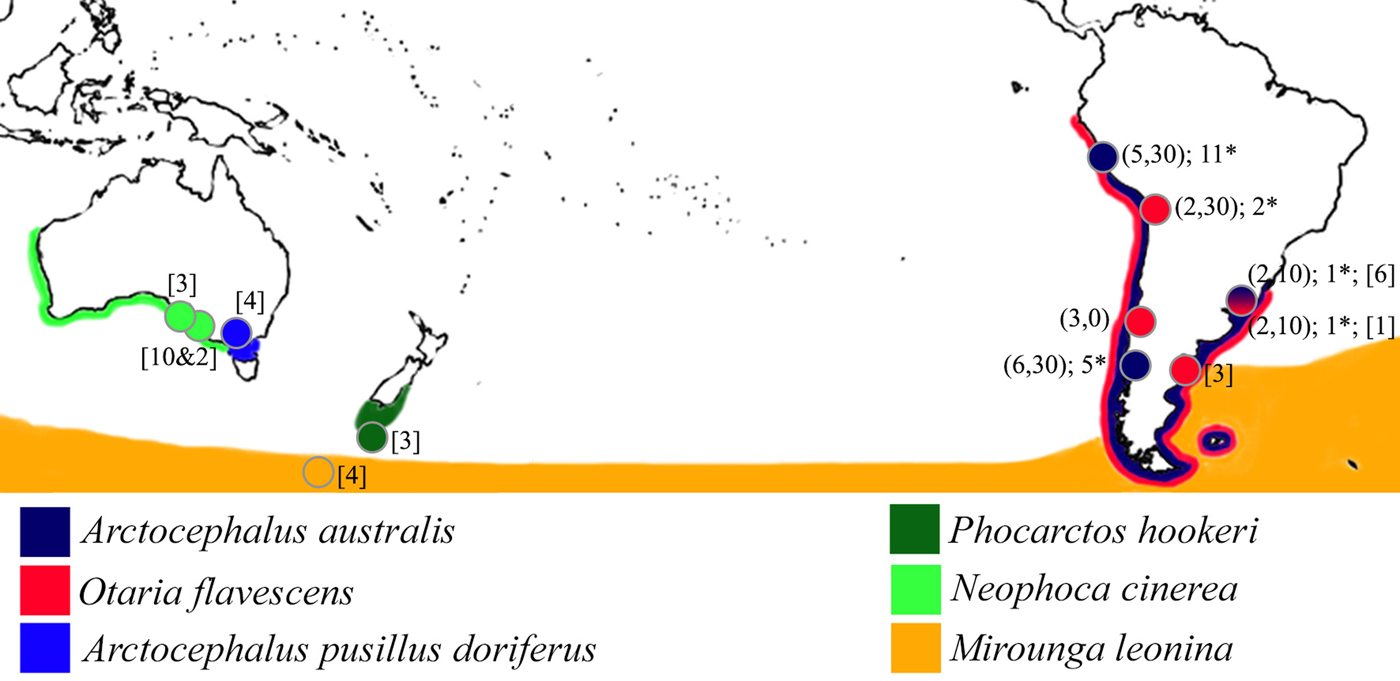
Adult specimens of Uncinaria were collected from five A. australis pups in Ica, Peru (12°S; n = 30), six A. australis pups in southern Chile (43°S, n = 30), and two O. flavescens pups in northern Chile (20°S; n = 30). Otaria flavescens pups sampled in central Chile (36°S) were also found to be parasitized with Uncinaria specimens. Additionally, ten parasites were collected from two A. australis pups and ten parasites were collected from two O. flavescens pups from the Uruguayan coast (fig. 1). Sampling in the Punta San Juan reserve, Peru, was authorized by SERNANP-RNSIIPG (resolution no. 09-2013-SERNANP-RNSIIPG). Sampling in Uruguay was authorized by DINARA (no. 584/2006). Sampling in southern Chile was performed using the framework of the “Guafo Island Conservation Program”, and SERNAPESCA authorized sampling in northern and central Chile. One female specimen, preserved in ethanol, was deposited in Natural History Museum of Chile, and it was labelled as MNHNCL NEM-15015.
Map showing host distributions and sampled localities. The number of examined hosts per locality and the number of parasites used for morphometric analyses are indicated in parentheses, and the numbers of parasites used for DNA analyses are indicated in square brackets. * indicates sequences obtained from GenBank.
Morphometric study
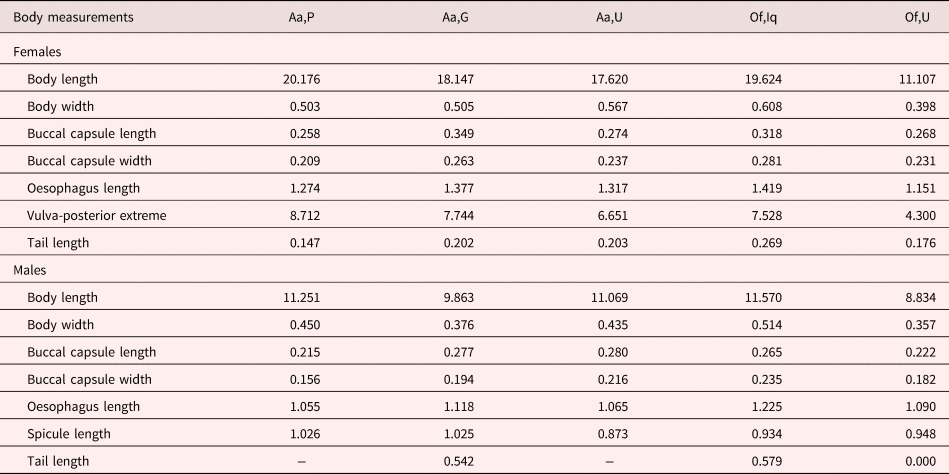
The Uncinaria specimens were preserved in 70% ethanol, cleared, and temporarily mounted on slides with lactophenol. Each Uncinaria specimen was observed and measured under light microscopy and body measurements were performed (table 1). Principal component analysis (PCA) was performed based on parasite body measurements relative to total body length (BL). The measurements for both Uncinaria sexes were as follows: body width/BL, oesophagus length/BL, buccal capsule length/BL, buccal capsule width/BL, and tail length/BL. For females, the distance from the vulva to the posterior end/BL was also measured, and for males, the spicule length/BL was measured.
Mean body measurements (mm) of Uncinaria specimens collected from Arctocephalus australis and Otaria flavescens in different geographical areas. Aa,P = A. australis from Peru; Aa,G = A. australis from Guafo Island, southern Chile; Aa,U = A. australis from Uruguay; Of,Iq = O. flavescens from Iquique (northen Chile, 20°S); Of,U = O. flavescens from Uruguay.
Molecular analyses
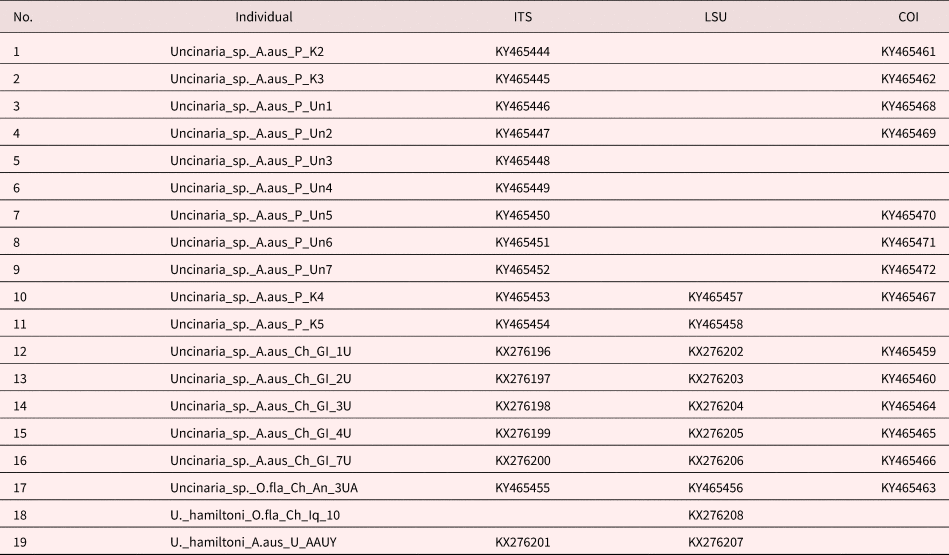
For sequencing, 19 adult Uncinaria from A. australis and O. flavescens were isolated individually and placed into a 1.5 ml microcentrifuge tube. Details of the numbers of specimens sequenced by host species and host geography as well as the GenBank accession numbers are shown in table 2. DNA extraction was performed by adding 500 μl of 5% Chelex and 2.5 ml of proteinase K (20 mg/ml) to each tube. The samples were incubated at 60°C for 4 h and boiled for 8 minutes. Two regions of nuclear rDNA and one region of mitochondrial DNA were amplified individually by polymerase chain reaction (PCR). The rDNA involved the ITS and 5.8S subunit regions (ITS-1, 5.8S, and ITS-2) and the D2/D3 region of the LSU (large subunit ribosomal DNA (lsrDNA)). The primers and cycling conditions followed the protocol described by Nadler et al. (Reference Nadler2013). The mitochondrial DNA involved the COI region, which was amplified using the following specially designed primers: UCoxF (5′-TTCCTTTAATGTTGGGTGCT-3′) and UCoxR (5′-GTAGCAGCCGTAAAATAAGC-3′). The amplifications were performed using the following parameters: initial denaturation at 95°C for 2 minutes; 35 cycles of 30 s at 95°C, 40 s at 56°C, 1 minute at 72°C; and a final extension for 10 minutes at 72°C. All amplifications, including positive and negative controls, were checked using 1.5% agarose gels with Tris/acetic acid buffer, with an appropriate molecular-weight ladder. The gels were visualized in an ultraviolet (UV) transilluminator. The PCR products were sequenced by Macrogen, Inc. (Seoul, South Korea; http://www.macrogen.com). Complementary sequences were assembled and edited using ProSeq v2.9 (Filatov, Reference Filatov2002). The fragments were aligned using the ClustalW algorithm with BioEdit software (Hall, Reference Hall1999).
GenBank accession numbers for sequences of ITS, LSU and COI genes, respectively, corresponding to parasite individuals collected for this study. Individuals 1–11: Uncinaria specimens from A. australis from Peru; 12–16: Uncinaria specimens from A. australis from Guafo, southern Chile; 17–18: Uncinaria specimens from O. flavescens from northern Chile; 19: Uncinaria specimens from O. flavescens from Uruguay.
For the phylogenetic analysis, the ITS and LSU datasets were analysed using Bayesian inference (BI), maximum-likelihood (ML), and maximum-parsimony (MP) methods. The MP method was performed using PAUP* 4.0b10 (Swofford, Reference Swofford2001). The ML method was performed using raxmlGUI version 1.5 (Silvestro and Michalak, Reference Silvestro and Michalak2012), with the GTR + G model being used for ITS and the GTR + I and GTR + G models being used for LSU. The BI method was performed using MrBayes software (Huelsenbeck et al., Reference Huelsenbeck2001). The MP analyses were performed using a heuristic search strategy with random-addition sequences. For the BI analyses, the HKY + G and HKY + I models were used for ITS, and the HKY + G model was used for LSU.
The node supports were evaluated statistically by bootstrapping involving 1000 resamples for ML and MP, respectively (Efron, Reference Efron1982). JModeltest 2 (Darriba et al., Reference Darriba2012) was used to compare the fit of nucleotide substitution models using the Akaike criterion. For BI inference, posterior probabilities were estimated over 10,000,000 generations via three runs with Markov Chain Monte Carlo (MCMC), with every 1000th tree saved. The first 1000 generations (10% burn-in) were discarded, as suggested by Nylander et al. (Reference Nylander2004), and the consensus trees were built with 1000 trees. The sequences were contrasted with Uncinaria spp. sequences (Nadler et al., Reference Nadler2013; Ramos et al., Reference Ramos2013; Haynes et al., Reference Haynes2014; Catalano et al., Reference Catalano2015). Ancylostoma caninum (GenBank accession no.: AM039739.1) (Chilton et al., Reference Chilton2006), A. caninum (JQ812694) (Lucio-Forster et al., Reference Lucio-Forster2012), and U. stenocephala (AJ407939.1) (Hu et al., Reference Hu2002) were used as outgroup species for the LSU and ITS genes. Individual parasites were classified into groups according to host species and host geography, and the distances were computed based on the mean number of mutations (substitutions). The divergence between groups was determined using the TN93 + G model and the number of mutations, in base pairs (bp), which was performed using Mega version 7 software (Kumar et al., Reference Kumar, Stecher and Tamura2016). In the ITS gene matrix, there were gaps and the sequences for U. rauschi and U. yukonensis were shorter; therefore, these spaces were filled with the “-” symbol representing missing. The LSU gene matrix did not have gaps.
Species delimitation analyses
We used the ITS sequences and the Generalized Mixed Yule Coalescent (GMYC) coalescent-based approach to test the alternative hypotheses of species delimitation outlined by Pons et al. (Reference Pons2006). Based on this, we used three Bayesian methods for reconstructing ultrametric trees: a strict-clock analysis with a coalescent prior, and two relaxed lognormal clock analyses, one using a coalescent prior and one using a Yule prior with the program BEAST 2 (Bouckaert et al., Reference Bouckaert2014). The DNA substitution model was chosen using jModelTest. We performed several initial runs considering a range of ITS mutation rates from 0.10 to 3.0% per Ma as the lower and higher thresholds. A Bayes factor analysis (Li and Drummond, Reference Li and Drummond2012) indicated that the uncorrelated lognormal relaxed-clock model using a mutation rate equal to a 1% per Ma divergence rate received decisive support in comparison with the uncorrelated exponential or strict-clock models. All other parameters were set to default. Two independent MCMC chains were run for 50 million generations and sampled every 1000 generations, resulting in 50,000 trees for each run. The first 10,000 trees were then discarded from each run, and the independent log and tree files were combined using LogCombiner version 2.4.7 (Bouckaert et al., Reference Bouckaert2014). The maximum clade credibility tree found using TreeAnnotator version 2.4.7 (Bouckaert et al., Reference Bouckaert2014) with all options set to default was used as input data for the GMYC model. The GMYC model was optimized using the script available within the SPLITS package (http://r-forge.r-project.org/projects/splits/) for R.
Results
Morphometry
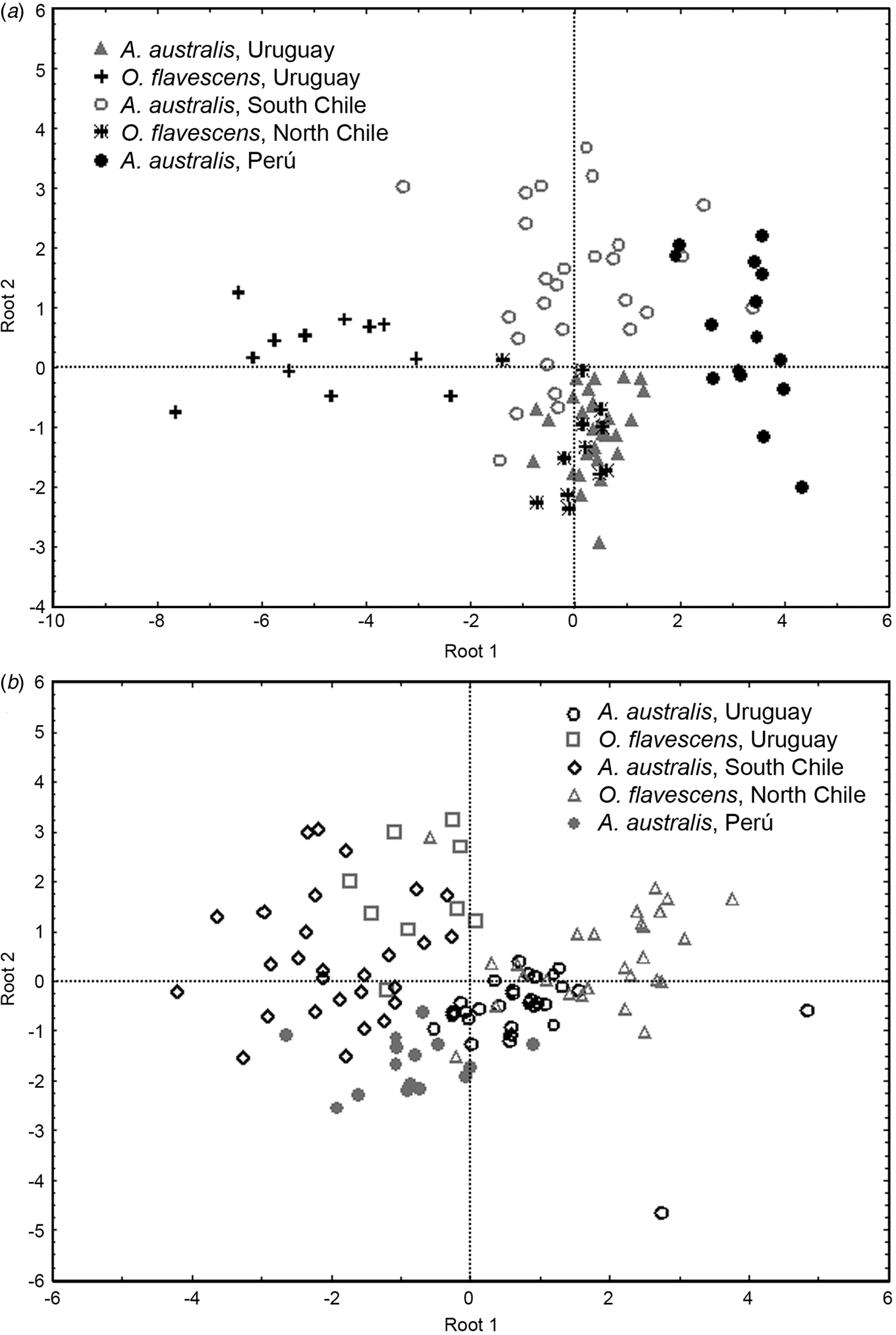
The morphometry of Uncinaria females infesting A. australis from Peru differed significantly from that of the Uncinaria females infesting O. flavescens and A. australis from the Uruguayan and Chilean coasts (table 1; fig. 2a). The most important relative measurements for distinguishing between Uncinaria females were buccal capsule length/BL, buccal capsule width/BL, and oesophagus length/BL (factor loads > 0.90). The morphometric differences between Uncinaria males of different hosts and locations were less clear than the differences between Uncinaria females. Nevertheless, Uncinaria males infesting A. australis from Peru differed from Uncinaria males infesting A. australis from southern Chile and A. australis from the Uruguayan coast, and from Uncinaria males infesting O. flavescens from northern Chile (fig. 2b). Only the length and width of the buccal capsule/BL were important for distinguishing among males from different hosts and locations (factor load > 0.89).
Results of principal component analyses using morphometric measurements of (a) female and (b) male Uncinaria specimens collected from A. australis and O. flavescens from the coasts of Uruguay, northern Chile (20–24°S), southern Chile (42°S) and Peru (11°S).
Phylogenetic analyses
The total lengths of the ITS, LSU and COI sequences were 782, 511 and 688 bp, respectively. The ITS analyses showed high resolution in the middle and basal nodes, and the LSU analyses showed high resolution in the middle and terminal branches. For both genes, the terminal branches did not exhibit good resolution due to polytomies. The phylogenetic relationships, based on different analyses (BI, ML and MP), showed low congruence, but the bootstrap values for IB, ML and MP were high. Four clades of Uncinaria were observed based on the ITS gene (fig. 3a).
Phylogenetic tree of specimens of Uncinaria spp. obtained from the hosts Arctocephalus australis (A. aus) and Otaria flavescens (O. fla) from Guafo Island-Chile (Ch-IG), Antofagasta-Chile (Ch-An), Iquique-Chile (Ch) and Peru (P), based on maximum likelihood (ML) analyses of the (a) ITS and (b) LSU genes. Numbers along branches indicate the percentages of support values resulting from the different analyses in the order ML/IB/MP for ITS gene and LSU gene. Values lower than 50% are indicated by dashes or are not indicated. The abbreviations for localities are Maldonado-Uruguay (U-Mal), Rocha-Uruguay (U-Roc), Punta Leon-Argentina (A-PLe), Victoria-Australia (Au-Vi), Australia (Au), New Zealand (NZ), Russia (R), Alaska-United States of America (USA-AK), and United States of America (USA). Hosts: Arctocephalus pusillus doriferus (A.pd), Neophoca cinerea (N. cin), Eumetopias jubatus (E. jub), Mirounga leonina (M. leo), Monachus monachus (M.mon), Zalophus californianus (Z. cal), Phocarctos hookeri (P. hoo), and Callorhinus ursinus (C. urs).
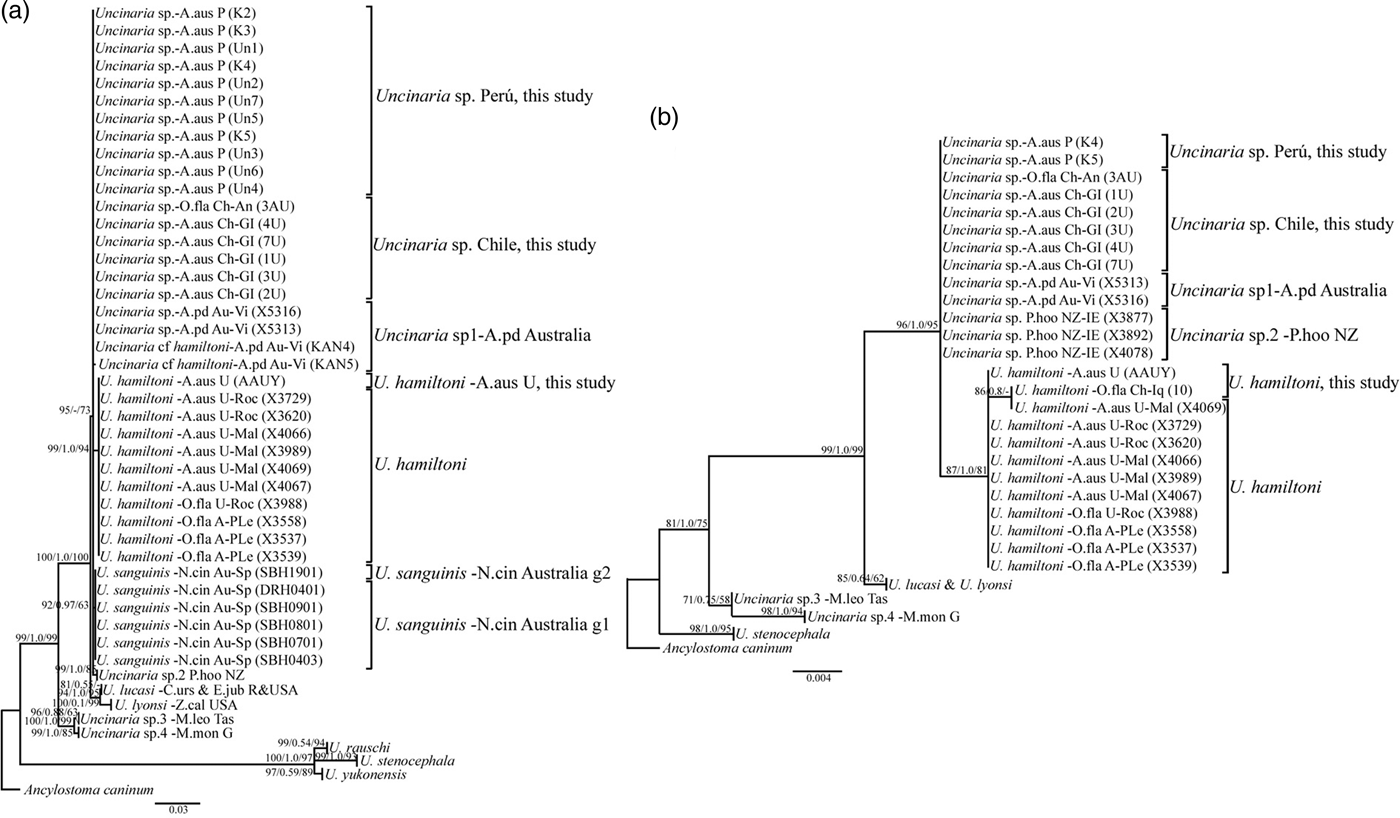
The first ancestral clade was composed of U. stenocephala, U. rauschi and U. yukonensis. The second clade was composed of Uncinaria spp. from Phocidae hosts (M. leonina and M. monachus). The third clade was composed of U. lucasi and U. lyonsi, which parasitize Otariidae hosts from the northern hemisphere. The fourth clade was composed of Uncinaria spp. parasitizing pinnipeds from South America (U. hamiltoni and Uncinaria sp. from Peru and Chile), Australia (U. sanguinis and Uncinaria sp. from A. pusillus doriferus), and New Zealand (Uncinaria sp. from P. hockeri), which formed a polytomy. In turn, the LSU gene analysis showed that U. hamiltoni was the most recent species obtained from Otariidae hosts along the South American coasts.
Regarding the MP analysis of the ITS gene, 170 characters were included, obtaining six equally parsimonious trees with a length of 198 steps, with high homology indices (CI = 0.94; HI = 0.06; RI = 0.98; RCI = 0.92). Regarding the MP analysis of the LSU gene, 14 equally parsimonious trees were obtained with a length of 22 steps. Twenty characters were included, and the homology indices were also high (CI = 0.91; HI = 0.09; RI = 0.99; RCI = 0.90). The strict consensus tree obtained using both genes (not shown) was similar to the ML topology (fig. 3b). Phylogenetic analyses, based on COI sequences, are not shown because COI sequences are available for U. sanguinis only.
Species delimitation analyses
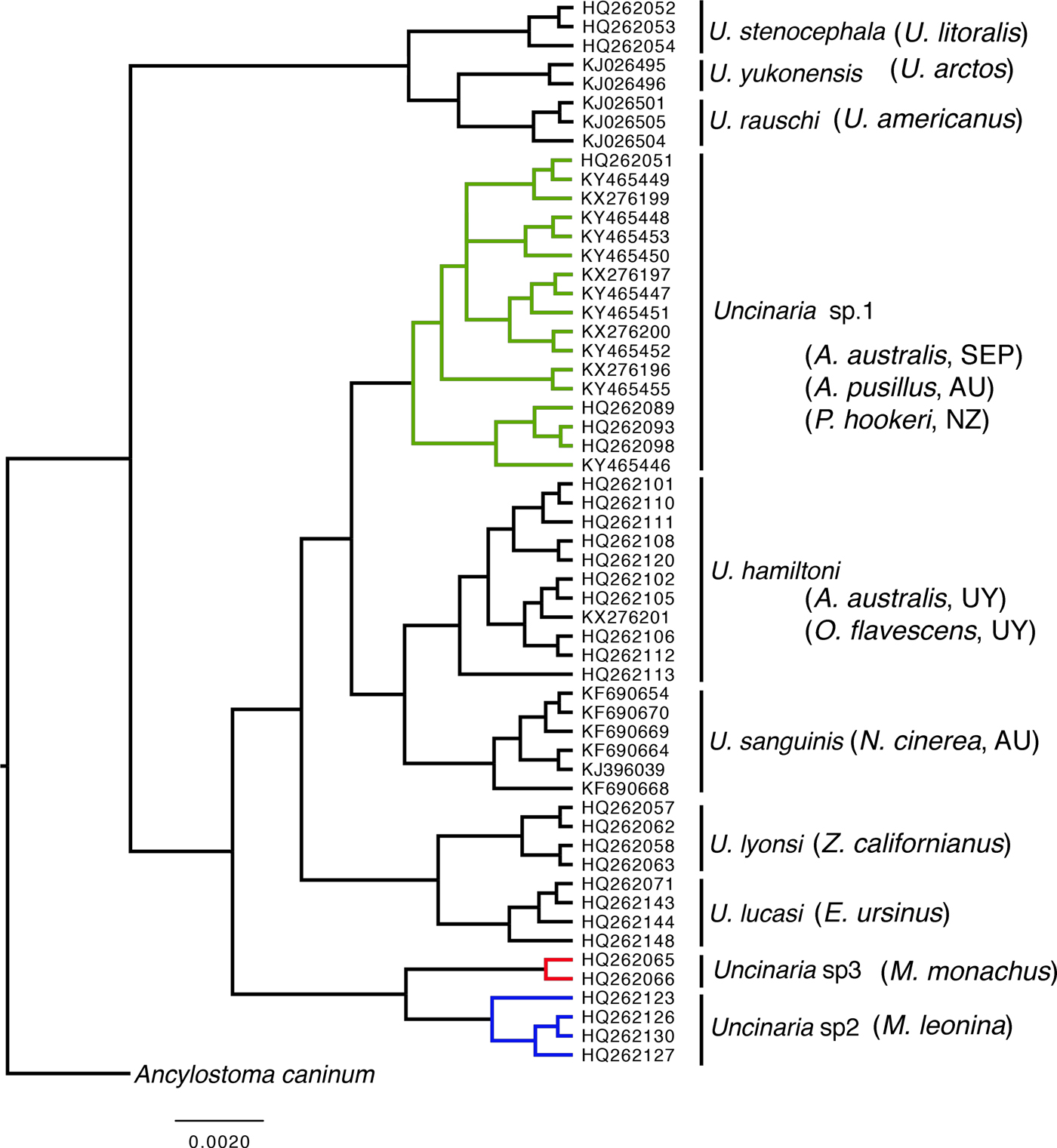
The total GMYC analysis, including the outgroup, was represented by eight ML entities (CI = 1–9) (fig. 4). Delimited GMYC clusters were largely also congruent with the species clades defined by the tree-based methods. Based on the supported monophyly of these lineages, combined with the pattern and number of genetic clusters seen in the GMYC analyses, we suggest that there are three putative species of Uncinaria along southern South American coasts: U. hamiltoni, Uncinaria sp.1 and Uncinaria sp. 2 (fig. 4).
Generalized Mixed Yule Coalescent species delimitation tree of Uncinaria, using ITS sequences. GMYC clusters were delimited using the single threshold model. Hosts are shown in parentheses.
Discussion
Understanding the specificity and diversity of Uncinaria spp. in pinnipeds is important for understanding hookworm diseases in pinniped pups. Uncinaria lucasi parasitizing C. ursinus in the northern hemisphere and U. hamiltoni parasitizing O. flavescens in the southern hemisphere were described in 1933 (Baylis, Reference Baylis1933). However, the geographical distribution and host range of U. hamiltoni has been controversial for many years (Baylis, Reference Baylis1933; Dailey and Hill, Reference Dailey and Hill1970; George-Nascimento et al., Reference George-Nascimento, Lima and Ortiz1992; Nadler et al., Reference Nadler2000). Nadler et al. (Reference Nadler2013) provided strong molecular evidence to definitively separate a third Uncinaria species from the two previously described species (U. lucasi and U. hamiltoni), recognizing, in turn, five undescribed Uncinaria species parasitizing pinnipeds. Since then, two new species have been formally described: U. sanguinis from the Australian sea lion (N. cinerea) (Marcus et al., Reference Marcus2014) and U. lyonsi from the California sea lion (Z. californianus) (Kuzmina and Kuzmin, Reference Kuzmina and Kuzmin2015). Additionally, Nadler et al. (Reference Nadler2013) identified U. hamiltoni as a parasite infesting both O. flavescens and A. australis from the Atlantic coasts. The breeding ranges of these host species overlap along the southern coasts of South America. Therefore, U. hamiltoni could be present in South American fur seals (A. australis) and sea lions (O. flavescens) from the Pacific and Atlantic coasts. Our study, however, showed that A. australis populations from the SEP coast harbour an undescribed taxon of Uncinaria, although U. hamiltoni was also detected in an O. flavescens pup from the SEP coast (northern Chile). Currently, it is proposed that A. australis from the Pacific coast and A. australis from the Atlantic coast should be considered different evolutionary units (Oliveira et al., Reference Oliveira2008). Additionally, A. australis from the Peruvian coasts has been recognized recently as a distinct subspecies (Berta and Churchill, Reference Berta and Churchill2012; Oliveira and Brownell, Reference Oliveira and Brownell2014). Thus, it is possible that host habitat separations occurred during the Pleistocene when the southern tip of South America was fragmented by glacial tectonic processes (Túnez et al., Reference Túnez2013). This may have led to host–parasite isolation and consequent genetic differentiation of the Uncinaria parasite.
The phylogenetic analyses of Uncinaria indicated a polytomy involving parasites from otariid hosts from the South Pacific coast (the Australian, New Zealand, Peruvian, and Chilean coasts), which concurs with the recent historical and ecological connections between these host species. Molecular analyses support the theory of a monophyletic group involving the southern hemisphere otariids (i.e. Otaria, Neophoca, Phocarctos and Arctocephalus), but the genus Arctocephalus has not been found to be monophyletic (Berta and Churchill, Reference Berta and Churchill2012). In turn, A. pusillus and O. flavescens are considered to be the closest species, belonging to the same phylogenetic clade (Nyacatura and Bininda-Emonds, Reference Nyakatura and Bininda-Emonds2012). Otariidae represent a group of recent radiation, and there was a distinct lag time between their origin and initial diversification (20.4 versus 8.1 Ma ago, respectively). Therefore, the phylogenetic relationships among otariids from the southern hemisphere remain an unresolved issue (Berta and Churchill, Reference Berta and Churchill2012; Nyacatura and Bininda-Emonds, Reference Nyakatura and Bininda-Emonds2012). Regardless of the Arctocephalus phylogeny, A. australis and O. flavescens are distributed along the SEP coasts, whereas A. pusillus doriferus is distributed along the south-western Pacific coasts (Australia). Therefore, it is possible that a recent speciation event that led to these host species could be reflected in the close phylogenetic relationships (and the observed polytomy) of the Uncinaria specimens parasitizing them.
The genetic markers used in this study, despite their different resolutions, indicated Uncinaria spp. phylogenetic relationships similar to the phylogeny proposed by Nadler et al. (Reference Nadler2013). In both studies, one clade was composed of hookworms from terrestrial hosts that are ancestral to Uncinaria spp. of marine hosts (according to ITS gene analyses). Another clade included Uncinaria spp. from Phocidae hosts that formed an ancestral clade (according to ITS gene analyses); this pattern concurs with phylogenetic relationships among host species because the Phocidae family is older than the Otariidae family (Berta and Churchill, Reference Berta and Churchill2012). The clade involving U. lucasi and U. lyonsi from northern otariids (C. ursinus and Z. californianus) evolved in parallel to the clade from the southern hemisphere (Nadler et al., Reference Nadler2013) and the clade involving U. hamiltoni from otariids from the South Atlantic coast. This latter clade could not be resolved with the genes used in this study (ITS and LSU); however, U. hamiltoni was observed to be a recent species. In addition, according to GMYC analysis (involving the ITS gene), Uncinaria sp. 1 is present in three host species (A. pusillus, P. hookeri and A. australis) from the South Pacific, suggesting a low host specificity.
Uncinaria specimens parasitizing otariids from the South Pacific could be considered cryptic species due to their similar morphology (Ramos et al., Reference Ramos2013; Kuzmina and Kusmin, Reference Kuzmina and Kuzmin2015), which makes it difficult to distinguish species only based on morphological characteristics. However, the morphometric variations between Uncinaria specimens parasitizing A. australis (Peru) and U. hamiltoni parasitizing O. flavescens (Uruguay) are concordant with interspecific parasite variations. On the other hand, the morphometric differences between Uncinaria sp. 1 parasitizing A. australis from Peru and A. australis from southern Chile (fig. 2), could be due to the geographical separation of the host populations along the SEP coast (Túnez et al., Reference Túnez2013; Pavés et al., Reference Pavés2016), which in turn could be concordant with the existence of two lineages of Uncinaria sp. 1 along SEP, as suggested by a preliminary analysis (not included here) based on our COI sequences. This isolation of host populations, with A. australis being absent along c. 2300 km of the Chilean coastline, is also supported by the temporal differences in breeding phenology (and pre-mating isolation mechanisms) between A. australis populations from the Peruvian coast and from the south of Chile (Pavés et al., Reference Pavés2016).
In summary, the phylogenetic and GMYC analyses suggest that the host A. australis from the SEP coast harbours an undescribed taxon of Uncinaria and that U. hamiltoni is distributed along both South American coasts. On the other hand, it is interesting to note that this putative species (Uncinaria sp. 1) could be a generalist parasite of pinnipeds, because it is present in A. australis, and O. flavescens from the SEP coast, in the fur sea lion species A. pusillus doriferus from Australia, and possibly in P. hockeri from New Zealand, thereby exhibiting an extensive distributional range across the South Pacific. Uncinaria sp. 2 and Uncinaria sp. 3 seem to be specialist parasites of M. leonina and M. monachus, respectively (fig. 4). Nevertheless, a more extensive study, including more samples from different colonies of both otariid species, will be necessary to clarify the genetic patterns of Uncinaria spp. distributed across the South Pacific.
Author ORCIDs
María Teresa González https://orcid.org/0000-0001-5787-4364
Supplementary material
To view supplementary material for this article, please visit https://doi.org/10.1017/S0022149X18000950
Acknowledgements
We thank the anonymous reviewers, whose comments improved the manuscript. KC thanks the staff from Punta San Juan Program for field assistance. DM and HK thank CSIC for partial support. MTG thanks Rosa Chavez, who helped to collect specimens from pups in northern Chile.
Financial support
This study was financed by Project “Semillero N° 5303-DGI” of “Dirección de Investigación of the Universidad de Antofagasta” granted to MTG.
Conflict of interest
None.



