Obesity pandemic has been identified as a global crisis and is considered a public health priority (Robinson, Reference Robinson2017). According to World Health Organization (WHO; 2020), achieving a body mass index (BMI) of 25 kg/m2 or higher is becoming easier and faster due to current lifestyles, with notable changes in the population dietary and physical behaviors which have led to the increase in the prevalence of obesity in all age ranges. The prevalence of obesity is increasing worldwide and is a major public health concern due to related co-morbidities and increased mortality risk. According to current figures from the WHO (2020) and the International Association for the Study of Obesity (IASO), one in two adults has overweight (35–40%) or obesity (15–20%). In Spain, up to two in three adults live with overweight (37–39%) or obesity (17–22%) (Aranceta-Bartrina et al., Reference Aranceta-Bartrina, Pérez-Rodrigo, Alberdi-Aresti, Ramos-Carrera and Lázaro-Masedo2016; Arrospide et al., Reference Arrospide, Machón, Ramos-Goñi, Ibarrondo and Mar2019; Instituto Nacional de Estadística, INE, 2018), making it one of the European nations with the highest prevalence (Marques et al., Reference Marques, Peralta, Naia, Loureiro and de Matos2018). Moreover, Andalusia is among the Spanish regions with the highest prevalence rates (Aranceta-Bartrina et al., Reference Aranceta-Bartrina, Pérez-Rodrigo, Alberdi-Aresti, Ramos-Carrera and Lázaro-Masedo2016). Obesity prevalence is now 2.4 times higher than 30 years ago in Spain (INE, 2018).
These figures are alarming not only in terms of obesity prevalence but also of health-related risks (e.g., more than 60% of Spain adult population might be currently on high cardiovascular risk due to weight) (Aranceta-Bartrina et al., Reference Aranceta-Bartrina, Pérez-Rodrigo, Alberdi-Aresti, Ramos-Carrera and Lázaro-Masedo2016). A study conducted with survey-based panel data has concluded that health-related quality of life of Spanish individuals with excess weight is diminished, particularly among those older, women and in lower social class (Arrospide et al., Reference Arrospide, Machón, Ramos-Goñi, Ibarrondo and Mar2019).
Body Perceptions, Body Satisfaction and Anthropometry-based BMI in Overweight and Obesity
Body image is a subjective and multidimensional construct (Cash & Smolak, 2011; Thompson et al., Reference Thompson, Heinberg, Altabe and Tantleff-Dunn1999). It is constituted by the perceptions (i.e., perceptual component) and emotions, cognitions and attitudes (i.e., evaluative component) we have of the whole body or its parts, translated into body weight and appearance management efforts (i.e., behavioral component). Thus, it incorporates size perceptions, appearance satisfaction, attractiveness evaluation and body control practices (Cash & Smolak, Reference Cash and Smolak2011; Grogan, Reference Grogan2017). Personal perceptions about the body refer to how a person considers their own body weight, size, shape and composition to be. In westernized societies, idealized body aesthetics is slender for women and athletic for men. Socially accepted and culturally transmitted beauty stereotypes reflect that men think that the ideal masculine body is strong and slim (Murray & Lewis, Reference Murray and Lewis2014; Parent & Moradi, Reference Parent and Moradi2011; Thompson & Cafri, Reference Thompson and Cafri2007; Tod et al., Reference Tod, Hall and Edwards2012) while women think that the ideal feminine body is thin and lean (Benton & Karazsia, Reference Benton and Karazsia2015; Ramírez et al., Reference Ramírez, Godoy-Izquierdo, Vázquez, Lara, Navarrón, Vélez and Jiménez2015; Swami et al., Reference Swami, Frederick, Aavik, Alcalay, Allik, Anderson, Andrianto, Arora, Brännström, Cunningham, Danel, Doroszewicz, Forbes, Furnham, Greven, Halberstadt, Hao, Haubner, Hwang and Quintelier2010; Tod et al., Reference Tod, Hall and Edwards2012), both being (self-)evaluated in accordance. These ideals of appearance, which are unrealistic and unattainable in many cases, often lead to body dissatisfaction and both healthy and unhealthy appearance investment actions.
Research examining the correspondence between a person’s actual weight status (e.g., using objective indicators of BMI) and perceived weight status is extensive (Latner & Wilson, Reference Latner, Wilson, Cash and Smolak2011). The misperception of weight has been repeatedly documented among adults with overweight and obesity (Maukonen et al., Reference Maukonen, Männistö and Tolonen2018). Even when most people with excess weight perceive themselves as in overweight or obesity conditions, they frequently have not completely accurate perceptions of their weight. In a study conducted with nearly 9,300 Spanish adults from all over the nation attending dietary consultation, of which 78% and 88% of females and males respectively had excessive weight, it was found that self-reported BMI and, particularly, perceived BMI trough silhouettes underestimated measured BMI (Acevedo et al., Reference Acevedo, López-Ejeda, Alférez-García, Martínez-Álvarez, Villarino, Cabañas and Marrodán2014).
In addition, there are numerous studies supporting a positive correlation between BMI and body dissatisfaction. Among people with overweight and obesity, a considerable number are dissatisfied with their body and wish they were thinner (Chao, Reference Chao2015; Sarwer et al., Reference Sarwer, Thompson and Cash2005; Silva et al., Reference Silva, Ferriani and Viana2019; Weinberger et al., Reference Weinberger, Kersting, Riedel-Heller and Luck-Sikorski2016). It has been also observed that women overestimate their self-perceived BMI more than men and are significantly more dissatisfied with their bodies compared to men (Seijo et al., Reference Seijo, Minckas, Cormick, Comandé, Ciapponi and Belizán2018; Silva et al., Reference Silva, Ferriani and Viana2019; Weinberger et al., Reference Weinberger, Kersting, Riedel-Heller and Luck-Sikorski2016). Others have found that a notable percentage are satisfied with their appearance and have a positive judgment of excess weight (Casillas-Estrella et al., Reference Casillas-Estrella, Montaño-Castrejón, Reyes-Velázquez, Bacardí-Gascón and Jiménez-Cruz2006; Millstein et al., Reference Millstein, Carlson, Fulton, Galuska, Zhang, Blanck and Ainsworth2008), often showing a distorted image of their body with underestimation of weight and size.
The issue of body image in obesity is important, as unawareness of weight excess can prevent weight loss attempts. Thus, people with overweight and obesity who think they are at an appropriate or healthy weight may be less aware of the need of losing weight and less motivated to adopt healthier lifestyle behaviors (Duncan et al., Reference Duncan, Wolin, Scharoun-Lee, Ding, Warner and Bennett2011; Gregory et al., Reference Gregory, Blanck, Gillespie, Maynard and Serdula2008; Kuk et al., Reference Kuk, Ardern, Church, Hebert, Sui and Blair2009). However, perceived excess weight or body dissatisfaction can also lead to unhealthy or unsuccessful weight-loss strategies, poorer treatment adherence, disordered eating and increased weight gain over time (Austin et al., Reference Austin, Serier, Sarafin and Smith2017; Feng & Wilson, Reference Feng and Wilson2019; Haynes et al., Reference Haynes, Kersbergen, Sutin, Daly and Robinson2018). As Duncan et al. (Reference Duncan, Wolin, Scharoun-Lee, Ding, Warner and Bennett2011) affirmed, weight misperception may limit the effectiveness of obesity prevention and management efforts.
Aims
In the present study, we explored the associations among excess weight (i.e., measured and self-reported BMI), body image and body satisfaction among Spanish adults with overweight or obesity, with a special focus in discriminating individuals who are and are not satisfied with their body and wish or not to change their appearance. Just unifying all individuals with excessive weight may lead to uncovering or denying different personal realities and developing unfitted clinical management options. We expected to confirm that a significant number of participants with excess weight will underestimate BMI and body size, as well as to complement existent evidence by supporting an interaction between BMI and sex-gender for BMI estimation, body perceptions, body satisfaction and desire of weight change. We also expected to find a number of adults with overweight and obesity with positive perceptions of their body and low desire of weight change.
Method and Materials
Participants and Procedure
A total of 100 adults from 19 to 57 years old (average age: 42.03 ± 10.74, 60% women) residing in Southern Spain voluntary participated in the study. No differences were found for age between females (41.03 ± 10.46) and males (43.53 ± 11.11), t = –1.139, p = .258. All had a BMI ≥ 25 (69% overweight: 45% overweight I, 24% overweight II; 31% obesity: 22% obesity I, 9% obesity II. See Table 1 for more information). All of them were Caucasian, white individuals in the average range of socioeconomic status [social class was determined by unifying education level, job status and income. Following the definition by the Health Determinants Taskforce of the Spanish Epidemiology Society, six categories were established which were regrouped into three: High (class I–II), middle (class III–IV) and low social class (class V–VI); Arrospide et al., Reference Arrospide, Machón, Ramos-Goñi, Ibarrondo and Mar2019].
Recruitment was conducted with convenience, non-probabilistic procedure according to the main inclusion criteria (i.e., having excessive weight, not suffering from severe physical and mental diseases, being 18–65 years old) in local medical settings. Specifically, recruitment was conducted in two primary care consultations among individuals with excessive weight who consulted on weight and health during March 2019. After providing the participants with detailed information on the study, the anonym nature of data and research participant’s rights, and after obtaining informed written consent, assessment was conducted in a habilitated room in the recruitment center. First, socio-demographics and self-reported weight and height were collected in an interview format. Then, the self-reports on body image were administered. Finally, objective measures of weight and height were obtained. Then, the participant was discharged.
Approval was obtained from the ethics committee of the authors’ institution. The procedures used in this study adhere to the tenets of the Declaration of Helsinki.
Study Variables and Measures
Sociodemographic data (age, gender) were asked to the participants. Based on self-reported weight and height we calculated BMI as kg/m2. We also measured weight and height with a mobile anthropometer (Aicok Weight Scale, mod. CF398BLE, USA), which uses bio-electrical impedance analysis technology for monitoring multiple physical indexes including body weight (weight range up to 400pounds/180kilograms and indexing value accurate to 0.2 pounds/0.1kilograms), BMI, percentage of body fat mass, visceral fat mass, muscle, body water and bone mass as well as basal metabolic rate, of which only BMI is reported herein. The weight was recorded while the subject was on the scale with his/her arms along the body, in bare feet and light clothes. Measured BMI was categorized according to international standards on nutritional status in adult population (Lecube et al., Reference Lecube, Monereo, Rubio, Martínez-de-Icaya, Martí, Salvador, Masmiquel, Goday, Bellido, Lurbe, García-Almeida, Tinahones, García-Luna, Palacio, Gargallo, Bretón, Morales-Conde, Caixàs, Menéndez and Casanueva2017; WHO, 2019), i.e., < 18.5 low weight; 18.5–24.9 normal weight; 25.0–29.9 overweight: 25.0–26.9 overweight I and 27.0–29.9 overweight II; and ≥ 30.0 obesity: 30.0–34.9 obesity I, 35.0–39.9 obesity II and ≥ 40.0 obesity III. Objective and subjective BMI were highly correlated (r = .92, p < .001). We calculated body weight, height and BMI estimations by using the difference between self-reported indicators minus measured parameters. Body weight estimation was defined as “correct” if the absolute difference between self-reported minus measured weight was < 2.0 kg, as “underestimated” if the difference was > –2.0 kg and as “overestimated” if the difference was > 2.0 kg (Bibiloni et al., 2017).
Body image was explored by using silhouettes corresponding to different BMI ranges (Gardner & Brown, Reference Gardner and Brown2010; Godoy-Izquierdo et al., Reference Godoy-Izquierdo, González Hernández, Rodríguez Tadeo, Ramírez Molina, Navarrón Vallejo, Lara Moreno and Jiménez Torres2019; Ramírez et al., Reference Ramírez, Godoy-Izquierdo, Vázquez, Lara, Navarrón, Vélez and Jiménez2015). Male or female figures were presented to the individual depending on their sex-gender in order to assess (a) one’s own perceived current body (perceived body image, PBI), (b) ideal body (ideal body image, IBI), (c) beliefs on others’ perceptions of the participant’s body (social body image, SBI), and (d) participants’ body perceptions of other people of the same age, sex and life conditions (normative body image, NBI). In all cases, a continuum with 15 anatomical models was presented which included figures graded in body size in terms of fat mass and weight (from –7 = Very obese to 0 = Very thin) as well as corporal constitution and body muscle mass (from 0 = Very flaccid to 7 = Very muscular) in order to simultaneously evaluate body shape and weight, and body composition or muscularity.
Besides, the desire of changing weight and body appearance was assessed by the discrepancy PBI-IBI (i.e., negative difference values indicate a desire of a slimmer and/or more muscular body; positive difference values indicate a desire of a heavier and/or less muscular body; 0 values indicate the desire of maintaining the same body and appearance). This discrepancy has been widely used as an indicator of body satisfaction (Bibiloni et al., 2017; Ibáñez-Zamacona et al., Reference Ibáñez-Zamacona, Poveda and Rebato2020; Varela et al., Reference Varela, Oda-Montecinos and Saldaña2019). Body dissatisfaction was also assessed by a face-valid single item ("How satisfied are you with your current body weight and bodily appearance?", 1 = Extremely dissatisfied, 7 = Extremely satisfied) (Godoy-Izquierdo et al., Reference Godoy-Izquierdo, González Hernández, Rodríguez Tadeo, Ramírez Molina, Navarrón Vallejo, Lara Moreno and Jiménez Torres2019; Ramírez et al., Reference Ramírez, Godoy-Izquierdo, Navarrón, Jiménez-Torres and Godoy2018). In the present study, the discrepancy PBI-IBI was correlated with body satisfaction at r = .26, p = .010.
Statistical Analyses
Statistical analyses for the current study were conducted using SPSS 25.0 (SPSS Inc., Chicago, IL, 2017). Nature and adequacy of data were checked as well as parametric assumptions. Besides running descriptive analyses (mean and standard deviation, M ± SD, for continuous variables, n and % for categorical variables), bivariate, zero-order Pearson correlations between the study variables were calculated. We also calculated Pearson Chi 2 tests for group comparisons with categorical variables for comparing desire of body change due to BMI categories, and Student t tests for comparisons of related samples in order to explore divergences in objective and subjective structural indicators of weight, height and BMI, as well as for comparisons of independent samples in order to explore differences in the study variables due to sex-gender and BMI category. A correction was adopted for unequal variances of subgroups when appropriate. One-way ANOVAs with post-hoc Bonferroni or Games-Howell tests were conducted in order to explore possible differences in the study variables due to desire of body change. Two-way ANOVAs were run to test the interaction of BMI and sex-gender on the study variables, with a calculation of main simple effects following Weinberg and Abramowitz (Reference Weinberg and Abramowitz2002) a posteriori comparisons. For all tests, Cohen’s d effect size (Cohen, Reference Cohen1988) was calculated (for equal sample sizes: d = |M 1−M 2|/√|(SD 12+SD 22)/2|; for unequal sample sizes: d = |M 1−M 2|/√|((n1–1)SD 12+(n2–1)SD 22)/(n1+n2–2)|; M = mean, SD = standard deviation), with d < 0.2 indicating a low effect size, 0.5 a medium effect size and > 0.8 a high effect size. Eta2 was obtained for ANOVA tests. As age did not show significant correlations with any of the study variables, we did not consider it in the analyses.
Results
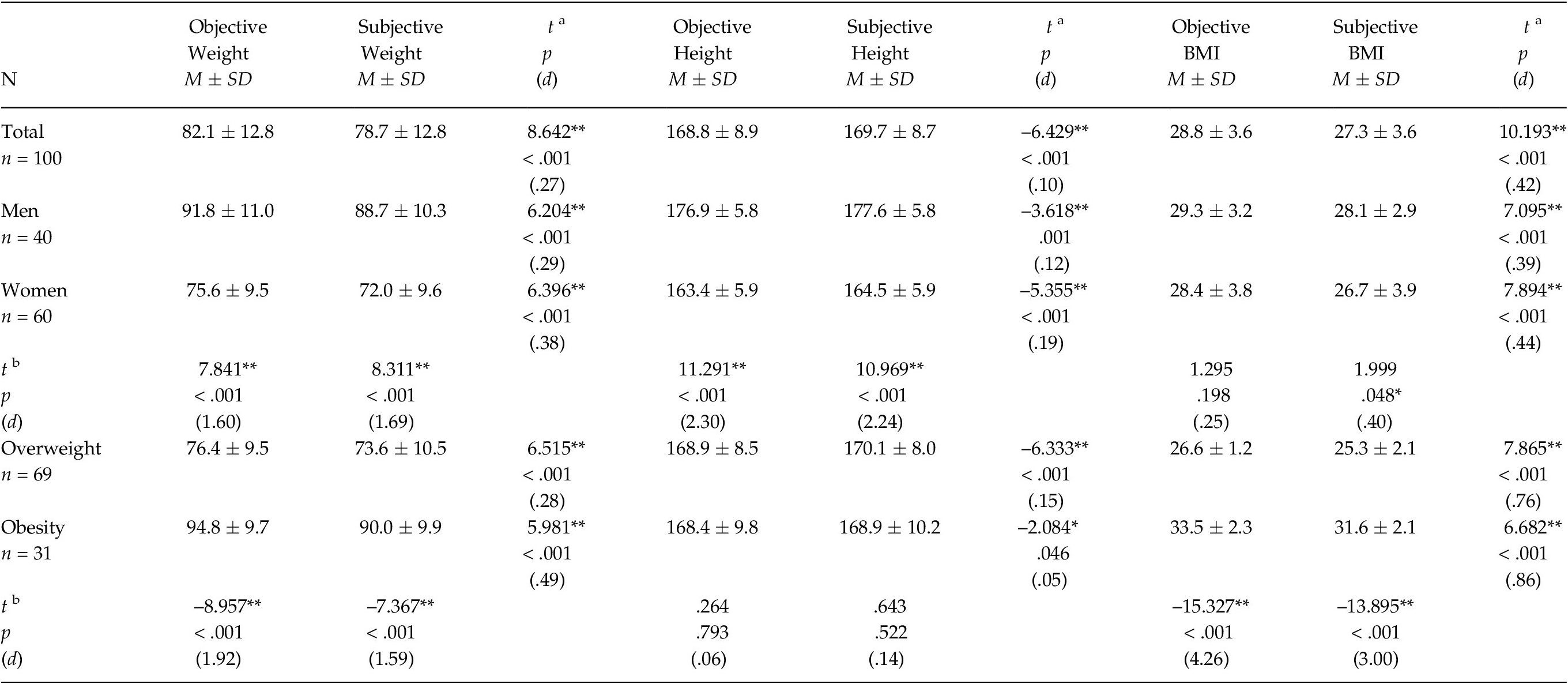
In the present study, 63% of the participants correctly estimated their weight (± 2 kg), while 34% underestimated it (2.1–21.2 kg) and only 3% overestimated it (3.2–17.4 kg). Table 1 shows the discrepancies found for objective and subjective weight, height and BMI. Average objective weight and BMI was higher than subjective weight and BMI; on the contrary, average subjective height was higher than objective height. In all cases, women showed a higher discrepancy between measured and self-reported indicators in virtue of d values. In addition, while men were heavier and taller compared to women in both objective and subjective indicators, objective BMI did not differ between females and males, although women self-reported a lower BMI compared to men. Both objective and subjective weight and BMI were higher among participants with obesity compared to individuals with overweight. The discrepancy between objective and subjective weight and BMI was higher also among the participants with obesity. A two-way ANOVA was conducted for exploring the interaction of BMI category (i.e., overweight/obesity based on measured BMI) and sex-gender on BMI based on subjective indicators (i.e, self-reported BMI). There was a significant interaction effect, F = 8.567, p = .004, ω2 = .08. Simple effects revealed that women with overweight underestimated their weight (M = 24.8; p = .008) and women with obesity tended to overestimate it (M = 32.2; p = .095) at a higher degree than men in both weight categories (M = 26.2, M = 31.0, respectively) (see Figure 1).
Comparisons between Measured and Self-reported Structural Indicators and Divergences due to Gender and BMI Category

Note. a Student t tests for related samples for comparisons between objective and subjective measures. b Student t tests for independent samples for comparisons due to gender and BMI category.
* p < .05. ** p < .01.
The Interaction between Measured BMI and Gender on Weight Estimation

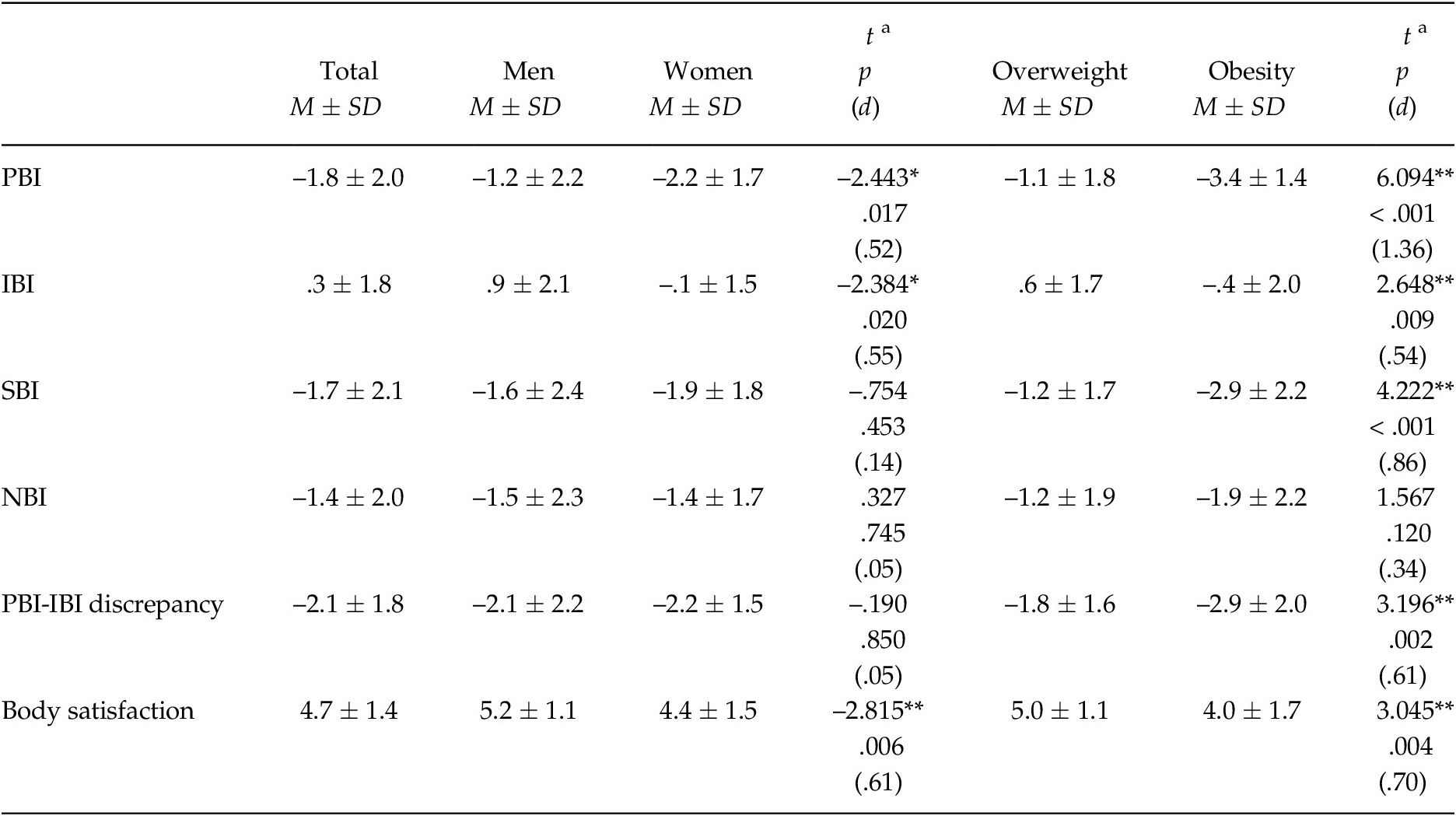
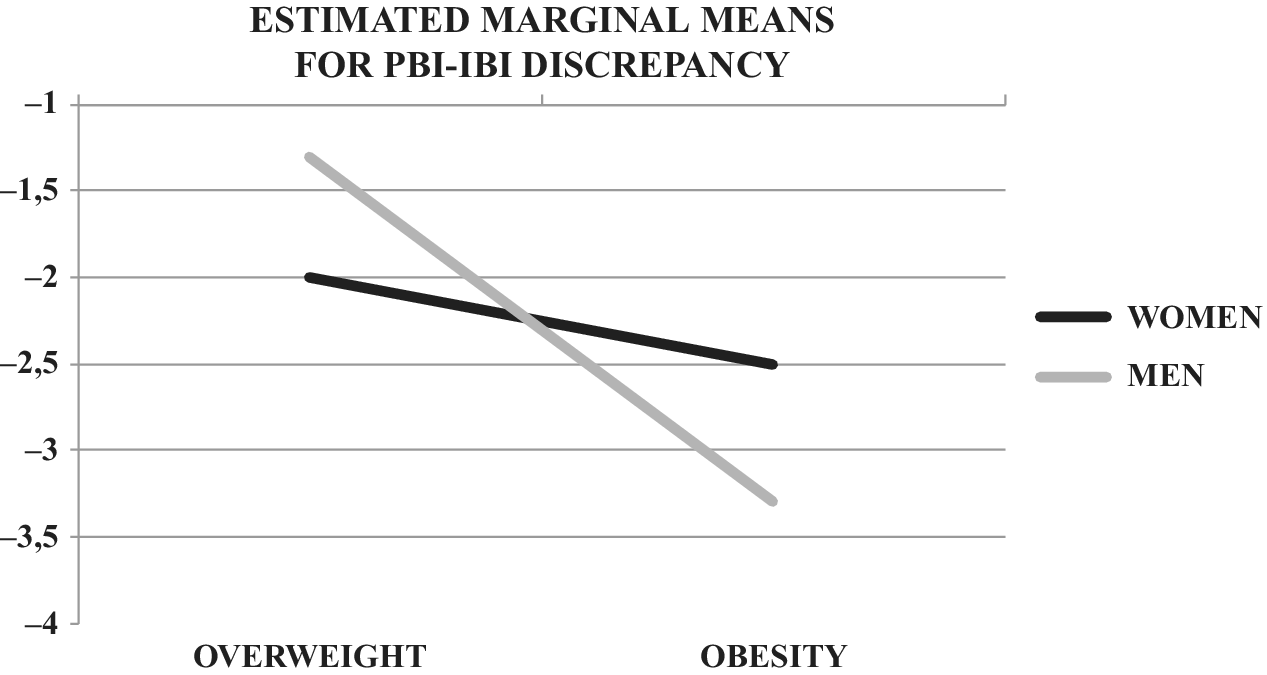
Women also showed significantly poorer body self-perceptions, i.e., bodies containing higher fat mass, and a slimmer ideal appearance, as well as lower body satisfaction compared to men (Table 2). Males and females did not differ in terms of social and normative body perceptions and desire to change weight (i.e., PBI-IBI discrepancy). Participants with obesity demonstrated significantly poorer PBI and SBI as well as a less exigent IBI, corresponding to bodies with overweight; they also reported a greater desire to change their weight compared to participants with overweight. Besides, individuals with obesity showed significantly lower body satisfaction. No differences were found for NBI. Two-way ANOVAs were conducted for exploring the interaction of measured BMI-based category and sex-gender on body perceptions, desire of body change (i.e., PBI-IBI discrepancy) and body satisfaction. There was a significant interaction effect for desired body change, F = 4.390, p = .039, ω2 = .04. While women with overweight and obesity desired a rather similar body change (p = .312), corresponding to a 2–2.5 points or figures in the silhouette progression, men with obesity desired a greater weight change, 3.3–point change, than men with overweight, 1.3–point change (p < .001) (see Figure 2), though both genders in both categories desired to be slimmer in average. No significant interaction was found for any of the dimensions of body perceptions (PBI: F = .310, p = .579; IBI: F = 2.443, p = .121; SBI: F = .140, p = .709; NBI: F = .239, p = .626) and body satisfaction, F = .232, p = .631. For both males and females, a higher BMI was associated with perceptions of heavier current, social and normative bodies and thinner ideals, as well as lower body satisfaction.
Comparisons by Gender and BMI Categories

Note. a Student t tests for independent samples for comparisons due to gender and BMI category.
* p < .05. ** p < .01.
The Interaction between Measured BMI and Gender on the Amount of Desired Weight Change (PBI-IBI Discrepancy)

A case-to-case analysis based on the PBI-ICI discrepancy showed that, among the participants in all BMI ranges, the vast majority perceived themselves as having overweight or obesity and wished to lower their weight in terms of fat mass (39%) or to lower their weight as well as to gain muscularity (34%), whereas a few wished to maintain their current weight (9%). In addition, curiously approx. 2 in 10 of the participants perceived themselves as lean, and wished to maintain their appearance (7%), or to lose a little weight (4%) or to gain a little muscularity (7%). No participant manifested wishing gaining fat-related weight. Body change desires were not dependent on BMI ranges of overweight I, overweight II, obesity I and obesity II (χ2 = 20.316, p = .160).
Given that several subtypes of participants existed due to their bodily perceptions and their desire to change or maintain current body weight and appearance, we explored whether the study variables differed between these subgroups of participants. Given that body perceptions were considered for grouping the participants, and in order to reduce type I error, we analyzed only objective BMI and body satisfaction. In addition, we regrouped the participants in those with self-perceptions of excess weight who desired to be thinner (G1, 39%), those with self-perceptions of excess weight who desired to be leaner (G2, 34%) and those with more positive, even unrealistic self-perceptions who desired to be equal or a little thinner or more muscular (G3, 27%), for more equivalent and easily interpretable subgroups. One-way ANOVAs indicated that, for BMI (F = 7.133, p = .001), differences emerged between the participants with excess weight who desired to lose body fat (30.3 ± 3.7) and those who wanted a leaner body (27.8 ± 3.2, p = .005) or had a more positive appreciation and self-acceptance of their body (27.7 ± 3.0, p = .006). Similarly, for body satisfaction (F = 6.746, p = .002), differences appeared between the participants with excess weight who desired to lose body fat (4.2 ± 1.6) and those who wanted a leaner body (4.9 ± 1.0, p = .045) or had a more positive appreciation and self-acceptance of their body (5.3 ± 1.2, p = .004).
Discussion
In the present study, we explored the associations among excess weight (i.e., measured and self-reported BMI) and perceptual and evaluative dimensions of body image among adults with overweight or obesity. Overall, average self-reported BMI was lower than actual BMI, and misperceptions corresponded to –3.5 kg in average. Our findings parallel previous research obtained with Spanish adult samples (Acevedo et al., Reference Acevedo, López-Ejeda, Alférez-García, Martínez-Álvarez, Villarino, Cabañas and Marrodán2014) on the discrepancy between objectively assessed BMI and weight estimation based on self-reports, and also confirm that people with excess weight, when having a distortion in their self-evaluations, more likely underestimate their real weight. We found that six in ten adults with overweight correctly estimated their weight within a range of 2 kg, supporting findings on accuracy of weight perceptions of individuals both in all BMI ranges and with excess weight (Acevedo et al., Reference Acevedo, López-Ejeda, Alférez-García, Martínez-Álvarez, Villarino, Cabañas and Marrodán2014; Bibiloni et al., 2017; Ibáñez-Zamacona et al., Reference Ibáñez-Zamacona, Poveda and Rebato2020; Marrodán et al., Reference Marrodán, Martínez-Álvarez, Villarino, Alférez-García, González-Montero de Espinosa, López-Ejeda, Sánchez-Álvarez and Cabañas2013), yet some have found that these percentages decrease to four in ten when they have obesity (Bibiloni et al., 2017). We also found that among those with distorted perceptions, 34% underestimated their weight and only 3% overestimated it. While it has been previously found that the percentage of males and females with excess weight who underestimated their weight (30 to 55%) was notably higher than that of individuals overestimating it (10% as much) independently of BMI category (Acevedo et al., Reference Acevedo, López-Ejeda, Alférez-García, Martínez-Álvarez, Villarino, Cabañas and Marrodán2014; Bibiloni et al., 2017), others have found that people at all BMI ranges tend to more frequently overestimate their weight (Ibáñez-Zamacona et al., Reference Ibáñez-Zamacona, Poveda and Rebato2020).
Participants with obesity demonstrated a greater discrepancy between measured and self-reported indicators (Bibiloni et al., 2017; Marrodán et al., Reference Marrodán, Martínez-Álvarez, Villarino, Alférez-García, González-Montero de Espinosa, López-Ejeda, Sánchez-Álvarez and Cabañas2013). We also found that women showed a higher discrepancy, but others (Ibáñez-Zamacona et al., Reference Ibáñez-Zamacona, Poveda and Rebato2020) have not confirmed gender differences in weight estimation, and others (Acevedo et al., Reference Acevedo, López-Ejeda, Alférez-García, Martínez-Álvarez, Villarino, Cabañas and Marrodán2014; Bibiloni et al., 2017) have found that mismatches are higher among males, who more likely underestimate their weight, with more females correctly estimating their size, or overestimating it; unfortunately, the authors did not analyze their data by grouping the participants also by BMI categories.
We further found that male and females were affected differently by BMI in that women with overweight underestimated their weight and women with obesity overestimated it at a higher degree than men at both weight categories. Contrarily, others have found that those more frequently underestimating their weight were those women with higher BMI (Ibáñez-Zamacona et al., Reference Ibáñez-Zamacona, Poveda and Rebato2020). In another study (Bibiloni et al., 2017), BMI and sex-gender separately influenced weight underestimation: while 28% of men and 26% of women with overweight considered their weight as inferior to real weight, 45% of men and 37% of women with obesity underestimated their size. Underestimation was, then, higher as BMI increases and this was particularly true for men. For overestimation, males with overweight more frequently overestimated their weight compared to males with obesity. Furthermore, in another study (Marrodán et al., Reference Marrodán, Martínez-Álvarez, Villarino, Alférez-García, González-Montero de Espinosa, López-Ejeda, Sánchez-Álvarez and Cabañas2013) underestimation of BMI was 2.6% in men and 3.1% in women, corresponding to around 1 kg/m2 in both sexes, but gender did not influence discrepancy magnitude while BMI did.
When our findings are considered along with previous research conducted with Spanish adult samples, non-conclusive evidence on the realistic weight perceptions of men and women with excess weight is obtained. Our results seem to point out that most of the individuals living with obesity know they have excessive weight yet both women and men tend to report lower weight and BMI than actual figures; however, more research on the intersection of sex-gender and weight was needed, as we were unable to find this analysis in previous research although our findings point to the relevance of such an interaction.
These findings have important derived applications for weight management. Distortions and underestimation reduce estimated prevalence of excess weight. Moreover, self-perceived weight and body image is an important factor for eating habits and lifestyle behaviors (Acevedo et al., Reference Acevedo, López-Ejeda, Alférez-García, Martínez-Álvarez, Villarino, Cabañas and Marrodán2014; Bibiloni et al., 2017). Holding distorted body perceptions by over- and under-estimating real weight is a risk factor itself by increasing body dissatisfaction, weight concern, unhealthy weight control practices and thus the vulnerability for eating disorders, or by minimizing health risks linked to obesity, unawareness of having excess weight and unhealthy lifestyle, respectively. Despite health policies and community campaigns being focused on raising awareness about healthy weight, a number of individuals with excess weight fail to recognize that their weight is a cause of concern (Bibiloni et al., 2017). Although Spanish adults with excessive weight are more concerned about their weight and more likely to be on diet for weight control than normal-weight counterparts, many others are unconcerned and uncared about their weight (Bibiloni et al., 2017). Thus, efforts must be maintained for making individuals with excessive weight more aware of their condition, health risks and behavioral habits in order to decrease the number of individuals who do not care of their weight condition. Without making the people with excessive weight more conscious and concerned of their own weight, as well as self-accepted of their condition (Acevedo et al., Reference Acevedo, López-Ejeda, Alférez-García, Martínez-Álvarez, Villarino, Cabañas and Marrodán2014), motivation and action for managing excess weight on behalf of the targets will be reduced, and globally the treatment of obesity will be an unreachable aim. We think that exploring body perceptions through silhouettes, besides body weight estimations, may help individuals in having a better recognition and more realistic perception of their weight than weight per se or BMI, which are likely unknown by them. Notably, many participants ignore or are reluctant to report their perceived weight (for example, 25% and 41% of men and women with excessive weight in Bibiloni et al., 2017).
The body images reported by the participants in the present study agree with other findings with individuals with excessive weight in our nation. In a sample of Spanish adults with excess weight, Godoy-Izquierdo et al. (Reference Godoy-Izquierdo, González Hernández, Rodríguez Tadeo, Ramírez Molina, Navarrón Vallejo, Lara Moreno and Jiménez Torres2019) found that approx. 80% of their participants indicated body figures corresponding to excess or very high excess of weight, i.e., high fat mass and low muscular mass, and 94% indicated to desire a thinner body, with one in three indicating low or very low body satisfaction. They found that, on average, the participants perceived their bodies as overweight and not athletic (corresponding silhouette: –3) and would like to have thinner and leaner bodies (corresponding silhouette: 1), and simultaneously reported low-to-moderate body satisfaction. Comparing our findings to community Spanish samples (Ramírez et al., Reference Ramírez, Godoy-Izquierdo, Vázquez, Lara, Navarrón, Vélez and Jiménez2015, 2018), the expected divergences can be confirmed, as PBI, IBI, NBI and body satisfaction are more positive as well as exigent in normal-weight individuals than among individuals with excess weight. Gender-related divergences can also be observed in a similar way to our findings.
Women reported significantly poorer body self-perceptions, i.e., bodies containing higher fat mass, and a slimmer ideal appearance, as well as lower body satisfaction compared to men. Men and women did not differ in terms of social and normative body perceptions. Others have also found lower body satisfaction among women with excess weight (Bibiloni et al., 2017; Varela et al., Reference Varela, Oda-Montecinos and Saldaña2019). Other researchers did not establish sex-gender differences in current body perceptions, but women selected thinner figures as body ideals whereas men chose heavier figures, and approx. 8 in 10 women expressed body dissatisfaction by excess weight, whereas half of the men were satisfied with their weight (Ibáñez-Zamacona et al., Reference Ibáñez-Zamacona, Poveda and Rebato2020). In a previous study conducted also mixing Spanish individuals all over the nation with normal weight and overweight, both women and men demonstrated to have body ideals in terms of both aesthetics and health that were thinner (i.e., 4 kg lower) than their real weight (Rodríguez-Rodríguez et al., Reference Rodríguez-Rodríguez, Aparicio, López-Sobaler and Ortega2009). It was also found that more women than men expressed body dissatisfaction due to excess weight (i.e., PBI-IBI, 56 vs. 17%), desired to lose weight (69 vs. 56%) and dieted for that (50 vs. 31%), mainly for appearance-related motives. In the study by Acevedo et al. (Reference Acevedo, López-Ejeda, Alférez-García, Martínez-Álvarez, Villarino, Cabañas and Marrodán2014) with mainly individuals with overweight, participants’ both aesthetic and healthy ideals were very similar and up to 10 kg/m2 lower than their actual weight, and were found to correspond to a BMI < 24 kg/m2, near the limits of normal weight, for both sexes, yet men reported bigger figures compared to women. The authors concluded that people do not have a realistic perception of their body but are aware that their weight exceeds the healthy threshold. This might motivate them for initiating weight management.
Participants with obesity demonstrated significantly poorer PBI and SBI as well as a less exigent IBI, corresponding to bodies with overweight, and lower body satisfaction compared to their counterparts with overweight, but similar NBI. Among Spanish adults, individuals with overweight or obesity were found to have perceptions of bigger and heavier bodies and lower body satisfaction as well as poorer body attitudes and higher weight concern compared to individuals with normal weight, particularly as BMI increases (Bibiloni et al., 2017; Varela et al., Reference Varela, Oda-Montecinos and Saldaña2019). Our findings also parallel those of others (e.g., Ibáñez-Zamacona et al., Reference Ibáñez-Zamacona, Poveda and Rebato2020) reflecting that both men and women with excess weight more frequently select silhouettes corresponding to overweight bodies as current body and silhouettes slightly more thinner than their PBI but greater as BMI increases as ideal bodies, and that body dissatisfaction increases as BMI increases by desiring smaller body sizes. As Ibáñez-Zamacona et al. (Reference Ibáñez-Zamacona, Poveda and Rebato2020) stated, individuals with obesity may choose larger silhouettes as a more realistic goal in their attempt to reduce their excess weight.
BMI and gender did not interact for the different dimensions of body perceptions and body satisfaction. However, we found that desire to change weight (i.e., PBI-IBI discrepancy) was different for women and men depending on their BMI. While both women with overweight and obesity desired a rather similar body change in order to be thinner, men desired a greater weight change when having obesity than when having overweight, this change indicating not only that they wished to be slimmer but also more muscular. Although the separate influence of BMI and sex-gender on body image and satisfaction has been deeply explored, we were unable to find interaction analyses in Spanish samples with overweight and obesity. In the study by Varela et al. (Reference Varela, Oda-Montecinos and Saldaña2019), the PBI-IBI discrepancy was of 1.8 points in a 0–8 discrepancy scale among the participants with excess weight, twice the value found in the normal weight condition; as we found, no differences were established when males (1.5 points) and females (2 points) were compared in the PBI-IBI discrepancy, but women with overweight demonstrated poorer body perceptions and satisfaction compared to men and participants with normal weight. Rodríguez-Rodríguez et al. (Reference Rodríguez-Rodríguez, Aparicio, López-Sobaler and Ortega2009) did not find either differences between males and females for the discrepancy between healthy and aesthetic ideal and current weight, but they mixed the samples of normal and excessive weight and this could be neglecting individual divergences. However, they found that women with overweight reported lower desire for weight loss compared to women with normal weight. Finally, it has been also found that whereas more men than women are satisfied (i.e, no PBI-IBI discrepancy) with their overweight or obese body (8–21% vs. 1.5–2%, respectively), dissatisfaction for having excessive weight affect to 77% and 90% of males with overweight and obesity respectively, and 97% and 99% of females with overweight and obesity (Bibiloni et al., 2017). This is important as it has been found that people with excess weight, even when were more likely to underestimate their real weight, were more likely to be worried about weight gain and to diet, particularly as BMI increases and among women; interestingly, one in four women and one in two men did not report concern on gaining weight, and six (among women) to eight (among men) didn’t diet for control weight (Bibiloni et al., 2017). Unfortunately, none of the described studies analyzed the intersection of BMI and gender as we did, being this another relevant contribution of the present study to the evidence obtained with Spanish samples.
Besides, our findings demonstrated that women at any age range value and use as comparison standard a slender, lightly toned body while men value thin and muscular, athletic-type bodies (Grogan, Reference Grogan2017), including women and men with overweight and obesity (Weinberger et al., Reference Weinberger, Kersting, Riedel-Heller and Luck-Sikorski2016). Moreover, our findings confirm that as women experience high social pressures to conform the rigid aesthetics standards of beauty (i.e., thinness) and femininity, they frequently demonstrate high body dissatisfaction, conforming the so-called "normative discontent" (Rodin et al., Reference Rodin, Silberstein and Striegel-Moore1984) regarding body image observed among all-ages females. However, the same discontent among men is increasing lately as masculinity has been highly related to body image (i.e., muscularity) (Tantleff-Dunn et al., Reference Tantleff-Dunn, Barnes and Gokee Larose2011). For men, as has occurred traditionally for women, as the social pressure to attain an “ideal” physique has progressively increased along with internalization of body ideals and (sexual) objectification and self-objectification of the body, the discrepancy between that ideal and one’s body reality increases as well, resulting in higher negative self-concept and body dissatisfaction, weight concern, unhealthy appearance-related behaviours and other derived consequences.
Our findings, along with other obtained in Spain, reflect that body attitudes mirror sociocultural pressures on aesthetics and ideal bodies revealing sexual dimorphism (Ibáñez-Zamacona et al., Reference Ibáñez-Zamacona, Poveda and Rebato2020), gender role endorsement (Bibiloni et al., 2017), internalized social pressures (Varela et al., Reference Varela, Oda-Montecinos and Saldaña2019) and weight prejudices (Rubino et al., Reference Rubino, Puhl, Cummings, Eckel, Ryan, Mechanick, Nadglowski, Ramos Salas, Schauer, Twenefour, Apovian, Aronne, Batterham, Berthoud, Boza, Busetto, Dicker, De Groot, Eisenberg and Dixon2020). Along with increasing awareness on body weight and health, public campaigns and health policies should foster the promotion of positive and realistic body image, acceptance and value of the body, functional attitudes to body appearance and care, and healthy behaviors for managing weight- and appearance-related issues far from conquering unrealistic and unattainable bodies linked to youth, leanness and (re)productivity, as posed by the "body cult" that characterizes current societies. Thus, the fight against obesity should focus on changes in lifestyle, inclusive aesthetic models and combating social stigmatization of people with excess weight.
As part of our main aim, in the present study we also paid special attention into discriminating individuals who are and are not satisfied with their body and wish or not to change their appearance, and in which terms, in order to understand the varied personal realities linked to obesity. We only found a study in which a distinction was made between participants based on their desired weight change. Ibáñez-Zamacona et al. (Reference Ibáñez-Zamacona, Poveda and Rebato2020) grouped their participants in 7 categories from severe dissatisfaction by excess weight to severe dissatisfaction by deficient weight, but they did not either consider whether the participants were valuing only fat mass or also muscular mass or analyzed data based on such categories. Based on a case-to-case analysis, we established that three fourths of the participants perceived themselves as having overweight or obesity and wished to lower their weight in terms of fat mass or to lower their weight as well as to gain muscularity, whereas the remaining wished to maintain their current weight, and this was independent of BMI. When we regrouped the participants in those with self-perceptions of excess weight who desired to be thinner by losing body fat (39%), those with self-perceptions of excess weight who desired to be leaner (34%) and those with more positive, even unrealistic self-perceptions who desired to be equal or a little thinner or more muscular (27%), we found that the first group, compared to that of individuals who wanted a leaner body or had a more positive image and self-acceptance of their body, was composed of those participants with higher BMI and lower body satisfaction.
This finding may inform clinical practice, as there are different realities and wishes for people with excessive weight, and interventions fitted to their desires and expectations are more likely to be successful by incrementing individuals’ motivation and efforts. In other words, the personal experiences that individuals have with obesity, instead of obesity itself, should be considered for disentangling management efforts. Thus, interventions aimed at producing changes in lifestyle should be aware of whether the individual wants a higher weight modification (i.e., higher BMI and lower body satisfaction subgroup) versus lower weight change, and whether (s) he desires just to diminish fat mass (i.e., higher BMI and lower body satisfaction subgroup) or to decrease fat mass and increment muscle mass, by implementing different diet and exercise programs well-suited to participants’ expectations. Furthermore, steps in such programs can be introduced to move the individuals with high BMI and low body satisfaction to the other subgroups, in order to reach the final aim of converting individuals with excessive weight in healthy and fit adults, and eventually normal-weight individuals. Recommending the same principles to all people with excess weight can be misleading and ineffective.
We also found another finding which is infrequently mentioned but is also a reality for some individuals living with excess weight. While no participant manifested wishing gaining fat-related weight, curiously 9% of the participants wished to maintain their current weight and an additional 18% perceived themselves as lean and healthy, even having overweight or obesity, thus demonstrating a distorted body perception as well as a positive value of obesity. Bibiloni et al. (2017) informed that there were 2% of men being dissatisfied for having underweight independently of their BMI, whereas 0.6% of women with overweight were so (vs. 0% of women with obesity). Ibáñez-Zamacona et al. (Reference Ibáñez-Zamacona, Poveda and Rebato2020) commented that there were a few individuals with excess weight in their study that were dissatisfied by insufficient weight, but only affirmed that these figures affected more frequently to young men desiring more muscular bodies. These findings point to a reduced but real group of individuals with excess weight who wish to be bigger and heavier. This condition is manifested, although considered as anecdotic or irrelevant, in other research with non-Spanish populations (see Godoy-Izquierdo et al., Reference Godoy-Izquierdo, González Hernández, Rodríguez Tadeo, Ramírez Molina, Navarrón Vallejo, Lara Moreno and Jiménez Torres2019).
Individuals with obesity can be aware of their body size and can be also happy with their appearance, thus having a positive view about overweight and obesity (Godoy-Izquierdo et al., Reference Godoy-Izquierdo, González Hernández, Rodríguez Tadeo, Ramírez Molina, Navarrón Vallejo, Lara Moreno and Jiménez Torres2019). There are cases of bodily dissatisfaction in which the individual desires to have a heavier and more bulky body. In both cases, these people, to be happy with their real body or to have an ideal body in the BMI categories of excess weight, consider not only aesthetic reasons such as "looking good" or "liking my weight" but also health-related reasons such as "it is healthy" (Godoy-Izquierdo et al., Reference Godoy-Izquierdo, González Hernández, Rodríguez Tadeo, Ramírez Molina, Navarrón Vallejo, Lara Moreno and Jiménez Torres2019). For the first time, Godoy-Izquierdo et al. (Reference Godoy-Izquierdo, González Hernández, Rodríguez Tadeo, Ramírez Molina, Navarrón Vallejo, Lara Moreno and Jiménez Torres2019) commented extensively on these subgroup of individuals with obesity, and in order to know whether they were dissatisfied with their weight and size due to amount of fat mass or muscular mass, they assessed bodily perceptions in both dimensions. They found that one in ten participants perceived their body as being normal in weight or size, and another 11% perceived their body as athletic type. Further, they found that a considerable number (6.5%) of participants wished an overweight appearance and figure. Moreover, 4.2% wished to maintain their current weight and an additional 1.8% indicated to desire a body with greater weight and size in terms of fat mass. Trough a case-to-case analysis, they obtained a 3% of participants with obesity that wished to be fatter, not more athletic and muscular but round and flabby, and termed this reality oberexia.
As they proposed, oberexia is manifested through the ignorance or denial that having overweight or obesity is a risk factor for disease, distorted positive bodily perceptions of normal, beautiful, healthy, vigorous and functional body, a desire to have a heavy (heavier) and (more) voluminous body in terms of fat mass and weight-control practices aimed at maintaining or increasing fat mass and weight and thus improving body satisfaction (Godoy-Izquierdo et al., Reference Godoy-Izquierdo, González Hernández, Rodríguez Tadeo, Ramírez Molina, Navarrón Vallejo, Lara Moreno and Jiménez Torres2019, p. 188). They also affirmed that this condition is extremely dangerous for the individual, who, by rejecting the threats linked to obesity and holding a positive conception of excess weight, will volitionally adopt unhealthy habits to maintain or gain weight, thus augmenting considerably their risk for severe obesity- and risky lifestyle-related diseases.
Consequently, along with the derived applications commented above resulting from our findings, it is important to detect this low but relevant number of individuals with excessive weight who value obesity in positive terms, given that they will be particularly reluctant to weight control interventions. In Spain, as in other nations, during the last years weight-related stigma has activated a fat pride or fat activism among individuals with obesity who redefine and celebrate fatness and dispute prescriptive standards of body health and beauty, contest weight-based stereotypes and challenge the conception of obesity as a disease in need of medical intervention, and emphasize recognition of variability in and multiple experiences of body size (Casadó-Marín & Gracia-Arnaiz, Reference Casadó-Marín and Gracia-Arnaiz2020). Therefore, it would be also interesting to explore whether individuals with oberexia are adhering to fat pride as a resistance to traditional views on obesity within a social biopolitic movement.
Despite the contributions of the present study, which included the evaluation of BMI with objective and subjective indicators and of several dimensions of body perceptions in a sample of men and women with overweight and obesity, it suffers from several shortcomings which should be addressed in the future. The sample is limited and probably it is not representative of the whole Spanish population or of the Southern Spain subpopulation either. Cultural influences determine the evaluations and appreciation of the body (Gramaglia et al., Reference Gramaglia, Delicato, Zeppegno, Cuzzolaro and Fassino2018; Swami, Reference Swami2015), with body size misperceptions occurring more frequently in nations where obesity is prevalent (Robinson, Reference Robinson2017) and a smaller and leaner body is found to be desirable (Dragone & Savorelli, Reference Dragone and Savorelli2012; Krul et al., Reference Krul, Daanen and Choi2011). However, values and perceptions may differ also inside the nation, as samples from the North, Eastern Coast, Centre, Islands and South of Spain reflect some divergences, as we have observed when reviewed the existing literature. Our findings need to be replicated with broader and more heterogeneous samples all over the nation. Further, other factors may have an influence, such as age, physical activity or employment status (Bibiloni et al., 2017), but we did not explore their role. Future research should investigate sociodemographic determinants of body appreciations. Moreover, (self)stigma has revealed as a pivotal variable for well-being and quality of life in individuals with excess weight (Rubino et al., Reference Rubino, Puhl, Cummings, Eckel, Ryan, Mechanick, Nadglowski, Ramos Salas, Schauer, Twenefour, Apovian, Aronne, Batterham, Berthoud, Boza, Busetto, Dicker, De Groot, Eisenberg and Dixon2020), and future research is needed addressing its possible interactions with body image and weight loss intentions and efforts. In addition, motivational factors are key for behavioral change, and conceptual frames such as the Transtheoretical model (TTM) of stages of change can be appropriate for guiding interventions aimed at promoting motivation for weight management. Yet more research examining the short- and long-term outcomes of weight loss interventions based on the TTM is warranted (Mastellos et al., 2014), evidence supports notable improvements in dietary and physical activity habits that facilitate weight control. Thus, future research is needed on emotional and motivational factors related to weight loss and their association with body image issues. Finally, the descriptive, correlational nature of the study limits the conclusions to be derived, and future research should adopt other research designs and analytical procedures in order to complement our knowledge on the issues explored herein.
In the present study, we confirmed that, for a number of individuals with excessive weight, underestimation of weight and body size is evident but there is also a desire to alter weight and appearance. BMI and sex-gender interacted for influencing body weight estimation as well as desired weight change. Furthermore, though most of the participants desired to change substantially their body, half of them wanted just to lose fat, corresponding to those with higher BMI and lower body satisfaction, and the other half wished to lose fat mass and increase toned, muscle mass. Notably, there were also individuals (almost three in ten) who had more positive appreciation of their body and desired a lower body modification in magnitude. The latter two subgroups of participants corresponded to individuals with lower BMI and higher body satisfaction. Only discovering and considering different personal realities and corporeal experiences among individuals with excess weight will help responsibles and practitioners to develop adjusted clinical management options.