

1. INTRODUCTION
Different varieties of Scandinavian use different kinds of expressions to query for kind, i.e. expressions which can be used on a par with English what kind of N, henceforth referred to as ‘wh-modification’. There is also variation as to the expressions used to query for token, i.e. expressions corresponding to English which N, henceforth referred to as ‘wh-determination’. Moreover, certain expressions can in certain varieties be used to query for both kind and token as is arguably the case for English adnominal what.
A basic test to distinguish wh-modification from wh-determination can be illustrated by the English examples in (1) and (2).
(1)

A: A station wagon.
B: #The station wagon.
(2)
A: #A station wagon.
B: The station wagon.

The point here is that the B answer in (1) is infelicitous since it picks out a particular referent, a token, rather than a kind of something. The query is for the properties that characterize the referent rather than the referent itself. On the other hand, in (2) the B answer is quite appropriate whereas A is not. The indefinite noun phrase fails to refer to a particular car, which is the query induced by the which-phrase.
In the syntactic literature, which-phrases have been characterized by the notion D-linking (Pesetsky Reference David, Reuland and Meulen1987), for discourse linking, which in essence says that such D-linked wh-expressions presuppose a set of referents of the kind determined by the noun (and modifiers) of the noun phrase. My choice of the label ‘wh-determination’ emphasizes the DP-internal properties of the wh-word: the idea is that which and its equivalents are determiners akin to definite/specific articles and relate to the referential part of the functional sequence of a noun. The label ‘wh-modification’ for expressions like what kind of, on the other hand, signals that they relate to the intensional part of the extended noun phrase, i.e. the part which hosts adjectives and other modifiers – constituents which contribute to defining the sense of the noun phrase as a whole. (The syntactic status of wh-modification will be slightly adjusted below.)
Bare adnominal what seems to be compatible with queries for both kind and token, at least by the tests set up here.
(3)
A: A station wagon.
B: #The station wagon.
(4)
A: #A station wagon.
B: The station wagon.
Adnominal what can thus be both a determiner and a modifier.
Notice that the test set up here is not watertight. Kind interpretations can be coerced in the token context as in, for example, ‘Landrover is definitely my kind of car. What kind of car is yours?’. Furthermore, which can quite appropriately occur in the kind context used here, but notice that the query would require a different kind of answer.
(5)
A: #A station wagon.
B: A Landrover.
C: The Landrover.
Rather than querying for a certain kind of car, the question now queries for a particular brand or model of cars, in which the indefinite noun phrase in the B alternative would be an appropriate answer. We can relate this to the D-linking property of which: a more or less salient list of car models will function as the presupposed set from which the which-phrase picks one item. Thus, a token is identified, but then to a class rather than to an individual token. We may label queries of this kind ‘list queries’, and whereas the indefinite kind answer a station wagon is infelicitous in (5), the indefinite list answer a Landrover is quite appropriate.
Notice that the definite description in the C alternative in (5) entails what we may consider the regular use of which: the query now presupposes a set of given cars, not models or brands, out of which one should be picked. (This reading becomes clearer if, for instance, the adverbial today is added to the question in (5).) Interrogative DPs with what or what kind of may of course also be used to query for models/brands, and this conceptual area appears to be one where wh-determination and wh-modification conflate.
In any event, the following generalization is convenient as far as the referential properties of English adnominal wh-expressions are concerned.
(6) what kind of = +kindq
which = −kindq
what = ±kindq
Although wh-modification and wh-determination can conflate conceptually as well as morphologically, there seems to be one striking formal difference between the two categories of interrogative DPs: query for kind is incompatible with cardinality and cannot, for instance, be combined with a numeral that scopes over the modified noun, as illustrated in (7a). Cardinality is not barred from occurring in the wh-modifier as shown in (7b), but in that case the scope of the cardinality will be internal to the modifier. Combining a wh-determiner of the which-type is fine, as evident from (7c).
- (7)
a. *What kind of three cars do you have?
b. What three kinds of cars do you have?
c. Which three cars are yours?
Without going into a formal semantic account on this restriction on kindq, I will take this observation to be indicative of the structural status of wh-modifiers, namely that they occupy the same position/domain as numerals and that it can be considered a sort of classifier along the lines proposed in Vangsnes (Reference Vangsnes1999:92f., Reference Vangsnes2001:293f.) for container expressions like a glass of, etc. As for wh-determiners I will argue that they relate to the same position/domain as definite determiners, which is higher in the functional sequence than that of cardinal/classifying expressions. Following standard terminology I will label the former DP, and following Julien (Reference Julien2005) I will label the latter CardP (corresponding to NumP in Vangsnes Reference Vangsnes1999, Reference Vangsnes2001).
I will let these introductory remarks suffice as a background for investigating the ways in which wh-DPs are formed across Scandinavian varieties. The main objective of the paper is to display the rich (micro)variation we find in this domain and also to show how dynamic a grammatical field we are dealing with.
The structure of the paper is as follows. In section 2, I will give a quick overview of the variation across Scandinavian languages. In section 3, I will discuss wh-determiners of the ‘which’-type as well as other types. In section 4, I will turn to the widespread adnominal use of manner ‘how’, that is to say the adnominal use of the same wh-expression as is used at the clausal level to query for manner (Vangsnes Reference Vangsnes2008a, Reference Vangsnes, Johannessen and Hagenb). In section 5, I will discuss adnominal wh-expressions which involve ‘what’, which can occur with the preposition ‘for’, an overt kind noun combined with a genitive formative, and with the indefinite article.
One picture that will emerge during the exposition is that the various expression types may seem to involve a development from being +kindq to becoming ±kindq, and eventually sometimes even –kindq, a development either witnessed through historical facts or by virtue of contemporary dialectal variation. This may suggest that such adnominal wh-expressions are subject to a grammaticalization cycle whereby modification is extended to determination. Section 6 develops a proposal which captures some of the key points of the previous sections and which at the same time seeks to account for the putative grammaticalization cycle. This section also concludes the paper.
Discovering such a cycle is quite fascinating, and moreover it can be made perfect sense of by current syntactic theory given the structural assumptions made above: as in most other Western European languages wh-expressions normally move to the left periphery (of both clauses and DPs) in Scandinavian, and given that a wh-modifier will move past the determiner layer of a noun phrase, it can readily be (re-)associated with the latter. In very general terms we can describe the development as a change from the scheme in (8a) to the one in (8b), where KP is the noun-phrase-internal correlate of CP in clauses.
(8)
Let us then quickly go through some of the kinds of adnominal wh-expressions that we encounter in Scandinavian before we return to study them in more detail.
2 SCANDINAVIAN ADNOMINAL WH-EXPRESSIONS: AN OVERVIEW
First of all, all of the standard, written Mainland Scandinavian varieties except Nynorsk Norwegian have a cognate of English which, (h)vilken, which, as we will see later, uniquely entails queries for token, like its English counterpart.
(9)
Second, we find a kind-querying expression involving an overt kind noun followed by the linker element -s, otherwise found in genitive constructions. The kind noun can in some Mainland Scandinavian varieties be preceded by the preposition for/för ‘for’, and on this issue we see some interesting variation across the varieties which will be discussed below. The most widespread combination of kind noun plus linker is slags. In Swedish we also find sorts. The -s element is glossed here as of.
(10)
In Icelandic several kind nouns are used in the corresponding cases, and both the kind noun and the wh-word will always appear in the genitive singular.
(11)
All: ‘What kind of meat is this?’
Third, at least two of the standard(ized) varieties, Nynorsk Norwegian and colloquial Danish, also allow the use of a bare ‘what’ in wh-DPs, and the combination of ‘what’ with ‘for’ and the indefinite article seems to have a wider, overlapping distribution. In Nynorsk Norwegian one encounters phrases of the three kinds illustrated in (11a), i.e. with either just kva ‘what’, kva for ‘what for’ or kva for ein ‘what for a’. Crucially, the presence of the indefinite article is dependent on the presence of for, as indicated by the ungrammatical example in (12b).
(12)
The example(s) in (13) involve a typical kind-querying context, but the same range of spelled-out structure can be found also in token-querying contexts.
(13)
In other words, the ‘what (for (a))’ determiner seems to correspond to English what as well as to the German was für construction in being neutral with respect to the kind~token distinction (see Leu Reference Leu2008 and references provided there).
Fourth, across colloquial and dialectal Norwegian and colloquial Icelandic it is quite common to use the wh-item which corresponds to English manner ‘how’ adnominally (cf. Vangsnes Reference Vangsnes2008a, Reference Vangsnes, Johannessen and Hagenb). It seems that for all of the varieties in question, manner ‘how’ is morphologically complex and crucially ‘bigger’ than degree ‘how’. This DP-internal use of manner ‘how’ can be illustrated by the following examples from the Tromsø dialect.
(14)
Calling the wh-expression in question manner ‘how’ entails an a priori assumption that the manner adverb use is the primary one, but the important point is of course that we find the same (complex) wh-item in the two distinct syntactic contexts. The a- and b-examples here suggest that adnominal korsn in the Tromsø dialect is ±kindq. Dialects differ on this point, however, as we will see later.
Summarizing this far, we have at least four main types of adnominal wh-expressions for queries in Scandinavian: (i) a ‘which’ type expression, (i) a ‘what (for) kind of’ type, (iii) a ‘what for’ type, and (iv) a manner ‘how’ used adnominally. In the next section we will turn to Mainland Scandinavian (h)vilken and its cognates as well as other token-querying determiners across the varieties. We will then consider the adnominal use of manner ‘how’ more closely before we turn to the two classes that involve ‘what’.
3. WH-DETERMINERS IN SCANDINAVIAN
3.1 Hvilken versus hvílíkr
As already mentioned, all the standard varieties of Mainland Scandinavian except Nynorsk Norwegian possess a cognate of English which, namely (h)vilken. The cognateness of these items can be retrieved from (etymological) dictionaries, and we will return to this etymology below.
Like its English counterpart, Mainland Scandinavian (h)vilken seems to uniquely entail query for token. Consider the following example from Bokmål Norwegian; a query for which day it is today is appropriately answered by one of the weekdays (as in A) or a specific date (as in B), but not by a description of what the day is like, for instance, weatherwise (as in C).
(15)
A: Mandag.
Monday
B: 9. april.
9 April
C: #En regnfull en.
Likewise a query for which car is yours requires a definite description in the answer rather than kind-referring indefinite noun phrase.
(16)
And using (h)vilken in a kind-referring context entails a list query, as discussed in the introduction: the B alternative in the following example would answer such a list query, whereas the C alternative entails a regular token query where one item is picked out of a presupposed set of specific cars. The indefinite noun phrase in the A answer is simply odd.
(17)
These Bokmål Norwegian examples can be paralleled by Swedish and Danish examples, and hence Mainland Scandinavian (h)vilken seems to have the same basic properties as English which.
The Icelandic adnominal expression hvílíkur is obviously also cognate with which and (h)vilken, being almost identical to the Old Norse form, but unlike its counterparts in the other contemporary Germanic languages, it cannot be used to form questions; its use seems to be restricted to exclamatives only. (The example in (18b) is due to Gunnar Hrafn Hrafnbjargarson, p.c.)
- (18)
a.
b.
‘What a fancy car you have!’
In this respect it is of some importance to notice that in the older stages of Germanic the which type wh-item was not uniquely token-querying. In fact, in both J. Fritzners ordbok and Heggstad, Hødnebø & Simensen (Reference Heggstad, Hødnebø and Simensen1975), the adnominal use of hvílíkr is listed as kind-querying. Heggstad et al. (Reference Heggstad, Hødnebø and Simensen1975:213) gives the example in (19) to illustrate the kind reading, and the non-normalized example in (20) excerpted from the MENOTA corpusFootnote 1 also suggests that hvílíkr was kind-querying.
(19)
‘We listended to what (kind of) proof E. gave.’
(20)
‘I had wanted something else, that I should show everyone what (kind of) love I feel for you.’
The same kind-querying property seems to have held also for the cognates of hvílíkr in other varieties of Old Germanic. Consider the following entry for which in The Concise Oxford Dictionary of English Etymology:Footnote 2
(21) The Concise Oxford Dictionary of English Etymology
which † of what kind?; † what?; what one? OE.; as rel. adj. and pron. XII. OE. hwilċ = OS. (h)wilik, MLG., MDu. wilk, ON. hvílíkr, corr. with a different grade to OE. hwelċ = MDu. wel(i)c, walc, OHG. hwelĩh, Goth. hvileiks; Gmc. formation on *χwa- *χwe- (see WHO) and *lĩka- body, form; cf. EACH, SUCH.
Notice here that the sense ‘of what kind?’ is listed as an antiquated meaning for which. Moreover, we see that the etymology is a combination of an (instrumental/dative) form of who/what plus a noun meaning ‘body’ in Proto-Germanic,Footnote 3 and Webster (1913) has the following comment on this etymology: ‘hence properly, of what sort or kind’.
In other words, it seems that which and its counterpart in Mainland Scandinavian has gone through a development from being kind-querying to becoming token-querying. In Icelandic, on the other hand, the corresponding element has lost its querying capacity and is only retained in a particular non-interrogative context, still clearly with a kind-referring capacity. This historical development will be of great importance later on.Footnote 4
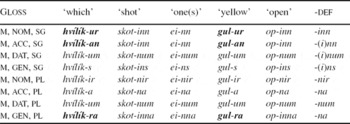
There are furthermore significant morphological differences between the Mainland Scandinavian (h)vilken and the Old Norse/Icelandic hvílík(u)r. First of all, we notice a difference in the stems with -(h)vilk- versus -hvílík-. Second, and more importantly, the Mainland Scandinavian expression can be argued to inflect like the indefinite article, participles, participial adjectives (like ‘open’), and the definite article, whereas the Old Norse/Icelandic expression inflects like a strong (non-participial) adjective. This is illustrated by tables 1 and 2 for Swedish and Icelandic, respectively.Footnote 5 The inflectional difference is most evident when we compare Swedish with the nominative and accusative singular and the genitive plural forms in Icelandic. The two morphological differences between Mainland Scandinavian and ON/Icelandic may suggest that the historical origin of (h)vilken is more complex and that it is not a direct descendant from Old Norse. Given the well-known massive impact from Low German on Scandinavian from the late Middle Ages and onwards (see Jahr Reference Jahr1998, Reference Jahr2000), one may in fact envisage that the expression is flavored by the corresponding welk in Low German (and Dutch) to give the stem (h)vilk-.
The inflection of ‘which’, past participles, the indefinite article/‘one’, regular strong adjectives, participial adjectives, and the definite suffix in Swedish.

The inflection of ‘which’, past participles, ‘one’, regular strong adjectives, participial adjectives, and the definite suffix in the masculine in Icelandic.

The inflectional difference is not perfect in that the Swedish plural form vilka patterns with the adjectival inflection in being marked with the formative -a and not -na as in the other classes. The same discrepancy holds for Bokmål Norwegian and Danish, where we find the plural form hvilk-e rather than, for example, hvilk-ne.
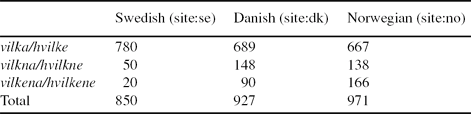
Interestingly, however, the non-sanctioned forms vilkna/vilkena for Swedish and hvilkne/hvilkene for Norwegian and Danish are far from infrequent in texts found on the Internet. Table 3 presents the (uncontrolled) results of a Google search.Footnote 6
Plural forms of (h)vilken across Mainland Scandinavian (Google search).
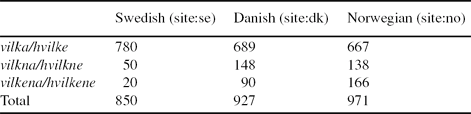
These unsanctioned forms better conform to the general morphological pattern for (h)vilken found in the singular, and according to the figures in table 3, they make up around 8% for Swedish, 15% for Danish, and 31% for Norwegian of the total numbers, and we may then more readily ask what the status of this inflection is.
One thought that springs to mind given the token-querying property of Mainland Scandinavian (h)vilken is that the inflection is in fact the definite suffix. The examples in (22) and (23) elaborate on the morphological similarity of the elements.
(22)
The proposal is slightly problematic with respect to (Bokmål) Norwegian for two reasons: (i) there exists no singular feminine form *hvilk-a corresponding to, for instance, bok-a ‘the book’, and (ii) the final -t of the neuter singular hvilk-et is pronounced unlike the (spelled) final -t of the definite suffixed article. This is illustrated by the following paradigm pair where the imbalance in the feminine and neuter is evident from the b- and c-examples.
(24)
However, there are reasons to believe that hvilken has a special status in Norwegian. First of all, it is rarely found in the traditional dialects but seems to be found first and foremost in the Standard East Norwegian spoken in the larger Oslo area as well as the vernaculars of other cities which can be described as close to the written Bokmål standard of the language. This distribution is underscored by the fact that the word is completely absent from the Nynorsk standard of Norwegian insofar as this standard is conceived of as being based on the traditional rural dialects of Norwegian. One could thus argue that hvilken in Norwegian is borrowed into the spoken language from the written language, thus ultimately from Danish, given that (written) Bokmål has evolved from (written) Danish. And in Danish there is (i) no masculine/feminine distinction, and (ii) the final neuter -t of both hvilken and the definite suffix is pronounced (as /ð/ in the dominant Copenhagen colloquial variety).
Second, until recently there has existed a cognate for hvilken in East Norwegian dialects, namely vekken, and according to the description in Larsen (Reference Larsen1907:116), this item was inflected like the definite suffix in the Oslo dialect, with a distinct feminine form vekka and a neuter form vekke without the final -t. This supports the view that contemporary hvilken is borrowed from the written language and still has properties that partly relate to a different grammar or register – the word has not yet been fully integrated in the contemporary colloquial grammar.
Although this line of reasoning raises some important general questions, such as whether a particular lexical item can at all ‘lie outside’ of the grammar proper as it were, the bottom line is that we may, on formal, morphological grounds, argue that Mainland Scandinavian (h)vilken consists of a stem (hvilk-) plus the definite suffix which otherwise attaches to nouns across Scandinavian.
Given the well-established insight that the Scandinavian definite suffix entails specificity (Julien Reference Julien2005, Anderssen Reference Anderssen2005), and given that specificity quite clearly must be an integral component of the semantics of reference to token, we would then have a very direct way of accounting for the Mainland Scandinavian vs. ON/Icelandic semantic difference: the definite suffix involved in (h)vilken is only compatible with queries for token.
Although this line of reasoning will not shed any light on why English which is apparently token-querying, the idea seems worth following up for Scandinavian, and we will return to it below.
3.2 Icelandic hvaða
The way to form queries for token in Icelandic is to use the expression hvaða. Consider the illustration in (26).
(26)
An interesting point of difference between the Mainland Scandinavian (h)vilken and Icelandic hvaða is that whereas the former is inflected (for gender and number) the latter does not show any inflection whatsoever. This lack of inflection on hvaða is illustrated by the following examples – notice the inflection on the adjective.
- (27)
a.
‘Which fancy boat did you buy?’
b.
‘Which fancy house did you buy?’
c.
‘Which fancy book did you buy?’
Given that Icelandic otherwise displays rich agreement on adnominal constituents, the lack of agreement on hvaða is a somewhat peculiar fact. Still, the expression appears to be morphologically complex, consisting of hvað ‘what’ plus the formative -a. The origin and contemporary status of -a is uncertain; in section 6 I will suggest that it is a head in the left periphery of the noun phrase to which hvað moves and aligns with phonologically speaking, i.e. that -a is a kind of complementizer/preposition.
3.3 ‘Who’ as a determiner
One phenomenon which does not bear directly on the morphosyntactic considerations of the previous two subsections, but which nevertheless deserves to be mentioned, is the fact that in some East Norwegian dialects the wh-item corresponding to English who can be used adnominally.Footnote 7 The example in (28a) has been retrieved from a discussion forum on the InternetFootnote 8 and the example in (28b) has been construed on the basis of the a-example to illustrate the regular pronominal use of hvem.
- (28)
a.
‘Which day will the tax money come?’
b.
‘Who will come with the tax money?’
Speakers who use hvem adnominally inform me that it entails queries for token on a par with hvilken and that for queries for kind they would use a different expression, for example, åssen (manner) ‘how’. This is, for instance, the system of the dialect spoken by younger people in the town of Kragerø on the coast about 200 km southwest of Oslo (Gard F. Vangsnes, p.c.).
- (29)
a.
‘What kind of car do you have?’
b.
‘Which car is yours?’
Although perhaps somewhat exotic at first sight, finding such an extended use of ‘who’ does make sense: in contrast to ‘what’, ‘who’ as a pronoun does indeed query for specific individuals, hence token, and the dynamic relationship between pronouns and determiners are otherwise well-known in historical linguistics. In very general terms, what we may say about the dialects in question is that their ‘who’ is endowed with some lexical feature that makes it amenable also for a DP-internal use, but that the semantic properties and entailments of the expression are otherwise not different from what we see in other dialects.Footnote 9
We also find examples of an extension going in the other direction among Scandinavian varieties, i.e. a wh-determiner which is also used as a wh-pronoun corresponding to ‘who’. The Övdalian variety of Mainland Scandinavian, spoken in Älvdalen, Sweden, is a case in point. The wh-item ukin in this dialect, which quite clearly is cognate with hvílík(u)r/(h)vilken Footnote 10 is used both adnominally and for ‘who’: there is no other item corresponding to ‘who’.
- (30)
a.
‘Which car is yours?’
b.
‘Who will you meet in Stockholm?’
Again, the dynamic relationship between the wh-determiner and the wh personal pronoun functions makes perfect sense from a semantic/conceptual point of view.
The next step now is to consider another somewhat exotic property of many Scandinavian varieties, namely the adnominal use of what is otherwise a manner-querying wh-expression.
4. MANNER ‘HOW’ AS WH-MODIFIER AND WH-DETERMINER
The adnominal use of manner ‘how’ is quite widespread across Norwegian dialects and non-standard varieties, even the one(s) spoken in Oslo (Vangsnes Reference Vangsnes, Johannessen and Hagen2008b), and it is also a common trait of colloquial Icelandic (Vangsnes Reference Vangsnes2008a). Furthermore, the use can also be encountered in Jutlandic dialects of Danish.Footnote 11 Interestingly, in opposite terms, it seems that Old Norse had a manner ‘how’ use of hvílíkr.Footnote 12
As already mentioned the varieties differ as to whether adnominal manner ‘how’ can yield both kind and token queries. The Kragerø examples in the previous section suggest that in this dialect it can only query for kind (see also Vangsnes Reference Vangsnes, Johannessen and Hagen2008b:52f.) and that clearly seems to be the case also for Icelandic, as the following examples indicate:
- (31)
a.
‘What kind of car do you have?’
b.
c.
‘How are you going to solve the problem?’
In the overview section above, however, we saw that in the Tromsø dialect of Norwegian the adnominal manner ‘how’ can be both a modifier and a determiner (i.e. ±kind-querying). The same holds for my native Sogn dialect, illustrated here by two examples from a corpus of recent video recordings.Footnote 13
- (32)
a.
‘What kind of car/#which car drives he?’
b.
‘Which/#what kind of gender is it?
As should be evident just from the examples given so far there is considerable variation in the form that manner ‘how’ takes across the varieties: korsn, åssen, hvernig, kelais. These are just a few of a great multitude of forms (see the entry for korleis in Norsk Ordbok, vol. 6), but importantly, as discussed in Vangsnes (Reference Vangsnes2008a), most of the many forms can be related to just two abstract morphological templates, one which involves an incorprated direction noun (cf. English what way) and another which involves the formative -dan, arguably a borrowing of the past participle of ‘do’ in Low German. The Bokmål Norwegian and Danish form hvordan is an example of the latter.
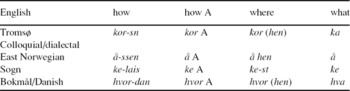
Another finding in Vangsnes (Reference Vangsnes2008a) is that whenever manner ‘how’ can be used adnominally it can be argued to be (i) morphologically complex, (ii) distinct from degree ‘how’, and (iii) in a morphological relationship with other short wh-items, notably with ‘what’ and/or ‘where’.Footnote 14 Swedish and Faroese are varieties where manner ‘how’ and degree ‘how’ are identical (with the forms hur and hvussu, respectively) as in English (how) and German (wie): neither Swedish nor Faroese allows manner ‘how’ to be used adnominally. Most other forms seem to subsume the degree wh-item which in turn is either identical to either ‘what’ or ‘where’ or at least involved in the relevant expressions. Consider the comparison between English and four Norwegian varieties in table 4.
Manner ‘how’, degree ‘how’, ‘where’, and ‘what’ in English and four varieties of Norwegian.

Although Swedish does not allow hur manner/degree ‘how’ to be used adnominally, there exists a particular wh-expression, hurdan, which in its composition clearly is parallel to the Danish/Norwegian form hvordan and which can only be used adnominally. Furthermore, although most speakers find this expression quite archaic and formal, they have a clear judgment that it is only compatible with queries for kind. Hence, we have the examples in (33), where I have glossed hurdan according to the etymology and internal structure proposed in Vangsnes (Reference Vangsnes2008a).
- (33)
a.
‘What kind of car do you have?’
b.
The existence of the expression hurdan as a uniquely kind-querying element paired with the observation that only a subset of the Norwegian varieties allow adnominal manner ‘how’ to query for token suggests that the primary adnominal use is the kind-querying one. In turn, this means that we again have a case of extension from wh-modification to wh-determination: in this case the historical development is suggested by contemporary microcomparative variation.
We will now turn to a third case which provides evidence for this cycle within wh-DPs, namely the expressions in Scandinavian which involve combination of ‘what’ with other elements such as ‘for’, the indefinite article, or an overt kind noun plus genitive marking.
5 INTERROGATIVE DPs INVOLVING ‘WHAT’
As mentioned above, Nynorsk Norwegian bare, adnominal ‘what’ has a general ±kind capacity on a par with English what, and several Norwegian dialects seem to share this capacity. The Sogn dialect of West Norwegian is a case in point – consider the following examples from the corpus of video recordings referred to earlier.
- (34)
a.
‘What hair color does he have?’
b.
‘Which/#what kind of gender is it?’
Alongside this and the adnominal use of manner ‘how’ it seems that most dialects of Scandinavian can resort to a strategy whereby ‘what’ combined with an overt ‘kind’ noun is used. This noun is followed by the -s formative in Mainland Scandinavian, and the preposition for/för may optionally intervene between the invariant ‘what’ and the kind noun. In Danish one can also encounter an indefinite article between for and the kind noun: for cannot then be absent (cf. above). Hence, we have the following:Footnote 15
(35)
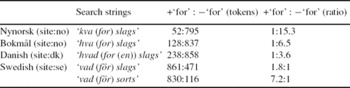
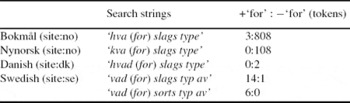
Moreover, with respect to the presence/absence of for/för, there are statistical differences between the Mainland Scandinavian standard varieties. Results from a Google search suggest that absence of for is preferred in Norwegian, most strongly so in Nynorsk Norwegian. In Danish the distribution is more even, but still with a slight preference for the absence of for. For Swedish the situation is turned with higher numbers for the presence of för, and this is strongest when the kind noun is sort. The numbers and ratios from the Google search are given in table 5: for Danish I have summarized the numbers for . . . for slags . . . (32 hits) and . . . for {en, et} slags . . . (206 hits).
Ratios of ±‘for’ in kind-querying determiners in Mainland Scandinavian (Google search).

In Norwegian the kind noun slags can be reinforced by another kind noun such as type ‘type’. Consider the following Nynorsk Norwegian example retrieved from the Internet:Footnote 16
(36)
‘What kind of ventilation does the house have?’
Two quite interesting observations can be made in this respect on the basis of web statistics. First of all, this kind of reinforcement in ‘what kind of’ DPs appears to be more or less restricted to Norwegian. Second, in Norwegian this kind of reinforcement is only found if for is absent. Table 6 gives the figures for a Google search exploring the issue. The table shows that there are in fact some very few examples of reinforcement in Swedish, (almost) all appearing with för, but crucially with the preposition av ‘of’ after the reinforcer.
Tokens of ±‘for’ in kind-querying determiners reinforced by ‘type’ (Google search).

Leaving kind-reinforcement in Swedish aside as a quirk for future investigations, we can now summarize the findings above as follows:
- (37)
(i) Among the Mainland Scandinavian varieties absence of for/för from the ‘what kind of’ determiner is preferred in Norwegian.
(ii) kind-reinforcement is (more or less) restricted to Norwegian.
(iii) kind-reinforcement requires absence of for/för.
At this point it is of great importance to observe that for Norwegian it seems that, at least for some speakers, the kind denotation of slags has become bleeched and that the expression in fact can be used to query for token. Corroborative evidence for this can be easily retrieved from the Internet. Consider the dialogue in (38)Footnote 17 and the example in (39)Footnote 18 for Nynorsk Norwegian, and (40)Footnote 19 and (41)Footnote 20 for Bokmål Norwegian.
- (38)
A:
‘What book or film would you recommend to others?’
B:
‘The books about Kurt Wallander by Henning Mankell.’
(39)
‘What day is it that you sell them?’
(40)
‘That way you don't need to pay attention to which day and week the renovation car is out driving’
(41)
‘Which celebrity would you like to go on a vacation with?’
I have so far not been able to find comparable token-querying cases of such wh-DPs with an overt kind noun in Danish and Swedish. That supports the language-internal findings for Norwegian: from a purely technical point of view it is tempting to suggest that the absence of for may have paved the way for extending the use of the ‘what kind of’ expression from wh-modification to wh-determination. In turn, now having an expression which is ±kindq opens up for reinforcement of the modifier function by the addition of another kind noun.
This is, then, our third case which suggests that there is a cycle involved in the domain wh-modification/wh-determination. This time the cycle manifests itself when we compare numerical data from the contemporary written Mainland Scandinavian varieties.Footnote 21
Let us then summarize and consider the findings in the preceding sections in relation to the rough phrase structural sketch given in the introduction.
6. ANALYSIS AND CONCLUSION
This overview of interrogative noun phrases in Scandinavian has discussed essentially three different types of adnominal wh-expressions: cognates of English which, manner ‘how’ used adnominally, and expressions involving ‘what’ plus an overt kind noun.
For all of these three domains we have seen that varieties differ with respect to whether the expressions query for kind or token or for both: Old Norse hvílíkr queries for kind whereas contermporary Mainland Scandinavian (h)vilken queries for token; Icelandic hvernig (manner ‘how’) only queries for kind, whereas korsn in the Tromsø dialect and other North Norwegian dialects can query for both kind and token; for many speakers of Norwegian hva slags can query for both kind and token whereas the corresponding expression presumably queries for kind only in Swedish and Danish. We have also seen that Icelandic hvaða only queries for token, and that the same holds for the adnominal use of hvem ‘who’ in East Norwegian dialects, and furthermore that bare adnominal ‘what’ is ±kind in Scandinavian just as in English.
One indisputable conclusion can be drawn from this: we are dealing with a highly flexible part of grammar, at least from a historical and dialectological point of view. The question then arises whether this flexibility is unpredictable and unconstrained. I have suggested that it may not be, and that we can observe a general tendency whereby wh-modifiers develop into wh-determiners.
There are reasons to believe that this general development path is not confined to Scandinavian/Germanic: it seems to have a parallel in Romance at least in that Latin qualis queried for kind whereas its descendants in Italian and Spanish, quale and cual, now only query for token. Consider the examples in (42).
- (42)
a.
‘What kind of leader is Hannibal?’
b.
‘Which day should we meet
c.
‘Which day of the week is your favorite one?’
A host of interesting issues concerning morphosyntactic details can be detected on the basis of the presentation above. In the remainder of this paper I will, however, concentrate on discussing how the putative modification–to–determination cycle can be captured in quite general terms, and leave the more detailed questions to future work.
Following Leu (Reference Leu2008a, Reference Leub) I will argue that adnominal wh-expressions can originate in the adjectival domain of the noun phrase. This seems quite justifiable for cases like hvílíkr which inflects precisely like a strong adjective, see above. Leu also gives arguments from Swiss German to show that adjectival morphology can appear even on the preposition in the was für-construction (Leu Reference Leu2008a:7).
(43)
‘What kind of wine did you buy?’
Very similar data of the Swiss German type can be found in the North Ostrobothnian dialects (of Swedish) in Finland. Consider the following data, which were collected during the NORMS fieldwork in the area in June 2006.Footnote 22 The first set of examples is from Esse.
(44)
In the dialect of Nedervetil (which lacks gender marking altogether) the same adjectival formative can appear both on the ‘for’ preposition and on an overt kind noun.
(46)
An interesting fact about the apparent affix we see in these cases is that it probably is not an affix at all, but rather a postadjectival enclitic element. The reason for arguing this is that when two adjectives are conjoined, the element will only appear once, and then on the last adjective; thus, we have (47a), but not (47b). However, if the adjectives are adjacent, without an intervening conjunction, the element will appear on both, as in (47c).
- (47)
a.
b. *ein stor-an o fin-an bil
c. ein stor-an, fin-an bil
This means that the element shows very similar properties to the so-called postadjectival indefinite article discussed in Delsing (Reference Delsing1993:142ff., Reference Delsing, Vangsnes, Holmberg and Delsing2003:45ff.), and what I will tentatively take this to mean is that also adnominal wh-expressions that involve the indefinite article start out in the adjectival domain of the noun phrase.
In turn I will argue that the kind reading is established by the expression moving into the classifier domain of the noun phrase, i.e. into CardP, whereas the token reading is established if it moves into the DP domain. From these positions the wh-expression will in turn move leftwards to KP in order to license wh features.
The rough sketch from the introduction can then be augmented as follows, where αP is the adjectival domain of the noun phrase (see Julien Reference Julien2005).
(48)
The very general idea I offer to account for the apparent drift from modification to determination is then quite simple. A modifier will pass the D° head when moving further to KP, and over time it may then also be associated with this part of the functional domain and develop into a licensor for token queries, say through a change in the feature composition of the expression.
In more concrete terms my proposal is then that Old Norse hvílíkr would undergo a derivation like the one in (49a). At some historical stage hvílíkr (or some cognate variant) would optionally be able to undergo the derivation in (49b) and serve to license a token query. This is the status I will attribute to korsn in the Tromsø dialect and other North Norwegian varieties, i.e. adnominal ‘how’, which in these varieties can be used to query for either kind or for token.
(49)
Then, as hvílíkr developed into contemporary (h)vilken, the expression would no longer be first merged in the adjectival domain, but rather directly into the DP domain. At this point the expression has developed into a true determiner with no capacity to license a kind reading anymore.
For Mainland Scandinavian the last stage coincides with a change in morphological properties: as argued above, the inflection of contemporary (h)vilken is the definite suffix otherwise found on nouns. Perhaps this change in morphology was downright triggered by the grammaticalization drift.
This means that we can attribute the same status to the pure determiners hvaða (Icelandic) and hvem (East Norwegian dialects) as to (h)vilken: they are all merged directly in DP, except that I will argue that -a is merged in K° and that it is phonologically merged with (uninflected) hvað after the latter has moved to KP. Nothing crucial bears on this treatment of hvaða, except that it possibly leaves some room for understanding why it shows no gender, case, and number inflection. As for the other expressions discussed above, both the adnominal ‘how’ and the expressions involving an overt kind noun I will assume that they are all merged in the adjectival domain of the noun phrase. They all have the capacity to license a kind query by movement into CardP and some of them have also acquired a capacity to license a token query by moving into DP.
According to this very general proposal we should not expect cases of ‘downward’ grammaticalization, i.e. that a pure wh-determiner should develop into a wh-modifier, the reason simply being that a pure wh-determiner will not move ‘over’ CardP. Whether there exist no such cases of determiner-to-modifier development is of course an empirical matter.
Many unsolved puzzles remain. More detailed investigations of the morphological and compositional structure of the various wh-expressions needs to be carried out and brought to bear on the general proposal presented here. The conceptual basis for using manner ‘how’ adnominally also seems to be an interesting issue to pursue.
There are currently several detailed and fine-grained analyses of the structure of Germanic adnominal wh-expressions available on the market: see, for instance, Bennis, Corver & den Dikken (Reference Bennis, Corver and Dikken1998) and Haegeman (to appear), which pursue a predicate inversion analysis of determiners, and van Riemsdijk (Reference Riemsdijk, Vulchanova and Åfarli2005) and Leu (Reference Leu2008a, Reference Leub), which analyze the structure of complex determiners by invoking the notion of silent nouns. Although it is not immediately clear whether the core of the current proposal can be withheld when confronted with these analyses, i.e. as far as accounting for the putative general drift from modifier to determiner is concerned, I believe that the data presented here can be a valuable contribution to the further development of such analyses, and I consider that the next step.
ACKNOWLEDGEMENTS
For comments and discussion on previous versions of this paper I would like to thank Liliane Haegeman, Terje Lohndal, and an anonymous reviewer. I am furthermore grateful to Tom Leu for continuous and continued discussion of the internal structure of interrogative noun phrases in particular and DP syntax in general. The paper has in part evolved from a number of presentations given since winter 2006, and thus benefitted from feedback from and discussions with a large number of people.