Introduction
With an increased volume of acute care hospitalisations for adults with psychiatric conditions in the US (Blader, Reference Blader2011) and shortened stays for psychiatric hospitalisation (National Association of Psychiatric Health Systems, 2002), clinical staff aim to rapidly engage inpatients in the treatment milieu to accelerate recovery and improve functionality. Though patient engagement in the therapeutic milieu is one of the primary elements supporting inpatients’ goals for recovery, patient avoidance of daily programming (e.g. skills groups, occupational, and recreational therapies) is a common occurrence (Pereira & Woollaston, Reference Pereira and Woollaston2007). Experiential avoidance is a behavioural pattern evident across psychiatric disorders (Hayes et al. Reference Hayes, Wilson, Gifford and Follette1996), correlated with adverse health consequences, including reduced quality of life (Kortte et al. Reference Kortte, Veiel, Batten and Wegener2009; Kingston et al. Reference Kingston, Clarke and Remington2010), poor coping (Karekla & Panayiotou, Reference Karekla and Panayiotou2011), depression (Bruder-Mattson & Hovanitz, Reference Bruder-Mattson and Hovanitz1990; DeGenova et al. Reference DeGenova, Patton, Jurich and MacDermid1994) and substance use (Ireland et al. Reference Ireland, McMahon, Malow and Kouzekanani1993). The challenge on an inpatient unit is to identify the extent to which patient avoidance hampers recovery and to use interventions that reduce patient avoidance.
Behavioural activation (BA) is a structured evidence-based intervention that helps patients to modify their avoidant behaviour and interaction with the environment. Symptom reduction is achieved various ways, including: monitoring daily activities to assess patterns of low reward and mood; assessing and assigning tasks that invoke pleasure or satisfaction, and competence; rehearsal of scheduled activities; understanding the function of avoidance; and improving skill deficits designed to reduce avoidance (Dimidjian et al. Reference Dimidjian, Marrera, Martell, Munoz and Lewinsohn2011). Outpatient BA interventions are recommended as efficacious psychological treatments for adults with major depressive disorder (MDD) (National Institute of Health and Clinical Excellence, 2009, pp 238–242) and meta-analyses have highlighted the parsimony and efficacy of BA (Cuijpers et al. Reference Cuijpers, van Straten and Warmerdam2007; Ekers et al. Reference Ekers, Richards and Gilbody2008) with a variety of medical conditions and contexts (Hopko et al. Reference Hopko, Lejuez, LePage, Hopko and McNeil2003; Daughters et al. Reference Daughters, Braun, Sargeant, Reynolds, Hopko, Blanco and Lejuez2008; Snarski et al. Reference Snarski, Scogin, DiNapoli, Presnell, McAlpine and Marcinak2011) and, notably, among patients with higher depression severity (Dimidjian et al. Reference Dimidjian, Marrera, Martell, Munoz and Lewinsohn2011).
Inpatient treatment outcome studies with BA interventions have used the behavioral activation treatment for depression (BATD; Hopko et al. Reference Hopko, Lejuez, LePage, Hopko and McNeil2003) lending support for the utility of BA with inpatients. Hopko et al. (Reference Hopko, Lejuez, LePage, Hopko and McNeil2003) reported that six, 20-minute BATD sessions conducted across two weeks for depressed inpatients generated clinical reduction in depressive symptoms from pre to post-treatment relative to a supportive psychotherapy group. Snarski et al. (Reference Snarski, Scogin, DiNapoli, Presnell, McAlpine and Marcinak2011) reported that eight 30–60 minute sessions of BATD resulted in 24% of depressed inpatients showing symptom reduction as compared to 12% of the treatment-as-usual participants. Finally, BA has also been shown to be effective in an inpatient context when administered by mental health nurses (Ekers et al. Reference Ekers, Richards, McMillan, Bland and Gilbody2011) in which a hybrid of both BA models was delivered in an individual therapy context, generating significant reductions in depressive symptoms compared to treatment-as-usual.
We developed and tested Behavioural Activation Communication (BAC), a newly designed milieu approach to assist acutely ill psychiatric inpatients to identify their own avoidance behaviour, and to apply BA principles in daily programming on the unit (Martell et al. Reference Martell, Addis and Jacobson2001), with the goals of reducing symptoms and increasing positive emotion. All patients on the BAC unit were encouraged to learn how to track behavioural patterns, monitor, and schedule their mastery and pleasure activities, identify and replace avoidance patterns on the unit, learn new approach strategies, and to maintain their activation with the program. BA was integrated across the unit into most aspects of patient programming, including patient group meetings, psycho-education sessions, nursing care, physician inquiry with patient and morning rounds, discharge plans, and social work activities. Mental health counsellors ran two ‘BAC groups’ with a 30 minute morning group and a 30 minute evening review of BA skills. All clinicians were attuned to discuss the BA techniques in their interaction with patients, and to support and remind patients to use the BA skills. In sum, patients had access to the morning and wrap up groups, a BAC patient guide, and informal consultation with the medical staff.
This study compared BAC versus treatment as usual (TAU) units on outcomes including psychiatric symptoms, negative and positive affect, engagement with the milieus. We proposed that BAC relative to TAU patients would demonstrate the following: higher positive affect, behavioural activation sensitivity, and behavioural approach of the daily milieu programming; and, lower negative affect, behavioural inhibition sensitivity, and avoidance of the milieu programming, as well as lower psychiatric symptoms. Also, we proposed that BAC patients would demonstrate relative greater change of approach and avoidance and of positive and negative affect than TAU patients.
Method
Patients
The sample included 144 patients, 65 (45%) males and 79 (55%) females with a mean age of 38.6 years (SD = 13.6), collected between January 2011 and July 2011. Half of the patients (n = 71 patients, 49%) were assigned to the BAC unit and the other half assigned to the TAU unit (n = 73 patients, 51%). Missing data analyses revealed that data was missing at random for both units: Little's MCAR test: χ2(1, 141) = 133.6, p = 0.65. Of the 144 patients, 30 patients (11 TAU, 19 BAC) failed to return either the admission or discharge packet, and due to occasional admissions and discharges during hours unstaffed by research personnel, some patients provided incomplete responses.
Patients were provided with a written description of the program evaluation with a description of risk and benefits, and each signed a written consent indicating acceptance of enrollment in a hospital-approved quality improvement initiative using de-identified data. Patients were eligible if they could read English and comprehend at a seventh grade reading level; they were ineligible if there were precautions for suicidal or disruptive behaviour during the first 24 hours of admission, inability to complete the forms, repeated hospitalisations during the data collection period, and less than 24 hour stay. The hospital quality improvement protocol did not collect information on race and ethnicity.
Chi-square analyses revealed group differences in gender, [χ2(143) = 5.5, p = 0.01]. The proportion of women was higher on the BAC unit (n = 46, 55%). The average length of hospitalisation across the units was 7.18 days (SD = 6.7 days) with no significant differences by unit, F(1,143) = 0.7, p = 0.44.
Design and procedure
Based on bed availability at the time of admission, the unit director (PR) assigned patients to one of two similar units: a 17 bed unit (TAU) or a 19 bed unit (BAC). Participants were assessed twice, within 24 hours after admission and 24 hours before discharge.
Treatment fidelity
The BAC and TAU units had identical daily programming to control for level of inpatient activity (e.g. number of groups, occupational therapy, physical training, and medication management). Staff remained nested within each unit for the duration of the evaluation. The units had equal clinician competencies, with equivalent years of experience working in acute psychiatric care at the medical center (all BAC staff: 190 total years across staff; all TAU staff: 200 total years).
Competence and adherence
BAC delivery was measured two ways. Staff attended a four hour continuing medical education course on BAC and passed an examination. Then staff were observed in BAC groups and received competency scores on the Behavioral Activation Communication Competency Scale (BACCS; J. K. Gollan, D. Hoxha, and B. Hanson, unpub. doc. 2011) a measure that quantifies skills in providing the BAC rationale, case conceptualisation, and dissemination of BAC skills for an inpatient environment (10/14 is the minimum competency rating). Staff members were evaluated twice, four months apart, to show stable BACCS ratings.
TAU unit
The TAU unit reflected standard care offered in a psychiatry unit. At the time that BAC patients were attending BAC groups, TAU patients attended a daily community group that outlined unit rules and goal-setting.
BAC unit
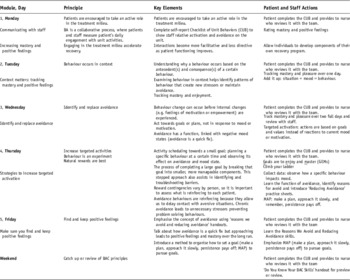
The BAC unit reflected the integration of standard of psychiatric care (reflected in the TAU unit), with two 30 minute BAC groups. The morning BAC group introduced the patient guide, helped patients to identify behavioural avoidance using the Checklist of Unit Behaviors (CUB; Hanson et al. Reference Hanson, Hoxha, Roberts and Gollan2013), one BA principle, and two BA techniques (Table 1). Patients were encouraged by to rehearse the BAC skills throughout the day, by nursing staff with daily activities, social workers with discharge planning, recreational and occupational therapists in group meetings, and by medical staff who discussed the BAC skills during treatment planning meetings.
Five modules of Behavioural Activation Communication

Measures
Self-report measures included the Brief Symptom Inventory (BSI; Derogatis & Spencer, Reference Derogatis and Spencer1982), a 53-item measure of nine dimensions of psychopathology. Brief Symptom Inventory subscales have strong internal consistency for the nine dimensions reflecting symptom sets (Derogatis et al. Reference Derogatis1993). The Brief Symptom Inventory also includes a Global Severity Index (GSI), measuring general distress. The Positive Affect and Negative Affect Scale (PANAS) (Watson et al. Reference Watson, Clark and Tellegen1988) is a 20-item questionnaire that measures the extent to which patients experienced specific positive and negative emotions in the past week using a five-point scale (‘not at all’ to ‘extremely’). The Positive Affect subscale (10 items) and the Negative Affect subscale (10 items) have strong internal consistency (α = 0.88; α = 0.85, respectively, (Watson et al. Reference Watson, Clark and Tellegen1988). The Checklist of Unit Behaviors (CUB; Hanson et al. Reference Hanson, Hoxha, Roberts and Gollan2013), is a 16-item questionnaire of patient's activity level in hygiene, daily programming, discharge planning, and social interaction with staff. Two subscales reflect Approach and Avoidance, scores range from 0–34, with higher scores representing higher patient activation or avoidance with the unit in the last 24 hours. Psychometric properties of the final 16-item solution were satisfactory and published elsewhere (Hanson et al. Reference Hanson, Hoxha, Roberts and Gollan2013) (Approach: Cronbach's α = 0.93; Avoidance: Cronbach's α = 0.79).
Statistical plan
Tests of baseline differences in demographic and clinical characteristics were investigated using independent samples t-tests or analysis of variance (ANOVA) for continuous variables and chi-square tests of independence for categorical variables. We conducted two sets of analyses: independent samples t-tests establishing similarity in the Brief Symptom Inventory symptoms at admission; and univariate analyses of covariance (ANCOVA) to examine group effect in change scores from admission to discharge. Finally, we examined relative change scores on the CUB and PANAS subscales. Relative change was defined by the score at admission minus the score at discharge.
Results
Unit differences in reduction of symptoms, affect, and behaviour
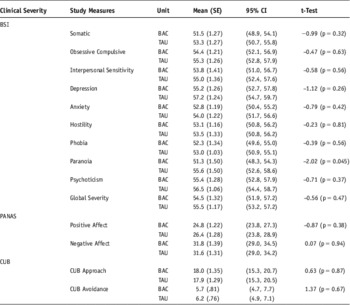
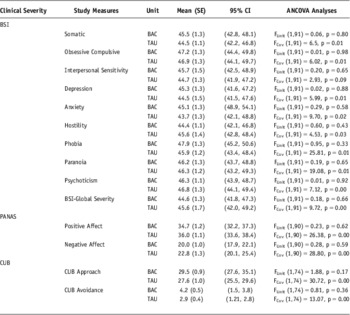
Descriptive information and results from the independent samples t-tests and analyses of covariance are shown in Tables 2 and 3. Patients on the BAC and TAU units showed similar clinical severity on psychiatric symptoms at admission across eight of the nine Brief Symptom Inventory subscales and the Global Severity Index. Specifically, there was a significant difference of estimates of the Brief Symptom Inventory Paranoia subscale, [t(143) = –2.02, p = 0.045] with a higher average score of paranoia symptoms among patients on the TAU unit. Baseline estimates on the Paranoia subscale were used as covariates in subsequent analyses. There were no group differences on patient positive and negative affect at admission [t(143) = –0.87, p = 0.38, t(143) = 0.07, p = 0.94)], respectively, and of patient approach and avoidance of the treatment milieu at admission [t(143) = 0.63, p = 0.87, t(143) = –1.37, p = 0.67], respectively.
Patient psychiatric dimensions, affective experience, and approach and avoidance of the milieu at admission (N = 144)

BSI = Brief Symptom Inventory; PANAS = Positive Affect and Negative Affect Scale; CUB = Checklist of Unit Behaviors
Patient psychiatric dimensions, affective experience, and approach and avoidance of the milieu at discharge (N = 89)

BSI = Brief Symptom Inventory; PANAS = Positive Affect and Negative Affect Scale; CUB = Checklist of Unit Behaviors
Analyses of covariance assessed the main effect of group (BAC, TAU) on discharge measures (BSI, PANAS, CUB) while controlling for their respective baseline clinical estimates. First, we examined interaction effects (covariate * unit) and proceeded with ANCOVA analyses after removing the non-significant interaction terms. As shown in Table 3, there were was no significant main effect of unit after adjustment for covariates across measures of psychiatric status (BSI), positive and negative affect (PANAS), and approach and avoidance behaviours (CUB). One of the covariates (Brief Symptom Inventory-Interpersonal Sensitivity Subscale) was not significant whereas other covariates were significantly associated with clinical measures at discharge.
Relative change
Next, change of the CUB and PANAS score from admission to discharge were examined. Using ANOVA, results indicated a significant main group effect (BAC vs TAU) for CUB Approach, F(1,76) = 2.86, p = 0.09. BAC patients doubled their approach strategies (M = 13.7, SD = 9.6) relative to TAU patients (M = 8.1, SD = 8.7). No main group difference in CUB avoidance was observed, F(1,78) = 0.28, p = 0.59. Examining the change score on the PANAS, there was a main group effect for positive affect change, F(1,76) = 4.9, p = 0.049, but no main group effect for change of negative affect, F(1,76) = 0.1, p = 0.88, suggesting a similar decrease of negative affect from admission to discharge for both units.
Discussion
BAC and TAU patients at admission were equivalent on clinical acuity and on age, length of hospital stay, and burden of illness. Our results did not show a significant difference in psychiatric symptoms at discharge, though this may have been due to the clinical practice of discharging patients once they demonstrate readiness for the transition and achieve targets signaling propensity for recovery. Relative change of positive affect and CUB approach was significantly higher for BAC than TAU patients, which is consistent with research on BA across outpatient and primary care contexts (Cuijpers et al. Reference Cuijpers, van Straten and Warmerdam2007; Ekers et al. Reference Ekers, Richards and Gilbody2008). As BAC is compatible with other modalities, the BAC program appears to offer support for patients relative to standard inpatient care.
These data highlight the value of engaging inpatients in the milieu to accelerate recovery (Murugesan et al. Reference Murugesan, Amey, Deane, Jeffrey, Kelly and Stain2007; Thibeault et al. Reference Thibeault, Trudeau, d'Entremont and Brown2010). Our results suggest that the BAC program offers a clinical advantage to patients, while also helping medical staff to use a common framework for encouraging patients to engage in self-care and the daily programming. BAC is compatible with other modalities, which may generate greater change than standard inpatient care. These data offer the first observation that inpatients across the diagnostic spectrum respond to clear guiding principles that help patients to understand the effects of their avoidance; and how to counter avoidance with deliberate, goal-oriented behaviours while residing in the inpatient setting.
Strengths included using on-site expert trainers to provide real-time, individual, and group BAC instruction, inclusion of inpatients with varied psychiatric disorders using ordinary bed assignment, and inclusion of allied health care providers. Limitations included the absence of a randomisation strategy to assign patients to a specific unit, absence of structured clinical interviews, and independent verification to assess staff competence in BAC. Finally, variations in inpatient milieus, staff experience, patient illness, and daily programming in acute psychiatric units in the US may limit generalisability.
In conclusion, this report offers initial support for a novel milieu-based treatment approach for psychiatric inpatients. Efficacious, unit-wide programming that is appropriate for patients spanning a spectrum of psychiatric disorders, addresses a gap in current clinical practice, and provides an avenue for increasing inpatient engagement in psychiatric. This report highlights the beneficial effects for inpatients when treatment teams use milieu-based approaches that promote approach behaviours while helping patients identify and address maladaptive avoidance. Our findings suggest that positive affective experience and engagement in the daily programming is modifiable using behavioural interventions. Future work may develop strategies that help patients to continue to rehearse behavioural activation after discharge towards supporting recovery.
Acknowledgments
This project was funded by the Northwestern University Feinberg School of Medicine Psychiatry Fund (PI JKG). The content of this publication does not necessarily reflect the views or policies of the Northwestern Memorial Hospital, nor the Northwestern University's Feinberg School of Medicine.
This Quality Improvement project was reviewed by Northwestern University's IRB, which requested that it be sent to the Northwestern Memorial Hospital Nursing Approval Board and The Department of Psychiatry Quality Integrity Review Board, who approved the design and conduct of the study, but performed no role in the collection, management, or interpretation of the information analysed in this manuscript, nor in the preparation, review or approval of this manuscript.
JKG and her study team are responsible for the integrity of the work, from inception of the study to published article and had access only to de-identified data. The authors participated in the conception, design, and analyses of the data. JKG drafted the article and all authors assisted in revising it critically for intellectual content, and all approved the final version submitted for publication.
JKG received grant/research support from the National Institute of Mental Health, Northwestern Memorial Hospital Women's Board, Evergreen Invitational Award, National Alliance for Research on Schizophrenia and Depression (NARSAD), Educational Foundation of America, American Foundation of Suicide Prevention, and Brain Research Foundation, Philoptochos Society, and has received financial or material support from the American Psychological Association. She has been a consultant for Prevail Inc. The other authors have no disclosures to report.
Ethical standards
The authors assert that all procedures contributing to this work comply with the ethical standards of the relevant national and institutional committees on human experimentation and with the Helsinki Declaration of 1975, as revised in 2008.