





LEARNING OBJECTIVES
After reading this article you will be able to:
-
• describe the principal behavioural and cognitive accounts of therapeutic change in CBT, including contemporary inhibitory learning and expectancy-violation models of exposure
-
• appraise the component and mechanism evidence in social anxiety disorder and depression, and explain why claims about mechanisms of change in CBT should be made cautiously
-
• use a formulation-driven approach to select and sequence behavioural and cognitive strategies, including reasonable adjustments for people with an intellectual disability.
Cognitive–behavioural therapy (CBT) is a structured, time-limited and collaborative psychotherapeutic treatment for a wide variety of mental health conditions. CBT alleviates distress by enabling people to develop more helpful cognitions and behaviours (Fenn Reference Fenn and Byrne2013). A review of 106 meta-analyses supported the effectiveness of CBT for affective, obsessive, psychotic, eating and anxiety disorders (Hofmann Reference Hofmann, Asnaani and Vonk2012), and widely used clinical guidelines recommend CBT for a range of psychiatric disorders (Fenn Reference Fenn and Byrne2013).
The integration (and divergence) of traditions
CBT arose from the integration of two distinct traditions: behavioural methods grounded in learning theory and observable change, and cognitive techniques focused on modifying maladaptive beliefs and information processing. Historically, these traditions were unified by the shared goal of improving psychological outcomes, but a degree of divergence has re-emerged, with renewed debate about what drives therapeutic change (Blackwell Reference Blackwell and Heidenreich2021).
This conceptual branching can manifest in clinicians choosing between modifying the content of thoughts (a cognitive focus) or changing functional responses to thoughts and contexts (a behavioural focus). For example, a patient with panic disorder may undergo cognitive restructuring to challenge catastrophic thinking (‘I’m dying’), or exposure and interoceptive training to reduce conditioned fear of bodily sensations.
Three claims about ‘integration’ are often run together and are worth separating at the start. The first is theoretical integration: that behavioural and cognitive theories have merged into a single account of psychopathology. The second is clinical integration: that behavioural and cognitive techniques are combined, within one formulation, in routine practice. The third is mechanistic interdependence: that cognitive and behavioural change have been shown empirically to depend on one another. These are not equivalent, and the evidence for each differs in strength.
The current article
This article is primarily concerned with the second claim: how behavioural and cognitive processes are combined in contemporary, formulation-driven CBT. Mechanistic research is reviewed because it informs clinical choices but, as will become clear, it more often establishes association and plausibility than settled causal pathways.
The article reviews the development of the behavioural and cognitive traditions in outline, describes how contemporary CBT integrates them in practice, examines component and mechanism evidence in social anxiety disorder and depression, and considers adaptation for people with an intellectual disability as an applied example of formulation-driven flexibility. Whereas existing reviews often assess outcomes, describe each tradition separately or examine the philosophical assumptions of the ‘waves’ of CBT (Carona Reference Carona2023a), the focus here is on how the two traditions are used together in present-day therapeutic decision-making. Third-wave approaches (such as acceptance-based, mindfulness-based and metacognitive therapies) and the emerging process-based movement extend this account in important ways, but they raise distinct conceptual questions and are beyond the scope of this article (Hayes Reference Hayes and Hofmann2017; Carona Reference Carona2023a).
The case vignettes in boxes are fictitious composites created for educational purposes.
The behavioural tradition
Humans share fundamental behavioural learning processes with other animals, particularly in how responses are shaped by environmental consequences. Early behaviourism drew on these observable patterns to develop testable models of learning. This approach assumed that behaviour is learned from the environment, that psychology is a science, that observable behaviour matters more than thought or emotion, that human and animal learning are continuous, and that behaviour can be analysed in stimulus–response terms (Moore Reference Moore and Thyer1999).
Early models of anxiety: classical and operant conditioning
In the well-known and methodologically limited case of ‘Little Albert’, an infant was conditioned to fear a white rat by repeatedly pairing it with a loud noise, providing an early demonstration that a fear response could be acquired through classical conditioning (Watson Reference Watson and Rayner1920). A single case of this kind cannot establish how clinical disorders such as panic disorder or post-traumatic stress disorder develop, although conditioning processes remain relevant to contemporary models of fear acquisition. It was also noticed that particular behaviours were more likely to occur again when followed by a reward, a principle later formalised in operant conditioning: Skinner demonstrated that reinforced behaviour tends to be strengthened and that behaviour that is not reinforced tends to weaken over time (Skinner Reference Skinner1938).
These principles offered early models of anxiety. The development of a phobia was attributed to a paired association between a neutral and a feared stimulus (classical conditioning), while operant conditioning explained its maintenance: avoiding the feared stimulus is negatively reinforced because it removes distress (Mowrer Reference Mowrer1947). Jones, Wolpe and Bandura showed or argued that pairing a feared object with an incompatible relaxed response, or observing others respond calmly, could reduce fear through counterconditioning and modelling (Jones Reference Jones1924; Wolpe Reference Wolpe1958; Bandura Reference Bandura1977). Such findings laid the groundwork for behavioural therapies based on repeated, prolonged exposure to feared stimuli.
Systematic desensitisation and behavioural activation
Systematic desensitisation was developed from the principle that relaxation is incompatible with anxiety, so that pairing the two through gradual exposure up a fear hierarchy weakens the anxiety response (reciprocal inhibition) (Box 1) (Wolpe Reference Wolpe1958). Exposure-based techniques derived from this work remain central to the behavioural component of contemporary CBT (Carona Reference Carona, Ramos and Salvador2023b).
Behavioural therapy: Daniel
Daniel, a 29-year-old accountant, developed panic symptoms and began avoiding supermarkets, buses and crowded places because he feared he would collapse or be unable to escape. He carried water, stood near exits and phoned his partner before entering shops.
A behavioural formulation suggested that his anxiety was being maintained by avoidance and escape behaviours, which were negatively reinforced because they brought immediate relief. Treatment therefore focused on graded exposure, beginning with brief periods in small shops and progressing to longer journeys on public transport, while gradually reducing avoidance and escape behaviours. With repeated, graded exposure he learned that the outcomes he feared did not occur, and situations he had avoided became progressively easier to enter.
Clinical implication: exposure reduces fear by interrupting avoidance and escape, allowing new learning that feared outcomes do not occur and that anxiety can be tolerated.
Exposure and response prevention extended the approach to obsessive–compulsive presentations: confronting feared situations while refraining from anxiety-reducing compulsions leads to a decline in fear and in the urge to ritualise (Meyer Reference Meyer1966). Around the same time, behavioural activation was developed from the claim that loss of positive reinforcement from the environment contributes to depression, which can be addressed by re-engaging with activities that provide pleasure or mastery (Lewinsohn Reference Lewinsohn, Friedman and Katz1974; Cuijpers Reference Cuijpers, Karyotaki and Harrer2023).
The re-examination of exposure
How exposure works has itself been re-examined. Early accounts emphasised habituation: the waning of the fear response with repeated or prolonged contact with the feared stimulus. Contemporary accounts, drawing on extinction research, instead emphasise inhibitory learning: the original threat association is not erased but is inhibited by new learning that the feared outcome does not occur, which helps to explain why fear can return after successful treatment when context changes or time passes (Rachman Reference Rachman1979; Craske Reference Craske, Treanor and Conway2014).
On this view, the most useful ingredient of exposure is expectancy violation, i.e. maximising the mismatch between what the patient predicts and what actually happens, together with strategies that help the new learning to be retrieved outside the clinic, such as varying stimuli and contexts and removing safety behaviours (Craske Reference Craske, Treanor and Conway2014). Habituation still occurs, but within-session fear reduction is no longer regarded as the necessary index of therapeutic change. Emotional processing theory, which built on Peter Lang’s bio-informational analysis of fear, occupies an intermediate position: it holds that exposure works by activating the underlying fear structure and incorporating corrective information (Lang Reference Lang1979; Foa Reference Foa and Kozak1986).
These developments matter clinically because they shift the aim of exposure from ‘staying until anxiety falls’ towards ‘testing what the patient expects’, which brings behavioural practice close to the logic of the behavioural experiment described below.
Behavioural approaches provided practical, testable methods for modifying maladaptive behaviour, but they had less to say about the appraisals, images and beliefs that shape how people interpret events. It was partly this gap that the cognitive tradition addressed.
The cognitive tradition
Philosophical traditions such as Stoicism and Buddhism long recognised that the way we interpret events, rather than the events themselves, shapes emotional experience. Within the behavioural tradition itself, Meichenbaum’s self-instructional training taught patients to modify internal dialogue and self-instruction (for example, ‘I can try again’) to improve persistence and emotion regulation, reflecting a growing recognition that behaviour, physiological arousal and cognition form interconnected response systems (Meichenbaum Reference Meichenbaum1977). Social learning research likewise highlighted cognition as a critical mediator between stimulus and response: we learn not only through direct experience but also by observing and mentally representing others’ behaviour and its consequences (Bandura Reference Bandura1977). For example, a child may develop prosocial behaviour by watching peers being praised for sharing, a process of reinforcement that operates through cognitive appraisal rather than conditioning alone.
The cognitive framework of CBT was shaped primarily by Albert Ellis and Aaron Beck, both of whom moved away from orthodox psychoanalysis under the influence of writers such as Alfred Adler, Karen Horney and George Kelly, with their emphases on conscious goals, self-imposed demands (‘the tyranny of the shoulds’) and people as informal scientists testing predictions about the world (Ellis Reference Ellis1962; Beck Reference Beck1967). In Ellis’s ABC model, emotional and behavioural consequences (C) arise not from activating events (A) themselves but from beliefs (B) about those events, placing interpretation at the centre of emotional response (Ellis Reference Ellis1962). Beck proposed that depression arises from patterns of distorted thinking rooted in enduring belief systems. Negative automatic thoughts, which are immediate, involuntary appraisals that colour emotion and behaviour (for example, ‘I’m useless’ after a mistake), are shaped by negative schemas or core beliefs about the self, others and the world (for example, ‘I’m unlovable’, ‘The world is unsafe’) (Beck Reference Beck1967). Early stressful experiences or critical life events can activate these schemas, generating negative interpretations of the self, the world and the future that precipitate low mood and unhelpful behaviour. By identifying and modifying these distorted appraisals, cognitive therapy aims to restore more balanced thinking and mood.
Thought records and the continuum technique
Two widely used cognitive techniques are thought records and the continuum (Box 2). Thought records enable patients to record negative automatic thoughts, monitor them, evaluate them and respond to them in written form. An automatic thought such as ‘Nobody likes me’ is examined by collecting the evidence for and against it, and the patient is helped to arrive at a balanced alternative (Beck Reference Beck, Rush and Shaw1979). Thought records give many patients clarity about their internal processes, although their usefulness is limited for people who find sustained attention or diary-keeping difficult. A person recording the thought ‘I always fail’ may identify evidence both supporting and contradicting it, enabling reappraisal.
Cognitive therapy: Sarah
Sarah, a 35-year-old teacher, presented with shame, self-criticism and withdrawal after being passed over for promotion. After minor setbacks she concluded ‘I am a failure’, and interpreted neutral feedback as evidence of inadequacy.
Therapy focused on identifying negative automatic thoughts, examining the evidence for and against them, and tracing them to a deeper core belief: ‘If I am not exceptional, I am worthless’. A thought record helped her monitor and evaluate these appraisals. A continuum was then used to test her all-or-nothing judgement: placing herself and others on a 0–100% scale from ‘completely incompetent’ to ‘exceptionally successful’ allowed a fairer comparison and a re-rating of her belief that she was a failure. As her thinking became less rigid and more balanced, her mood improved and she became more willing to re-engage at work.
Clinical implication: cognitive therapy techniques aim to modify distorted appraisals and underlying beliefs that shape emotional distress and behaviour.
The continuum technique applies continuous properties to beliefs that tend to be held in an all-or-nothing manner. Encouraging the person to entertain the idea that there are stages between two extremes helps to loosen rigid thinking (Kennerley Reference Kennerley, Kirk and Westbrook2016). Gradual modification of entrenched beliefs tends to be more effective than abrupt restructuring.
Cognitive therapy is a collaborative approach that helps individuals examine and test their beliefs. It recognises that change can begin at different levels, from modifying automatic thoughts to addressing deeper core beliefs.
Integration and application
From the 1970s onward, cognitive and behavioural strategies converged into CBT, catalysed by early integrative treatments that combined exposure-based methods with cognitive restructuring (Rachman Reference Rachman, Clark and Fairburn1997). The convergence was bridged by figures who already straddled both camps: Meichenbaum’s self-instructional training and Mahoney’s cognitive-learning analysis of behaviour change brought cognition into behaviour therapy, while Bandura’s social learning theory had incorporated expectancies and self-efficacy into an account of learning (Mahoney Reference Mahoney1974; Bandura Reference Bandura1977; Meichenbaum Reference Meichenbaum1977).
The behavioural experiment became a signature technique of this integration: a planned activity, grounded in the formulation, that tests the validity of a specific belief in real life (Bennett-Levy Reference Bennett-Levy2003). A person who believes ‘If I blush, everyone will think I’m incompetent’ may be helped to enter a mildly anxiety-provoking situation and observe others’ reactions, comparing the feared prediction with what actually happens. Safety behaviours, the visible or hidden strategies a person uses to prevent a feared outcome, provide short-term relief but block disconfirmation; identifying and reducing them is part of the experiment.
Behavioural experiments are sometimes described as behavioural techniques in the service of cognitive change, but they are better regarded as inherently integrative: the procedure is behavioural, the target is an appraisal and the learning is both (Box 3).
Behavioural experiment: Imran
Imran, a 29-year-old international medical graduate, experienced intense anxiety during ward rounds and team meetings. He believed that if he spoke spontaneously, colleagues would notice his anxiety and judge him as incompetent. Before one meeting, he estimated an 80% chance that others would notice he was anxious, a 70% chance that they would think less of him and a 60% chance that he would ‘make a fool of himself’. He also identified safety behaviours, including over-rehearsing, avoiding eye contact, staying behind others and keeping his contributions brief.
A behavioural experiment was designed in which he would ask one unrehearsed question while reducing these safety behaviours. Afterwards, he reviewed what had happened and sought feedback from two trusted colleagues. He rated the actual outcome as 20% noticeable anxiety, 10% likelihood that others had judged him negatively and 0% evidence that he had made a fool of himself.
Clinical implication: behavioural experiments test specific beliefs in real-life situations and weaken maladaptive appraisals by comparing predicted and actual outcomes.
Behavioural experiments versus exposure
The relationship between behavioural experiments and exposure should also be stated consistently. From an inhibitory learning perspective the two share a common process, the disconfirmation of threat expectancies, and differ mainly in emphasis: exposure protocols stress repeated, often prolonged engagement with feared stimuli, whereas behavioural experiments frame each task explicitly as a test of a stated prediction (Craske Reference Craske, Treanor and Conway2014). In a small study in which trainee cognitive therapists practised the techniques on themselves, behavioural experiments were experienced as producing greater belief and behaviour change than thought records alone (Bennett-Levy Reference Bennett-Levy2003), although direct comparisons in clinical populations remain limited.
Weekly activity scheduling uses the logic of the behavioural experiment to challenge negative predictions about activity. Patients plan and complete activities that provide achievement, connection or enjoyment; completing them is positively reinforcing and at the same time gathers experiential evidence that contradicts beliefs such as ‘nothing will help’. Together, such techniques illustrate the reciprocal relationship that integrated CBT assumes between belief and behaviour: behaviour shapes belief, and belief guides behaviour (Box 4). Whether that reciprocity amounts to a demonstrated mechanism of change is a further question, which the next section examines in the two disorders where the components of CBT have been studied most directly.
Weekly activity scheduling: Chiamaka
Chiamaka, a 22-year-old university student, described low mood, loss of structure and increasing withdrawal after moving away from home. She believed there was ‘no point’ doing anything because she would not enjoy it or feel any better.
A weekly activity schedule was introduced collaboratively to identify periods of rumination, oversleeping and passive scrolling, and to plan activities likely to provide a sense of achievement, connection or enjoyment. Together with the clinician, she gradually scheduled a fixed waking time, one study session each morning, a walk with a friend after lunch, a phone call with her mother and sister, and a favourite tea in the evening. By planning and completing these activities, she found that some were less aversive than predicted and a few were mildly rewarding. This began to challenge her belief that action was futile, while also increasing positive reinforcement and restoring routine.
Clinical implication: weekly activity scheduling can challenge negative assumptions about activity by increasing a sense of achievement, connection and enjoyment (‘ACE’ activities) and by providing experiential evidence that small, gradual changes in behaviour can influence mood.
Empirical evidence on components and mechanisms
Social anxiety disorder and depression are considered here for a pragmatic reason: they are the conditions in which the cognitive and behavioural components of CBT have been most directly compared, in component (dismantling) trials and in head-to-head comparisons of largely behavioural with largely cognitive treatments. They also carry historical weight, since cognitive therapy for depression and the cognitive model of social anxiety were central to the argument that adding cognitive work to behavioural methods matters. The UK’s National Institute for Health and Care Excellence recommends CBT for both conditions within a stepped-care approach, in which less-intensive interventions such as guided self-help and group formats are offered first (National Collaborating Centre for Mental Health 2011).
Social anxiety disorder
Early meta-analytic work found that exposure-based treatment alone produced outcomes comparable to interventions combining exposure with cognitive restructuring (Feske Reference Feske and Chambless1995). Later randomised controlled trials of cognitive therapy targeting maladaptive appraisals, such as exaggerated perceptions of social threat, reported outcomes as strong as, or stronger than, exposure-based and other comparison treatments (Stangier Reference Stangier, Heidenreich and Peitz2003; Clark Reference Clark, Ehlers and Hackmann2006; Mörtberg Reference Mörtberg, Clark and Sundin2007).
A subsequent meta-analysis comparing cognitive therapy with exposure found no differential efficacy in panic disorder, post-traumatic stress disorder or obsessive–compulsive disorder, but superior efficacy of cognitive therapy in social anxiety disorder at both short- and long-term follow-up (Ougrin Reference Ougrin2011). That finding rested on a small number of trials and should not be over-read as showing that cognitive restructuring prevents relapse in general; it suggests, more modestly, that in social anxiety disorder the appraisals maintaining the problem may need direct attention. In practice, a series of behavioural experiments in social situations allows patients to test and revise threat-based appraisals, self-focused attention and safety behaviours, and this is how cognitive and behavioural elements are usually combined in this condition (Box 5).
Social anxiety disorder: Zichen
Zichen, a 39-year-old software developer, avoided speaking in meetings, attending work social events and eating in public because he feared others would notice his anxiety and judge him negatively.
Initial treatment focused on exposure-based work, including remaining in social situations for longer, speaking briefly in meetings and reducing avoidance. This led to some reduction in anxiety and greater participation. However, he continued to interpret blushing, trembling and pauses in conversation as signs that he appeared incompetent. Therapy therefore shifted to include behavioural experiments targeting the feared predictions maintaining his anxiety, alongside further exposure. He was helped to re-evaluate thoughts such as ‘If I look anxious, people will think I am weak’ against evidence from actual interactions. As these interpretations became less catastrophic, his improvement became more stable.
Clinical implication: in social anxiety disorder, exposure may reduce symptoms, but behavioural experiments that directly test threat-based appraisals can address the beliefs that maintain anxiety and avoidance.
Depression
An early meta-analysis of 28 trials reported that cognitive therapy outperformed behaviour therapy and medication in reducing depressive symptoms, although follow-up data were limited (Dobson Reference Dobson1989). A landmark component analysis then compared three conditions: behavioural activation alone; behavioural activation plus work on automatic thoughts; and full cognitive therapy including schema-focused work. The three produced comparable improvement at 6 months (Jacobson Reference Jacobson, Dobson and Truax1996) and similar relapse rates at 2 years (Gortner Reference Gortner, Gollan and Dobson1998), indicating that behavioural change alone can shift maladaptive thinking, although the absence of a no-treatment control and the difficulty of fully isolating components limit firm conclusions.
Subsequent trials found behavioural activation to be as effective as cognitive therapy for moderate to severe depression (Dimidjian Reference Dimidjian, Hollon and Dobson2006) and non-inferior to CBT, at lower cost, when delivered by junior mental health workers (Richards Reference Richards, Ekers and McMillan2016). Relative efficacy nevertheless varies with population, illness severity, delivery format, comparator and trial design, and equivalence in one setting should not be generalised to all. One practical consideration is that the poor concentration and memory that often accompany more severe depression can make cognitively demanding tasks difficult early in treatment (Austin Reference Austin, Ross and Murray1992), a common reason for beginning with behavioural work (Box 6).
Depression: Hema
Hema, a 52-year-old woman with major depression, presented with low mood, anergia, hopelessness and marked withdrawal. She also had poor concentration and reduced memory, which made detailed cognitive work difficult at the outset.
Treatment therefore began with behavioural activation, using small, structured activities to restore routine and increase access to experiences associated with pleasure or mastery. As her activity level increased, she became more able to engage in therapy and noticed that thoughts such as ‘Nothing I do makes any difference’ were not supported by the evidence. Later in treatment, more explicit cognitive work addressed persistent beliefs of worthlessness and failure, particularly around relapse and self-criticism. This combination supported both symptom improvement and change in the beliefs she brought to setbacks.
Clinical implication: in moderate to severe depression, behavioural activation may be a practical starting point when concentration and memory difficulties limit engagement, with cognitive work introduced as engagement improves.
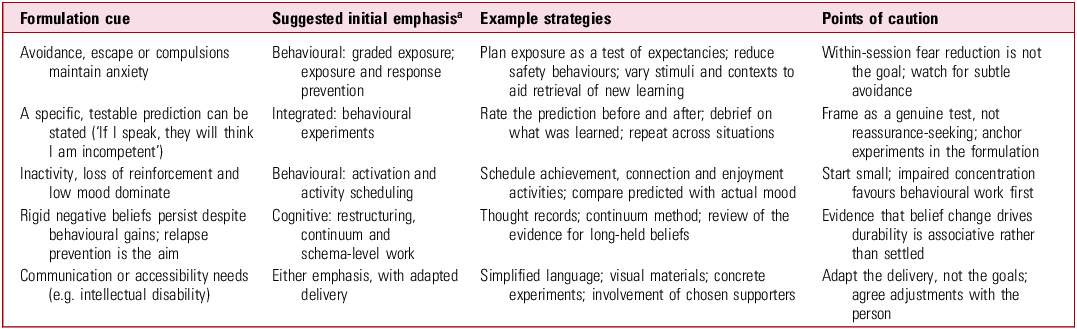
What drives recovery is less settled. Cognitive change is observed whether improvement follows behavioural activation, cognitive therapy or pharmacotherapy, and shifts in negative thinking are associated with, and sometimes precede, symptom change. Demonstrating that cognitive change is the mechanism of improvement, rather than a correlate or consequence of it, has proved difficult, and the mediation literature remains contested (Longmore Reference Longmore and Worrell2007; Lorenzo-Luaces Reference Lorenzo-Luaces, German and DeRubeis2015). A formulation-driven reading of this evidence is summarised in Table 1.
Matching therapeutic emphasis to formulation: a clinical decision aid

Table 1 Long description
A table with four columns and five rows, detailing therapeutic strategies based on formulation cues. The columns are labeled Formulation cue, Suggested initial emphasis, Example strategies, and Points of caution. The rows present different formulation cues such as avoidance behaviors, specific testable predictions, inactivity, rigid negative beliefs, and communication needs. Each row provides suggested initial emphasis, example strategies, and points of caution for the corresponding formulation cue. The table aims to guide clinical decisions by matching therapeutic emphasis to specific formulation cues.
a. This table is a guide to initial emphasis based on the formulation, not a protocol: most treatments combine emphases, and the formulation is revised as treatment proceeds. The emphases summarised here draw on the mechanisms and evidence discussed in the main text.
Adapting CBT for people with an intellectual disability: an applied example
In the UK, the term learning disability corresponds to what the international research literature calls intellectual disability. This section is included as an applied example of the article’s central point: because CBT can work through behavioural and cognitive routes, it can be adapted to fit a person’s communication style and support context, rather than requiring the person to fit a standard protocol. Adaptation is best framed in terms of accessibility: reasonable adjustments to communication, materials, pacing and environment. Simplified language, visual aids, concrete behavioural experiments, shorter or more frequent sessions and the involvement of chosen supporters are feasible and acceptable in practice (Hassiotis Reference Hassiotis, Serfaty and Azam2013).
Psychological therapies such as adapted CBT can reduce anger and depressive symptoms in people with an intellectual disability (Vereenooghe Reference Vereenooghe and Langdon2013), and in a cluster randomised trial of group anger management, adults with mild to moderate intellectual disabilities reported greater use of coping skills and their key workers reported reduced challenging behaviour (Willner Reference Willner, Rose and Jahoda2013). Trials in this area need larger samples, better reporting of participant characteristics and closer study of which adaptations matter most. The wider point stands: the processes CBT draws on can be made accessible across a range of cognitive and communication profiles when delivery, rather than the person, is adapted (Box 7) (Roth Reference Roth and Pilling2007).
Intellectual disability: Tom
Tom, a 28-year-old man with a mild intellectual disability, was referred to the mental health team because of frequent angry outbursts and low mood in supported accommodation, particularly when routines changed or staff corrected him. He often concluded ‘Everyone is against me’, and reacted by shouting, withdrawing or slamming doors.
An adapted cognitive–behavioural therapy (CBT) approach was used, with simplified language, visual aids and concrete behavioural practice. Recent incidents were broken down into situations, thoughts, feelings and actions using pictures and short phrases. Tom and his support worker practised a visual coping plan and rehearsed alternative responses through role-play, and staff supported his use of coping strategies between sessions. Over time, Tom used his anger-management skills more often and had fewer aggressive outbursts.
Clinical implication: core CBT strategies can be made accessible to people with an intellectual disability through adjustments to communication, materials and pacing, and through involving chosen supporters.
Conclusion
Contemporary CBT integrates cognitive and behavioural strategies at the level of the individual formulation. The clinician and patient identify what maintains the problem, choose techniques accordingly and treat each intervention as a test whose results feed back into the formulation. Behavioural methods can change thinking; cognitive methods can support changes in behaviour; and much of the practical craft lies in selecting and sequencing them for a particular person at a particular stage of treatment.
The mechanistic questions still remain open. Component studies suggest that behavioural interventions alone are often sufficient for symptom change; cognitive change accompanies improvement in all effective treatments, but its status as the mechanism of durable recovery is contested; and accounts of exposure have themselves shifted from habituation towards inhibitory learning and expectancy violation. These are reasons for humility rather than paralysis. The same uncertainty that unsettles strong claims about mechanism supports a flexible, formulation-driven practice in which no single route to change is privileged in advance. Epictetus advised: ‘First say to yourself what you would be; and then do what you have to do’ (Discourses: III.23.1). In CBT the order can also be reversed, and often is: doing differently is one of the most reliable ways of coming to think differently.
MCQs
Select the single best option for each question stem
-
1 Which of the following best describes the relationship between cognitive and behavioural mechanisms in contemporary CBT?
-
a Cognitive change must occur before any meaningful behavioural change can be achieved
-
b Behavioural and cognitive processes operate independently and should be targeted separately
-
c Behaviour and cognition continuously influence each other, so intervention at either level can drive change in the other
-
d Behavioural methods are now largely considered outdated compared with cognitive techniques
-
e Cognitive restructuring is effective only when combined with pharmacotherapy.
-
-
2 According to contemporary inhibitory learning accounts, the most important ingredient of successful exposure therapy is:
-
a complete reduction of fear within each exposure session
-
b violation of the patient’s threat expectancies, with support for retrieving the new learning in other contexts
-
c pairing the feared stimulus with deep muscle relaxation
-
d daily repetition of an identical exposure task
-
e ensuring that the patient experiences no anxiety during the task.
-
-
3 A 55-year-old man presents with severe depression, marked anergia, poor concentration and memory, and finds detailed written work difficult early in treatment. Which initial CBT-based intervention is most appropriate?
-
a Schema-focused therapy targeting core beliefs about worthlessness
-
b Daily thought records with evidence-for-and-against analysis
-
c Behavioural activation
-
d Continuum technique for rigid self-critical beliefs
-
e Metacognitive therapy for rumination.
-
-
4 In the treatment of social anxiety disorder, the main therapeutic purpose of using behavioural experiments is to:
-
a help the patient avoid situations that are likely to trigger embarrassment
-
b provide repeated reassurance that other people are unlikely to notice anxiety symptoms
-
c test feared predictions about social evaluation and support reappraisal of threat-based beliefs
-
d replace exposure therapy when the patient finds social situations too distressing
-
e focus primarily on reducing physiological symptoms such as blushing and trembling.
-
-
5 Which of the following adaptations is most consistent with evidence-based CBT for adults with a mild to moderate intellectual disability?
-
a Removing all behavioural components and focusing on verbal cognitive restructuring
-
b Using simplified language, visual aids, concrete behavioural practice and involvement of chosen supporters
-
c Replacing adapted CBT with unstructured supportive counselling
-
d Delivering only group-based interventions with no individual component
-
e Restricting CBT to those able to keep detailed daily thought records.
-
MCQ answers
-
1 c
-
2 b
-
3 c
-
4 c
-
5 b
Data availability
Data availability is not applicable to this article as no new data were created or analysed in this study.
Acknowledgements
Artificial intelligence use: the authors made use of OpenAI’s ChatGPT Edu (GPT-5 series, GPT-5.5 and 5.6, accessed via the ChatGPT Edu platform at https://chatgpt.com) to assist with language refinement, sentence-level rewording, organisation and restructuring of their text. The tool was not used to generate the article’s arguments, clinical interpretations, data, conclusions or references; AI-generated suggestions were reviewed, critically evaluated and modified by the authors before incorporation into the manuscript. The authors retain full responsibility for the intellectual content, interpretation of evidence, accuracy of references and final manuscript. The tool was used during manuscript preparation and revision in 2026.
Author contributions
S.F.T. and D.A. contributed equally to this work and are joint first authors. S.F.T. conceived the article and wrote the original draft; D.A. developed it into the submitted manuscript and led the revision and response to reviewers; B.K.A contributed clinical content and revised the manuscript. All authors approved the final version.
Funding
This work received no specific grant from any funding agency, commercial or not-for-profit sectors.
Declaration of interest
None.

 Open access


eLetters
No eLetters have been published for this article.