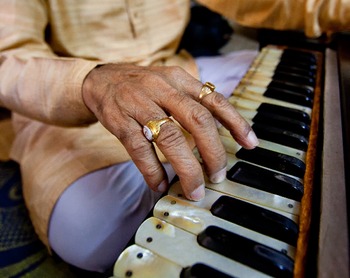
The small harmonium…has spread over the country like a plague, and even reached remote villages. It has the worst quality of sound imaginable, and has further our tempered scale, by which it irreparably spoils much that is characteristic of Indian music….As the player finds all these notes ready for use, he needs only a little deftness to play it, and the result is a torture only fully appreciated by those who have undergone it.…The effect is to destroy not only the melody, but also the musical understanding of player and hearer (Bake Reference Bake1961, 22).
The harmonium, a portable reed-organ, is the most widely-used melodic instrument in South Asia. Harmoniums are used to accompany nearly every major genre of vocal music, from Rabindrasangit in Bengal to Natyasangit in Maharashtra, for devotional singing among Muslims, Hindus, Christians, and Sikhs, and for art musics such as khyal and thumri. Music professors, hereditary masters, and village schoolteachers alike use the harmonium to impart the principles of Indian music. The harmonium is seen and heard in villages and cities, in concert halls and private homes, in trains, temples and theaters.
One might expect that such an instrument would be embraced as a symbol of musical nationhood, as a common thread that unites the diversity of Indian musics. But in fact, modern music writers have argued overwhelmingly that the harmonium is the embodiment of everything Indian music is not, that it is, on the contrary, dangerously un-Indian. The harmonium has attracted more elite contempt than any other instrument in the history of Indian music. All-India Radio banned the harmonium from its airwaves for over thirty years, and it has long been banished from the South Indian classical music stage. Early twentieth century music writers–both British and Indian–called it a “menace,” the “Harm-Onium,” and, perhaps most famously, the “bane of Indian music.” At a time when Indians were working to liberate themselves from British rule, British and Indian music enthusiasts found common ground in declaring the harmonium unfit for IndianFootnote 1 music.
There have been three principal objections to the harmonium. First, that it cannot glide smoothly between discrete notes; second, that its tuning is wrong; third, that it is un-Indian. The first two objections to the harmonium are taken seriously by harmoniumists. Every player has developed techniques to overcome to these limitations. Some strategies include special reed-banks tuned for specific rags and specific keys, subtle ornaments and slurring that suggest melodic curves, volume modulation, variations in pump pressure to alter pitch, and, when accompanying singers, the omission of notes (such as the gently undulating third and sixth scale degrees of Rag Darbari Kanada) that are impossible to reproduce on a harmonium. Harmoniumists agree that ragas like Darbari Kanada are inappropriate for solo rendering on the harmonium, just as light ragas are inappropriate for a full hour of elaboration on the rudra vina, or heavy ragas are inappropriate for singers with very light voices. As harmoniumist Jnan Prakash Ghosh puts it: “Neither the [harmonium] masters of the glorious past or the aspirants of the present age ever believed that slow and melodious movements would suit the basically detached notes of the harmonium” (Ghosh 1971, 23).
The third objection, however (that the harmonium is a foreign instrument) inverts this formula: the claim is that the harmonium itself is inappropriate for raga music, rather than that a specific raga is inappropriate for the harmonium. Assertions that the harmonium is alien to Indian music are generally founded on an early twentieth century vision of radical difference between India and the modern West—a vision that was central to both romantic and nationalist agendas. Though sometimes stated explicitly, in relation to the harmonium's European provenance, this objection is more often cloaked in technical discussions of the harmonium's sound. The rejection of the harmonium on the basis of its inability to produce continuous slides between notes is inevitably based on the notion that Indian melody is essentially continuous and Western melody is essentially discrete. The rejection of the harmonium on the basis of its tuning is likewise based on the persistent notion that India and the West have essentially different intonational systems. Though these generalizations offer a tidy theoretical distinction between Indian and Western music, they do not account well for the technical practices of Indian or Western musicians. Examples of tonal continuity in Western art music include string, trombone, and vocal portamenti, expressive vibrato, and the whole range of rhythmic nuance between staccato and legatoFootnote 2. The many examples of tonal discreteness in Indian music include taan, jhala, and sparsh on fretted instruments such as sitar and dilruba, and the rapid, stop-laden vocables of sung taranas. Other instruments used for raga music, such as the santur (a hammered dulcimer) and the jal-tarang (a series of cups tuned by filling them with varying amounts of water) are incapable of bending notes, and thus avoid ragas with great tonal nuance, as the harmonium does–and yet they are widely accepted as Indian instruments. Assertions about a unique Indian system of intonation are difficult to maintain in the face of the fact that Indian and Western musicians share a theoretical 12-note division of the octave. In practice, both Western and Indian musicians articulate these notes with highly variable intonation according to melodic context, even within a single performance (Jairazbhoy & Stone Reference Jairazbhoy and Stone1963, Levy Reference Levy1982).
The point here is not that we should simply dismiss factually dubious assertions about the difference between Indian and Western music as nonsense. On the contrary, these assertions make a great deal of sense as political propositions. The first thing to notice is that these categorical objections to the harmonium are quite different, both in tone and logical structure, from the pointed criticism that a musician might level against a badly-tuned harmonium or a stiff-fingered harmoniumist. The latter is generally whispered at concerts rather than committed to print, and is often didactic in tone, suggesting musical ideals which a particular player has failed to attain. When music scholars, politicians, and administrators spoke out against the harmonium, however, it was typically without reference to individual musicians, performances, or harmoniums. Though they bemoaned the damage that the harmonium would do to the Indian ear, the objections never specified singers whose ears had been ruined.Footnote 3 These writers were, on the whole, less concerned with making music than with making boundaries. Just as French colonial officials adopted systems of instrument classification that marked racial difference among their imperial subjects in Africa and Indochina (Pasler 2004), elite British and Indian musicologists who worked to exclude the harmonium from Indian music sought to reinforce the boundaries between India and the West. This is why the threat of the harmonium crossing these lines evoked not only disgust, but a vivid metaphoric language of pollution, plague, and miscegenation. The harmonium, in these debates, does not threaten individual Indian musicians so much as it threatens the idea of a singular Indian musical sensibility. The idea of this standard Indian musical sensibility crystallized in its current form at a particular historical moment: India's struggle for recognition as a sovereign nation, independent from Britain.
In other times and places, when the distinction between India and the West was not at issue, the harmonium has been seen as paradigmatically Indian. In Herat, Afghanistan, in the early part of the twentieth century, the tuning of the harmonium was understood to be decidedly “Indian” in contrast to the rather different “Persian” tuning afforded by the frets of the tar (Baily Reference Baily1996, 59–60). Similarly, in Trinidad, the harmonium has come to stand for Indian music in contrast to the steel drum, the emblematic instrument of Afro-Trinadadians. Some Indo-Trinidadians have even argued, in an inversion of the prevailing Indian nationalist view, that its intonation is specially adapted for Indian music (Manuel Reference Manuel1997, 25). Even in India, for several decades after its arrival in India in the nineteenth century, the harmonium seems to have been tacitly accepted as a viable instrument for Indian music.
The fiercest objections to the harmonium arose quite suddenly, several decades after it had been assimilated into both performance and education, in the years leading up to Indian independence. As we shall see, this critique was developed by a community of British and Indian scholars (such as Rabindranath Tagore, A.H. Fox-Strangways, Ananda Coomaraswamy, and K.B. Deval) who were committed to defining and preserving a pure Indian musical heritage. Sometimes attacks on the harmonium adopted romantic or even orientalist language; sometimes they were expressed in stark nationalist terms. In all cases, such rejections served to define a distinctive Indian musical sensibility.
The rejection of the harmonium, then, cannot be seen merely as an issue of acoustics, or of geographical origin, or as an extension of the boycott on British goods carried out during the Swadeshi movement. Understanding why the harmonium has aroused such vitriol, why, in other circumstances, it is tacitly accepted as Indian, and why, despite this controversy, it is played throughout the South Asian diaspora, requires an engagement with discourses in which aesthetics, acoustics, and politics are tightly intertwined. After all, the violin has been welcomed into Indian classical music, both North and South. Indeed, Amanda Weidman (Reference Weidman2006) argues that the violin was hailed as an exemplary instrument in Carnatic music by virtue of its close sonic kinship with the human voice, a crucial site of tradition and national identity. Something about the sound of the harmonium–not merely its provenance–posed a problem for those who wanted to distinguish India from the West.
Inspired by Regula Qureshi's virtuosic survey of the rich array of meanings–sensuality, longing, decay, etc.–embodied by the sound of the sarangi (1997), this paper seeks to explicate the meanings carried by the sound of the harmonium. My intention is not to assert that the harmonium is politically innocent, nor to persuade contemporary critics of the harmonium that they should like how (and what) it sounds. Indeed, it was my curiosity about my own initial aversion to the harmonium, despite the fact that all of my vocal heroes used them, that motivated me to investigate what I was hearing. Although claims about the inherent incompatibility of the harmonium with Indian music (like claims about the inherent sensuality of the sarangi) may not all hold up under empirical scrutiny, they still do important cultural work: they construe the sound of the harmonium as the sounding of a certain social order. But it is precisely their appeal to aesthetics that obscures their politics. What follows is an exploration of various ways of hearing politics in the sound of the harmonium.
The Indian Harmonium: 1870–10
As the British established themselves more firmly in India in the eighteenth and nineteenth centuries, hundreds of organs and harpsichords were imported for use in homes and churches. However, none of these instruments seem to have been used much in playing Indian music. Indeed, most did not last long enough to play much music at all, as the perilous journey destroyed many of them, and the rest deteriorated quickly in the heat and humidity of the Indian summer and monsoon (Woodfield Reference Woodfield2000, 15). The problem of portability was solved by the development of the reed organ in Europe in the middle years of the nineteenth century. In 1842, Alexandre Debain, a French inventor, patented a design for the first harmonium: a foot-pumped, upright reed organ with two rows of free reeds. The harmonium's primary distinction was that it was far cheaper, easier to transport, and more durable than any other keyboard instrument. For this reason, it was among the first mail-order items in the world (Ord-Hume Reference Ord-Hume1986, 26). These portable harmoniums were widely used in India by naval chaplains, camp meeting organizers, and traveling missionaries to accompany hymn-singing (Gellerman Reference Gellerman1996). There is no clear evidence about which areas of India first saw the harmonium, or which models were brought. But within a few decades, there was enough demand for the harmonium in India that it was being produced domestically.
By 1875, a Calcutta instrument maker named Dwarkanath Ghose was manufacturing a modified version of the French hand-pumped portable model for use in Hindustani music. This model, unlike the larger foot-pumped kind, could be played while seated on the floor with singers and percussionists. Ghose simplified the internal design of the harmonium to make it more durable, cheaper to build, and easier to repair. He also added drone stops for use in accompanying classical music (Brockschmidt Reference Brockschmidt2003, 19). Over the next few decades, Europe's harmonium production slowed dramatically and India was making nearly all of its own portable harmoniums on the Dwarkanath model. By 1913, India had become the richest market in the world for harmoniums—for church services, for missionaries in the field, for accompaniment of urban musical dramas, and, increasingly, for playing in Indian classical music. A keyboard trade journal from 1913 indicates that French portable harmoniums for use in Indian classical music were sold for around Rs. 140 (Ord-Hume Reference Ord-Hume1986, 96). Though there have been various advances and experiments in scale-changing technology and reed tunings, the Dwarknath model—hand pumped, with drone stops, and played seated on the ground—continues to be the dominant type of harmonium in India.
These redesigned harmoniums began to replace the sarangi (a bowed instrument with sympathetic strings) as the principal melodic accompaniment for khyal and thumri vocalists. The sarangi faced many obstacles to wide acceptance in new urban concert settings, such as its association with the musical world of courtesans, the amount of time required to tune it for each raga, and the technical difficulty of mastering it (Qureshi Reference Qureshi1997; Bor Reference Bor1987, 111). The harmonium, in contrast, was free of associations with courtesanry, could be tuned months ahead of time, and was easy to learn. Because the intonation of a harmonium depends far less on the skill of its player than that of a sarangi, even amateurs could become passable harmonium accompanists in a short time.
Early harmoniumists such as Ganpat Rao (d. 1924) found ways to perform in classical settings despite the harmonium's inability to bend notes and its fixed intonation. Rao learned singing and sitar in Gwalior before beginning his harmonium career in Lucknow, and, in the words of one connoisseur, he “was able to play the harmonium in such a way that everyone began liking it. He played in a soft, inimitable way, giving the right touches” (cited in Bor Reference Bor1987, 111). Another early influential classical harmoniumist was Govindrao Tembe, a Maharashtrian who worked in Kolhapur, Pune, and Bombay. Tembe began his career composing music and playing harmonium in Marathi opera. He is said to have later developed his style by learning from vocalists, and was particularly influenced by Alladiya Khan. In a rare description of a vocalist (Bhaskarbuwa Bakhale) and harmoniumist (Tembe) improvising together, Deshpande writes: “Whenever Buwa did an improvisation, Govindrao would listen carefully and reproduce what had been sung with the same grace. Or he would play a matching improvisation of his own which would inspire Buwa to improve on what he had just sung…. The improvisations produced alternately by Buwa and by Govindrao on that harmonium were the most striking features of the recital that evening.” (Deshpande Reference Deshpande1989, 45).
In 1902, a Parsi theatre troupe brought harmoniums to Mysore for the coronation of Krsnaraja Wadiyar IV. Two harmoniumists (twin brothers Nanji and Mahanji), retained by the king, and were among the first to teach and play harmonium in Carnatic music (Deva Reference Deva1977, 48). By 1913, the instrument was used in concerts in Trivandrum (Fox-Strangways Reference Fox-Strangways1914, 163). Later Carnatic harmoniumists included P. S. Venkataramana Rao and H. S. Dikshitar. Later well-known Hindustani harmoniumists–both soloists and accompanists–include P. Madhukar, Tulsidas Borkar (Figure 1), Bhure Khan, and Arvind Thatte.
Tulsidas Borkar playing the harmonium. Copyright Rajan Parrikar.

The late nineteenth century critical reception of the harmonium, in both North and South, was fairly mild. An early positive evaluation of the harmonium was given by Bhavanrav Pingle in his 1894 History of Indian Music. Pingle scolds loud instrumentalists who overpower the voices of vocalists. He is heartened, however, by the “adoption of European wind-instruments.” Although these instruments cannot produce slides, he says, “the performing voice can do its Ghasit [slides] without support after a long practice” (Pingle Reference Pingle1894, 108).Footnote 4 Venkatasesha Sastri claimed that the harmonium sounded discordant to Indian ears. “…they are simply confused—being unaccustomed to anything but simple melody—when they hear five or six notes played in chords. The chief difference seems to me to be that the Hindus prefer melody simply, while to European ears melody is preferred when clothed, as it were, with harmony of some sort.” (quoted in Day 1891, 59).
Sastri attributes the differences in taste to untrained ears, rather than to an inherent racialized psychoacoustic difference, as later scholars would do. But this is an early indication of the next stage of harmonium reception: using the harmonium to posit a fundamental difference between Europe and India.
The Harmonium Becomes Foreign: 1910–40
Music scholarship during the most vigorous period of Indian independence movements assessed the harmonium far more harshly. As Janaki Bakhle demonstrates, music reformers in the early years of the twentieth century reframed raga-based music as “simultaneously classical and national” (Bakhle Reference Bakhle2005, 2). Accordingly, music critics rarely mentioned the use of harmonium in regional and sectarian musics, but were outraged by the use of the harmonium in vocal genres, such as khyal, that bore the burden of representing India's classical heritage and national distinctiveness. In these genres, as the vocalist spontaneously maneuvers along the paths of a raga, the harmoniumist follows close behind the trajectories of the voice, echoing what was just sung and joining in on fixed passages (for a detailed analysis of harmonium accompaniment, see Napier Reference Napier2006).
The first public debate about the harmonium seems to have taken place in The Dawn (a nationalist magazine published in Calcutta) in 1910 and 1911, though private debates about the harmonium were likely going on for several years before. The early calls to dismiss the harmonium from India echoed the principles of the Swadeshi movement, which called on Indians to avoid British products in favor of domestically manufactured ones.Footnote 5 In the case of the harmonium, which was by this point largely manufactured in India, its foreignness was seen as a consequence of its design and sonic qualities rather than the geographic origin of any particular harmonium. Although most criticisms of the harmonium were ostensibly about melody and intonational arithmetic, marking a scale or a musical practice as “foreign” had powerful political implications during this period.
Dozens of articles and books were published proposing to deal with Indian music in the early twentieth century, and a remarkable proportion of them focused on determining a distinctive theory of Indian tuning. Various theories of Indian intonation would be proposed, but nearly all of the theories proposed in the early twentieth century hinged on a single theoretical entity: the sruti. “Sruti,” as used by performing musicians, indicates subtle but unmeasured aural distinctions; late nineteenth century music theorists, on the other hand, attempted to translate srutis into objectively measurable frequency ratios. Writings on Indian music during this period, by both Indian and British scholars, focused on a particular system of tuning described in the Natyasastra of Bharata (ca. 2nd c. CE) and elaborated in the Sangitaratnakara of Sarangadev (13th c. CE). This system divides an octave into twenty-two srutis on the basis of which seven-note scales were constructed. Significantly, though, as there is no algorithm given for objectively measuring srutis, this tuning system required aural judgments. Music theorists worked to determine a single, unique Indian gamut of pitches that could be measured arithmetically rather than by ear; more significantly, this scale was to be utterly distinct from that of the modern West.
K.B. Raosaheb Deval, a Maharashtrian revenue official, was among the first to try to determine an essential, objectively measurable Indian scale. He measured the intervals used in vocal music in terms of arithmetic ratios. Deval asked Abdul Karim Khan (a major Hindustani singer of that time) to sing, and measured the pitches using a dichord. Deval concluded from this experiment that the system of Hindustani intonation in practice was identical to the ancient system of twenty-two srutis. In collaboration with district judge Ernest Clements, Deval translated this system into three key ratios of just intonation: “two srutis make a just semitone [16:15], three srutis a minor-tone [10:9], and four srutis a major-tone [9:8]” (Clements Reference Clements1913, 6). It was an exceedingly tidy solution, but hard to evaluate on its own terms, as the individual data (string lengths, etc.) were not made available in the publication of his results. A more fundamental weakness of the experiment is that his method guaranteed the measurement of rational intervals. Deval was not asking whether Abdul Karim Khan's intonation was rational, but which ratios were being sounded. Deval's contribution was not to conclusively demonstrate the use of twenty-two-sruti intonation, but to creatively conflate a twenty-two sruti gamut with rational intervals. Deval later published an article called “The Hindu Musical Scale and the 22 Shrutees” based on his system. Clements published his Introduction to the Study of Indian Music in 1913, based largely on Deval's findings, with Abdul Karim Khan as the supporting (though largely unquoted) authority on intonation. The focus of Clements's book is Deval's rationalized srutis and the extension of staff notation to fit them. Deval and Clements, however, seem not to have objected to the use of the harmonium–so long as they were tuned according to their system. They designed a special “sruti harmonium” in accordance with their intonational model. The harmonium had, in addition to white and black keys, brass studs to give pitches that corresponded to the srutis that they had measured.Footnote 6 The Maharajas of both Gwalior and Baroda (the latter of whom would patronize and host All-India musical conferences) both ordered sruti harmoniums for their courts (Musical Opinion Feb. 1913, 378). Although the sruti harmonium was not used widely in performance, it suggested a model for what a full harmonium tuned to the “Indian system” should look like; the five-black-key-seven-white-key harmonium appeared to be missing some teeth in contrast.
Clements lamented that “Correct intonation is only to be found practiced by a few professionals” (Farrell Reference Farrell1997, 52), and indeed, Deval's and Clements's “correct” intonation seems to have sounded odd to even the best Indian musicians. Their presentation at the first All-India Music Conference in Baroda in 1916 was received quite harshly. The musicians present seem to have agreed overwhelmingly that the system of tuning embodied in the sruti harmonium was unacceptably out of tune with conventional practice (Bakhle Reference Bakhle2005, 189–190). Even Abdul Karim Khan himself, who served as Deval's original voice of authority for this intonational model, eventually rejected it (Jariwalla 1973, 167). But despite the failure of Deval's and Clements's particular tuning model, the sense that the harmonium is necessarily out of tune with Indian intonation persised both in casual conversation and in musicological writing.
While the struggle to define Indian intonation went on, marked by paper after paper speculating about 22-sruti intonation, the “West” was assumed to use a single system: equal temperament, or an idealized system of compromised, irrational, slightly-out-of-tune intervals that make modulating harmony possible. The facile, commonsense link between equal temperament and the West among music scholars was not diminished by the fact that equal temperament was still a relatively recent innovation in Europe, only loosely adhered to (even as an ideal) for keyboard instruments, let alone violins, wind instruments, and the human voice. Although there are a few medieval Indian theoretical treatises that assign precise ratios to fret spacings, such as Ramamatya's Svara Mela Kalanidhi (Reference Aiyar1550) sitarists and other players of fretted lutes, then and now, set their movable frets by ear, not by number, and fine intonation depends on finger pressure, not on measured distances. Vocalists, of course, have no ready means of measuring or articulating melody arithmetically. Indeed, sur (the word that is usually translated as “pitch” or “intonation”) does not merely denote pitch, but also includes timbre, attack, decay, and subtle nuances of approach and retreat from notes (Van der Meer 1980, 10). But rather than dealing with dynamic sounded notes whose precise frequencies would vary with the contexts of their sounding, Clements, Deval, and the other scholars of this period were seeking a fixed scale: a framework of numerical relationsFootnote 7 that would account for all of Indian music. There were various proposals that differed in their details. But in every case, the putative Indian scale was remarkable for its incommensurability with so-called Western intonation.
The political implications of this incommensurability were explicated by Ananda Kentish Coomaraswamy. Coomaraswamy, an Anglo-Ceylonese, British-educated art historian, deplored the harmonium and other “modern” influences on Indian music. On the liner notes for a 1912 album of Indian music recorded by his wife, Alice (AKA Ratan Devi) he wrote that Indian music was “rapidly vanishing before the gramophones, harmoniums, and brass bands of modern Western commerce and modern Indian taste” (Bor Reference Bor1987, 111). Coomaraswamy also wrote the foreword to Clements's Introduction to the Study of Indian Music, in which he warned that “The constant use of the tempered harmonium…[has] actively contributed to the degeneration of Indian music. By degeneration, I mean literally confusion, a running together, and destruction of bounding-lines; a process quite distinct from any natural waning of vitality at the latter end of an art cycle.” (Coomaraswamy in Clements Reference Coomaraswamy1913, vi).
The statement contains two potent metaphors. First, Indian music is degenerating. Earlier in the foreword, he had asserted that the “golden age” of Indian music had already passed (having occurred in the first millennium, marked by the work of Kalidasa and Bharata). This much was a common feature of much writing of the time, both from Hindu revivalists and Indologists. But the more explicit metaphor is that of broken rules: the equal-tempered harmonium represents “a confusion, a running together, and destruction of bounding-lines.” The harmonium was a threat to the bounding-lines that Coomaraswamy and others were working to establish between the West and the emerging Indian nation.
The link between politics and acoustics is less surprising if read in the context of nineteenth century comparative musicology, in which the measurement of scales had become a sort of sonic phrenology. Particular scales were derived from recordings, and associated with particular places and peoples. The study of various musical scales as an audible icon of the human soul is millennia old, but the special concern with regional, indigenous scales that would correspond to race and nation was a special concern of the late nineteenth century. As Katherine Bergeron points out, the very measurement of scales is a certain kind of social order:
….to play in tune is to make judgments, to mark precise distances between sounds in the act of producing them. Indeed, such a marking of difference points to one of the earliest senses of the word canon….The canon is, in this sense, an ideal of order made material, physical, visible. In the scale, of course, such order is also audible, materialized as a finite set of intervals, perfectly tuned by mathematical calculation, by the ratio—the numerical representation….of order, “reason.”…. the tuned scale, or canon, is a locus of discipline, a collection of discrete values produced out of a system that orders, segments, divides (1992, 2).
Though Coomaraswamy, Deval, and Clements accomplished a good deal of theoretical ordering, segmentation, and division in their defense of a pure Indian canon, the most influential national figure writing against the harmonium was poet and composer Rabindranath Tagore. Tagore composed hundreds of songs, including the enduringly popular body of songs known as Rabindrasangeet, and the Indian national anthem. He also gave lectures on nationalism in Japan, the US, Europe, and India. Tagore had taken some Hindustani vocal lessons when he was young, and had learned several English songs during his travels in Britain (Farrell Reference Farrell1997, 157). His brother Jyotirindranath played the piano at home (Sangeet Natak Akademi 1961, 13). Tagore himself played the harmonium, as he mentions several times in his Reminiscences (2003 [1912], 193, 254). Although he admired European music, he considered it quite different from Indian music–writing that they “abide in altogether different apartments, and do not gain entry to the heart by the self-same door” (Tagore Reference Tagore2003 [1912], 229). The distinguishing feature of Indian music, he said, was
those extra-fine semi-tones….It is this factor which determines not only the relative positions but also the actual relationship between one note and another. It is a kind of blood relation, which if it be severed, is bound to change the character of the rags and raginis even if they are spared their actual existence….In [Western music], the notes set up a kind of staccato dance—oblivious of that element of correlationship which endows music with its depth. (Sangeet Natak Akademi 1961, 107)
This “blood relation” metaphor, on the surface, seems to recall Coomaraswamy's allegations of cultural miscegenation, but in fact, it is rather different. Tagore is not describing miscegenation between racially distinct intonation systems, but blood relations between dynamic, sounded notes. Here, he seems to be referring both to microtonal intervals and to glides between notes. Playing discrete, unconnected notes (as, according to Tagore, Western musicians do and the harmonium must) has both aesthetic and political consequences: not only notes, but blood relations are severed—a family is shattered into disconnected fragments. The implications for the Indian national project were clear.
Tagore's most enduring contribution to the anti-harmonium cause was his coinage of a phrase that has haunted the harmonium to this day: “The harmonium, that bane of Indian music, was not then in vogue.” However, it is in the sentence that follows, less often quoted, that the political stakes in Tagore's rejection of the harmonium become clear: “I practiced my songs with my tambura resting on my shoulder; I did not subject myself to the slavery of the keyboard” (Sangeet Natak Akademi 1961, 10). The notion that playing a keyboard instrument would be a kind of slavery indeed may seem like a frivolous concern in light of the actual economic oppression that many landless Indians were suffering under British rule–especially coming from an aristocrat like Tagore. But in 1912, it was an extension of Tagore's nuanced critique of British cultural hegemony. He was critical of strains of oppressive nationalism that threatened to dissolve India's internal diversity within a single, homogeneous national identity–and yet also believed in an Indian national character that distinguished it from Europe. He imagined a free modern India, but one that, like Japan, had developed an indigenous modernity, separate from Europe (Sutaria Reference Sutaria2005). Thus, the sense in which the harmonium represented “slavery” was that it confused modernity with Europeanness:
Modernism is not the dress of the Europeans, or in the hideous structures where their children are interned when they take their lessons, or in the square houses with flat, straight wall surfaces, pierced with parallel lines of windows, where these people are caged in their lifetime….These are not modern, but merely European. True modernism is freedom of mind, not slavery of taste (Tagore Reference Tagore1917, 30–31).
Here, Tagore poetically conflates the “hideous” aesthetics of modern European right-angular architecture with the evident political hideousness of slavery. Moreover, Tagore links this geometric logic to cages, internment, and fragmentation. This link is apparent again in verse 35 of his best-known poem, Gitanjali:
Where the world has not been broken up
into fragments by narrow domestic walls…
Where the mind is lead forward by thee into ever-widening thought and action—
Into that heaven of freedom, my Father, let my country awake.
This association of Europe with social fragmentation, straight lines, right angles, and the discrete notes of the harmonium are manifestations of a single discursive structure in which Indian curvilinear continuity is oppressed by European right-angular discreteness. The political imperative to break free of European rule is intertwined with the aesthetic imperative to reject the sound of the harmonium.
Tagore's authority in Europe stemmed not only from his poetic work, but also from his position as a spokesperson for India. Increasingly, after his first visit to Europe, he wrote as a messenger to the West from the East. In this capacity, he came to know Arthur H. Fox-Strangways, who was secretary of the India Society, and an amateur music scholar. After Tagore was awarded the 1913 Nobel Prize in literature, Fox-Strangways served as his unofficial agent in England (Lago Reference Lago and Ronald1989, 8). Before meeting Tagore, Fox-Strangways had published “The Hindu Scale” (Reference Fox-Strangways1908) a lengthy attempt to reconstruct Indian 22-sruti intonation from Sanskrit texts. This paper was an exposition of the similarities he saw between music-theoretic treatises of classical India and classical Greece. He argued that Indian music was based on the same intonational principles as ancient Greek music but that it has remained truer to its source than Western music had.
In 1914, Fox-Strangways published his classic and highly influential treatise The Music of Hindostan, which at the time was the most thorough and detailed study of Hindustani music available in English. Echoing Tagore, he contrasts the “rounded” contours of Indian melodies with the “sharp edges” produced by keyboard instruments (1914, 18). A running theme in the book is Fox-Strangways's anxiety that Indian music was in danger of ruin from foreign influence:
…[I]f the Mohammedan ‘star’ singer knew that the harmonium with which he accompanies himself was ruining his chief asset, his musical ear, and if the girl who learns the pianoforte could see that all the progress she made was as sure a step towards her own denationalization as if she crossed the black water and never returned—they would pause before they laid such sacrilegious hands on Saraswati. Excuses may be made for such practices, but there is one objection fatal to them all; the instruments were borrowed….To dismiss from India these foreign instruments would not be to check the natural, but to prune away an unnatural growth (Fox-Strangways Reference Fox-Strangways1914, 16).
This objection to the harmonium rings out in nationalist tones. To play a keyboard is to cross the “black water” that forms a boundary around India, and therefore (according the Hindu theology invoked in this case and its attendant national logic) to irreversibly renounce both caste and nation. Fox-Strangways goes so far as to say that playing the harmonium constitutes a violation of Saraswati, the devi of learning and music. As noted earlier, his dire prediction that the harmonium would ruin the “musical ear” of Indian vocalists seems not to have come true, if we are to judge by recordings of master vocalists from the 20th century, but this is a clue that Fox-Strangways was not merely talking about discernment of pitches. The anxiety he voices about ruining the ear through exposure to the harmonium is also anxiety about spiritual ruination through exposure to the modern West.
It is here that Fox-Strangways's work on intonation dovetails with his politics. He was writing in a tradition of comparative musicology that largely organized its work around trajectories of evolution and decay in the world's musics, and his work is peppered with evolutionist assertions, such as that American Indian music is at a “very early stage,” and that Hindustani music “has not advanced beyond the principles of Greek music” (1914, 163). Fox-Strangways saw this not as stunted growth, but as a music in the full, delicate bloom of youth, in danger of corruption. As he says in the introduction to his book, the great melodic potency (he uses the Greek word dynamis) of Indian music, like that of Greek music, lies in its innocence, its being “absolutely untouched by harmony” (v). Later in the book, the threat of the harmonium to innocence is expressed in a poignant anecdote: he attempts to persuade an intransigent woman not to play the harmonium, lest she awaken her sleeping infant (63). The danger posed by the harmonium, according to Fox-Strangways, lies in its equal-tempered tuning and its consequent potential for harmony. He later explicates the political stakes of its tuning system through an appeal to the time-honored political metaphor of chess:
As the Rag now is, its notes are like the pieces on the chess-board; harmony, by investing them all equally with powers of its own, would make them like the pawns. Hence the serious menace to Indian music of the harmonium, which has penetrated already to the remotest parts of India. It dominates the theatre, it desolates the hearth; and before long it will, if it does not already, desecrate the temple. Besides its deadening effect on a living art, it falsifies it by being out of tune with itself (Fox-Strangways Reference Fox-Strangways1914, 163).
His writing here is full of poetic action, conflating politics, modal practice, and chess. His likening of the notes of a raga to kings, bishops, and other specialized chess pieces is almost certainly a reference to the technical designation of certain notes in specific ragas as “king” and “vizier.” The unsettling image of a chessboard ruled by pawns links the intonational homogeneity of equal-temperament to classic anxieties about democracy. It resonates closely with the argument of botanist Joseph Dalton Hooker (a contemporary of Fox-Strangways who had conducted several field expeditions in India) that natural selection favors aristocracy, and that democracy was as unnatural as “a country populated by one invariable species” (Rogers Reference Rogers1972, 271). In this blend of politics and aesthetics, the harmonium flattens out rankings in both social and melodic function; it seems to threaten both a delicate melodic practice ordered by fine intonational distinctions and a delicate social structure ordered by fine caste distinctions.Footnote 8 For Fox-Strangways, India's unchanging political and melodic innocence was threatened by the audible presence of history in the sound of the harmonium.Footnote 9
In stark contrast to these romantic accounts, the harmonium is also sometimes figured in Marxist terms as a sign of inevitable progress from a feudal past in which the sarangi was the accompanying instrument par excellence. As Regula Qureshi astutely puts it, “from the bourgeois cultural nationalist position the sarangi has often conjured up a spectre of past feudal Muslim domination and of a culturally sanctioned sensuality abhorrent to bourgeois gender norms” (1997, 29). Sociologist Vinayak Purohit argues that while soft instruments like tanpura and sarangi were suitable for “feudal” performance settings, the harmonium was the suitable instrument for “bourgeois auditoriums with hundreds of listeners assembled for low per capita admission charges” (Purohit Reference Purohit1988, 895).Footnote 10 On the other hand, he points out that the harmonium, unlike the sarangi, enjoys none of the “feudal-artisanal value attached to even senselessly strenuous, prolonged, and complicated labour” (ibid., 893). This assignment of a feudal past to the sarangi and a modern present to the harmonium is echoed in V.H. Deshpande's comment that the “sarangi was perfectly all right in the spacious olden days of Kings and Queens and Sardars and Jagirdars,” but “in modern times,” it is an “anachronism” (Reference Deshpande1971, 18).
Some, like Purohit and Deshpande, see the modern virtues embodied by the harmonium as a step forward from a dark feudal past. Others, like Fox-Strangways, yearned for a bygone golden age, and tended to see the rise of the harmonium as a sign of Indian music's inevitable decline. As Dard Neuman points out, the ustads who used the harmonium despite the outcries from musicologists lost on both counts. Figured both as stubbornly feudal and inappropriately modern, the ustad playing the harmonium was “performing an ethic that was unconcerned with classical or nationally reactive ideas of purity and cultural integrity.” Thus, musicians were condemned both for adopting a non-traditional instrument and, paradoxically, for their conservative resistance to innovation (2004, 21). Thus, as Deshpande notes, classical musicians are discursively constrained to publicly criticize the harmonium even if they perform regularly with it.
Clearly, though the harmonium is free of the associations of feudalism and immorality carried by the sarangi (Bor Reference Bor1987), it bears its own burden of meaning. Its sound is marked by various binary oppositions: it is heard as Western (not Indian), imitative (not authentic), modern (not traditional), bourgeois-capitalist (not feudal), right-angular (not curvilinear), fragmented (not relational.) Its tuning is construed to be inherently out of tune with an essentially Indian intonational canon. Its presence is described in terms of pollution, degeneration, and the violation of boundaries: all threats to a romantic vision of an ancient, bounded, culturally pure nation.
The Air Harmonium Ban: 1940–71
I have argued thus far that the construction of a unique Indian musical sensibility, distinct from the West, served both romantic visions of an unchanging Orient and nationalist visions of a sovereign India. Just as the need for a reformed, desexualized national music would later lead to the ban of “scandalous” female singers from the radio in the 1950s (Qureshi 2006, 312), the sonic scandal of the harmonium was deemed inappropriate for national radio. By the 1930s, a dedicated movement to ban the harmonium had successfully banished it from the South Indian classical stage (Weidman Reference Weidman2006). In 1940, the harmonium was banned from All-India Radio, theretofore the largest single employer of harmoniumists in India.
John Foulds, a prolific composer and the European music director of All-India Radio, Delhi, was largely responsible for this ban. His compositions included pieces based on ragas as well as a vocal concerto based on a 22-sruti division of the octave (MacDonald Reference MacDonald1980). He also set several of Tagore's poems to music. On the surface, his writings assert that “real music has nothing essentially national about it at all” (Foulds in MacDonald Reference MacDonald1989, v), but Foulds's objections to the harmonium were founded on tightly bounded notions of Western and Indian intonation. His notions of the intonational principles of Indian music derived from his study of Deval's and Clement's acoustical works, and, despite being married to a violinist, he often wrote as though equal temperament were the single intonational system universally in use by Western musicians (Foulds Reference Foulds1934, 344).
Foulds thought and wrote a good deal about tuning and temperament, and the prescription of precise intonation became one of the major defining features of his later compositions. Foulds did not favor flexible intonation for the sake of a musician's own freedom from restrictions. On the contrary, he wanted his musicians to have flexible intonation so that they could follow his precise intonational directions. Foulds's desire as a composer to regulate intonation, his belief that the power of Indian music was related to cosmic intonational principles, and his distaste for much of British contemporary music (Van der Linden 2008) disposed him poorly toward the 12-note gamut of the harmonium. In 1938 Foulds published an article called “The Harmonium” in which he suggested that it be banned because its tuning was incompatible with Indian classical music. Echoing a term coined by fellow theosophist Margaret Cousins, he called it the “Harm-Onium” in this article. But more significantly, he called it “un-Indian.” Shortly afterward, Lionel Fielden, the Controller of Broadcasting at the time, sent out a circular banning the use of the harmonium as an accompanying or solo instrument in Indian classical music broadcasts (Mullick Reference Mullick1974, 10).Footnote 11
In protest, a group of Indian musicians staged a funeral procession for the harmonium near AIR headquarters. Several harmonium artists and other AIR staff served as pallbearers for eleven harmoniums, and lowered them into a specially-prepared grave (Mullick Reference Mullick1974, 10). This performance was one of the few public statements about the harmonium made by performing musicians before independence. The discursive import of this demonstration stemmed from its resonance with a legendary mock funeral for music in protest of the Mughal emperor Aurangazeb's putative ban of music on theological grounds (see Brown Reference Brown2006).
The harmonium ban, however, seems to have been generally received enthusiastically. The March 22, 1940 issue of Indian Listener, the AIR journal, featured a cartoon of “Herr Monium,” dressed in a Nazi uniform, and advertised “a special programme featuring the rise and fall of a dictator” (Luthra Reference Luthra1986, 303). Rabindranath Tagore, among others, wrote AIR in support of the ban soon afterward. During the thirty years of the harmonium ban, violin, sarangi, esraj, and, occasionally, clarinet were used to accompany vocal performances instead of the harmonium. Harmoniumists continued to accompany singers at live concerts.
In 1970, AIR sponsored a Sangeet Natak Akademi seminar of musicologists to discuss the possibility of changing the policy (published in 1971 as the Journal of the Sangeet Natak Akademi 20). Some of the participants rehearsed the standard attacks on the harmonium but several novel defenses of the harmonium were also offered. Perhaps the most overtly political defense of the harmonium, however, came from P.V. Subramaniam, a South Indian music critic. He compared the harmonium ban to caste bigotry, saying that the harmonium should not be treated as an “untouchable.” Subramaniam also asserted that the harmonium's free reed design had its origin in a South Asian instrument called rusem or sheng, a mouth organ played in northeast India (see Deva Reference Deva1977, 94, for a full explication of this hypothesis). Although there is no clear evidence to support this hypothesis (Gellerman Reference Gellerman1996, 4), imagining a South Asian origin for the harmonium seems to replace its presumed European essence with an Asian one.
The outcome of the seminar was a partial removal of the ban on the harmonium. It was resolved that A grade (but not B grade) singers and Qawwali parties could choose to be accompanied by harmonium. Choral groups could as well, with permission from the director of the local station. The producer of a “specially produced” program could likewise require the use of a harmonium if necessary (Sangeet Natak Akademi 1971, 29). The restrictions have now eased somewhat: even B grade singers are allowed to sing with harmonium accompaniment if they choose, but solo harmonium performances are still banned on AIR national music programming. The exception to this rule (one that may have troubled Fox-Strangways) is that harmonium solos are allowed during children's and youth programming such as Yuva Vani. A policy with more serious repercussions for musicians is that, unlike sarangi players, harmoniumists cannot be hired as regular staff artists of AIR. They are hired and paid only for accompanying individual performances, but cannot rely on a steady income from the radio.Footnote 12
The Harmonium as an Instrument of Education
Even during the AIR ban, the harmonium continued to face attacks for its conspicuous role in Indian educational institutions. The early architects of North Indian music education had quietly embraced the harmonium from the beginning. S.M. Tagore's music school in BengalFootnote 13 (Capwell Reference Capwell1986, 154), Maula Bakhsh's music schools in Baroda (Bakhle Reference Bakhle2005, 44), and Vishnu Digambar Paluskar's Gandharva Mahavidyalaya music schools (Kippen Reference Kippen2006, 29)—in short, the first major schools of music in North India—all taught harmonium to large numbers of students. Indeed, when Ananda Coomaraswamy's visited the Lahore Gandharva Mahavidyalaya in 1907, he was dismayed to find fourteen students practicing harmonium and only one practicing vina (Coomaraswamy in Kippen Reference Kippen2006, 32).Footnote 14
In 1874, S.M. Tagore published Harmonium Sutra,Footnote 15 a guide for playing the harmonium using K.M. Goswami's notation system (Kobayashi Reference Kobayashi2003, 68). This was just before Dwarkanath remodeled the harmonium specifically for use in Indian music, suggesting that these technical innovations may have been in response to demand from a new market of harmonium students from the Tagore's school.
This association with educational institutions may be part of the reason that many singers–rightly or wrongly–consider harmoniumists to have a more reliable sense of standard raga grammar than sarangiyas.Footnote 16 This is in part an outgrowth of the hackneyed stereotypical contrast between the figure of a school educated, middle-class Hindu musician and the figure of an illiterate hereditary Muslim musician, the latter of whom is often assumed to be a craftsman, ignorant of theoretical raga knowledge (Neuman Reference Neuman2004, 22). The association of the harmonium with book learning, however, is not a mere historical accident, nor merely a consequence of its bourgeois markings. While most sarangiyas are hereditary professionals who inherit highly nuanced understandings of raga obtainable only through esoteric training (Qureshi Reference Qureshi2007), the harmonium often is learned from books and schools with standardized curricula, providing a standard point of contact with canonical models of raga grammar.
The harmonium works well in demonstrations of standardized accounts of raga grammar in terms of discrete note sequences, which are easily reproducible on a keyboard. Vishnu Narayan Bhatkhande, the most influential musicologist of the twentieth century, accepted the harmonium's twelve notes as a model of Indian melodic practice.Footnote 17 Although Bhatkhande went to great lengths to build a history of Indian music that emphasized authoritative scriptures and rejected foreign influences (Bakhle Reference Bakhle2005, 113), the keyboard of the harmonium nonetheless served as a dependable basis for his music theory. He used the white keys of the harmonium as an easy reference for shuddh (pure) svaras, writing that the harmonium's notes were “very similar to our notes…even though it is said that there is a difference between the notes of the harmonium and the prevalent twelve notes” (Bhatkhande Reference Bhatkhande and Garg1990, 3, translation mine). Bhatkhande describes the highly variable position of notes in the course of performance, saying that “wise people do not like to exert themselves unduly with the trouble of trying the ascertain the minute intervals” (Bhatkhande in Jairazbhoy Reference Jairazbhoy1995, 35), and specifically criticized Deval and Clements's “ridiculous conclusions” (Bakhle Reference Bakhle2005, 187). Unlike sruti-centered theories that made distinctions based on subtle differences in tuning, Bhatkhande's method of notating and classifying ragas operated in terms of a twelve-note gamut. According to this system, rags are placed in groups called thaats according to which of these twelve notes were used,Footnote 18 and distinguished from each other on the basis of characteristic sequences of notes. Though he himself was no great lover of the harmonium, Bhatkhande's theoretical system was perfectly in tune with its layout.
The layout of the harmonium also served as an instrument for evaluating musical progress, a key requirement for mass education. Examinations at music schools typically require students to be able to reproduce rags according to the kinds of grammatical models proposed by Bhatkhande. That is, rather than fine intonational nuance or idiosyncratic approaches learned from individual teaching lineages, students are graded on how closely their rag renderings match those prescribed in standard textbooks.Footnote 19 If an important phrase in one raga is missing, or mixed with the phrases of another, the rendering may be rejected as inaccurate. The details of Bhatkhande's raga grammars are not universally accepted, but the very idea of grammatical rules for proper rag rendition allows music examiners to make judgments about performance based on adherence to a national standard, for which the layout of the harmonium serves as a model.
This canon of this educational method is in tune with the harmonium, and critics of the method criticize it on the same terms as they criticize the harmonium itself. A common criticism of school-educated singers is that they sing “like a harmonium”—that is, with no nuance, no connections between notes. The prominent dhrupad singers, Ramakant and Umakant Gundecha, for example, recently made the following plea for intonational nuance between the keys of the harmonium, linking the harmonium to the practice of teaching ragas via catch-phrases, “…[T]he phrase Pa Ni Sa Ga, when sung correctly, can communicate the precise mood of Raga Bihag….However, when this phrase is played on the harmonium, it always sounds the same, because the harmonium is only able to produce twelve equal semitones in the octave.” (Gundecha and Gundecha Reference Gundecha and Ramakant2001). In this view, the uniqueness of a raga like Bihag lies in nuances of articulation that a harmonium (even using varied rhythm, air pressure, and ornamentation) could never reproduce.
But, like most ostensibly technical discussions about the harmonium, this one carries implications about social organization. The harmonium highlights the contrast between the relatively few exquisitely trained musicians who have learned face-to-face with a master and the multitude of amateurs who teach themselves to pick out melodies on the harmonium. The subtle feeling for intonation that the Gundecha brothers describe here cannot be gained from books or by pressing keys. It is possible only in long hours of face-to-face transmission from teacher to student. Chains of teachers and students are imaginatively extrapolated back in time as continuous oral traditions reaching back before printing presses, harmoniums, newspapers, and other modern things. Here the traditional basis of an imagined community (rooted in continuous, unbroken chains of transmission) comes into conflict with the practical details of standardized mass education.
The harmonium also has become the instrument of choice to guide group singing. In large vocal classes, students typically sing together in unison, as the teacher scaffolds their singing by playing the melody on the harmonium. In large classes, an unamplified tanpura can easily be drowned out, but a harmonium, played at top volume, can be heard even over ten or fifteen voices. For this reason, it is also used to accompany public choral singing, in which many students sing together. The texts of these songs may not be overtly political,Footnote 20 but the very act of singing simple, unornamented songs together in unison in large groups is a performance of solidarity in a single, standard, shared music, in which individuals become sonically indistinguishable from the group. More than any other instrument, the harmonium facilitates the processes of standardized transmission of musical knowledge that undergirded Bhatkhande's oft-quoted ambition: “the great Nation will sing one song” (quoted in Subrahmanian 2006, 55).
Conclusion
The harmonium was caught between two distinct visions of national music: a nation singing a song, and a nation adhering to a scale. While the harmonium is helpful in teaching songs to large classes, it is of little use in passing on fine nuances of intonation and vocal ornament to individual students. Opponents of the harmonium claimed that these nuances were not only musically important, but were the essential feature of Indian melody that distinguished it from Western melody. Bhatkhande, Paluskar, Bakhsh, and other educationists, on the other hand, focused on the wide transmission of standard repertoire, and were only secondarily concerned with establishing boundaries between Indian and European music.Footnote 21
Those who were primarily concerned with drawing and reinforcing these boundaries were mostly, like the harmonium itself, positioned in the margins between India and Europe (see Capwell 1991). Unlike educationists like Bhatkhande, Paluskar, and Bakhsh, scholars writing against the harmonium wrote mostly in English, directed much of their writing to Europeans, and defined Indian music largely in comparison to the West. Through some combination of international travel, institutional positioning, and bi-musicality, Tagore, Fox-Strangways, Deval, Foulds, Coomaraswamy, and the other major opponents of the harmonium all lived in the interstices of India and Europe. This positioning allowed them to stand apart from India and the West alike, bound neither to Indian musical traditions nor to European modernity. From that privileged vantage point, they took it upon themselves to map the sonic boundaries between these two terrains and to declare the harmonium an outsider.
But the harmonium works simultaneously for and against a vision of a unified Indian music. It serves as a tool for standardizing theory and practice even as it seems to represent a break from an ancient Indian musical sensibility. It provides a sonic means of unifying large classes and choruses even as it seems to obviate the need for extended guru-shishya parampara. It offers a progressive alternative to the sarangi's echoes of politically fragmented feudal courts, but its own discursive burden links it to precisely the modern European ethos against which Indian nationalism had to define itself. Inasmuch as anyone can quickly learn to make sounds on it, it is a force for musical egalitarianism, but this same ease threatens the traditional authority of elite oral traditions. Standardizing national raga grammars requires a set of discrete notes on which these grammars can operate, but proclaiming a uniquely Indian music sensibility requires a system of intonation that is incommensurable with a western instrument. Thus, the harmonium is both widely played and widely condemned. V. H. Deshpande points out that even those singers that speak against the harmonium insist on harmonium accompaniment in their concerts (1971, 16). This apparent contradiction is a sign of the great weight of contradictory meaning borne by this perplexing instrument.
The harmonium, after all, is caught between two conflicting forms of nationalism. The first, central to the project of anti-harmonium activists located in the margins of India and Europe, is a centrifugal nationalism—it reinforces a sense of national singularity by asserting an essential, canonical sonic difference between India and Europe. The second, so crucial to the project of educationists who were well-disposed toward the harmonium, is a centripetal nationalism—it reinforces a sense of national unity by teaching a standard repertoire, so that the nation may “sing one song.”
A century after the first harmonium debates, writers still resort to metaphors of plague, decay, miscegenation, and pollution in describing the effects of the harmonium. But the ubiquitous sound of the harmonium in public and private spaces throughout South Asia and its diaspora rings out in counterpoint against the lines of verbal discourse that figure the harmonium as un-Indian. Harmoniumists continue to play music among these discourses, both as accompanists and as soloists. One may or may not find the harmonium's sound to be beautiful, and indeed, to suddenly recognize the familiar form of a raga depicted in the tones of a harmonium can be unsettling. But to hear the harmonium as consonant or dissonant, supporting a voice or distorting it, as an integral member of an ensemble or as an unwanted intrusion, is to hear politics in its sound.
Acknowledgement
I am grateful to Sharmadip Basu, Vasudha Dalmia, Max Katz, Chaitanya Kunte, Rachel Mundy, Radhika Natarajan, Dard Neuman, Jenna Dawn Rice, Justin Scarimbolo, Richard Taruskin, Bonnie Wade, and several anonymous reviewers for their insightful advice and critique.