

Adult survivors of childhood central nervous system (CNS) cancer are five times more likely to be unemployed when compared to their non-cancer survivor counterparts (Crom et al., Reference Crom, Lensing, Rai, Snider, Cash and Hudson2007; de Boer, Verbeek, & van Dijk, Reference de Boer, Verbeek and van Dijk2006; Zeltzer et al., Reference Zeltzer, Lu, Leisenring, Tsao, Recklitis, Armstrong and Ness2008). The CNS cancer or tumour including brain stem glioma, craniopharyngioma, medulloblastoma and meningioma is formed when normal cells in the brain or spinal cord change and grow uncontrollably (American Society of Clinical Oncology, 2012).Often times the treatment for CNS cancer, such as cranial radiation, surgery and chemotherapy contribute to lower employment participation. For instance, impairments in memory, auditory attention, concentration, abstract reasoning and increasing the individual's level of fatigue (Mehnert, Reference Mehnert2011; Morell & Pryce, Reference Morell and Pryce2005). Further, as a result of their earlier age at diagnosis, disease progression and exposure to invasive treatment regimes, many of these cancer survivors may not have experienced opportunities to develop the skills in childhood required for effective career and work behaviours as adults. The disrupted developmental milestones associated with work behaviours may interfere with CNS survivors ability to participate in work or employment as young adults (Chan et al., Reference Chan, Strauser, da Silva Cardoso, Xi Zheng, Chan and Feuerstein2008; Strauser & Chan, Reference Strauser and Chan2008; Strauser et al., Reference Strauser, Feuerstein, Chan, Arango, da Silva Cardoso and Chiu2010).
Developmental work personality (DWP) is a construct that may be facilitative of improved career and work behaviour and increased employment outcomes for individuals with disabilities and chronic health conditions (O'Sullivan & Strauser, Reference O'Sullivan and Strauser2010; O'Sullivan, Strauser, & Wong, 2012; Strauser, Waldrop, & Ketz, Reference O'Sullivan, Strauser and Wong1999). The DWP model synthesises Bandura's (Reference Bandura1989) social learning theory and Erikson's (Reference Erikson1963) developmental stage theory, to explain how the home and school environments influence adult work identity during the grade school years. The DWP model outlines how role models, such as parents and teachers, influence the developing identity related to completion of schoolwork and chores, as well as social and interpersonal skills of relating to peers and authority figures. These two developmental milestones of childhood development are believed to strongly influence the necessary adult vocational behaviours of task completion and social skills (O'Sullivan & Strauser, Reference O'Sullivan and Strauser2010; O'Sullivan et al., Reference O'Sullivan, Strauser and Wong2012). Erikson termed this stage ‘Industry vs Inferiority’ because so much of what children are exposed to during the grade school years prepares them for future educational and vocational endeavours (Erikson, Reference Erikson1963). According to Bandura (Reference Bandura1989), children in this developmental stage improve their work and social task efficacy as they observe role models, and as they practice new skills and behaviours. Children who grew up with chronic illness and severe disability are presented with fewer opportunities to observe, learn, rehearse, and adjust their behaviours as needed (Bandura, Reference Bandura1989). Additionally, children who are receiving intensive treatment, or those who miss a lot of school, or who spend a lot of time in recovery may not be held to the same behavioural standards as children not experiencing complications of chronic illness. For these reasons, it is believed that these children are at increased risk for under-developing their identity as it pertains to work tasks, social skills and positive interactions with role models. The DWP construct has been tested in a limited number of research investigations with some interesting results.
Among individuals with disabilities, those with psychiatric disabilities reported significantly lower levels of the work tasks and social skills components of the developmental work personality compared to those with physical disabilities (O'Sullivan et al., Reference O'Sullivan, Strauser and Wong2012). Much less is known regarding differences in developmental work personality for other categories of disability. These personality attributes are necessary for job tenure for many jobs in today's labour market (Department of Labor, 2009). To date, no research has investigated developmental work personality among young adult CNS cancer survivors and a group of non-disabled counterparts. Determining (a)typicality of developmental work personality among young adult CNS cancer survivors is an important first step in developing effective interventions designed to increase employment and potential work behaviours with them. The primary aim of this brief exploratory study is to determine if developmental work personality in a sample of young adult CNS cancer survivors was different from that of typically developing same age peers.
Method
Participants
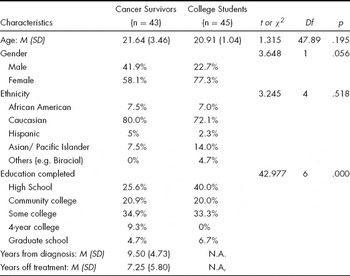
Participants were 43 young adult CNS cancer survivors (females = 58.1%, mean age = 21.64, SD = 3.46 years). The mean number of years from time of diagnosis was 9.5, SD = 4.73, with mean years in remission without treatment = 7.25, SD = 5.80. We also sample 45 college students (females = 77.3%, mean = 20.91, SD = 1.04 years) for contrastive analysis. Table 1 provides descriptive demographic information regarding both samples utilised in this study. The 45 college students used in the comparison group indicated no chronic health conditions, disability, or receipt of student disability services.
Participant Characteristics (N = 88)

Procedures
Permission for the study was granted by the University of Illinois at Urbana-Champaign Institutional Review Board and participants granted individual written consent. The data collection instruments were provided to participants in pre-packed packets with non-person identifier. Data were collected from the cancer survivors by the lead author and a graduate assistant in the Work and Disability Lab at the University of Illinois at Urbana-Champaign. Participants were at least 18 years of age, and agreed to voluntarily participate. Cancer survivors who participated had been in remission for at least five years at the time of data collection. College students completed the data collection instruments under the supervision of the lead author and a graduate assistant from the Work and Disability Lab at the University of Illinois at Urbana-Champaign and insured that their responses would be confidential and that they were free to withdraw at any time with no adverse impact.
Measures
Participants completed the Developmental Work Personality Scale (Strauser, Waldrop & Ketz, Reference Strauser, Waldrop and Ketz1999). They also self-reported on their demographics (gender, age, race, education, and marital status). The DWPS is a 25-item, 6 point Likert scale self-report instrument assessing three aspects of work personality on a scale from 0 not at all like to me, to 5 very much like me. The scale items address behaviours and experiences relevant to the 4th stage of development, termed ‘Industry versus Inferiority’. The scale items pertain to childhood, but the measure is designed to assess people in late adolescence or adulthood as they reflect on their childhood experiences pertaining to work tasks, social interactions and role model exposure during grade school. The Work Task subscale contains eight items, with an example being ‘I complete all my assignments in school’. The Role Model subscale contains three items with an example item of ‘Growing up, I had someone who inspired me’ The Social Skills subscale contains five items with an example item of ‘When I was in school, I had problems getting along with classmates’. Factor analysis results confirmed construct validity and adequate to strong internal consistency estimates for the three DWPS subscales in a previous study (O'Sullivan & Strauser, Reference O'Sullivan and Strauser2010). For the current sample, the internal reliability estimates are Work Tasks (α = .76), Role Model (α = .27), and Social Skills (α = .69) and DWPS total (α = .83). Due to low reliability of the RM subscale for the current sample, the scores for this subscale were not included in the analyses.
Data Analyses
Multivariate analyses of covariance (MANCOVA) with post-hoc between cancer status group comparisons were computed. No significant differences were found among the two groups by age, t(47.89) = 1.315, p = .195; gender, χ 2(1) = 3.648, p = .056; and ethnicity, χ 2(4) = 3.245, p = .518. For this reason we proceeded with the analyses assuming comparability of the two samples of their demographics. Estimates of effect-size were measured by partial eta-square (η 2) and 90% confidence intervals (CIs) were calculated (Ferguson, Reference Ferguson2009; Sapp, Reference Sapp2004; Smithson, Reference Smithson2001).
Results
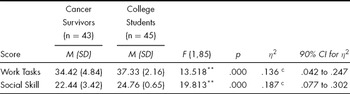
The results of the omnibus MANCOVA indicated that the overall model was significant (Pillai's Trace: F (2, 85) = 11.989, p < .001, η2 = .220). We then examined the data to contrast CNS cancer survivor Work Tasks (WT) and Social Skills (SS) scores with those of typical others (see Table 2 for mean scores by demographics).
Univariate Analysis for the Subscale Scores of Developmental Work Personality Scale (N = 88)

Note. * p ≤ .005. ** p ≤ .001. η 2 = partial eta2 statistics: a small effect (η 2 = .01); b medium effect (η 2 = .06); c large effect (η 2 = .14).
Work Tasks among CNS cancer survivors (M = 34.42, SD = 4.84) was lower than among typically developing others (M = 37.33, SD = 2.16), F (1,86) = 13.518, p. <.001. Social Skills were lower among CNS cancer survivors (M = 22.44, SD = 3.42) in comparison to typically developing others (M = 24.76, SD = .65), F (1, 86) = 19.813, p. < .001.
Discussion
Results of this study provide some initial evidence that young adult CNS cancer survivors have lower levels of developmental work personality, especially pertaining to work tasks and social skills when compared to typically developing peers. This finding is consistent with the research that has indicated physical and psychological late effects impact on work task behaviour (decreased attention, processing speed and executive control) (Jain, Brouwers, Okcu, Cirino, & Krull, Reference Jain, Brouwers, Okcu, Cirino and Krull2009; Stern et al., Reference Stern, Krivoy, Foster, Bitsko, Toren and Ben Arush2010). The finding may be explained by the fact that CNS cancer survivors may experience reduced social experiences and functioning in their development (Bonner et al., Reference Bonner, Hardy, Willard, Anthony, Hood and Gururangan2008; Rey-Casserly & Meadows, Reference Rey-Casserly and Meadows2008). The results of this exploratory study may provide useful insights regarding how, when and where these reductions in social and other functioning occurs for many children living with CNS cancer.
Despite their relatively high education level, CNS cancer survivors had lower self-reported levels of work tasks and social skills. The reasons for this outcome are not clear. We speculate that young adult CNS cancer survivors were exposed to fewer opportunities to develop this component of their identity compared to their peers who did not experience chronic illness or disability during this developmental stage. Illness and treatment related activities may disrupt WT and SS development among young adult CNS survivors. Chronic illness is also likely to negatively impact the quality of role model interaction. Although the RM scale scores were not analysed due to low internal consistency of the subscale, several of the items contained within the total DWPS relate to role model, and as such, it is important to consider this component of the DWP when considering the differences. As children experience and recover from severe symptoms, well-intended role models are not providing consistent and structured work and social activities and the accompanying feedback. Children learn to be ‘industrious’ as they observe others, rehearse behaviours, incorporate feedback from role models and adjust accordingly. It is easy to imagine loving parents and caring teachers establishing different standards for work and social behaviours for children with cancer, or for childhood cancer survivors. These reduced standards of work and social behaviour is one plausible explanation for the significantly lower scores of developmental work personality in our sample.
Limitations of the study include the fact that data were self-report and cross-sectional in nature. Findings may be different with observational data and a different cohort of participants. The use of college students for comparison was less than ideal as they may be different from community young adults in their developmental work personality. We conclude from the findings that young adult CNS survivors have relatively less developed work personality when compared to typically developing others. Further exploration of the experiences during the developmental stage believed to contribute to adult work role behaviour may be beneficial.