I Introduction
“This Commission is determined to change both what the Union does and how it does it. Better regulation is therefore one of our top priorities”.Footnote 1 Evidently, better regulation is a political priority in the EUFootnote 2 and has been so for quite some time.Footnote 3 The agenda is driven forward by the European Commission – an institution that is both “independent” or regulatory and at the same time “European” or political.Footnote 4 The technocratic face of the Commission is especially present when it comes to regulation and the Internal Market. Harcourt and RadaelliFootnote 5 even dub the Internal Market “the ‘paradise’ of European technocratic regulation” and in more general terms, Robinson states that the Commission’s “regulatory function still bears the imprint of the early technocratic approach”.Footnote 6
This technocratic approach to regulation is embedded in much of the meta-regulatoryFootnote 7 architecture installed by the European Commission. The focus of these “better regulation” instruments, such as impact assessments,Footnote 8 consultations and the like, is effective and efficient attainment of policy objectives, rather than the articulation of such objectives. In other words, the better regulation agenda deliberately seeks to be depoliticised. This is also the case for the newest “better regulation” instrument: the high-profile REFIT Programme and its so-called Stakeholder Platform, which is the empirical object of this investigation. The research question governing the inquiry below concerns whether this endeavour towards depoliticisation can be successful at all. This leads us first to examine whether the practice of the European Commission echoes and supports the theoretical premise of depoliticisation that the Commission itself has installed, and second to scrutinise the political conflict potential of the most depoliticised regulatory reform proposals discussed by the REFIT Stakeholder Platform.
To examine the research question, this paper develops a novel and interdisciplinary typology of regulatory reform proposals. Under the REFIT Programme, the Commission invites stakeholders and others to send in such proposals, but it acts as a gatekeeper of what should be allowed serious consideration later on. In terms of the degree of latent politicisation, the typology suggested in this paper categorises those stakeholder proposals that the Commission has allowed access to the better regulation agenda. Against that background, we can analyse whether or not Commission gatekeeping practice reflects the premise of depoliticisation that the Commission itself hails, and we can also say something about the general level of political conflict potential. This leads to the conclusion that the Commission has a certain degree of responsibility if the better regulation agenda and its manifestations, in casu the REFIT Stakeholder Platform, are qui exanimis nascitur – stillborn.
II Presenting the case: the REFIT stakeholder platform
“The search and struggle” for better regulationFootnote 9 is an agenda that reflects the very nature of the European Commission: a body in which technocracy and depoliticisation have been firmly institutionalised, especially when it comes to regulation and the Internal Market. And it is an agenda that seeks to enhance the output legitimacyFootnote 10 of the Union, an explicit priority for the Commission: “We are listening to the concerns of citizens and businesses – especially SMEs – who worry that Brussels and its institutions don’t always deliver rules they can understand or apply. We want to restore their confidence in the EU’s ability to deliver high quality legislation.”Footnote 11
The REFIT Programme is a classic example of a better regulation item that seeks to strengthen technocracy in an attempt to support output legitimacy: by enhancing regulatory quality,Footnote 12 effective functioning, implementation and thus output legitimacy can be strengthened. All in all, this institution is installed as a feature of the EU “regulatory state”Footnote 13 and not as a feature of EU democracy. The Programme seeks to “identify burdens, inconsistencies, gaps and ineffective measures”Footnote 14 and as such it seeks to improve “policy instruments” rather than to define new “policy principles”;Footnote 15 it is technical-evaluative by nature. REFIT was established in 2012Footnote 16 as an expansion of previous policy “fitness checks”.Footnote 17 It follows on from a gradual strengthening of the better regulation agenda in the EU, dating back to the 2001 Commission White Paper on European governanceFootnote 18 and the 2001 Mandelkern Report on better regulationFootnote 19 – and with roots even predating these.Footnote 20
Literature on the functioning of this programme is scarce. SmismansFootnote 21 gives a fine presentation of the strategy and thinking that lies behind it, and the general law-making process in Brussels is a topic examined by Robinson,Footnote 22 who suggests that the whole framework for ensuring regulatory quality needs “radical rethinking”. On a case-basis, REFIT has been the fulcrum for Bartl,Footnote 23 who advances suggestions for new General Food Law Regulation currently under scrutiny in the REFIT machinery. But these three contributions are the exceptions and none of them focus on REFIT as such.
There are, however, plenty of reasons for such a focus. The Juncker Commission revitalised the REFIT ProgrammeFootnote 24 and at the heart of this we find the establishment of a so-called “REFIT Stakeholder Platform” (“the Platform”). Here, both government representatives and civil society stakeholders meet and discuss concrete stakeholder proposals for simplification, more effective regulation, legal efficiency, etcFootnote 25 – a dialogue that the Commission sees as very important.Footnote 26 The Platform has a dual role: it shall both “invite, collect and assess suggestions from all available sources, including from members of the Platform, on how to reduce regulatory and administrative burden” and it must “reply to any Commission request for information and evidence on the prospective impact of any REFIT proposal or the actual impact of the application of any REFIT initiative that has been implemented.”Footnote 27 The Platform held its first meeting on 29 January 2016, when the agenda was mainly procedural.Footnote 28 The following meetings on 5 April and 24 May 2016 were the first substantial sessions of the Platform.Footnote 29
At this point, it is important to stress a few things about REFIT and the Platform. To begin with, the proposals considered by Platform members originate both from the members themselves and from other sources, including the publically available “Lighten the Load” website and in letters from Member State authorities. Proposals can come from member state authorities, business interests, other civil society interests, and even citizens.Footnote 30 The Commission, however, serves as gatekeeper by determining which proposals are to be considered further. It is exactly this function that is scrutinised here. Second, it is important to understand that the Platform actually comprises two platforms, as it consists both of a group of government officials and a group of civil society stakeholders.Footnote 31 The civil society group is very broad and includes representatives from business interests and, for instance, environmental organisations; the European Economic and Social Committee and the Committee of Regions are also represented in the Platform. In addition, participants are chosen because of expertise in their respective fields and not openly as representatives.Footnote 32 Third and most importantly, the aims and limits of the Platform must be acknowledged. It is a forum for making implementation better, not a place to discuss new policy initiatives. To the participant in the Platform deliberations, the Commission has consistently stressed that their proposals have to accept the political objectives of existing rules.Footnote 33 This is a condition of enormous weight as it illustrates the Commission’s understanding of better regulation and tells us that the institution seeks to avoid politicisation understood as discussion of “policy principles” rather than “policy instruments”;Footnote 34 the Commission focuses on reregulationFootnote 35 rather than deregulation or creation of new rules. A question that this researcher dwells on, then, is if that premise is actually echoed in the practice of the Commission.
Besides being highly prioritised, the REFIT Platform is an interesting research object, as it can be seen as a ‘strategic case”Footnote 36 allowing us to investigate a vital part of the better regulation efforts of the EU. Studying the REFIT Platform now as it is still struggling to define its modus operandi, its ambitions, and its role in the EU system, is even more relevant. If the Commission allows politicisation where it otherwise seeks to depoliticise, it will be hard to turn back; this early stage is a critical juncture defining the further path of this institution.Footnote 37 Or to put it differently: the more politicised proposals that the Commission allows to access to Platform deliberations, the higher the risk that the Platform will suffer the same fate as the so-called Stoiber Committee, which met with severe criticism of being partisan from, inter alia, European trade unions.Footnote 38 And that is exactly what the Commission seeks to avoid.
III A typology for latent politicisation of regulatory reform proposals
To answer the research question posed at the beginning of this paper – can the REFIT Stakeholder Platform truly be a depoliticised forum for better regulation? – the paper digs into a content analysisFootnote 39 of the items on the agenda of the first two substantial meetings of that Platform: do these represent a high degree of latent politicisation?
This analysis takes the form of categorisation of the stakeholder proposals that the Commission has allowed to enter the discussions. The main inspiration comes from HallFootnote 40 and Knill et al., who introduce the pivotal distinction between “policy principles” and “policy instruments”. This distinction is fundamental here, as it also functions as a way of distinguishing the more political from the more technical. And as stated in the previous section, the whole better regulation agenda and the REFIT Programme in particular were from the outset explicitly defined as mechanisms to improve policy instruments, not principles. Thoughts along a similar theoretical line – albeit from a much different perspective – are presented by Fliedner, who separates “politische Maßstäbe” from “gesetzgebungsfachliche Standards”.Footnote 41 Another source of inspiration is the typology suggested by Hansen and PedersenFootnote 42 and especially as this is nuanced by Pedersen and Pasquali.Footnote 43 Among other things they introduce the concept of “reregulation” as a regulatory reform proposal that does not challenge the political objectives of existing regulation but seeks merely to enhance the effectiveness and efficiency of policy instruments. To further define and nuance the concept of reregulation, much inspiration has been drawn from writings on legal effectivenessFootnote 44 and especially on regulatory quality.Footnote 45 This will also be clear in the following introduction of the typology.
The suggested typology has two features that distinguish it from these inspirational sources: first of all, it combines regulatory typologies from political science with legal theory and interdisciplinary studies. In that way, it seeks to allow a detailed analysis resting on the substance of regulatory reform proposals. Second, it explicitly combines the different types of regulatory reform proposal with a certain level of risk of politicisation. This combination is not new as suchFootnote 46 but is often found at a more anecdotal level. Here, it is the epicentre of the typology.
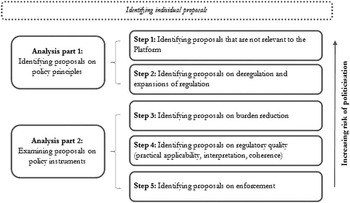
All in all, this background allows us to construct a line from a low degree of latent politicisation to a high degree of latent politicisation; from proposals that are clearly reregulatory (such as those that pertain to regulatory quality) to proposals that might be politicised (such as those of burden reduction) to proposals that are clearly political (such as those for deregulation or expansion of regulation or those that clearly fall outside a regulatory agenda). The analysis along this line will naturally fall into two parts. The first part rests on the distinction between policy principles and policy instruments and identifies proposals with direct political implications, i.e. those that directly challenge the depoliticisation premise of the REFIT setup. The second part of the analysis rests on the conceptualisation of reregulation and identifies the level of potential political spurred by the reregulatory proposals, i.e. the potential for political conflict even in a depoliticised field. Figure 1 illustrates.
Risk of politicisation and type of proposal.

1 First part of the analysis: identifying political reform proposals
The ambition of the first part of the analysis is to distinguish outright political stakeholder proposals from other proposals. This will allow a conclusion on whether or not the European Commission’s better regulation practice reflects its “better regulation” theory and ambitions. After all, it is the Commission that defines the agenda.
After having identified the substance of the proposals, we therefore filtered out those that were not relevant to the REFIT and broader “better regulation” agenda. This would, for example, be the case with proposals that transgress EU competencies or those that are not relevant in a regulatory sense at all. Following the very premises for the Platform deliberations, such proposals are not to be discussed as they are clearly political; they serve a different goal to that of the Platform as this goal is envisaged by the Commission. If the Commission has accepted a large number of these for discussion, this is an indicator of it not having a clear idea of how to operationalise its own premise of depoliticisation and reregulation.
The next step was to identify proposals that are openly political, i.e. stakeholder proposals that directly challenge the reregulatory premise and depolitical ambition of the Commission. Here, the distinction between the categories taken from Knill et al.Footnote 47 becomes useful: policy principles versus instruments or reregulation respectively.
The concepts of “policy principles” and “policy instruments” are useful as they establish the fundamental distinction between outright political reform proposals and those that accept the political ambitions but seek to reform the way to achieve these. Challenging policy principles or objectives is inherently a politically contentious exercise. Logically, such an exercise can take two directions: narrowing the scope of the rules or correspondingly expanding them. “Indeed, the relevant literature often neglects that change is not unidirectional, but can go in two ways, that is, policy expansion and policy dismantling” as Knill et al.Footnote 48 puts it. “Policy dismantling” is also known as “deregulation”,Footnote 49 and I thereby reserve that specific term for changes that narrow the scope of the political objectives of given regulation, for instance through simple abolition. it is important to stress this, as “deregulation” is often used as a strawman argument for almost every thinkable reduction of rule complexity. However, whatever the direction of a reform proposal that alters the objectives of regulatory mechanism – deregulation or expansion of regulation – this proposal will have a great risk of political conflict. And such proposals are not accepted by the Commission as relevant to the Platform. If they still find their way on to the agenda of the Platform meetings, it is a sign of the gatekeeping practice of the Commission not being aligned with its ambitions of depoliticisation.
2 Second part of the analysis: potential for political conflict among the reregulatory proposals
That leaves the rest of the proposals as those to alter policy instruments and thus falling inside the scope of the Platform. This implies accepting the purposes of given rules. Such proposals are dubbed “reregulation”, i.e. achieving the same goals through improved methods. Reregulatory suggestions are by nature less inclined to politicisation, as the centrepiece of politically contestation – the objectives of the rules – is never questioned. As described above, the Commission understands this when it wishes Platform reform advice to stay within the politically-defined purposes of rules. In other words, the distinction made here is important and only the reregulatory aspects are relevant to the Platform (and the REFIT program as a whole). And of this, stakeholders have been informed.Footnote 50
Reregulation, however, can take on many forms, some of which are more prone to political conflict than others. Scrutinising the proposals that actually fits into the REFIT agenda will therefore allow us to conclude something about the risk of conflict even in this depoliticised field. And this is relevant to our analysis: if we – from the first steps of the analysis – conclude that the Commission’s practice does not reflect its own premise of depoliticisation, and we – from the following steps of analysis – are able to conclude that even the depoliticised field of reregulation has a high risk of conflict, then we are saying something about whether or not the endeavours towards technocracy in the field of better regulation are qui exanimis nascitur – stillborn – or not. This second part of the analysis is thus crucial to the answering of the research question posed in the introduction of this article.
Therefore, we need a more elaborate conceptualisation of reregulation. And the obvious starting point is to look at the beneficiary of a given reregulatory reform proposal. Is the beneficiary a specific type of regulatee or is it the functioning of the regulatory system as such? The former can be dubbed “burden reduction”, which includes, inter alia, lowering of thresholds and the like. The latter can be dubbed regulatory quality – can a rule actually be meaningfully applied? Is it functional to achieve what it is constructed to achieve? The former (burden reduction) is advantageous for specific regulatees and thus it has a higher risk of interest-based conflict and politicisation than the latter (regulatory quality). In both cases, however, that risk is indirect and diminishes the risk from proposals to reform the policy principles.
That brings us to the final step of the analysis, namely the categories with the lowest risk of politicisation. These are proposals for better enforcement and those pertaining to regulatory quality. The former is easily identified; the latter is somewhat more complex and actually entails three additional analytical steps. “Regulatory quality” describes regulatory reform proposals that accepts existing political objectives and do not count as mere burden reductions. Judging from the Commission’s letters to the participants in the Platform, this seems to be the core of the work: enhancing regulatory quality (and enforcement). Regulatory quality is in itself a highly contested conceptFootnote 51 and although it has a certain meaning attached to it in political circles,Footnote 52 it is a concept used differently across scholarly traditions such as law and political science. If we wish to categorise the stakeholder proposals that the Commission has allowed on the agenda in terms of the latent risk politicisation of these proposals, we need to operationalise “regulatory quality” even further. And in doing so, we need to cross disciplines. This part of the categorisation of the stakeholder proposals is at least partially inspired by the literature on legal effectiveness,Footnote 53 and suggestions of such an elaborate understanding of “regulatory quality” are seen,Footnote 54 though from a much more procedural perspective than here. Again, the purpose is to allow us to discuss the risk of politicisation of reregulatory proposals judged by their substance; therefore, the concept of regulatory quality will only be examined superficially, as other and more comprehensive presentations of it can be found elsewhere.Footnote 55
In law a rather useful notion of regulatory quality exists: it is seen as characteristic of a given legal text (of whatever form) that enables that text to meet its political aims. In practical law, this has led to numerous guides on how to write a “good” law.Footnote 56 It is the impression of this author that such guides exist in nearly every language imaginable. Two central concepts can be distilled from the legal tradition: coherence and interpretation. Coherence is the least complex of the two. Is a given rule or set of rules compatible: (a) internally, i.e. with itself (do, for example, two articles in the same law counter each other?); and (b) externally, i.e. with other sources of law? That this must be the case in order for any given piece of legislation to achieve effective and efficient functioning should be fairly obvious. In addition and more relevant here, legal coherence – be it internal or external – has a very low risk of politicisation due to its technical character. Interpretation is a more sensitive term. Is the legal text and its central legal concepts so non-ambiguous in order to support an expectation of effective and uniform application? Interpretation is relevant both when talking about the text per se, meaning its structure, readability and such, and when talking about central legal concepts.Footnote 57 The importance of this category of regulatory quality is very high in the EU where at least 28 different authorities have to implement any given rule. That texts have to be accessible and central concepts unambiguous seems rather evident; therefore, interpretation also has a rather low degree of risk of politicisation. However, as interpretation is a more complex and more contestable task than defining legal coherence, the risk of politicisation of interpretation is higher than that of coherence. To us, this means that if the proposals carried onto the Platform are dependent on interpretation, this will raise the risk of politicisation compared to whether the proposals were all about legal coherence. In both instances, however, that risk is low. Finding stakeholder proposals that point to coherence problems or interpretative problems would thus be the expectation – if the Commission’s gatekeeping practice reflects its own understanding of the functioning of the Platform and the REFIT as such.
These legal necessities for effective and efficient functioning have been the fulcrum of research focusing on the problem of transposition and implementation,Footnote 58 but the problem of implementation leads us to political science. Here, the argument often goes that “quality” cannot be defined, as it is contingent.Footnote 59 The sensitivity to context in political science brings about a very important point, namely that the milieu – the practical circumstances under which the law has to be applied, practical applicability – has enormous relevance when it comes to the ability of any given legal remedy to meet political ambitions. And this milieu can take many forms, not least in the EU. This can be understood as a need for congruence between law and “reality” – a practical applicability. This point seeks to include behavioural sciences and insightsFootnote 60 in the analysis of regulatory quality. The legal categories of regulatory quality – coherence and interpretative field – do not see this. The question of practical applicability is, of course, much more complex and thus potentially more contestable than the two former and more legalistic categories of regulatory quality, coherence and interpretative fields. In addition, a problem of incongruence between the legally envisaged regulatory reality and the empirically experienced reality may be hard to distinguish from suggestions of burden reduction. The difference is, though, that this kind of critique is centred on the functioning of the law – can it actually be meaningfully applied and thus meet its aims? Burden reduction is, well, burden reduction. The former, therefore, is a rather structural point whereas the latter is actor-centred and from a specific actor’s perspective.
Proposals that point out problems with one of the three dimensions of regulatory quality as understood above seem to be exactly what the Commission seeks from Platform members. Such proposals are reregulatory and have a lower degree of latent politicisation than other types of regulatory reform proposals, including proposals for burden reduction.
The different types of regulatory reform proposals – from deregulation and policy expansion over burden reduction to the three categories of regulatory quality and enforcement – entail varying degrees of latent politicisation. Enforcement and the regulatory quality category of coherence are the ones least prone to political debate and conflict, whereas the discussion of practical applicability is more open to interpretation and discussion, with burden reduction even more so as these suggestions may even be mistaken for ideas of deregulation. And proposals to deregulate or to expand regulation have an open and directly political nature.
3 Summing up: the analytical design
The analysis below is structured by the different steps of its two parts. The idea was categorisation of the proposals remaining after the previous analytical step. Coding was undertaken twice to ensure a consistency in the categorisation of the from time to time very technical and/or underspecified proposals. If discrepancies between the two codings occurred, the second was given priority due to an assumed effect of learning. Ideally, an analysis like this is implemented through blinded coding as suggested by, for instance, NeuendorfFootnote 61 and Krippendorff.Footnote 62 However, due to the extremely technical nature of the coding applied here and of the data, blinded coding as such was never feasible. Figure 2 illustrates the analytical design as a whole.
Analytical design.

Moving from one step to the next will gradually lower the number of uncategorised stakeholder proposals and at the final stage, all proposals should be categorised. On that background, we can – from Figure 1 – say something about the distribution of stakeholder proposals that furnish politicisation of an institution the Commission has envisaged as depolitical.
IV Results
Before we could enter the substance of the analysis, it was necessary to establish the data. This consisted of the proposals presented to the Platform members in January 2016. It included 16 thematic documents of proposals. Prima facie, the number of proposals was 110. However, many contributions did in fact include several different proposals under one heading and these had to be identified. The German Chambers of Industry and Commerce (“Deutsche Industrie- und Handelskammertag”) had, for instance, a proposal under the heading “Reducing bureaucracy for ERDF/ESF funding”. This heading, however, included several proposals such as, for example, one to improve the approval process so as to install “a single check with final notification and a binding effect for all suppliers of capital/participants” and another to “avoid ‘gold-plating’ through further synthesis and interim reports”. This led to the identification of 197 individual proposals.
The analysis then went on to identify the outright political proposals that the Commission – despite the depoliticisation ambition of that same body – had allowed to enter the agenda. As described in the methods’ section, this part of the analysis consisted of two steps: first, identification of proposals that have no relevance to the REFIT Programme or even to the EU as such, and second, identification of proposals the challenge political objectives. Both types spur politicisation and such proposals should have been excluded by the Commission if the premise for the Platform’s work was given any weight.
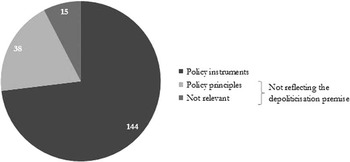
Of the 197 proposals, 15 – or in the vicinity of 8% – were categorised as irrelevant to better regulation and REFIT. Several of these suggestions of lesser relevance to the Platform are not regulatory but meta-regulatory, i.e. ideas for enhanced impact assessments, fitness checks of specific regulations and the like. Such proposals are irrelevant to the REFIT (and thus to the Platform), as such proposals seek to alter the intra-institutional setup of decision-making in the Commission rather than the substance of regulation. At this point, it was also striking that several of the proposals coming from citizens seem to fall into this box. Of the seven from citizens, five were classified as irrelevant – including, for example, those for EU regulation of maximum speed limits or “facilitating transport regulations from Ireland to the UK for greyhounds” – and the remaining two as proposals of regulatory expansion. In its comments on several of these proposals, the Commission itself openly deemed them irrelevant but it still accepted them as items to discuss with Platform members. By that measure, the Commission served as a gatekeeper and yet not. Filtering out these irrelevant proposals left us with 182.
These 182 were then scrutinised for proposals to alter policy objectives or principles. And this is where it gets interesting. Suggestions to change policy objectives – i.e. deregulation and regulatory expansions – are directly at odds with the very premise of the Platform and the REFIT programme; and of the 182 regulatory relevant proposals, 38 items were categorised as either deregulatory or proposals to expand regulation. That amounts to nearly a fifth of the total amount of proposals allowed onto the agenda. Proposals of deregulation include, for instance, the Austrian Federal Economic Chamber’s (Wirtschaftskammer Österreich) proposal to “scrap the Cross-Sectional Correction Factor” in the Emissions Trade Directive and the Danish Business Forum’s (Virksomhedsforum) proposal to abolish ‘statistics for environmental investment to reduce the administrative cost imposed on businesses.” Proposals to expand regulation include, for instance, the House of Dutch Provinces” (Huis van Nederlandse Provincies) proposal to include student grants under Regulation 883/2004 that regulates the coordination of social policies in the EU, and the German Chambers of Industry and Commerce’s proposal to allow granting “Regional State Aid for large companies […] for new products, services or innovations.” Of the 38 proposals to change policy objectives, 18 were examples of deregulation and 20 of expansions of regulation.
Taken together, the first part of the analysis showed us that of the 197 proposals, a total of 53 items or nearly 27% of the total number of proposals ought not to have been on the agenda at all if the Commission’s own well-established premise for depoliticisation was reflected in its gatekeeping practice. This is illustrated in Figure 3.
Identifying proposals at odds with Platform premises (N=197).

This may lead us to conclude that a considerable risk of politicisation exists in what has been constructed as a depoliticised forum. And that brings us to the next part of the analysis: what about the reregulatory proposals? Do they represent a high or a low degree of political conflict potential? To assess the further risk of politicisation even in the apparently hypothetical event of a strict gatekeeping practice from the side of the Commission, we therefore have to take a close look at the remaining 144 proposals.
As suggested in the methods’ section and illustrated by Figure 1, the different types of reregulatory proposals represent varying levels of indirect risk of politicisation: burden reduction is more prone to foster political conflict than, say, questions of legal coherence. If, then, we find that a major part of these reregulatory proposals are proposals to reduce burdens, that tells us about a certain (although indirect) risk of politicisation even among the reregulatory proposals to be considered by the Platform members.
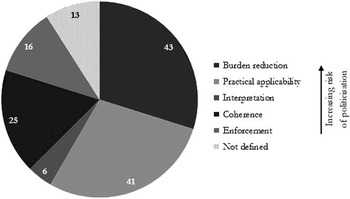
And that is exactly the picture that was found. Of the 144 reregulatory proposals, 43 were classified as proposals for burden reductions, i.e proposals that reduce administrative requirements only to make things easier for regulatees. These proposals included, for instance, the Austrian Federal Economic Chamber’s proposal to reduce the financial burden for Emission Trade System businesses or the Danish Business Forum’s proposal to allow retail traders only to inform consumers “about conditions that go beyond what is required by the law instead of being individually required to inform every consumer about the law or statutory rights”. Many of the proposals, however, were simple and unspecified calls to make a certain area less bureaucratic. These are evidently not direct politicisations but they do pose a more potent threat to the technocratic nature of the REFIT programme than do proposals to improve regulatory quality – especially because burden reduction and deregulation can easily be mistaken for one another. That is, of course, also a potential source of error in this analysis, but it can hardly influence the conclusion that the two categories are “neighbours” when it comes to latent politicisation in Figure 1.
The next step was to look deeper into the proposals on regulatory quality – 72 in total: how many were pointing at coherence, interpretation, and practical applicability problems, respectively? The latter – proposals to improve applicability – take up the biggest share. These included, for instance, the Danish Business Forums proposal to simplify “the way in which wind breaks are considered as ecological focus areas”, as the present method according to the proposal does not ensure that the “original intention to use windbreaks as EFAs can be carried out in practice by the Member States.” Another example of a problem of practical applicability was the Finnish Survey for Better Regulation’s proposal to repeal Article 5 in the Universal Service Directive as it “contains unnecessary provisions on the right of end-users to telephone directories and public pay telephones.” This was deemed outdated and thus unnecessary to uphold as a legal requirement.
As applicability is a more complex dimension than, say, coherence, it is also a stronger source of political conflict than the legalistic dimensions of regulatory quality. When these legalistic dimensions occurred, it was most often problems of coherence that were stressed. These included, for example, in the field of competition and state aid, the German Chambers of Industry and Commerce’s proposal to review “the rules on business-related infrastructure and state resources on the basis of the case-law of the Court of Justice.” And an example of a proposal regarding language and interpretation was the Danish Business Forum’s proposal to alter the wording in the withdrawal form in the appendix to the Consumer Rights Directive, as this “can be confusing to consumers because it concerns both services and goods causing consumers to doubt whether the withdrawal form is relevant to them.” And the Board of Swedish Industry and Commerce’s (Näringslivets Regelnämd) call for the Commission to “present a definition or guidance in explanatory notes on the distinction between single and composite supplies” in the field of taxation, was another example of a proposal to clarify legal-linguistic issues and thus to ease implementation and improve functioning of the regulatory remedy. In addition, the analysis revealed 13 proposals as “reregulatory” but “not defined”. These included, for instance, questions that would demand a reregulatory response but without the proposal in the data actually defining the proper response.
Finally, we were left with 16 proposals, all of which were on enforcement, such as BusinessEurope’s proposal to establish “so-called Single Market Centres in every EU Member State”. The results of the analysis of the 144 reregulatory proposals considered by the Platform is depicted in Figure 4.
Reregulatory proposals divided by type (N=144).

In sum, the REFIT Stakeholder Platform was to discuss 197 proposals from different stakeholders in its first two, path-defining meetings. Of these 197, more than a fifth went against the technocratic nature of the setup and were thus open sources of political conflict – they could hardly be classified as ideas for better regulation but rather as ideas for interest-driven regulation or as completely irrelevant to REFIT and the “better regulation” agenda. Of the remaining 144 reregulatory proposals, 43 were on burden reduction, an indirect but potent source of politicisation. That left only little more than a third of the total number of proposals on regulatory quality (72) and enforcement (16).
V Conclusions
The query in this contribution was motivated by the apparent apolitical nature of the better regulation agenda in the EU. If that agenda is to be kept aconflictual and apolitical – reflecting the technocratic nature of the European Commission’s handling of the internal market and the explicit credo of the REFIT Programme – two criteria have to be met. First, the European Commission needs to function as an effective gatekeeper to ensure depoliticisation. Second, the proposals actually considered cannot be dominated by the kinds that have a high risk of spurring political conflict. If the former is not the case, too many discussions on “pure” political matters will take up time. And if the latter is the case, discussion may risk drifting in a political direction anyway. Both these situations undermine the premises for the functioning of the Platform, the REFIT and the better regulation agenda as they are explicitly defined by the European Commission.
This paper examined the status of these two criteria by looking very closely at the first 197 proposals considered in the REFIT Stakeholder Platform. This institution was chosen as a strategic case, as it is the newest and one of the most highly-prioritised mechanisms of better regulation in the EU. The examination utilised a novel and interdisciplinary typology of regulatory reform proposals drawing on elements from political science and law alike.
The first precondition led us to the distinction between policy principles and policy instruments. The investigation shows that while the Commission has a theoretical understanding of this distinction as a premise for the REFIT Programme, its practice does not reflect this. That is – to say the least – not a very consistent approach.
The second precondition led to the discussion of different policy instruments. Building on that, the concept of regulatory quality was developed to show the nuances and different levels of latent politicisation even in these reform proposals. The conclusion is that proposals with the higher risk of politicisation dominate even among the reregulatory proposals. This gives the Commission a very hard task if it wishes to avoid political conflict within this technocratic setup – even in the case when it had served its function as gatekeeper more consistently. The results in this part of the analysis are perhaps not to be read on the third decimal point as some coding categories – especially “burden reduction” and “applicability” – can be hard to distinguish in all but theory. That source of coding error, however, does not alter the conclusion.
Overall, there seems to be a high risk of politicisation of the Platform’s work despite the depolicisation ambitions hailed by the Commission. And through its not very well-developed gatekeeping practice, the Commission itself even supports such politicisation.
Perhaps this pessimism is unsurprising.Footnote 63 But are we then to conclude that better regulation in the EU cannot succeed? Not necessarily. Much depends on how the Platform members receive and interpret the proposals. But an alignment between the Commission’s theoretical stance and its practice would do much to support the desired depoliticisation. Such a new and more consistent gatekeeping practice would lead to higher thresholds for proposals to gain access to deliberation in the better regulation agenda – in casu in the Platform discussions – and that would among, other things, reduce the number of items on the better regulation agenda. This could foster criticism from stakeholders but it would also allow for more substantial and focused preparation and deliberation.
For now, however, the results are quite clear: there is a high risk of the REFIT Stakeholder Platform ending up as a forum for political discussion reproducing already-existing cleavages, despite the explicit ambitions to go beyond exactly that. This, as provocatively suggested in the title of this contribution, could lead us to classify the better regulation efforts in the REFIT Stakeholder Platform and perhaps even more broadly as qui exanimis nascitur: stillborn.