Introduction
There are many criteria that influence a consumer's decision to purchase meat, including appearance, taste, aroma, and texture. Generally, consumers prefer to have high quality, convenient and safe meat products that contain natural flavour and taste (Aymerich et al., Reference AYMERICH, PICOUET and MONFORT2008). Flavour, which comprises mainly the two sensations of taste and aroma or smell, has been found to be one of the most important factors affecting consumers’ meat-buying habits and preferences even before the meat is eaten (Shahidi, Reference SHAHIDI1989; Sitz et al., Reference SITZ, CALKINS, FEUZ, UMBERGER and ESKRIDGE2005). Of all types of meat consumed in the world, chicken continues to be the cheapest, and its consumption is expected to increase by 34% by 2018 (Jung et al., Reference JUNG, JEON, JUNG, CHOE, LEE, HEO, KANG and JO2011). Fast-growing commercial broiler strains and few indigenous chicken breeds fulfil the global demand of chicken meat over the years (Jaturasitha et al., Reference JATURASITHA, SRIKANCHAI, KREUZER and WICKE2008).
Uncooked meat has a blood-like taste with little or no aroma. Cooked meat flavour development is a complex scenario which yields a large number of volatile compounds as a result of thermally induced reactions between the non-volatile components of lean and fatty tissues during cooking. Aromatic residues and most of the characteristic flavours of meat are mainly contributed by these volatile compounds (Mottram, Reference MOTTRAM1998). However, the cooked meat flavour is dependent upon several factors relating to the source animal, including age, breed, sex, nutritional status, post-mortem ageing, and method of cooking (Spanier et al., Reference SPANIER, FLORES, McMILLIN and BIDNER1997; Liu et al., Reference LIU, JAYASENA, JUNG, JUNG, KANG, HEO, LEE and JO2012). Furthermore, chicken meat is liable to lipid oxidation and thereby the development of off flavours, due to higher unsaturated fatty acids in its composition. Eventually, this makes the producers, processors, and even consumers adapt different off-flavour-preventing mechanisms. Hence pre- and post-slaughter factors can change the status of chicken meat flavour. Understanding the factors which influence flavour quality, especially during the production and processing of meat is, therefore, vital to consistently produce the most flavoured product possible. The purpose of this review is to highlight the mechanisms and chemical compounds responsible for cooked chicken meat flavour in brief and to discuss the main factors affecting cooked chicken meat flavour in detail.
Chemistry of cooked chicken meat flavour
Generally, raw meat has a bloody, metallic, salty taste, with an aroma resembling blood serum (Wasserman, Reference WASSERMAN1972). The Maillard reaction, the thermal degradation of lipids and Maillard-lipid interactions are considered to be the main reactions, which result in flavour and aroma compounds during cooking (Brunton et al., Reference BRUNTON, CRONIN and MONAHAN2002). Around 500 volatile compounds have been identified in cooked poultry meat, of which the majority is recognised in chicken (Brunton et al., Reference BRUNTON, CRONIN and MONAHAN2002).
Free sugars, sugar phosphates, nucleotide-bound sugars, free amino acids, peptides, nucleotides, and other nitrogenous components such as thiamine are considered as the main water-soluble flavour precursors (Mottram, Reference MOTTRAM1998). Similar to other meats, lipids play a vital role in the flavour development of poultry meat (Perez-Alvarez et al., Reference PEREZ-ALVAREZ, SENDRA-NADAL, SANCHEZ-ZAPATA and VIUDA-MARTOS2010). Lipid degradation, mainly the oxidation of the fatty acid components of lipids, results in several hundred volatile compounds, including aliphatic hydrocarbons, aldehydes, ketones, alcohols, carboxylic acids, esters, some aromatic hydrocarbons, and oxygenated heterocyclic compounds such as lactones and alkylfurans (Mottram, Reference MOTTRAM1998).
Volatile compounds generated from the Maillard reaction and lipid oxidation, including 2-methyl-3-furanthiol, 2-furfurylthiol, methionol, 2,4,5-trimethylthiazole, nonanol, 2-trans-nonenal, 2-formyl-5-methylthiophene, p-cresol, trans,trans-2,4-nonadienal, trans,trans-2,4-decadienal, 2-undecenal, β-ionone, ɣ-decalactone, and ɣ-dodecalactone are the major sources of chicken flavour (Shi and Ho, Reference SHI and HO1994). Of all these compounds, 2-methyl-3-furanthiol is considered the most important compound responsible for the meaty flavour of chicken broth (Shi and Ho, Reference SHI and HO1994). Furthermore, the brothy taste of meat has been attributed to umami (mouth feel) relevant components (Sasaki et al., Reference SASAKI, MOTOYAMA and MITSUMOTO2007). In addition, a large number of heterocyclic compounds including pyrazines, alkylpyrazines, pyridines, pyrroles and thiazoles are formed during roasting, grilling, frying, or pressure cooking of chicken meat due to the higher temperature and lower moisture conditions used in these cooking methods. These compounds are absent in boiled meat (Shi and Ho, Reference SHI and HO1994; Melton, Reference MELTON1999).
Main factors affecting chicken meat flavour
breed/strain
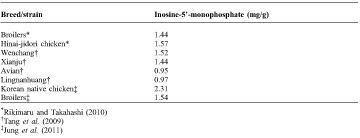
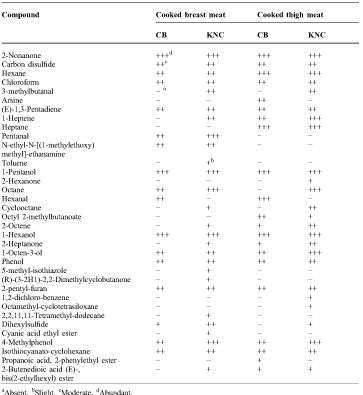
Increased palatability of the meat from some breeds/strains of chicken, particularly in indigenous chickens, compared to broilers is well documented. For instance, Hinai-jidori chickens from Japan were more palatable for humans than broilers during a sensory evaluation conducted by Kiyohara et al. (Reference KIYOHARA, YAMAGUCHI, RIKIMARU and TAKAHASHI2011). Significantly higher flavour scores for Korean native/farm chickens in sensory analysis compared to that of broilers has also been reported (Jung et al., Reference JUNG, JEON, JUNG, CHOE, LEE, HEO, KANG and JO2011). Furthermore, concentrations of inosine-5′-monophosphate (IMP) in Korean native chicken and Hinai-jidori chicken meat were higher than those in broiler chicken meat (Table 1). IMP is generally considered as the major nucleotide in muscle that imparts flavour to the cooked meat (Yamaguchi, Reference YAMAGUCHI1991). Slow-growing genotypes in China (Wenchang and Xianju) have displayed higher IMP concentrations (Table 1) than the commercial broiler lines (Tang et al., Reference TANG, GONG, WU, JIANG, WANG and LI2009). According to Tang et al. (Reference TANG, GONG, WU, JIANG, WANG and LI2009), the differences in IMP content among genotypes may be explained by the effects of genotype, age, or their interaction. Further, IMP content in breast muscle was significantly higher than that in leg muscle (Tang et al., Reference TANG, GONG, WU, JIANG, WANG and LI2009). This could have resulted in some flavour differences between the 2 muscles within the same breed. Vani et al. (Reference VANI, MODI, KAVITHA, SACHINDRA and MAHENDRAKAR2006) has reported that variations in nucleotide content in muscles can be due to the differences in species, breed, age, sex etc. Because different breeds/strains contain different levels of flavour precursors, the type and concentration of volatile compounds generated will also vary. Recently, Lee et al. (Reference LEE, KIM, LEE, KANG and JO2012) assessed the components related to flavour and taste in commercial broiler and Korean native chicken meat (Table 2). The findings revealed that the thigh meat from Korean native chickens showed higher contents of arachidonic acid and docosahexaenoic acid (DHA) compared to commercial broilers. In addition, flavour contributing amino acids, including aspartic acid, threonine, serine, glycine, alanine, tyrosine, lysine, and arginine, were significantly higher in breast meat from Korean native chickens. Koriyama et al. (Reference KORIYAMA, WONGSO, WATANABE and ABE2002) showed that eicosapentaenoic acid (EPA) and DHA suppressed sourness and bitterness but increased sweetness and umami characteristics.
Inosine-5’-monophosphate contents of different chicken breeds.
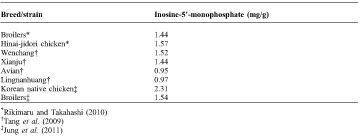
*Rikimaru and Takahashi (Reference RIKIMARU and TAKAHASHI2010)
†Tang et al. (Reference TANG, GONG, WU, JIANG, WANG and LI2009)
‡Jung et al. (Reference JUNG, JEON, JUNG, CHOE, LEE, HEO, KANG and JO2011)
Major volatile compounds (area count x 103) of the cooked breast meat and thigh meat from commercial broiler (CB) and Korean native chicken (KNC; modified from Lee et al., Reference LEE, KIM, LEE, KANG and JO2012).
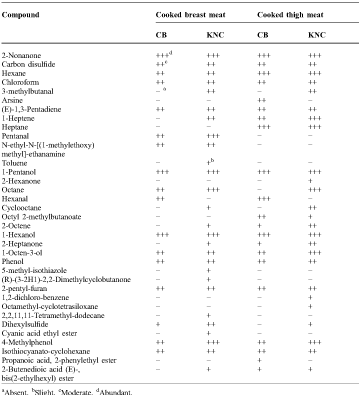
aAbsent, bSlight, cModerate, dAbundant.
components in meat
Lipid class and fatty acid composition
Despite the flavour of meat from different species upon heat processing being expected to be similar due to the similarities in the free amino acids and carbohydrates in their meat (Shahidi, Reference SHAHIDI2002), this idea was challenged by the lipid-derived species-specific notes, mainly from the intramuscular lipids (Perez-Alvarez et al., Reference PEREZ-ALVAREZ, SENDRA-NADAL, SANCHEZ-ZAPATA and VIUDA-MARTOS2010). On the other hand, the precursors supplied by lean tissues generate the meaty flavour common to all cooked meats (Mottram, Reference MOTTRAM1998).
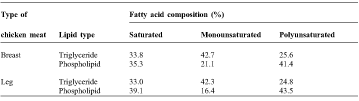
Aldehydes produced during lipid degradation are probably characteristic features of certain species. For example, the 2-alkenals such as hexenal, heptenal, octenal, nonenal, undecenal, and dodecenal as well as aldehydes, including octanal, nonanal, decanal, and decadienal are related to both chicken-specific aroma and flavour (Ramarathnam et al., Reference RAMARATHNAM, RUBIN and DIOSADY1993). Deposition of fatty acids between ruminants and non-ruminants is different mainly due to the differences in their digestive systems. Poultry and pork muscle have higher levels of polyunsaturated fatty acids in the triglycerides than lamb or beef (Calkins and Hodgen, Reference CALKINS and HODGEN2007). Thus, more unsaturated volatile aldehydes are formed in chicken and pork compared to beef or lamb (Table 3). These compounds contribute to the specific aromas of chicken and pork (Noleau and Toulemonde, Reference NOLEAU and TOULEMONDE1987; Mottram, Reference MOTTRAM1991). Therefore, the influence of lipids is primarily due to the differences in fatty acid profile and the resulting carbonyls (Perez-Alvarez et al., Reference PEREZ-ALVAREZ, SENDRA-NADAL, SANCHEZ-ZAPATA and VIUDA-MARTOS2010).
Fatty acid composition of the phospholipid and triglyceride fractions of chicken meat (adapted from Shi and Ho, Reference SHI and HO1994).
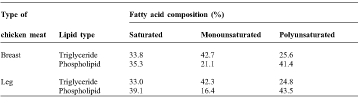
The unsaturated fatty acids present in the triglycerides of red meat and poultry are mainly oleic and linoleic acids. However, phospholipids contain a relatively higher proportion of linolenic and arachidonic acids (Shahidi, Reference SHAHIDI2002). Fatty acids such as linoleic and arachidonic acids auto-oxidize and form 2,4-decadienal, 2-nonenal, 1-octen-3-one, 2,4-nonadienal, and 2-octenal through 9-hydroperoxide and 11-hydroperoxide, respectively. Of them, 2-nonenal and 2,4-decadienal contribute to a meaty flavour (Perez-Alvarez et al., Reference PEREZ-ALVAREZ, SENDRA-NADAL, SANCHEZ-ZAPATA and VIUDA-MARTOS2010). However, the most intense aroma compound from the oxidation of arachidonic acid is trans-4,5-epoxy-(E)-2-decenal, followed by 1-octen-3-one, 2,4-decadienal, 2,4,7-tridecatrienal, and hexanal (Blank et al., Reference BLANK, LIN, VERA, WELTI and FAY2001).
Free amino acid and nucleotide contents
Takahashi et al. (Reference TAKAHASHI, RIKIMARU, KIYOHARA and YAMAGUCHI2012) correlated the presence of free amino acids, including glutamic acid and nucleotides, such as IMP with the taste of chicken meat. Better taste observed in chicken soup prepared with broiler meat than that prepared with Japanese native chicken meat from a Jidori breed was thought to be due to the significantly higher free amino acid content in broiler (Matsuishi et al., Reference MATSUISHI, KATO, ISHIGE, HORI, ISHIDA, KANEKO, TAKENONAKA, MIYAMURA, IWATA and OKITANI2005). A study that analysed the chemical components in meat has suggested that free amino acids are responsible for improving the taste of meat during storage (Rikimaru and Takahashi, Reference RIKIMARU and TAKAHASHI2010). In contrast, Fukunaga et al. (Reference FUKUNAGA, KOGA, MAITA and MATSUOKA1989) has reported that phenylalanine content has a close association with bitter taste in meat. Glutamic acid is one of the most influential amino acids for chicken meat flavour, particularly on umami sensation where it plays an important role singly or in combination with other taste-related compounds (Kurihara, Reference KURIHARA1987). Aliani and Farmer (Reference ALIANI and FARMER2005) have investigated the most important flavour precursors affecting the sensory attributes of consumers by monitoring a series of sensory experiments. The authors isolated precursors and added them to ground raw chicken before cooking, and the cooked products were then evaluated by trained sensory panellists. On using the thiamine precursor, the panellists described the flavour of the cooked product as ‘roasted’ and ‘vegetable soup’. In the same study, the flavours of samples with added cysteine and ribose were described as ‘chicken’ and ‘savoury’. Recently, Liu et al. (Reference LIU, JAYASENA, JUNG, JUNG, KANG, HEO, LEE and JO2012) showed that several unique proteins or peptides including phosphoglucomutase 1, NRXN3 96 kDa protein, HSPB1 22 kDa protein, and TF 78 kDa protein were present in higher levels in Korean native chickens when compared to broilers. The authors explained that these proteins were likely attributed to the degradation of muscle protein during the post-mortem aging period and thereby contributed to the characteristic flavour in the cooked meat.
Components related to umami taste such as amino acids, inosine, IMP, and peptides (Sasaki et al., Reference SASAKI, MOTOYAMA and MITSUMOTO2007) have been considered important contributors to the sensory quality of meat (Kato and Nishimura, Reference KATO and NISHIMURA1987; Fuke and Konosu, Reference FUKE and KONOSU1991). For example, Fujimura et al. (Reference FUJIMURA, KOGA, TAKEDA, TONE, KADOWAKI and ISHIBASHI1996) indicated that glutamate and IMP contributed to the taste of chicken meat, and Nishimura et al. (Reference NISHIMURA, RHUE, OKITANI and KATO1988) noted that an increase in free amino acids during conditioning affected the umami taste. Moreover, Vani et al. (Reference VANI, MODI, KAVITHA, SACHINDRA and MAHENDRAKAR2006) suggested that cooking of Indian country hen meat at high temperatures resulted in improved flavour, primarily because of the formation of high levels of IMP degradation compounds.
However, different volatile compounds were generated when different sugars were combined with amino groups under different conditions. Cysteine and glucose produced mainly sulphur compounds, whereas more pyrazines and furans were formed by the combination of cysteine with glucose under oxidation conditions (Tai and Ho, Reference TAI and HO1997). Maillard volatile compounds from glutathione/glucose systems at pH 6 and 8 produced sulphur-containing compounds such as thiophenes, thiazoles, and cyclic polysulphides, whereas furans often became the end products at a more acidic pH. When glutathione is oxidised, it becomes glutathione sulphonic acid, which produces furans, carbonyls, pyrroles, and pyrazines with glucose. Sulphur-containing compounds are not formed when glutathione is oxidised (Tai and Ho, Reference TAI and HO1998).
diet
Besides the natural compounds in meat, the diet of the bird contributes to the flavour (Perez-Alvarez et al., Reference PEREZ-ALVAREZ, SENDRA-NADAL, SANCHEZ-ZAPATA and VIUDA-MARTOS2010). Although it was considered that poultry flavour could be improved by manipulating the diet (Fanatico et al., Reference FANATICO, PILLAI, EMMERT, GBUR, MEULLENET and OWENS2007), it can either positively or negatively affect the flavour of chicken meat. Lyon et al. (Reference LYON, SMITH, LYON and SAVAGE2004) reported that meat from corn-fed birds scored significantly higher for broth than that from milo- or wheat-fed birds. In another study, when poultry diets were supplemented with fish meal at 3 different levels (4, 8, and 12%), it was determined that even small amounts of feed additives affected the flavour of cooked meat. Birds fed a diet containing 8% herring meal resulted in fishy, unpleasant, rancid, or stale flavoured raw meat (Poste, Reference POSTE1990). After cooking, the off-flavour was less apparent but increased when the samples were maintained overnight at 4°C and re-evaluated 24 h later.
Jang et al. (Reference JANG, LIU, SHIN, LEE, LEE, LEE and JO2008) indicated that taste of breast meat from broiler chickens which were fed a dietary medicinal herb extract mix (at 0.3% level) consisting of mulberry leaf, Japanese honeysuckle, and goldthread at a ratio of 48.5:48.5:3.0 scored higher than control meat. Further, feed supplements including dietary fat source, dl-α-tocopheryl acetate and ascorbic acid, influenced the flavour of chicken meat (Bou et al., Reference BOU, GUARDIOLA, GRAU, GRIMPA, MANICH, BARROETA and CODONY2001). The sensory panellists noted that variations in sensory scores (rancid aroma, rancid flavour, and acceptability) were due to dietary fat sources and α-tocopheryl acetate content. However, ascorbic acid had no influence on these scores. No adverse effect on chicken flavour was observed when 1.2% of formic acid or up to 7.5% of shrimp by-catch composed mainly of brush tooth lizard fish and herring (Poste, Reference POSTE1990) were added to the feed.
The effect of dietary lipids on the fatty acid composition of lipids in chicken muscle was assessed by Huang et al. (Reference HUANG, LEIBOVITZ, LEE and MILLAR1990). In this experiment, the commercial diet was supplemented with 1, 2, and 3% menhaden oil which was stabilised with 0.1% ethoxyquin (antioxidant). The results showed that DHA in thigh flesh could be increased without causing fishy flavour by feeding up to 3% fish oil. Recently, Kiyohara et al. (Reference KIYOHARA, YAMAGUCHI, RIKIMARU and TAKAHASHI2011) showed that meat obtained from Hinai-jidori chickens fed diets containing high levels of arachidonic acid displayed better sensory attributes, including total taste intensity, umami, kokumi, aftertaste, and saltiness. It was further confirmed by a similar study conducted by Takahashi et al. (Reference TAKAHASHI, RIKIMARU, KIYOHARA and YAMAGUCHI2012) using broiler chickens. Correlations between sensory data and arachidonic acid content in the thigh meat of broiler chickens have shown a significant positive relationship. The authors explained that arachidonic acid can serve as a flavour enhancer by activating the TRPM5 cation channel, which is considered as a component of the sweet, bitter, and umami taste pathways of type II receptor cells. This is in agreement with other reports that higher sensory scores were observed for native chickens as compared to broilers which contained higher arachidonic acid content (Choe et al., Reference CHOE, NAM, JUNG, KIM, YUN and JO2010; Jeon et al., Reference JEON, CHOE, JUNG, KRUK, LIM and JO2010; Jung et al., Reference JUNG, JEON, JUNG, CHOE, LEE, HEO, KANG and JO2011).
post slaughtering process
pH
The pH of food is important in the development of flavours in the Maillard reaction (Calkins and Hodgen, Reference CALKINS and HODGEN2007). The formation of nitrogen-containing compounds such as pyrazines is favoured when the pH increases between 4.5 and 6.5 (Mottram and Madruga, Reference MOTTRAM and MADRUGA1994). However, the effect of pH on Maillard products has not been investigated extensively because fresh meat has a normal pH range of 5.5–6.0 together with a good buffering ability. On the other hand, Shi and Ho (Reference SHI and HO1994) reported that the organoleptic quality of 2,4,6-trimethylperhydro-1,3,5-dithiazines (thialdine), one of the major volatile compounds of fried chicken together with other dithiazines, is governed by pH. At a pH value of 1.6, thialdine displays a weak flavour of edible mushrooms, whereas a sweet odour might be detected at pH of 2.5. However, it provides a medium roasted shrimp flavour at pH 3.5 and 8.1.
Ageing
According to Liu et al. (Reference LIU, JAYASENA, JUNG, JUNG, KANG, HEO, LEE and JO2012) the most important factor that determines the final flavour of meat is post-mortem ageing due to the generation of many chemical flavour compounds during this process, including sugars, organic acids, peptides, free amino acids, and metabolites of adenine nucleotide metabolism. Amino acids and peptide levels change with post-mortem ageing in muscle (Spanier et al., Reference SPANIER A.M., FLORES, TOLDRÁ, ARISTOY, BETT, BYSTRICKY and BLAND2004) and are known to increase during ageing (Yano et al., Reference YANO, KATAHO, WATANABE, NAKAMURA and ASANO1995). Because the content of free amino acids is interrelated with the taste of chicken meat, ageing can lead to increased flavour. Nishimura et al. (Reference NISHIMURA, RHUE, OKITANI and KATO1988) also noted that an increase in free amino acids during conditioning is responsible for meaty taste. These components serve either directly as flavour components or as a pool of reactive flavour intermediates that form many of the characteristic meat flavours after cooking (Spanier et al., Reference SPANIER, FLORES, McMILLIN and BIDNER1997).
cooking
The acceptability and volatile flavour components of poultry meat are affected by cooking (Sanudo et al., Reference SANUDO, ENSER, CAMPO, NUTE, MARIA, SIERRA and WOOD2000). Many flavoured compounds isolated recently undergo alterations throughout storage and cooking (Perez-Alvarez et al., Reference PEREZ-ALVAREZ, SENDRA-NADAL, SANCHEZ-ZAPATA and VIUDA-MARTOS2010). Chikuni et al. (Reference CHIKUNI, SASAKI, EMORI, IWAKI, TANI, NAKAJIMA, MUROYA and MITSUMOTO2002) investigated the relationship between raw and cooked meat in the contents of free amino acids, IMP, and peptides before and after cooking. They found that intramuscular content of these umami-relevant components decreased on cooking and the decline in taste-generating substances may be caused by leaching of these substances from meat samples.
Christensen et al. (Reference CHRISTENSEN, GUNVIG, TØRNGREN, AASLYNG, KNØCHEL and CHRISTENSEN2012) evaluated the sensory characteristics of heat-treated chicken meat at low temperature for prolonged time (LTLT, 53 and 58°C for 30 h) and concluded that the flavour attributes were slightly affected by the LTLT treatments used in the study where time had the main impact on the increasing intensity of cooked meat flavour in chicken. This shows that intensities of flavour compounds at low temperatures are in low quantities because they are mainly generated at higher temperatures.
As discussed earlier, cooking methods such as roasting, grilling, frying, and pressure cooking compared to boiling involves heat treatments in which the temperature exceeds 100°C. Such a high temperature favours the formation of a vast number of heterocyclic compounds found in the aroma of cooked meats (Melton, Reference MELTON1999). Especially, the generation of pyrazines requires high temperature and low moisture conditions. Therefore, many pyrazines, pyridines, pyrroles and thiazoles have been identified in only roasted and fried chicken meat but not in chicken broth (Shi and Ho, Reference SHI and HO1994). The occurrence of heterocyclic compounds generated at higher temperatures and low moisture conditions during cooking of meats are responsible for the flavours of chicken meat prepared by roasting, grilling, frying, or pressure cooking. It is further governed by the concentration and characteristics of the compounds formed via the Maillard reaction, lipids degradation and Maillard-lipid interactions (Melton, Reference MELTON1999).
additives
There is an increasing trend to incorporate plant extracts into several meat products to reduce/arrest lipid oxidation mainly because of toxicological concerns in using synthetic antioxidants (Ahn et al., Reference AHN, OLSON, JO, CHEN, WU and LEE1998). In a recent study conducted by Rababah et al. (Reference RABABAH, HETTIARACHCHY, HORAX, CHO, DAVIS and DICKSON2006), plant extracts having high content of antioxidants such as grape seed extract, green tea extracts, and their combinations, were effective in minimizing lipid oxidation products such as pentanal and hexanal from chicken meat. Therefore these additives may reduce the formation of off flavours in chicken meat. Jahan et al. (Reference JAHAN, PATERSON, PIGGOTT and SPICKETT2005) found a connection between the antioxidants α-tocopherol, total polyunsaturated fatty acids (PUFAs) and omega-3 fatty acids and flavour components from cooked chicken. PUFA and α-tocopherol contents were strongly related (r2 = 0.96 and 0.99, respectively) to total flavour component abundance. However, there were no relationships between PUFA and abundance of nitrogen-rich components, such as pyrazines and pyridines. They further reported that two antioxidant enzymes, glutathione peroxidase and glutathione reductase were related to chicken flavour components.
irradiation and high pressure
Irradiation affects meat quality including flavour and aroma primarily through the production of free radicals (Perez-Alvarez et al., Reference PEREZ-ALVAREZ, SENDRA-NADAL, SANCHEZ-ZAPATA and VIUDA-MARTOS2010). The volatile compounds formed during the irradiation processes which are mainly aldehydes (hexanal, pentanal, heptanal, octanal, and nonanal) and sulphur volatiles are responsible for the associated off-odour (Patterson and Stevenson, Reference PATTERSON and STEVENSON1995; Ahn et al., Reference AHN, JO and OLSON2000; Ahn and Lee, Reference AHN and LEE2002). Patterson and Stevenson (Reference PATTERSON and STEVENSON1995) reported dimethyl trisulphide as the most potent off-odour compound in irradiated raw chicken followed by cis-3- and trans-6-nonenal, oct-1-en-3-one and bis(methylthio)methane. It has been reported that irradiated raw chicken meat gave off a bloody and sweet aroma (Heath et al., Reference HEATH, OWENS, TESCH and HANNAH1990). Increase in irradiation-induced sulphur-containing volatiles appears to be the result of radiolytic degradation of sulphur-containing amino acids (Ahn, Reference AHN2002) and lipid oxidation (Jo and Ahn, Reference JO and AHN2000), which produces cabbage-like or rotten vegetable putrid odours. Because sulphur-containing amino acids are considered to be a major source of irradiation-induced odorous sulphur compounds, the concentration of these amino acids in meat prior to irradiation directly affects the odour occurrence after irradiation. According to Patterson and Stevenson (Reference PATTERSON and STEVENSON1995), chickens contain about two times the total sulphur-containing amino acids (cysteine + methionine; 1.58 g/100 g) as compared to that of beef, lamb, perch and salmon (0.87, 0.75, 0.97, and 0.89 g/100 g, respectively). Jo et al. (Reference JO, LEE and AHN1999) showed that irradiation produced characteristic new volatile compounds such as 2-propenal, 1-heptene, ethylbenzene, 3-methylthiopropanal, 2-methyl-1-propene from meat model systems containing high content of leucine, valine, isoleucine, phenylalanine, methionine, or cysteine by radiolytic degradation when compared to non-irradiated controls. Hashim et al. (Reference HASHIM, RESURRECCI´ON and McWATTERS1995) reported that irradiated raw chicken gave off more intense ‘fresh chicken’, bloody and sweet aromatic odours than did non-irradiated samples. They determined that cooked, irradiated frozen dark chicken meat had a more intense chicken flavour than non-irradiated samples.
However, electron beam irradiation expressed very little unfavourable effect on the flavour of preheated chicken breast meat (Rababah et al., Reference RABABAH, HETTIARACHCHY, HORAX, CHO, DAVIS and DICKSON2006). Further, modified atmosphere packaging, reducing temperature (freezing) before irradiation and addition of antioxidants could decrease the irradiation-associated odours (Ahn et al., Reference AHN, OLSON, JO, LOVE and JIN1999; Jo et al., Reference JO, AHN and BYUN2001). The detrimental effects of irradiation can be reduced or eliminated by ensuring oxygen permeability packaging after irradiation. Vacuum packaging retains irradiation-generated sulphur-containing compounds, but re-packaging meat in oxygen-permeable materials allows for dissipation of these compounds (Nam and Ahn, Reference NAM and AHN2003). Rababah et al. (Reference RABABAH, HETTIARACHCHY, HORAX, CHO, DAVIS and DICKSON2006) demonstrated that plant extracts, grape seed and green tea extracts, infused into the chicken meat could lessen lipid oxidation in both irradiated and non-irradiated chicken meat.
High pressure treatment had no negative effects on the sensory quality of various meat products (Hayman et al., Reference HAYMAN, BAXTER, O'RIORDAN and STEWART2004). However, Kruk et al. (Reference KRUK, YUN, RUTLEY, LEE, KIM and JO2011) reported that exposure to a pressure of 300 MPa resulted in better flavour and taste than to a 450 MPa treatment. Rivas-Canedo et al. (Reference RIVAS-CANEDO, FERNANDEZ-GARCIA and NUNEZ2008) showed that high pressurize treatment of minced beef and chicken breast at 400 MPa significantly changed the levels of some volatile compounds. Accordingly, few alcohols and aldehydes decreased while other compounds, such as 2,3-butanedione and 2-butanone were more abundant in high pressure-treated meats. This could have an impact on flavour, especially the aroma strength. High pressure treatment may accelerate other reactions such as denaturation of muscle proteins and pressure-induced increase in proteolytic enzyme activity in the muscle that have a bearing on food flavour. Cheah and Ledward (Reference CHEAH and LEDWARD1996) stated that the changes leading to catalysis of lipid oxidation in pressure processed meat initiated at around 300 MPa at room temperature.
Conclusions
Of all the volatile compounds generated from the Maillard reaction and lipid oxidation, 2-methyl-3-furanthiol is considered to be the most important one in imparting cooked chicken meat flavour. In addition, it is affected by the breed/strain of the chicken and their diet, content of free amino acids such as glutamic acid and nucleotides such as IMP, classes of the lipids and fatty acid composition, irradiation, high pressure treatment, cooking, antioxidants, pH, and ageing.
Acknowledgement
This work was carried out with the support of "Cooperative Research Program for Agriculture Science & Technology Development (Project No. PJ90701104)" Rural Development Administration, Republic of Korea.