INTRODUCTION
Climate change causes some serious issues such as crop failure, water shortages and population displacement (McMichael et al., Reference McMichael, Lendrum, Corvalán, Ebi and Githeko2003; Thuiller, Reference Thuiller2007; Thuiller et al., Reference Thuiller, Richardson, Midgley and Nentwig2007; Walther et al., Reference Walther, Post, Convey, Menzel, Parmesan, Beebee, Fromentin, Hoegh-Guldberg and Bairlein2002). Changes in mean temperatures can impose a negative effect on the time to maturity of a crop, thus reducing yield (Challinor et al., Reference Challinor, Simelton, Fraser, Hemming and Collins2010). For example, it is reported that small changes in the quantity and pattern of precipitation resulting from climate change caused a 50% crop failure in Sudan in 2009 (Elshibli et al., Reference Elshibli, Elshibli and Korpelainen2009). On the other hand, it is reported that climate change-induced drought caused 50–60% crop failure in some regions in India (McDermott, Reference McDermott2009). Besides, the distribution of some economically important crops such as date palm across the globe and some invasive species are projected to change in response to climate alteration (Shabani et al., Reference Shabani, Kumar and Taylor2012; Taylor et al., Reference Taylor, Kumar, Reid and Kriticos2012). The issue of climate change as a result of rapid increases in concentrations of atmospheric greenhouse gases (GHGs) has attracted considerable attention globally. It is reported that the surface temperature will experience a 4 °C increase by 2100 (Intergovernmental Panel on Climate Change IPCC, 2007; Suppiah and Hennessy, Reference Suppiah and Hennessy2007). There is a significant body of evidence for rapid climate change, including increasing global mean surface temperature (Intergovernmental Panel on Climate Change IPCC, 2007) and major changes in rainfall patterns including increases, decreases and changes in their seasonal patterns. These changes will lead to plant species’ ranges expanding to higher latitudes (Morriën et al., Reference Morriën, Engelkes, Macel, Meisner and Van der Putten2010). Thus, agriculture is under threat from climate change and there is a high demand for techniques to estimate potential changes in species’ ranges with environmental variables measured by meteorological stations, satellite imagery and ground observations.
The date palm is a palm tree growing in desert oases. It is highly dependent on high temperatures for ripening and commercial growth. The date palm is a very special crop. As a plant specifically adapted to desert oases, it requires very special climatic conditions. These are required at both flowering and fruit set, during fruit development and especially during ripening (Jain et al., Reference Jain, Al-Khayri, Dennis and Jameel2011). Heat is so important that accumulation of sufficient ‘heat units’ are required for commercial date cultivation. In the Middle Eastern countries, date palm fruits (P. dactylifera) have served as a food source for thousands of years. The annual incomes from date palm fruits in Algeria, France and Iran were 2052, 3316 and 326 thousand dollars, respectively, in 1990; however, these values fell to 1368, 1958 and 240 thousand dollars, respectively, in 2000 (Botes and Zaid, Reference Botes and Zaid2002). A number of factors could be involved in this reduction, and climate change could be one of them, because plant diseases resulting from climate change have been implicated in the significant loss in yield of some economically important crops (Jain, Reference Jain2011). Thus, climate change can affect the distribution of agricultural products globally and can impose a negative effect on economically important crops such as date palms (Chakraborty et al., Reference Chakraborty, Murray, Magarey, Yonow, O’Brien, Croft, Barbetti, Sivasithamparam, Old, Dudzinski, Sutherst, Penrose, Archer and Emmett1998).
Long-term management strategies to sustain the production of such economically important crops are crucial and require information on the anticipated distribution and relative abundance under current and future climate scenarios. Many models have sought to address this issue, including bioclimatic models, ecological niche models and species distribution models (Guisan and Zimmerman, Reference Guisan and Zimmerman2000; Pearson and Dawson, Reference Pearson and Dawson2003; Soberon and Peterson, Reference Soberon and Peterson2005). CLIMEX is a semi-mechanistic model that enables the user to estimate the potential geographical distribution of different species (Kriticos and Leriche, Reference Kriticos and Leriche2010; Kriticos et al., Reference Kriticos, Reynaud, Baker and Eyre2012). This model is based on an eco-physiological growth model that assumes that a population will experience positive growth during favourable seasons and negative growth during unfavourable seasons (Kriticos, Reference Kriticos2006; Kriticos et al., Reference Kriticos, Reynaud, Baker and Eyre2012; Sutherst and Bourne, Reference Sutherst and Bourne2009; Taylor et al., Reference Taylor, Kumar, Reid and Kriticos2012; Yonow and Sutherst, Reference Yonow and Sutherst1998). Additionally, CLIMEX enables users to employ climate mapping in creating the potential niche of different species and pests in an alien range (Follak and Strauss, Reference Follak and Strauss2010). CLIMEX has been widely used to estimate species distributions in the future (Chakraborty et al., Reference Chakraborty, Murray, Magarey, Yonow, O’Brien, Croft, Barbetti, Sivasithamparam, Old, Dudzinski, Sutherst, Penrose, Archer and Emmett1998; Kriticos and Randall, Reference Kriticos, Randall, Groves, Panetta and Virtue2001; Kriticos et al., Reference Kriticos, Reynaud, Baker and Eyre2012; Shabani et al., Reference Shabani, Kumar and Esmaeili2013a; Reference Shabani, Kumar, Esmaeili and Saremib; Taylor et al., Reference Taylor, Kumar, Reid and Kriticos2012). However, it has been suggested that investigating additional non-climatic factors makes CLIMEX results more accurate (Sutherst et al., Reference Sutherst, Maywald and Kriticos2007a).
Some regions will be warmer and some colder, some dryer and others much wetter under future climate (Intergovernmental Panel on Climate Change IPCC, 2007). So, certainly for date palm, as for other plants and crops, there will be regions that will become more suitable and others that will become less favourable for future date palm cultivation. It is important to classify which regions will be conducive to date palm production in the future and which regions will be adversely affected as a result of climate change. The aim of this study was to determine the potential distribution of P. dactylifera under current climate, to assess the sensitivity of its distribution to climate change, and to evaluate the concurrent implications for cultivation of date palms. This study utilized the CLIMEX and Arc GIS software to develop a model of the response of date palm to climate and compared the forecast distributions with the current date palm distribution in Middle East countries.
METHODOLOGY
Current distribution of date palms (P. dactylifera)
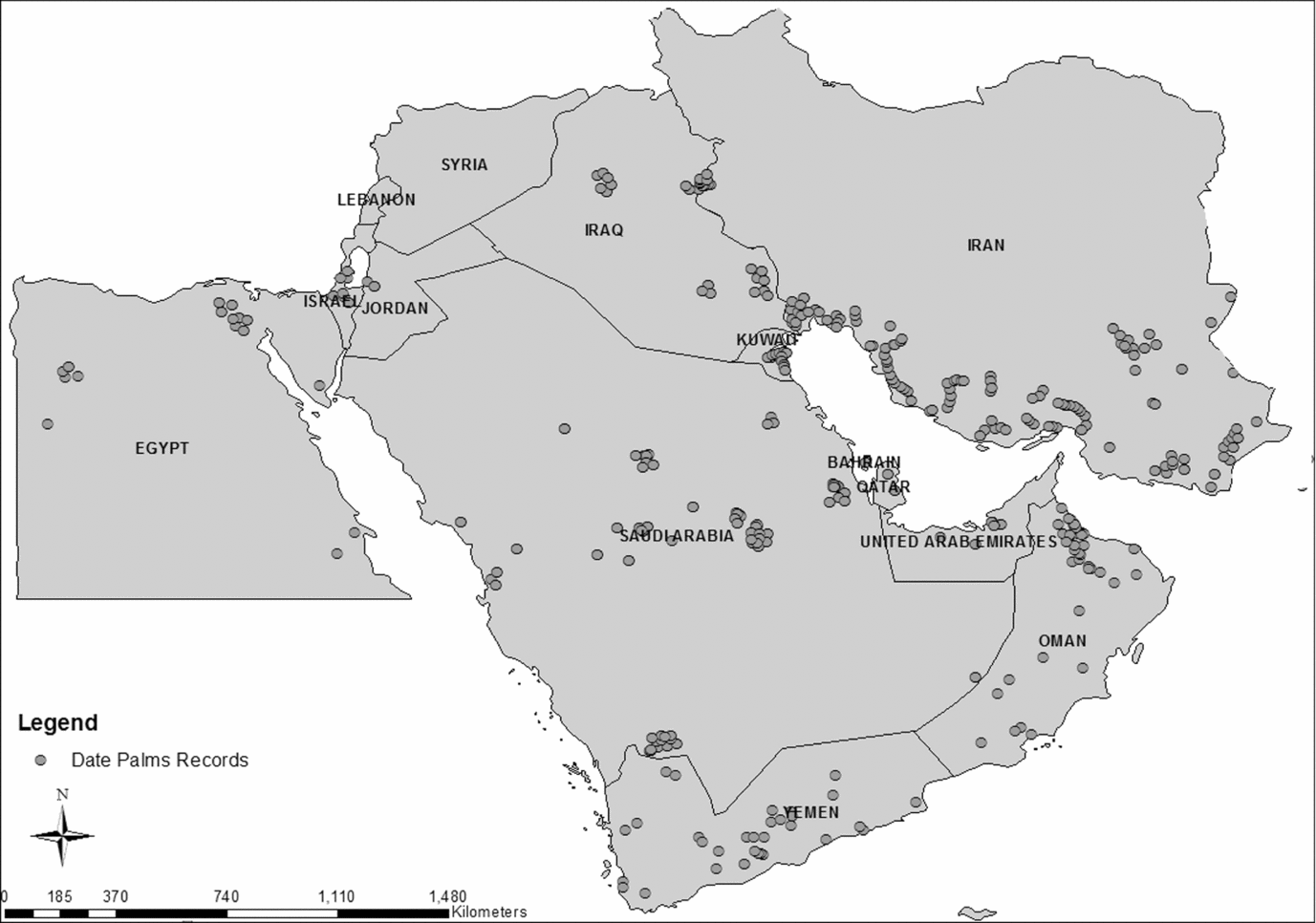
Based on the Global Biodiversity Information Facility (GBIF), Missouri Botanical Gardens’ database, satellite images available at USGS database and the other date palm literatures in CAB Abstracts databases (Abbas et al., Reference Abbas, Mouhi, Al-Roubaie, Hama and El-Bahadli1991; Al-Senaidy et al., Reference Al-Senaidy, Abdurrahman and Mohammad2011; Auda and Khalaf, Reference Auda and Khalaf1979; Bokhary, Reference Bokhary2010; Elhoumaizi et al., Reference Elhoumaizi, Saaidi, Oihabi and Cilas2001; Eshraghi et al., Reference Eshraghi, Zarghami and Mirabdulbaghi2005; Hasan et al., Reference Hasan, Baksh, Ahmad, Maqbool and Ahmed2006; Heakal and Al-Awajy, Reference Heakal and Al-Awajy1989; Jain et al., Reference Jain, Al-Khayri, Dennis and Jameel2011; Mahmoudi and Hosseininia, Reference Mahmoudi and Hosseininia2008; Markhand, Reference Markhand2010; Marqués et al., Reference Marqués, Duran-Vila and Daròs2011; Shabani and Kumar, Reference Shabani and Kumar2013; 2014; Shabani et al., Reference Shabani, Kumar and Taylor2013c; Shabani et al., Reference Shabani, Kumar and Taylor2014; Shayesteh and Marouf, Reference Shayesteh and Marouf2010; Tengberg, Reference Tengberg2011), the distribution of date palms in the Middle East countries was gathered (Figure 1). Missouri Botanical Gardens’ database had 22 records for P. dactylifera which all were used in this study. The GBIF database for the aforementioned region had 219 records for P. dactylifera, but 42 records did not have geographical coordinates and were therefore removed, leaving 177 records. Some of these records were duplicates and were also deleted. In the end, 112 records from the GBIF database, 22 records from Missouri Botanical Gardens’ database and 29 records obtained from literature research were used to fit parameters in CLIMEX.
The current distribution records of P. dactylifera in Middle East countries obtained from the literature and other databases.

CLIMEX software and climate data
CLIMEX assumes that the climate is the chief determinant of the distribution of plants and poikilothermal animals (Kriticos et al., Reference Kriticos, Potter, Alexander, Gibb and Suckling2007). It allows users to geographically determine the climatic parameters that describe the species’ response to climate (Sutherst et al., Reference Sutherst, Maywald and Bourne2007b). CLIMEX endeavours to simulate the mechanisms that limit species’ geographical distributions and determine their seasonal phenology and to a lesser extent their relative abundance (Sutherst et al., Reference Sutherst, Maywald and Kriticos2007a). In CLIMEX, an annual growth index (GIA) refers to the potential for growth of a population during the favourable season. Four stress indices (cold, hot, wet and dry) and their interactions can illustrate the extent to which the population is reduced during the unfavourable season (Sutherst et al., Reference Sutherst, Maywald and Kriticos2007a). The growth and stress indices are combined to give the ecoclimatic index (EI) which shows an overall measure of favourableness of the location or year for permanent occupation by the target species. The EI is an average yearly index of climatic appropriateness based on weekly calculations of growth and stress indices. The EI value is scaled from 0 to 100, and species can establish if EI > 0 (Shabani et al., Reference Shabani, Kumar and Esmaeili2014b). In this study, CLIMEX was used to develop a model of the potential distribution of P. dactylifera under current and various future climate scenarios (Shabani et al., Reference Shabani, Kumar and Taylor2012).
The CliMond 10′ gridded climate records were used for modelling (Kriticos et al., Reference Kriticos, Webber, Leriche, Ota, Macadam, Bathols and Scott2011). The averages of different climatic parameters from 1950 to 2000 were used to monitor the historical climate. The climatic parameters were the overall maximum and minimum monthly temperature (Tmax and Tmin), overall monthly precipitation (Ptotal) and relative humidity at 09:00 h (RH09:00) and 15:00 h (RH15:00). The aforementioned parameters were also used to project possible climates in 2030, 2050, 2070 and 2100.
Global climate models and climate change scenarios
We established our choice from an initial 23 GCMs, seeking a dataset which included output based on the following three criteria. The first criterion necessitated monthly averages of daily maximum and minimum temperature, precipitation, mean sea level pressure and specific humidity (Kriticos et al., Reference Kriticos, Webber, Leriche, Ota, Macadam, Bathols and Scott2012b). Data for these variables enabled the calculation of vital input data for CLIMEX as well as the extended list of 35 Bioclim variables. Second, we sought a programme with output capable of relatively small horizontal grid spacing and third, in terms of a listing of rating GCM output factors and tools, the chosen software all perform well in relation to other GCMs, in terms of modelling basic aspects of the observed climate on a regional scale (Hennessy et al., Reference Hennessy, Colman, Pearce, Holper, Hopkins, Bouma, Whetton, Hennessy and Power2007; Kriticos et al., Reference Kriticos, Webber, Leriche, Ota, Macadam, Bathols and Scott2012b). Two different GCMs, including CSIRO-Mk3.0 (CS) and MIROC-H (MR), were used to illustrate the P. dactylifera potential distribution under current and future climate conditions. The A2 SRES (Special Report on Emissions Scenarios) scenario was used as one possible climate scenario for 2030, 2050, 2070 and 2100. The A2 scenario includes various issues such as demography, as well as the financial and technological forces driving GHG emissions. The A2 scenario assumes neither very high nor low global GHG emissions compared to other scenarios such as A1F1, A1B, B2, A1T and B1 by 2100 (Intergovernmental Panel on Climate Change IPCC, 2007; Taylor et al., Reference Taylor, Kumar, Reid and Kriticos2012) (Figure 2).
Different climatic scenarios based on the emissions of CO2, CH4, N2O and F-gases; source: IPCC Fourth Assessment Report (Ruosteenoja et al., Reference Ruosteenoja, Carter, Jylha and Tuomenvirta2003).
Model framing and parameter fitting
Primary modelling attempts were focused on building a CLIMEX model illustrating the climate suitability for P. dactylifera, based on both native and exotic distributions of date palm from different sources (Abbas et al., Reference Abbas, Mouhi, Al-Roubaie, Hama and El-Bahadli1991; Al-Senaidy et al., Reference Al-Senaidy, Abdurrahman and Mohammad2011; Auda and Khalaf, Reference Auda and Khalaf1979; Bokhary, Reference Bokhary2010; Elhoumaizi et al., Reference Elhoumaizi, Saaidi, Oihabi and Cilas2001; Eshraghi et al., Reference Eshraghi, Zarghami and Mirabdulbaghi2005; Hasan et al., Reference Hasan, Baksh, Ahmad, Maqbool and Ahmed2006; Heakal and Al-Awajy, Reference Heakal and Al-Awajy1989; Jain et al., Reference Jain, Al-Khayri, Dennis and Jameel2011; Mahmoudi and Hosseininia, Reference Mahmoudi and Hosseininia2008; Markhand, Reference Markhand2010; Marqués et al., Reference Marqués, Duran-Vila and Daròs2011; Shabani et al., Reference Shabani, Kumar and Taylor2012; Shayesteh and Marouf, Reference Shayesteh and Marouf2010; Tengberg, Reference Tengberg2011). In this study, stress parameters were fitted using the native distribution of date palm at a global scale. Stress parameters were adjusted depending on satisfactory agreement reached between the potential and known distribution of P. dactylifera in the Middle Eastern countries. Subsequently, the fitted parameters and their results were double checked to ensure that they were biologically reasonable. Spain and Sudan were set aside for model validation because of the availability of g ood data in Spain and the similarity in climate between Sudan and the Middle Eastern countries.
Wet stress
Rain and high humidity can negatively affect date production. For example, rain produces long and deep cracks in the date. Also, it can stimulate development of fungi that attack the fruit and cause spoilage (Abdul-Baki et al., Reference Abdul-Baki, Aslan, Linderman, Cobb and Davis2007). Date palms get wet stress easily (Elshibli et al., Reference Elshibli, Elshibli and Korpelainen2009). Wet stress resulting from 78.74 mm of rainfall during one week in southern Egypt caused the loss of more than half of the date palm crop (Abdul-Baki et al., Reference Abdul-Baki, Aslan, Linderman, Cobb and Davis2007; Elshibli et al., Reference Elshibli, Elshibli and Korpelainen2009; Shabani et al., Reference Shabani, Kumar and Taylor2012). The wet stress threshold (SMWS) was set to 0.9 and the accumulation rate (HWS) was set at 0.022 week−1 to allow the species to grow well in arid and semi-arid regions such as Iran and Saudi Arabia.
Dry stress
Date palms grow best and produce the highest quality fruit in regions with a prolonged hot dry summer and without rain or humid weather during the fruit ripening in late summer and early fall (Abdul-Baki et al., Reference Abdul-Baki, Aslan, Linderman, Cobb and Davis2007). This desert species has evolved some strategies to protect itself in the face of stressors (Chao and Krueger, Reference Chao and Krueger2007; Jain et al., Reference Jain, Al-Khayri, Dennis and Jameel2011). Physiologically, this species is able to keep a high level of hydration as a result of its high level of water absorption (Elshibli et al., Reference Elshibli, Elshibli and Korpelainen2009). A widespread root system is another strategy for preventing dry stress for this species which brings the palm in contact with ground water and makes it less susceptible to short-term water stress. (Jain et al., Reference Jain, Al-Khayri, Dennis and Jameel2011; Shabani et al., Reference Shabani, Kumar and Taylor2012). Besides, it is cited that very little rainfall or water delivered by modern methods of irrigation during the period from pollination to harvest can provide favourable condition for date palm cultivation since it is adapted to the arid desert conditions (Abdul-Baki et al., Reference Abdul-Baki, Aslan, Linderman, Cobb and Davis2007). Thus, dry stress was not used in this study for the above reasons.
Cold stress
Cold stress in the CLIMEX program can be defined by two parameters: the cold stress temperature threshold (TTCS) which defines a temperature below which cold stress begins to accumulate, and the rate at which this stress accumulates is determined by the cold stress temperature rate per a week (THCS). Although the minimum winter temperature tolerated by P. dactylifera has been generally recorded as 10°C, it is reported that date palms have been found in locations where temperature can be as low as 4 °C (15° N and 35° N) from Morocco in the west to India in the east (Chao and Krueger, Reference Chao and Krueger2007). Therefore, intolerance to frost was incorporated by setting the accumulation stress when the average monthly minimum temperature fell below 4 °C, with the frost stress accumulation rate (THCS) set at −0.01 week−1. This cold-stress mechanism allowed the species to survive in Pakistan (31° 9′ N and 72° 42′ E) (Global Biodiversity Information Facility, 2012)
Heat stress
In CLIMEX software, the heat stress parameter and the heat stress accumulation rate are defined by TTHS and THHS, respectively. The TTHS parameter in this study was set at 46 °C because it is documented that in eastern Pakistan and southern Iran, P. dactylifera is capable of persisting in conditions up to this temperature. Additionally, the heat stress accumulation rate (THHS) was set at 0.9 week−1, which allowed P. dactylifera to persist along southern Iran (Eshraghi et al., Reference Eshraghi, Zarghami and Mirabdulbaghi2005). The annual heat sum for population restriction (PDD) was set at 4200°C which constrained the projected range of P. dactylifera to southern Iran, Saudi Arabia, Oman and Iraq.
Growth index
The growth index in CLIMEX is categorized into temperature and moisture indices. The temperature index includes the limiting low temperature (DV0), the lower (DV1) and upper (DV2) optimal temperatures, and the limiting high temperature (DV3). P. dactylifera has been found in areas with a mean annual surface temperature greater than 16 °C (Elshibli et al., Reference Elshibli, Elshibli and Korpelainen2009; Hasan et al., Reference Hasan, Baksh, Ahmad, Maqbool and Ahmed2006; Shabani et al., Reference Shabani, Kumar and Taylor2012; Tengberg, Reference Tengberg2011). Comparing western Pakistan's climatic parameters to the other places suitable for date palm growth indicates similar climatic conditions in both places, with the exception of the annual surface temperature, which for western Pakistan is 13 °C. Therefore, the limiting low temperature (DV0) should be between 13 °C and 16 °C. Thus, 14 °C was determined to provide the best fit to the observed distribution of date palms in Saudi Arabia, Iran and the other regions. The summer temperatures in the areas, which are climatically ideal for this species, rarely exceed 46 °C, so the limiting high temperature (DV3) was set at 46 °C (Burt, Reference Burt2005). The lower optimal temperature (DV1) was set at 20 °C because it has been documented as a favourable temperature for date palms. The upper optimal temperature (DV2) was set at 39 °C because temperatures up to 39 °C are preferable temperatures for date palms, depending on the varieties (Jain, Reference Jain2011). In other words, the best values have been set as parameters DV1, DV2 and DV3 so that EI exhibited the highest values within native areas that had the highest density of records.
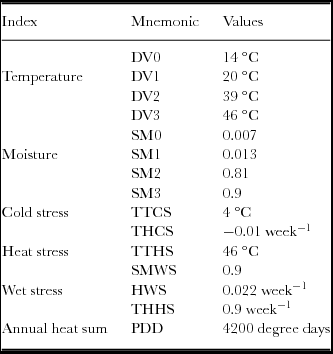
The moisture index in CLIMEX consists of a lower moisture threshold (SM0), the lower (SM1) and upper (SM2) optimum moisture thresholds and the upper soil moisture threshold (SM3). In this study, SM0 was set at 0.007 to denote the permanent wilting point (Kriticos et al., Reference Kriticos, Potter, Alexander, Gibb and Suckling2007). This value provided the appropriate fit to the observed distribution of date palms in Egypt, Saudi Arabia, Iran and Pakistan. The lower (SM1) and upper (SM2) optimum moisture thresholds were set at 0.013 and 0.81, respectively, to include species growth in Egypt, Saudi Arabia and Iran. The upper soil moisture threshold (SM3) was set at 0.9 because this species and its fruit can be negatively affected by high soil moisture (Elshibli et al., Reference Elshibli, Elshibli and Korpelainen2009). Also, the selected values for parameters SM0, SM1, SM2 and SM3 allowed the highest EI values within native areas that had the highest density of records. All CLIMEX parameters are summarized in table 1.
The CLIMEX parameter values that were used for P. dactylifera modelling.

RESULTS
Model validation and projections under current climate
The distribution of P. dactylifera taken from different databases and an appropriate match between the EI from the CLIMEX model for the Middle East countries is illustrated in Figure 3. The modelled results show that southern Iran, Yemen, Oman, Saudi Arabia, western Jordan, northern Egypt, Israel, eastern Syria and Kuwait have suitable climatic condition for P. dactylifera. While large parts of Iraq and southern Saudi Arabia are modelled to have suitable climatic conditions for P. dactylifera in its current known distribution, inadequate distribution data were available from these regions. This could be due to a shortage of reporting from these areas as a result of lack of human distribution, or biotic factors such as competition or lack of dispersal opportunities could prevent this species from occurring in these areas (Brooker et al., Reference Brooker, Travis, Clark and Dytham2007; Crossman et al., Reference Crossman, Bryan and Cooke2011; Management, Reference Management2010; Svenning and Skov, Reference Svenning and Skov2007).
The ecoclimatic index for P. dactylifera. resulting from CLIMEX and the current distribution records of this species in the Middle East countries.
The current distribution of P. dactylifera in Spain and Sudan was used for model validation as illustrated in Figure 4. These regions were not used for model fitting. In validation regions, the model projects much of south-eastern Spain to be climatically suitable. Additionally, large parts of Sudan had suitable climatic conditions for P. dactylifera (Figure 4). Nearly 94% of the occurrence records fall within the suitable categories, confirming that the values selected for the various parameters in CLIMEX were optimum.
The current and potential distribution of P. dactylifera in validation regions (Sudan and Spain) based on the EI index. The green dots show the distribution of date palm, and the red area is climatically suitable regions for date palm growth.
Projected distribution under climate change scenarios
The results of the two GCMs containing CS and MR with the A2 emission scenarios for the potential distribution of P. dactylifera for 2030, 2050, 2070 and 2100 are shown in Figures 5 and 6, respectively.
The climate (EI) for P. dactylifera at present and projected using CLIMEX under the CSIRO-Mk3.0 GCM running the SRES A2 scenario and for 2030, 2050, 2070 and 2100 for the Middle East.
The climate (EI) for P. dactylifera at present and projected using CLIMEX under the MIROC-H GCM running the SRES A2 scenario and for 2030, 2050, 2070 and 2100 for the Middle East.
Results from the CS model
From the CS GCM, it can be seen that much of Jordan, Lebanon, Syria and Israel are projected to become climatically suitable for date palm growth between 2030 and 2100 (Figure 5). Additionally, this model projects that more areas in central Iran will become suitable for P. dactyliferas’ growth between 2030 and 2070.
On the other hand, the CS GCM projected that by 2030, western Iran would be less climatically suitable than it currently is for this species, as would Iraq, Saudi Arabia and Bahrain between 2050 and 2100. Furthermore, the same trend can be observed in north-eastern Syria between 2070 and 2100. Moreover, the CS GCM showed that some climatically suitable areas in central Iran become unsuitable for P. dactyliferas’ growth between 2070 and 2100. Thus, a considerable reduction in suitability of climate for date palm growth was projected from 2050 to 2100 in some Middle East countries (Figure 5).The CS GCM predicts that almost all of northern Egypt, Yemen, southern Iran and western Saudi Arabia will remain suitable for P. dactylifera in the future (Figure 5).
Results from the MR model
In the countries of the Middle East, using MR GCM (Figure 6), the model projects much of Jordan, Lebanon, Syria, Israel and large areas in central Iran to be more climatically appropriate for P. dactylifera between 2050 and 2100. Additionally, records indicate that in north Egypt, the range of P. dactylifera appears to expand further inland between now and 2100 (Figure 6).
Under the MR GCM, by 2030, western Iran becomes climatically unsuitable for date palm growth and this area is projected to become progressively less suitable up to 2100. Most drastically, in areas from northern Iraq to the central regions in Saudi Arabia, the climate will be highly unsuitable for date palm growth by 2070. The MR GCM results indicate that the reduction in suitable habitat continues in all regions in Iraq, excluding the western side, and in Saudi Arabia, excluding western and southern areas. The same loss was found in eastern Syria (Figure 6). From the MR GCM, it can be seen that Yemen, southern Iran and northern Oman will remain climatically suitable for P. dactylifera until 2100.
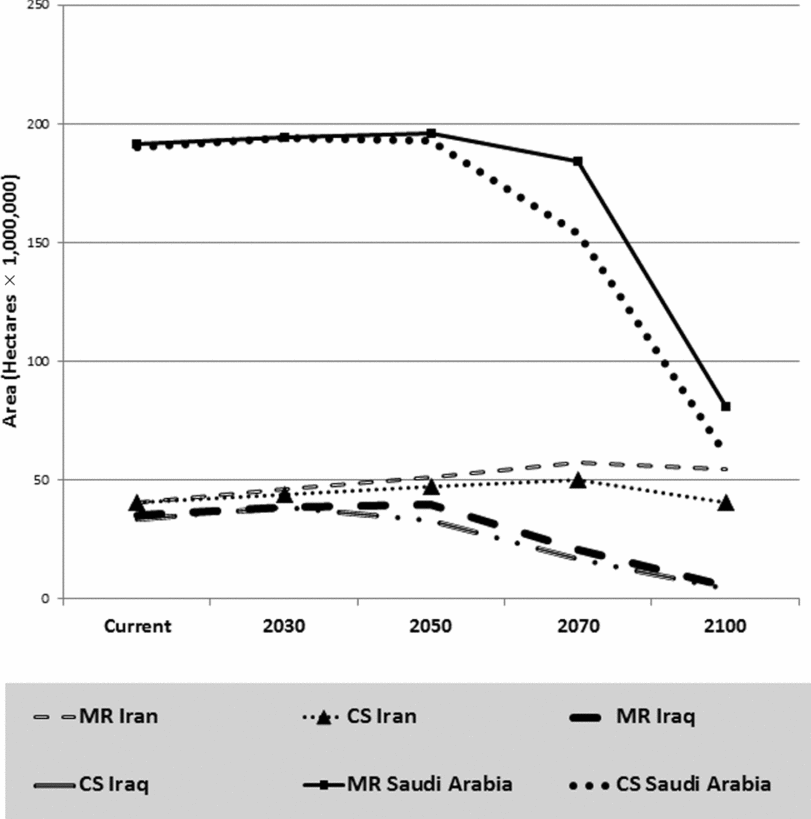
Figure 7 indicates the trend of some selected countries for P. dactyliferas’ growth for the present, 2030, 2050, 2070 and 2100. In selecting the countries in Figure 7, care was taken to illustrate the significant changes in the projected areas compared to the current time.
Areas projected as climatically suitable for P. dactyliferas’ growth (in hectares) by the CS and MR GCMs.
The results of the MR GCM indicate that 191 million ha in Saudi Arabia is currently suitable for date palm cultivation; however, this value shrinks to 80 million ha by 2100 (Figure 7). The same trend is also observed using CS GCM, which gives a reduction of suitable areas from 190 to 61 million ha by 2100 (Figure 7). Additionally, Iraq is projected to become less climatically suitable for date palm growth and to lose most of the 34 million ha presently available by 2100, when only 5 million ha are suitable, based on MR GCM. A similar trend was observed in the CS model, which projected a loss from 33 million ha at present to 16 million ha by 2070 and only 4 million ha by 2100 (Figure 7). In Iran, the MR GCM projects that suitable areas for date palm growth will increase from 41 million ha at the present time to 54 million ha by 2100. The CS GCM indicates a stable condition in the suitability of date palm cultivation areas in Iran from the present to 2100 (Figure 7).
There are some differences in the projection of date palm distribution between the CSIRO-Mk3.0 and MIROC-H GCMs. These differing results are due to the different predictions of future climate by the two GCMs. However, in general, the CS and MR GCMs project similar trends for the study area.
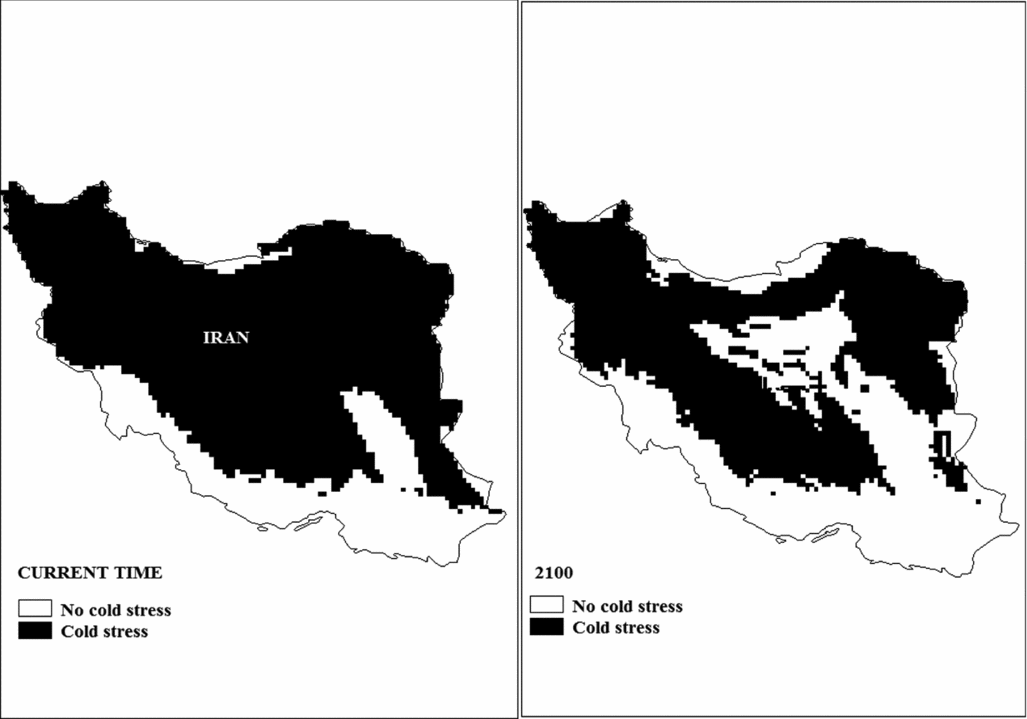
Based on the two models, cold (Figure 8) and heat stress (Figure 9) are the two major factors restraining date palm distribution in these regions. The same result is also reported by Challinor (Challinor et al., Reference Challinor, Simelton, Fraser, Hemming and Collins2010). The results of this study indicate that the heat stress imposes a significant negative effect on date palm distribution in all Middle Eastern countries by 2100 (Figure 9). Conversely, the cold stress problem is limited to Iran and absent from the rest of the Middle Eastern countries by 2100.
Comparison of the location of cold stress in Iran for date palm growth from the present to 2100. Iran was selected on the basis of large changes in cold stress in the future.
Comparison of the location of heat stress in Middle East countries for date palm growth between the present and 2100.
DISCUSSION
The favourable climatic areas for P. dactylifera under present climate and future climate scenarios using CLIMEX were modelled in this study. The differences in the results from the two GCMs exemplify differences in future greenhouse emission patterns (Figures 5–7) (Jain et al., Reference Jain, Al-Khayri, Dennis and Jameel2011). For example, the MR model predicts that temperature will increase approximately 4.31 °C, while the CS model predicts a rise of only 2.11°C by 2100. From the rainfall perspective, some differences can be found between the MR and CS models. For example, the CS model predicts a 14% decrease in future mean annual rainfall, whereas the MR model predicts a 1% reduction (Chiew et al., Reference Chiew, Kirono, Kent and Vaze2009; Suppiah and Hennessy, Reference Suppiah and Hennessy2007). The CLIMEX modelling results do not take into account non-climatic parameters such as land-use, soil type, soil drainage and soil-nutrients (Elshibli et al., Reference Elshibli, Elshibli and Korpelainen2009). In this paper, the projected suitable areas are only based on the climatic factors and do not incorporate other factors such as biotic interactions, land use and soil type. We emphasize that these areas are based on climate suitability only. The actual decrease in area under date cultivation may be much smaller when abiotic and other environmental variables are taken into account.
Both MR and CS GCMs project that large parts of Saudi Arabia become climatically unsuitable for date palm cultivation towards 2100 (Figures 5 and 6). The MR and CS GCMs indicate a decline in the area that is suitable for date palm growth in Saudi Arabia and Iraq. This decline is a consequence of increased heat stress in these regions (Figures 7 and 9).
There was some agreement in the projections of suitable areas for date palm growth between CS and MR GCMs for some Middle Eastern countries. For example, both models projected that Yemen and northern Egypt will remain climatically suitable for P. dactylifera growth up to 2100 because neither cold stress nor heat stress occurs in these countries (Figures 5, 6 and 9). Furthermore, both models projected that western Syria will be suitable climatically, by 2100, through decreasing cold and heat stresses (Figures 5 and 6). However, there were some disagreements between the CS and MR GCMs (Figures 5–7). The MR GCM projected that most regions in Saudi Arabia will remain climatically suitable until 2070 but, based on CS GCM, this suitability will be limited to the southern regions due to an increase in the heat stress in these regions and eastern Saudi Arabia (Figures 5–7 and 9).
The results of the climate change modelling provide an indication of the probable changes in the potential distribution of P. dactylifera in the future. As the climate changes, some areas where P. dactylifera currently occurs may become climatically unsuitable and, as a consequence, the economies in those areas will be affected.
This study indicates that large areas of Saudi Arabia and Iraq will become climatically unsuitable due to the westward shift of the heat stress in these countries. This means that there will be less area available that is not affected by heat stress (Figures 7 and 9), and the regions will be less conducive for date palm cultivation. These countries will not be able to cultivate this profitable crop to the same extent in the future as they have done previously. The results of this paper can provide some advance warning to countries that rely on income from date production. While date export may form a very small percentage of total exports for some countries, (such as Saudi Arabia where date export is less than 1% of total exports) the internal consumption is quite large. If date production falls by a large percentage in the future then some of these countries may become net importers of date rather than net exporters. Furthermore, strategic planning for climate change scenarios may prevent some negative economic impacts. This awareness is particularly important for some of the Middle Eastern countries. Implications for date palm production in the future in these regions are adapting the cultivation of date palm in areas which become less suitable by irrigation or planting special varieties more tolerant to heat.
The results of this study indicate that some areas that are climatically unsuitable at the present time will become climatically suitable for date palm cultivation in the future. For example, the cold stress in Iran will lessen by 2100, meaning that more regions will become climatically suitable through reduced negative effects of cold stress (Figures 7 and 8). These outcomes may be useful in making informed choices in advance about the location of date palm farms and associated industries in these regions. Israel, Lebanon, Jordan and western Syria will get the opportunity to cultivate date palm and export their produce in the future. Under future climatic conditions, P. dactylifera will be able to be cultivated in areas that are currently too cold for it, for example, the climatic suitability will improve in Iran. Iran should be prepared to make use of these opportunities because, climate-wise, these areas will become highly suitable for this plant. It should also be noted that, over a larger period, plant species could adapt to changing climate. New species have evolved over millions of years to survive in new environment. Date palms could also go through this evolutionary phase. It is also possible that agricultural researchers engineer new genotypes to cope with changing climate. Our modelling probably emphasizes the worst case scenarios. Any new genotypes and self-adaptation will certainly reduce the impacts reported in this paper.
CONCLUSION
This research has shown broad-scale shifts in the area conducive to date palm cultivation, and has depicted how different regions of the world will be affected by climate change. Such modelling is useful for planning strategies that minimize economic impacts in areas that will be adversely impacted and for gearing up to take advantage of the new opportunities in regions that will be positively impacted.
This study has identified a number of countries that could be negatively impacted through increased heat stress caused by climate change. In addition, it has identified other countries that could see increased areas becoming available for date palm cultivation because of reduced cold stress. Such modelling provides an opportunity for affected countries to examine the possible impacts of climate change on their agricultural production and to take appropriate steps, either to minimize impacts or to benefit from new opportunities that may arise in the future.
For future studies, there is a need to take into account additional non-climatic factors to the CLIMEX modelling output. Additionally, the limitations of this study were that other factors such as land use, soil type, biotic interactions, diseases, and competition were not considered. In other words, diseases of the date palm may also alter with climate change due to changes in the distribution patterns of pathogens. Therefore, future distribution of disease as a consequence of climate change could be a suitable tool to refine the CLIMEX outputs. This modelling was completed based only on climate. Results of this study are based on broad-scale climate data that are currently available and therefore only show the broad-scale shifts.