Research on the acquisition of sociolinguistic variation has demonstrated that, as children acquire language, they also acquire the linguistic, stylistic, and social constraints to which they are exposed (Foulkes, Docherty, & Watt, Reference Foulkes, Docherty and Watt1999; Romaine, Reference Romaine1984; Smith, Durham, & Fortune, Reference Smith, Durham and Fortune2009). In the relatively homogeneous, stable settings that have conventionally been studied in the variationist paradigm, children are consistently found to target and acquire the sociolinguistic norms of their community (e.g., Smith et al., Reference Smith, Durham and Fortune2009). In dialectally diverse environments with high levels of mobility, however, both newcomer and local children face a more challenging and ambiguous task. These difficulties are compounded in the case of settings such as the Southeast Asian city-state of Singapore, in which the local language variety is not only stigmatized, but is also ideologically positioned as less legitimate than the varieties used by many newcomers (Park & Wee, Reference Park and Wee2009). Under these circumstances, children's sociolinguistic acquisition is intertwined with their negotiation of personal identity, their uptake of language ideologies, and their evolving understanding of the social meanings indexed by the linguistic features and varieties that they encounter.
The present study investigates variation in the speech of children living in Singapore and, specifically, their patterns of -t/d deletion, a socially salient feature of Singapore English (henceforth SgE) and a well-studied variable in English sociolinguistics more generally. This analysis contrasts the behavior of local and expatriate children, assessing the relative impacts of national background, school type, level of dialect exposure, and attitudes towards the status of SgE. Although local and expatriate children share a single geographic community, and, in some cases, attend the same schools, their rates and patterns of -t/d deletion are found to orient to distinct norms.
ACQUISITION OF VARIATION AND ‘THIRD CULTURE KIDS’
In situations of dialect contact, outcomes have been found to vary based upon factors including age of acquisition, degree of contact, feature complexity, language attitudes, and variety status (Chambers, Reference Chambers2002; Nycz, Reference Nycz2015; Payne, Reference Payne1976; Tagliamonte & Molfenter, Reference Tagliamonte and Molfenter2007). Rather than newcomers uniformly adopting established local norms, speakers may exhibit leveling in the opposite direction; in a study of Raleigh, North Carolina, Dodsworth and Kohn (Reference Dodsworth and Kohn2012) found that the first generation of locals to grow up amid contact has rapidly shifted away from the stigmatized Southern Vowel Shift. Similarly, social and attitudinal factors are found to play a role in the acquisition of regional and nonstandard features in a second language (Regan, Howard, Lemée, Reference Regan, Howard and Lemée2009; Starr, Reference Starr2016b; van Compernolle & Williams, Reference van Compernolle and Williams2012; Wolfram, Carter, & Moriello, Reference Wolfram, Carter and Moriello2004).
The situation of so-called ‘expatriate’ children, generally referring to the children of high-skilled workers who migrate to another country, often for a fixed period, has historically been distinguished from that of conventional first-generation immigrants, both in popular discourse and in disciplines such as sociology (Useem & Useem, Reference Useem and Useem1967). Expatriate children have traditionally been characterized as isolated from the local community and have been observed to develop a distinctive, hybrid culture among themselves as a result of high mobility and contact with expatriates from a range of nationalities. Referring to this distinctive culture, which differs from both that of the local community and the parents’ home countries, Useem and Useem (Reference Useem and Useem1967) dubbed expatriate children ‘third-culture kids.’ The limited sociolinguistic research that has been done on third-culture kids supports this notion of a hybrid expatriate culture. In the case of expatriate children in Hong Kong, Vowell (Reference Vowell2018) found no evidence of Hong Kong English features among eight children with New Zealand parents but did observe American English (AmE) and British English (BrE) influence in their vowel systems, reflecting their interactions with expatriate peers.
Although both Hong Kong and Singapore are urban, highly developed former British colonies in Asia, the circumstances of expatriate children in the two regions differ in several respects. First, the proportion of expatriates in Singapore is far larger, with foreign nationals comprising 38.2% of the population relative to 7.7% in Hong Kong (Population By-Census, 2016; Population SG, 2018). This high proportion is the result of three decades of government policy in which foreign workers have been recruited to spur economic development (Yang, Yang, & Zhan, Reference Yang, Yang and Zhan2017). The perception of expatriates in Singapore relative to Hong Kong is also shaped by multiculturalism. Singaporean citizens are a more ethnically heterogeneous group, and one in which ethnolinguistic diversity serves as a core element of local identity (Goh, Reference Goh2007). As a result, attitudes towards new citizens of various ethnicities are relatively accepting; 78.5% of Singaporeans agree that new citizens of Caucasian ancestry are ‘truly Singaporean’ (Mathew, Lim, Shanthini, & Cheung, Reference Mathew, Lim, Shanthini and Cheung2017:19). The extent of English dialect contact is also greater in Singapore, as English is more prevalent in everyday interactions, and the degree of social interaction between locals and expatriates is higher. Although expatriate children historically attended only private ‘international’ schools, this situation has changed over the past decade, with many expatriate children now enrolled in government schools (known as ‘local schools’) (Tulshyan, Reference Tulshyan2015). More generally, the social lives of these two groups have increasingly converged; 45% of young Singaporeans ages 15 to 34 now report having a close friend of a different nationality (National Youth Survey, 2016). As a result of this level of contact, both Singaporean and expatriate children develop an early ability to explicitly identify the regional origins and prestige levels of a range of English varieties present in Singapore (Starr, Theng, Wong, Tong, Bte Ibrahim, Chua, Yong, Loke, Dominic, Fernandez, & Peh, Reference Starr, Theng, Wong, Tong, Ibrahim, Nurul A., Alicia M.Y., Clarice H.M., Frances W., Helen, Keith and Peh2017). However, Starr et al. (Reference Starr, Theng, Wong, Tong, Ibrahim, Nurul A., Alicia M.Y., Clarice H.M., Frances W., Helen, Keith and Peh2017:529) also observed that children attending local schools evaluated varieties in a manner more consistent with the local market relative to their peers in international schools. The present analysis, which involves a subset of these participants, assesses whether these differences in social evaluation task performance translate into significant differences in language use patterns.
VARIATION AND CHANGE IN SINGAPORE ENGLISH
The sociohistorical status and ideological positioning of SgE make Singapore a particularly interesting site for the investigation of dialect contact. First introduced in 1819 upon the establishment of the British port, English has evolved in Singapore from the language of a small elite to the language of school, the workplace, and, as of 2015, the most commonly spoken language in the home (Singapore Department of Statistics, 2015). Early work on SgE primarily adopted a lectal continuum approach (e.g., Platt & Weber, Reference Platt and Weber1980), distinguishing between the acrolectal form, Standard Singapore English, and the basilectal form, Colloquial Singapore English, popularly known as ‘Singlish’ and generally described as a contact language with substrates of Malay, Malay-based creoles, and Southern Chinese varieties (Lim, Reference Lim2004). Various alternative models of SgE have subsequently been proposed, including the expanding triangles model (Pakir, Reference Pakir1991) and cultural orientation model (Alsagoff, Reference Alsagoff2010). In light of increasingly hybrid practices in SgE, Leimgruber (Reference Leimgruber2012) and Starr (Reference Starr, Hall-Lew, Moore and Podesvaforthcoming) both put forward a case for adopting a variationist approach that shifts the focus from coherent codes, such as Standard Singapore English, to the indexical meanings of individual variables. As this study investigates the patterning of a single variable across a range of speakers, some of whom hold ambiguous identities and orientations towards SgE, I adopt this feature-based, variationist approach, rather than characterizing the realization or deletion of -t/d as a matter of code-switching between sociolects.
Kachru's (Reference Kachru, Bolton and Kachru2006) Three Circles of English model traditionally positions Singapore in the Outer Circle, referring to postcolonial societies in which English is used institutionally but is not widely learned as a first language, in contrast to the Inner Circle, in which English is spoken natively (e.g., the UK) and the Expanding Circle, in which it is learned as a foreign language (e.g., China). Although the role of English in Singapore has expanded to that of a first language, Park and Wee (Reference Park and Wee2009:401) argued that, from an ideological standpoint, Singapore retains its Outer Circle status in the sense that SgE is still widely perceived as a nonnative, illegitimate form of English. The ideological framing of SgE as a nonnative variety, and variability in the extent to which this stance is acquired by children, presents a possible account for observed differences among participants in the current study.
Recent work on variation and change in SgE identifies two shifts underway in the community: rising endonormativity, and Americanization. Schneider's (Reference Schneider2007) dynamic model of postcolonial Englishes locates SgE in the phase of endonormative stabilization, meaning that the community is in the process of reorienting from external norms (i.e., Received Pronunciation [RP]) towards local norms for English. For example, while older educated Singaporeans use an RP-like raised caught/court vowel in careful speech, younger educated Singaporeans no longer do so, but instead merge these vowels with cot (Starr, Reference Starr, Hall-Lew, Moore and Podesvaforthcoming). On a broader level, scholars have observed that SgE is becoming increasingly salient and commodified as a marker of local identity (Lim, Reference Lim2015).
The second major shift in SgE, Americanization, has been observed at both the lexical and phonological levels. While Starr (Reference Starr2019) found no evidence of a full-scale shift to AmE norms in the bath-trap distinction in Singapore, a significant effect of US media consumption was observed; a similar media-based account has been proposed for the apparent increase in postvocalic rhoticity in SgE (Tan, Reference Tan2012). Aside from media consumption, Singaporeans also receive significant exposure to nonlocal Englishes through interpersonal interaction, due to the rising number of foreign workers and increasing frequency of international travel (see Starr, Reference Starr2019). Starr (Reference Starr2019) argued that the Outer Circle status of SgE contributes to Singaporeans’ willingness to adopt nonlocal features encountered via such exposure. Thus, while Americanization of English is an international phenomenon that has been observed in other settings (e.g., Awonusi, Reference Awonusi1994), Singaporeans may be more likely than others to show effects of this trend.
The parallel rise in features of both AmE and SgE illustrates the multifaceted nature of language use in Singapore and demonstrates the advantages of a variationist approach, in which features with a range of indexical associations may be juxtaposed in a process of bricolage to construct social meanings (Eckert, Reference Eckert2008). Regarding the variable of interest in this study, the ongoing rise of local norms is likely to result in individual variation in -t/d deletion among children, with those who exhibit a strong orientation to local norms expected to demonstrate more typical SgE -t/d deletion patterns. At the same time, rising exposure to AmE and other nonlocal English varieties may result in the weakening of the more cross-dialectally unusual aspects of SgE -t/d deletion, as detailed in the following section.
-T/D DELETION
The deletion of -t/d in English word-final consonant clusters (e.g., the realization of past as /pæs/) is one of the most well-studied phenomena within the variationist sociolinguistics tradition (Guy, Reference Guy, Fasold and Shuy1977, Reference Guy and Labov1980, et seq.; Labov, Reference Labov1972, Reference Labov1989, et seq.; Patrick, Reference Patrick1991; Roberts, Reference Roberts1997; Smith et al., Reference Smith, Durham and Fortune2009; Tagliamonte & Temple, Reference Tagliamonte and Temple2005; inter alia). In SgE, -t/d deletion has been found to occur at a notably high overall rate relative to Inner Circle Englishes. Gut (Reference Gut2007) observed a deletion rate of 85% among 10 university-educated SgE speakers in formal interviews. Lim & Guy (Reference Lim and Guy2005), a study of four Singaporeans enrolled in an elite American university, found a similarly high rate of approximately 73% in casual speech. The SgE deletion rate is thus more comparable to those found in other contact varieties, such as the 75% rate in Jamaican Creole (Patrick, Reference Patrick1991:175), in contrast to Inner Circle rates of deletion, such as 24% for BrE (Tagliamonte & Temple, Reference Tagliamonte and Temple2005:287), 29% for Scottish English (Smith et al., Reference Smith, Durham and Fortune2009:77), and 33% for North American English (Guy, Reference Guy1991:5).
While certain factors have consistently—although not universally—emerged as pan-dialectal constraints on -t/d deletion, others have been argued to operate as community-specific norms. Researchers have pointed to a number of underlying factors (e.g., the sonority hierarchy) to account for the common patterns observed across dialects (see Tagliamonte & Temple, Reference Tagliamonte and Temple2005:282–5). Table 1 lists the factors commonly identified as significant constraints on -t/d deletion in descending order of approximate strength and specifies the nature of the patterns found for each factor in SgE (Gut, Reference Gut, Deterding, Brown and Low2005, Reference Gut2007), AmE (adapted from summary given in Smith et al., Reference Smith, Durham and Fortune2009:72–73), and BrE (Tagliamonte & Temple, Reference Tagliamonte and Temple2005).
Ordering of major internal and external constraints on -t/d deletion identified in Singapore, American, and British English

Of the linguistic factors, the identity of the following segment has proven to be the largest and most robust, with obstruents most favorable and vowels least favorable to -t/d deletion. Although most studies have found prepausal environments to disfavor deletion, Guy (Reference Guy and Labov1980:8) proposed that this environment is available for cross-dialectal variation, as it is not subject to the same hierarchy of phonological constraints as segmental environments. In the case of SgE, while Gut (Reference Gut2007) observed a consonant > vowel > pause ranking, Lim & Guy (Reference Lim and Guy2005:163) argued that the prepausal environment in SgE is more favorable to deletion than is typical in AmE.
Regarding morphological structure, prior work generally characterizes the ranking of monomorphemes (e.g., fast) > semiweak past tense forms (e.g., kept) > regular past tense forms (e.g., passed) as a robust pattern that arises due to inherent structural factors, including the functional load of the -t/d segment and the process of lexical derivation (Guy & Boyd, Reference Guy and Boyd1990). While this account is logical, many studies of -t/d deletion have failed to observe any significant morphological effects (Gut, Reference Gut2007; Patrick, Reference Patrick1991; Tagliamonte & Temple, Reference Tagliamonte and Temple2005; inter alia) or have observed different behavior for semiweak verbs (Smith et al., Reference Smith, Durham and Fortune2009). The inconsistent behavior of semiweak verbs has led to the proposal that some speakers analyze these forms as monomorphemes, while others do not (Guy, Reference Guy, Fasold and Shuy1977, Reference Guy and Labov1980). Studies have also argued for a tendency for individuals to shift over their lifespan from a monomorphemic to bimorphemic analysis of semiweak verbs (Guy & Boyd, Reference Guy and Boyd1990).
One account for the lack of morphological constraints in certain varieties, as proposed by Patrick (Reference Patrick1991) for Jamaican Creole, is that an apparent high rate of -t/d deletion for regular past tense verb forms may, in fact, result from the absence of explicit past-tense -ed marking at the morphological level. In the case of SgE, however, Gut (Reference Gut2009) argued that the underlying rate of explicit past-tense marking is too high for absence of morphological -ed to be a likely explanation for this phenomenon. She also observed that participants explicitly marked the past tense at a higher rate than Singaporeans of a similar education level in earlier studies (Ho & Platt, Reference Ho and Platt1993), indicating that a change is in progress. Other evidence for such a change comes from Lim and Guy (Reference Lim and Guy2005), who found a lower rate of -t/d deletion for regular past-tense forms among Singaporeans attending a university in the United States. Moreover, these speakers treated semiweak verbs as monomorphemes in casual speech but showed a more AmE-like grouping of semiweak with regular past tense forms in formal speech. While it is unclear whether these findings regarding Singaporeans living abroad reflect broader trends in SgE, they nonetheless suggest that SgE speakers are open to restructuring the internal constraints on -t/d deletion upon exposure to nonlocal dialects.
SgE has also been found to differ from other varieties with regard to the effect of preceding segment on -t/d deletion. A consistent ranking of sibilant > nasal > liquid is identified in prior work on varieties of AmE and BrE; the location of stop and nonsibilant fricatives within this hierarchy, as well as the behavior of /r/ versus /l/, vary across communities (Smith et al., Reference Smith, Durham and Fortune2009; Tagliamonte & Temple, Reference Tagliamonte and Temple2005). Gut (Reference Gut2007), however, found little impact of preceding segment in SgE, with liquids slightly disfavoring deletion. Given that SgE is nonrhotic and /l/ is frequently vocalized (Tan, Reference Tan, Brown, Deterding and Low2005; Tan, Reference Tan2012), this effect may result from the absence of a true consonant cluster in this environment.
Regarding social effects, -t/d deletion in Inner Circle varieties is generally characterized as a stable, low-salience variable that is moderately favored by the working class and men, and in casual speech contexts. Effects of gender, however, have sometimes been reversed in previous work (see Roberts, Reference Roberts1997). In SgE, there is reason to believe that the social salience of -t/d deletion is greater than in Inner Circle Englishes. First, the extent of overall deletion rate, at nearly 85% even among the university-educated in formal speech (Gut, Reference Gut2007), provides a dramatic contrast with the external Inner Circle norms to which SgE speakers are frequently exposed. Second, evidence can be observed in folk linguistic discourse that -t/d deletion is enregistered as a prominent, nonstandard phonological feature of Singlish; this feature was singled out for critique on the television program ‘Say the Word,’ a 2013 game show that tested Singaporeans’ adherence to standard English (Starr, Reference Starr2016a) and was similarly identified as a nonstandard feature on the website for the Speak Good English Movement, a government language campaign (Bruthiaux, Reference Bruthiaux, Lim, Pakir and Wee2010:93). Thus, while -t/d deletion does not have the prominence of certain lexical aspects of Singlish, such as sentence-final particle lah, there appears to be a general societal awareness of this feature as nonstandard and local. This salience may hold implications for the degree of stylistic variation exhibited by SgE speakers, as well as for uptake of the feature among new arrivals to the community.
Studies investigating the acquisition of -t/d deletion patterns in Inner Circle contexts conclude that children largely match the deletion rates and constraints used by adult caregivers by age four, with the notable exceptions of semiweak verbs, which children tend to treat as monomorphemes, and stylistic variation patterns (Labov, Reference Labov1989; Roberts, Reference Roberts1997; Smith et al., Reference Smith, Durham and Fortune2009). Guy and Boyd (Reference Guy and Boyd1990), in a study of the -t/d deletion patterns of Americans aged four to 65, found that the behavior of semiweak verbs exhibits a gradual shift over the lifespan, even changing well into adulthood. Because semiweak verbs are relatively rare, however, evidence regarding their behavior is less robust than the data available for monomorphemes and regular past tense forms, which children appear to acquire by an early age.
In the present analysis, the classic predictors of -t/d variation described above will be examined together with several sociolinguistic knowledge and evaluation factors, to assess the degree to which the speech of children from various backgrounds correlates with their exposure to and stance towards SgE.
METHOD
Participants
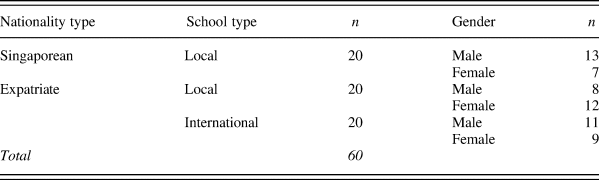
A total of 60 participants ages five to 19 were analyzed for the present study, divided into three primary groups consisting of 20 participants each: Singaporeans attending local schools (henceforth Sing-Local), expatriates attending local schools (Expat-Local), and expatriates attending international schools (Expat-Int'l) (see Table 2). As many children who are considered expatriates are born in Singapore, participants were only classified as ‘Singaporean’ if they and at least one parent were both born in Singapore. Due to government restrictions, very few Singaporean citizens are permitted to attend international schools; this study therefore excludes children with that profile.
Summary of participant backgrounds by nationality type, school type, and gender

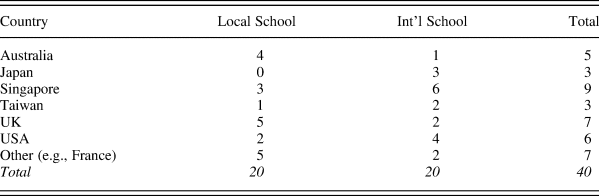
Relative to the Singaporean group, the expatriate participants have more varied and complex backgrounds; many have lived in multiple countries, have parents of different nationalities, and are citizens of countries that they have never lived in themselves. An indication of the backgrounds of the two expatriate groups is given in Table 3, which lists the birthplaces of Expat-Local and Expat-Int'l participants. It is important to bear in mind that the birthplace of these children often does not wholly capture their linguistic environment. Among the three participants born in Japan, for example, one has a Korean and an Australian parent, another has a Japanese and an Irish parent, and the third has a Japanese and an Argentinian parent; all three children were reported to be spoken to in English by at least one parent in the home.
Expatriate participant birthplaces by school type

The average ages of the Sing-Local, Expat-Local, and Expat-Int'l groups is 12, 10.95, and 9.15, respectively. Although the younger skew of the expatriate groups is not ideal, given the findings of Smith et al. (Reference Smith, Durham and Fortune2009) and Roberts (Reference Roberts1997) regarding children ages two through four, it is expected that children by age five have largely acquired adult-like constraints on -t/d deletion; potential areas of lag among the very youngest children in the sample are stylistic variation and the rate of deletion for semiweak verbs. The impact of age on these and other factors is considered in the forthcoming analysis.
All participants were reported by parents to be native or fluent speakers of English, with 75% and 80% of Singaporean and Expat participants, respectively, acquiring English before age one; all began learning English by age five. All participants speak English in the home with at least one of their primary caregivers, except for one participant who attends an English-medium international school. All participants attend schools that are primarily or exclusively English-medium, with the exception of one participant who attends an English-Mandarin bilingual program and two participants who attend French international school but have lived in the United States and speak English at home.
Data collection for the present study was carried out in a single one-hour session either in children's homes or in the linguistics experimental laboratory at the National University of Singapore.Footnote 1 Participants were recorded using an Audio Technica AT831b lavalier microphone attached to a Zoom H5 or H4N recorder. Sessions were conducted individually by Singaporean undergraduate research assistants and consisted of two social evaluation tasks, a reading task, a cross-dialectal picture-naming task, an interview, and a vocabulary assessment task. The tasks that were incorporated into the present analysis are described below.
Production tasks
The production portion of this analysis draws on data from the reading task and interview. The reading task included two short stories composed for this study that incorporate several phonological features of Singapore English, including -t/d deletion (see full text in Appendix A). The texts were presented on a laptop screen in an illustrated storybook format.
The interview, which lasted approximately 15 minutes, consisted of a semistructured, one-on-one interaction with a Singaporean undergraduate research assistant. The first portion of the interview focused on school, daily life, hobbies, and travel. In the second portion, the topic shifted to Singapore; participants were asked about their favorite places in Singapore and how they would describe the country to someone who had never been there before. In the final section, participants were asked several questions relating to accent and sociolinguistic variation, including whether they believed that they had an accent, whether any of their friends spoke differently from themselves, whether they consumed any media where people spoke differently, and whether they could tell that someone was from Singapore by the way that they spoke. This final section yielded a rich set of data on language ideologies with implications beyond the scope of the present study. To assess whether there is any relationship between participants’ self-perception and their speech production patterns, the current analysis incorporates participants’ responses regarding whether they believe that they have an accent. In the discussion section, participants’ responses relating to exposure to various dialects will also be briefly considered in light of the findings observed.
Social evaluation tasks
While the present study focuses on language production, certain aspects of participants’ performance in the social evaluation tasks are incorporated into the analysis in order to investigate potential correlations between children's speech patterns and their language exposure and attitudes. The social evaluation portion of the study consisted of a regional identification task and an occupation judgment task. Both tasks used speech stimuli from 12 female speakers, consisting of three speakers each from Australia, China, the Philippines, and Singapore (see Starr et al., Reference Starr, Theng, Wong, Tong, Ibrahim, Nurul A., Alicia M.Y., Clarice H.M., Frances W., Helen, Keith and Peh2017).
In the regional identification task, participants were shown a group of cartoon owls whom they were told were from Australia, China, the Philippines, and Singapore; the owls were depicted visiting an art museum and describing the paintings. For each item in the task, participants were asked to identify which of two owls was from a particular country, based on audio stimuli from each owl that described a simple image presented as a ‘painting’ in the museum. In the occupation judgment task, cartoon bears were presented engaging in the same art museum visit. This time, participants were told that some of the bears worked as English teachers, others were coffee shop workers, and others were ‘helpers’ (the local term for domestic workers or maids). For each item in the task, participants were asked to indicate whether they believed that a bear worked in a particular profession (e.g., English teacher) based on the audio stimulus (see Starr et al. [Reference Starr, Theng, Wong, Tong, Ibrahim, Nurul A., Alicia M.Y., Clarice H.M., Frances W., Helen, Keith and Peh2017] for a more detailed description of the methodology and findings of these tasks).
Performance on the regional identification task was high overall. Within each group of participants in the present study (Sing-Local, Expat-Local, Expat-Int'l), 80% were able to correctly identify all of the Singaporean speakers. Participants’ ability to identify SgE speakers in this task will be used as a proxy for familiarity with SgE; this analysis will investigate whether participants’ performance in SgE identification correlates with their own production patterns.
In the occupation judgment task, 40% of both the Sing-Local and Expat-Local groups indicated that all of the Singaporean speakers were likely to be English teachers, while 35% of Expat-Int'l participants did the same. Drawing on broader evidence from the ratings of speakers across the various regions, Starr et al. (Reference Starr, Theng, Wong, Tong, Ibrahim, Nurul A., Alicia M.Y., Clarice H.M., Frances W., Helen, Keith and Peh2017) argued that the occupation judgment ratings were an effective proxy for the perceived prestige of each variety. While this rating does not capture all aspects of participants’ attitudes towards SgE, their views regarding the variety's suitability for English teaching are particularly significant, because, as noted in the discussion above, SgE is in the process of acquiring the status of a local norm, with only some community members regarding it as a ‘standard’ form of English. Participants’ rating of the likelihood that SgE speakers are English teachers will therefore be used as an indirect measure of participants’ acceptance of SgE as a standard variety.
Coding of -t/d variation
Every token of word-final consonant cluster -t/d produced by participants in the interview was coded auditorily by the author. Tokens were coded as ‘t,’ ‘d,’ ‘glottalized,’ ‘deleted,’ or ‘other’; for the purposes of this analysis, all categories other than ‘deleted’ are merged, thus yielding a binary distinction between ‘deleted’ and ‘present.’
Following previous work (e.g., Gut, Reference Gut2007), the function word and, words containing the contraction ‘n't’ (e.g., doesn't), and words followed by homorganic obstruents and nasals (e.g., want to) were excluded from analysis; following Tagliamonte and Temple (Reference Tagliamonte and Temple2005), in light of frequent th/dh-stopping in SgE (Wee, Reference Wee and Mesthrie2008:267), words followed by interdental fricatives (e.g., want the) were also excluded. Because SgE is primarily nonrhotic and is characterized by /l/-vocalization (Tan, Reference Tan, Brown, Deterding and Low2005; Tan, Reference Tan2012), the analysis also excluded clusters involving a preceding liquid (part, bold). Following these exclusions, 2265 tokens were analyzed in total.
Statistical modeling
The data were quantitatively analyzed via generalized linear mixed-effects modeling in the software environment R, using the glmer function of the lme4 package (Bates, Maechler, Bolker, & Walker, Reference Bates, Maechler, Bolker and Walker2015). Models incorporated random effects of participant and word; best fit models were selected via model comparison using ANOVA and by comparison of Akaike Information Criteria (AIC).
The fixed effects considered in the analysis are summarized in Table 4. As indicated in the discussion above, factor (12) regarding Singaporean accent familiarity is based on performance in the region identification task; participants who successfully identified all SgE speakers are classified as ‘high’ familiarity, while those who did not are classified as ‘low.’ Similarly, for factor (13), participants who labeled all SgE speakers as likely to be teachers in the occupation judgment task are classified as ‘high’ for Singaporean teacher attitude.Footnote 2 Factor (14) refers to participants’ responses in the interview; participants who indicated that they did believe they had an accent are classified as ‘yes,’ while others are classified as ‘no/unsure.’
Summary of fixed effects considered in mixed-effects modeling of -t/d deletion

FINDINGS
Figure 1 illustrates the -t/d deletion rates observed among each of the three participant groups in their interview and reading styles. The Sing-Local group's overall mean deletion rate in spontaneous speech of 76.2% is somewhat lower than, but comparable to, the 84.8% found among university-educated speakers in Gut (Reference Gut2007). As anticipated based on the social saliency of -t/d deletion in SgE, unlike the patterns observed in research on Inner Circle Englishes, a dramatic difference is observed between interview and reading styles in this group. Notably, while only a handful of Singaporean participants used lower deletion rates in the interview, there is a great deal of intragroup variation in the reading context, with many using rates more typical of Inner Circle Englishes, and others maintaining higher rates.
Overall rates of -t/d deletion for each participant in interview and reading styles, grouped by participant background (n = 20 for each participant group).

Turning next to the Expat-Int'l group on the right, we observe a pattern consistent with Inner Circle varieties, with mild stratification between interview and reading styles, and spontaneous interview speech showing a deletion rate comparable to Tagliamonte & Temple's (Reference Tagliamonte and Temple2005) observed 24% for BrE speakers. The Expat-Local group shows elements of the behavior of both other groups. While -t/d deletion rate in reading is on par with the rate of Expat-Int'l speakers, deletion in the interview shows a binomial distribution, with most speakers adopting a rate similar to Expat-Int'l, but a substantial minority using higher rates more in line with SgE norms.
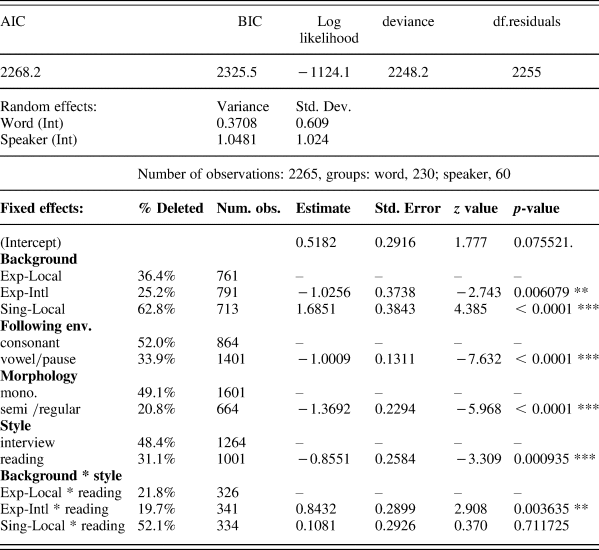
The significant fixed effects identified in a model incorporating all participants are detailed in Table 5. Participant background, with a comparison level of Expat-Local, shows significant differences between this group and both Sing-Local and Expat-Int'l, meaning that expatriate children attending local schools are significantly more likely to delete than expatriates in international schools but are also significantly less likely to delete than their Singaporean peers in local schools. For phonological effects, a binary distinction in following segment between consonant and vowel/pause is observed to be significant, with consonants favoring deletion; preceding segment, however, is not significant in this model. As found in previous work on Inner Circle varieties, monomorphemes are found to delete significantly less often than semiweak and regular verb forms. Finally, both a main effect of style and a significant interaction between style and background are observed. Participants are significantly less likely to delete in reading style, but this difference is significantly smaller among the Expat-Int'l group.
Generalized linear mixed-effects model of -t/d deletion for all participants. For reference purposes, deletion rates and observation numbers are provided for comparison levels (e.g., Exp-Local). Positive z value indicates more deletion of -t/d. ‘***’ = p-value less than < 0.001, ‘**’ = p < 0.01

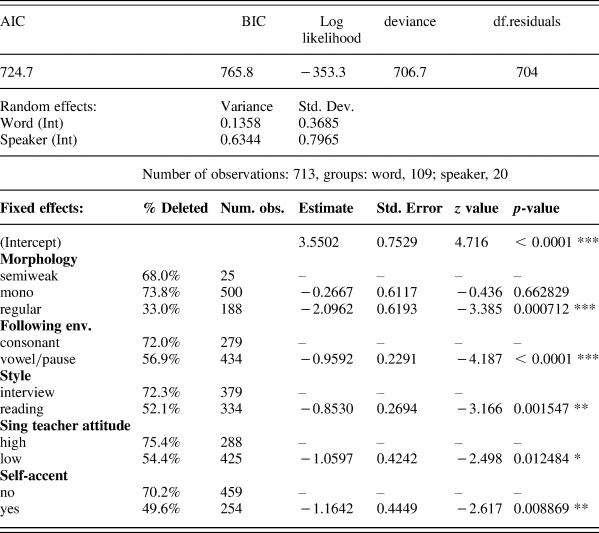
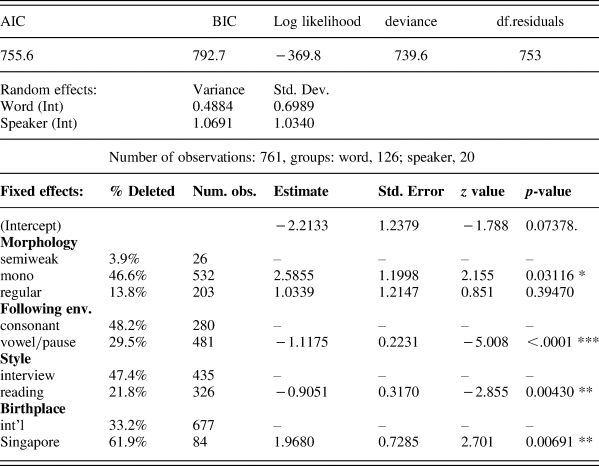
To better account for effects that operate only among one of the participant groups, individual models were run for Sing-Local, Expat-Local, and Expat-Int'l, shown in Tables 6, 7, and 8, respectively. For the Sing-Local group (Table 6), a three-level morphology factor with semiweak verbs as the comparison value yields a significant difference between semiweak verbs and regular past-tense verb forms, but no significant difference between semiweak verbs and monomorphemes, meaning that semiweak verbs pattern with monomorphemes for this group. In addition to the same effects for following segment and style identified in the overall model, the Sing-Local group also shows independent significant main effects for both SgE teacher attitude and self-reported accent, such that participants who rate SgE speakers as likely to be English teachers and participants who do not report that they have an accent have significantly higher rates of deletion.
Significant fixed effects in generalized linear mixed-effects model incorporating random effects of participant and word, for Singaporean participants. For reference purposes, deletion rates and observation numbers are provided for comparison levels (e.g., semiweak verbs). Positive z value indicates more deletion of -t/d. ‘***’ = p-value less than < 0.001, ‘**’ = p < 0.01, ‘*’ = p < .05

Significant fixed effects in generalized linear mixed-effects model incorporating random effects of participant and word, for Expatriate participants who are enrolled in local government schools. Positive z value indicates more deletion of -t/d. ‘***’ = p-value less than < 0.001, ‘**’ = p < 0.01

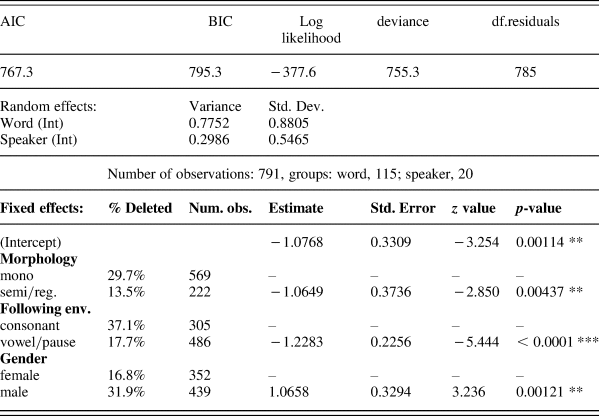
Significant fixed effects in generalized linear mixed-effects model incorporating random effects of participant and word, for Expatriate participants who are enrolled in private international schools. Positive z value indicates more deletion of /t, d/. ‘***’ = p-value less than < 0.001, ‘**’ = p < 0.01

In contrast to the Sing-Local group, the Expat-Local group (Table 7) shows a significant difference between semiweak verbs and monomorphemes, but no difference between semiweak and regular past-tense verbs; for these participants, semiweak verbs pattern with regular verbs. In addition to following segment and style, a significant effect is identified for birthplace, such that participants who were born in Singapore use significantly more -t/d deletion than those who were born elsewhere. Unlike the Sing-Local group, no effects are observed for either SgE teacher attitude or self-perceived accent.
The Expat-Int'l group (Table 8) also demonstrates a grouping of semiweak and regular past-tense verbs. Because this group uses a lower overall level of -t/d deletion, this effect is only significant when collapsed into a binary monomorpheme versus semiweak/regular distinction. While following segment remains significant for this group, style is no longer significant. Unlike for the other three groups, however, gender is a significant factor in this model, such that male participants are significantly more likely to delete than female participants. In contrast to the Expat-Local group, no significant effect of birthplace is identified.
DISCUSSION AND CONCLUDING REMARKS
This analysis of -t/d deletion among children in Singapore has identified several key differences in the speech of Singaporeans attending local school, expatriates attending local school, and expatriates attending international school. First, overall deletion rate was found to be significantly different among the three groups, with Expat-Local speakers using significantly more deletion than the Expat-Int'l group but significantly less than their Sing-Local peers. As indicated in Figure 1, this difference is not due to Expat-Local speakers generally raising somewhat more than Expat-Int'l speakers, but rather results from a minority of participants in this group using SgE-like -t/d deletion rates. While the effect of preceding segment was not significant, all three groups show a consistent significant effect of following segment, with deletion more frequent before a consonant, as is generally found in -t/d deletion work in other settings. Unlike Gut's (Reference Gut2007) finding of no morphological conditioning in SgE, the Sing-Local participants exhibit a pan-dialectally typical ranking of monomorphemes > regular past tense verb forms. However, Singaporean and expatriate groups show different patterning with regard to semiweak verbs, with Sing-Local treating them as monomorphemes and Expat-Local and Expat-Int'l grouping them with regular past tense, a pattern more typical of Inner Circle varieties.
In terms of stylistic variation, the Singaporean and expatriate children in local schools pattern together, showing significantly more deletion in spontaneous speech, while the Expat-Int'l group exhibits only a nonsignificant trend. Among the social factors examined, age is not selected as significant in the model, but male speakers are found to use significantly more -t/d deletion among the Expat-Int'l group, again consistent with Inner Circle research. Only Expat-Local speakers, and not Expat-Int'l speakers, exhibit an effect of birthplace. Expat-Local speakers born in Singapore have significantly higher rates of deletion. Finally, while familiarity with SgE was not found to be significant among any of the groups, the Sing-Local group shows significant effects of accent self-perception and attitude towards likelihood of SgE speakers working as English teachers.
Given that age of arrival is generally a crucial factor in language and dialect acquisition research, the patterning of effects related to time in Singapore is worthy of further comment. The statistical analyses find the binary factor of birthplace in Singapore versus elsewhere to be a better predictor of -t/d deletion rate among the Expat-Local group than other considered factors, including age of arrival, time lived in Singapore, and birthplace in the Inner, Outer, or Expanding Circle of English. Among the Expat-Int'l group, however, no correlations were identified between birthplace or length of time in Singapore and -t/d deletion behavior. In fact, among the six Expat-Int'l participants born in Singapore, the mean deletion rate is 35.3% in the interview and 20.2% in the reading task, with no participant in this group using a deletion rate approaching the SgE norm. This finding suggests that identity, not length of exposure, is the key factor determining whether expatriate children come to align their speech practices with SgE norms.
In the initial discussion of variation and change in SgE, it was noted that greater exposure to nonlocal varieties of English, and particularly AmE, was a proposed cause of certain ongoing shifts in the variety, including rising postvocalic rhoticity. Relative to the findings of Gut (Reference Gut2007), a few aspects of the Sing-Local data are consistent with this account; the overall rate of -t/d deletion is somewhat lower, and the data now show a preference for preserving -t/d for regular past tense forms, a finding previously observed only for Singaporeans living in the United States (Lim & Guy, Reference Lim and Guy2005). Overall, however, the SgE patterning and rate of -t/d deletion still look different from that of AmE or BrE. This is an expected finding, given prior scholarship that affirms the difficulties of acquiring complex phonological patterns from media or limited interactional exposure (Trudgill, Reference Trudgill2014).
Participants’ responses in the interview portion of the study make clear that media and interpersonal exposure to nonlocal dialects play a role in Singaporean children's perception of their own accent. Many of the Singaporean participants distanced their speech from that of a ‘typical’ Singaporean, with some explicitly attributing this distance to media consumption. Many also reported having a friend or acquaintance who was from another country or had spent time in another country and, consequently, had a different accent from themselves. This increasing exposure to outside dialects enhances the potential of local SgE features as indices of localness. Avoiding these features thus becomes a means of constructing a more cosmopolitan identity (Johnstone, Reference Johnstone2016; Starr, Reference Starr, Hall-Lew, Moore and Podesvaforthcoming). Indeed, the observed correlation in the data between self-perception of having an accent and a lower -t/d deletion rate indicates that Singaporean participants who are aware of how local norms are distinct from other varieties are less likely to conform to those norms in their own speech. Similarly, Sing-Local participants who were skeptical that SgE speakers would work as English teachers demonstrate less conformity to SgE norms in their -t/d deletion rates.
In contrast to the Sing-Local group, the expatriate groups showed no impact of attitudes. This is particularly surprising in the case of expatriates in local schools, who have considerable exposure to SgE. Excerpt (1) gives some indication of the ideologies that discourage Expat-Int'l students from adopting local norms for -t/d deletion. This participant reports that, while he has learned to speak Singlish (suggesting that it is a legitimate variety that one can learn) and speaks it with his friends, he speaks ‘properly’ at home—meaning in Australian English, which he frames as more standard than SgE. Later in the excerpt, the participant reports that his teacher has praised him for improving the standard of English in the class, leading his Singaporean classmates to produce ‘proper’ sentences. Thus, while this participant indicates a positive, solidarity-based orientation towards SgE in the sense that he has seen the need to learn it and speak it with friends, his response also reflects the belief that SgE is a deficient form of English that is less proper than Australian English, his home variety. In light of these comments, one possible account for the absence of a teacher attitude effect among this group is that some participants may recognize that SgE speakers work as English teachers in Singapore, but nonetheless do not perceive the English used in local schools as a standard variety.
1. Excerpt from interview with Expat-Local participant, male, 12 years old, born in Australia, in Singapore since age 6.
Interviewer: Do you find yourself that you have an accent when you talk to other people in— in school?
Child: Um, no, ‘cause I've learnt how to speak Singlish, and I talk to my friends in that, but at home, I speak properly.
…
Interviewer: Um so do most of you, you know, your classmates in Singapore, do they speak the same way as you, or speak differently than you?
Child: I've uh, in my class this year, my music teacher told my brother that I've actually changed the class in like their speaking. Instead of— ‘cause they usually don't speaker proper se— finish their sentences and stuff, I've actually made a change, and they speak proper sentences.
Among the Expat-Int'l participants, although performance on the SgE identification task was just as strong as the other two groups, their interview responses revealed that many perceived themselves as having little day-to-day contact with Singaporeans; in some cases, they were not confident that they could identify SgE, as in Excerpt (2) (this particular child has underestimated his abilities, and was in fact able to accurately identify all SgE speakers in the experimental task). It is therefore unsurprising that Expat-Int'l -t/d deletion patterns are found to be consistent with Inner Circle contexts.
2. Excerpt from interview with Expat-Int'l participant, male, seven years old, born in Japan, in Singapore since age three.
Interviewer: Do you have any Singaporean friends?
Child: Mm, no.
Interviewer: Not— not at all?
Child: No.
Interviewer: Can you tell when someone's from Singapore, by listening to them speaking?
Child: (laugh) No.
Interviewer: Okay.
Child: Because in our school, I saw about only two Singaporeans.
A final noteworthy factor that potentially contributes to the low level of expatriate uptake of local norms is the perception that SgE is an in-group variety that cannot be authentically adopted by outsiders. As SgE rises in prominence as a marker of national identity, and as the distinction between Singaporeans and non-Singaporeans becomes increasingly salient in the local community (see Starr & Balasubramaniam, Reference Starr and Balasubramaniam2019), children who perceive themselves as non-Singaporean may be more reluctant to adopt local features, regardless of whether they view SgE as a legitimate variety of English. Indeed, interview responses from the expatriate groups revealed that even those children who were born in Singapore, and had lived there for their entire lives, largely perceived themselves as non-Singaporean. At the same time, preliminary observations suggest that expatriates enrolled in local schools with phenotypes that can be interpreted as belonging to a typical Singaporean ethnicity, that is, those who were Chinese, Southeast Asian, or South Asian in appearance, were more likely to adopt a Singaporean identity and local -t/d deletion norms. In fact, all of the Expat-local participants who were born in Singapore and used -t/d deletion at higher rates were of Chinese heritage (although not all participants of Chinese heritage used similarly high deletion rates). Ongoing research on expatriate children from China and India aims to further explore whether children from these groups are more likely to take on local identities, and whether they, in consequence, differ from other expatriate children in their adoption of SgE norms.
Previous work on second dialect acquisition suggests that children moving to a new region are able to acquire simple phonological features, but not those with complex conditioning (e.g., Payne, Reference Payne1976). While it is therefore unsurprising that expatriates retain internal constraints consistent with Inner Circle Englishes, the fact that they do not raise their overall -t/d deletion rate to match local norms makes this case notably different from studies of second dialect acquisition in Inner Circle settings. While this study has limited its scope to -t/d deletion, the behavior of this variable is representative of a range of phonological features associated with SgE that are not observed in the speech of expatriate children. As has been argued above, this finding results from pervasive ideological stances towards SgE as a nonnative, less legitimate, and in-group variety. Similar ideological factors are found to be at play among Singaporean children; local children's attitudes towards the status of SgE and beliefs about their own accent significantly condition their adherence to local norms for -t/d deletion. The considerable power of language ideology and identity construction in shaping language use accounts for how children who grow up in the same location and, in some cases, interact on a daily basis may nonetheless remain in distinct speech communities.
APPENDIX A READING PASSAGES
Instructions:
Please read these two short stories aloud. You can read each page to yourself first before
you read it out loud. Take as much time as you need!
Story 1: The Cake
Joy baked a mint chocolate cake. She sent the cake to her friend Pat. It didn't taste very good, but Pat didn't want to make Joy feel bad. When he met her the next day, she kept asking him about the cake. Finally he said, “It wasn't the best.”
Joy stuck out her lip and made a sad face. “You just don't want to admit that I can cook better than you,” she cried. “If you are my friend you should be nicer to me.”
“Can we please stop fighting,” said Pat. “It doesn't matter how the cake tasted, I am still happy that you gave me a present.”
Joy sighed. “I guess I should thank you for telling me the truth about the cake. Next time it will be better. I'll ask my mother to help me make it.”
Joy walked home and started making plans for her new cake, a chocolate one filled with strawberries.
-THE END -
Story 2: The Trip
Tom took a ship across the water to visit his friend who lived in a city far away. When he reached the city, he sat on a bench by the dock, waiting for someone to meet him.
At last, a tiny car came to pick him up. The back seat of the car was so small that Tom could barely fit inside, but he squeezed in.
As the car set off for the long drive to his friend's house, Tom was feeling tired, so he decided to take a nap. He slipped his cap down over his face and closed his eyes.
While he was sleeping, he had a strange dream. He saw four little black sheep in a field. Each one had white feet and a white star on its head. There was a girl with silver slippers watching the sheep.
“Are these your sheep?” Tom asked the girl.
“Yes,” she replied, “They are my pets. I hope you are not here to steal them.”
Just then, Tom woke up. They had reached his friend's house.
Tom was still sleepy, so after he said hello to his friend he went straight to bed. He dreamed again about the sheep in the field.
In the morning Tom thought, “This city is giving me strange dreams! I'd better go home soon.”
-THE END -