In Korea, many multi-casualty incidents have occurred for decades, but there were no significant changes to the disaster medical assistance system. In 1995, after the Sampoong Department Store collapse, significant changes were made to the system, such as the passing of the Disaster Management Act. The importance of disaster medicine was highlighted, a national 119 Rescue Team was launched, and the related regulations were realigned. Since then, despite the 2003 Daegu subway fire that resulted in more than 100 casualties, there were no significant changes to the disaster medical assistance system except for the organization of the National Emergency Management Agency.
However, after the 2014 Gyeongju Mauna Resort gym collapse, which caused 155 casualties,Reference Cha, Kim and Kim 1 many problems in the country’s disaster response system were exposed; lively discussions ensued, and follow-up measures were proposed. By the time the Sewol Ferry disaster caused more than 300 deaths, all of society had been awakened to the country’s safety issues,Reference Woo, Cho and Shim 2 making it easier to pass budget measures related to disaster response. There were major changes in government organizations, including the fire department, and revised legislation regarding the disaster medical system. The Disaster Medical Assistance Team (DMAT) was more active in incidents that occurred in 2014 through 2015,Reference Chae, Kim and Park 3 , Reference Woo, Lee and Cho 4 and their experience and problem recognition were driving forces behind changes in the system.
Changes in the disaster medical assistance system were mainly led by the government, particularly the Ministry of Health and Welfare (MHW). This article refers to 4 aspects of system changes: (1) the DMAT itself, (2) DMAT training, (3) an information and communication system, and (4) hospitals as disaster bases. The aim was to share South Korea’s experiences with other municipalities that seek to develop or improve disaster medical systems, including ensuring that all knowledge is available to local emergency medical workers.
METHODS
Of the multi-casualty incidents that occurred from January 2014 to February 2015, the DMAT was dispatched to or on standby for a total of 23 of them. Among them, the Gyeongju Mauna Resort gym collapse, Goyang Terminal fire, and Yeongjong Bridge car accidents were reported in the papers.Reference Cha, Kim and Kim 1 , Reference Chae, Kim and Park 3 , Reference Woo, Lee and Cho 4 In addition to information that was reported in the papers, the authors of this study were able to retrieve data from 5 additional incidents: the Incheon industrial hospital fire, the Jangseong Hyusarang hospital fire, the Uijeongbu Daebong green apartment fire, the Bundang ventilation window fall, and the Sangwangsimni Station train crash. The data were collected from written reports from the National Emergency Medical Center (NEMC) and interviews with DMAT members who participated in the disaster responses. The Emergency Medical Department of the MHW and the NEMC identified the related problems and organized the different responses. As a result, the Emergency Medical Service Act was amended, 5 new DMAT guidelines were created, 6 and the new disaster emergency medical service (EMS) room was installed. 7
The current study’s authors analyzed the above data and referred to other countries’ disaster-related medical systemsReference Kondo, Koido and Morino 8 , Reference Knouss 9 and produced an emergency response manual 10 and a new disaster medical education program.
RESULTS
DMAT
The revised Emergency Medical Service Act of 2000 led to the installation of the new NEMC and the Emergency Medical Information Center (EMIC). In addition, existing emergency rooms were classified into 1 of 4 types depending on their sizes, and the Korean DMAT was also created. The 1 or 2 largest city- or state-level emergency rooms were designated as regional emergency medical centers (REMCs). Because these hospitals take responsibility for disaster response and education services, they are considered disaster base hospitals, and the medical staff of these hospitals who are dispatched to disaster scenes become DMAT staff. Initial DMAT goods and vehicles were provided by the MHW, and the first DMAT dispatch was reported at the 2002 Air China aircraft crash near Kimhae Airport.Reference Cho, Yeom and Jeong 11 Although as of 2015, the official number of DMATs at the REMCs was 20—including the teams that already operated locally—the current number is much larger.
The DMAT was initially composed of 8 people, but since 2002, the actual number of personnel dispatched to the field in multi-casualty incidents has varied from 3 to 15.Reference Cha, Kim and Kim 1 , Reference Chae, Kim and Park 3 , Reference Woo, Lee and Cho 4 , Reference Cho, Yeom and Jeong 11 , Reference Jang, Cho and Kim 12 The supplies include an air tent to install advanced medical posts, and the teams use 2.5-ton trucks that can carry the necessary goods. Although response time has never been specifically determined except in one accident in an isolated area (Yeonpyeong Island), it is typically less than 24 hours.
The late dispatch of the DMAT was highlighted as the problem in the Mauna Resort gym collapse,Reference Cha, Kim and Kim 1 and it will be mentioned again. The MHW judged that the DMAT was too large to rapidly assemble and dispatch all 8 team members and that the large trucks were also too slow. Thus, the Ministry proposed to improve the problems as follows. In Korea, the DMAT limited its numbers to small teams of 4, such as the Japan DMAT, and revised their procedures to allow for every disaster base hospital to be able to dispatch 3 teams sequentially.Reference Fuse and Yokota 13 When 4-member teams are dispatched, the first team must bring the DMAT bag by ambulance within 10 minutes, and the second team must bring the supplies for installing the advanced medical post by truck within 2 hours. Response time cannot exceed 12 hours per team, and the third team must be dispatched within 12 hours so they can relieve the earlier teams. In addition, to reduce the travel times to disaster sites, the number of DMAT teams had to be increased; as a result, existing disaster base hospitals were increased in number from 20 to 40, which will also be mentioned again.
DMAT Training
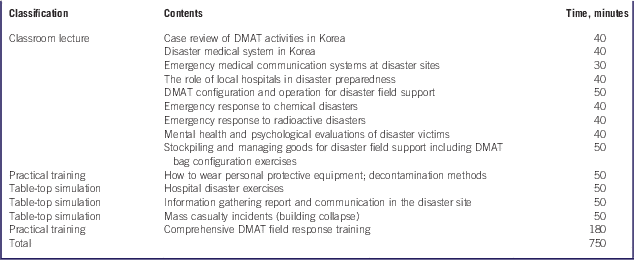
Training programs for disaster medical support staff were first instituted in 2011 by the MHW based on their available budget, and they were held every year. However, public health officials were the primary targets of the training rather than the disaster base hospitals’ DMAT members, and the training was mainly theoretical. Of the total of 630 minutes of programming, only 150 minutes consisted of table-top simulations, and the remainder was theory. Therefore, it can be seen that there is no specific DMAT training program. The National Disaster Life Support introduced a course in Korea that contained contents that could help with DMAT training, especially its very well-organized simulation training. However, there was no support for the course in the national budget (some local governments could offer budget support), and mostly trainees have to take the course at private expense.
One of the 2015 amendments to the Emergency Medical Service Act was a provision that the country had to provide an emergency response manual regarding disasters and emergencies, that all medical personnel have to be educated about and trained in the manual’s contents, and that there must be related budget support; the manual refers mainly to emergency medical systems in disaster areas, including emergency medical support personnel, goods, and communication, as suggested by law. The current study’s authors reviewed the most recent studies on multi-casualty incidentsReference Cha, Kim and Kim 1 , Reference Chae, Kim and Park 3 , Reference Woo, Lee and Cho 4 as members of the working group organized by the Korean Society of Emergency Medicine and developed the manual 10 and new DMAT training programs based on the amended legislation 5 and guidelines. 6
In the cases of the 2014 Gyeongju Mauna Resort gym collapse and the 2015 Yeongjong Bridge multi-car accidents, it was observed that the cooperation at the scene between the DMAT and the fire department field commander was not smooth.Reference Cha, Kim and Kim 1 , Reference Woo, Lee and Cho 4 The purpose of the training program was thus to deliver the emergency response manual contents and to help medical staff understand actual field response activities, especially the incident command systems at disaster scenes; in the basic course that was created in 2015, 430 of the 750 minutes of training time consist of actual practice (the detailed configuration is shown in Table 1). By 2015, each of the 3 DMATs from the 20 disaster base hospitals had completed the training.
Emergency Response Training ManualFootnote a

a Abbreviations: DMAT, Disaster Medical Assistance Team.
Information System and Communication
As was previously described, the revised Emergency Medical Service Act in 2000 led to the installation of the new NEMC and the EMIC. The EMIC’s main role was to provide guidance and counseling to emergency patients and to manage and provide information on medical emergencies. Because the government entrusted the REMCs with the duty to operate the 24-hour information centers, each could recognize the need for and dispatch DMATs during any disaster emergency. Furthermore, because the EMICs managed the information on the bed availability for each local hospital emergency room, even with multiple casualties, the new system eased the transfers of patients to hospitals. However, the EMIC’s role was significantly reduced and the 24-hour operation ceased because it was observed that the centers’ roles overlapped with those of the fire station control rooms.
At the time of the 2014 gym collapse, it took more than 1 hour to decide to dispatch a DMAT, which contributed to the team’s late arrival.Reference Cha, Kim and Kim 1 In the case of the 2014 fire accident, relaying the incident to the DMAT took more than 45 minutes, which also delayed the teams’ dispatch.Reference Chae, Kim and Park 3 In addition, because the disaster area was located closer to the disaster base hospital in the neighboring province than to the hospital in its own province,Reference Cha, Kim and Kim 1 it was again highlighted that a national emergency medical system was necessary that could nationally mobilize DMATs 24 hours a day.
As a result, in May 2014, the NEMC launched the 24-hour Disaster EMS Situation Room (Disaster EMS). The Disaster EMS criteria for mobilizing DMATs are as follows: (1) when the relevant authorities, including the fire department, make the request; (2) in the event or suspected event of more than 10 casualties; (3) when the accident involves airplanes, ships, trains, etc; (4) when multi-car accidents involve more than 10 vehicles; and/or (5) when a portion of the affected population has been confirmed as being exposed to radiation or other chemicals. 7
When disasters occur, the Disaster EMS addresses DMAT dispatch requests, informs local emergency rooms and public health officials of the situation, and collects and distributes to the DMATs information on the available emergency room beds near the disaster scene so they can transfer patients appropriately.
Trunked radio (wireless) systems were the previously used communication means for disasters in Korea. However, in some cases of multiple-casualty incidents, the use of these systems was limited at disaster sites;Reference Cha, Kim and Kim 1 , Reference Jang, Cho and Kim 12 as a result, the communication system was improved to long-term evolution (LTE) in 2015. Due to the high smart phone penetration rate, the use of mobile instant messaging at disaster sites, and the NEMC’s temporary situation room following the Mauna Resort gym collapse,Reference Cha, Kim and Kim 1 the new approach demonstrated itself to be successful and is now the official means of communication. During 2016, a new messenger application customized to disaster medicine is scheduled to be disseminated and will replace the current messaging service. Instant messaging is effective in communicating information about disasters, but when it becomes the only tool for field communication, situations can be recognized later than they would have been before, and thus it is necessary to ensure the manpower to regularly add updated information to these messaging services. As such, currently the messenger is used with LTE or two-way radios rather than alone. In addition, because the need is increasing to integrate radio use with other disaster response agencies such as fire departments, the government is taking the lead on developing such integration projects.
Disaster Base Hospitals
The REMCs that now play the role of disaster base hospitals were mainly responsible for disaster response and for training regional EMS personnel. The main task was dispatching DMATs to disasters, and there was little focus on hospital preparedness for disasters.
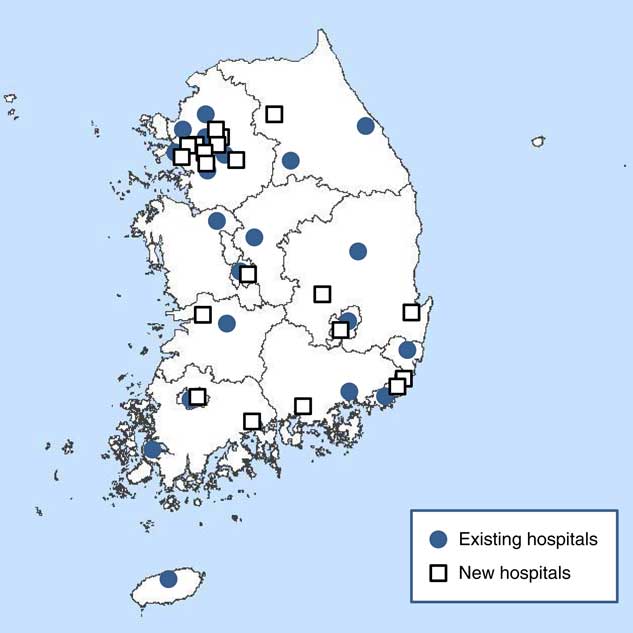
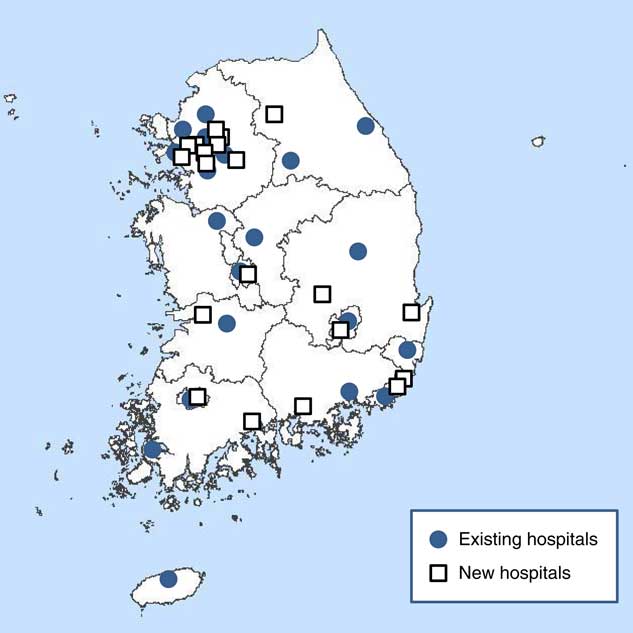
As was previously described, the disaster base hospitals doubled in number from 20 to 40 by 2015 (Figure 1); the aim was to increase the number of DMATs so teams could arrive at disaster sites more quickly and also to increase the regional capacity to treat multiple casualties.
Locations of the Disaster Base Hospitals.
The emergency response manual explains hospital preparedness as part of the role of disaster base hospitals, with an entire chapter devoted to hospital disaster response and the corresponding principles. Trainees’ responses to the new DMAT training program have been positive because both theory and table-top simulation have been introduced (Table 1).
DISCUSSION
There have been no major natural disasters in one large area of Korea (such as hurricanes or earthquakes) since the country’s disaster medical assistance systems have been built, and thus, disaster countermeasures mainly consist of using regional resources for multiple-casualty incidents, field rescue, DMAT activities within short periods of time (usually within 24 hours), and short-range transfers. When the emergency response manual is next revised, although the likelihood of disaster occurrence is very low, the authors recommend adding the minimum principles of responding to such disasters.
The initial DMAT training program had the purpose of delivering essential content for all occupations; naturally, therefore, it is necessary to develop advanced courses such as occupational field medical training and DMAT leader education in the future.
The satellite phone was reviewed as the new secondary means of communication, but it was not accepted as an official means of emergency medical assistance response owing to its cost. However, because regional communication failures have occurred in the pastReference Jang, Cho and Kim 12 and there is always the need for secondary communication means, satellite phones should continue to be reviewed.
Hospital preparedness in Korea is measured in the National Hospital Accreditation assessment guidelines with the item, “Does the hospital have a disaster preparedness plan and conduct periodic training?” Currently the MHW is responsible for this. The MHW’s annual National Emergency Room Evaluation assessments only look at whether disaster base hospitals conducted disaster preparedness training each year. However, it has been concluded that for these hospitals that must accommodate large numbers of patients when multiple casualties occur, merely ensuring annual preparedness training is not sufficient; it is necessary to present more than the minimum principles in the manual.
Although future items to be supplemented have been suggested here, changes to the emergency medical assistance system have been made such as increasing the number of disaster base hospitals and DMATs, expanding emergency response services to 24-hour operation, and developing an emergency response manual and a related training program. These facts alone are sufficient encouragement to expect better medical responses at disaster sites in the future. Future disasters in South Korea and related countermeasures, as well as future international disasters and disaster responses, can lead to continued improvements in the world’s disaster medical assistance systems.
CONCLUSIONS
Based on the multiple-casualty incidents, and the related responses, that occurred from 2014 to 2015 in South Korea, policy changes were made to the country’s disaster medical assistance system in 4 aspects. These changes are expected to increase the DMATs’ field response capacity.
Acknowledgment
This research was supported by the Korean Ministry of Health and Welfare.