I
On no one quality, on no one process, on no one country, on no one route and on no one field must we be dependent. Safety and certainty in oil lie in variety and variety alone.
Winston Churchill, first lord of the Admiralty of the British Empire, 1913Interest in energy transitions has accelerated in recent years due to rising concerns about global warming and resource scarcity. Historical studies of energy transitions provide a rich understanding of their nature and implications, but fewer explore the major drivers of these transitions.Footnote 1 It is, to state the obvious, quite difficult to tease out, assign proper importance to, and generalize about the many factors driving energy transitions. The two transitions from one dominant source to another – wood to coal and coal to oil – occurred over several decades and when overall energy demand was growing, but energy demand growth is not guaranteed to drive a future transition.Footnote 2 The abundance of the new source has not necessarily determined the pace of its adoption,Footnote 3 nor has the remaining availability of the existing source necessarily determined the rate of its decline.Footnote 4 Oil became the dominant energy source, but coal has remained a major part of the energy mix.
Energy transitions involve the search for additional, better, and cheaper services associated with the deployment of new energy sources and technologies. Assessing whether energy sources are better depends on numerous factors, including gravimetric and volumetric energy density, power density, emissions, cost and efficiency of conversion, financial risk, amenability to storage, risk to human health, and ease of transport, etc.Footnote 5 The performance of end-user technologies, in other words, determines the pace of transitions, which are often adopted in various hybrid forms before the technology is finalized and disseminated widely.Footnote 6 Governments also play a major role in initiating transitions between energy sources if the national imperative to do so arises.Footnote 7
The preponderance of work by social scientists focuses on energy transitions as driven by commercial and technological factors, but energy is also a strategic commodity, something that social scientists are starting to recognize but are not yet exploring sufficiently.Footnote 8 Victoria C. A. Johnson, Fionnguala Sherry-Brennan, and Peter J. G. Pearson offer an exception, arguing that energy security, energy framing, and governance logics dynamically interacted with one another in extremis and in more intermediate states in Britain's pursuit of synthetic fuels during the interwar period.Footnote 9 Heightened energy security made liquid fuels a ‘special article’ or ‘social service’ rather than a ‘market commodity’, and subject to greater state intervention.Footnote 10
Historians, meanwhile, have been examining oil's role as a strategic commodity in earnest since the two oil price shocks in the 1970s, when Western oil-supply security was threatened by political disruptions and higher prices. Since economic and military power depended on oil-supply security, Western governments took military and hence security-related decisions to address this concern. The United States, most notably, established a military presence to protect to oil supplies in the Gulf, promulgating the Carter Doctrine in January 1980 after the Soviet invasion of Afghanistan.Footnote 11 Higher oil prices in the 1970s also encouraged consumers to shift to alternative energy sources such as coal and renewables in the 1980s.
This article seeks to establish a connection between geopolitics and military decision-making, energy security, and energy transitions during a much earlier period, namely the transition from coal to oil from 1898 to 1917. Historians may have previously ignored this connection because oil's strategic value was not patent until the advantages of mechanized warfare and the dependence of allies on US oil imports were revealed during the First World War.Footnote 12 Oil and the internal combustion engine, moreover, did not come to dominate the non-military commercial transportation sector until the 1920s and 1930s, when ample supplies came on the market from the United States, Latin America, the Middle East, and the Soviet Union and drove down price.Footnote 13
Yet numerous studies, on which this article relies, demonstrate that naval and government policy-makers in world powers such as Britain, Germany, and the United States sought, as early as 1898, to convert their navies to oil-burning engines to take advantage of new technologies and to create oil-supply security.Footnote 14 Daniel Yergin's Pulitzer Prize-winning history of oil, The prize, presents the most convincing case for why Britain's rivalry with Germany and quest to maintain superiority at sea drove it to convert its navy from coal to oil.Footnote 15 Marian Jack provides the definitive account of Churchill's support for the British Admiralty to build oil-powered battleships and to take a financial stake in and supply contract from the Anglo Persian Oil Company (APOC) from 1911 to 1914.Footnote 16 G. Gareth Jones also demonstrates how the alliance between the British government and the private oil industry expanded Britain's access to oil from 1912 to 1924.Footnote 17 Marian Kent and Edward Mead Earle, meanwhile, describe how Britain and Germany competed to gain access to oil in Mesopotamia before and during the First World War.Footnote 18 The above-mentioned studies, however, do not connect the search for oil-supply security to the naval transition or to British efforts to gain oil concessions in Persia and Mesopotamia at the turn of the twentieth century.Footnote 19 The studies on the United States, on the other hand, demonstrate that oil-supply security from domestic production and the price of oil directly shaped the timing and pace of the naval transition.
The larger shortcoming of all these studies is that no one has considered the naval transitions to oil and the search for oil-supply security in Britain, Germany, and the United States at the same time and linked them to the global transition from coal to oil.Footnote 20 Geopolitics drove governments to enact the transition from coal to oil in the naval sector, which created, for the first time, the problem of oil-supply security for governments, especially the British and German, which did not have ample supplies of oil at home or in their colonies like the United States did. These governments in turn took decisions to secure access to oil, which resulted in vast new supplies coming on to the global market from the 1900s to the 1920s. It was not a foregone conclusion, moreover, that gasoline-powered diesel engines would dominate land transportation from the 1890s to the 1910s. Electric vehicles posed competition, but the superiority of the internal combustion engine ultimately helped the gasoline-powered car ascend to dominance.Footnote 21 Nevertheless, it is worth considering the role of the government-led transition in the military sector to creating global oil-supply security and therefore a path for oil to become dominant in the commercial market. These policies brought abundant supplies of oil on to the market for the first time, which resulted in low prices, the ideal environment in which the internal combustion engine came to dominate the broader commercial transportation sector.
The second reason that historians may have ignored the connection between geopolitics, military decision-making, energy security, and the transition from coal to oil prior to 1917 is that oil's importance to naval strategy in this period has not been fully appreciated. The confusion appears to stem partly from a fundamental flaw in Karl Lautenschläger's seminal article on naval technology and strategy, in which he describes a transformation in naval strategy from 1907 to 1914:
The essence of the change was system integration – integration both of platforms with one another and of several systems aboard a single platform. In the former case, the torpedo boat destroyer matured and joined the fleet as an offensive/defensive arm of the battle line. In the latter case, integrated components of a centralized fire control system gave the new dreadnought-type battleships twice the effective fighting range and twice the hitting power of the latest pre-dreadnoughts.Footnote 22
Lautenschläger goes on to argue that the British and German navies ‘led in the development of the destroyer’ in the 1890s, which was a key component in system integration. What is so surprising about his analysis, however, is that he does not mention oil's role. The powers first focused on converting their destroyers to oil prior to 1907 and then Britain and the United States were able to begin converting their capital ships in 1911–12 and Germany in 1915.Footnote 23 Lautenschläger also makes a confusing argument that since the adoption of coal in the second half of the nineteenth century, navies faced a trade off in fuel choice between tactical speed during battle with wind power and strategic endurance to position the time and place of battle with coal power. But oil, which provided both greater speed and endurance, nullified this trade off. How could system integration, after all, have been possible without the greater speed and endurance offered by oil?Footnote 24
We argue that the state-led transition from coal to oil in the naval sector was driven by geopolitical threats, was paced by the ability to secure oil supplies, and helped hasten the global transition from coal to oil. Britain's position as the hegemonic power and its insecurity about supplies of both coal, on which its navy and empire stood, and oil, on which they would depend in the future, created a period of geopolitical and military competition from 1898 to 1917 with its main challenger Germany. But the pace and extent to which the two rivals and the United States transitioned either to oil-only engines or to coal-fired engines that permitted oil to be used as an auxiliary fuel depended on their respective oil-supply security.
This article first looks at the decline of Britain's dominance in coal, the rise of the United States in both coal and oil, and the confluence of technology with these developments. It then details how geopolitics and military decision-making as well as oil-supply security shaped the pace at which Britain, Germany, and the United States adopted oil-powered navies from 1898 to 1917. It concludes by summarizing some lessons for the current-day transition.
II
Prior to 1780, agriculture was the world's largest sector of economic production, for which the main sources of energy were mostly renewables, including wood, water, wind, peat, charcoal, sedges, reeds, and other animal and plant remains.Footnote 25 After 1780, coal began to be mined extensively, and Britain became the world's largest coal producer, had the largest reserves of coal throughout the nineteenth century, and dominated coal-related science, technology, and industries. Coal-powered advances in industrial manufacturing and transportation undergirded the Industrial Revolution and Britain's rise as a global hegemon. Its coal-powered navy dominated the seas and ensured the free flow of goods and people within its empire and around the globe.Footnote 26 The relationship between global hegemony and the dominant energy source is not firmly established and requires deeper investigation. But since the advent of fossil fuels, the global hegemon has been the largest or one of the largest producers of the dominant energy source and the leader in producing that source's related technologies – the British with coal from 1815 to 1873 and the United States with oil from 1945 to the present.Footnote 27
The emergence of oil as an energy source of strategic value dates to the application of modern drilling techniques in Pennsylvania in 1859, which made oil increasingly affordable and available.Footnote 28 Though oil was primarily used for illumination, lubrication, and insulation in the nineteenth century, the British, Russian, and US navies recognized as early as the 1860s that oil was potentially a better maritime fuel than coal. The United States and Britain conducted experiments in the second half of the 1860s to determine whether oil could be used as a naval fuel, but concerns about safety and cost – oil was eight times more expensive than coal – outweighed the advantages of reduced bulk and weight.Footnote 29 Oil-rich Russia also conducted experiments with oil-powered equipment on its Caspian Sea fleet in the 1870s and 1880s.Footnote 30
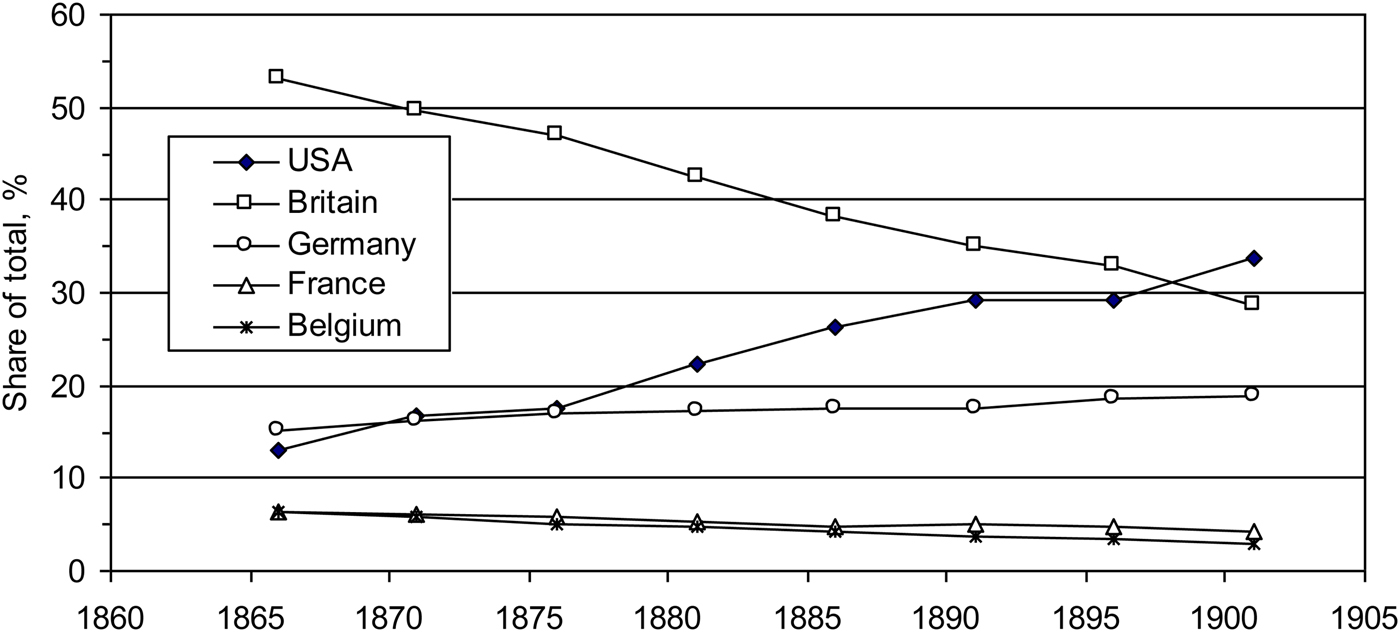
Britain's interest in converting its navy from coal to oil in the 1860s is puzzling because it was the world's largest producer and exporter of coal and had no domestic supplies of oil. But Britain had begun to worry, owing to the work of William Stanley Jevons in the 1860s, that its coal supplies would deplete faster than expected in the coming decades and, in fact, its relative dominance in coal production did decline steadily thereafter.Footnote 31 The British economy likewise declined in relative terms, and the US economy surpassed it in the 1870s,Footnote 32 even though London bankers still controlled approximately 75 per cent of global capital movements until 1900.Footnote 33 US coal production then exceeded British production for the first time in 1901, and the United States also became the world's largest energy consumer. From 1899 to 1903, the United States produced 33.8 per cent of the world's coal, Britain produced 28.8 per cent, and Germany 19.0 per cent (Figure 1). The United States also led in coal-powered transportation. In 1909, US freight traffic far exceeded other countries, and the US railway network comprised two-fifths of the world's total and was 15 per cent longer than all of Europe.Footnote 34 In addition, the United States had reversed the balance of its steel trade with Europe by 1899, producing 34.6 per cent of the world's total compared to 23.6 per cent in Britain, the traditional leader.Footnote 35
Average annual coal production of major countries, 1864–1903

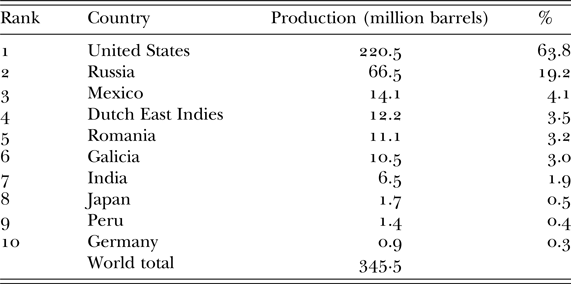
The situation in oil was similar. The United States had been the world's largest oil producer since 1860 except for a three-year period from 1898 to 1901, when Russia was the largest.Footnote 36 New discoveries in Oklahoma, Texas, Louisiana, and California from 1900 to 1905, however, caused US production to soar to 220.5 million barrels (mbbls) in 1911, or 63.8 per cent of world production (Table 1). Britain had 6.5 mbbls under its direct control in India in 1911, but could buy oil from the United States, Russia, or other friendly countries. Germany produced less than 1 mbbls.
World oil production, 1911

Source: P. M. Paine and B. K. Stroud, Oil production methods (San Francisco, CA, 1913), p. 18.
Alongside considerations of global hegemony and world energy balances, oil needed available and affordable technologies to enable it to enter the market and compete against the existing dominant energy source, coal.Footnote 37 Experiments to discover how to use gas and liquid hydrocarbons as engine fuels began as early as the eighteenth century, when Richard Watson extracted gas from coal and issued three patents on the use of coal gas (synthetic gas or syngas) and air mixture in motors in 1791–1801.Footnote 38 The testing and designing of gas-fuelled engines from 1794 to 1873 were carried out, mostly in Britain, France, Germany, Italy, and the United States.Footnote 39 From 1883 to 1900, gas-consumption efficiencies per indicated horsepower rose from 17 per cent to a maximum of 28 per cent, making gas-fuelled electric generators better and cheaper than steam engines.Footnote 40 The invention of oil-fired engines occurred much more swiftly after that. The first patent was issued to Julius Hock of Vienna in 1873, and British engineer William Dent Priestman publicly introduced it in 1888. After Priestman, the German investor and mechanical engineer Rudolph Diesel proposed his ‘rational motor’ in 1892 and was granted the first patent for his ‘combustion engine’ in February 1893. In 1895, German engineer Gottlieb Daimler introduced his high-speed motor that led to the development of the process of carburation to utilize liquid fuels, which enormously widened the scope and field for the internal combustion engine.Footnote 41 By the beginning of the twentieth century, petroleum products such as gasoline, naphtha, and kerosene could be used to generate power,Footnote 42 and the commercial development of the diesel engine dramatically increased oil consumption.Footnote 43 The use of oil as a maritime fuel, however, remained limited to pumping, electricity generation for lighting, fog signalling, and driving launches and barges, and yachts in the nineteenth century.Footnote 44
Four factors caused world powers to reconsider oil as a maritime fuel during the 1890s. First, the development of the oil tanker, christened by Marcus Samuel's shipment of Russian kerosene to the Far East through the Suez Canal in 1892, demonstrated that oil could be transported safely and in quantities large enough to fuel an entire navy. Second, vast new supplies of oil came online, first from Russia and the Dutch East Indies in the 1890s and from the United States in 1897–1901. Third, three technological improvements in the design of the oil-burning diesel engine made it effective for large ships: turbines that were directly coupled to the propellers replaced reciprocating engines, gearing between the turbines and propellers was introduced, and water-tube boilers were adopted.Footnote 45 Fourth, the global struggle for power between the hegemon Britain and the challenger Germany intensified, a naval arms race ensued, and the United States became a world power. Nations had come to recognize, moreover, that naval power was critical, a view articulated most forcefully by US admiral and strategist Alfred Thayer Mahan.Footnote 46 Britain had already launched a modernization and expansion of its fleet with the British Naval Defence Act of 1889,Footnote 47 whereas Germany passed its First Naval Bill in 1898 and then the more ambitious version in 1900 that called for new levels of shipbuilding.Footnote 48
In this context, the potential value of oil as a naval fuel was difficult to ignore. Oil's higher calorific value increased speed and acceleration, which was essential to the tactical purposes of smaller vessels such as submarines and destroyers. Higher calorific value also gave 30–40 per cent more energy output than coal and 40 per cent more efficiency in the quantity of tonnage required for sea transportation. Oil allowed ships to travel twice as far without refuelling, meaning an oil-powered fleet could choose the time and location of engaging a coal-powered fleet in battle. As a liquid fuel, moreover, oil required less volume on ships and storage tanks could be placed anywhere on board, reducing the size of boiler rooms, creating more room for armaments and manpower, and fostering more efficient ship designs. Oil also emitted less particulate matter, sulphur, and other greenhouse gases, meaning that fleets could disguise their presence more easily. Oil was even cleaner to handle and could be transferred by pipes, reducing the personnel required for refuelling, making refuelling possible at sea, and, perhaps most importantly, improving the morale of the sailors who disdained shoveling coal and dirty smoke.Footnote 49
III
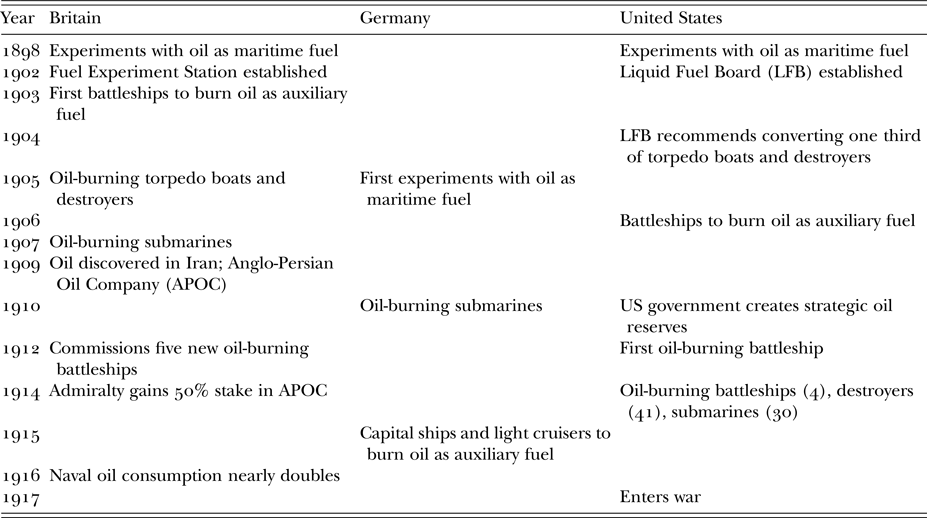
By the end of the 1890s, oil became widespread as an auxiliary fuel in smaller vessels such as destroyers, of which Britain and Germany had led the development.Footnote 50 The Italian navy was the most successful; having experimented with oil in 1890 due to its lack of domestic supplies of coal, most of its torpedo boats burned only oil by 1900.Footnote 51 Yet no major navy had introduced a system to use oil as the primary fuel or even as an auxiliary fuel in larger, capital ships. Starting from 1898, Britain, Germany, and the United States adopted oil-burning capabilities for their navies but at different paces (Table 2).
Milestones, conversion of British, German, and US naval fleets to oil, 1898–1917

Convinced that Germany would convert its navy to oil because it lacked coaling stations around the world,Footnote 52 Britain began conducting experiments in 1898–1901, the results of which were promising enough that it decided to use oil as an auxiliary fuel to coal.Footnote 53 The Fuel Experiment Station was established in 1902, and the first battleships that used oil as an auxiliary fuel were launched in 1903, increasing engine power by 20–5 per cent.Footnote 54 But Britain made an even stronger commitment to oil in 1904, when Admiral Sir John (Jacky) Arbuthnot Fisher was appointed first sea lord. Fisher, a self-proclaimed ‘oil maniac’, saw as early as 1886 that oil-fuelled navies could provide a strategic advantage to defend the empire against a rising Germany.Footnote 55 He implemented a programme of major administrative reforms, began developing new-model capital ships, including the more lethal dreadnought battleships, and pushed the Admiralty to convert to oil.Footnote 56 The Admiralty transformed two battleships, the Mars and the Hannibal, to burn oil as an auxiliary fuel in 1904–5 and laid down its first ships that only burned oil, the Beagle-class destroyers, in 1905. Thereafter, all capital ships – battleships and large cruisers – could burn oil as an auxiliary fuel.Footnote 57 Britain restrained from converting its battleships to burning only oil because, according to Lord Selborne, the first lord of the Admiralty from 1900 to 1905: ‘oil does not exist in this world in sufficient quantities. It must be reckoned only as a most valuable adjunct.’Footnote 58 Fisher himself acknowledged that the ideal battleship would use oil to gain speed and manoeuvrability, but coal during normal transit to conserve supply, at least until supplies were assured.Footnote 59
Britain's partial conversion to oil is nonetheless remarkable because it contravened its existing advantages in coal, as well as the entrenched domestic interests that favoured coal, and was undertaken with great speed. Not only did Britain have available, reliable, and affordable domestic coal supplies at home, but it was also the only power with coaling stations that spanned the globe. Oil, on the other hand, was two to three times more expensive to import and had less reliable combustion systems. However, the geopolitical threat from Germany in particular and the necessity to keep pace with technological change prompted Britain to transition its navy to oil.Footnote 60 Other individuals such as Marcus Samuel also played a role in lobbying the Admiralty to switch from coal to oil, primarily to create a market for the oil that the tankers of Samuel's Shell Trading and Transport Company carried from Borneo and the United States.Footnote 61
Moreover, Britain had some degree of oil-supply security, according to Skelton: ‘by 1903 or thereabouts, the Admiralty was satisfied that supplies of suitable fuel in the desired quantities would be forthcoming, and the devices began to be applied to new construction’.Footnote 62 Since the only oil concession in the empire was Burma, where production was miniscule, one might conclude that he was speaking of purchasing fuel from the booming markets in Russia and the United States, the transportation of which could be assured by Britain's dominant navy. From 1898 to 1903, British investments accounted for 85 per cent of total foreign investment in the Russian oil industry.Footnote 63 Depending on US goodwill, however, was not a guaranteed strategy in wartime, and the loss of Russian oil in 1905 would affect policy-makers’ decisions, as we will see below. Skelton's use of the word ‘forthcoming’ suggests that Britain was confident about its prospects in Persia, which was known to have prodigious oil deposits. A British subject, William Knox D'Arcy, obtained in 1901 a sixty-year concession for oil exploration in southern Persia and began drilling in 1902.Footnote 64
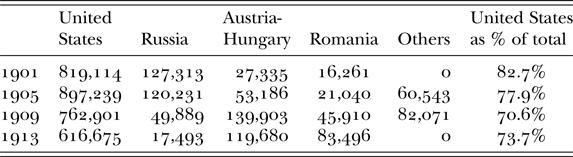
Germany, meanwhile, viewed the struggle with Britain at sea as ‘a question of survival’ and, after the outbreak of the Boer War, championed the Naval Bill of 1900, which sought to double Germany's fleet to thirty-two battleships, twenty armoured cruisers, and thirty-eight light cruisers by 1920.Footnote 65 Germany built ten new battleships in 1901–5, with eight more under construction. In comparison, Britain built nine, with nine under construction, and the United States built six, with thirteen under construction.Footnote 66 Unlike Britain, however, Germany could not consider oil for these ships because it had no supply security and depended on US oil imports from the Standard Oil Company, which also dominated distribution and marketing in Germany's domestic market (Table 3).
German oil imports by country, 1901–13, metric tons

Source: Flanigan and Flaningam, ‘Some origins’, p. 114.
Germany's best hope for independent oil supplies was Mesopotamia, and the government had made diplomatic and commercial inroads with the Ottoman Empire in the late nineteenth century, capped by visits by Kaiser Wilhelm II to Istanbul two times in 1889 and 1898 that included discussions about building a railway from Berlin to Baghdad by a Deutsche Bank-led consortium.Footnote 67 In 1903, the Germans successfully negotiated for a concession to explore for oil within a 20-kilometre area of the railway line, which passed through the oil-rich areas of Mosul and Baghdad provinces.Footnote 68
The United States also considered converting its navy to oil, owing to its prodigious domestic supplies. The US Congress appropriated $15,000 for experiments in 1898 and another $20,000 in 1902 to establish the Liquid Fuel Board (LFB) to explore the question further. This occurred concurrently with the emergence of the United States as a world power following its victory over Spain in 1898 and acquisition of Cuba and the Philippines.Footnote 69 President Roosevelt entered office in 1901 and sought to expand the navy in order to defend economic interests abroad and guard against British and German encroachment in the Western Hemisphere, whose threat was revealed by the British–German–Italian blockade of Venezuela in 1902–3.Footnote 70 By 1905, Roosevelt had authorized the construction of ten battleships, four armoured cruisers, and seventeen other vessels of different classes, all of which were coal-powered.Footnote 71
But the LFB recommended in 1904 the conversion to oil of only one third of all torpedo boats and destroyers; a full conversion required more supply security.Footnote 72 Part of the LFB's concern stemmed from oil's popularity in the commercial transportation sector, which had caused demand to soar and prices to rise. Private companies committed roughly $200,000 for experiments and studies on using oil as a maritime fuel during this period.Footnote 73 The lack of government regulation over the coal and oil industries added to the uncertainty, creating waste and overproduction, while regional disparities in preferences for oil and coal emerged.Footnote 74 Oil supplies in Texas and California, meanwhile, made oil the fuel of choice for railroads in the south-western United States, while coal dominated in the eastern and central regions.Footnote 75
Diplomatic realignments and geopolitical instability characterized the period from 1904 to 1907, which intensified the British–German rivalry and, along with it, the two countries’ naval arms race and competition for oil supplies. Britain, in a bid to check Germany, forged the Anglo-French Entente in 1904–5, ending centuries of rivalry with its powerful neighbour. This agreement came after the German Kaiser William II had met with the Russian Tsar Nicholas II about a coaling agreement and the outbreak of the Russo-Japanese war.Footnote 76 Japan's victory at Port Arthur decimated the Russian navy, and internal turmoil subsumed the Russian oil industry, causing Russia's share of global oil exports to fall from 31 per cent to 9 per cent for 1904–13.Footnote 77 In 1907, Britain and France brought Russia into the alliance against Germany, creating the so-called Triple Entente.Footnote 78 The Russo-Japanese war, meanwhile, provided two lessons for naval policy-makers about fuel. First, the British had denied the Russian fleet access to its coaling stations as it journeyed across the globe to engage Japan, creating logistical problems that an oil-powered fleet might not have faced.Footnote 79 Second, the naval battle itself reinforced the view that overwhelming firepower from battleships was the key to victory.Footnote 80
In Britain, the Fisher-led expansion of the Admiralty had culminated in 1905 with the introduction of the dreadnought-class capital ship, which was far more heavily armed than its predecessors, using all-big-gun batteries as opposed to mixed-calibre ones. Using oil as an auxiliary fuel, meanwhile, had increased the speed of the dreadnought by 11 per cent over previous battleships but resulted in a 70 per cent increase in fuel consumption, with fuel expenditures rising at an even higher rate.Footnote 81
Supply concerns rose as new oil-powered ships were commissioned in 1905–7 and Russian production declined. Storage was also a problem: Britain would require 350,000 tons of new oil-storage capacity to meet its requirements in 1909.Footnote 82 Even the creation of Royal Dutch-Shell, a joint venture launched in 1907 with 60 per cent owned by a Netherlands-based Royal Dutch and 40 per cent by a British-based Shell, caused angst. Though the majority of Royal Dutch-Shell's directors were British and the company was domiciled in London, many worried that its majority-Dutch composition made it susceptible to German influence, which could deprive Britain of supplies in wartime. Taken together, these concerns drove the Admiralty to revert to coal for the twenty Acorn-class destroyers that were laid down in 1908–9. These ships performed so poorly, however, that all destroyers from 1910 were oil-powered.Footnote 83
Britain's hopes for securing oil supplies then received a major boost in 1908, when D'Arcy struck oil at Masjid-i Suleiman in Persia. In 1909, the APOC was founded, and the British government directed Sir Percy Cox, British resident at Bushehr province in Persia, to negotiate an agreement for the APOC to build oil-refining, depot, and storage facilities on Abadan Island, which came online in 1912.Footnote 84 The APOC also renewed its push for concessions in Mesopotamia, particularly in Kirkuk in Mosul province after the 1908 revolution of the Young Turks opened a new era in British–Ottoman relations.Footnote 85 The Admiralty also diversified its oil supplies from relying solely on Burma and the United States to purchasing oil from Romania in large quantities and from Scotland and Borneo in small amounts after 1910.Footnote 86 Greater supply security emboldened the Admiralty to move resolutely towards oil. Whereas its only step towards oil in 1905–9 was to convert its submarines in 1907, it had built or was building fifty-six destroyers and seventy-six submarines powered only by oil in 1911, and all subsequent ships in these classes would only burn oil.Footnote 87 All that remained was to convert battleships to oil as their sole fuel, rather than as an auxiliary fuel.
Seeking to match Britain, Germany amended the Naval Law in 1906 and 1908 and dramatically expanded its fleet. The 1906 bill called for six new cruisers, three dreadnoughts, and one battle cruiser to be laid down every year, while the 1908 bill raised the annual battleship output to four every year. This put Germany on course to have a fleet of 58 capital ships (38 battleships and 20 battle-cruisers), 38 light cruisers, and 144 submarines by 1920. Germany's coal-powered dreadnought battleships began to be outfitted with turbines in 1911.Footnote 88
But Germany only partially converted its fleet to oil during this period. Germany introduced diesel engines for auxiliary power for some destroyers in 1908 and converted its submarines to using only oil by 1910, which had been in development since 1905.Footnote 89 It also began considered converting its capital ships to oil. In 1909, the navy created a design alteration in the Prinzregent Luitpold, a third-generation dreadnought, to use a diesel engine for cruising, but abandoned the idea for technical reasons. In planning meetings in 1910, naval leaders had also committed to lay down in 1911 one large cruiser that would burn oil as an auxiliary fuel, but Grand Admiral Alfred von Tirpitz later cancelled this and other commitments to redesign the fourth-generation dreadnought battleship, the Konig class, with oil engines and instead concentrated on expanding the calibre and size of its guns to gain an advantage in firepower.Footnote 90
Germany's handicap in converting to oil was lack of oil-supply security. Its hopes of gaining German-only concessions in Mesopotamia had collapsed in 1907.Footnote 91 It increased imports from Romania and Austria-Hungary from 1906 to 1912, but US oil remained over 70 per cent of total imports.Footnote 92 Deutsche Bank had even used its dominance of the petroleum market in Romania through Steaua Romana to win a national monopoly in the German market by 1912, but this did not reduce imports from Standard Oil in practice and in fact created a less efficient market.Footnote 93
The US navy wanted to move towards oil from 1906 to 1910, committed to making future dreadnought battleships capable of using oil as an auxiliary fuel and all destroyers powered solely by oil in 1907.Footnote 94 Yet by 1910, only four destroyers and four submarines relied solely on oil, with two battleships that burned oil as an auxiliary fuel.Footnote 95 The problem was, like Germany, supply. In 1908, the US Geological Survey published a detailed estimate of domestic oil supplies and concluded that the country could maintain the current rate of production for a few more years and would deplete supplies altogether by 1935.Footnote 96 In early 1909, Secretary of Interior Richard A. Ballinger, citing the report and concerned about the navy's future supplies, asked President Taft to curtail oil production by private companies on public land. Taft responded in September 1909 by issuing orders to withdraw from some public lands and, by 1910, the US Congress passed legislation that created a supply of strategic reserves for the navy on public lands in California and Alaska.Footnote 97 The legal ruling that disbanded the Standard Oil Company in 1911 further demonstrated that the US government was willing to regulate its domestic oil industry, which provided greater security of supply.Footnote 98
With supply more secure and greater state control established, the US navy decided to rely entirely on oil for its battleships in 1911.Footnote 99 Mahan had warned in 1909 that Germany could try to build a coaling station in the Western Hemisphere, and the friendly voyage of the German battle cruiser, the SMS Moltke, across the Atlantic in 1912 fed such fears.Footnote 100 Strategists argued that a Pacific Ocean-based, oil-powered US fleet could draw on the surge in oil production in the south-west and west and be situated geographically to project force in Asia against a rising Japan. It would be hamstrung neither by the lack of coaling bases outside of Hawaii and the Philippines nor by the need to import coal from Wales and Appalachia. Such a fleet, moreover, could transit the Panama Canal en route to defend the Atlantic against Germany.Footnote 101 The navy's oil needs and costs quickly rose, from 5,778,657 gallons of fuel oil at $131,176.75 in 1911 to 14,146,714 gallons at $340,387.07 in 1912.Footnote 102
Winston Churchill became Britain's first lord of the Admiralty in November 1911 and embraced oil with as much zeal as Fisher had as a way to thwart the German threat. He requested a study by the War College, which concluded that oil would create a new division capable of moving at 25 knots, as opposed to 21 knots with coal. Churchill committed to oil battleships in April 1912, when he included five oil-powered Queen Elizabeth battleships with larger-calibre guns in the naval budget. The naval programmes of 1912, 1913, and 1914 were Britain's largest ever in cost and scope, and all of the ships would run on oil.Footnote 103
To address supply concerns, the Admiralty began considering a direct stake in the APOC. In July 1912, Churchill appointed Fisher, who was then over sixty years old, to chair the Royal Commission on Fuel and Engines that examined the matter. The commission's crucial witness was the APOC's managing director Charles Greenway, who warned that Royal Dutch-Shell would amalgamate the APOC and reminded the commission that the German navy had asked for a quotation for an oil-supply contract. No deal was reached in 1912, and Churchill failed to sign contracts with independent companies in January 1913, causing the battleships approved that year to revert to coal.Footnote 104 Undeterred, Churchill met with Greenway in March 1913, and the APOC presented an offer for the Admiralty to buy £2.2 million of shares in the company and enter into a supply contract. Both the commission and the war staff report supported the deal, which was finalized at the House of Common's meeting on the Navy Estimates in July 1913. The House of Commons approved the deal in June 1914.Footnote 105 This was the first stake that the British government took in private oil companies abroad and previewed their close public–private partnership after the war.Footnote 106
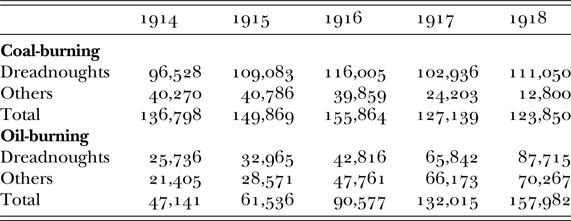
At the outbreak of war in August 1914, Britain had twenty dreadnought battleships in service, while Germany had fifteen, but the maximum capacity of Britain's warships for coal was roughly three times higher than for oil. Thereafter, the maximum oil capacity increased substantially with the addition of the new oil-fired warships. The gap between coal- and oil-fired vessels also widened, as coal-fired ships were destroyed in the war and, by the beginning of 1917, the maximum oil capacity of the fleet surpassed that for coal (Table 4). Meanwhile, monthly oil requirements, over 90 per cent of which was naval, increased more than 2.3 times from 80,500 tons in January 1915 to over 190,000 tons in January 1917.Footnote 107 US oil accounted for over 62 per cent of British imports in 1913, with Romania, Russia, the Dutch East Indies, and Mexico supplying the bulk of the rest. Britain's reliance on American oil grew with the loss of Russian and Romanian oil after the Ottoman Empire entered the war. During the war itself, the Allies received roughly 84 per cent of their oil imports from the United States.Footnote 108 Persian oil, on the other hand, was immaterial.
Maximum coal and oil capacity of warships of British fleet in tons, 1914–18

Note: ‘Others’ include cruisers, light cruisers, leaders, and destroyers.
Source: Sumida, ‘British naval operational’, pp. 462–3.
Germany also did not stop building ships after 1912 – its 1912 Navy Bill sought to grow the fleet to forty-one battleships, twenty large cruisers, and forty light cruisers – but only submarines were converted to only oil before the war. The cited justification was that side coal bunkers added underwater protection to the torpedo bulkheads, but the lack of supplies remained the over-riding concern.Footnote 109 To compensate, Germany developed the process of hydrogenation, whereby hydrocarbon liquids could be extracted from coal. Friedrich Bergius received financial support from the Aktiengesellschaft fur Petroleumindustrie to study the liquefaction of coal for gasoline in 1910 and succeeded in patenting the process by May 1913.Footnote 110 Deutsch Bank also gained a 25 per cent stake in the Turkish Petroleum Company, a consortium established by an Armenian Calouste Gulbenkian to produce oil in Mesopotamia in 1912. The Turkish National Bank (TNB), a British-controlled bank located in Turkey, and Royal Dutch-Shell owned the remaining 50 per cent and 25 per cent, respectively.Footnote 111 There was some threat that Royal Dutch-Shell would buy out the TNB and create a potential German-majority entity, but the British and German governments agreed that the APOC would buy out the TNB in 1914, making Britain the undisputed leader in Middle East oil.Footnote 112 None of Germany's attempts to create oil-supply security – a government-controlled monopoly over its domestic market, diversification of supply, synthetic oil, or Mesopotamian oil – succeeded. It was only able to equip its capital ships and lights cruisers with the capacity to burn oil as an auxiliary fuel in 1915 and 1916, respectively.Footnote 113
Rising oil demand and prices, meanwhile, renewed supply concerns for the US navy in 1912–13. Secretary of the Navy Josephus Daniels, however, gained assurances of supply from the Department of the Interior, and plans to build the oil-powered Nevada battleship continued as planned.Footnote 114 By the end of 1913, the US navy had built or had under construction four battleships, forty-one destroyers, thirty submarines, and several tugs and other smaller vessels that exclusively burned oil. In addition, it had eight battleships, one transport ship, and one supply ship that could use oil an as auxiliary fuel.Footnote 115
To further address supply, Secretary of State William Jennings Bryan urged President Wilson to encourage oil exploration and production in Mexico in 1914, and Mexican exports to the United States rose dramatically during the war.Footnote 116 The US Senate also approved a resolution that directed the secretary of the navy and the secretary of the interior to explore the ‘feasibility, expense, and desirability’ of having a pipeline and refinery built and operated by the government, as well as extending government ownership of oil lands. But Congress never supported the proposals, and the decline in oil prices in 1914–15 reduced their urgency.Footnote 117 Oil prices increased from $0.61/barrel in 1910 and 1911 to $0.74 in 1912 and 0.95 in 1913 and then fell to $0.81 in 1914 and $0.61 in 1915.Footnote 118 In 1916, the navy set up the Fuel Oil Board to assess the supply question. It recommended exploiting Mexican oil, requisitioning lands in Oklahoma from the Osage Indians to explore, and acquiring vast reserves of shale; accordingly, President Wilson withdrew territory in Utah and Colorado for Naval Oil Shale Reserves Nos. 1 and 2.Footnote 119 Nevertheless, the United States entered the First World War in 1917 with the supply question unanswered and even considered converting back to coal after the war.Footnote 120
Oil affected the outcome of the war itself and changed the nature of warfare. On land, the internal combustion engine powered the tanks, airplanes, and transport vehicles of the Allies to victory, whereas the Germans relied on coal-powered railroads, and were unable to marshal resources and troops as efficiently and across multiple fronts.Footnote 121 At sea, the British and German navies only fought once at Jutland in 1916. Germany's larger guns were more effective, but Britain's advantage in numbers and mobility kept Germany's navy at harbour for the rest of the war.Footnote 122 Britain's blockade led to food shortages in Germany, which responded by intensifying submarine warfare against Allied shipping lines in the Atlantic, including against US oil tankers destined for Britain and France.Footnote 123 Thereafter, oil-powered cruisers escorted tankers across the Atlantic.Footnote 124
The commercial use of oil-powered diesel engines for maritime transport also grew dramatically during the war. The United States had 239 oil-burning vessels which required 656,364 gross tons of oil in 1914, but this rose to 1,790 vessels and 8,857,087 gross tons by 1922. Britain went from 121 vessels requiring 558,743 gross tons in 1914 to 601 vessels requiring 3,460,428 gross tons.Footnote 125
IV
This study has demonstrated that strategic factors – geopolitics, military decision-making, and energy security – hastened the transition from coal to oil prior to and during the First World War. After the war, the British, French, and American governments moved to secure oil supplies abroad, most notably in the Middle East, through public–private co-operation.Footnote 126 The resulting surge in supplies in the 1920s and 1930s lowered prices and enabled the transition across the transportation and power sectors.
This study also showed that new dominant energy sources and their accompanying technologies were first accepted in the military transportation sector, after which they entered the commercial transportation sector. The transition from wind to coal-fired steam power in the naval transportation sector occurred nearly as rapidly as the transition from coal to oil. The first steamship crossed the Atlantic in 1838, and Britain launched its first steam-powered battle fleet in 1854 against Russia. This naval transition from wind to coal was also similar to the coal-to-oil transition in that smaller, auxiliary ships were first converted to coal, followed by hybridization of larger vessels, and finally full conversion.Footnote 127
Today, there are two new fuel sources being developed in the United States that could revolutionize the military transportation sector. The first is rechargeable batteries, which create a chemical reaction that provides electricity for vehicles. Tesla, an automobile, energy storage, and solar-panel manufacturer in California, has pioneered the development of this technology and seen dramatic growth in electric vehicle sales. The other possibility is fuel cells, which convert hydrogen, when mixed with oxygen, into electricity. This technology is already available for passenger automobiles, and NASA is using hydrogen as a rocket fuel. It will be worth monitoring whether these fuels replace oil in the naval, air, or land-based transportation sector of the military.
Finally, this study posits a connection between global hegemony and the dominant energy source. Hegemonic Britain led and shaped the global coal industry, but its production peaked in 1913 at 1,478 million short tons.Footnote 128 World coal consumption also peaked at 60 per cent of total world energy use in 1913.Footnote 129 The industry experienced volatility in the interwar period and a brief increase in production before steadily contracting as oil use increased.Footnote 130 The United States became the global hegemon in 1945 and dominated oil production and oil-related industries and technology until US production peaked in 1970, world oil consumption peaked at 50 per cent of total energy consumption in 1973, and the Soviet Union surpassed it as the largest producer in 1975.Footnote 131 Yet by harnessing new technologies – horizontal drilling, hydraulic fracturing with water and acid, and 3D seismic imaging – to exploit its shale oil and gas resources (unconventionals), the United States became the world's largest producer once again. This will extend oil's run as the dominant energy source and should invigorate those most concerned about global warming.