Recent research into second language (L2) acquisition and bilingualism in general suggests that interfaces—that is, areas in which different linguistic modules integrate information—may constitute part of the explanation for many of the issues that have been raised by scholars in recent years regarding interlanguage, such as the use of target and nontarget forms found in bilingual grammars. In particular, it has been argued that phenomena at the interface between modules of the grammar, such as morphology and syntax, and grammar-external components, such as discourse or pragmatics, are quite difficult for learners to acquire (Sorace, Reference Sorace2004; Sorace & Filiaci, Reference Sorace and Filiaci2006), meaning that, even in cases in which the syntax has been acquired, it is possible that the pragmatic interpretation may be impaired; that is, the link between the two modules may be faulty. In more recent work, Sorace (Reference Sorace2011) has argued that it is more difficult for L2 speakers to demonstrate nativelike knowledge with respect to external interfaces because of limited processing capacities. In contrast, grammar-internal interfaces—that is, interfaces between modules of the grammar proper—are easier to acquire and process than grammar-external interfaces, presumably because they do not involve the same high computing costs necessary for relating linguistic properties with pragmatic or discourse information (Sorace, Reference Sorace2011; Tsimpli & Sorace, Reference Tsimpli, Sorace, Bamman, Magmitskaia and Zaller2006). However, recent research also points to difficulties experienced by learners, even at near-native proficiency levels, in mastering properties involving grammar-internal modules, such as morphology and syntax (e.g., Lardiere, Reference Lardiere2007) and (morpho)syntax and semantics (Choi & Lardiere, Reference Choi, Lardiere, Belletti, Bennati, Chesi, Di Domenico and Ferrari2006; Umeda, Reference Umeda2008; Yuan, Reference Yuan, Slabakova, Rothman, Kempchinsky and Gavruseva2008; see White, Reference White2011b, for an overview). To account for interface problems related to semantics, Slabakova (Reference Slabakova2008, Reference Slabakova, Caunt-Nulton, Bowles, Ionin, Montrul and Tremblay2009) proposed the bottleneck hypothesis, according to which the source of the difficulty is not lack of knowledge of semantic properties or features but rather their mapping relationship with target functional morphology.
In this article we examine control of the morphosyntax-semantics interface by adult L2 learners of Spanish. In particular, we focus on the contrast illustrated in (1). In (1a) the verb in the relative clause is realized by way of the indicative, and, in (1b), it is realized by way of the subjunctive. Both moods are grammatical in this context, but the interpretation of the sentence changes when the mood is changed. When the indicative is used (cortan “cut-ind” in [1a]), it is understood that there is a specific pair of scissors that meets the description expressed by the relative clause. For this reason, it is logical to continue the idea by saying that you left them close by, as in the example. However, when the subjunctive corten is used, as in (1b), any particular pair that meets the requirement of cutting wire will do; the existence of the object in question is not presupposed. Therefore the denial of the possible existence of these scissors is logical, but the assumption that you left them somewhere is not.
(1) a.Busco unas tijeras que cortan alambre.
look-for-I some scissors that cut-ind wire
/Creo que las dejé por aquí.
believe-I that them left-I around here
/#Creo que no se fabrican tijeras así de duras.
Believe-I that no refl make scissors that hard
“I am looking for some scissors that cut wire. I think I left them around here/I believe they don’t make scissors that are hard enough.”
b. Busco unas tijeras que corten alambre.
look-for-I some scissors that cut-subj wire
/#Creo que las dejé por aquí.
believe-I that them left-I around here
/Creo que no se fabrican tijeras así de duras.
believe-I that no refl make scissors that hard
“I am looking for some scissors that cut wire. I think I left them around here/I believe they don’t make scissors that are hard enough.”
As the examples in (1) show, the language learner will hear both the indicative and the subjunctive used in situations in which the object denoted by the determiner phrase (DP) is not present in the extralinguistic context. The speaker must somehow learn to associate the use of the indicative with a specific object whose existence the speaker presupposes and the subjunctive with a nonspecific object. The learners’ problem is exacerbated if they speak a first language (L1) that does not mark this semantic distinction in a similar way; this is true of English, as the translations show.
On the basis of our results, we argue that the acquisition of an interface between morphosyntax—in this case the use of the indicative-subjunctive contrast in relative clauses—and semanticsFootnote 1—particularly the specific-nonspecific interpretation of the antecedent DP—is possible (Dekydtspotter, Sprouse, & Swanson, Reference Dekydtspotter, Sprouse and Swanson2001; Montrul & Slabakova, Reference Montrul and Slabakova2003). However, we will show that there is a certain variability in interpretation, not only among the L2 learners but also among monolingual native speakers (NSs). Similar variability has also been found in other studies on interface conditions (Belletti, Bennati, & Sorace, Reference Belletti, Bennati and Sorace2007; Lozano, Reference Lozano2006; Slabakova, Kempchinsky, & Rothman, Reference Slabakova, Kempchinsky and Rothman2012; Sorace & Filiaci, Reference Sorace and Filiaci2006), although it has not received much attention or discussion (but see Slabakova, Rothman, & Kempchinsky, Reference Slabakova, Rothman, Kempchinsky, Roberts, Pallotti and Bettoni2011, which addresses monolingual and L2 interface optionality directly).
BACKGROUND
Language Acquisition and Interfaces
The causes of variability in the interlanguage of L2 learners have been the topic of intense debate for some time now. On one hand, scholars have argued that variability is evidence that the grammar of L2 speakers differs in important ways from that of NSs (e.g., Meisel, Reference Meisel1997). On the other hand, other researchers have argued that the target grammar is, in principle, attainable, but other factors such as transfer from the L1 or mapping difficulties cause a certain amount of instability (Lardiere, Reference Lardiere1998, Reference Lardiere and Archibald2000; Prévost & White, Reference Prévost and White2000). Recently, the questions asked regarding interlanguage grammars have been considerably refined, leading to a greater understanding of the issues involved. In particular, it has been shown that, in many cases, variability is somehow related to internal interfaces—that is, interfaces between modules of the grammar proper—or external ones (i.e., between these modules and external components; White, Reference White, Ritchie and Bhatia2009). Internal modules include, among others, the interfaces between syntax and phonology (Goad, White, & Steele, Reference Goad, White and Steele2003) and syntax and morphology (Haznedar & Schwartz, Reference Haznedar, Schwartz, Hughes, Hughes and Greenhill1997; Ionin & Wexler, Reference Ionin and Wexler2002; Lardiere, Reference Lardiere1998; Prévost & White, Reference Prévost and White2000; White, Reference White2003). The external interfaces have been the subject of a great deal of research, and it has been suggested that, although syntax proper, constrained by Universal Grammar (UG), may be acquired to near-native levels, serious problems may arise when the syntax must interface with external components such as pragmatics. For example, there are now many studies on the production and acceptance of null and overt subjects in pro-drop languages in cases of language contact, including simultaneous bilingualism (Hacohen & Schaeffer, Reference Hacohen and Schaeffer2007; Paradis & Navarro, Reference Paradis and Navarro2003; Serratrice, Reference Serratrice2007; Sorace, Serratrice, Filiaci, & Baldo, Reference Sorace, Serratrice, Filiaci and Baldo2009), L1 attrition (Montrul, Reference Montrul2004; Tsimpli, Sorace, Heycock, & Filiaci, Reference Tsimpli, Sorace, Heycock and Filiaci2004), and L2 acquisition (Belletti et al., Reference Belletti, Bennati and Sorace2007; Montrul & Rodríguez-Louro, Reference Montrul, Rodríguez-Louro, Torrens and Escobar2006; Rothman, Reference Rothman2009; Sorace & Filiaci, Reference Sorace and Filiaci2006). There is general agreement among scholars that the syntax of pro-drop can be (easily) acquired; in other words, different types of speakers come to know that languages such as Italian and Spanish license null subjects. It is argued, however, that speakers in these situations of contact may not be fully aware of the pragmatic constraints that govern the production and interpretation of both overt and null subjects. In particular, speakers tend to overuse overt pronominal subjects in [−topic shift] contexts in which a null subject should be used instead (for a summary of this research, see Sorace, Reference Sorace2011). It is important to note, nevertheless, that, in many studies, NSs do not behave as “ideal” with respect to subject omission, often using it where the rules would predict they should not. They simply do this to a lesser degree. For example, Paradis and Navarro (Reference Paradis and Navarro2003) concluded that it was not possible to tell whether their simultaneous bilingual participant overused subjects because of pressure from the L2, a non-pro-drop language, or because his parents, one of them a NS of Cuban Spanish, also overused them (see Prévost, Reference Prévost2011, for other examples of optionality in NSs involved in studies of interface phenomena).
Although there appears to be some consensus that the syntax-pragmatics interface may be an area of particular vulnerability, if not for ultimate attainment then to some degree for development, research has shown that internal interfaces such as morphosyntax-semantics may also lead to variability, particularly in L2 acquisition but also among NSs. The explanation given is often that the judgments are so subtle that there is bound to be some disagreement. This applies to phenomena at the intersection between syntax and semantics (e.g., in the work of Laurent Dekydtspotter and his colleagues: Dekydtspotter, Sprouse, & Thyre, 1999/2000; Dekydtspotter et al., Reference Dekydtspotter, Sprouse and Swanson2001) and to phenomena involving morphological encoding of semantic primitives, which is the topic of the present article. For instance, several studies have examined the acquisition of determiners by L2 learners (e.g., Ionin, Ko, & Wexler, Reference Ionin, Ko and Wexler2004; Ionin, Montrul, & Crivos, Reference Ionin, Montrul and Crivos2013; Ionin, Zubizarreta, & Philipov, Reference Ionin, Zubizarreta and Philipov2009). Languages differ not only in whether or not they have articles but also regarding which features are encoded by the different articles. For example, both Spanish and English have articles, but their distribution is markedly different, particularly in the case of subjects. English subjects can appear as bare plural noun phrases (NPs), as in (2a), in which case their interpretation is generic (e.g., if it is an individual-level predicate), or as full DPs, as in (2b), in which the interpretation is specific. Spanish, in contrast, generally only allows full DPs in (preverbal) subject position, whether or not the interpretation is generic, as shown in the example in (3). In other words, the distribution of the semantic features of specificity and definiteness are encoded differently in these two languages.
(2) a.Lions are fierce.
b. The lions are fierce.
(3) Los leones son feroces.
the lions are fierce
“Lions/the lions are fierce.”
Ionin et al. (Reference Ionin, Montrul and Crivos2013) carried out a bidirectional study on the acquisition of the use of articles in subject position (see also Cuza, Guijarro-Fuentes, Pires, & Rothman, Reference Cuza, Guijarro-Fuentes, Pires and Rothman2013). Results for the Spanish test showed that the low L2 Spanish group exhibited a strong preference for the specific interpretation of definite plurals, whereas the intermediate and advanced groups patterned in between, choosing the specific interpretation half the time and the generic half the time. Besides this, there were two interesting results. First, the Spanish NSs showed a strong tendency to accept a generic reading in all sentences with definite plurals, a somewhat unexpected result given the ambiguity of DPs in Spanish. Second, of the 28 L2 speakers in the more advanced groups, 14 consistently opted for the specific reading, similar to the NSs, and five chose both. In the same vein, Ionin et al.’s (Reference Ionin, Zubizarreta and Philipov2009) study of the acquisition of English articles by speakers of languages without determiners (Korean and Russian) showed the tendency to overuse and overaccept definite articles where specific indefinites were required and to overaccept indefinite articles where nonspecific definites were expected, again pointing to a difficulty with the morphosyntax-semantics interface. It can be concluded that, although phenomena at the morphosyntax-semantics interface can be acquired, L2 learners, as well as NSs, may have a tendency not to “see” certain ambiguities that are permitted by the language.
For Slabakova (Reference Slabakova2008, Reference Slabakova, Caunt-Nulton, Bowles, Ionin, Montrul and Tremblay2009), functional morphology is the bottleneck of L2 acquisition. Semantic primitives, as well as morphosyntactic features and categories, are acquired “easily,” presumably because they are universally available to learners, via UG. In contrast, functional morphology is language specific, not only because morphological forms marking similar linguistic features may differ from language to language but also because formal features are not always marked overtly across languages. Thus, one of the difficulties facing L2 learners is the acquisition of a mapping relationship between a feature and a piece of morphology in the L2, whereas the same feature receives no morphological marking in the L1 (see also Lardiere, Reference Lardiere and Archibald2000, Reference Lardiere2007).
As we can see from the studies just reviewed, as well as in other studies addressing the acquisition of interface phenomena (see Prévost, Reference Prévost2011), significant differences may be found between the performance of NSs and that of L2 learners, even near-native speakers, on a given task. This usually takes the form of variability in the performance of the learners, such that both the hypothesized targetlike and nontargetlike options are used or accepted by them. However, in many cases, the difference is simply a matter of gradience of variability. In other words, it is not always the case that the NSs strongly reject the nontargetlike option; they may accept it as well as the targetlike option, but to a lower extent than the learners. Because variability can be found in NSs as well as in L2 learners, variability per se as observed in L2 acquisition should not always be equated with grammatical deficiency in the sense of interlanguage grammars being fundamentally different from native grammars. We now turn to relative clauses, in which morphosyntax signals a semantic interpretation.
Mood in Relative Clauses
Relative clauses in Spanish—as is the case in Romance languages in general as well as in languages from other families, such as Greek—can appear with a verb in the indicative or the subjunctive mood, as shown in (4).
(4) El bailarín que hace / haga nueve piruetas será contratado.
the dancer that does-ind / does-subj nine pirouettes will-be hired
“The dancer who does nine pirouettes will be hired immediately.”
Mood in these cases is clearly not selected, given that both the indicative and subjunctive are possible in identical contexts; the choice of mood depends on the interpretation of the DP modified by the relative. According to most analyses of relative mood (starting with Rivero, Reference Rivero1975, Reference Rivero1977), mood correlates with (non)specificity in the following way: A DP with a relative clause verb in the indicative is specific, whereas it is nonspecific if the relative clause verb is in the subjunctive. In the example in (4), for instance, the indicative signals that a specific, identified dancer capable of nine pirouettes will be hired, whereas the use of the subjunctive signals that the DP is nonreferential and receives, in this case, a free-choice reading; any dancer capable of doing nine pirouettes will be hired, although it is possible that there is no one who meets the condition. Relative clauses, then, differ from (most cases of) complement clauses in this regard: In complement clauses, a higher head lexically selects one or the other mood, and use of the wrong mood entails ungrammaticality. Modal choice in relatives is associated with interpretation, and selection (requiring a governing head) plays no part in the phenomenon.
Specificity
The notion of specificity is problematic (both descriptively and explanatorily), and, as a result, many competing accounts of it have been given, in both semantic and pragmatic terms. Farkas has argued in recent papers (Farkas, Reference Farkas, von Heusinger and Egli2000, Reference Farkas, Condoravdi and Renardel2001, Reference Farkas2002) that specificity is an epiphenomenon, an umbrella that covers a family of distinctions that are not always encoded grammatically, as our Spanish-English comparison will show. Within this family of specificity distinctions, the scopal cases are the most prominent, and they constitute the basis for our experimental design.Footnote 2
Specific-nonspecific is a distinction that applies to indefinite DPs; the evidence is far weaker in the case of definite DPs, and we do not discuss it here. Definite DPs typically have a unique, identifiable, and identified referent. Indefinites, in contrast, do not always have a determinate reference; when they do not, they are nonspecific. The example in (5a) receives a specific interpretation; the example in (5b) is ambiguous between the two interpretations:
(5) a.I talked to a vicar this morning. (Specific indefinite)
b. I need a vicar to discuss some doctrinal problems. ([Non]specific indefinite)
Specificity is invoked in at least three different cases: scopal specificity, epistemic specificity, and partitivity. The last two types are not addressed in this article, for reasons discussed in the next paragraphs.
Epistemic nonspecificity has been invoked in episodic contexts such as in the example in (6).
(6) One of the students in the class plagiarized his paper but we don’t know which one.
In (6), there is no operator with regard to which scopal relationship with the DP could be established. The verb is in the preterit, a perfective past tense, which guarantees that the sentence is episodic. The continuation cancels the presupposition of speaker knowledge of the referent of the DP, and it is on the basis of cases similar to this that some linguists have built a case for epistemic specificity (Farkas, Reference Farkas, von Heusinger and Egli2000; Leonetti Jungl, Reference Leonetti Jungl, Bosque and Demonte1999). Other research (see Geurts, Reference Geurts, Bäuerle, Reyle and Zimmermann2001; Leonetti Jungl, 2003; among others) has argued that a speaker’s having a referent in mind is not a sufficient condition for establishing specificity, but this is not a universally accepted view. In the research we report here, we have exclusively tested indefinite DPs in the presence of operators. However, even though we have not tested cases of epistemic nonspecific indefinites, the existence of examples such as (6) points to an interesting division of labor between mood and interpretation that we exploit when discussing our results. In these cases, the DP is modified by a relative clause in the indicative, as we see in (7):
(7) Uno de los alumnos que se sienta / *siente en el fondo plagió su trabajo,
one of the students that refl sit-ind / sit-subj in the back plagiarized his work
pero no sabemos cuál.
but not know-1pl which
“One of the students who sits in the back plagiarized his paper, but we don’t know which one.”
As for partitivity, Enç (Reference Enç1991) proposes an influential analysis of specificity based on this notion, but there is no agreement about partitivity being the central property present in all specific interpretations. If one follows the Farkas (Reference Farkas2002) line of thought, partitivity is another way of obtaining a specific interpretation and is not necessarily one of its defining traits. We can safely ignore these cases, which have not informed our experimental design.
We now turn to scopal specificity. If the reference of an indefinite is fixed independently of an operator present in the proposition, the indefinite picks out a referent in the real world; it is hence specific. If, in contrast, the indefinite’s reference varies with each world that the operator introduces, it will be labeled nonspecific. Technically, in cases such as these, specificity is defined in terms of relative scope or semantic field of action: If the indefinite has wider scope than the operator, it is interpreted as being [+specific], and if it has lower scope, it is nonspecific. Consider the example in (8), with the strong intensional verb want acting as the required operator:
(8) a.Sylvie wants to wear a red tutu (that does not give her the hiccups).
b. ∃x : red tutu (x) and Want (Sylvie, to wear x)
b’. Want [∃x : red tutu (x) and Wear (Sylvie, x)]
Under the reading in (8b), with the existential quantifier scoping above the operator introduced by want, the DP denotes a particular entity whose existence is presupposed. In (8b’), with the existential quantifier introducing the indefinite scoping below the operator, the DP refers to any entity that satisfies the description red tutu (that does not give her the hiccups). Want introduces a multiplicity of worlds (to simplify a complex literature, we can describe the worlds in question as those with an epistemic modal base and a bouletic ordering source anchored on Sylvie; see Giannakidou, Reference Giannakidou, Musan and Rathert2011, for example). If the indefinite takes narrow scope, the reference of the indefinite can vary in each of these worlds; any red tutu that satisfies the description may be worn, and the possibility exists of there being no individual tutu with the required characteristics. If the indefinite takes a wide scope, its reference will be anchored to one world, that which models the real one, and a single entity will be picked. The example in (8a) is ambiguous in English but not in Spanish. In Spanish, it has to be translated in either of the two following ways, (9a) or (9b); the two interpretations are thus disambiguated by mood:
(9) a.Silvia quiere ponerse un tutú rojo que no le da hipo.
Silvia wants put-on a tutu red that not pron-dat gives-ind hiccups
b. Silvia quiere ponerse un tutú rojo que no le dé hipo.
Silvia wants put-on a tutu red that not pron-dat gives-subj hiccups
“Silvia wants to wear a red tutu that doesn’t give her the hiccups.”
Under a syntactic view of the relationship among mood, interpretation, and scope, mood can be analyzed as a logical form (LF) mapping instruction: The indicative forces LF movement of the DP + subordinate clause to a higher clausal position outside of the scope of the operator; the subjunctive is an instruction not to move, and the result is an in situ interpretation with narrow scope. The syntactic scopal approach to mood alternations in Romance subordinate clauses has been developed in Brugger and D’Angelo (Reference Brugger and D’Angelo1995), Uribe-Etxebarria (Reference Uribe-Etxebarria1994), and others. It is immaterial to us whether movement targets categories or features, as in Chomsky (Reference Chomsky and Kenstowicz2001); what was said in the preceding paragraphs can easily be translated into a feature-movement approach.
In the absence of the relevant operator, it follows that indefinite DPs receive a specific reading (unless the second member of the family, epistemic specificity, is invoked). In most episodic sentences, indefinites are interpreted specifically; the sentence in (10a), for example, says that there is a man wearing a purple hat and that I met him; the Spanish equivalent can only be constructed in the indicative (10b):
(10) a.I met a man who was wearing a purple hat.
b. Conocí a un hombre que llevaba- ind/ *llevara- subjun sombrero violeta.
To anticipate the Discussion section, we note that the subjunctive encodes nonspecificity semantically; there are no specific DPs modified by subjunctive relatives. The indicative, in contrast, is the unmarked member of the pair. It does not encode specificity semantically; it is the default form.
We now return to the central cases involved in licensing nonspecific indefinites, those defined scopally. It follows from the preceding discussion that nonspecific interpretations are always possible in the contexts in which the semantic analysis demands an operator, with regard to which the indefinite can have narrow or wide scope. A relatively exhaustive list of such contexts includes negatives and interrogatives (11a–b); imperative verbs (11c); strong intensional predicates, as defined in Farkas (Reference Farkas1982) and following work (11d); protases of conditional periods (11e); modal verbs (11f); and sentences in the future (11g). See the following examples; in these examples each DP is modified by a subjunctive relative.
(11) a.No veo ningún piso que me convenga- subj.
“I don’t see any apartment that suits me.”
b. ¿Ves un piso que te convenga- subj?
“Do you see an apartment that suits you?”
c. ¡Alquila un piso que te convenga- subjde una vez!
“Rent an apartment that suits you, once and for all!”
d. Te sugiero que alquiles un piso que te convenga- subj.
“I suggest you rent an apartment that suits you.”
e. Si encuentras un piso que te convenga- subj, alquílalo de inmediato.
“If you find an apartment that suits you, rent it immediately.”
f. En este barrio puedes encontrar un piso que te convenga- subj.
“In this neighborhood you may find an apartment that suits you.”
g. Ignoraré los pisos que me convengan- subj.
“I’ll ignore the apartments that suit me.”
The DPs are all interpreted as nonspecific, as intended. As shown in these examples, the co-relation between nonspecificity and subjunctive relatives is strong. Of course, a specific interpretation would also be possible if the relative were in the indicative; mood can alternate here (except with certain DPs introduced by a negative determiner), with the concomitant interpretation of the DP.
In episodic sentences (i.e., sentences that are not modalized and in which, by hypothesis, no intensional operators are present), indefinite DPs are interpreted specifically (modulo the examples of epistemic nonspecificity mentioned in the preceding section). The preterit in Spanish is a superrealis tense that does not receive a modal analysis (see Arregui, Reference Arregui2005; Borgonovo & Cummins, Reference Borgonovo, Cummins, Eguren and Fernández Soriano2007; and others); neither does the perfect in Iberian dialects. Sentences with a verb in the preterit (or the perfect) existentially quantify over a single event, hence the episodic interpretation. In such sentences, the interpretation of the DP is specific, and subjunctive relatives are predicted to be ungrammatical, which obtains, as illustrated in (12).Footnote 3
(12) a.Compró un piso que le *conviniera / convenía.
bought-pret an apartment that him-dat suited-impf.subj / suited-impf.ind
“He bought an apartment that suited him.”
b. Ya he visto un piso que me conviene. ind/ *convenga. subj
already have-pres seen an apartment that me-dat suits-ind / suits-subj
“I have seen an apartment that suits me.”
The Interpretation of Indicative Mood
As anticipated, several authors, among them Leonetti Jungl (1999), claim that the subjunctive is semantically linked to nonspecificity, but the indicative, the unmarked member of the modal pair, is not necessarily linked to the opposite interpretation. This observation is on the right track, though it is infrequently mentioned in the literature. As examples of the indicative appearing with nonspecific DPs, we can point to generic DPs, which are clearly nonspecific, that may appear with a relative in the indicative (for this reason, they were excluded from this study); see also the examples in (12), in which an epistemically nonspecific DP is modified by an indicative relative.
It has been observed (in Horn, Reference Horn1995, and others) that whenever there is an opposition in the grammar, the unmarked member of the pair (the indicative, in our case) tends to take on the meanings not signaled by the marked member (the subjunctive, in our case). The subjunctive is semantically linked to nonspecific interpretations; the indicative, being underspecified for specificity, is the default mood. Our results confirm this view. Positing a strong co-relation between specificity and the indicative helps explain some of our results in which the link between the indicative and specificity is much stronger than we would expect if the indicative were absolutely indifferent to the interpretation of the DP but is still not as strong as the link between the subjunctive and nonspecificity, which is dictated by semantics.
Summarizing this section, we can conclude that the subjunctive in the relative clause signals nonspecificity of the DP, and this signaling is established in the semantics; the indicative tends to co-relate with a specific interpretation of the DP, but this is a tendency and, hence, is not exception-free.
Additional Factors: Differential Object Marking
Spanish does not treat all objects equally. When the object refers to a [+human] entity, it may be marked by the dative preposition a. If it is so marked, it is obligatorily interpreted as specific. Nonspecific objects are left unmarked, as are nonanimate objects, such as in (13). When the determiner is indefinite, the marking is obligatory if the verb is telic but optional if it is not (Torrego, Reference Torrego1998), as in (14).
(13) a.Vi a la mujer que se postuló para el puesto.
saw-1sg.Sa the woman that applied for the job
“I saw the woman who applied for the job.”
b. Vi (*a) el libro que dejaste en la mesa.
saw-1sg.S (*a) the book that left.2sgS on the table
“I saw the book that you left on the table.”
(14) a.Detuvieron *(a) unos inmigrantes.
detained-3pl.S some immigrants
“They detained some immigrants.”
b. Conocieron (a) unos inmigrantes.
met-3pl.S some immigrants
“They met some immigrants.”
It is clear that the presence of differential object marking, given its correlation with specificity, strongly implies the use of the indicative in any relative clause that modifies the object, as shown in (13). However, as usual, things are not so straightforward. The presence of the subjunctive with a personal a is not totally ruled out, as shown in (15). These sentences have not been remarked on in the literature. It would seem that the use of an intensional context, such as the future, trumps the presence of differential object marking in the interpretation. Because of these problems, we have not included contrasts related to differential object marking in our tests.
(15) Contrataremos a un profesor que sea competente, cueste lo que cueste.
employ-1pl.S.fut.a a professor that be-3sg.S.subj competent, cost what it costs
“We will employ a professor who is competent, whatever the cost.”
The Subjunctive in English
As is well known, the use of the subjunctive in English has declined over the course of its history (see Jespersen, Reference Jespersen1965). According to Berk (Reference Berk1999), besides the use of the subjunctive in formulaic expressions (e.g., Be that as it may), the subjunctive is used in mandatory (e.g., I insist that you be quiet) and volitional (e.g., He wishes he were rich) contexts and, in most cases, can be replaced by the indicative (e.g., He wishes he was rich).Footnote 4 It is clear that the subjunctive is never used in relative clauses to distinguish the specificity of the antecedent (e.g., *I need a book that be not too expensive). The issue is, therefore, whether learners for whom mood is not overtly marked in their L1 can acquire the morphological marking based on specificity in Spanish.
RESEARCH QUESTIONS
The present study was guided by these four research questions:
1. Overall, do the NSs behave in a manner consistent with a representation of mood in which the subjunctive is associated with nonspecific antecedents and the indicative has a tendency to be interpreted as referring to specific antecedents?
2. Overall, do the L2 learners behave in a manner consistent with a representation of mood in which the subjunctive is associated with nonspecific antecedents and the indicative has a tendency to be interpreted as referring to specific antecedents?
3. Regarding specific and nonspecific antecedents, are the responses of the NSs similar across contexts (i.e., strong intensionals, future conditions, negation, interrogatives, imperatives, and modals), or is there variation among contexts?
4. Regarding specific and nonspecific antecedents, are the responses of the L2 learners similar across contexts (i.e., strong intensionals, future, negation, interrogatives, imperatives, and modals), or is there variation among contexts?
L2 ACQUISITION OF MODAL CONTRASTS
Modal contrasts in relative clauses should, in principle, be difficult to acquire (or be vulnerable to residual optionality for processing reasons, in Sorace’s terms; Sorace, Reference Sorace2011; Sorace et al., Reference Sorace, Serratrice, Filiaci and Baldo2009) precisely because grammaticality is not always at stake: In (4) and (11a–g), both moods are grammatical, in contrast to (10). Because mood marks interpretation, the relevant evidence for acquiring the distinction is much harder to come by for the L2 learner. Although choice of mood is taught explicitly in foreign language Spanish courses at almost all levels, the effectiveness of the methodology generally used is doubtful. More than 15 books that we examined followed the same path for the teaching of relative clauses. First, students read a short explanation such as, “You will now learn how the subjunctive can be used in adjective clauses to express that the existence of someone or something is uncertain or indefinite” (Blanco & Donley, Reference Blanco and Donley2005, p. 434). This is followed by more detailed explanations, with examples that contrast the use of the subjunctive and the indicative but in which no context is supplied. Finally, we find exercises that may include filling the blanks with the correct form in sentences without context, sentences formed from a list of words, and classified ads that do, in fact, provide a context. After around two pages, we move on to some other grammar point. The use of examples and exercises without context is particularly counterproductive, the impression being that the use of the two moods in relative clauses is arbitrary, particularly in view of the fact that most students do not know what adjective clauses are or what indefinite existence may be. The dismal results of this approach to teaching have been noted in the literature, for example, in work by Collentine (Reference Collentine1995, Reference Collentine, Lafford and Salaberry2003).
It is well known that L2 learners struggle with the subjunctive. Collentine (Reference Collentine1995, Reference Collentine, Lafford and Salaberry2003) reports that in L2 Spanish, learners have difficulties using the subjunctive in clausal complements of verbs expressing doubt, denial, or emotion as well as in relative clauses. Incidentally, these are contexts in which there is variability in NSs, and they are the first lost in attrition (Quer, Reference Quer1998). Nevertheless, learners can reach nativelike command of the subjunctive in other contexts, such as argument clauses selected by volitional and directive predicates in which there is no mood choice. Quer (Reference Quer1998, Reference Quer, Costa and Freitas2002) suggests an explanation in terms of economy. For him, the fact that some predicates require subjunctive in their complements is probably grammatically encoded by the computational system. In contrast, mood selection triggered by operators or background information is not. According to economy considerations, Quer argues, grammatical encoding is cheaper than resorting to interpretive procedures or to discourse storage knowledge. Translated into acquisitional terms, this means that grammatically encoded dependencies are acquired first, whereas other dependencies—those deemed vulnerable in the sense of Sorace (e.g., Sorace, Reference Sorace2011; Sorace et al., Reference Sorace, Serratrice, Filiaci and Baldo2009)—develop later, if at all.
Yet dependencies triggered by operators or background information can be acquired by L2 learners, as suggested by Borgonovo and Prévost (Reference Borgonovo, Prévost, Beachley, Brown and Conlin2003). They investigated knowledge of the polarity subjunctive (Stowell, Reference Stowell1993) in verbal complements in Spanish by French-speaking learners. The polarity subjunctive can be licensed by the presence of an operator such as negation or interrogation that takes under its scope a verb that normally selects indicative, as in (16).
(16) No dijo que habías / hubieras venido aquí.
neg say that had-ind / had-subj come here
“(S)he didn’t say you had come here.”
Just like mood choice in relative clauses, this phenomenon is dependent on interpretation because mood selection relates to the presuppositional status of the embedded clause, with indicative signaling that the speaker presupposes the lower proposition and subjunctive indicating a lack of presupposition. Both Spanish and French exhibit the polarity subjunctive but not in the same contexts. In Spanish, the polarity subjunctive is licensed with epistemic verbs (e.g., creer “believe”), perception verbs (e.g., ver “see”), and communication verbs (e.g., decir “say”), as in (16). In French, only negated matrix epistemics license the polarity subjunctive in the embedded clause; with perception and communication verbs, the indicative is the only option. Results from a truth-value judgment task show that the most advanced learners performed within the range of NSs: They accepted the subjunctive and rejected the indicative with predicates that do not license the subjunctive in their L1. These results have well-known consequences with regard to the role of UG in L2 acquisition (see Dekydtspotter et al., Reference Dekydtspotter, Sprouse and Swanson2001; Dekydtspotter et al., 1999/2000): They suggest that L2 learners can reach a near-native level of competence.
The present study pursues this line of research by looking at the acquisition of mood selection in another context in which mood choice is not lexically selected—namely, relative clauses. What is interesting here, in comparison to our previous research, is that the learners’ L1, English, does not exhibit the subjunctive, so the contrasts we have discussed cannot be overtly marked. In particular, nonspecific interpretations of DPs are not marked by the verb’s morphology in English. Learners are tested on the connection between mood and interpretation by having to choose the most appropriate sentence according to a given context. The test sentences exemplify the conditions (i.e., the presence of different types of modal operators, such as negation and modals, among others shown in the examples in [11]) identified in the Specificity section. Following the literature on the L2 acquisition of interfaces previously reviewed, we predict that targetlike mood choice can be attained in L2 acquisition, although we also expect a certain degree of variability given that internal interfaces such as the morphosyntax-semantics interface have been shown to not be entirely free of problems. In other words, when confronted with a specific or nonspecific context, the learners, at least at an advanced level, will know which mood—indicative or subjunctive—is appropriate.
METHODOLOGY
Participants
Thirty-eight English-speaking learners and 36 NSs of Spanish were involved in our study. The learners all reported having started learning Spanish as adults, at a mean age of 18.2. Their proficiency level in Spanish was established via a multiple-choice task (the reading/vocabulary section of the MLA Cooperative Foreign Language Test [Educational Testing Service, Princeton, NJ] and a cloze test from the Diploma de Español como Lengua Extranjera [Spanish Embassy, Washington, DC]). On the basis of the results of these tests, the learners were divided into two groups: an intermediate group (n = 16) and an advanced group (n = 22). The advanced learners were aged 32 (SD = 11.7 years) on average and started learning Spanish at a mean age of 19 (SD = 9.9 years). Therefore, they had been using Spanish for about 13 years at the time of testing. The mean age of the intermediate learners was 23.2 (SD = 6.9 years). Their mean age of onset for L2 acquisition of Spanish was 17.1 (SD = 8.0 years), so they had been practicing their L2 for about 6 years at the time of testing.
The 36 NSs of Spanish came from various countries in Central and South America, including Chile (n = 1), Colombia (n = 11), Costa Rica (n = 1), El Salvador (n = 1), Mexico (n = 20), Peru (n = 1), and Venezuela (n = 1). The inclusion of different varieties of Spanish was meant to cancel out potential dialectal effects. Nine of the 20 Mexican speakers were tested in Mexico, and the rest of the NSs were tested in the Canadian regions of Quebec City and London, Ontario.Footnote 5 Details on the participants are summarized in Table 1.
Participants’ information

Tests
The participants were administered a grammaticality judgment (GJ) task and an appropriateness judgment (AJ) task, both focusing on mood selection. The present tense was used in both tests. All participants first took a mood-recognition test; the purpose of this task was to make sure that they were able to distinguish the subjunctive and the indicative forms of the verbs involved in the two main tasks. The participants all scored above 90% correct in this task.
Grammaticality Judgment Task
The GJ task comprised 24 biclausal sentences in which the lower verb appeared either in a complement lexically selected (n = 12) by the main verb or in a relative clause (n = 12). Half of the lower clauses displayed the verb in the subjunctive and half in the indicative. The participants were asked to judge the grammaticality of each sentence on a 5-point scale, from −2 (completely ungrammatical) to +2 (completely grammatical). In the instructions, the participants were told to interpret 0 as “I don’t know” and to try to avoid this response as much as possible. In lexical selection, the main clause involved volitional and directive predicates, such as querer “want” and ordenar “order,” which obligatorily select the subjunctive; lower verbs in the indicative were therefore ungrammatical. This is illustrated in (17). No filler sentences were included in this test.
(17) a.Quiero que mi nuevo coche no cueste /*cuesta mucho.
want-I that my new car not cost-subj / cost-ind much
“I want my new car to be cheap.”
b. Le ordeno que haga / *hace la tarea ya mismo.
him-dat order-I that make-subj / *make-ind the homework right away
“I order him to do his homework right away.”
In the sentences exhibiting a relative clause, the context was episodic, which means that the indicative was the only acceptable mood (see the example [10]). Therefore, there was no mood choice possible in either sentence type. The objective of this task was to determine whether the learners were able to tease the two moods apart.
Appropriateness Judgment Task
The AJ task contained 36 scenarios (given in the learners’ L1) followed by two sentences in Spanish, one displaying a relative in the subjunctive, the other in the indicative.Footnote 6 The scenarios were meant to establish the specific versus nonspecific status of the DP. The participants had to decide, for each sentence, whether or not it appropriately corresponded to the situation described in the scenario. Judgments were given on a 5-point scale (from −2 to +2). In the instructions, the participants were told to interpret 0 as “I don’t know” and to try to avoid this response as much as possible. All sentences were grammatical in Spanish. Six conditions were investigated: strong intensional, future, negation, interrogative, imperative, and modal conditions (recall the examples in [11]). The examples in (18) and (19) illustrate the strong intensional and interrogative conditions with appropriate indicatives and subjunctives (for further examples, see the Appendix).
(18) It is Marisol’s birthday. Her friends don’t know what to get her, so they ask her boyfriend. He saw a perfume advertised on TV, and he knows she wants it. He says:
a. Marisol quiere un perfume que anuncien en la televisión.
M. wants a perfume that announce-subj on the television
b. Marisol quiere un perfume que anuncian en la televisión.
M. wants a perfume that announce-ind on the television
(19) I must spend a week in a hotel, but I cannot leave my dog alone at home. The problem is that most hotels don’t allow pets in the rooms. I ask a friend of mine:
a. ¿Conoces un hotel que acepte perros?
know-you a hotel that accept-subj dogs
b. ¿Conoces un hotel que acepta perros?
know-you a hotel that accept-ind dogs
Note that all relative heads were introduced by an indefinite determiner, because use of a definite article may have biased the learners in favor of the indicative. Furthermore, the test contained no filler items. Finally, we claim that, although the context is important for the establishment of the specific or nonspecific interpretation of the DP in the AJ task, what we are investigating here is the morphology-semantics interface. Specificity, as argued for previously in this article, is defined in terms of scopal relations: If a DP is under the scope of an operator explicitly introduced in the target sentence, it is nonspecific; if the DP scopes over the operator, it receives a specific construal. In Spanish, a relative modifying a DP in the first case will be in the subjunctive, and it will be in the indicative in the second case. The crucial relation is one established between a certain semantic representation (i.e., relative scope) and mood; it involves an internal interface. The context is needed to target a particular semantic representation, one that learners need to associate with a particular mood in Spanish. In this respect, we can safely claim that we are studying an internal interface. Recent important (and very necessary) discussions have focused on clarifying what we mean when we talk about interfaces in L2 studies and to what extent context must always be present in experimental design, even when purely formal features are being tested (e.g., see Pérez Leroux, 2011; Schwartz, Reference Schwartz2011). The issue is far from settled, but we believe that our work contributes to this discussion.
RESULTS
We first report on the results of the GJ task and then present the results of the AJ test. Because of the small size of the groups and lack of normal distribution throughout the variables, nonparametric statistical tests were run on our populations—the Mann-Whitney U-test for independent measures and the Wilcoxon test for dependent measures.
Grammaticality Judgment Task
There were two main sentence types in the GJ task, as illustrated previously in (18): 12 with an embedded clause lexically selected by the verb in which subjunctive was the grammatical mood, and 12 with a relative clause in an episodic context in which indicative is the grammatical option.
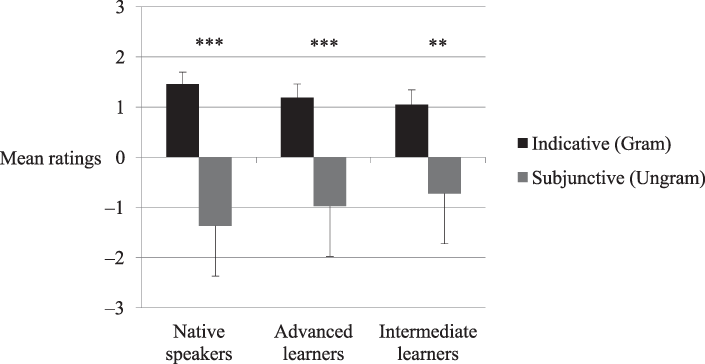
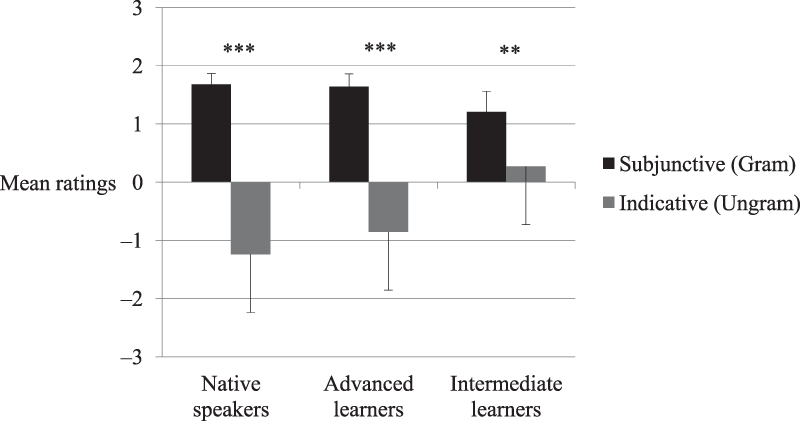
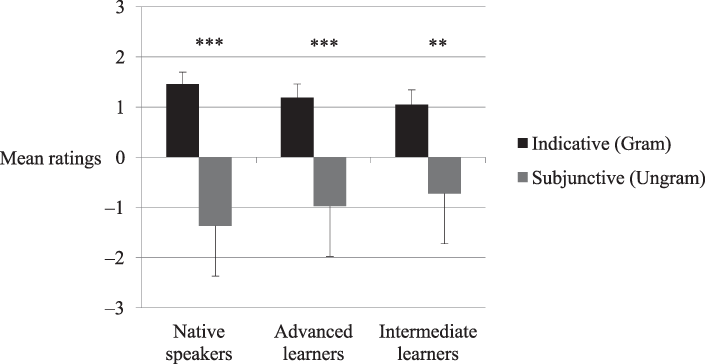
As shown in Figures 1 and 2, the results from the NSs and the advanced learners were targetlike with both sentence types, in that the grammatical mood was accepted and the ungrammatical mood rejected. There was also a significant difference between the acceptance scores of the grammatical and ungrammatical moods in each of the two contexts: episodics and lexical selection. However, the advanced learners performed significantly worse than the NSs on episodics, especially on rejection of ungrammatical subjunctives (indicative grammatical: U = 278.5, p = .058; subjunctive ungrammatical: U = 260.5, p = .028), whereas no significant difference was found between the two groups on lexical selection (subjunctive grammatical: U = 358, p = .477; indicative ungrammatical: U = 288.5, p = .083). Turning to the intermediate learners, we can see that they made the distinction between the indicative and the subjunctive in episodic contexts (Figure 1; with a highly significant preference for the indicative) but that, with lexical selection, the difference was not clearly made to the same extent (although it was still significant; Figure 2). In particular, whereas the intermediate learners correctly accepted the subjunctive in these contexts (M = 1.21), they also accepted the indicative (M = 0.27), which is ungrammatical in Spanish. Such was not the case of the advanced learners, who rejected the indicative (M = −0.86), which suggests that the learners’ performance becomes more targetlike as proficiency increases. This is confirmed by the fact that all conditions yielded significant differences between the intermediate learners and the controls (indicative grammatical: U = 175.0, p = .024; subjunctive ungrammatical: U = 142.5, p = .004; subjunctive grammatical: U = 171.5, p = .017; indicative ungrammatical: U = 45.0, p < .001). Moreover, two important differences were found between the advanced learners and the intermediates, one significant (with indicative ungrammatical: U = 68.5, p < .001) and the other one nearly significant (with subjunctive grammatical: U = 110.0, p = .052).
Mean responses on episodic contexts (GJ task; target: indicative), showing significant differences between grammatical (Gram) and ungrammatical (Ungram) moods (Wilcoxon tests). ***p < .001; **p < .01.
Mean responses on lexical selection contexts (GJ task; target: subjunctive), showing significant differences between grammatical (Gram) and ungrammatical (Ungram) moods (Wilcoxon tests). ***p < .001; **p < .01.

Finally, all groups clearly distinguished, for each mood, between grammatical and ungrammatical use. The statistical difference was higher for the NS and advanced learner groups for both indicative grammatical versus ungrammatical (NSs: z = −5.23, p < .001; advanced learners: z = −4.03, p < .001) and subjunctive grammatical versus ungrammatical (NSs: z = −5.24, p < .001; advanced learners: z = −4.12, p < . 001) than for the intermediate learners (indicative grammatical vs. ungrammatical: z = −2.38, p = .017; subjunctive grammatical vs. ungrammatical: z = −3.36, p < .001).
Despite the difference between the intermediate and the advanced learners, the results clearly indicate that all learners were able to distinguish between the two moods. This is obvious in the case of the advanced group, but it is also true of the intermediates. This is shown by their performance on episodics, for which the subjunctive was clearly rejected. In other words, as further indicated by their results on the recognition task, all learners were able to recognize subjunctive forms, despite the fact that the subjunctive is lacking in their L1, and were able to decide whether or not they were appropriate in episodic contexts. Their poorest performance in lexical selection contexts is surprising, given what has been said previously about lexically selected subjunctive being acquired earlier. We do not have an explanation for these results except for the fact that we used a wide variety of subordinating verbs, and among them there might have been some not yet acquired.
Appropriateness Judgment Task
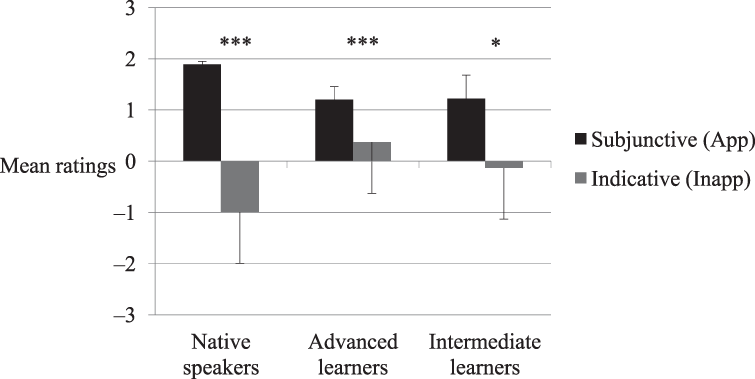
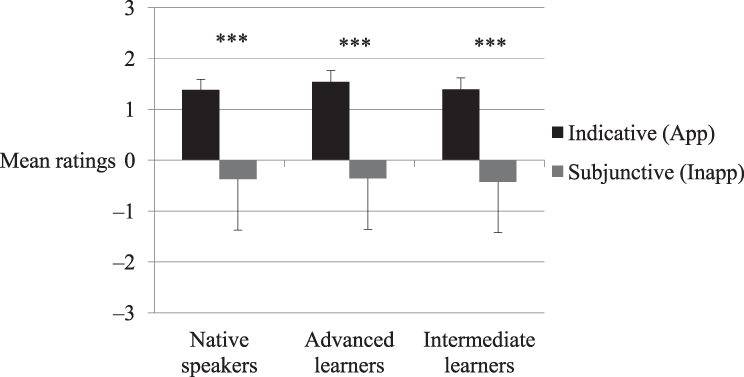
The general results of the AJ task are given in Figures 3 and 4. Two main contexts are involved that depend on the specificity status of the DP. With a nonspecific DP, the subjunctive is appropriate; when the DP is specific, the appropriate mood is the indicative.
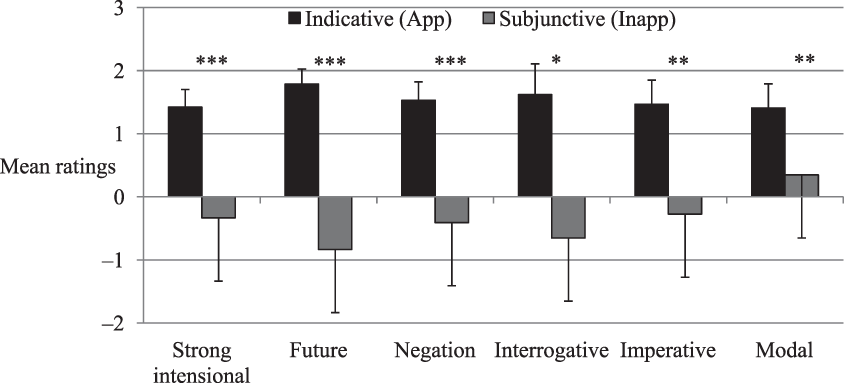
General mean responses on nonspecific contexts (AJ task; target: subjunctive), showing significant differences between appropriate (App) and inappropriate (Inapp) moods (Wilcoxon tests). ***p < .001; *p < .05.
General mean responses on specific contexts (AJ task; target: indicative), showing significant differences between appropriate (App) and inappropriate (Inapp) moods (Wilcoxon tests). ***p < .001.
The responses given by the NSs were as expected. In each case, the difference between the appropriate and inappropriate mood was highly significant. Nevertheless, the rejection level of the inappropriate mood was higher with the indicative (with nonspecific DPs; Figure 3) than with the subjunctive (with specific DPs; Figure 4; −1.00 vs. −0.37; z = −4.52, p < .001). As will become clear subsequently, this mainly concerned the interrogative, imperative, and modal conditions.
The learners made targetlike distinctions between the two moods in nonspecific contexts (Figure 3), as they accepted the subjunctive significantly more often than the indicative. However, they did not reject the indicative to a high extent; this was especially true for the advanced learners, who tended to accept it (M = 0.37; SD = 0.81). In other words, there was variability. Note that the difference between the advanced and the intermediate learners on the indicative in nonspecific contexts (0.37 vs. −0.18) was nearly significant, which suggests that there was no strong improvement with proficiency (U = 113.5, p = .064). The picture is different with specific DPs, in which the indicative is appropriate (Figure 4). There, not only did the learners correctly accept the indicative and reject the subjunctive, but the rejection rate of inappropriate subjunctives was also higher than the rejection rate of inappropriate indicatives in nonspecific contexts (advanced learners: −0.36 vs. 0.37; intermediate learners: −0.42 vs. −0.13). The difference was statistically significant in the case of the advanced learners (z = −3.36, p < .001) but not in the case of the intermediates (z = −0.62, p = .535). Note also that there was no improvement with proficiency in regard to rejection of inappropriate subjunctives (U = 175.0, p = .988).
When we compared appropriate and inappropriate use of the two moods, we found that the difference was significant throughout for each group, although the difference was stronger for the NSs and the advanced learners (NSs: z = −5.52, p < .001; advanced learners: z = 4.11, p < .001) than for the intermediate learners (z = −3.36, p < .001).
In sum, all groups made the distinction between appropriate and inappropriate moods, even though the learners found it easier to reject inappropriate subjunctives than inappropriate indicatives. Moreover, there was a slight improvement with proficiency, although the results of the advanced and intermediate learners were not significantly different. We now turn to more detailed results on nonspecific and specific contexts.
Nonspecific Contexts
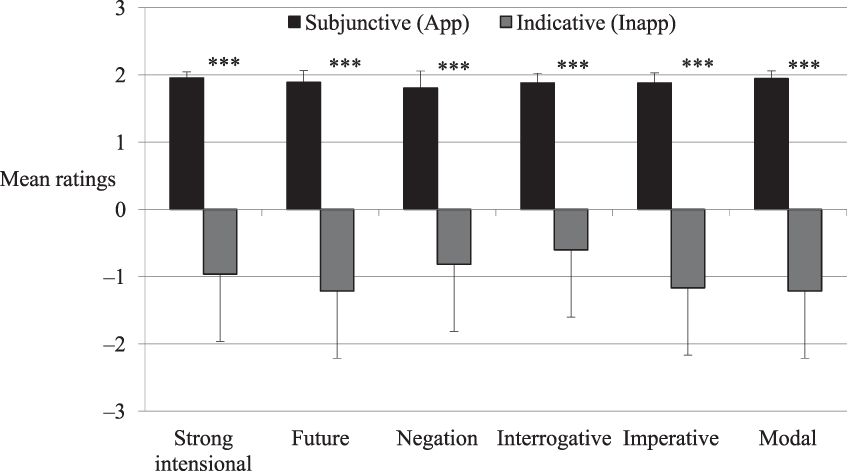
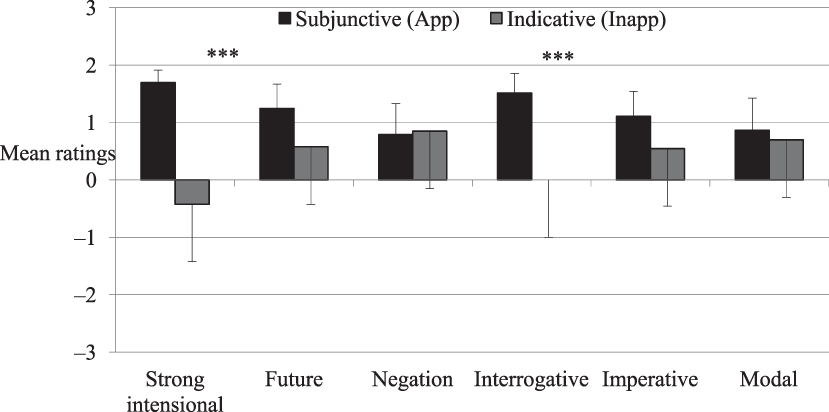
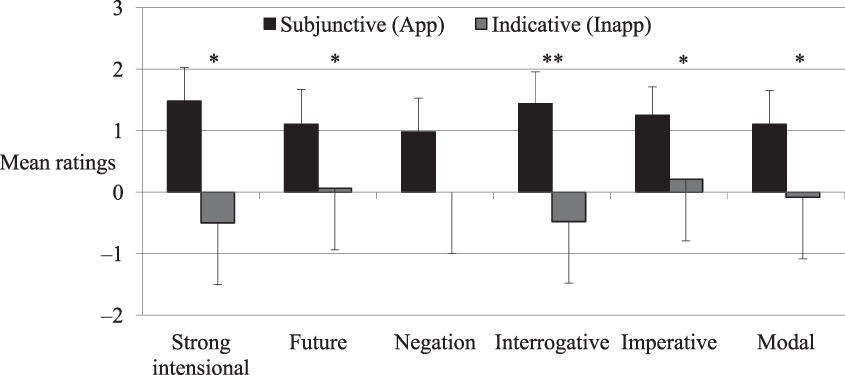
The results for the six conditions involved in nonspecific contexts, where the subjunctive is the appropriate mood, are reported in Figures 5 through 7.
Native speakers’ mean responses on nonspecific contexts (AJ task; target: subjunctive), showing significant differences between appropriate (App) and inappropriate (Inapp) moods (Wilcoxon tests). ***p < .001.
Advanced learners’ mean responses on nonspecific contexts (AJ task; target: subjunctive), showing significant differences between appropriate (App) and inappropriate (Inapp) moods (Wilcoxon tests). ***p < .001.
Intermediate learners’ mean responses on nonspecific contexts (AJ task; target: subjunctive), showing significant differences between appropriate (App) and inappropriate (Inapp) moods (Wilcoxon tests). **p < .01; *p < .05.
Starting with the NSs (Figure 5), we can see that for each condition the subjunctive was strongly accepted and the indicative strongly rejected. A relatively lower rejection rate was obtained on interrogatives (M = −0.60), compared to the other conditions (between −0.82 and −1.23). Wilcoxon tests revealed statistically significant differences between the interrogatives and all other conditions (strong intensional: z = −2.39, p = .017; future: z = −3.34, p = .001; imperative: z = −2.68, p = .007; and modal: z = −3.31, p < .001), except for negation (z = −1.16, p = .248).
In the advanced learners’ group (Figure 6), the subjunctive was accepted to a significantly higher extent than the indicative in two conditions—namely, strong intensionals and interrogatives—and a significant difference was almost reached with imperatives (z = −1.79, p = .074). For the future and interrogative conditions, the results go in the targetlike direction, with higher acceptance rates of the subjunctive, but the difference is not statistically significant (future conditions: z = −1.70, p = .088; interrogatives: z = −1.66, p = .098). In the negation and modal conditions, the subjunctive and the indicative were accepted at almost similar levels (negation: 0.79 vs. 0.85, z = −0.15, p = .879; modals: 0.86 vs. 0.70, z = −0.61, p = .542). In general, although the subjunctive was (correctly) accepted, the indicative was not systematically rejected. In fact, the indicative was positively accepted in four of the six conditions, which indicates variability. The only condition in which it was clearly rejected was the strong intensional condition (M = −0.42). Sixteen learners out of 22 rejected the indicative there, versus only five with negation. In all, six advanced learners rejected the indicative in at least four conditions, and three in at least five conditions.
The intermediate learners (Figure 7) accepted the subjunctive significantly more often than the indicative in more conditions than the advanced learners (five against two). Note that the intermediate learners’ most targetlike performance was found with strong intensionals, as was the case with the other learners. The only condition for which no significant difference is observed between the two moods for the intermediate learners was negation (z = −1.61, p = .108), which, as we have seen, also caused problems for the advanced L2 group. However, although the difference between the two moods was often statistically significant for the intermediate learners, the indicative was not strongly rejected. In two conditions (future and imperative), the performance on the indicative was close to zero. Moreover, there were no significant differences between the intermediate and the advanced learners on inappropriate indicatives in most conditions (strong intensional: U = 164.5, p = .737; future: U = 119.0, p = .095; interrogative: U = 136.5, p = .246; imperative: U = 147.0, p = .404), except for negation (U = 108.0, p = .044) and modal (U = 106.0, p = 0.39) conditions. So there also was variability in the intermediate learners’ group, and there was no real progress as proficiency increased.
Specific Contexts
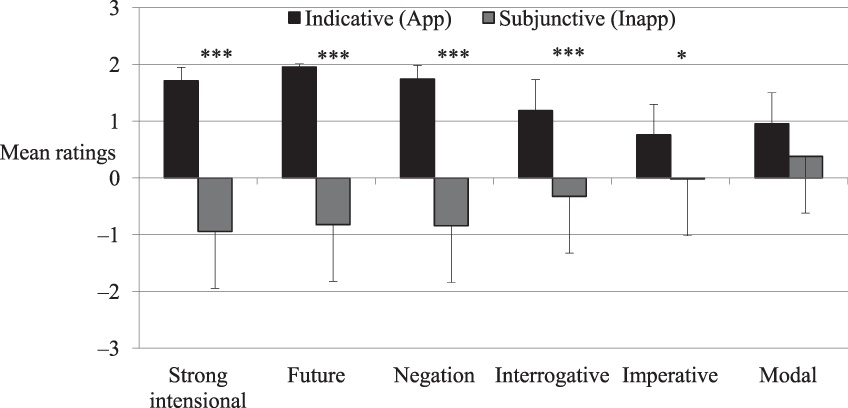
The results for the six conditions displaying specific DPs, with the indicative as the appropriate mood, are given in Figures 8 through 10.
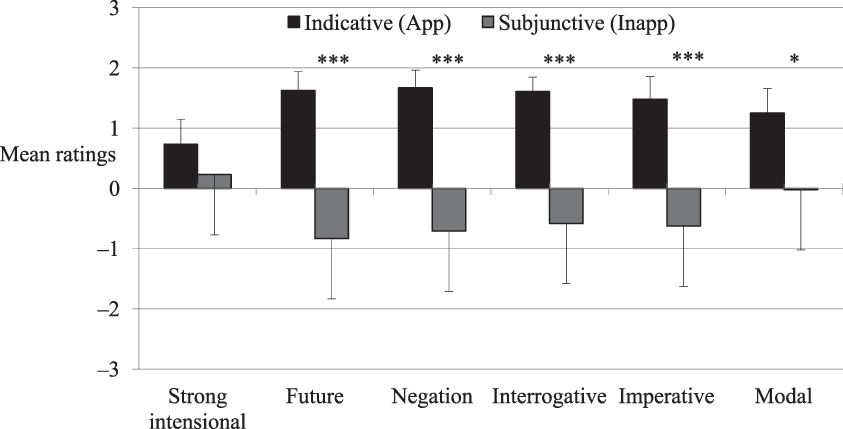
Native speakers’ mean responses on specific contexts (AJ task; target: indicative), showing significant differences between appropriate (App) and inappropriate (Inapp) moods (Wilcoxon tests). ***p < .001; *p < .05.
Advanced learners’ mean responses on specific contexts (AJ task; target: indicative), showing significant differences between appropriate (App) and inappropriate (Inapp) moods (Wilcoxon tests). ***p < .001 ; **p < .01, *p < .05.
Intermediate learners’ mean responses on specific contexts (AJ task; target: indicative), showing significant differences between appropriate (App) and inappropriate (Inapp) moods (Wilcoxon tests). ***p < .001; *p < .05.
In the control group (Figure 8), the performance on the indicative was significantly higher than on the subjunctive in five of the six conditions. There was no significant difference in the modal condition (0.95 vs. 0.38) (z = −1.67, p = .094). Moreover, rejection of the subjunctive was significantly weaker with interrogatives (−0.32) and imperatives (−0.02), compared with strong intensionals (−0.94), future conditions (−0.82), and negation (−0.84), for which rejection was close to −1 (interrogatives vs. strong intensionals, z = −2.53, p = .011, vs. future conditions, z = −2.13, p = .033, and vs. negation, z = −2.01, p = .044; imperatives vs. strong intensionals, z = −4.03, p < .001, vs. future conditions, z = −3.81, p < .001, and vs. negation, z = −3.46, p < .001). In other words, all conditions were not considered equal by the NSs of Spanish. At the individual level, at most 10 NSs accepted the (inappropriate) subjunctive in strong intensional, future, and negation conditions, compared to 17 in interrogative and imperative conditions and 24 in modal conditions.
In the advanced learners’ group (Figure 9), significant differences between the two moods were found on every condition, which contrasts with what we observed in nonspecific contexts. The indicative was strongly (and correctly) accepted, whereas the subjunctive was globally rejected, except for in the modal condition, where it was accepted (0.36). This performance in modal contexts matched the lowest performances on the part of the NSs. Comparisons between the rejection of the indicative (Figure 6) and of the subjunctive (Figure 9) show that the subjunctive was rejected to a significantly higher extent in four out of six conditions (future: z = −3.53, p < .001; negation: z = −3.21, p = .001; interrogative: z = −2.26, p = .024; and imperative: z = −2.87, p = .004). By comparison, in target contexts, acceptance of the indicative was statistically superior to acceptance of the subjunctive in three conditions (future: z = −2.64, p = .008; negative: z =−2.58, p = .01; and modal z = −2.25, p = .024). In the future condition, the subjunctive was accepted at a rate of 1.24 (compared to 1.79 for acceptance of the indicative), which is quite high. In other words, the fact that the indicative was not rejected as frequently as the subjunctive was not due to the indicative being accepted across the board; on the contrary, when the subjunctive was the targeted mood, the advanced learners generally accepted it.
As shown in Figure 10, the intermediate learners also preferred the indicative significantly more often than the subjunctive in almost every condition, except for the strong intensional condition (0.73 vs. 0.23). There, the learners accepted the subjunctive, which was not the case with the advanced learners, who rejected it (−0.33). Although the difference is not statistically significant (U = 122.0, p = .109), this suggests improvement. In the modal condition, the mean score for intermediate learners is close to zero (−0.02). In all three groups, then, it seems that the occurrence of the subjunctive with modals was problematic. Finally, comparisons between rejection of the subjunctive (Figure 10) and of the indicative (Figure 7) show that rejection of the subjunctive was globally stronger, which is also what was found for the advanced learners, although significant differences arose in only two conditions, future and imperative (strong intensional: z = −1.68, p = .093; future: z = −2.08, p = .037; negation: z = −1.73, p = .084; interrogative: z = −0.09, p = .929; imperative: z = −2.30, p = .021; and modal: z = −0.53, p = .593).
DISCUSSION
We saw that the L2 learners of Spanish could make the distinction between subjunctive and indicative morphology, as shown by the very high scores obtained on the recognition task. They also knew when the subjunctive and indicative should be used. This is true of episodic contexts (in which the indicative is grammatical) and lexical contexts (in which the subjunctive is obligatorily selected). In spite of these results, both the advanced and the intermediate learners scored significantly worse than the NSs on rejection of the ungrammatical subjunctive. With lexical selection, the advanced learners obtained nativelike results compared to the intermediates, which suggests that knowledge of subjunctive use develops over time.
With respect to the contexts in which the (non)specificity status of the DP plays a crucial role in the distribution of the subjunctive and indicative, the general results show that the learners could appropriately select the expected mood. When the DP was nonspecific, the learners generally selected the subjunctive; when it was specific, the indicative was chosen. This indicates that the learners had acquired the fact that the two moods are associated with different semantic interpretations of the relative head. However, we also saw that performance on the inappropriate indicative was less targetlike than performance on the inappropriate subjunctive. In other words, with nonspecific DPs, the indicative was more often selected than was the subjunctive with specific DPs. This means that, in relative clauses in which the head was nonspecific, there was variability in mood selection: Although the subjunctive was preferred, the indicative was not completely rejected. This differed from what was found for the NSs, who clearly rejected the (inappropriate) indicative (M = −1 on the AJ task). For the advanced learners, there was a significant difference between the inappropriate indicative and the inappropriate subjunctive, with a more targetlike performance on the inappropriate subjunctive. This strongly suggests that subjunctive inflection is associated with nonspecificity, whereas the indicative tends to be used as a default marker. This is consistent with Leonetti Jungl’s (1999) claim that the subjunctive is linked to nonspecificity, whereas the indicative is not necessarily linked to specificity. At the same time, the learners were not completely indifferent to the interpretation of the DP when the indicative was used: They associated the indicative with a specific relative head, but this association was not as strong as that between the subjunctive and nonspecificity, as the indicative was not widely rejected when the DP was nonspecific.
We also saw that performance was not uniform across the various conditions tested, especially with nonspecific DPs. There, targetlike results were obtained with strong intensional verbs. In other conditions, some statistically significant differences were found between the two moods, specifically interrogatives for the advanced and the intermediate learners, and future conditions, imperatives, and modals for the intermediates. In other conditions, there were no statistically significant differences between the two moods, although the results go in the expected direction, with the subjunctive being more often selected than the indicative (except for negation with the advanced learners). There was also no difference between the intermediate and the advanced learners with respect to the inappropriate indicative (except on negation and modals), which further confirms the default status of the indicative. The learners’ results on nonspecific DPs differed from those obtained by the NSs, who clearly accepted the subjunctive and rejected the indicative in all conditions. However, this should not be interpreted as suggesting a fundamental difference between interlanguage and native grammars. First, we saw that the learners, like the NSs, could distinguish significantly between the two moods at the global level in nonspecific contexts (recall Figure 4). Second, it is not the case that the learners’ behavior systematically differed from that of the controls. With specific DPs, the performance of the L2 learners was more uniform, especially in the advanced group, for whom significant differences between the two moods were found in every condition tested. This mirrors the performance of the NSs (except in the modal condition, where both moods were accepted to a similar extent by the NSs). In fact, the difference between the learners and the controls largely amounts to the use of default forms (i.e., the indicative) on the part of the learners, which has been largely documented in the L2 acquisition literature (see, among others, McCarthy, Reference McCarthy2008; Prévost & White, Reference Prévost and White2000; White, Reference White2003). Following Leonetti Jungl (1999), among others, we have argued that the subjunctive is semantically linked to nonspecificity, but the indicative, as the unmarked form, is not necessarily linked to the opposite interpretation. The use of the indicative, which is less specified than the subjunctive, does not lead to a clash. This lack of specification is what we interpret as a default (McCarthy, Reference McCarthy2008). Crucially, the use of default forms by L2 learners has been argued not to necessarily mirror grammatical deficiencies in L2 systems. In particular, errors strongly tend to go in one direction only—in our case, the indicative was substituted for the subjunctive and not vice versa. It could be that the acquisition of interface phenomena is particularly conducive to the use of default forms and, thus, to variability (which would also be in line with Slabakova’s, Reference Slabakova2008, bottleneck hypothesis, according to which the difficulty facing L2 learners is the acquisition of the morphology encoding underlying semantic features), but this should not necessarily be thought of as stemming from faulty interlanguage grammars. It also does not mean that variability should persist in L2 learners. Our prediction is that learners at even more advanced levels would use the default indicative to a lower extent than the participants in our study.
Our results show that the difficulties facing L2 learners at interfaces not only involve grammar-external modules, such as pragmatics, but may also concern phenomena related to different-internal areas of the grammar. As such, our results go in the same direction as those reported for other phenomena at the morphosyntax-semantics interface, such as article choice—in contrast to the views held by Sorace (Reference Sorace2011). However, Sorace (Reference Sorace2011) specifically argues that the difficulties associated with interfaces are due to processing, a claim our methodology does not allow us to test. Furthermore, it could be said that, as our study involved L2 learners at intermediate and advanced levels of proficiency, it should not have much bearing on Sorace’s hypothesis, because this hypothesis specifically targets near-native speakers. We follow White (2011a; see also Rothman, Reference Rothman2009) in claiming that studying the acquisition of interface phenomena should also target earlier developmental stages. Variability does not start at the ultimate level of acquisition, and looking at it from a developmental standpoint may even offer some insight into its nature. This is what we intend to do, as stated previously, via testing near-native speakers.
The other point that we would like to raise is that variability is not the sole product of L2 acquisition; it can be found in NSs as well (see also the results on the Spanish NSs in Ionin et al., Reference Ionin, Montrul and Crivos2013, reviewed previously in this article). We saw that, in contrast to the L2 learners, the NSs tended to reject the inappropriate indicative more easily than the inappropriate subjunctive, although, globally, the NSs’ performance displayed expected significant differences. Of the 36 NSs, six accepted the (inappropriate) subjunctive in at least four of the six conditions, and an additional eight accepted it in half of the conditions. This means that 14 NSs—that is, nearly 40%—made unexpected judgments on the inappropriate subjunctive. By comparison, only five NS participants made unexpected judgments on the inappropriate indicative. This echoes findings in other research on the acquisition of interface phenomena (Belletti et al., Reference Belletti, Bennati and Sorace2007; Lozano, Reference Lozano2006; Sorace & Filiaci, Reference Sorace and Filiaci2006), although the authors of these studies did not dwell on them. The fact that variability may be found in L2 learners and in NS controls (although maybe to a lesser extent) suggests that variability itself cannot be identified with the source of qualitative differences between L2 learners and NSs; here quantitative differences may be involved. To give but one example, Belletti et al. (Reference Belletti, Bennati and Sorace2007) found that, in their production (headlines) task, which elicited all-focus sentences with unaccusative verbs (and thus the verb-subject [VS] order), the L2 learners of Italian produced the SV order significantly more often than the Italian controls, who preferred the VS order. However, in the Language Acquisition and Interfaces section, we saw that, despite this difference, the acceptance rate of SV by the NSs of Italian was not 0%; it was 54% with definite subjects and 31% with indefinite subjects, suggesting some variability. In fact, despite larger variability rates, the learners may still display trends that are similar to what can be observed in NSs. As can be seen in Belletti et al.’s study, when the SV order was accepted by the Italian controls, it was mainly due to the presence of a definite subject. Crucially, the same difference between definite and indefinite subjects is also reported for the L2 learners: Their acceptance rate of SV order is higher with definite subjects (74%) than with indefinite subjects (59%), which suggests a sensitivity to definiteness and subject placement.
Finally, variability may be observed in the different constructions related to the linguistic property under investigation. In other words, neither the NSs nor the learners performed similarly in all contexts. Borgonovo, Bruhn de Garavito, and Prévost (2012) compared NS responses from several regions: Mexico, Colombia, Argentina, and Spain. Although the acceptance of the subjunctive in nonspecific contexts was high overall, regional and individual variation was found in the rejection of the indicative in nonspecific contexts in almost all categories and in the acceptance of the subjunctive in specific imperative and modal contexts. These results seem to suggest that learners will receive input that exhibits both regional and individual variation and that this variation may affect particular contexts only, which would make the acquisition of the morphosyntactic-semantic interface under discussion particularly difficult. We found that the distinction between the indicative and subjunctive was easiest to achieve in strong intensional contexts and was more difficult with modals, which reflects at least in part the possible input. Surprising results were also obtained with negation and interrogatives.Footnote 7 More general considerations about the subjunctive and modal distinctions are in order. The subjunctive has long been observed to be on the wane crosslinguistically; witness the disappearance of two of its tenses in French (three in oral French), the gradual loss of the subjunctive with emotive factives, and other similar facts. The results obtained on negative antecedents in nonspecific contexts, for example, surprised the two authors of this article who are NSs of Spanish. For the two of us, some of the judgments reported by our controls, who accepted the indicative, were inexplicable when first obtained; only later did we realize the extent of variation in judgments and use in this particular context. Our study, then, illuminates an area of language change, albeit unintentionally at the beginning; this factor also contributes to the explanation of our results.
APPENDIX
EXAMPLES OF ITEMS IN THE DIFFERENT CONDITIONS OF THE AJ TASK
1. Future
1.1. Future, nonspecific.
My son is looking for a job now that he has graduated. During his studies he always worked for minimum wage, but he is tired of having no money. He is open to all kinds of jobs, with only one condition. He says:
a. Sólo aceptaré un trabajo que paga más que el salario mínimo.
b. Sólo aceptaré un trabajo que pague más que el salario mínimo.
1.2. Future, specific.
Sara and Pedro have a leak in their bathroom faucet but they don’t have the money to pay the plumber. Pedro goes to the library, where he finds one book explaining how to change that particular kind of faucet. He calls Sara and says:
a. Sacaré de la biblioteca un libro que explica cómo arreglar el problema.
b. Sacaré de la biblioteca un libro que explique cómo arreglar el problema.
2. Negation
2.1. Negation, nonspecific.
There has been a moth invasion in Felipe’s house. All his woolen things are ruined. He says:
a. No encuentro ningún suéter (= jersey, chompa, etc.) que no tenga agujeros.
b. No encuentro ningún suéter que no tiene agujeros.
2.2. Negation, specific.
John and Mary want to buy a house. They saw one on sale two weeks ago and they liked it. They go to a realtor and look through several catalogues of houses for sale. They are very disappointed. Mary says to the realtor:
a. No tiene en su lista la casa que nos interesa.
b. No tiene en su lista la casa que nos interese.
3. Interrogative
3.1. Interrogative, specific.
Luisa and María go shopping together. They go their own way for an hour. During this time, Luisa sees a jacket with a picture of a dragon in the back. She loves it. The two friends meet again, and Luisa asks María:
a. ¿Has visto una chaqueta que tiene un dragón en la espalda?
b. ¿Has visto una chaqueta que tenga un dragón en la espalda?
4. Imperative
4.1. Imperative, nonspecific.
Vicente spends all day listening to religious music. Rosa is tired of hearing such serious music. She tells Vicente:
a. Por favor, hombre, cómprate un CD que nos alegre más la vida!
b. Por favor, hombre, cómprate un CD que nos alegra más la vida!
4.2. Imperative, specific.
Carmela is on a diet. She has heard of a new sugarless ice cream and she wants to try it. When her mother goes shopping, Carmela tells her:
a. Por favor, cómprame un helado que no tiene azúcar.
b. Por favor, cómprame un helado que no tenga azúcar.
5. Modal
5.1. Modal, nonspecific.
Carlota wants to move. She lives in an apartment that is full of cockroaches, like most apartments in the city. She really hates insects. She says to herself:
a. Debo encontrar un apartamento que no tiene cucarachas.
b. Debo encontrar un apartamento que no tenga cucarachas.
5.2. Modal, specific.
Jacinta has $100,000 to buy an apartment. Although her friend tells her it is impossible, she finally finds one with three large bedrooms and a balcony for that price. She tells her friend.
a. ¿Han visto? Con $100,000 se puede comprar un apartamento que tiene tres cuartos grandes y un balcón.
b. ¿Han visto? Con $100,000 se puede comprar un apartamento que tenga tres cuartos grandes y un balcón.