Introduction
‘This war will bring about a Europe more united; though uncertain in terms of international law, it's a fact that it will be.’Footnote 1 When the later famous journalist Otto Schulmeister concluded a book on the European economy in 1942, he expressed a position that was by no means marginal. For him and many other intellectuals, the Second World War did not only bring about death and destruction. They associated the war with hope for something new, with constructive feelings for a new European order, or even with ideas of a European unification. Indeed, the overcoming of the post-First World War order and the destruction of the ‘system of Versailles’ triggered a multitude of ideas how a future European order should look like. The political borders of central and south-eastern Europe shifted as result of the Munich Agreement of 1938 and the Vienna Awards of 1939/40. Germany had become the leading power on the continent, and the Nazis pursued the reshaping of Europe with astonishing speed. For German scholars who had worked against ‘Versailles’ for decades, these events must have seemed like a dream come true. They had constantly called for such border shifts and justified the destruction of the post-Versailles order with historic, cultural and demographic arguments. Ethnic cleansing before and during the Second World War was grounded in an academic discourse on population transfers, and academics advocating ethnic engineering paved the way for violent expulsions. Those German researchers who focused on German minorities in eastern Europe and were skilful in Europeanising the issue of minority rights stand at the centre of this paper.
The involvement of experts in population transfers and their cooperation with the SS in the cases of ethnic cleansing and genocide in Poland and Yugoslavia are well known.Footnote 2 The passionate debate on the character and the aims of the German Ostforschung not only demonstrated that scholars paved the way for genocidal crimes intellectually, but it also showed that one did not need to be a Nazi to support imperial and genocidal takes on eastern Europe. Scholarly involvement was by no means limited to the years between 1933 and 1945, or to Nazi ideologues only. Apolitical, conservative and even some liberal scholars shared visions of a redesigned order in eastern Europe mastered by Greater Germany. Recent scholarship also unveiled the paths of continuities of such ideas from the German Empire to the Federal Republic.Footnote 3 The debate was so passionate because a generation of German scholars discussed the genocidal involvement of their own teachers and forefathers.Footnote 4 It largely focused on eastern Europe, where the Nazi genocidal project unfolded with unrestrained force. The issue of scholarly involvement needs to be debated regarding south-eastern Europe.Footnote 5 Research on scholarly involvement on the Nazi genocidal project in this part of Europe, however, faces two blind spots: cooperation and Europe.
The main feature is that national entities in central eastern Europe, namely Poland, were to be destroyed and to be subjected to direct German rule, whereas the south-eastern European nation-states were to be included into the New Order with a certain degree of autonomy. That does not only explain why local perpetrators had carried out the bulk of wartime-mass crimes in south-eastern Europe (and Germans to a lesser extent). But the dominant focus on German supremacist ideology and genocidal violence in eastern Europe involved an underestimation of certain aspects of collaboration. Whilst collaboration on the ground has recently received the attention it deserves, the cooperation between German and (south)-east European intellectuals is a relatively under-studied field.Footnote 6 This leads to the second blind spot: most German historians and Slavists who studied Polish, Bohemian, Baltic or Russian history and culture had a relatively hostile stance towards the region they studied, their inhabitants and, most importantly, their gentile scholars. In a nutshell, they claimed German racial superiority over the Slavic peoples of eastern Europe.Footnote 7 In contrast to that, German scholars who dealt with south-eastern Europe were far more cooperative, and their supremacist prejudices were less widespread. German and south-eastern European scholars had intensive and persistent contacts. The scholarly cooperation between Germans and their colleagues in Hungary, Romania, Yugoslavia and other countries before and during the war allowed them to have a transnational debate regarding the question what a New European Order should look like. They might not have agreed on the details, but they did agree that Europe needed to have a modern, anti-liberal order based on ethnically homogeneous nation-states. By taking such ideas seriously, this paper hopes to contribute to the debate on German Ostforschung and its European implications, and to measure the tension between German supremacist scholarship on the one hand, and European cooperation on the other.
Historical research has pointed out that ideas of Europe had been popular well before 1945, and that anti-liberal and right-wing movements could well have a European horizon, whether it was the cooperation between fascist movements, or between Germans and their local partners in western and eastern Europe during the Second World War, or right-wing intellectual exchange.Footnote 8 Transnational right-wing and fascist concepts of race, space and culture are part of the shared intellectual history of Europe and it is time to attend to such ideas. Believing that only German domination would make the continent heal and prosper, German intellectuals were ardent supporters of both the right-wing and Nazi movements. However, being German supremacists did not prevent them from having a European horizon. In his seminal book on Nazi rule in Europe, Mark Mazower analysed how the Nazis tried to build a European empire founded on the idea of the dominance of the German race. As the Nazi leaders thought in large-scale categories of race instead of nation, Mazower concludes, they were neither interested in meeting the demands of other nations nor in seeking cooperation between European nation-states. In such a perspective, they could only exploit the pro-European sentiments of the peoples Germany dominated. ‘One of the reasons why Germans failed to think deeply about Europe was because for much of the war they did not need to: Europeans fell into line and contributed what they demanded anyway.’Footnote 9 Mazower's statement might be true for the higher echelons of the Nazi party, but it fails to acknowledge that many scholars and intellectuals in Nazi Germany did, in fact, think deeply about Europe.
This paper thus highlights such European agendas and argues that many Völkisch scholars believed in the necessity of genuine cooperation among the nations of Europe. To this end, I will focus on scholarly cooperation between German and Croat scholars and their focus on the ethnic and demographic history of south-eastern and eastern Europe. The paper centres on a group of Völkisch scholars who serve as a good example of cooperation across national boundaries. The ethnographer Karl Christian von Loesch (1880–1951) and the sociologist Max Hildebert Boehm (1891–1968), who were key figures of the Völkisch movement in Germany, devoted their careers to fighting the Paris peace system by incorporating non-German scholars and activists into a transnational alliance. Thus, they stood for scholarly cooperation on a European level with the goal of designing a new territorial and ethnic order in the eastern and south-eastern parts of Europe. Over the decades, they spun a large network of colleagues and former students who – during the Second World War – would try to put their ideas of a new ethnic order into practice. That applies in particular to three of their disciples: the German social scientist Franz Ronneberger (1913–99), who during the war formed a Nazi think-tank that became a hub for information regarding the Balkan states; the German-Hungarian historian Fritz Valjavec (1909–60), who was perhaps the most dynamic figure within German Südostforschung in the twentieth century; and the Croat lawyer Mladen Lorković (1909–45), who was a key figure of the separatist Croatian Ustaša movement and who became Croatian foreign minister in 1941 once Croatia was awarded independence by Hitler and Mussolini. These three men were young intellectuals who hoped to change the world they lived in and perceived demographic changes as the key to an altered future. Ronneberger stated how he, already as a student, was tempted by the idea ‘to plough the unworked field of south-eastern Europe’.Footnote 10 They were students when the Nazis came to power, and their professional careers started well after 1933. But during the war, their careers skyrocketed. They would come into a position to put the ideology their teachers planted into genocidal practice, at least in part.
In the first part of this paper, I will discuss how unfulfilled Wilsonian promises led to a certain degree of frustration amongst ethnocentric nationalists throughout Europe after the Paris Peace Treaties. I then introduce Loesch and Boehm and their proposals for a new European demographic order based on the principles of border shifts, assimilation and dissimilation or population transfer and the impact these ideas had on younger scholars such as Ronneberger, Valjavec and Lorković. I conclude with a discussion of the attempted violent implementation of demographic plans during the Second World War in the Independent State of Croatia and elsewhere, the role scholars had in campaigns of ethnic cleansing, and the ultimate failure of schemes of grand planning.
The impact of the Paris Treaties on the Völkisch movements
The Wilsonian policy of fostering nation-states in Europe based on ethnicity paved the way for the breakthrough of the ethnic paradigm. President Wilson had promised in 1917 that ‘national aspirations must be respected; people may now be dominated and governed only by their own consent. Self-determination is not a mere phrase; it is an imperative principle of action’.Footnote 11 The problem was that the hopes for sovereignty and statehood Wilson had nourished could never be satisfied. In the eyes of many central, eastern and south-eastern European nationalists, this promise had not been applied to their nations; those who belonged to the losers of the Great War especially felt betrayed by the signatory powers. Frustrated, political activists now aimed at putting the Wilsonian paradigm into reality in the way they had understood it: only if Europe consisted of sovereign ethnically homogenised nation-states, they argued, could a just territorial and political order in Europe be reached.Footnote 12 The historian Eric Weitz has pointed at the links between the interwar debates surrounding minority rights protection, on the one hand, and campaigns for ethnic homogeneity, on the other.Footnote 13 Indeed, German diplomats learned to turn the tool of internationally monitored minority rights against their initiators, and skilfully used the League of Nations framework not only for the protection of German minorities in the neighbouring states, but as a weapon in its fight against the Paris peace order as such. And Germany served as a role model for eastern European governments on this front: looking at Romania and Hungary, the historian Holly Case demonstrates that local leaders ‘had come to associate minority rights not only with…international agreements…and the League of Nations, but also – perhaps primarily – with Germany's resistance to the League’.Footnote 14 And they felt encouraged that the international community would accept ‘demographic solutions’ as they demanded it for their countries. Had not the League of Nations acknowledged the paradigm of ethnic homogeneity by agreeing on population exchanges, or by sanctioning them ex post facto at the treaty of Lausanne?Footnote 15 In this respect, the protagonists of this article managed to be both fervent activists in the field of minority rights in the 1920s and 1930s and promoters of ethnic homogeneity at the same time. This is the context in which scholars from Germany, eastern Europe and south-eastern Europe cooperated, and tried to provide their governments with demographic ammunition against the Paris peace order. Most plans for restructuring the demography of Europe were thus inextricably intertwined with the idea of German dominance over eastern and south-eastern Europe.Footnote 16
Two Völkisch eminences: Boehm and Loesch
The ethnographer Karl Christian von Loesch and the sociologist Max Hildebert Boehm were luminaries in the field of ethnicity and minority studies, anti-Versailles activists and counsellors to German governments before and after 1933. They stood for a stream of nationalist activism that was in opposition to Nazi racial scholarship, in particular to its neo-pagan and blood-mystifying tendencies; but their scholarly opposition quickly faded away after 1933, and they tried to find accommodation with the Nazi party. Boehm's and Loesch's interest in eastern and south-eastern Europe stemmed from their biographical backgrounds: Loesch was born in Silesia, Boehm in Livonia. During the Great War, both held positions within the German occupation regime in eastern Europe and had the opportunity to travel in and study eastern Europe.Footnote 17 After the war, they were leading figures in what they called Volkstumskampf: an integral strategy that consisted of political, academic and educational elements with the aim of justifying the historically German character of lost territories, preserving the alleged or real Germanness of the population in the eastern borderlands, and fostering German culture and ‘Germanic’ historical awareness in East and south-eastern territories. Both Loesch and Boehm developed a focus on German minorities in eastern Europe and were skilful in Europeanising the issue of minority rights, thus feeding the question of German minorities into a larger context. Boehm headed an inter-party committee for minority rights. Loesch, as a leading figure of the ‘German League for the Protection of Germans in the Borderlands and Abroad’, an umbrella organisation addressing itself to concerns of the German borderlands, at times advocated a pan-European solution for all ethnographic and minority questions and sympathised with a union of the European peoples. That was, however, to be achieved under German leadership. It is therefore not surprising that Loesch fervently fought against cooperative visions of Europe like Coudenhove-Kalergi's ‘pan-Europe’. Instead, he highlighted ideas of Europe with Germany being the dominating power. Therefore, it is no coincidence that he intensified his European propaganda after 1938.Footnote 18
In 1926, Boehm and Loesch founded the Institute for Borderland and Foreign Studies (IGA) in Berlin-Steglitz, with Boehm as director and Loesch as his deputy.Footnote 19 Another important body was the Institute for Southeastern Studies (SOI), founded in 1930 in Munich. After 1936, similar institutes mushroomed in Leipzig, Vienna and Graz, which all, to a certain extent, advocated applied sciences and provided the Nazi authorities with their demographic expertise. The Nazi takeover in 1933 did not mark any relevant caesura regarding German Balkan studies or German policies towards south-eastern Europe.Footnote 20
Boehm and Loesch continued their scholarly careers. Boehm was appointed professor of ethno-national sociology (Volkstumssoziologie) at the University of Jena in 1933. Loesch was running the institute and was appointed professor for ‘Germandom abroad’ at the Faculty of Foreign Studies at the Friedrich-Wilhelms University Berlin in 1940. Their successes after 1933 notwithstanding, their relationship to Nazism was ambiguous. For one thing, their offer to become Nazi party members was rejected rather coolly by Reichsleiter Rudolf Heß, given their request that their membership not be made public, lest it disrupt their international academic activities.Footnote 21 In addition, Boehm was under constant attacks from the League of National-Socialist Lecturers, because his definition of Volk was not entirely based on biological grounds.Footnote 22
Nonetheless, Boehm and Loesch inspired a generation of scholars with their focus on social and demographic issues and their combination of national and European approaches, and they dominated the discourse in the 1930s and the early 1940s. They also trained a number of students from south-eastern Europe and had a considerable impact on their political and demographic theories. Loesch later looked back full of praise at the early years of his Volkstumsarbeit, and highlighted the interdisciplinary character of the work of geographers, historians, linguists, economists, racial scientists, human biologists, ethno-psychologists, social psychologists and pedagogues researching German and non-German minorities in the ethnic shatter-zones of eastern Europe.Footnote 23
With their foci on eastern-central Europe (Boehm) and south-eastern Europe (Loesch) both scholars entered a fascinating field of study that offered the opportunity to build up international networks of nationalistic scholars, who fought for independence and ethnic purity against great powers or powerful neighbours. In their view, both regions were underdeveloped and paralysed by their multi-ethnic demographic design. This view sat well with the goal of many (South)-Eastern European nationalists finally to ‘arrive’ in Europe by transforming their homelands into proper nation-states and by rebuilding the demographic and social structure of their states.Footnote 24 German scholars interested in ethnic homogenisation agreed that population policies needed to be pursued and systematically coordinated by Germany as an intermediary power. But non-German nationalists also welcomed the war, as they saw it as an opportunity not only to revise the Paris order, but to achieve their own national demographic goals. There was a match of interests, because such a new order would finally bring peace, security and a reconstruction of economic and cultural life, and thus, as Loesch put it, safeguard the supremacy of European civilisation.Footnote 25
Concepts of dissimilation and assimilation
According to Loesch, south-eastern Europe consisted of seven state-building peoples: Hungarians, Romanians, Bulgarians, Serbs, Croats, Greeks and Albanians, each with a size of between one and a half and fourteen million people. The Turks were seen as a non-European people (and the emigration of Turks as a non-European people from the Balkans as desirable). Loesch sought to reestablish the primordial order and pre-modern ethnic cores of these nations.Footnote 26 He called for the demographic separation of the south-eastern European nations from each other and the reerection of what he saw as the natural boundaries between them by ‘harmonising’ political and ethnic borders. According to Loesch, 15 per cent of the population of south-eastern Europe belonged to ethnic minorities: this included Jews, Gypsies and ethnic pockets within the mainland. What he was more concerned with, however, were the ethnically mixed borderlands, which he perceived as a source of instability between the remaining ethnic cores. Everything that blurred these boundaries and weakened the ethnic cores – be it individual migration; pan-Slavism; shifts in religion, identity or language; or assimilation – was seen as a danger to the natural order.Footnote 27 But Loesch's horizon as an ethnic engineer was much broader: the remedy he prescribed to Europe was to turn back time and undo early modern and modern migration as a whole. Loesch, the international lawyers Werner Hasselblatt (1890–1958) and Viktor Bruns (1884–1943), as well as Boehm, thought that the time had come for a new legal status for minorities in Europe (Volksgruppenrecht), and they initiated a think-tank called Arbeitsgemeinschaft für Völkerpolitik with the aim of developing a continental master plan for a new system of inter-ethnic and inter-state relations in Europe.Footnote 28 The goal was to initiate a continental dialogue between Germany and smaller nations regarding the ethnic, demographic and geographic future of Europe and its nationalities. Censuses based on ethnicity and large-scale assessments of the ethnic character of the population of the multi-ethnic borderlands (volkstumsbiologische Prüfungen) were to be organised by a trust.Footnote 29 An arbitration board would collect the concerns and ideas of smaller nations and feed them into the general framework. At the end of the process, a new phase of orderly migration and settlement would bring about a New European system based on the principle of ethnicity.Footnote 30
How was this new system to be achieved? According to Loesch, only a combined application of two methods could lead to success: assimilation and dissimilation. Both terms he borrowed from the biosciences.Footnote 31 Those ethnic minorities that would stay within a nation-state's borders, because migration was not an option, should be assimilated or absorbed by the majority ethnic group. As Loesch put it, they needed to undergo a ‘liquidation of their ethnic character’ including language, religion and culture.
‘Dissimilation’ was the second wing of Loesch's demographic master plan. Those ethnic minorities in between the ethnic cores that populated contested borderlands were to be dissimilated, in other words physically segregated by means of forced migration. Loesch and like-minded colleagues took great interest in population exchanges between Greece, Turkey, Romania and Bulgaria in the decades between 1910 and 1930, which Loesch saw as ‘adjustment of ethnic territories (völkische Siedelböden) and state borders’.Footnote 32 Many scholars were thrilled to be able to contribute to that process, and eager to avoid the mistakes that had been made during earlier population transfers, for example between Greece and Turkey after the Treaty of Lausanne of 1923. Loesch fervently criticised the population transfers that followed the treaty, because religion and not ethnicity was made the decisive criterion for resettlement, calling it an example of harmful dissimilation.Footnote 33 Analogously, he saw the migration of Muslims from Yugoslavia to Turkey as a ‘loss of Caucasian blood’, as they were not Turks but Croats who had been converted to Islam under the Ottomans.Footnote 34 In contrast, Loesch illustrated cases of necessary and useful dissimilation using the example of the Jews. Holding Jews to be an obstacle on the path to a new European order, he suggested an ‘all-European dissimilation of Jews’ (alleuropäische Judendissimilation). Loesch imagined the resettlement of the Jews on a continental scale, even though he did not say where the European Jews should be concentrated. In his earlier writings, Loesch sympathised with a Palestinian solution of what he perceived to be the Jewish question. After 1939 however, he made increasing use of terminology inspired by Nazi racial anti-Semitism: since intercontinental resettlements were no longer an option, Loesch suggested regional ‘spatial solutions of the Jewish question’, which indicated concentration and segregation of Jews in Europe or elsewhere.Footnote 35
A key flaw of Loesch's ethnographic theories, however, remained unresolved. Although he asserted that neither religion nor language, in the case of Jews and Muslims, should be taken as a proxy for ethnicity, he was unable to offer a clear method by which ethnicity (Volkstum) was to be proven. Loesch acknowledged that his project of ‘dissimilation’ of the Jews was extraordinarily difficult, especially due to the high degree of intermarriages and Jewish assimilation in the Balkans. Loesch, in his post-1945 writings, never reflected on the possibility that his suggestions could be seen as a blueprint for the Holocaust as a giant murderous ‘dissimilation’. In this regard, he is typical of his generation of Völkisch scholars.
Croats in Berlin
As an example of the impact of German Völkisch scholarship on non-German scholars, I will highlight the career of Croatian intellectual Mladen Lorković, who was the youngest member of the leadership of the Ustaša movement, a terrorist organisation supported by Italy with the aim to dissociate Croatia from Yugoslavia by force. Once that goal was achieved in 1941, Lorković became Minister of Foreign Affairs of the Independent State of Croatia.Footnote 36
Non-German nationalists started populating German universities once more from the mid-1920s. In 1925, for instance, the Humboldt Foundation was reestablished and offered scholarships for foreign students. Here, the funding bodies made a distinction between eastern and south-eastern Europe. They tried to make sure that students from eastern Europe had an ethnic German background in order to strengthen their German identity and to segregate them from elites critical of Germany. In contrast, students from south-eastern Europe were seen as future partners and possible multipliers of the Völkisch ideology. This went hand in hand with the efforts of the German industry to intensify its presence in south-eastern Europe. German managers organised the Council of the Central European Economy and started promoting a united European economy. German industry became increasingly interested in peacefully penetrating south-eastern Europe. One element in the strategy was to bring young elites from the Balkan states to Germany to train them. The rationale was that they would form Germany-friendly opinion leaders upon returning to their homelands. The number of stipends for Yugoslav students skyrocketed as a consequence of Hermann Göring's visit to Yugoslavia in 1934. Ironically, and in contrast to Göring's Yugoslavia-friendly stance, the beneficiaries of these stipends were to a large extent Croatian separatists. In the 1930s, 40 per cent of all foreign students at German universities came from south-eastern European states, and their share was still growing.Footnote 37 Semi-official bodies such as the German Academy for Politics announced that foreigners were welcome to study in Germany and to get a feeling of the new spirit of the German Volksgemeinschaft.Footnote 38
Many Humboldt-fellows saw Berlin as a particularly fitting locale for their studies and their activism directed against the Paris peace order. The presence of a number of lobbyists, pressure groups, and scientific and political organisations and the new air of Nazism provided an attractive mix.Footnote 39 Important discussions regarding the demographic reshaping of Germany, the Balkans and Europe also took place at the IGA, where Boehm and Loesch mentored young German and (south)-east European scholars and activists; Loesch's and Boehm's institute received students from Croatia, Slovakia and the Ukraine after its founding in the late 1920s, and partly sponsored their fees. In the 1930s, a good part of the later leadership of the Croatian state (founded in 1941), studied or resided in Germany. South-eastern European intellectuals received an excellent education at German universities, broadening their intellectual horizons and sharpening their analytical toolkits.
In September 1930, Lorković arrived in Berlin as a nineteen-year-old student. As a teenage political activist, he had been forced to leave Yugoslavia and pursue his academic studies in Innsbruck, where he became acquainted with Fritz Valjavec. He moved on to Berlin, where he conducted research at Boehm's Institute for Borderland Studies. With a study on the violation of minority rights by the Yugoslav government in Macedonia, he skilfully positioned himself as an expert on all demographic questions regarding minority rights in south-eastern Europe.Footnote 40 Shortly after, he was awarded a doctorate at Berlin's Friedrich-Wilhelms University with a study arguing that the existence of the Yugoslav state was actually a violation of international law, because the Croats had not given their consent to the creation of the state.Footnote 41
Croatian nationalist intellectuals portrayed the demographic situation of their homeland as a doomsday scenario. Yet, the problem could be fixed, as Croatia still had a ‘healthy, safe and sound ethnic value’.Footnote 42 Large-scale resettlement of minorities would bring peace and social stability to the Balkans. Out of six million inhabitants of the Croatian state, two million were seen as non-Croats. Some hundred thousand were to be resettled to Serbia, or – in the case of Jews – to other countries, whilst the remaining majority of Serbs was to be merged with the Croatian population, as they were said to be actual Croats by blood.Footnote 43 These measures were presented as a historic task: reestablishing the supposedly natural ethnic order in a part of the world troubled by ethnic diversity, Loesch argued, would add value to Europe as a whole.
Ethnic cleansing during the Second World War
Hitler's decision to split up the Yugoslav state along ethnic lines was a break with Nazi foreign policy prior to 1941, but it went along with Nazi ideology and set in motion what Völkisch scholars had advocated for a long time. Thus, they could offer their expertise for one of the most extensive projects of wartime ethnic cleansing. Hitler set the scene at his first meeting with Ustaša leader Ante Pavelić – who had been appointed head of the Croatian state in April – at the Obersalzberg in June 1941: only clear spatial segregation between ethnic groups would enable peaceful and stable relations between ethnicities. Deportations and resettlements would be temporarily painful for those affected, but in the long run, their effect would be healing and beneficial.Footnote 44 Hitler preached to the converted, as Pavelić was already obsessed with the idea of an ethnically homogenised Croatian state. Pavelić must have understood Hitler's sermon as a licence to set in motion what would become one of the largest resettlement programmes during the Second World War.
It is remarkable, however, that – with the exception of the Vienna Awards, where their institute served in an advisory capacity – Boehm and Loesch were relatively uninvolved when it came to border shifts and large-scale resettlements, and their aspirations to practise applied sciences remained unfulfilled. Boehm continued to teach throughout the war, maintained contact with most of his non-German colleagues and gave a series of talks in south-eastern European states; Loesch also maintained his theoretical work, and was appointed professor for ‘Germandom abroad’ at the Faculty for Foreign Studies at the University of Berlin in 1940. In 1941, his former students, who had all high posts within the new Croatian government, invited him to visit the Independent State of Croatia, and he toured the country together with his family.Footnote 45 Even though both scholars still had a number of opportunities to get involved in hands-on projects, their impact on the war-time population transfers was minimal. It was rather the younger generation of scholars who had aligned themselves smoothly to the new realities after 1933, seeing Nazism in power as an opportunity for the launching of their careers, which advanced remarkably thereafter, enabling them to attain positions in which they could apply their science in practice during the war. Lorković, Valjavec and Ronneberger can serve as examples of a generation of young scholars who offered their expertise to the SS or branches of the Nazi government, thus getting involved in Nazi mass crimes during the war. They found it easier to bring their Völkisch ideals and Nazi ideology in line as their teachers, who had started their careers in the 1920s or even before the First World War. Ronneberger was a frequent visitor to several south-eastern European countries during the war and worked as an intermediary between various German and south-eastern European politicians. He became a member of the SS in 1939 and advisor for the Security Service of the Nazi Party (SD) in south-eastern European matters. In Vienna, he founded a public-relations office that edited weekly digests and provided the Foreign Office as well as the SD with both intelligence and public information on south-eastern Europe. Through his expertise, he was a valuable asset for a number of governmental institutions.Footnote 46 Valjavec, already a shooting star in the field of Südostforschung and managing director of the SOI, offered his expertise to the SS as well. In the wake of the attack on the Soviet Union, he gave up his Hungarian in favour of German citizenship; he was awarded German citizenship and was part of the ‘Task Force 10b’ of the Einsatzgruppe, which was dispatched to the northern Bukovina.Footnote 47
Valjavec found himself in a region whose multi-ethnicity had always been one of his key research interests. And he was there at a time when Romania tried to engineer the region ethnically by oppressing Ukrainians and by deporting Gypsies, and killing Jews in collaboration with the Einsatzgruppe. Valjavec was having meetings with Ukrainian officials and tried to play off their separatism against the Romanian authorities. Ultimately, the Romanian governor asked for Valjavec's removal from the region.Footnote 48 In 1943, he was appointed professor at the Faculty of Foreign Studies, thus becoming Loesch's colleague.
As for Croatia, a wave of articles and monographs introduced the new state to a broader German public, in which the authors called for ethnic engineering in the former Yugoslav state and for the physical segregation of Serbs and Croats.Footnote 49 The upcoming ethnic engineering was also prepared by an extensive output of ethnic maps produced in the first half of 1941 by research institutes such as the Southeast German Research Council (SOFG, or Südostdeutsche Forschungsgemeinschaft).Footnote 50 They comprised detailed information on the ethno-religious composition of eastern and south-eastern Europe down to the village level, building on Mladen Lorković's research. Indeed, his book was quickly translated in 1941 by the SOFG ‘for official use only’.Footnote 51 At the same time, German ethnographers, cartographers and geographers entered a bizarre contest regarding the question of who had been the first to map the ethnic boundary between Serbs and Croats (most of the pre-1940 maps did not distinguish between the nationalities). One of the protagonists was Johann Wüscht (1897–1976), an ethnic German geographer from Yugoslavia, who was praised for the quality of his maps, on which he distinguished between ethnic groups, and on which he also visualised post-1919 migration such as the arrival of ‘colonist settlers’ (war veterans who were awarded with formerly imperial lands). Ronneberger and Valjavec were highly interested in safeguarding his services for their purposes. Such maps were sharp tools in the hands of experts especially after the German occupation of the countries concerned. Ronneberger and Valjavec were keen to offer such services to the authorities. Hence, they tried to keep Wüscht away from other German Südostforscher, which they saw as competitors.Footnote 52
Of all the scholars discussed here, Mladen Lorković had the most significant impact. In 1941, he was appointed Croatia's Minister of Foreign Affairs, and in 1943, Minister of Interior Affairs, thus bearing responsibility for a number of mass crimes committed by the Croatian government including the deportations of Jews. Very quickly after the Croatian state was proclaimed, Germany and Croatia agreed on a resettlement programme that resembled the master plan Lorković had published in 1939. On 4 June 1941, the German ambassador to Croatia, Siegfried Kasche, led a meeting of German and Croatian officials who agreed on a resettlement scheme that would ultimately affect half a million persons in four countries. Lorković, by then Croatian Minister of Foreign Affairs, attended the meeting as well as two historians from the South-East German Institute in Graz (Helmut Carstanjen and Heinz Hummitzsch). Up to 260,000 Slovenes from German-annexed Lower Styria and Upper Carniola were to be deported partly to Croatia, partly to Serbia. In exchange, the Croatian state was granted permission to deport an even higher number of Serbs from Croatia to Serbia.Footnote 53
It is not the aim of this paper to analyse how the resettlement programmes were performed. It is, however important to note that the plans discussed in this paper largely failed. The euphoria of Croat nationalists in the summer of 1941, and the figures they were juggling with, belied the utopian character of their demographic endeavour: the Independent State of Croatia was a multi-ethnic and multi-religious state with a highly heterogeneous population. It was simply impossible to resettle or to assimilate a third of the population. Therefore, the ambiguous consequences of the Ustaša´s demographic plan were foreseeable. On the one hand, the Ustaše unleashed a brutal programme of ethnic cleansing, thus coming closer to the ethnically homogenised Croatian nation-state they desired. On the other hand, the brutal expulsions involved massacres and triggered Serb resistance on a massive scale. Thus, the consequences were a civil war within Croatia that considerably weakened the Ustaša regime. Due to the sheer size of the Serb community, as well as its readiness to resist, Serbs were partly successful in rebuffing the Ustaša militias and Croatian state organs in their attempt at ethnic cleansing. Being resettled was a desperate experience for those affected, which often ended in a deadly catastrophe. The same applies for the overblown plans to bring home the Croat communities from abroad. None of this was ever realised, with the exception of the ‘return’ of a few hundred Croatian settlers from Macedonia and the Kosovo in late 1941.Footnote 54
The fact that the German-Croatian cooperation regarding the resettlement of Serbs brought the Ustaša movement closer than ever to the ethnically homogenised nation-state they had always desired also radicalised their policy toward other minorities, namely Jews and Gypsies. In the summer of 1941, the Croatian government started to discuss ‘spatial projects’ as goals of Jewish ‘resettlement’: remote islands, ‘reservations’, ghettoes, as well as deportations of Jews to Serbia (which the Germans declined).Footnote 55 The intention of Loesch´s idea of ‘Jewish dissimilation’ might not have been genocidal, but its consequences, as practised in Croatia and elsewhere, were: Lorković in his capacity as Foreign Minister tried to get permission from the Germans to deport Jews from Croatia to other countries as early as the summer of 1941.Footnote 56 But none of these ‘spatial solutions of the Jewish question’ was feasible. Assimilation had turned into dissimilation, and dissimilation into annihilation: from the summer of 1941, Croatian Jews were deported to the Ustaša camps, where the vast majority perished, or, from 1942 onwards, to Auschwitz, where they were killed upon arrival. As for the resettlement of Serbs, the Germans had to realise that their utopian scenario of population transfers was not feasible, and that the Ustaša constantly violated their mutual agreements. Ultimately, frustrated German partners withdrew their support for any further resettlements. The consequence was that the Ustaša militias acted even more ruthlessly. More massacres and more expulsions without German consent were the consequence.
Conclusion
Most Völkisch scholars were not directly involved in executing population transfers on the ground. Inside as well as outside the sphere of German influence, police forces, armies and militias were responsible for ethnic cleansing and genocide; more often than not, it was local personnel that pushed for action motivated by local goals, rather than great schemes of ethnic engineering. The grand demographic schemes paved the way for ethnic cleansing, but had little to do with the way they were carried out. Yet, all wartime efforts at ethnic cleansing can be said to have arisen from the academic debates on population transfer in the decades succeeding the Great War. Scholars such as Boehm, Loesch, Ronneberger, Valjavec and Lorković contributed to demographic debates in Germany and in the countries they studied, and they ignited national aspirations by internationalising them and integrating them into their all-European framework of ethnic homogenisation.Footnote 57
During the Second World War, the way ethnic cleansing was performed mostly led to the opposite of what social engineers had initially envisaged. The widespread destruction of existing social structures that resulted from ethnic violence went against all theories of ethnic reorganisation: where villages had been looted and destroyed, and where the population had been expelled or massacred, measures of social engineering could not possibly be implemented. The dynamics of mass violence prevented most attempts of resettlement. But even where ethnic cleansing did not turn into mass murder, the ambitious project of large-scale social engineering mostly failed.Footnote 58 When it came to plans to alter the social composition of villages and regions, to improve the demographic distribution of occupational groups or the agrarian structure of the rural economy, almost nothing could be implemented. In Croatia as everywhere else, the state was too weak and its staff too inexperienced, and greed and the readiness to loot prevented all attempts at the redistribution of property.
Moreover, Völkisch scholars were frustrated when the principle of ethnic homogenisation was violated. In Yugoslavia, for instance, the German–Italian annexation of Slovenia and the subsequent deportation of Slovenes to Croatia and Serbia were opposed to Völkisch principles. Such resettlement projects were undertaken in the spirit of Nazi imperialism, and they sometimes led to conflicts between scholars and activists on the one hand, and the official or party line on the other. But when it came to actual resettlement projects in eastern and south-eastern Europe, Völkisch advocates of ethnic homogenisation rather disregarded their own reservations for the sake of the ‘greater good’. They were, however, disillusioned by the way their concepts were put into reality. By highlighting Nazi criticism of their work after the war, they presented themselves as opponents of the Nazi movement. In terms of content, however, they followed the old tracks after 1945.
After the war, the younger generation of scholars found it much easier to adjust themselves to the new realities and to start new careers. This is somewhat ironic as Valjavec and Ronneberger were far less ambivalent towards the Nazi movement than their teachers’ generation, represented by Loesch and Boehm. The former died in 1951 without having the opportunity to start a new career, not least because he was too old and exhausted at the end of the war.Footnote 59 The latter had a somewhat bumpy restart of his career; after his flight from Jena in 1945, German universities did not appoint him again. But he was able to found another institute in Lüneburg in 1951, which he called the ‘Ost-Akademie’. Boehm did not even try to reform his old Völkisch viewpoints, as he based his theory on the same assumptions as prior to 1945.Footnote 60 The younger scholars who made a fresh start after 1945 did not have to reinvent themselves. Ronneberger's and Valjavec's experiences in the Balkans during the war, based on tasks they had fulfilled for the Foreign Office, the Security Service or the SS, allowed them to position themselves as apolitical experts after the war. They could promote the same picture of Europe they had before the war. The narrative that the nations of Europe had to defend themselves against eastern threats remained largely unchanged. The focus on ethnic homogenisation was slightly revised into a narrative of minority rights, thus coming back to where they had started in the years after the Paris treaties. Their enthusiasm for south-eastern Europe prevailed. In 1952, they became founding fathers of the Südosteuropa-Gesellschaft in Munich, a lobbyist association that aimed to improve relations between the Federal Republic of Germany and the south-eastern European states.Footnote 61 The fate of Mladen Lorković is the one exception. For him, the fields of scholarship and political activism had always been muddled. But when he was appointed minister in 1941, he crossed a line. Ironically, he did not to have face justice, as his own men executed him in April 1945 because of his participation in a conspiracy to join the Allies towards the end of the war. His goal had always been to safeguard an independent, ethnically homogenised Croatian state, so it is not surprising that it was secondary whether this state would be part of the Axis or of an Allied world.
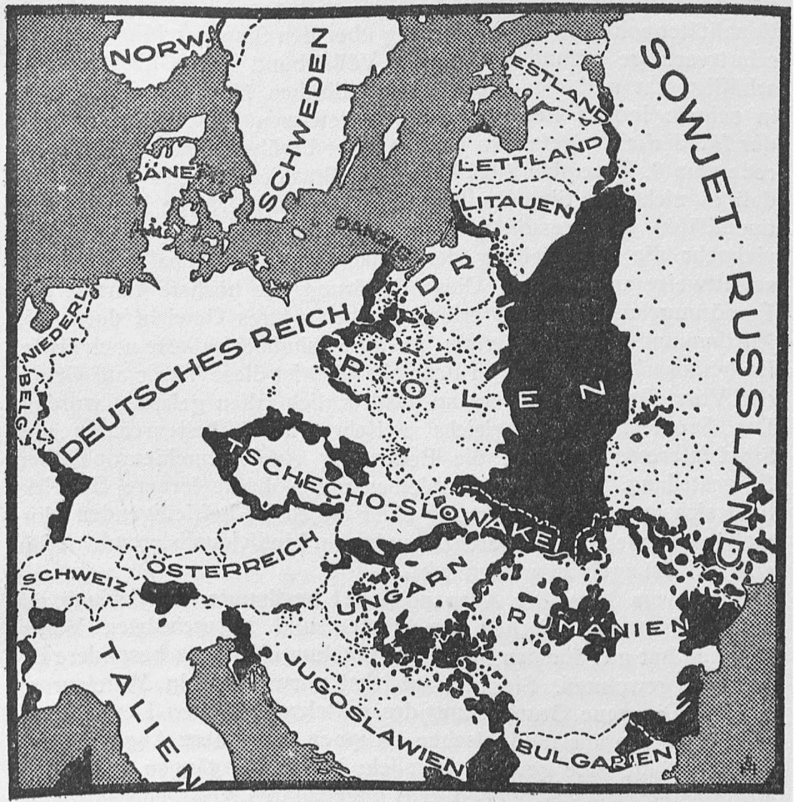
Map of ethnic groups in central Europe: borders were to be shifted; minorities were to be assimilated or dissimilated. Source: Zehn Jahre Versailles. Die grenz- und volkspolitischen Folgen des Friedensschlusses, iii, ed. M. H. Boehm and K. C. Loesch (Berlin, 1930), 445.