Introduction
Fatigue is common and experienced by many but prevalence rates vary according to the setting (Kroenke & Price, Reference Kroenke and Price1993; Pawlikowska et al. Reference Pawlikowska, Chalder, Hirsch, Wallace, Wright and Wessely1994; Eriksen et al. Reference Eriksen, Svendsrød, Ursin and Ursin1998; Van't Leven et al. Reference Van't Leven, Zielhuis, van der Meer, Verbeek and Bleijenberg2009). It is distributed as a continuous variable in the community (Pawlikowska et al. Reference Pawlikowska, Chalder, Hirsch, Wallace, Wright and Wessely1994). Moving from normal tiredness through mild to severe fatigue, the controversial syndrome of chronic fatigue syndrome (CFS) lies at the severest end of this spectrum. Although ubiquitous, fatigue is not a trivial problem and is often associated with disability comparable with that found in other illnesses (Kroenke et al. Reference Kroenke, Wood, Mangelsdorff, Meier and Powell1988). In the primary care setting it is commonly associated with psychological distress and not disease as some might assume (Ridsdale et al. Reference Ridsdale, Evans, Jerrett, Mandalia, Osler and Vora1993). Despite the rise in interest in fatigue over the last few years there has been little prospective research into its aetiology.
Complaints of fatigue were in a recent study found to affect as much as one-third of the general population, with 5% short-term fatigue (<6 months), 31% chronic fatigue (>6 months), and 1% CFS-like fatigue (Van't Leven et al. Reference Van't Leven, Zielhuis, van der Meer, Verbeek and Bleijenberg2009). Common characteristics between all three groups of fatigued subjects were an unhealthy life-style that included smoking, unhealthy food, little physical activity and more use of analgesia, antidepressants and sedatives (Van't Leven et al. Reference Van't Leven, Zielhuis, van der Meer, Verbeek and Bleijenberg2009). This indicates that life-style is a crucial factor for the whole dimension of fatigue, and might also be important for prolongation of fatigue. Other prospective population-based studies have found that previous psychiatric disorder (Harvey et al. Reference Harvey, Wadsworth, Wessely and Hotopf2008) or pre-morbid emotional instability (also known as neuroticism) and self-reported stress are important predictors for developing chronic fatigue (Kato et al. Reference Kato, Sullivan, Evengard and Pedersen2006). Pre-morbid fatigue score was the only significant predictor of chronic fatigue when examined prospectively in another population-based study (Lawrie et al. Reference Lawrie, Manders, Geddes and Pelosi1997). The authors found a cross-sectional correlation between fatigue and psychological distress, but not a predictive relationship, indicating that psychiatric morbidity is associated with, but not necessarily a risk factor for, chronic fatigue (Lawrie et al. Reference Lawrie, Manders, Geddes and Pelosi1997). This is not quite in agreement with other studies that have found psychological distress to be a predictor of CFS (Hotopf et al. Reference Hotopf, Noah and Wessely1996) and post-infectious fatigue. Several outcome studies have further suggested that psychiatric and psychological rather than physical measures predict long-term disability in CFS (Sharpe et al. Reference Sharpe, Hawton, Seagroatt and Pasvol1992; Lawrie & Pelosi, Reference Lawrie and Pelosi1994; Wilson et al. Reference Wilson, Hickie, Lloyd, Hadzi-Pavlovic, Boughton, Dwyer and Wakefield1994; Cairns & Hotopf, Reference Cairns and Hotopf2005).
Long-term fatigue is frequently reported after various viral illnesses (Hotopf et al. Reference Hotopf, Noah and Wessely1996; White et al. Reference White, Thomas, Amess, Crawford, Grover, Kangro and Clare1998; Buchwald et al. Reference Buchwald, Rea, Katon, Russo and Ashley2000). Viral illnesses have therefore been suggested to be a risk factor for CFS (Cope et al. Reference Cope, David, Pelosi and Mann1994), although our previous study found no evidence of CFS being caused by common viral infections (Wessely et al. Reference Wessely, Chalder, Hirsch, Pawlikowska, Wallace and Wright1995). Several retrospective studies have reported the presence of stressful life events and difficulties before onset of CFS (Stricklin et al. Reference Stricklin, Sewell and Austad1990; Masuda et al. Reference Masuda, Nozoe, Matsuyama and Tanaka1994; Theorell et al. Reference Theorell, Blomkvist, Lindh and Evengard1999; Hatcher & House, Reference Hatcher and House2003), including childhood adversity (Heim et al. Reference Heim, Wagner, Maloney, Papanicolaou, Solomon, Jones, Unger and Reeves2006). One of the studies suggests that a particular kind of stressor precedes the onset of CFS, namely irresolvable dilemmas which were detected in nearly a third of the CFS patients but not in the controls (Hatcher & House, Reference Hatcher and House2003). However, other studies have not been able to find this difference (Lewis et al. Reference Lewis, Cooper and Bennett1994). Another factor purported to maintain fatigue is reduced exercise capacity or deconditioning (Berelowitz et al. Reference Berelowitz, Burgess, Thanabalasingham, Murray-Lyon and Wright1995; White et al. Reference White, Thomas, Kangro, Bruce-Jones, Amess, Crawford, Grover and Clare2001). The purpose of this study was to test the hypothesis that negative life events, lack of social support and lack of fitness were independently associated with incident fatigue, irrespective of the presence of a viral infection and concurrent psychological distress.
Method
Design
A longitudinal cohort study was conducted in UK primary care. At stage 1, 31 651 men and women aged between 18 and 45 years and registered with five general practices were mailed a questionnaire, designed to measure subjective physical and mental fatigue (Chalder et al. Reference Chalder, Berelowitz, Pawlikowska, Watts, Wessely, Wright and Wallace1993), and the 12-item General Health Questionnaire (GHQ-12; Goldberg et al. Reference Goldberg, Gater, Sartorius, Ustun, Piccinelli, Gureje and Rutter1997).
Recruitment procedures
Between 1 and 12 months later, patients between the ages of 18 and 45 years (stage 2) visiting the general practitioner (GP) with an acute viral illness were recruited to the study. Most patients presented with ‘flu-like’ episodes or infections of the upper respiratory tract. An additional group of patients, presenting with complaints unrelated to viral infections, were also recruited as controls. More detailed descriptions of the sample and recruitment procedures are reported elsewhere (Wessely et al. Reference Wessely, Chalder, Hirsch, Pawlikowska, Wallace and Wright1995; Chalder et al. Reference Chalder, Power and Wessely1996). Those with anxiety and depression were not excluded. After complete description of the study, written informed consent was obtained from all subjects. They were then asked to complete a series of questionnaires (see Fig. 1).
Patient flow and patients analysed in this study. FQ, Fatigue questionnaire; GHQ, General Health Questionnaire; GP, general practitioner.

Measures
Chalder Fatigue Scale
The Chalder Fatigue Scale is an 11-item scale measuring physical and mental fatigue during the last month. There are four response options available, ranging from ‘less than usual’ to ‘much more than usual’. The scale's total score can range from 0 to 33, but a bimodal score ranging from 0 to 11 can also be obtained. With a cut-off score of ⩾4, the bimodal score is considered indicative of excessive fatigue. The scale is both reliable and valid (Chalder et al. Reference Chalder, Berelowitz, Pawlikowska, Watts, Wessely, Wright and Wallace1993).
GHQ
The short version of the GHQ (GHQ-12) has been extensively used as a short screening instrument to assess psychological distress during the past few weeks. It has been shown to be both reliable and valid, and a good case detector when compared with diagnostic interviews (Goldberg et al. Reference Goldberg, Gater, Sartorius, Ustun, Piccinelli, Gureje and Rutter1997). The GHQ has also been used extensively in primary care.
Life Events Inventory
The Life Events Inventory is a checklist of both positive and negative life events (Cochrane & Robertson, Reference Cochrane and Robertson1973). The checklist includes 48 life events and has spaces for subjects to indicate which, if any, of the events have happened to them during the last 6 months. The questionnaire has two subscales: positive life events and negative life events. The score used in this report is a summary of negative life events only.
Significant Others Scale (social support)
The Significant Others Scale measures different functional resources of social support that may be provided by a number of significant role relationships within an individual's social network. We used a shortened version of the Significant Others Scale which yields levels of actually received and ideally desired levels of support and the discrepancy between them, further called ‘perceived lack’ (Power et al. Reference Power, Champion and Aris1988).
Allergy Scale
An allergy questionnaire designed specifically for this study covered self-reported atopic and allergic symptoms. A question called ‘breathlessness on exertion’ was included and assumed to assess perceived lack of physical fitness. The exact wording of the question was: ‘Have you ever been excessively breathless after minor exercise or after exposure to smoke, fumes or similar factors?’ Responses were dichotomous (0=no, 1=yes).
Social class was measured using the Registrar General's Classification System.
Statistical analysis
All analyses were performed using SPSS version 15 (SPSS Inc., USA). The primary outcome used was fatigue cases (defined as those scoring ⩾4 out of a maximum of 11 on the fatigue scale). Odds ratios, obtained by logistic regression, were used to compare associations between fatigue cases and non-cases. Marital status, social class, presence of viral illness and breathlessness on exertion were treated as categorical variables (e.g. married/co-habiting versus other; professional/intermediate/skilled versus part-skilled/unskilled/unemployed).
To obtain an incident fatigue sample, subjects scoring ⩾4 on the fatigue questionnaire or who had missing data at stage 1 were excluded from the analysis, leaving 1219 subjects. First, crude associations between fatigue caseness at stage 2 and the various risk factors were obtained. Second, we examined whether these associations differed by the presence of viral illness, using the likelihood ratio test for interaction. Third, a full model was specified containing all variables and the interaction terms between them. The time lag between stages 1 and 2 (1–12 months) was controlled for throughout. A final model was obtained using a backward stepwise approach.
Results
There were 15 283 responders at stage 1, an overall response rate of 48%. The response rate adjusted for inaccuracies in the inner-city practice registers was 67% (Pawlikowska et al. Reference Pawlikowska, Chalder, Hirsch, Wallace, Wright and Wessely1994). At stage 2, 2376 subjects were recruited, 1199 with a viral illness and 1177 without a viral illness. All or nearly all of the questionnaires were completed by 97% of those with (n=1167) and 98% of those without viral illness (n=1160). A total of 1873 subjects completed questionnaires at stages 1 and 2. Subjects with missing data at either stage were more likely to be male (181/723=25%) than female (302/1633=18%) (p<0.001), and unmarried (187/456=41%) than married (880/1841=47.8%) (p=0.009). Social class did not differ between responders and non-responders. More information about response rates is reported elsewhere (Wessely et al. Reference Wessely, Chalder, Hirsch, Pawlikowska, Wallace and Wright1995; Chalder et al. Reference Chalder, Power and Wessely1996). There were 502 cases of incident fatigue at stage 2.
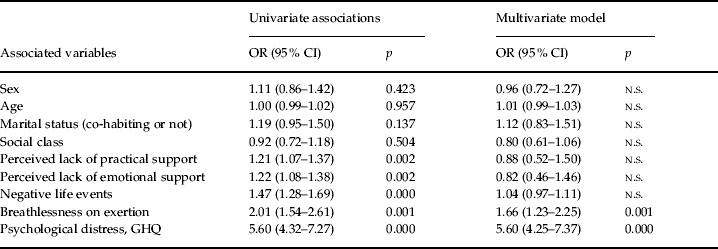
Negative life events, psychological distress, perceived lack of practical and emotional support, and breathlessness on exertion were crudely associated with incident fatigue, all of which were assessed at stage 2. None of the demographic variables was associated with fatigue and the crude associations did not differ between subjects with or without a viral illness. Thus, viral illness is not considered in the subsequent analyses. Past psychological distress (measured at stage 1) did not predict new incidents of fatigue (at stage 2) and was therefore not included in the multivariate model. The best model for new onset fatigue included negative life events and breathlessness on exertion. None of the other variables contributed significantly. The final model including negative life events and breathlessness correctly classified 63.0% of cases and non-cases of fatigue compared with 63.8% in the full model with all variables included (see Table 1).
Univariate and multivariate associations (ORs) between fatigue caseness and other variables at stage 2

OR, Odds ratio; CI, confidence interval.
However, when concurrent psychological distress (from stage 2) was added to the multivariate model, the effect of negative life events disappeared (see Table 2). The final model including psychological distress and breathlessness now correctly classified 71.5% of cases and non-cases of fatigue compared with 71.6% in the full model with all variables included (see Table 2). The final model explained between 16% and 21% of the variance.
Univariate and multivariate associations (ORs) between fatigue caseness and other variables, with psychological distress at stage 2 included

OR, Odds ratio; CI, confidence interval; n.s., non-significant; GHQ, General Health Questionnaire.
Discussion
As hypothesized, this study found that negative life events and lack of fitness were associated with incident fatigue. However, when concurrent psychological distress was included in the multivariate model, the independent association of negative life events disappeared. Perceived lack of support, whether it be emotional or practical, was not independently associated with incident fatigue. Concurrent psychological distress was the strongest factor in determining fatigue.
The results could be interpreted in a number of ways. First, the association between negative life events and fatigue disappeared when controlling for psychological distress, which could indicate that psychological distress mediates the effect of negative life events on fatigue. However, the direction could also go the other way, as the data were collected simultaneously; chronic fatigue has for instance been found to predict psychiatric disorders in another community-based sample (Taylor et al. Reference Taylor, Jason and Jahn2003). Second, our findings are in agreement with Lawrie et al. (Reference Lawrie, Manders, Geddes and Pelosi1997) where cross-sectional correlations between fatigue and psychological distress were found but no predictive relationships when adjusted for baseline fatigue. The authors hence concluded that psychiatric morbidity is associated with, but not necessarily a risk factor for, chronic fatigue. Our results, on the other hand, cannot eliminate the possibility of psychological distress as a predictor of chronic fatigue, as this study only investigates new onset of fatigue. Given the evidence of emotional instability (Kato et al. Reference Kato, Sullivan, Evengard and Pedersen2006) and psychological distress as predictors of chronic fatigue (Hotopf et al. Reference Hotopf, Noah and Wessely1996; Russo et al. Reference Russo, Katon, Clark, Kith, Sintay and Buchwald1998) and post-infectious fatigue (Wessely et al. Reference Wessely, Chalder, Hirsch, Pawlikowska, Wallace and Wright1995), it still seems reasonable to assume that psychological distress is involved in prolongation of fatigue.
Breathlessness on exertion was the other independent association with fatigue in this study. Breathlessness is a symptom of anxiety. However, given that this question specifically asked about breathlessness on exertion it seems unlikely that anxiety was the sole explanatory factor. Second, breathlessness could have been associated with asthma. However, both univariate and multivariate statistics were carried out excluding subjects with self-reported asthma. The effect remained. In keeping with previous research, it seems plausible therefore that breathlessness on exertion is indeed an indication of lack of fitness or deconditioning. Lack of activity or exercise is commonly associated with fatigue (Haines, Reference Haines1974; Greenleaf & Kozlowski, Reference Greenleaf and Kozlowski1982; White et al. Reference White, Thomas, Kangro, Bruce-Jones, Amess, Crawford, Grover and Clare2001), and the negative effects of inactivity on exercise physiology are well established (Convertino et al. Reference Convertino, Bloomfield and Greenleaf1997), as is post-exertional malaise which has been associated with prolongation of fatigue (Taylor et al. Reference Taylor, Jason and Curie2002). Finally, breathlessness on exertion as an indication of little physical activity is in agreement with Van't Leven et al. (Reference Van't Leven, Zielhuis, van der Meer, Verbeek and Bleijenberg2009) who argued that an unhealthy life-style is significant in the whole spectrum of fatigue.
In this study, we asked about people's perception of their fitness, which could differ from their actual level of physical fitness. Future studies should therefore look at both subjective and objective measures of physical fitness. In addition, the latter part of the question (… exposure to smoke, fumes or similar factors) might conflate sensitivity to exposure and perceived sensitivity to exposure, which may in turn be associated with neuroticism and distress (Van den Bergh et al. Reference Van den Bergh, Winters, Devriese, van Diest, Vos and de Peuter2004). On balance, however, we think that the most likely interpretation of this finding is level of fitness in accordance with previous studies showing that physical activity is associated with reduced feelings of fatigue (Puetz, Reference Puetz2006).
There did not appear to be any interactions between possible viral infection and the other risk factors such as psychological distress, life events, social support or breathlessness on exertion. The multivariate analysis was therefore carried out without entering viral status as a covariate. This does not necessarily exclude a role for viruses in a model of understanding chronic fatigue. It does seem reasonable to assume that in some, the virus acts as a trigger for the fatigue in a vulnerable individual but does not diminish the effect of other predictor variables such as psychological distress and breathlessness on exertion. We were interested in the fact that social support was not retained in the final model and so examined the correlation between social support and psychological distress and found small but significant associations (−0.22, p<0.01). It is possible that although social support is not central to the development of fatigue it may be more important in determining chronicity.
The main methodological problem with this study is the fact that most of the risk factors were assessed at the same time as the outcome, introducing the possibility of reporting bias. However, although this may have inflated the univariate associations, this is less likely to have affected the multivariate model because all estimates would have been inflated more or less to a similar extent. The salient associations found in this study should therefore be investigated further in order to determine their significance as risk factors for new onset fatigue.
In conclusion, psychological distress did not predict new onset of fatigue, but was strongly associated with fatigue and hence emphasizes the significance of psychological distress as a concomitant complaint in fatigue. Further, the salient association between breathlessness and fatigue could indicate a need to recommend exercise as a therapeutic strategy to improve physical fitness in the primary care setting, although these findings need replication before such therapeutic strategies are recommended.
Acknowledgements
We are grateful to Vivian Hobbs, Julie Dennison, Dawn Baker, Sue Fox, Marjorie Peers and Brenda Hinton for helping with the data collection. We would also like to thank the GPs for their assistance. The study was supported by the Linbury Trust. T.C. and S.W. acknowledge financial support from the Department of Health via the National Institute for Health Research (NIHR) Specialist Biomedical Research Centre for Mental Health award to South London and Maudsley NHS Foundation Trust (SLaM) and the Institute of Psychiatry at King's College London.
Declaration of Interest
Trudie Chalder is an author of books on chronic fatigue.