Implications
Calves fed high-concentrate diets in intensive beef production systems consume low amounts of forage when dietary components are offered separately. Total mixed ration could be a good way of promoting greater intake of roughage, because when concentrate and barley straw were mixed, animals consumed a larger amount of roughage than when offered separately, and heifers also spent a longer time ruminating. The promotion of rumination is, at the same time, a way to reduce the risk of ruminal acidosis when this feeding method is used.
Introduction
Ruminants require roughage in their diets to maximize production and to maintain health by sustaining a stable environment in the rumen (Allen, Reference Allen1997). Of particular importance is the regular intake of fibrous material, and the extent to which ruminants exhibit an appetite for fibre is also relevant. Given a free choice between forage and concentrates, cattle consume ∼20% of their dry matter intake (DMI) as forage (Forbes and Provenza, Reference Forbes and Provenza2000). However, young cattle fed diets based on concentrate and barley straw, offered both ad libitum and separately, consume the roughage in a much lower proportion. Devant et al. (Reference Devant, Ferret, Gasa, Calsamiglia and Casals2000) reported that the concentrate : barley straw ratio decreased from 95 : 5 to 92 : 8 in Friesian crossbred heifers from 80 to 230 kg BW. González et al. (Reference González, Ferret, Manteca, Ruíz de la Torre, Calsamiglia, Devant and Bach2008), working with Friesian heifers from 140 to 380 kg BW in feedlot conditions, reported an average concentrate : straw ratio of 89 : 11 when both ingredients were also offered separately and on an ad libitum basis.
Chewing time is strongly related to forage content and forage particle size (Colebrander et al., Reference Colebrander, Noller and Grant1991). Physically effective fibre is the fraction of feed that stimulates chewing activity. Chewing, in turn, stimulates saliva secretion. Bicarbonate and phosphate buffers in saliva neutralize acids produced by fermentation of organic matter (OM) in the rumen. The balance between the production of fermentation acid and buffer secretion is a major determinant of ruminal pH. Low ruminal pH may decrease intake, fibre digestibility and microbial yield and thus affect animal performance and increase feed costs. Diets should be formulated to maintain adequate mean ruminal pH, and its variation should be minimized by feeding management (Allen, Reference Allen1997).
A free-choice feeding method partially mimics nature and facilitates selection based on nutrient requirements that fluctuate along with feed quality and availability (Provenza, Reference Provenza1996). Animals can more efficiently meet their individual needs for macronutrients when offered a choice among dietary ingredients than when constrained to a single diet, even if it is nutritionally balanced (Atwood et al., Reference Atwood, Provenza, Wiedmeier and Banner2001). In contrast, when rations are chopped and mixed, these components become increasingly difficult for animals to separate. Atwood et al. (Reference Atwood, Provenza, Wiedmeier and Banner2001), working with fattening calves, found that animals offered the mixed ration tended to eat more than animals offered a free choice but they did not gain weight at a faster rate. Calves restricted to the total mixed ration (TMR) ate a constant ratio of protein to energy, whereas animals offered a choice fluctuated throughout the trial. Moreover, providing feed components as a TMR increased the distribution of DMI over the course of the day and reduced the amount of sorting in young dairy heifers (DeVries and von Keyserlingk, Reference DeVries and von Keyserlingk2009). We hypothesized that young cattle fed diets based on concentrate and barley straw by means of TMRs could increase the amount of roughage intake and the chewing activity, reducing the risk of ruminal acidosis. The objective of the present experiment was to compare the intake and feeding behaviour of individually housed beef female calves offered a TMR or dietary components separately. Moreover, we wanted to ascertain whether there was sorting and whether the feeding method affected this activity.
Material and methods
Animal procedures were approved by the Institutional Animal Care and Use Committee of the Universitat Autònoma de Barcelona.
Animals, experimental design and housing
A total of eight Simmental heifers (114 ± 3.2 days old and with an average initial BW of 118 ± 3.8 kg) were purchased from a commercial market and used in a crossover experimental design in spring 2010. Treatments consisted of feeding concentrate and chopped barley straw as (1) choice (CH; concentrate and straw in separate feedbunks) or (2) TMR (concentrate and straw in one feedbunk). Feeds were offered on an ad libitum basis, but always maintaining a concentrate to straw ratio of 90 to 10. The ratio of the CH diet was maintained by adjusting the amount of concentrate and straw allocated each day based on the actual intake of the previous day. Heifers were assigned to each treatment on the basis of BW to obtain two groups with the same average BW and standard error; four animals received concentrate and barley straw that were offered separately, whereas the other four received concentrate and barley straw as TMR. The experiment was performed in two 21-day periods, and sampling was carried out in the last week of each period. At the end of the first period, treatment was changed; thus, the final number of animals in each treatment was eight.
Animals were allotted to eight individual roofed pens. Each pen had a concrete floor and was 5 m long and 2.5 m wide (12.5 m2/pen). Each pen had a 6.25 m2 resting area, bedded with wood shavings, and a 6.25 m2 feeding area. There were two feedbunks in pens for heifers fed the concentrate and barley straw separately and one feedbunk for those fed the mixed ration. The feeders were placed at the front of the 2.5-m-wide feeding area and one water trough was placed beside the feedbunk. The adjacent pens were separated by a metal fence with a bar design that allowed contact between animals.
Feed, water supply and data collection
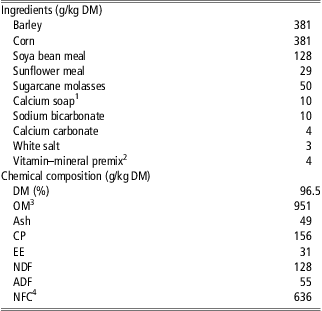
The concentrate was formulated according to the National Research Council (1996) to meet the requirements of beef heifers weighing 150 kg and growing 1.4 kg/day. The ingredients and chemical composition of the concentrate are shown in Table 1. All ingredients of the concentrate were ground through a 3-mm screen and mixed. Barley straw was coarsely chopped with a chopping machine and contained 94.4% DM, 93.6% OM, 3.1% CP, 81.9% NDF and 51.3% ADF, on a DM basis. Once chopped, all the straw was handled for particle size separation using the 2-screen Penn State Particle Separator (PSPS; Lammers et al., Reference Lammers, Buckmaster and Heinrichs1996) and only material of more than 8 mm was used to feed the heifers. Feeders were cleaned and orts were collected at 0830 h each morning, and feed was offered once daily at 0900 h. Straw samples were taken on days 2, 4 and 6, for the straw offered, and daily for the straw refused, just before cleaning the feedbunks. These samples were taken for DM determination, chemical analysis and particle size separation. Particle size separation was performed using the 2-screen PSPS. To separate the straw refused in TMR from the concentrate refused, the mixed orts were sieved in two sequential processes: first, the 2-screen PSPS was used, with the assumption that the material harvested in the top screen (19 mm) and in the second screen (8 mm) was refused straw, and second, the material harvested in the first process from the bottom pan was again sieved through the 8 mm screen, to ensure that all the straw refused was retained by the pan. In these two processes, the PSPS was only used as a sieving device without applying the shaker procedure proposed by the PSPS user's manual. Orts were weighed before feeding and the diet offered was 115% of the previous day's intake. To register water consumption, individual drinking cups fitted with a measuring scale were used. Water was available at all times.
Ingredients and chemical composition (g/kg DM) of concentrate

DM = dry matter; OM = organic matter; EE = ether extract; NFC = non-fibre carbohydrates.
1Magnapac® (Norel Animal Nutrition, Madrid, Spain).
2Nutral Terneros® (NUTRAL, S.A., Colmenar Viejo, Madrid, Spain): vitamin and mineral premix contained per kg premix (as fed): 1.500 kIU vitamin A, 500 kIU vitamin D3, 3.75 g vitamin E, 0.5 g vitamin B1, 0.5 g vitamin B2, 0.25 g vitamin B6, 1.25 mg vitamin B12, 15.0 g Zn, 2.5 g Fe, 83.3 g S, 55.0 mg Co, 2.5 g Cu, 7.5 g Mn, 100.0 mg I, 100.0 mg Se.
3OM calculated as DM minus ash content.
4NFC calculated as 100 − (CP + ash + NDF + EE).
Data collection and analyses
BW was recorded before feeding and after withdrawal of refusals on 2 consecutive days at the start and the end of the experiment. Intermediate weights were taken at the end of the experimental week for the calculation of the average daily gain (ADG) and the feed to gain ratio. Concentrate and barley straw orts, separately or mixed, were collected daily for 7 consecutive days and composited for each heifer to calculate nutrient intake. Samples were analysed for DM content in order to record daily feed DMI. Dry matter (DM) content of offered feed and refusals were determined by drying samples for 24 h at 103°C in a forced-air oven according to the Association of Official Analytical Chemist (AOAC, 1990). Feed offered and refusal samples were dried in a forced-air oven at 60°C for 48 h for later chemical analysis. Feeds and refusals were ground in a hammer mill through a 1-mm screen (P. PRAT SA, Sabadell, Spain) and retained for analysis of DM (AOAC, 1990; ID 950.01) and ash (AOAC, 1990; ID 942.05). Nitrogen content was determined using the Kjeldahl procedure (AOAC, 1990; ID 976.05). OM was calculated as the difference between DM and ash content. Ether extract was performed according to AOAC (1990; ID 920.39). The NDF and ADF contents were determined sequentially by the procedure of Van Soest et al. (Reference Van Soest, Robertson and Lewis1991) using a thermostable α-amylase. Sodium sulphite was used to determine the NDF content of concentrate but not for the determination of the NDF content of barley straw. DM and nutrient daily intake were calculated as the difference between the amount of DM or nutrient offered and refused. Physically effective NDF (peNDF) was calculated by multiplying the straw intake by the proportion of straw greater than 8 mm in length and by the NDF content of the straw.
Sorting of the particle size in the roughage ingredient was calculated as the actual intake of each fraction expressed as a percentage of the predicted intake, where the predicted intake of Y fraction equals the product of as-fed intake and as-fed fraction of the Y fraction in the roughage ingredient. Values <100% indicate selective refusals, >100% is preferential consumption and = 100% is no sorting (Leonardi and Armentano, Reference Leonardi and Armentano2003).
Animal behaviour
To monitor animal behaviour throughout the day, a digital video-recording device was set up close to the pens (model VS-101P VioStor NVR, QNAP Systems Inc., Xizhi City, Taipei County, Taiwan). A digital colour camera (model VIVOTEK IP7142, Vivotek Inc., Chung-HO, Taipei County, Taiwan) was placed in front of the feeding area of each pen at a height of 3 m. An IR light with photoelectric cells was set at each end of the paddock for video-recording at night (λ = 830 nm and 500 W; Dennard 2020, Hants, UK). Animal behaviour was video-recorded for 24 h on day 2 and day 6 of each experimental period. Data processing was carried out by continuous sampling for the behaviour of each heifer. The behavioural categories used were mutually exclusive and as defined later. Recorded activities were registered together with their beginning and ending times. Data for each activity are presented as the total time, expressed in minutes, in which the animal maintained this specific activity.
Chewing behaviour was divided into eating and ruminating. An observation was defined as eating when the animal had its muzzle in the feedbunk or was chewing or swallowing food with its head over it. Ruminating included regurgitation, mastication and swallowing of the bolus. An activity was recorded as drinking when the heifer had her muzzle in the water bowl or was swallowing the water. Non-chewing behaviour categories were resting, self-grooming, social behaviour, oral behaviours and rummaging in wood shavings. Resting was recorded when no chewing behaviour and no apparent activity were being performed. Self-grooming was defined as non-stereotyped licking of the body or scratching with a hind limb or against the fixtures. Social behaviour was registered when a heifer was licking or nosing a neighbouring heifer with the muzzle or butting. Oral behaviours included the act of licking or biting the fixtures and tongue-rolling, both of which were considered stereotyped behaviours. Finally, rummaging in wood shavings was considered an exploratory behaviour. To analyse behaviour patterns, the day was sub-divided into 12 intervals of 2-h each, starting at the beginning of the day (intervals 1 to 12).
Statistical analyses
Each heifer fed a given treatment diet at each period was considered the experimental unit in all the analyses. The daily mean value for each intake variable was calculated as the average of 7 days in each experimental period and was statistically analysed using a mixed-effects regression model ANOVA using the MIXED procedure of SAS (v. 9.1; SAS Institute Inc., Cary, NC, USA, 2008). The model contained the fixed effects of treatment, period and their interaction and the random effect of heifer nested within sequence. A square root-arcsine transformation was applied to the variables expressed as percentage but presented as back-transformed least square means. Data from sorting of straw particle size were tested for a difference from 100 using the t-test.
To test treatment effect for each behavioural activity, a repeated measures analysis was performed using the GLIMMIX procedure of SAS (v. 9.1; SAS Institute Inc., Cary, NC, USA, 2008). The model included the fixed effect of treatment, period and their interaction. The time interval was considered the repeated measure and heifer nested within sequence was considered the random effect. Regression analyses were also performed to obtain the coefficients of determination between rumination time and dietary factors across treatments using the REG procedure of SAS (v. 9.1; SAS Institute Inc., Cary, NC, USA, 2008). Significance was set at P < 0.05 and tendencies are considered at P < 0.10 unless otherwise noted.
Results
Period effect was statistically significant in the majority of the variables studied, as expected in growing animals and with variables in which intake is involved, but this will not be discussed here. However, treatment × period interaction was not detected in any variable; thus, we will only refer to the treatment effect.
Feed intake, water consumption, performance and sorting of particles
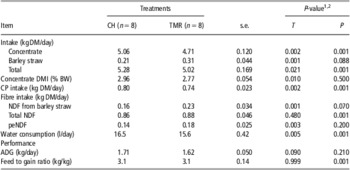
Concentrate intake and the total DMI of heifers fed with the CH feeding method were higher than when fed with TMR (P = 0.002 and P = 0.021, respectively; Table 2). Conversely, barley straw was consumed in higher amounts in heifers fed with the TMR feeding method (P = 0.001). Concentrate DMI, expressed in percentage of BW, was high in both treatments but greater in heifers fed with CH than with TMR (2.96 and 2.77, respectively; P = 0.010). These high concentrate intakes resulted in a high concentrate to straw ratio (96 : 4 and 94 : 6, for CH and TMR, respectively), which was higher in CH than in TMR (P = 0.001; data not shown in Table 2).
Intake, water consumption and animal performance in heifers feeding concentrate and barley straw as a choice (CH) or as TMR

CH = choice; TMR = total mixed ration; DM = dry matter; DMI = dry matter intake; peNDF = physically effective NDF; ADG = average daily gain.
peNDF = straw DMI × sum of percentages of particle sizes bigger than 8 mm × straw NDF content.
1Factors are: T = treatment; P = period.
2 T × P interaction was not significant.
The intake of CP was higher in heifers fed with the CH than with the TMR method (P = 0.002) but the total NDF intake was similar in both treatments. In contrast, NDF intake from barley straw and peNDF intake were higher in heifers fed with the TMR feeding method than when fed with CH (P = 0.001 and P = 0.003, respectively). Water consumption, expressed as litres per day, was greater in CH than in the TMR treatment (P = 0.005). Heifers fed with the CH feeding method tended to grow more than when fed with TMR (P = 0.090). As a consequence of both a higher ADG and a higher total DMI in heifers fed with the CH feeding method, the feed to gain ratio was similar in both treatments.
The feeding method used to feed heifers did not affect the consumption of the different kinds of barley straw particles, which were separated using the PSPS (Table 3). Sorting of particles was not detected, except in the case of particles between 8 and 19 mm in size, where there was a tendency (P < 0.10) to sorting for in heifers fed TMR.
Effect of feeding method, choice (CH) v. TMR, on the sorting1 (%) of particles

CH = choice; TMR = total mixed ration; DMI = dry matter intake.
1Sorting % = 100 × (particle size n DMI/particle size n predicted DMI). Sorting values equal to 100% indicate no sorting, <100% indicate selective refusals (sorting against) and >100% indicate preferential consumption (sorting for).
2Particle size determined by Penn State Particle Separator.
3Factors are: T = treatment; P = period.
4 T × P interaction was not significant.
5Difference in sorting values from 100%: P < 0.10.
Animal behaviour
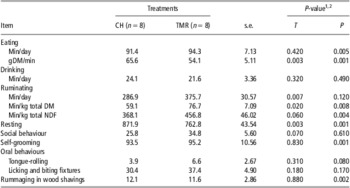
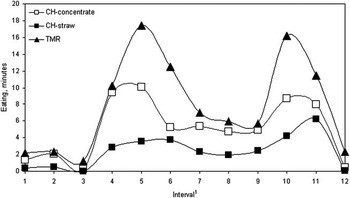
Feeding method did not affect eating and drinking behaviours. The heifers devoted, on average, 93 and 23 min/day to each activity (Table 4). Taking into account both time spent eating and the total DMI recorded on the 2 days of behaviour observation, we calculated the corresponding feeding rate (g DM/min), which was higher in heifers fed CH. When the eating pattern was divided in the 2-h intervals (Figure 1), two peaks were observed at intervals 5 (from 0800 to 1000 h) and 10 (from 1800 to 2000 h). However, when eating behaviour of the concentrate and barley straw of the heifers fed with the CH feeding method was compared, a 2-h displacement was observed between the intakes of the two components of the ration when offered separately, with concentrate peaking first on both occasions.
Behaviours of heifers feeding concentrate and barley straw as a choice (CH) or as TMR

1Factors are: T = treatment; P = period.
2 T × P interaction was not significant.
Eating time patterns obtained from video recordings of heifers fed concentrate (- ▪ -) and barley straw (- □ -), either separately by the choice feeding method, or as total mixed ration (-▴-).1 The day was divided into 12 intervals of 2 h each. Intervals were: 1, 2, 3, 4, 5, 6, 7, 8, 9, 10, 11 and 12, corresponding to 0 to 2, 2 to 4, 4 to 6, 6 to 8, 8 to 10, 10 to 12, 12 to 14, 14 to 16, 16 to 18, 18 to 20, 20 to 22, 22 to 24 h of the day, respectively.

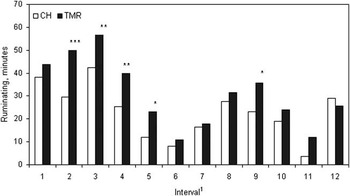
Ruminating behaviour was affected by the feeding method. Heifers fed TMR spent more time ruminating than heifers fed concentrate and barley straw separately (P = 0.007). The differences in the ruminating activity of the two feeding methods were detected at intervals 2, 3, 4, 5 and 9 (Figure 2).
Ruminating time patterns obtained from video recordings of heifers fed concentrate and barley straw, either separately by the choice feeding method (□) or as total mixed ration (▪).1 The day was divided into 12 intervals of 2 h each. Intervals were: 1, 2, 3, 4, 5, 6, 7, 8, 9, 10, 11 and 12, corresponding to 0 to 2, 2 to 4, 4 to 6, 6 to 8, 8 to 10, 10 to 12, 12 to 14, 14 to 16, 16 to 18, 18 to 20, 20 to 22, 22 to 24 h of the day, respectively. The effect of feeding method was significant at *** P ≤ 0.001, ** P ≤ 0.01 or * P ≤ 0.05.

Resting was affected by treatment (P = 0.003), the activity being greater in heifers fed the components of the ration separately. The remaining behaviours were not affected by the feeding method. There were no differences among treatments with regard to stereotyped behaviours.
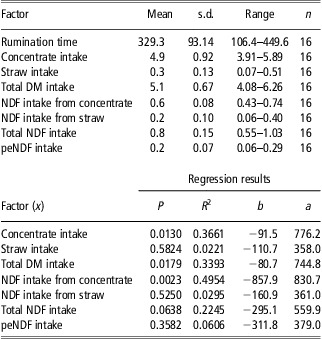
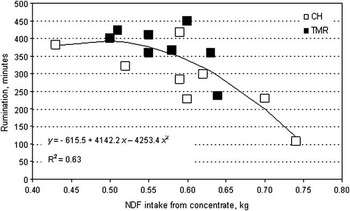
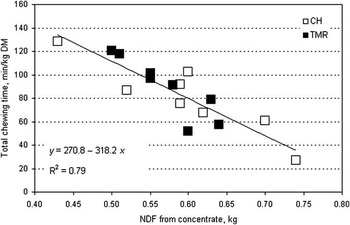
The factors that better explained the variation in rumination activity were the NDF intake from concentrate, concentrate intake and the total DMI, the coefficients of determination being 0.50 (P = 0.0023), 0.37 (P = 0.0130) and 0.34 (P = 0.0179), respectively (Table 5). When a quadratic approach was carried out between the best dietary factor and rumination time, the R 2 increased to 0.63 and the resulting equation was: rumination time (minutes) = −615.5 + 4142.2 x − 4253.4 x 2 (P = 0.0489; root mean square error (RMSE) = 60.87; Figure 3), where x is the NDF intake from concentrate (kg). When expressing the total chewing time as minutes per kg DMI and correlating it with NDF intake from concentrate (kg), the equation obtained was: total chewing time (min/kg DMI) = 270.8 − 318.2 x (r = −0.89; P = 0.001; RMSE = 13.19; Figure 4), where x is the NDF intake from the concentrate (kg).
Mean, standard deviation (s.d.) and range of rumination time, and dietary factors and their relationships determined by regression1

DM = dry matter; peNDF = physically effective NDF.
1Rumination time = a + bx, where a = intercept and b = slope.
The quadratic relationship between NDF intake from concentrate (x) and rumination time (y). Symbols represent heifers fed concentrate and barley straw, either separately by the choice feeding method (□) or as total mixed ration (▪).

The linear relationship between NDF intake from concentrate (x, kg) and total chewing time (y, min/kg DM intake). Symbols represent heifers fed concentrate and barley straw, either separately by the choice feeding method (□) or as total mixed ration (▪).

Discussion
Heifers offered a choice ate more concentrate and total DM than animals offered a TMR. This result contrasts with those obtained by other researchers (Atwood et al., Reference Atwood, Provenza, Wiedmeier and Banner2001; DeVries and von Keyserlingk, Reference DeVries and von Keyserlingk2009; Moya et al., Reference Moya, Mazzenga, Holtshausen, Cozzi, González, Calsamiglia, Gibb, McAllister, Beauchemin and Schwartzkopf-Genswein2011). Atwood et al. (Reference Atwood, Provenza, Wiedmeier and Banner2001) compared the intake of beef calves offered a choice or no choice among foods. Diets consisted of ad libitum access to either a chopped, mixed ration of forage (corn silage, 15.5%, and alfalfa hay, 18.9%) and concentrate (rolled barley, 31.3%, and rolled corn, 31.3%) or a choice among those foods offered individually, and they found that animals offered the mixed ration tended to eat more than animals offered a free choice. DeVries and von Keyserlingk (Reference DeVries and von Keyserlingk2009) offered 2.02 kg/day DM of grain concentrate and ad libitum chopped grass hay to prepubescent heifers. Treatments consisted of feeding the diet ingredients as a choice, top-dressed ration and TMR, and no differences in DMI were found between treatments. Finally, Moya et al. (Reference Moya, Mazzenga, Holtshausen, Cozzi, González, Calsamiglia, Gibb, McAllister, Beauchemin and Schwartzkopf-Genswein2011), working with crossbred beef heifers, found similar intakes when heifers were fed a TMR with a 10 to 90 corn silage to concentrate (tempered barley-grain, 85% and vitamin and mineral supplement, 5%) ratio and when heifers received both feeds separately. The fact that we used barley straw as a roughage source instead of corn silage or hay (Atwood et al., Reference Atwood, Provenza, Wiedmeier and Banner2001), beef heifers with no limitation in concentrate availability instead of dairy heifers offered a limited amount of concentrate (DeVries and von Keyserlingk, Reference DeVries and von Keyserlingk2009) and young animals reared individually instead of heifers more aged and reared in groups (Moya et al., Reference Moya, Mazzenga, Holtshausen, Cozzi, González, Calsamiglia, Gibb, McAllister, Beauchemin and Schwartzkopf-Genswein2011) could explain the contrasting results between this previous research and those obtained in the present experiment. Differences in the type and availability of ingredients offered and differences in the animal behaviour as a result of the rearing system could affect the response of animals to the feeding method.
As a result of higher concentrate DMI, the CP intake was also higher in heifers fed CH than in the TMR treatment. In contrast, the total NDF intake was the same in both feeding methods because the lesser concentrate intake in TMR treatment was compensated for by a greater barley straw intake, resulting in a higher NDF intake from barley straw in heifers fed the TMR treatment. Corresponding to a greater total DMI in animals fed the CH treatment, the water consumption registered in these animals was greater. Finally, the greater ADG recorded in heifers fed CH treatment was the result of a greater concentrate and total DMI in these animals, which led to an increase in nutrient availability, as was recorded in the case of protein intake. However, there was no difference in gain efficiency between treatments due to the fact that greater ADG observed in animals fed the CH treatment corresponded with a greater total DMI.
Concentrate to barley straw ratio was offered at 90% to 10% in both the free choice and the TMR treatment. However, in both treatments, heifers ate less forage than expected and much less than the level of 20% proposed by Forbes and Provenza (Reference Forbes and Provenza2000) for ruminants given a free choice between forage and concentrate. This result is in agreement with data obtained by Devant et al. (Reference Devant, Ferret, Gasa, Calsamiglia and Casals2000) in young heifers (80 kg BW) given free-choice barley straw and concentrate in which they found a concentrate to forage ratio of 95 to 5, between the ratio recorded in the present experiment (96 to 4 and 94 to 6 for CH and TMR treatment, respectively). To design a TMR diet for young animals, it may be necessary to reduce the proportion of barley straw to fit the animals’ requirements better. Also, Maekawa et al. (Reference Maekawa, Beauchemin and Christensen2002) found that feeding forage and concentrate separately resulted in dairy cows consuming a higher proportion of concentrate than intended. It is evident that independent of the feeding method, animals fed high-concentrate diets sorted against the forage component. With regard to possible differences in the consumption of different kinds of barley straw particles, the ANOVA showed that the intake was similar, although the t-test confirmed that there was a tendency towards preferential consumption of medium-sized particles (from 8 to 19 mm) in heifers fed TMR.
Time spent eating was not different between treatments. Despite the greater total DMI in heifers fed the CH feeding method, animals did not spend more time eating. This resulted in a higher feeding rate in these animals, in accordance with DeVries and von Keyserlingk (Reference DeVries and von Keyserlingk2009). The higher consumption rate in the CH treatment was probably caused by the higher rate of concentrate intake. Maekawa et al. (Reference Maekawa, Beauchemin and Christensen2002) also found that cows fed components of the ration separately ate the concentrate portion more than twice as fast as the forage portion of the ration.
Cattle ingest their food essentially during the daytime, with the major eating peaks at the beginning and at the end of the day (Jarrige et al., Reference Jarrige, Dulphy, Faverdin, Baumont and Demarquilly1995). This is also true when high-concentrate diets are offered to ruminants, as was observed under feedlot conditions by González et al. (Reference González, Ferret, Manteca, Ruíz de la Torre, Calsamiglia, Devant and Bach2008) with heifers fed a diet with an average forage to concentrate ratio of 11% to 89% and confirmed in the present experiment. This behaviour pattern was observed in both treatments, although in the CH treatment, a displacement was observed in the peaks of concentrate and barley straw consumption, confirming that animals first ate the concentrate and when they are satiated with this component, they ingest the forage component. Similar results were reported by Quigley et al. (Reference Quigley, Steen and Boehms1992) and DeVries and von Keyserlingk (Reference DeVries and von Keyserlingk2009) in calves and dairy heifers, respectively.
Although heifers in both treatments consumed the same amount of NDF, heifers fed TMR spent more time ruminating than heifers fed the CH feeding method, probably as a consequence of the greater straw, NDF from straw and peNDF intake. Due to the fact that ruminal pH is highly responsive to meals and chewing behaviour, because pH decreases following meals and increases during bouts of rumination (Allen, Reference Allen1997), we assume that the use of TMR as a feeding method contributed to maintaining adequate mean and variation of ruminal pH, reducing the risk of ruminal acidosis.
Although dietary NDF is related to chewing activity for all forage diets (Welch and Smith, Reference Welch and Smith1969), dietary NDF is not strongly related to chewing across the range of diets consumed by dairy cows (Allen, Reference Allen1997). When the relationships across treatments were determined in the present experiment, the best coefficient of determination obtained was between rumination activity and dietary NDF intake from the concentrate. It is likely that in high-concentrate diets in which the amount of forage intake is very low, the dietary factor best correlated with chewing activity is linearly related to the concentrate component rather than the roughage component, as expected. Nevertheless, the quadratic relationship obtained between rumination activity and NDF intake from concentrate would indicate that up to a level of 0.5 kg of NDF from concentrate, which corresponds to 4.5 kg of concentrate intake and 4.7 kg of DMI, rumination would increase, but would decrease beyond this threshold. If this finding is confirmed in future research, it would be useful to identify in each growing period the threshold beyond which this decrease in rumination activity occurs. We hypothesize that until this level of concentrate consumption, young calves fed a high-concentrate diet spent more time ruminating to neutralize the acid load caused by the production of fermentation acid, but after this point, the equilibrium was broken, with a probable decrease in pH and a reduction in rumination activity. A probable loss in mastication efficiency would explain this decrease. The negative correlation coefficient obtained between ruminating time and the NDF intake from concentrate is in agreement with data reported by Dado and Allen (Reference Dado and Allen1994), who obtained a similar result in the linear correlation between the total chewing time and DMI in dairy cows. These authors explained that the amount of time spent chewing per unit of intake could be implicated as a measure of mastication efficiency (Deswysen et al., Reference Deswysen, Ellis and Pond1987). Increased efficiency may be due to a shorter time between boluses, a greater number of chews per unit time, a lower proportion of pseudorumination or more efficient regurgitation of long particles (DeBoever et al., Reference DeBoever, Andries, DeBrabander, Cottyn and Buysse1990). Except for the last argument, which is irrelevant in high-concentrate diets, the remaining three could explain the decrease in the total chewing time as NDF intake increases. However, due to the limited data in this study, this result should be interpreted with caution.
In conclusion, young female calves fed diets of concentrate and barley straw at 90 to 10 ratios and offered as a TMR had higher roughage intake than when the dietary components were offered separately. The increased intake in cereal straw resulted in a decrease in concentrate and the total DMI. In correspondence, the ADG tended to decrease when animals received the diet as TMR, although the feed to gain ratio was not affected. The increased amount of roughage intake also resulted in an increase in the time spent ruminating.
Acknowledgements
Financial support from the Spanish Ministry of Science and Innovation (AGL2008-03729) and technical support from Clara Puiggrós are acknowledged.