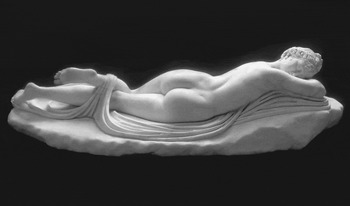
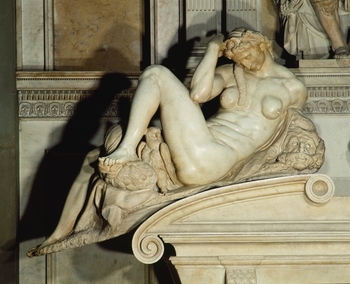
Two marble statues, each representing a reclining, sleeping nude of somewhat indeterminate sex, sit at the heart of Swinburne's early collections of poetry: the Hellenistic Sleeping Hermaphrodite (Figure 1) in his Poems and Ballads (1866) and Michelangelo's allegorical figure La Notte (Figure 2) in his “In San Lorenzo” sonnet in Songs before Sunrise (1871). Swinburne's dealings with the Hermaphrodite have had a long and ever increasing bibliography;Footnote 1 his fascination with Michelangelo's sculpture has, to my knowledge, not yet provoked much scholarly attention.Footnote 2 This imbalance may partly be ascribed to the immediate sex appeal of the Hermaphrodite – this “late Romantic freak,” as Camille Paglia appropriately called it (413) – which in the gendered critical discourse of the 1990s has given rise to a whole range of exciting explorations of Swinburne and the body, Swinburne and androgyny, Swinburne and poetic blindness. The Michelangelo statue was, however, turned into a poetic and political monument by Swinburne under far less erotically charged circumstances in the volume dedicated to Guiseppe Mazzini, and opens for different routes of inquiry.
Hermaphroditus. Roman copy of 2nd cent. A.D. after a Hellenistic original, marble. Courtesy of Musée du Louvre, RMN © Hervé Lewandoski.

(Color online) Michelangelo, La Notte. 1526–31. Florence, San Lorenzo, Medici Chapel. Courtesy of the Ministero per i Beni e le Attività Culturali © Nicolò Orsi Battaglini.

And yet the two sculptures and the poems they inspired are closely connected. They are both celebrated in the stanzaic form most closely related to the marble block, namely that of the sonnet, the compact fourteen-line stanza to which nothing can be added and where argument and structure twist and turn, not unlike the contortions of Hellenistic and Mannerist sculpture. They are highly literary sculptures which, ever since their first public display, the Hermaphrodite in the seventeenth and the Notte in the sixteenth centuries, have had an impressive literary reception:Footnote 3 Smollett, Winckelmann, Shelley and Gautier had provided literary responses to the Hermaphrodite, and in the sixteenth century Giovanni Strozzi, Michelangelo himself and Anton Francesco Doni had written verses to La Notte. In the nineteenth century she featured again in the poetry of E. B. Browning, and as Charles Baudelaire's “rouge idéal” in the company of such female monsters as Lady Macbeth and Clytemnestra.
The hybrid bodies, half male, half female, of the two statues invite the exploration of a whole range of issues; they are the visual embodiments of the Baudelairean aesthetic ideal expressed in his review of the 1855 Exposition Universelle, “Le Beau est toujours bizarre.”Footnote 4 In their bizarre freakishness, the two sculptures form an almost contrappostic or chiastic whole: one young, predominately female, body with a male appendage, concealing its front and displaying its back; the other, a middle-aged male body with female attributes, concealing its back and displaying its front. Together these Platonic halves of youth and age, male and female, front and back, contain all humanity, and instead of being – in Ovid's words about the hermaphrodite – “neutrumque et utrumque”Footnote 5 neither and both, they constitute a whole. Their hybridity opens up for what McGann has pointed out as the Swinburnian delight in double vision (171–72); gazing at these statues, reading Swinburne's poems about them, we gaze into two worlds at the same time, the worlds of marble and language, of male and female. In dealing with the conceit of dead matter represented as being asleep, we are exploring the highly Swinburnian boundary between life and death. The second sonnet in the “Hermaphroditus” opens with the line, “Where between sleep and life some brief space is,” and in many respects it is this liminal state of “betweenness” with which this article is concerned, the space between sculpture and language, between poetry and prose, fiction and criticism. In the following I intend to discuss the use of sculpture in Swinburne's aesthetic poetry and prose of the 1860s and 1870s and to demonstrate how, despite his claims to the opposite, he was, in fact, in very close dialogue with both French and English writers. The essay revolves around the notion of aesthetic writing as a hybrid art form, aiming at a whole range of Baudelairean correspondences with the other art forms, and the Hermaphrodite and the Notte therefore serve as constant points of reference.
When replying to the negative criticism of his Poems and Ballads in 1866, Swinburne described the statue of the Hermaphrodite as a “sculptured poem,” a “lyric,” as a Keatsian “thing of beauty” and hence as a “thing of joy forever” (“Notes on Poems and Reviews,” Swinburne, Complete Works 16: 367–68). Reviewing the reviewers, and the effect of his own controversial volume of poetry, Swinburne held up his own poem as the source of a resurrection of interest in sculpture amongst contemporary critics. He was fully aware of the disturbing physicality of sculpture and of the contemporary lack of interest in plastic art:
Sculpture I knew was a dead art; buried centuries deep out of sight, with no angel keeping watch over the sepulchre; its very grave clothes divided by wrangling and impotent sectaries, and no chance anywhere visible of a resurrection. I knew that belief in the body was the secret of sculpture, and that a past age of ascetics could no more attempt or attain it than the present age of hypocrites; I knew that modern moralities and recent religions were, if possible, more averse and alien to this purely physical and pagan art than to the others; but how far averse I did not know. There is nothing lovelier, as there is nothing more famous, in later Hellenic art, than the statue of Hermaphroditus. No one would compare it with the greatest works of Greek sculpture. No one would lift Keats on a level with Shakespeare. But the Fates have allowed us to possess at once Othello and Hyperion, Theseus and Hermaphroditus. At Paris, at Florence, at Naples, the delicate divinity of this work has always drawn towards it the eyes of artists and poets. (“Notes on Poems and Reviews,” Swinburne, Complete Works 16: 366–67)
Swinburne emerges from this passage as an intriguing kind of connoisseur and archaeologist. He is both full of knowledge and quite innocent as he brings about the resurrection of sculpture by dwelling on the loveliness and beauty of the Hermaphrodite as so many other artists and poets have done before him. His knowledge of the art and characteristics of sculpture has its roots in his own paganism; the poet as aesthete at no point attempts to conceal his delight in the pagan world of the senses, but he furthermore endows it with an almost Medieval spirituality when he also refers to the Hermaphrodite as “this mystical rose of ancient liveliness” (“Notes on Poems and Reviews,” Swinburne, Complete Works 16: 368). This Swinburnian self-portrait becomes an interesting precursor of Walter Pater's portrait of Winckelmann in the Westminster Review of January 1867. Winckelmann's arrival to Rome initiates a personal resurrection of the life of the senses at the same time as it puts him in touch with ancient sculpture, a process likened to the archaeological discoveries of sculpture during the Renaissance:
Hitherto he had handled the words only of Greek poetry, stirred indeed and roused by them, yet divining beyond the words some unexpressed pulsation of sensuous life. Suddenly he is in contact with that life, still fervent in the relics of plastic art. Filled as our culture is with the classical spirit, we can hardly imagine how deeply the human mind was moved, when, at the Renaissance, in the midst of a frozen world, the buried fire of ancient art rose up from under the soil. Winckelmann here reproduces for us the earlier sentiment of the Renaissance. (Pater, Renaissance 146)
The Victorian perception of sculpture as a “dead art” connects the material with a dead past and a numbed audience in need of aesthetic stimulus. For both Swinburne and Pater aesthetic poetry and prose become the means of such a sensuous awakening; in dealing with ideal and undivided beauty, Swinburne's poem about the Hermaphrodite brings about a strange organic growth of the pagan spirit of sculpture in his “mystical rose of ancient liveliness.” For Pater, his Winckelmann is the last man of the Renaissance, the man who connects antiquity with the Renaissance and the eighteenth and nineteenth centuries. He is a traveller, not just between the North and the South, but also between centuries as he revives antiquity in himself, in the form of statuary and makes his appreciations of it available to posterity through his writings on art. Pater speaks repeatedly of Winckelmann's “exercise of sight and touch”; he is a man of both the spirit and the body, a perfect hybrid in the best Greek tradition. Pater included a reference to the Louvre Hermaphrodite as the image of Greek and aesthetic perfection in his early printed versions of his essay,Footnote 6 a reference which would inevitably by January 1867 have directed the reader's attention to the Swinburne poem as one of the most controversial and frequently discussed poems of the previous year.
The Hermaphrodite thus becomes a visual symbol of the metamorphosis of one art form into another, and hence an emblem of aesthetic poetry and criticism. The story as originally told in Ovid's Metamorphoses, full of fluctuating gender in the fluxus of the pool, may have been fixed and arrested in marble, but in the nineteenth-century responses to the figure we see the marble dissolving and turning into other art forms, most explicitly, perhaps, to poetry and music in Gautier's poem “Contralto” from his collection Émaux et Camées (1852). The poem opens in the museum with emphasis on the sense of sight:
But by stanza nine, visual form is transposed into sound, to a bizarre vocal beauty in between the male and the female voice:
As Camille Paglia points out (413), “Its ‘multiple beauty’ unites the art object's sexual duality with the multiplicity of response art generates in its audience;” indeed, the statue becomes the origin of subjective criticism, as each spectator makes of it the object of his own desires:
Although sexually sterile, the Hermaphrodite begets new works of art, in the minds of the beholders, in the poems and prose of the writers who engage with it, and it thus becomes symptomatic of the whole generation of writers who, in the late nineteenth century, with Walter Pater were declaring “all literature as a fine art” (Pater, ‘Style’ in Appreciations 394), irrespective of whether it was poetry, fiction or prose criticism. For Gautier, Swinburne, Pater and Wilde, the questions posed by Pater in the voice of the aesthetic critic in his “Preface” to Studies in the History of the Renaissance (1873) summed up the departure points of many of their literary and critical activities: “What is this song or picture, this engaging personality presented in life or in a book, to me? What effect does it really produce on me? Does it give me pleasure? And if so, what sort or degree of pleasure? How is my nature modified by its presence, and under its influence?” (Pater, Renaissance xix–xx). Swinburne and Gautier's poems on the Hermaphrodite spring from an appreciation of its bizarre beauty, in full acknowledgement of it as a source of pleasure which affects or even transforms the beholder, and it produces highly different responses. Sculpture may be regarded as a dead art, but it proves capable of begetting new works of art in another medium.
In Gautier's Mademoiselle de Maupin (1835), the male protagonist d'Albert, in love with the elusive and hermaphroditic heroine, had sanctioned a creative and artistic response to all things of beauty: “When I see something beautiful I want to touch it with my whole self, all over and all at once. I want to sing it and paint it, sculpt it and write it, be loved by it in the same way as I love it. I want what is impossible and never will be possible” (163). The aesthete's approach to the world of beauty is as fraught with impossibilities as the body of the hermaphrodite, “neutrumque et utrumque,” of neither and of both. The beautiful object has to be enjoyed and appreciated through the body to the point of a complete merging. The aesthete is, very literally, one who perceives through the senses, and, in the case of d'Albert, one to whom the entire world has been turned into works of art. He confesses: “I have the eye of a sculptor where women are concerned, not that of a lover. All my life I have worried about the shape of the bottle and not the quality of what it contains,” (173) yet the moment he takes up the chisel and applies it to a block of marble, things go wrong:
I can easily imagine what the slender form looks like in the coarse slab. I have a very clear picture of it in my mind. But there are so many corners to hammer out, so many splinters to remove and so much grinding and banging to do before I can get anywhere near the right shape and capture the exact line of the curve that I get blisters on my hands and let my chisel drop.
If I persist, I get so exhausted that my inner eye becomes totally blind and I can no longer capture the white goddess concealed in the thick clouds of marble. So I seem to grope towards her in a random fashion. I chip into her too much in one place and not far enough in another. I take away the marble which is supposed to become an arm or a leg and I leave a solid mass in the place where there ought to be a hollow. Instead of a goddess I make an ape. (225)
Haunted by the ideal form, yet incapable of confining it to definite form in the marble, d'Albert has to accept his identity as aesthete rather than sculptor. He may have the eye of a sculptor, but certainly not the hand, nor the correspondence between “mano” and “intelletto,” between hand and mind, which Michelangelo was celebrating in one of his sonnets.Footnote 8 Sight and touch may be the senses at work for the aesthete in appreciation of the finished work, but the sculptor needs a creative correlation of the two. The ape resulting from his endeavours mocks his idealism, his “amour d'impossible”; indeed, in Baudelaire's art criticism, generally very hostile to nineteenth-century sculpture in particular and to sculpture in general, the ape emerges as one of the only creatures who can engage with this primitive three-dimensional art form.
The sculpture section of his “Salon of 1846” had carried the highly provocative title “Pourquoi la sculpture est ennuyeuse,” a phrase given such stylistically different English translations as “Why sculpture is tiresome” (Baudelaire, Art in Paris 111) and “Why sculpture is a bore” (Baudelaire, Selected Writings 97). The gist of Baudelaire's argument is that sculpture is a primitive art form, far too close to nature in its three-dimensionality and in its use of material; it is coarse, unsophisticated and makes no use of illusion or perspective, but exhibits too many surfaces at once and never the right one. It forces the viewer to use his body rather than his mind; the single viewing point of painting requires mental and creative sophistication from both the artist and the viewer and therefore places painting far above sculpture as the civilized art form of modern life. In his “Salon of 1859” he takes up this discourse again and tells the anecdote of a monkey which, when faced with a painting of nature, runs behind the picture to find its other side. The art form that contains the other side is, by inference, the art form appealing to apes, peasants, and primitive people. And, of course, by 1859, the year coinciding with Darwin's On the Origin of Species, apes were gaining quite a new significance. Frémiet's statue of a woman carried away by an orangoutang, rejected by the Salon and thus not even seen by Baudelaire, but nevertheless given lengthy criticism in his 1859 Salon, stands as the epitome of the degeneration of modern sculpture. Only the grand sculpture of Egypt, Greece, and Michelangelo obtains Baudelaire's highest praise – and is likened to poetry:
Just as lyric poetry makes everything noble – even passion; so sculpture, true sculpture, makes everything solemn – even movement. Upon everything which is human it bestows something of eternity, which partakes of the substance used. Anger becomes calm, tenderness severe, and the flickering and faceted dream of painting is transformed into a solid and stubborn meditation. (Baudelaire, Art in Paris 205)
The Winckelmannian echoes of “edle Einfalt und stille Grösse,” of the calming and monumentalising effects of sculpture are quite audible here, although we do not generally see Baudelaire as the great classicist. Certainly his critique of one of Gautier's favourite neoclassical sculptors, James Pradier, as one who “has spent his life fattening up a small stock of antique torsos and equipping them with the coiffures of kept women,” sets him apart from his “Très-cher et Très-Vénéré maître et ami” to whom in 1857 he would dedicate his Fleurs du Mal (Baudelaire, Art in Paris 113) We have already seen Gautier's sheer delight in sculpture as ideal form in his poetry and his fiction, but it is worth bearing in mind that he also spent four decades of his life as an art critic. Robert Snell has pointed out how, in many respects, sculpture was Gautier's favourite art form, as it was the art which best dealt with the human nude. In an article on sculpture of 1855, when summing up the basis of his own classicism, he was invoking Winckelmann as an authority. Winckelmann and Gautier shared the sheer sensuous and aesthetic delight in the Greek marble nude, a product of “‘an anthropomorphic religion’ whose gods and heroes assumed ‘the purified form of man within which to incarnate themselves’ and relied on marble to secure their earthly immortality.”Footnote 9 The rivalry between painting and sculpture about which was the finer art – the comparison known as the paragone – had been running since the Renaissance in the academies of Northern Italy. We have heard Baudelaire's position on this matter; Gautier had seen the relationship between the visual arts from a different angle in 1833:
Sculpture is . . . a loftier and more difficult art than painting; you could name one sculptor for every hundred painters . . . Sculpture . . . demands absolutely thorough study of a mass in its every profile, without the help of a background; the sculptor cannot dissimulate, for you walk around his figure, and any imperfections are immediately evident. (qtd. and trans. Snell 114)
What the two French critics could agree about was the modern hostility to and lack of appreciation of sculpture; modern civilization lacked an eye for pure physical beauty, and in Les Beaux Arts en Europe of 1855 Gautier compared sculpture to “a hot-house plant, cultivated at great expense and etiolated more often than not, in spite of all the attention that is lavished upon it” (Les Beaux Arts en Europe 1: 117, qtd and trans. in Snell 117). It is quite obvious, I think, that Swinburne's view of sculpture as a dead art had its origins in the art critical views of those two French writers who proved such an important influence on him in the 1860s and 1870s, but the question is, of course, how he positioned himself in the conflict between Gautier the paganist and Baudelaire the painter of modern life, as Snell lines up the differences between them:
Gautier's paganistic religion of art ultimately stands in direct opposition to Baudelaire's contemporary plea for a painting of modern life; his fundamental view was not that art should modulate itself to accommodate and celebrate the vicissitudes of life, but that it should exist as a constant reminder of what could be, set apart from life as its antidote. (119)
With his poems on the Hermaphrodite and Michelangelo's Notte, Swinburne was, in effect, paying tribute to them both, but his desire for a revival of pagan form – be it in verse or the visual arts – and his aesthetic ideal of the finished, polished nude, as rendered in painting or sculpture, comes closer to Gautier's paganism than to Baudelaire's modernism. When dealing with one such painter of modern life, D. G. Rossetti, in an essay of 1870, he was again invoking the Hermaphrodite together with such double-natured geniuses as Leonardo and Michelangelo:
[T]here is no room to doubt that such a double-natured genius as was theirs lies open to a double kind of attack from the rancorous tribe of weaklings and dullards. The haters of either light or of any may say that there cannot be sunlight and moonlight in the same sky; that a double-gifted nature must be powerless to beget as to bear, sterile by excess of organs as by defect, “like that sweet marble monster of both sexes” beloved of Shelley as of Gautier. (“The Poems of Dante Gabriel Rossetti,” Swinburne, Complete Works 15: 3)
Swinburne distances himself from “the rancorous tribe of weaklings and dullards”; he is a critic who embraces double natures, one who perceives and appreciates the cross-fertilization of the arts. In ranking Rossetti with Leonardo and Michelangelo, Swinburne partly provides a distinguished lineage for such a talent as Rossetti's, and partly launches the idea of a new English Renaissance which Pater and Wilde would support in the decades to follow. From the very beginning, his essay is set in the tone of a defence; since the Poems and Ballads controversy of 1866, Swinburne had been defending the poetic and aesthetic ideals which would soon be grouped by Robert Buchanan as “The Fleshly School of Poetry” in his 1871 article, aimed at Swinburne, Baudelaire and Rossetti. Complaining of the extraordinary “sensitiveness to smell, to touch, even to colour” in the poetry of the Fleshly School, Buchanan argued that
The fleshly gentlemen have bound themselves by solemn league and covenant to extol fleshiness as the distinct and supreme end of poetic and pictorial art; to aver that poetic expression is greater than poetic thought, and by inference that the body is greater than the soul, and sound superior to sense; and that the poet, properly to develop his poetic faculty, must be an intellectual hermaphrodite, to whom the very facts of day and night are lost in a whirl of aesthetic terminology. (335)
The image of the poet as an “intellectual hermaphrodite” would appear to contradict Buchanan's reference to Swinburne et al. as “the fleshly gentlemen,” obsessed with the body rather than the spirit. The intellectual hermaphrodite is the product of an artificial museum world, secluded from nature and subjected to the dangers of the formulaic language of aestheticism. By 1871, the hermaphrodite had obviously become a recognizable image of the aesthete: self-sufficient, artificially fixated on forms and thoroughly unnatural. Yet the dangers of this intellectual hermaphrodite must consist in its fertility, in the fact that it actually brings forth literary issue, and that its progeny is double-natured, crossing generic boundaries between the arts. The “aesthetic terminology” that Buchanan was raging against is exemplified by Swinburne's language in the essay on Rossetti in such passages as the following on Rossetti's sonnet cycle “The House of Life”:
There are no poems of the class in English – I doubt if there be any even in Dante's Italian – so rich at once and pure. Their golden affluence of images and jewel-coloured words never once disguises the firm outline, the justice and chastity of form. No nakedness could be more harmonious, more consummate in its fleshly sculpture, than the imperial array and ornament of this august poetry. Mailed in gold as of the morning and girdled with gems of strange water, the beautiful body as of a carven goddess gleams through them tangible and taintless, without spot or default. (“The Poems of Dante Gabriel Rossetti,” Swinburne, Complete Works 15: 7–8)
Rossetti's own metaphor of his sonnet cycle as a house, as an architectural structure, is replaced by Swinburne's sculptural images; structure, substance and outline are emphasized throughout in the critic's images of his friend's poetry as “fleshly sculpture,” a “carven goddess.” There is a curious conflict between the sensuous and the chaste in Swinburne's description; the sculptural body that emerges from the water is chaste perfection itself when stripped of the golden affluence of her images and the jewel-coloured words. Again we see Swinburne connecting the sonnet form with sculpture; the compactness, the materiality and the tangibility of sculpture are employed to suggest flawless poetic form, and Gautier's sensuous delight in the idealised nude marble body lies somewhere at the back of Swinburne's description.
“Fleshly” was becoming a heavily charged adjective in 1871. On 12 June, a few months before the “Fleshly School of Poetry” controversy broke out, John Ruskin had given his controversial lecture on “The Relation between Michael Angelo and Tintoret” in Oxford.Footnote 10 The lecture, in which he accused Michelangelo of excessive fleshiness, of ignoring the face and the spirit and focusing solely on the body, had such a depressing effect on Ruskin's protégé Edward Burne-Jones that he declared himself ready to “drown himself in the Surrey Canal or get drunk in a tavern” (2: 18). It sparked off a counter lecture by Edward Poynter,Footnote 11 and provoked Walter Pater's essay on “The Poetry of Michelangelo” in the November issue of the Fortnightly Review.Footnote 12 The connection between the “fleshly imagination” of Michelangelo, the double-natured genius who, in Ruskin's words, used “his pen like a chisel” and “his chisel like a pencil” (40, 5) and the fleshly school of poetry is a highly interesting one; identical charges were, in effect, being raised against Michelangelo and Swinburne, Baudelaire and Rossetti, the latter as representatives of a resurgence of the Renaissance spirit which Ruskin hated so much. Was Michelangelo, by inference, also an aesthete, an intellectual hermaphrodite?
Ruskin selected La Notte as a disturbing example of the artist's neglect of the face and focus on the body; its form was “not one which he [Michelangelo] delighted to see in women,” but was chiefly designed to obtain admiration and by “distorting form” he was “making her partly Medusa-like” (30). Ruskin's view of La Notte is as a female monster, akin to Baudelaire's “L'Idéal” from Les Fleurs du Mal in which the poet dismisses pale female prettiness in favour of his mature “rouge idéal”:
The difference is, of course, that where the Baudelairean poet embraces Michelangelo's female monstrosity, Ruskin abhors her and sees her as an indication of the artist's excessive carnality. Baudelaire's fascination with Michelangelo's Titanic Notte passed directly into Swinburne's elegy on the poet, “Ave atque Vale,” first published in the Fortnightly Review in January 1868, but possibly begun already in May the previous year.Footnote 13 In stanza VI, the poet imagines Baudelaire's spirit in the Medici Chapel, as a lover at the feet of Michelangelo's statue, whose gravity and solemnity form a sharp contrast to the strange loves cultivated during his lifetime. The “pale Titan-woman” thus becomes Death's equivalent of Baudelaire's “Black Venus,” his Haïtean mistress Jeanne Duval, whose dark-skinned beauty, temperamental behaviour and drug abuse recede into the background in the presence of the new Baudelairean ideal:
In referring to La Notte as “Medusa-like,” Ruskin was reviving a Renaissance convention that since 1543 had been closely connected to Michelangelo's statue. Its first audiences had been fascinated by the silent autonomy and apparent self-sufficiency of this sleeping figure which did not engage directly with the spectator or the outside world. Many of the responses to the figure revolve around the idea of rousing La Notte from her sleep and making her at least move, if not even speak. Thus in a letter to Michelangelo of 1543 the Florentine writer Anton Francesco Doni praised the lifelikeness of the Notte, and imagined himself visiting the Medici Chapel in the company of Michelangelo. Doni fantasized that Michelangelo, having similar powers over his creations as God's over Adam, would make La Notte move, while Doni himself would remain petrified in mere admiration of the artist's work and divine powers (qtd. Papini 424–25). Two years later Giovanni Strozzi sent a four-line epigram to Michelangelo in Rome which provoked what was to become one of Michelangelo's most famous and most frequently translated poems. Strozzi's epigram revolved around some of the same ideas as Doni's letter, but while stressing the stony origins of the statue, Strozzi concluded that since she was asleep, La Notte must also be alive and hence capable of being woken up and prompted to speak:
Swinburne produced a translation of the Strozzi poem, exactly when, we do not know. It was published in his Poems and Ballads Third Series (1889), but may well be of an earlier date, for the poem certainly runs as a subtext under the “In San Lorenzo” sonnet:
Michelangelo took up the conceit and replied from Rome in 1545:
This poem was also translated by Swinburne and inserted under his translation of the Strozzi epigram:
It is quite a forbidding speech, a linguistic paradox which, while being speech, also cancels any future speech. Michelangelo makes his figure wake up very briefly, to utter her four lines before she returns to sleep, silence and stone and bids her admiring spectator lower his voice if he has to carry on speaking. Strozzi's epigram concluded with one imperative, “Destatela”; Michelangelo fits in two imperatives, one negative and one positive, into his final line, “Non mi destar – deh, parla basso.” Strozzi's epigram had moved entirely within an art theoretical framework; Michelangelo had introduced a political and topical element by his mentioning of “il danno e la vergogna” in line two, and ever since the mid sixteenth century this was taken as the exiled artist's bitter reference to Medici tyranny in Florence. La Notte was instantly turned into the artist's mouthpiece, yet while briefly introducing the oppressive horrors of the outside world, Michelangelo also insisted on keeping his figure as a work of art, blind, deaf, autonomous, asleep, and essentially uninterested in the world around her.
I think there are many reasons why Swinburne translated these famous epigrams,Footnote 14 printed in full in Vasari's Life of Michelangelo and in many of the nineteenth-century biographies of the artist. They were lines produced in the art theoretical environment of the Florentine academies, and they invite an exploration of the boundaries between language and marble, between poetry and sculpture which would have had an obvious appeal for Swinburne. Since his “Hermaphroditus,” he had been fascinated with the conceit of waking up a sleeping marble statue and thus engaging with that other myth which, like the Medusa, is closely connected to sculpture: the Pygmalion myth. His “Hermaphroditus” famously begins with just such an exhortation:
Poetry can transcend the boundaries between stone and sleep and make dead marble move; the lips of the Hermaphrodite are, however, smiling, rather than speaking lips; indeed, both silence and blindness feature prominently in the poem, as Catherine Maxwell has pointed out. The Michelangelo epigram takes us back to this ideal state of blindness and silence; the statue may be speaking, but these are her last words. In sleep, the hybrid state between life and death, the senses are “sealed up all in rest”; a sleeping figure is the epitome of the aesthetic autonomous artwork, wrapped up in itself, in its own dream world. Late Victorian art is full on such variants of the sleeping beauty in the paintings of Burne-Jones, Albert Moore and Frederic Leighton where sleep itself becomes the main subject. And sleep invites inevitable speculations about dreams; Vasari commented on the melancholy facial expression of La Notte, and this comment soon developed into conjectures about the nature of her dreams. What was perceived as a graceful posture by Strozzi came under sharp scrutiny by nineteenth-century naturalism: many critics commented on the obviously uncomfortable, if not physically impossible, postures of the allegorical figures, while others saw the distorted bodies as extensions of the figures’ troubled minds. Thus Heath Wilson's description of La Notte of 1881 is quite representative of his period: “The attitude is constrained and uneasy as that of a sleeper haunted by terrible visions, their nature is indicated by the strange, vague horror of the mask close to her side. In her face also there is unmistakably and forcibly expressed suffering. She represents the doleful night which fell on the liberties of Florence, under the tyrannical policy and despotic power of the Medici” (392).
The political aspect of Michelangelo's response undoubtedly also appealed to Swinburne. In E. B. Browning's “Casa Guidi Windows” of 1851, the Medici statues figure prominently as long enduring republican art. The poem begins with song, with the voice of a little child, the personification of Mazzini's “Giovane Italia,” who sings the words “O bella libertà” outside Casa Guidi windows. Browning's text soon moves from song to silence, from outside to inside, from youth to three-hundred-year-old statues in the poet's meditation on the Medici Chapel. There the figures
There is nothing elevated about them; they are the figures of the Gothic grey-zone area which had frightened and mesmerized poor Samuel Rogers into returning to the chapel seven times during his two weeks’ visit to Florence in 1814 (188–278). Browning continues: “The Night has wild dreams in her sleep, the Dawn/ Is haggard as the sleepless, Twilight wears/ A sort of horror . . .” (Browning, Part 1, ll 86–88). She takes up Byron's image of Italy as the country of tombs, the “Niobe of nations,” petrified in her grief, and like Niobe, Michelangelo's figures have stiffened in the midst of their horrors. Yet their position is one of waiting, thus implying a future when they will spring to life; and, the first part of the poem, composed in 1847, is full of an optimistic belief in Italian liberty and unification. The second part, composed four years later, when things were looking far less promising in Italy, revises the optimism of the first part. The poet shuts her windows and looks at her two-year-old son, thus bringing the wheel full circle to the child's song of liberty at the opening of her poem.
Swinburne's Songs before Sunrise of 1871 can be seen as a continuation of the little Florentine child's song with the refrain “O bella libertà.” Stephanie Kuduk has recently explored a range of significant aspects of the collection as a whole, and I shall here focus only on the significance of Michelangelo and his sculpture in the volume. La Notte sits solidly at the very heart of this collection, in between the “Cor cordium” and the “Tiresias” poems. The collection, dedicated to Giuseppe Mazzini, contains plenty of poems on the subjects of night, darkness, blindness, the chaos before light, sleeping and waking, and La Notte is therefore an obvious choice as an emblem of the state of modern Italy. Swinburne had met Mazzini in London in 1867 to his great excitement.Footnote 15 Mazzini's first letter to the poet expressed the hope that he would use his poetry for political purposes: “you will endeavour to transform us, to rouse the sleeping, to compel thought to embody itself into Action. This is the mission of Art; and yours. . . . Don't lull us to sleep with songs of egotistical love and idolatry of physical beauty: shake us, reproach, encourage, insult, brand the cowards, hail the martyrs, tell us all that we have a great Duty to fulfill” (qtd. in Lafourcade 1: 253–54. Most of the poems are full of just this fiery, enthusiastic spirit of the revolution, and some reviewers saw the collection as an invitation to anarchy.Footnote 16 Mazzini had repeatedly used the metaphors of night being over, of rousing people from their sleep; Victor Hugo's revolutionary collection Les Châtiments of 1852, greatly admired by Swinburne, had also moved from the opening poem “Nox” to the final poem “Lux.” In Swinburne's collection, Michelangelo's Notte condenses so many of the themes in the volume into one compact stony image, as yet but peacefully asleep, but who knows what will happen when she wakes up? Swinburne lowers his voice considerably when he enters the Medici Chapel and addresses the Night:
His poem functions as part three of the Strozzi-Michelangelo exchange; the “we” have taken heed of Michelangelo's imperatives, but do not accept the closure of the dialogue. Time has come to make light, to call in the republican artist to revive his figure a second time. It is tempting to suggest that Swinburne was inspired by the Renaissance sequel to the Strozzi-Michelangelo epigrams: Anton Franceso Doni's collection of dialogues entitled I Marmi of 1552 (2: 21–31). In the third part, a pilgrim visits the chapel accompanied by an anonymous Florentine, and while they stand there admiring the allegorical figures, L'Aurora suddenly springs to life and starts speaking. She recounts how an anonymous visitor accompanied by Michelangelo was turned into stone on seeing the figures, how Michelangelo declared himself powerless to bring God's creatures to life, but how he subsequently made La Notte raise her head to greet the visitors, how she put it back in the wrong position and consequently broke her arm, so that Michelangelo had to make her a new one. Eventually even the human visitor comes to life again as the Notte is put to rest. Michelangelo the demiurge can bring stone to life, turn it back into stone and even revive a petrified human spectator. Meanwhile, in this convoluted narrative, the pilgrim turns into stone as he gazes on and listens to the speaking Aurora, and he is warned to revive carefully lest he too breaks an arm. He then lapses into a long monologue on the shameful way in which Florence has treated her artistic geniuses over the years. They too have all died in exile, and we get the catalogue of Dante, Petrarch, Boccaccio that Ugo Foscolo and Byron would repeat some 250 years later in a different context (in Foscolo's I Tombi (1806) and Childe Harold (1812–18) respectively).
We find a similar catalogue of exiled prophets at the end of the long “Tiresias” which follows the “In San Lorenzo” sonnet: Dante, Michelangelo and Mazzini appear as shades before the blind Tiresias, heralding dawn and new life in Italy. Although there are references to several of Michelangelo's other works, the artist himself features as his own Notte, a curious hermaphroditic artist who both creates and becomes his own work of art:
The Renaissance convention of regarding the Notte's brief epigram as lines spoken by Michelangelo had already introduced a certain amount of gender bending, and Swinburne reworks this fluid boundary between feminine and masculine, between the artist and his work when he resurrects the deathly pale Michelangelo and turns him into a statue. The status of the Medici figures as funerary monuments adds to their ghostliness and to the complexity of the life-in-death and resurrection themes that pervade the entire poem. Michelangelo's Notte, a cross between a statue and a dead soul, gradually dissolves towards the end of the poem when, in the final stanzas, life is breathed into night. The echoes of Swinburne's translations of the epigrams still resound, in the pentameter line as well as in the verbal echoes:
The third prophet, Mazzini, touches her eyes and brings about the death of night when those eyes open and reveal the power of morning and sunshine. Again, male blends with female:
The blending of male and female thus becomes a complex image of the Italian nation, of unity and unification, of the resurrection of the dead into the world of the living. Instead of being “neutrumque et utrumque,” neither and both, they constitute a whole; indeed, Michelangelo's Notte constitutes as important a sculptural reference in Songs before Sunrise as the Hermaphroditus does in Poems and Ballads, and the myths of Medusa and Pygmalion, so closely connected to death and resurrection and to sculptural form provide as important reference points in the later volume as the myth of the hermaphrodite does in the earlier.