Introduction
Family members are increasingly assuming the role of care provider, acting as the front line of support for those living with dementia (World Health Organization, 2012). Family and friends provide between 70 and 80 per cent of the care provided to older adults (Keefe, Reference Keefe2011), enabling older adults to age in their communities and saving costly placement in long-term care facilities or hospitals. Recent changes in patterns of older adult care provision include a ‘withdrawal of the formal system, and [an] increasing reliance on family care providers’ (Ward-Griffin and Marshall, Reference Ward-Griffin and Marshall2003: 189). As Baines et al. (Reference Baines, Evans, Neysmith, Baines, Evans and Neysmith1998: 4–5) explain, family care-giving ‘signals not only the reality that this work is frequently invisible and usually undervalued but that it also takes place in the context of relationships in which the norms of obligation, responsibility and feelings of affection and resentment intertwine’. Accessing, navigating and managing information on behalf of family members are especially complex and invisible forms of care work. The information work involved in taking responsibility for family members ‘involves much more than simply looking for and locating data relevant to a specific condition … it means sifting through, interpreting and dealing with the implications of the information one finds’ (Harris, Reference Harris, Balka, Green and Henwood2009: 78).
Information work (the seeking, use, evaluating or sharing of information) is crucial to the work of caring for oneself and for others. Care-related policies from the United Kingdom's Department of Health (2012a, 2012b) exemplify the construction of the centrality of information to carers’ lives, and represent information as fundamental to good care, enabling and empowering carers to make better choices and take control. Such policies reflect an increasing expectation that individuals should play a more active role in caring for themselves and managing their own health (Henderson and Petersen, Reference Henderson and Petersen2002), and rest on the speculative supposition that ‘if people are provided with “good” information, they will be “empowered” to make “good” choices’ (Harris et al. Reference Harris, Wathen, Wyatt, Harris, Wathen and Wyatt2010: 212). Despite a closely entwined relationship between information and care, extant research examining care-givers’ information work consistently conveys care-givers’ frustration with unmet information needs (Washington et al., Reference Washington, Meadows, Elliott and Koopman2011; Mastel-Smith and Stanley-Hermanns, Reference Mastel-Smith and Stanley-Hermanns2012; Vaingankar et al., Reference Vaingankar, Subramaniam, Picco, Eng, Shafie, Sambasivam, Zhang and Chong2013). As Given et al. (Reference Given, Sherwood and Given2008: 115) elaborate, ‘little information is available about the knowledge and skills that family care-givers need to provide care or how their knowledge and skills affect care’. With these persisting gaps, this scoping review serves as a baseline for subsequent research on this topic. By mapping the existing literature on the information practices of family care-givers of community-dwelling older persons with dementia, I investigate how academic scholarship studies family care-givers’ information work.
This article stems from a larger institutional ethnography study that seeks to understand and make visible the intricacies and invisibility of family care-givers’ information work. Pioneered by Canadian sociologist Dorothy Smith (Reference Smith1987, Reference Smith1999, Reference Smith2005, Reference Smith and Smith2006), institutional ethnography is a method of inquiry that brings attention to people's everyday work while simultaneously highlighting the broader institutions that may be invisibly co-ordinating that work. One of the co-ordinators that institutional ethnography studies take up are texts, often in the form of policies, forms, signage and other formal documentation. This study departs from typical textual forms in institutional ethnography research. Building on the recent scoping review of Malachowski et al. (Reference Malachowski, Skorobohacz and Stasiulis2017), detailing the appearance and applications of institutional ethnography in peer-reviewed literature, this is the first institutional ethnography study to examine scholarly literature using a scoping review.Footnote 1 Scoping reviews rapidly map key concepts and types of evidence underpinning a research area (Mays et al., Reference Mays, Roberts, Popay, Fulop, Allen, Clarke and Black2001). As this article reveals, an institutional ethnography inflection enhances the scoping review process through four key means: an awareness of what remains unsaid, a valuing of lived experiences, an emphasis on invisible forms of work and an attentiveness to authors’ positioning. I also utilise institutional ethnography to examine how academic research and writing might come to shape family care-givers’ experiences of their everyday information work. In a companion article (Dalmer, Reference Dalmersubmitted), I detail the affordances of a scoping review for institutional ethnography investigations, by interpreting the scoping review as both a text and a process.
Literature review
The seeking, use and dissemination of health information has ‘taken on enhanced importance in recent years because of the growing emphasis on the consumer/client in the health arena’ (Johnson and Case, Reference Johnson and Case2012: xi). Evolving producer–consumer boundaries enable more traditional consumers of information (patients, family members, care-givers) to join health-care providers and researchers as producers of information. Health information continues to expand in volume and increase in complexity. The process of using, interpreting and assessing the authority of health information is consequently becoming more arduous (Harris, Reference Harris, Balka, Green and Henwood2009), particularly with the increase of online health sources. With access to a wealth of information, increasing responsibility falls to individuals, with ‘their effectiveness determined by their ability to gather, then intelligently act on, health information’ (Johnson and Case, Reference Johnson and Case2012: 5).
Information and the work of care-giving
Persisting gendered divisions of care work reflect economic, political and power relationships that idealise women as natural care-givers and uphold the home as the site of care (Glazer, Reference Glazer1993; Hooyman and Gonyea, Reference Hooyman and Gonyea1995; Baines et al., Reference Baines, Evans, Neysmith, Baines, Evans and Neysmith1998). Just as women are often regarded as ‘natural’ care-givers, so too have they internalised and assumed responsibility for information work within the home (Harris, Reference Harris, Balka, Green and Henwood2009; Marton, Reference Marton2011). Harris (Reference Harris, Balka, Green and Henwood2009: 80) points to the invisibility and gendered nature of information work: ‘regardless of where it takes place, the health-informing support women provide to others is work, although it is a form of work that is seldom acknowledged’. The site of care, often the home (especially in an ageing in place climate), is also a contributing factor to this invisibility: ‘at home, information management, self-care, and health maintenance remain largely invisible and underarticulated’ (Harris, Reference Harris, Balka, Green and Henwood2009: 80). Moreover, care work directed towards older adults is said to absorb value but not produce it (Federici, Reference Federici2012), resulting in a double devaluation as not only are older adults no longer ‘productive’ members within the workforce but care-givers are often out of the labour market when caring. Characterising care-givers’ information practices as work brings attention to the time, effort and resources that scholarly literature, policy and discourse often make invisible by constructing care-giving as a gendered concept of social and familial responsibility.
Categorising family care-giving as a ‘labour of love’ occludes the work, including information work, needed to care for another. This study takes the concept of information work into the domain of elder-care, highlighting information work as an under-studied facet of care work. Troubling the concept of work is a central tenet of institutional ethnography. Smith defines work generously, as ‘anything done by people that takes time and effort, that they mean to do, that is done under definite conditions and with whatever means and tools, and that they may have to think about’ (Smith, Reference Smith2005: 151–152). This definition considers a host of unpaid activities as work and is evocative of arguments put forward in the 1970s by feminists bringing attention to the network of unpaid and invisible work performed by women in the home. Feminist scholar Silvia Federici (Reference Federici1975: 5) explains that making work visible is the ‘most indispensable condition to begin to struggle’ against its social organisation.
Corbin and Strauss (Reference Corbin and Strauss1985) were the first to conceptualise information work as one facet of their illness trajectory theory. They framed information work as ‘networking, scouting out, coaching and training, providing and clarifying instructions, distinguishing between needs and wants, searching for people, places, and necessary things’ (Corbin and Strauss, Reference Corbin and Strauss1985: 244). Information work is central to clinical processes, occurring between physicians and patients ‘when making arrangements for tests, explaining when, where and how those tests are to be conducted, discussing what preparation is needed, and communicating during the actual test procedure’ (Corbin and Strauss, Reference Corbin and Strauss1988: 26). The prevailing approach to studying information work in library and information science (LIS) focuses on individuals seeking information for themselves. Souden's (Reference Souden2008) and Hogan and Palmer's (Reference Hogan and Palmer2005) patient-focused examination of information work in the context of chronic illnesses occludes the complexities of information work when caring for another. Framing family care-givers’ information practices as work challenges and expands existing conceptualisations of information work by recognising the additional work of searching on behalf of or because of another. I assert that care work ‘has an information component and presumes some degree of information processing whether the work is manual labor or highly abstract decision making’ (Huvila, Reference Huvila2009: 3). This understanding of information work acknowledges its complexities, recognising that information work can be simultaneously instrumental and affective and allows for the incorporation of information management, sharing and avoidance as work.
Family care-givers’ information practices
Family care-givers fall under the category of information mediaries: ‘those who seek information … on behalf (or because) of others without necessarily being asked to do so, or engaging in follow-up’ (Abrahamson and Fisher, Reference Abrahamson and Fisher2007). Other terms used to describe information mediaries include: gatekeepers, proxies, encounterers, information-acquirers-and-sharers, information stars and natural helpers (Coward and Fisher, Reference Coward and Fisher2010). Latour (Reference Latour2005: 39) illuminates the distinction between intermediaries and mediaries: the former are conduits for information, applying no input or outside meaning, while the latter, at the focus of this study, ‘transform, translate, distort and modify the meaning of the elements they are supposed to carry’. Care-givers’ information work goes beyond direct transmission of information. Care-givers make constant judgements as they gather, filter and translate what they perceive to be helpful information for themselves, the older adult in their care, family members and other care partners.
A cross-country survey identified Canadian family care-givers’ top information needs, including: pain management, navigating complex health-care systems, respite, the illness progresses, legal and financial questions, emotional and spiritual support, and culturally appropriate services (Dunbrack, Reference Dunbrack2005). Many authors identify accurate and timely information provided in simple, easy to understand language as essential for a positive care-giving experience (Dunbrack, Reference Dunbrack2005; Kelly and Innes, Reference Kelly and Innes2016). Washington et al. (Reference Washington, Meadows, Elliott and Koopman2011) found that family care-givers require information that is individualised, understandable and designed to meet their unique needs. Wald et al. (Reference Wald, Fahy, Walker and Livingston2003) devised a ‘rule of threes’, suggesting that information should be delivered to care-givers in a series of scaffolded sessions, with three topics per session to avoid information overload. Some of the informational complexities stem from the need to integrate and mediate information from health-care professionals, other family members, websites and social media (Hirakawa et al., Reference Hirakawa, Kuzuya, Enoki and Uemura2011; van Vliet et al., Reference van Vliet, de Vugt, Bakker, Koopmans, Pijnenburg, Vernooij-Dassen and Verhey2011; Vaingankar et al., Reference Vaingankar, Subramaniam, Picco, Eng, Shafie, Sambasivam, Zhang and Chong2013; Peterson et al., Reference Peterson, Hahn, Lee, Madison and Atri2016). This information mediation process can prove difficult, particularly as health information is often overly technical and contains jargon which complicates care-givers’ ability to assess the information's authority and validity (Abrahamson et al., Reference Abrahamson, Fisher, Turner, Durrance and Turner2008). Specific to care-givers of older adults living with dementia, Wackerbarth and Johnson (Reference Wackerbarth and Johnson2002) found American care-givers valued information about finding helpful care services, diagnosis and treatment and information about legal and financial issues. Studies continue to document the inadequate dementia-related information provided to both patients and family members (Downs et al., Reference Downs, Clibbens, Rae, Cook and Woods2002; Van Hout et al., Reference Van Hout, Vernooij-Dassen, Jansen and Stalman2006; Bee et al., Reference Bee, Barnes and Luker2008; Greenwood et al., Reference Greenwood, Mackenzie, Cloud and Wilson2009). Contributing to the work of engaging with information, care-givers require different information at different stages of the dementia trajectory (Carter, Reference Carter2001; Wackerbarth and Johnson, Reference Wackerbarth and Johnson2002). Highlighting the temporality of care-givers’ dementia-related information needs, Pálsdóttir (Reference Pálsdóttir, Zhou and Salvendy2017) implemented Wilson's (Reference Wilson1989) temporal model to describe care-givers’ sequence of information behaviours: (a) information about the disease is noticed, (b) interpretation of information – normalising and discounting, and (c) suspecting – purposive information seeking begins.
Recognising that family care-givers risk increases in physical and mental health problems, social isolation and financial distress (Winter and Gitlin, Reference Winter and Gitlin2007; Marziali and Garcia, Reference Marziali and Garcia2011), a number of studies examine the utility of care-giver support groups, networks and intervention sessions. Support provided to care-givers over the telephone, for example, enhances skills, imparts information and links care-givers to peer support (Martindale-Adams et al., Reference Martindale-Adams, Nichols, Burns and Malone2002). While early studies examined the effects of in-person support groups and interventions (Haley et al., Reference Haley, Brown and Levine1987; Mohide et al., Reference Mohide, Pringle, Streiner, Gilbert, Muir and Tew1990; Gonyea, Reference Gonyea1991; Collins et al., Reference Collins, Given and Given1994; Mittelman et al., Reference Mittelman, Ferris, Shulman, Steinberg, Ambinder, Mackell and Cohen1995), more recent studies implement different technologies, including telephones (Winter and Gitlin, Reference Winter and Gitlin2007), video-conferencing tools (Marziali and Donahue, Reference Marziali and Donahue2006) and websites (Marziali and Garcia, Reference Marziali and Garcia2011), to deliver support and information. While these intervention or support group-based studies are likely rich sources of information seeking, gathering and exchange for family care providers, a majority of these studies focus their findings on care-givers’ health-based outcomes, including changes in burden, depression, sleep patterns, stress or health status. The training curriculum of Hepburn et al. (Reference Hepburn, Tornatore, Center and Ostwald2001), featuring a combination of classroom instruction and assignments with readings, revealed that care-givers prefer information provided in an ongoing manner. In what Hepburn et al. (Reference Hepburn, Tornatore, Center and Ostwald2001: 455) qualify as ‘linkages’, the authors begin to describe the work needed to engage with and process information, indicating that care-givers respond to specific information about services, including
salience (what a service did and how the caregiver and care receiver could benefit from it), access (whom to call), quality (who does the best job), and reasonable expectations (e.g., it may take a person a month to become accustomed to day care). (Hepburn et al. Reference Hepburn, Tornatore, Center and Ostwald2001: 455)
A number of studies also speak to the relational aspects of care-givers’ information practices. In a survey of 214 family and friend care-givers of individuals living with dementia, Allen et al. (Reference Allen, Cain and Meyer2018) found that health and social care professionals are preferred over the internet as a first point of access. Relational information, that is, information obtained from another person, is receiving increasing attention in research given family care-givers’ desire to hear personal experiences, to receive emotional support and to be seriously and empathically heard (Robinson et al., Reference Robinson, Elder, Emden, Lea, Turner and Vickers2009; Barnes et al., Reference Barnes, Henwood and Smith2016; Allen et al., Reference Allen, Cain and Meyer2018). Accordingly, this study builds on care-giver support and training research by explicitly focusing on the informational component of these training programmes and by highlighting the work family care-givers do to process, make sense of and use the information gleaned and shared in these programmes.
More than 80 per cent of family care-givers request more information on care-giving topics (National Alliance for Caregiving (NAC) and AARP Public Policy Institute, 2015). Ongoing evidence that care-givers encounter difficulties when seeking and using information about or for the older adult in their care warrants a different approach to studying care-givers’ information needs. There is a dearth, however, of research that critically examines how studies involving family care-givers are conducted and the contexts within which the results are unearthed. In response, this study takes a different approach from other investigations of care-givers’ information practices, examining instead existing research on the topic to document how it has, over time, studied and constructed care-givers and their information work.
Method
In institutional ethnography, texts are ‘integral to courses of action’ (Smith, Reference Smith and Smith2006: 87) as they co-ordinate people's activities. Therefore, as one component of a larger institutional ethnography study, this article took up a scoping review to examine how the ‘site’ of academic texts come to co-ordinate care-givers’ information work. First articulated by Arksey and O'Malley (Reference Arksey and O'Malley2005), scoping reviews are ‘a preliminary assessment of the potential size and scope of available research literature’ (Grant and Booth, Reference Grant and Booth2009: 95), a form of knowledge synthesis that summarises the ‘extent, range, and nature of research activity … to convey the breadth and depth of a field’ (Levac et al., Reference Levac, Colquhoun and O'Brien2010: 1).
This scoping review follows the framework of Arksey and O'Malley's (Reference Arksey and O'Malley2005) five stages: identification of research question, identification of relevant studies, selection of included studies, data extraction and charting, and summarisation and dissemination of findings. This review also takes up Arksey and O'Malley's (Reference Arksey and O'Malley2005) sixth recommended, yet rarely implemented, consultation stage with stakeholders (family care-givers) to determine whether the review's findings reflect participants’ everyday experiences. Following approval by The University of Western Ontario's Research Ethics Board, I interviewed 13 family care-givers of community-dwelling older adults living with dementia about their everyday information work. I preserved participants’ confidentiality through the application of pseudonyms.
Davis et al. (Reference Davis, Drey and Gould2009: 1398) cite the need for ‘greater transparency and methodological rigor’ around decision making in scoping reviews to ‘increase the legitimacy of findings and assist in peer review processes’. Similarly, Levac et al. (Reference Levac, Colquhoun and O'Brien2010) state that more consistently applied and structured guidelines would enable transparent scoping review reporting. In response to these appeals, this scoping review provides an auditable analytical approach to aid in the continued and evolving formalisation of this method's definition and processes.
Identification of research question
Scoping reviews are guided by ‘a requirement to identify all relevant literature regardless of study design’ (Arksey and O'Malley, Reference Arksey and O'Malley2005: 22). I intentionally kept my research question broad to capture a range of disciplines, methodologies, theoretical underpinnings and different ways of knowing. I asked ‘how does scholarly research conceptualise informational components of family care-givers’ work and to what degree are these components acknowledged as work?’
To get a sense of the extent, range and nature of the research on this topic, I then posed the following narrower questions:
• What are the publication trends of studies examining information work?
• What methods and types of data are used in these studies?
• Who are the populations under investigation in these studies?
• What theoretical framing is used to guide these studies?
• In what ways is information (and information work) acknowledged and framed?
• In what ways is the information–care relationship articulated?
Identification of the sample
I searched a variety of databases from the social sciences, health sciences and LIS: LISTA (Library, Information Science and Technology Abstracts), Library Literature & Information Science, Medline (including in-process and other non-indexed citations), CINAHL (Cumulative Index to Nursing and Allied Health Literature), Academic Search Complete, Social Science Abstracts, Scopus, SocINDEX, Social Sciences Abstracts, Web of Science Core Collection (including Social Science Citation Index) and AgeLine. Searching a broad spectrum of databases captured the multi-disciplinarity of the topics of care-giving, ageing and information. In addition to those databases listed above, given the diversity of topics that may be differently indexed, I hand-searched via reference harvesting and forward citation searching, retrieving a total of 19 additional articles.
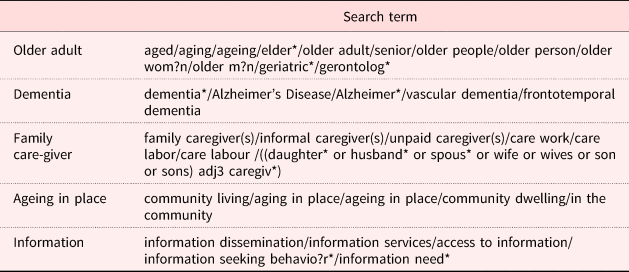
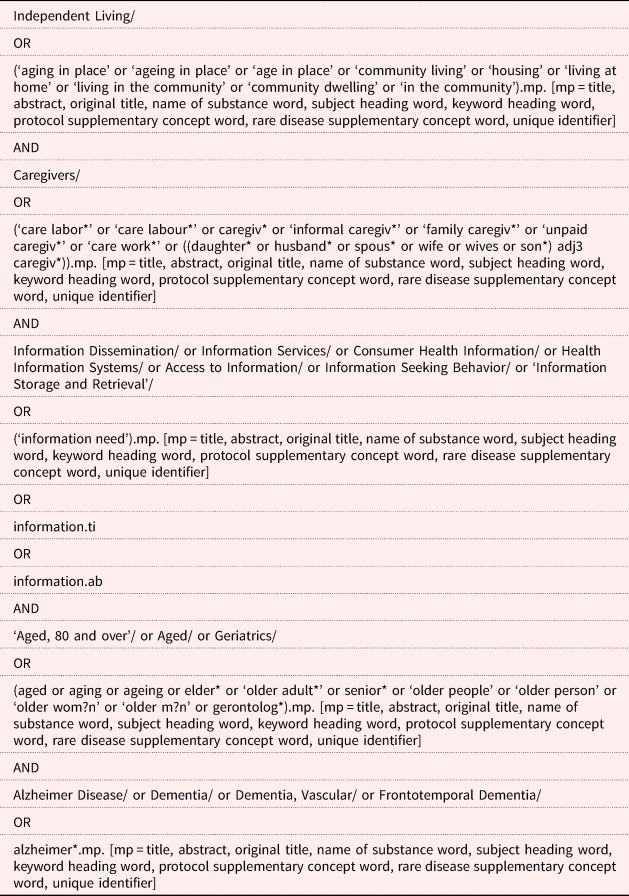
Table 1 outlines the five key concepts (ageing in place, information, older adult, dementia and family care-giver) and corresponding search terms used in the search. I limited results to the English and French language and then further to a time-frame of 25 years (1990–2015). A sample Medline search is included in Table 2.
Search terms used

Sample search in Medline

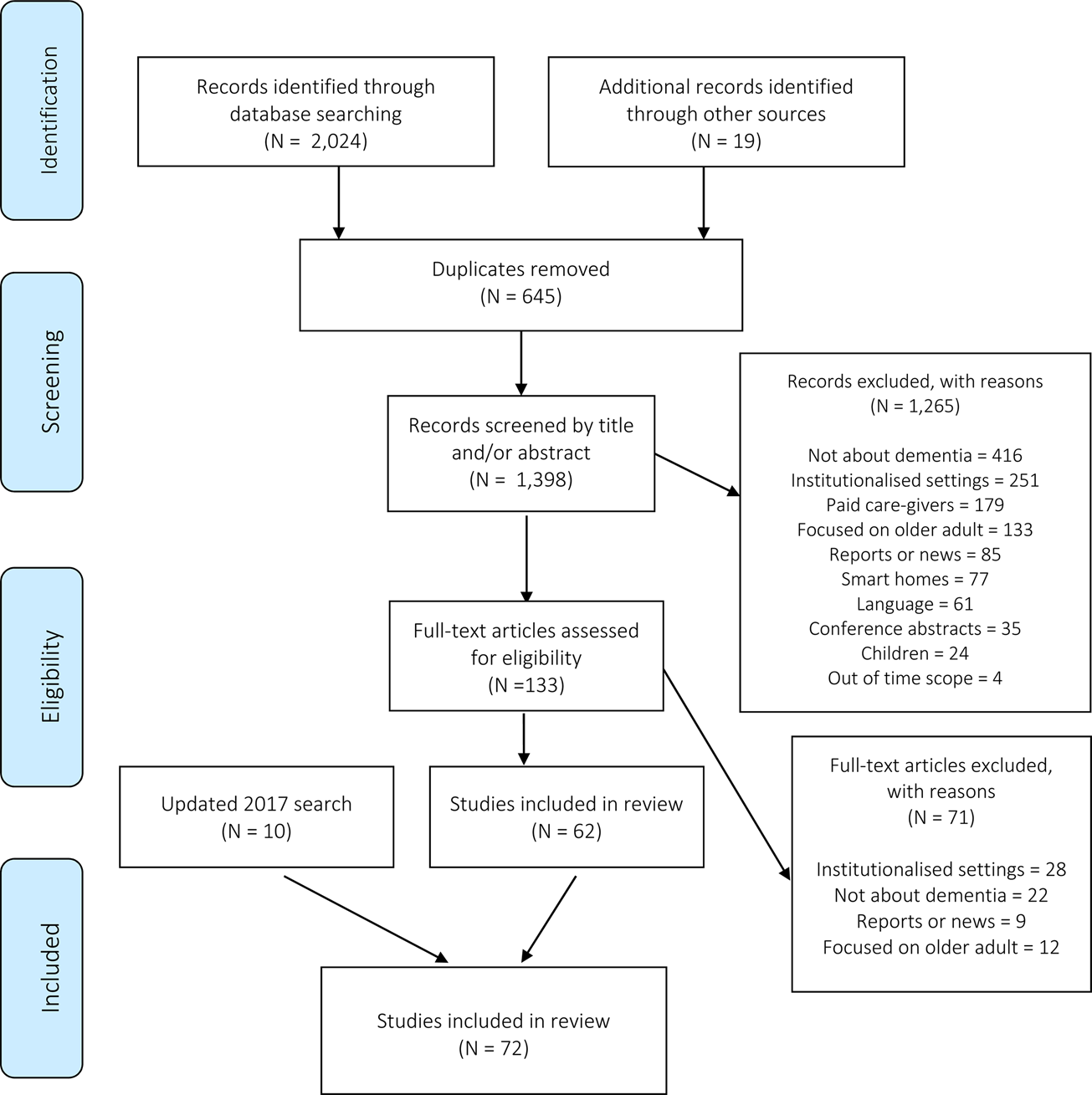
To contribute to the ongoing development and formalisation of scoping review methods, I documented the identification, screening and selection processes using a modified PRISMA (Preferred Reporting Items for Systematic Reviews and Meta-Analyses) flow diagram (see Figure 1). PRISMA is a set of standardised tools typically used with systematic reviews and meta-analyses (Liberati et al., Reference Liberati, Altman, Tetzlaff, Mulrow, Gøtzsche, Ioannidis, Clarke, Devereaux, Kleijnen and Moher2009), though its standardised flow diagram is helpful for replicability and transparency in scoping reviews.
Modified PRISMA flow diagram.

Sample selection
An initial search retrieved a total of 2,043 records (2,024 imported from database searching and 19 from hand-searching) after which I removed 645 duplicate records. A title and abstract-level screening removed 1,265 of the remaining 1,398 records. I read through the remaining 133 articles, assessing each article for its eligibility for inclusion. Of these articles, I removed 71 articles that met the exclusion criteria. I then conducted a second search in August 2017 to update the initial January 2016 search, adding an additional ten articles. A total of 72 articles were included for analysis in this scoping review.
As Levac et al. (Reference Levac, Colquhoun and O'Brien2010) corroborate, this third stage is not as linear as Arksey and O'Malley (Reference Arksey and O'Malley2005) suggest. In fact, both the second and third stages were iterative in nature; as I searched databases and reviewed articles for inclusion, I continually re-evaluated and refined search terms, search strategies, and inclusion and exclusion criteria. This need to revisit search terms continually is due, in part, to two of the concepts searched: information and ageing in place. Information is a concept that can be vague and amorphous, conceived of and enacted differently in different disciplines. Similarly, ageing in place is differently described and indexed by differently located scholars and by different databases. Determining how to best employ these two concepts within the different databases made the identification of eligible studies a lengthy and tedious process. As a majority of the retrieved articles were from outside the LIS discipline, resorting to the broader term ‘information’ proved most helpful in retrieving articles, though this general term required a closer reading of each candidate article. To determine how to best capture the housing context of each article, no one term was especially fruitful. Ultimately, articles had to be scanned to determine whether they fit the inclusion criteria. At all three levels of screening (title, abstract and full text), a majority of eliminated articles focused on care-givers of older adults moving into or already living in an institutional setting. While this moment of transition is undeniably a catalyst for information seeking, the number of articles on this topic is not in alignment with the global trend of ageing in place (Vasunilashorn et al., Reference Vasunilashorn, Steinman, Liebig and Pynoos2012), where older adults seek to age indefinitely in their homes.
Data extraction and charting
Scoping reviews are known for their ability to provide a ‘comprehensive and panoramic overview’ (Davis et al., Reference Davis, Drey and Gould2009: 1388), rather than an assessment of the quality of the evidence in each article (Arksey and O'Malley, Reference Arksey and O'Malley2005). Because of these two qualities, the data extraction and charting stages are not focused on any one article. Instead, data are described to illuminate ‘key themes, trends, and patterns in the articles under study – all at a general level rather than highlighting individual studies or particular findings’ (Rumrill et al., Reference Rumrill, Fitzgerald and Merchant2009: 403). Analysing texts within an institutional ethnography, however, necessitates a different kind of reading; searching for and identifying ‘how the [article's author] is located, the purposes for which a particular account is written and what activities this particular account supports – or, alternately, makes invisible’ (Campbell and Gregor, Reference Campbell and Gregor2004: 83). Therefore, in addition to a scoping review's traditional bibliographic summary, I attended to institutional ethnography's acknowledgement of authors’ positioning and attentiveness to invisible forms of work that a traditional scoping review may omit. I actively interrogated language that hid care-givers' work and read across articles to understand how family care-givers' information work is linked within broader institutional processes of studying and documenting family care-givers' information activities.
To summarise the 72 articles’ findings, I created a data abstraction table using the following categories: (a) citation, (b) first author's department/faculty, (c) study's location, (d) research question, (e) theory or framework, (f) study design, (g) sample size, (h) sample composition, (i) information delivery mechanism(s), (j) information topic(s), (k) indications of information work, and (l) additional notes. As I reviewed the sample, I added an additional column, (m) change/time, to capture whether articles demonstrated an awareness that care-givers’ information practices evolve over the course of the care-giving trajectory.
Results
The 72 articles under analysis fell into one of three broad categories that I label descriptive, desire or difference. The first category of articles (descriptive) featured descriptions of family care-givers’ information practices (35 of 72; 49%), the second category (desire) included studies documenting care-givers’ wishes or appeals for a different or changed way to receive or use information as they provided care (14 of 72; 19%) and the third category (difference) included studies that sought, through the implementation of an experimental intervention, to change information delivery systems (23 of 72; 32%).
Publication trends
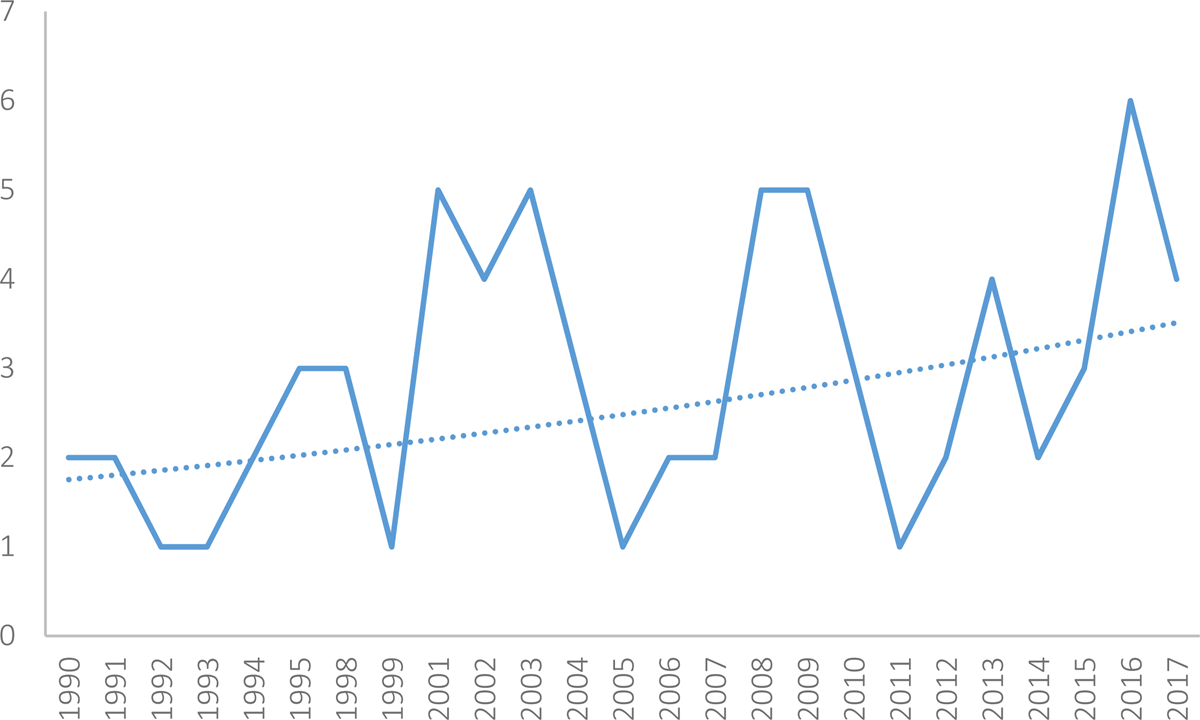
The earliest article meeting all the inclusion criteria was published in 1990. Since that time, as depicted in Figure 2, while there is an overall upward trajectory in the number of articles published on this topic, there is a high degree of variability from year to year. While no articles were published in 1996, 1997 or 2000, there is a notable increase in both the regularity and the number of articles published on this topic since the beginning of the 21st century.
Number of articles published, by year, with trendline.

The 72 articles were published in 39 distinct journals, representing a wide array of approaches, disciplines and publishers. Journals that published three or more of the included articles were primarily from the biomedical sciences: International Journal of Geriatric Psychiatry (N = 8), International Psychogeriatrics (N = 5), Dementia (N = 5), The Gerontologist (N = 5), Aging and Mental Health (N = 4), Research in Nursing and Health (N = 3) and BMC Geriatrics (N = 3). Twenty-five of these journals only published one of the included articles.
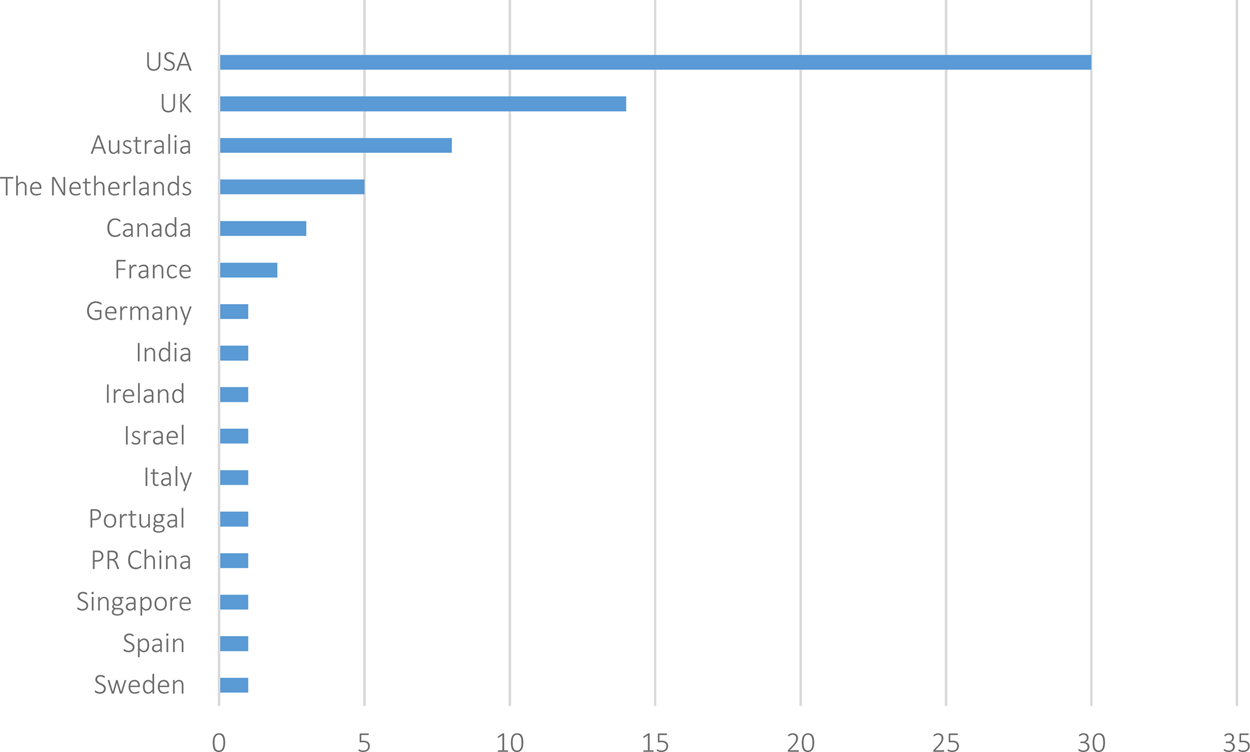
The first (or sole) authors of the included articles hailed from 16 different countries, as depicted in Figure 3. South American and African countries were not represented in this sample, which may be due to the exclusion of articles in languages other than English or French. First authors affiliated with an institution from the United States of America (N = 30) far outnumbered any other country affiliation, more than all articles written by European authors combined.
First author's country affiliation.

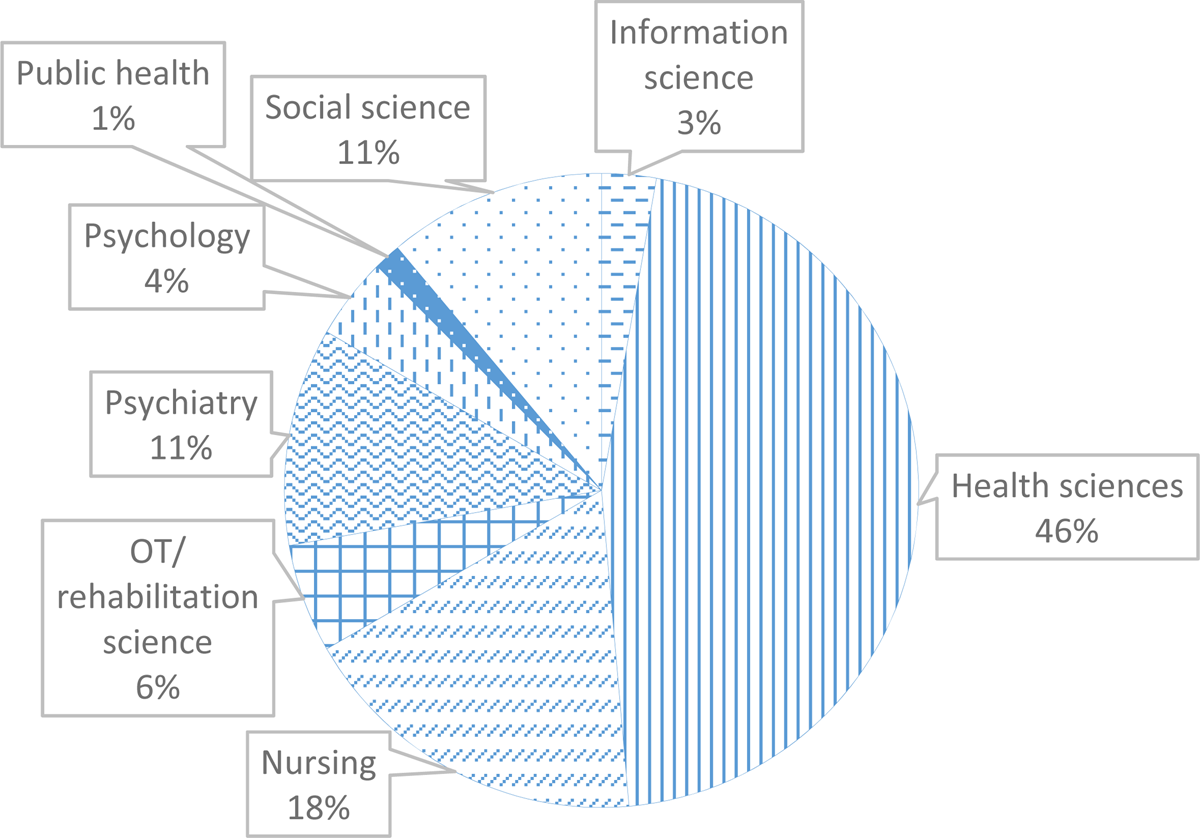
As illustrated in Figure 4, a majority of first authors originated from a biomedical background, with 33 (46%) articles from the medical or health sciences, 13 (18%) from nursing and eight (11%) from psychiatry departments. Eight articles (11%) were written by researchers affiliated with the social sciences (including gerontology) or humanities, and two articles (3%) were written by researchers in an information or communication studies department.
Primary author's departmental affiliation.

Study design
Of the 30 (41.6%) qualitative studies in the sample, a majority directly engaged with care-givers: 20 (66.7%) studies used interviews to understand care-givers’ information practices and seven (23.3%) implemented focus groups. Only 16 articles (22.2%) used quantitative approaches, with the majority of these (75%) gathering data using surveys or questionnaires. Of the 26 (36.1%) mixed method-based articles, 21 employed interviews, 13 used surveys or questionnaires, seven used standardised measures and six applied experimental conditions. Eight articles (11.1%) were literature reviews, three of which were systematic reviews.
Relationships between care-giver and care recipient
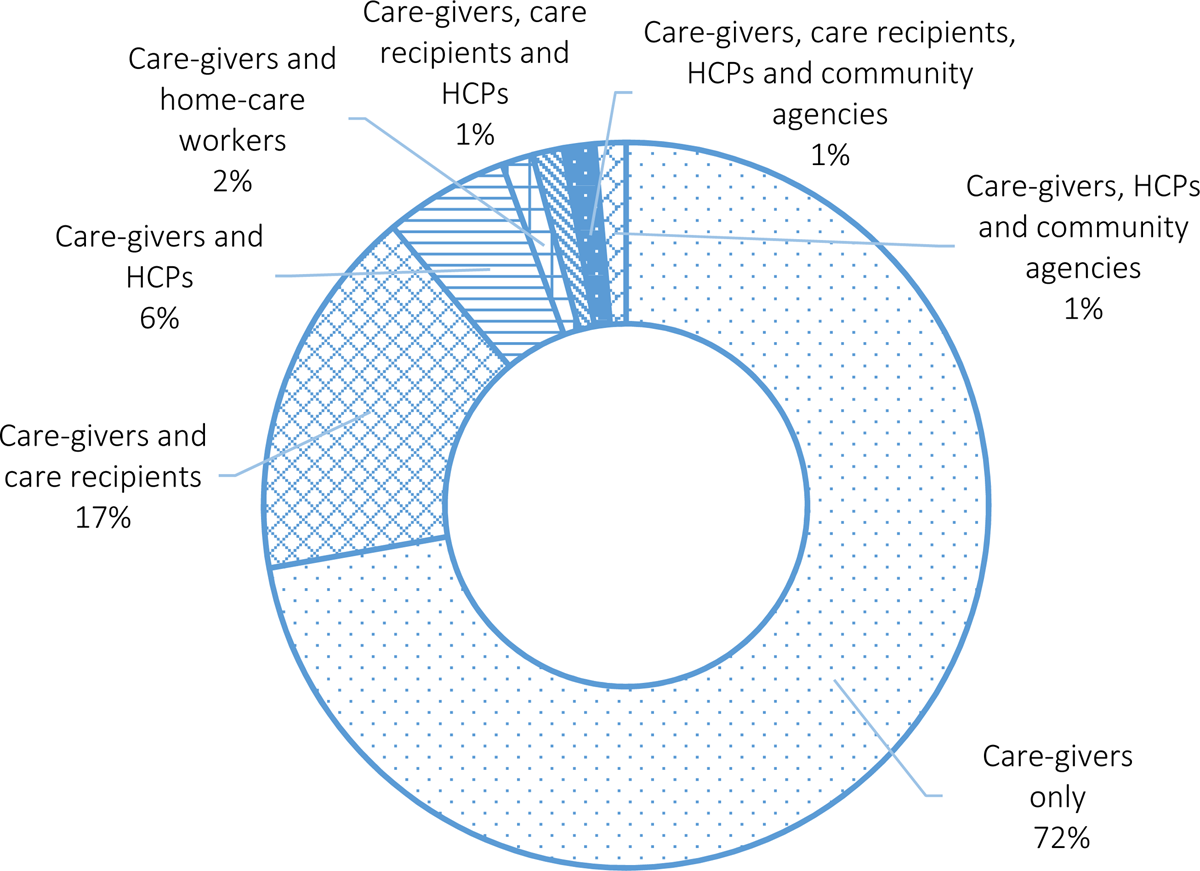
The 72 articles under analysis engaged with a variety of populations and combinations of populations. Nearly three-quarters of the articles (72%; 52 of 72) studied family care-givers in isolation from other individuals or groups. Twelve articles (17%) studied both care-givers and their care recipient (the older adult) in trying to understand the care-givers’ information needs, and four (6%) studied a combination of family care-givers and health-care professionals. As depicted in Figure 5, a smaller percentage of articles studied other unique population combinations.
Populations studied.

Authors predominantly defined care-givers by their relationship to the older adult. As I documented which participants were considered, counted or examined as a ‘care-giver’ in each article, 26 unique combinations of family and friend care-givers emerged. Categories of care-givers as they relate to the care recipient studied by two or more articles include: spouses and adult children (14), spouses, adult children and daughters-in-law (nine), spouses (seven), spouses, adult children and friends (six), spouses, adult children and other (six), spouses and daughters (four), and spouses, adult children and siblings (four). Three articles did not describe the composition of their care-giver population.
Few articles provided clear operational definitions of care or care-giving. The articles primarily focused on physical, instrumental and observable dimensions of care, such a medication management, steps to creating a safe home, issues with showering or dressing, and how to manage challenging or troubling behaviours.
Representations of information
Paralleling the lack of an operational definition of care or care-giving, no author provided a working definition, a description or a set of parameters of ‘information’ for their study, nor did any two articles discuss information in a similar manner, making comparisons between articles challenging. Authors used the following terms interchangeably with or as substitutes for information: training, knowledge, skills, communication, advice, education, support, understanding, a mediator that decreases burden, and social support services. An underlying premise to a majority of articles was that more information is beneficial and a lack of information is detrimental for the care-giver and the older adult. Authors ascribed care-givers a number of different descriptors regarding their role or interaction with information: accessors, seekers, recipients, navigators and mediators. In addition to this tangle of terms and labels, the theoretical framing around the study of information was equally inconsistent: 60 articles (83%) provided no theory, system or model from which or in which their study was rooted. Of the remaining 12 articles, the Stress Process Model was most often used (N = 5). Theories relating to technology include Eysenbach's Law of Attrition (N = 1), Diffusion of Innovation Theory (N = 1) and the Problematic Integration Theory (N = 1). The remaining theories tended towards behaviour or thought change, including cognitive reframing (N = 1) and the stress-buffering model (N = 1). One article implemented two approaches specific to care-giving: Corbin and Strauss’ notion of the illness trajectory and Bowers’ conceptualisation of caring. Finally, one article combined five models (from Wilson, Dervin, Kuhlthau, Johnson and Miller) from the LIS field.
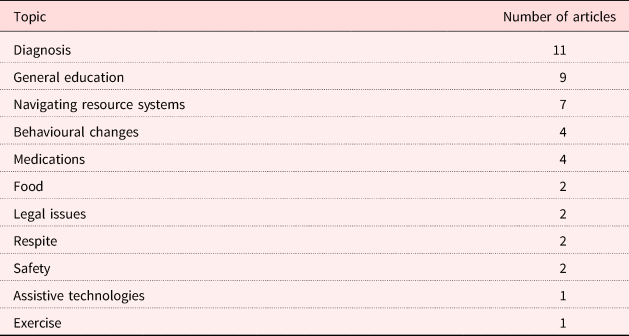
There was an equal amount of variety in the information topics studied. Twenty-seven articles spoke about information in a general manner, not explicitly discussing or identifying any particular topic. Of the remaining 45 articles (63%), the information topics listed in Table 3 were the primary focus of the study.
Primary topics covered

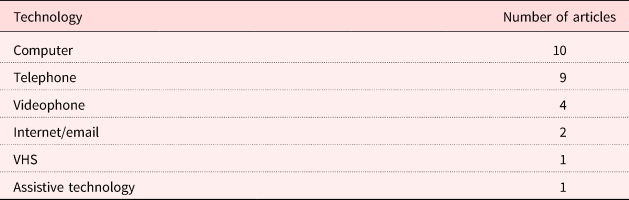
Twenty-nine (40%) articles explicitly spoke of information as an intervention or as part of an intervention, designed and provided by the study's author(s) and intended to be applied by care-givers, whether individually or in a support group setting, to boost their knowledge about dementia and care resources. There are a variety of possible intervention categories, including psycho-education, specialised skill development training and psychotherapy/cognitive behavioural therapy programmes (Gallagher-Thompson et al., Reference Gallagher-Thompson, Tzuang, Au, Brodaty, Charlesworth, Gupta, Lee, Losada and Shyu2012). As detailed in Table 4, however, of these information-as-intervention articles, the most prevalent type of intervention was technological in nature. Twenty-five articles (86% of intervention-based articles) integrated one or more forms of technology (such as computers, telephones or videophones) to deliver information to care-givers. These technological information interventions were lauded for their capacity to remove barriers when accessing information as well as facilitating care-givers’ ability to access necessary support (read: information) at the touch of a button. In these 25 articles, ‘information’ was not differentiated from the information and communication technologies used to provide, mediate or relay it. A majority of these technology-based information interventions were designed by authors based in the health and medical sciences, including health sciences (N = 9), nursing (N = 8), psychiatry (N = 4) and occupational therapy/rehabilitation (N = 2), as compared to six authors from the social sciences.
Information technology interventions

Four articles (6% of the scoping review sample) tangentially addressed the work involved in mediating information. Early in my analysis, it was apparent it would be difficult to find articles that acknowledged care-givers’ information work. Therefore, to assess differently how authors may acknowledge information work, I began to read articles for indications that care-givers’ engagement with information might change over time, assuming that the dementia trajectory changes over time in a non-linear fashion (Giebel et al., Reference Giebel, Sutcliffe and Challis2015). Nearly three-quarters of the sample (74%; 53 of 72) provided no obvious evidence that care-givers’ information needs or contexts may change as the needs of the care recipient evolve or as their role as care-giver changes. As the average length of care for a person living with dementia is nearly nine years (Keene et al., Reference Keene, Hope, Fairburn and Jacoby2001), care-givers will likely need different types of information as changes arise in care-givers’ status, role expectations, responsibilities, identity and care demands (Gaugler and Teaster, Reference Gaugler and Teaster2006; Montgomery and Kosloski, Reference Montgomery and Kosloski2009), changes that catalyse different information needs. These changes, however, were not reflected in a majority of the scoping review articles.
Consultation exercise
The scoping review by Pham et al. (Reference Pham, Rajić, Greig, Sargeant, Papadopoulos and McEwen2014) of 344 scoping reviews reported that stakeholder consultations were conducted in 39.8 per cent of reviews. The majority of these reviews (75%) implemented the consultation stage during the search phase (stage 2) to assist in the selection of keywords. This scoping review, however, integrated the consultation exercise at a different point in the scoping review. To determine the degree to which the articles’ findings resonated with family care-givers’ experiences of their information work, I implemented the consultation exercise during the analysis and interpretation phases (stages 4 and 5).
Disrupting the unidirectional delivery of information (from researcher to participant) observed in the majority of 72 articles, this scoping review used the consultation stage as an opportunity to foster a culture of information exchange and to provide family care-givers a voice in the research process. This consultation exercise was rooted in institutional ethnography's privileging of people's work knowledge, that is, ‘a person's experience of and in their own work, what they do, how they do it, including what they think and feel’ (Smith, Reference Smith2005: 151). The consultation exercise took place at the end of the 13 interviews with family care-givers, so as not to influence the informants’ understandings and descriptions of their information work. I provided an overview of the preliminary findings of the scoping review and asked informants to comment on their general impressions of the scoping review results as well as the degree to which the findings were in alignment with their own care experiences.
Overwhelmingly, informants indicated that other people are crucial for both information provision and accrual. Unlike the articles’ foci on studying care-givers independently from other individuals (Figure 4) and diverging from the inclusion of information intervention technologies (Table 3), the informants extolled their network of individuals (other care-givers, other family members and friends, and health-care professionals) that provided and sought information. Johanna, a wife caring for her husband diagnosed with early onset Alzheimer's explained that, ‘Without people, I would be … I don't know where I would be. I think people like to be connected. And they are some of your biggest resources – those people.’ Secondly, while hinted at in some of the articles analysed, informants were quick to discuss the need to be able to use information only as the need arose. Getting the right information at the right time was a key priority for informants, although this was often a difficult balancing act, as Betty, a daughter caring for her mother who is living with Alzheimer's disease, describes: ‘there's a fine line between what you want to know and what you will learn when the time demands’. Care-givers spoke about different tools they used to store information so that it could be accessed when the illness trajectory entered a new phase. As Ione, a wife caring for her husband with Alzheimer's disease, elaborates:
But I learned right then that it scares the heck out of me to look too far ahead and I can't manage it. I can't manage stuff that isn't relevant. So a lot of the information that I got at the course [an eight-week care-giver education course] … it was too far ahead. Like, I couldn't use it then. Like long-term care? I'm only now, three years later, ready to go back and look at that. So I'd file that information under ‘L’, but I wouldn't even look at it, you know? It's back there. But as you get closer to things, then you start, oh yeah, I've got some information about that and I'm going to look.
None of the articles discussed or studied Ione's work of strategically managing, organising and storing information. The work associated with information management is especially salient given the changes that occur over time as the older adult's dementia progresses. Ione's difficulty in dealing with information about long-term care and associated end-of-life issues speaks to the affective work that care-givers take on throughout the care-giving trajectory, having to deal with the implications of the information they find. Informants also highlighted the embodied dimension of information work. As Robert, a husband caring for his wife who is living with frontotemporal dementia (FTD) elaborates, ‘I don't want [people] telling me about FTD, I've got enough on FTD just living with and looking at my wife.’ Older adults living with dementia served as unique sources of information for their care partner, from changes in their daily rhythms and routines to appearances of challenging behaviours. This type of information was particularly vital when verbal communication was difficult or strained. This corporeal modality (Bonner and Lloyd, Reference Bonner and Lloyd2011; Lloyd, Reference Lloyd2011) underscores care-givers’ experiential and tacit information work. Learning the older adults’ preferences, habits and idiosyncrasies, care-givers accrued an array of experiential information that they incorporated into their information work.
The consultation exercise served as an opportunity for family care-givers to resist dominant discourses handed down by scholars and the ‘provider-centered, one-way practices of information transfer’ (Lee and Garvin, Reference Lee and Garvin2003: 462). By revealing how research findings may or may not reflect the everyday lived experiences of participants, this study contributes to an increasing number of scoping reviews that advocate for the integration of stakeholder consultations and, in particular, the use of consultation exercises in later stages of scoping reviews.
Discussion
Family care-givers’ information work was visible in four of the 72 articles in this scoping review. Perhaps unsurprisingly, the work involved in caring for a community-dwelling older adult living with dementia was also invisible. One contribution to this invisibility may stem from the way(s) in which information was conceptualised, written about, studied and shared in the 72 articles. Information was not defined and was generally narrowly constructed, often conflated with training, knowledge, skills, communication, advice, education, support, understanding and a mediator that decreases burden. Three consequences arise as a result of the articles’ uncomplicated approach to information. First, writing about information under the guise of other concepts or terms dilutes our understanding of the centrality of information in people's everyday lives. Second, over time, this simplistic writing about and limited understanding of care-givers’ information work (and, often, care work) stifles or makes it more difficult for ensuing researchers to take up different ways of writing about and thinking about care-givers’ engagement with information. Much like health and science professionals’ distinct ways of speaking about health issues (McCoy, Reference McCoy and Smith2006), research-writers studying care-givers’ information work write about this concept in a distinct way, as if it is self-evident (Campbell, Reference Campbell2003). Smith (Reference Smith and Smith2006: 72) goes so far as to call the term information ‘deceptive’, as it ‘hides the production and reading of texts’. Third, with an overly simplistic understanding of information, there is a tendency to conflate information with being informed. This signals an ‘add info and stir’ mentality which neglects the work (including resources, time, emotional impacts, etc.) that makes becoming informed possible.
Authors framed care-givers as being burdened due to a lack of information, with more information portrayed as a positive and a necessity in ensuring good care and in alleviating a care-giver's stress. The articles portrayed information provision as a beneficial way for care-givers to apply new knowledge, solve problems, decrease burden and enable a more supportive care-giving relationship, thus enabling older adults to age in place for a longer duration of time. As a result, care-givers were treated as secondary to the primacy of information in the information–care relationship. This finding is reminiscent of what Barnes and Henwood (Reference Barnes and Henwood2015) call the informatisation of care, in which care is marginalised and even replaced by information. Twigg and Atkin (Reference Twigg and Atkin1994) have previously alluded to this imbalance and the need to view family care-givers not as resources but instead as active partners in the care process. Barnes and Henwood (Reference Barnes and Henwood2015: 147) label some of the tensions within the information–care relationship: the ‘inform to care’ approach, dominant in policy and research and evidenced in this review, positions good care as a result of the availability of good information, with information as ‘separate and outside of care, while nevertheless acting upon it to produce care’. Barnes and colleagues’ ‘inform with care’ approach (Barnes and Henwood, Reference Barnes and Henwood2015; Barnes et al., Reference Barnes, Henwood and Smith2016) is attentive to the ‘affective aspects of information and the ways in which new information can destabilise as well as support caring relationships’ (Barnes and Henwood, Reference Barnes and Henwood2015: 159). This approach links information with care as situated knowledge and acknowledges experiential knowledge and the complexities of information within care.
Corbin and Strauss (Reference Corbin and Strauss1988) contend that managing a chronic illness, such as dementia, is best understood from a sociological rather than a medical perspective. As outlined below, three elements appearing in the scoping review articles, however, collectively point towards the existence of the biomedicalisation of care (Hooyman and Gonyea, Reference Hooyman and Gonyea1995) circulating throughout the ongoing thinking, studying and writing about family care-givers’ information work. Under biomedicalisation, thinking, processes and services are ‘increasingly brought under the domain and rationality of biomedicine, and elements of the community delivery systems are increasingly drawn toward the provision of medically related, medically supportive, and/or medically oriented services’ (Binney et al., Reference Binney, Estes and Ingman1990: 762). The biomedicalisation of ageing, on which the biomedicalisation of care is based, is built on two premises: the social construction of ageing as a medical problem and the praxis of ageing as a medical problem (Estes and Binney, Reference Estes and Binney1989).
Construction of information as an intervention delivered through technologies
Twenty-nine articles wrote about family care-givers’ use of information as an intervention to prevent or reduce the negative consequences of care-giver burden or stress. Classifying information as an ‘intervention’ to be delivered to and used by care-givers imposed a clinical tone to the construction of information. Furthermore, 86 per cent of those 29 information-as-intervention articles integrated one or more technologies, such as computers or telephones, to deliver or make information accessible. What was not acknowledged or discussed, however, was the work care-givers would need to do to learn to use the intervention and the work required to integrate the intervention into their daily lives. Information interventions were provided in such a way that they were ‘bereft of meaning, judgment, sense making, context and interpretation’ with the potential to create ‘considerable frustration and distress and marginalization and disempowerment’ (Simpson et al., Reference Simpson, Hall, Leggett, Balka, Green and Henwood2009: 39–40). Care-givers’ information work requires context, reflection and understanding, work that the articles ignored or took for granted. This focus on interventions combined with the privileging of experts over laypersons (explained below) pathologises care-givers who are poised as needing more information or an intervention (or both) from an expert or from a technology (or both) to be ‘fixed’ or made into more competent or empowered carers.
Summarising traditional approaches to health-promotion projects, Lee and Garvin (Reference Lee and Garvin2003: 462) indicate that interventions ‘have been … designed in isolation of the social, cultural, and structural constrains experienced by most patients and users’. A small number of articles focused on the impact that differences in ethnicities might have on care-givers’ information work. There were few attempts, though, to locate and study care-givers with varying socio-economic statuses, educational backgrounds, geographic locales, religious affiliations, etc., to determine how these impacts on care-givers’ everyday lives will contextualise and influence how they locate, assess and use information to guide and support their care work.
Privileging expert perspectives
Privileging professionals’ expertise over patients’ is a recognised limitation in current health-related information exchange practices (Lee and Garvin, Reference Lee and Garvin2003). This may be due, in part, to traditional biomedical approaches to health, with their ‘limited view of the role of communication, [seen] primarily as a vehicle for transferring authoritative knowledge to compliant patients’ (Johnson and Case, Reference Johnson and Case2012: 6). My consultation exercise revealed care-givers to be creative and active agents of information contemplation, digestion and production. In contrast with the consultation exercise, the articles portrayed care-givers as passive subjects on which knowledge acts. As a result, articles placed a great deal of agency in information and positioned information as being held or owned by individuals other than family care providers, whether health-care professionals or the author(s) of the study. Authors and creators of the interventions did not provide an opportunity for participants to define what information is or might include for them; instead, authors unilaterally determined a priori the boundaries of information (what topics to be covered, how information should be best delivered) and what technology would be used to deliver the information. Authors constructed information provision as a monologue (Lee and Garvin, Reference Lee and Garvin2003: 451), with information flowing unidirectionally, in a centralised fashion, from an expert (the author) to an often-passive layperson (the care-giver), with the implication that ‘the provider can exercise power over the receiver’. The sample's reliance on one-way information transfer as opposed to information exchange is reminiscent of what Freire (Reference Freire1970) describes as a banking concept. As Lee and Garvin (Reference Lee and Garvin2003) explain, this concept infers those who are knowledgeable will bestow knowledge upon the ignorant; the ignorant are constructed as unquestioning containers to be filled by the knowledge of the knowledgeable. Portrayed as empty containers, care-givers were denied the recognition and acknowledgement of their experiential, tacit and embodied information work. The articles constructed care-givers as lacking and therefore in need of training, education or support. Contributing to this general state of being ‘in want’, authors often described care-givers as being burdened, frustrated, confused and poorly prepared. Problematically, care-givers’ difficulties were constructed in such a way that information or information interventions were the only possible solution to settle their deficit or burden. This construction amplified information's clout while simultaneously stripping care-givers’ agency.
Individual as the unit of analysis
This scoping review revealed how research ‘both produce[s] and transform[s] as well as limit[s] and regulate[s]’ (Katz, Reference Katz1996: 48) its population in the process of studying it. Another characteristic of the biomedicalisation of care observed in the sample is a trend towards individualisation as a form of reductionism (Estes and Binney, Reference Estes and Binney1989). A potential contributor to the invisibility of care-givers’ information work is a focus on the family care-giver as a ‘lone ranger’ information seeker (Urquhart and Yeoman, Reference Urquhart and Yeoman2010). More than half of the articles (72%; 52 of 72) focused on care-givers as the sole users of information. Care-givers were the unit of analysis, keeping broader social and environmental factors from being considered (Estes and Binney, Reference Estes and Binney1989). This focus on the individual may explain why information interventions were primarily targeted at the level of the individual and were developed as one size fits all. At the same time that family care-givers are kept separate from other groups, the articles cast care-givers as a uniform population, not as complicated, unequal and multifaceted individuals. Katz (Reference Katz1996), documenting the formation of the discipline of gerontology, speaks of Foucault's notion of population, where entire populations are treated as subjects; sites of standardisation that serve to regulate risks, efficiencies and dangers more easily. Authors’ construction of care-givers as population-made-subject and as decontextualised objects of study served to minimise care-givers’ troubles while organising them with maximum efficiency (Katz, Reference Katz1996). These tactics collectively draw attention away from larger political, cultural and economic forces that shape, constrain and conceal the experiences of using information while providing care to an ageing family member, and may begin to explain why information interventions ignored the relational practices underpinning (and often complicating) care-givers’ information work (Barnes et al., Reference Barnes, Henwood and Smith2016).
Conclusions
This scoping review sought to gain a better understanding of the current state of research's conceptualisations of family care-givers’ information work. More specifically, this review aimed to uncover the degree to which academic studies acknowledge care-givers’ work of ‘sifting through, interpreting and dealing with the implications of the information one finds’ (Harris, Reference Harris, Balka, Green and Henwood2009: 78). As Anderson et al. (Reference Anderson, Allen, Peckham and Goodwin2008: 6) indicate, trying to make sense of a topic that crosses multiple, complex fields of enquiries ‘which lend themselves to interpretation through many academic and theoretical disciplines’ is a limitation of the scoping review method. In response to this limitation, this institutional ethnography scoping review stretched existing scoping review parameters. Looking not to solely provide descriptive, bibliographic summaries of existing literature, this review actively sought out invisible work and purposively went beyond rehearsing the narrative surrounding family care-givers’ information practices that articles have carried forward over time. Each scoping review article established patterns of thinking, giving shape to a particular discourse of care work and information work. An institutional ethnography inflection enhanced the scoping review process through four key means: attention to invisible forms of work, an awareness of what remains unsaid, a valuing of everyday, lived experiences, and an attentiveness to authors’ positioning. Approaching the scoping review with an institutional ethnography lens highlights texts as ‘productive relays between power and knowledge’ (Katz, Reference Katz1996: 102), revealing the often-invisible practices of funding institutions, teaching curricula, relations of prestige and university programmes (Katz, Reference Katz1996) that each article encapsulates. Through the use of a scoping review, I sought to deconstruct academic textual authority, bringing attention to those aspects of texts that organise research problems in ‘professionally legitimizing ways’ (Katz, Reference Katz1996: 77–78).
When transfers of care work occur between institutions, families and older adults, ‘people who need information must learn to find it in new ways … [with] a risk that people who cannot find the new information or understand the changing rules will have their important needs go unmet’ (Stark, Reference Stark2005: 25). Information's touted ability to decrease care-givers’ burden rests on a tenuous assumption that individuals are able and willing to engage with information. Authors presume information interventions will impart care-givers a myriad of benefits, including decreased stress, increased sense of competence and empowerment. Articulating the information–care relationship, however, remains elusive. Authors discuss the positive, enabling effect information has on the care-giver and their relationship with the care recipient as an assumed cause and effect relationship. What is lacking, however, is an exploration of how, where and why this relationship is able to develop and succeed. This may be due to the inconsistent application of theories or models in the articles, the lack of critical or feminist angles, and the glaring lack of contributions from LIS scholars who may be able to speak to the complexities of grappling with information and illuminate why more ‘information is not a panacea for uncertainty … more information might not necessarily lead to greater certainty or clarity’ (Barnes et al., Reference Barnes, Henwood and Smith2016: 523). Adopting an understanding of care-givers as mediaries (not intermediaries) who inform with care may be a means by which to elevate information within care as more than a practice, a skill, a passive occurrence or content that can be simply packaged and delivered in a technology, but as a complex and visible form of work.
While information work remains an uncommon way to talk, think about and study how people come to grapple and engage with information, it is an attempt to highlight the effort, time and resources needed to deal with the information needed to provide care. The findings from this scoping review, including the consultation exercise, are an invitation for those investigating how family care-givers engage with information to challenge the prevailing unidirectional delivery of information, moving from an information transfer monologue to information exchange between researchers and participants. Decreasing the polarisation between experts and lay persons and the dichotomisation of experience and expertise may be a means to move forward in this conversation, focusing instead on the middle ground between these two extremes, that is, ‘the collective knowledge’ (Wilcox, Reference Wilcox, Harris, Wathen and Wyatt2010); the summation of knowledge accrued through many sources and interactions. In alignment with Harland and Bath's (Reference Harland and Bath2008: 468) finding that ‘information is dependent on the individual user and that “best” information, as an objective reality, does not exist’, these findings serve as a call not to simplify how individuals conceptualise, use and interpret information, nor to view information as static or necessarily curative. Instead, this scoping review serves as a prompt to resist simplifying the complexities of information work and to recognise care-givers’ embodied, relational and experiential information practices as vital facets of their everyday information work.
Acknowledgements
I thank Dr Pam McKenzie for her steadfast guidance and support throughout the conceptualisation and writing of this article.
Financial support
This work was supported by the Social Sciences and Humanities Research Council of Canada's Joseph-Armand Bombardier Canada Graduate Scholarship-Doctoral (award number 767-2015-1920) and the Medical Library Association's Eugene Garfield Research Fellowship.
Conflict of interest
The author declares no conflicts of interest.
Ethical standards
This study was approved by the The University of Western Ontario's Research Ethics Board.