I
Central banking is a relatively recent innovation seen from a historical perspective. Only a few central banks (Sveriges Riksbank and Bank of England) date their establishment back to the 1600s. A range of West European countries founded central banks in the early nineteenth century, including France, Finland, Netherlands, Norway, Austria and Denmark. However, the vast majority of central banks were only established during the twentieth century (Capie et al. Reference Capie, Fischer, Goodhart and Schnadt1994).
It can be difficult to provide brief answers to the very fundamental but also somewhat philosophical questions of what constitutes a central bank and the rationale for having such institutions. The core role of central banking might best be characterised as the provision of public goods such as price stability, financial stability (last resort lending, macro-prudential oversight, bank supervision) and financial infrastructure (payment systems, financial statistics). However, the weights attached to the various core functions differ across countries and have evolved over time in step with economic and political developments (Goodhart Reference Goodhart1988, Reference Goodhart2011; Reis Reference Reis2013).
Central banks hold substantial financial assets and liabilities on their balance sheets. As a consequence, they are exposed to a variety of financial risks that also have a huge impact on financial returns and their income statements (i.e. their profit and loss accounts). Due to policy constraints derived from their overall objectives, central banks differ from private investors. As financial institutions, central banks are concerned with returns and risks. However, their mandates are usually focused on the provision of the public goods mentioned above rather than on maximising (risk-adjusted) profits. The risk-management frameworks used in the private fund management industry might therefore not always be directly applicable to central banks (Foster Reference Foster, Carver and Pringle2004; Bindseil et al. Reference Bindseil, González and Tabakis2009; Bank for International Settlements 2011; European Central Bank 2015; Bholat and Darbyshire Reference Bholat and Darbyshire2016). For instance, there might be a direct economic cost related to holdings of foreign-exchange reserves if the domestic short-term interest rate is higher than abroad. However, liquid reserves are necessary to maintain a credible fixed-exchange-rate regime and harvest the potential macroeconomic benefits from the regime. As another example, there might be credit risks associated with the role of lender-of-last resort; however, if in periods of severe financial instability a central bank neglects its lender-of-last-resort responsibilities due to such risks, the macroeconomic costs might be substantial. It is crucial that the policy decisions of a central bank are not influenced by considerations of the impact of its actions on its profitability and solvency.
In this article, I offer a long-term historical perspective on financial risks and returns in central banking using the central bank of Denmark, Danmarks Nationalbank, as a case study. I present an annual dataset based on the Nationalbank's balance sheets and profits that covers more than 175 years. The time series span over periods with different monetary regimes, institutional characteristics and incidence of real and financial shocks to the economy. It is therefore possible to trace potential links between the Nationalbank's financial risks and returns, the macroeconomic environment and the objectives and instruments of monetary policy. As far as the macroeconomic environment is concerned, for instance, there might be a link between a central bank's risks and returns and the volatility of long-term interest rates. The monetary-policy strategy might also matter. If a central bank follows a fixed-exchange-rate strategy, the exchange-rate risk associated with holding foreign exchange reserves denominated in the anchor currency is unavoidable if a successful peg is to be maintained.
The article is structured as follows. Section ii surveys the related literature. Section iii describes the dataset. Section iv summarizes the historical evolution of Danmarks Nationalbank's mission and institutional characteristics. Sections v and vi analyse the size and composition of its assets and liabilities, respectively, in the framework of different monetary and exchange-rate regimes. Sections vii and viii explore the determinants of financial returns and risks and their historical evolution. Section ix concludes.
II
This article relates most closely to two strands of research on central banking. The first one focuses on contemporary issues related to central banks’ balance sheets and income statements from a financial risk-management perspective. Some contributions analyse currency risks, credit risks, interest-rate risks and the liquidity of foreign-exchange reserves (Bernadell et al. Reference Bernadell, Cardon, Coche, Diebold and Manganelli2004), whereas others mainly focus on interest-rate risk on domestic portfolios (Christensen et al. Reference Christensen, Lopez and Rudebusch2015). Several papers have discussed the appropriate level of central-bank capital in order to ensure credibility, flexibility and independence in the implementation of monetary policy (Stella Reference Stella2005; Ize Reference Ize2005; Cukierman Reference Cukierman, Milton and Sinclair2011; Goodfriend Reference Goodfriend2011; Adler et al. Reference Adler, Castro and Tovar2016). Other authors also explored the financial risks potentially engendered by the recent expansion of central banks’ balance sheets via purchase of government bonds as part of ‘quantitative easing’ (Borio and Disyatat Reference Borio and Disyatat2010; Turner Reference Turner, Berg, Eitrheim, Qvigstad and Ryel2011; Capie and Wood Reference Capie and Wood2013; Karakitsos et al. Reference Karakitsos, Merriman, Schwarz and Studener2015; Carpenter et al. Reference Carpenter, Ihrig, Klee, Quinn and Boote2015; Del Negro and Sims Reference Del Negro and Sims2015; Blancheton Reference Blancheton2016; Goodhart Reference Goodhart, Bordo, Eitrheim, Flandreau and Qvigstad2016). Once interest rates bounce back to normal levels, some central banks might face market value losses on their government bond holdings that could affect credibility.
A second strand of related research provides a historical perspective on the evolution of central banks. Several contributions have focused on the construction of long-span time series based on central-bank balance sheets, e.g. for Sveriges Riksbank (Fregert Reference Fregert, Edvinsson, Jacobson and Waldenström2014), Norges Bank (Hvidsten Reference Hvidsten2013), Bank of England (Bank of England 1967), Switzerland (Halbeisen and Maurer Reference Halbeisen and Maurer2007) and De Nederlandsche Bank (Pattipeilohy Reference Pattipeilohy2013). However, most of these studies have no data on central-bank income statements. Furthermore, only a few studies dealt with central banks’ risk management in a historical perspective. One exception is a study of foreign reserve management at the National Bank of Belgium in the 1850s by Ugolini (Reference Ugolini, Ögren and Øksendal2012). Another one is the analysis by Flandreau (Reference Flandreau, Beyer and Reichlin2008) of potential corporate governance issues related to some central banks’ role as both a central bank and a private commercial bank during the nineteenth century.
III
For the analysis carried out in this article, I compiled annual time series of Danmarks Nationalbank's balance sheets and profits from financial assets over the period 1839–2014. Danmarks Nationalbank was founded in 1818. However, no complete consolidated balance sheets are available prior to 1839 (Johansen Reference Johansen1985, p. 248). The main data source is various issues of Danmarks Nationalbank's annual report and accounts, complemented by results from earlier research based on archival records and internal material from Danmarks Nationalbank. As far as possible, data was adjusted to take into account major changes in valuation and accounting principles (see details in the Appendix). A comprehensive description of the sources and methods used to construct the dataset as well as a detailed description of the content of each item in the balance sheet, profits from financial items, and sources for other time series used in this article is available in a background paper (Abildgren Reference Abildgren2016a). The full dataset is available in an Excel spreadsheet attached to the background paper and downloadable from the Nationalbank's website.Footnote 1
IV
According to its Royal Charter of 1818, the objective of Danmarks Nationalbank was originally to ‘provide a safe and secure currency system’ (§3) and to ‘promote currency circulation, facilitate production and trade through the extension of credit’ (§5). The current legal basis for the Nationalbank's activities is an Act of 1936 with a few minor amendments. According to the Act, the objective is ‘to maintain a safe and secure currency system and to facilitate and regulate the traffic in money and the extension of credit’ (§1). Fundamentally, the primary objectives of Danmarks Nationalbank have therefore remained unchanged with regard to the legislative basis since 1818: price stability, financial stability and a well-functioning payment system. It should be noted that profitability was not part of the mandate given to the Nationalbank, neither in the Charter of 1818 nor in the Act of 1936.
Right from the beginning, Danmarks Nationalbank was to be independent of the government (or the king during the absolute monarchy prior to 1849) in its implementation of monetary policy. The background of the 1818 Charter was Denmark's very considerable military expenditures during the Napoleonic Wars, which to a large extent were financed by a massive issuing of banknotes or close substitutes for money (Abildgren Reference Abildgren2010). As a result, the value of the banknotes was almost completely eroded, and the establishment of Danmarks Nationalbank was part of a plan to rebuild the domestic monetary system. Modern mainstream literature stresses that central bank independence plays a crucial role in maintaining price stability (Cukierman Reference Cukierman2008).
It was explicitly stated in §1 of the Royal Charter of 1818 that the Nationalbank was to be independent of the king in relation to the management of its financial assets. Prior to 1936, the Nationalbank was organised as a private joint-stock company that paid dividends to shareholders. However, the shareholders were not empowered with any direct influence on the management of the Nationalbank (including risk-management decisions) – they were only entitled to receive dividend payments, if any (Rubow Reference Rubow1918; Hartogsohn Reference Hartogsohn1936). The purpose was to ensure that the shareholders’ interest in high dividends should not influence the Nationalbank's ability to achieve its primary objectives.
With the 1936 Act, the Nationalbank was transformed from a private joint-stock company into a self-governing institution whose profits were to be transferred to the central government. The new Act did not imply any changes in the provisions regarding independence. It is explicitly stated in §12 of the by-laws of the Nationalbank related to the Act of 1936 that financial management decisions rest with its Board of Governors.
The Maastricht Treaty of 1992 states that the central banks of EU member states must be institutionally, personally and financially independent, even if the member state in question does not belong to the euro area, as is the case with Denmark. In 1998, the Council of the European Monetary Institute assessed that the 1936 Act on Danmarks Nationalbank fulfilled those criteria (Danmarks Nationalbank 1999, pp. 137–8). The central government therefore cannot influence the Nationalbank's decisions in order to maximise profits accruing to the Treasury. Profit transfers amounted to around 0.1–0.3 per cent of GDP per year in the period 1995–2014.
V
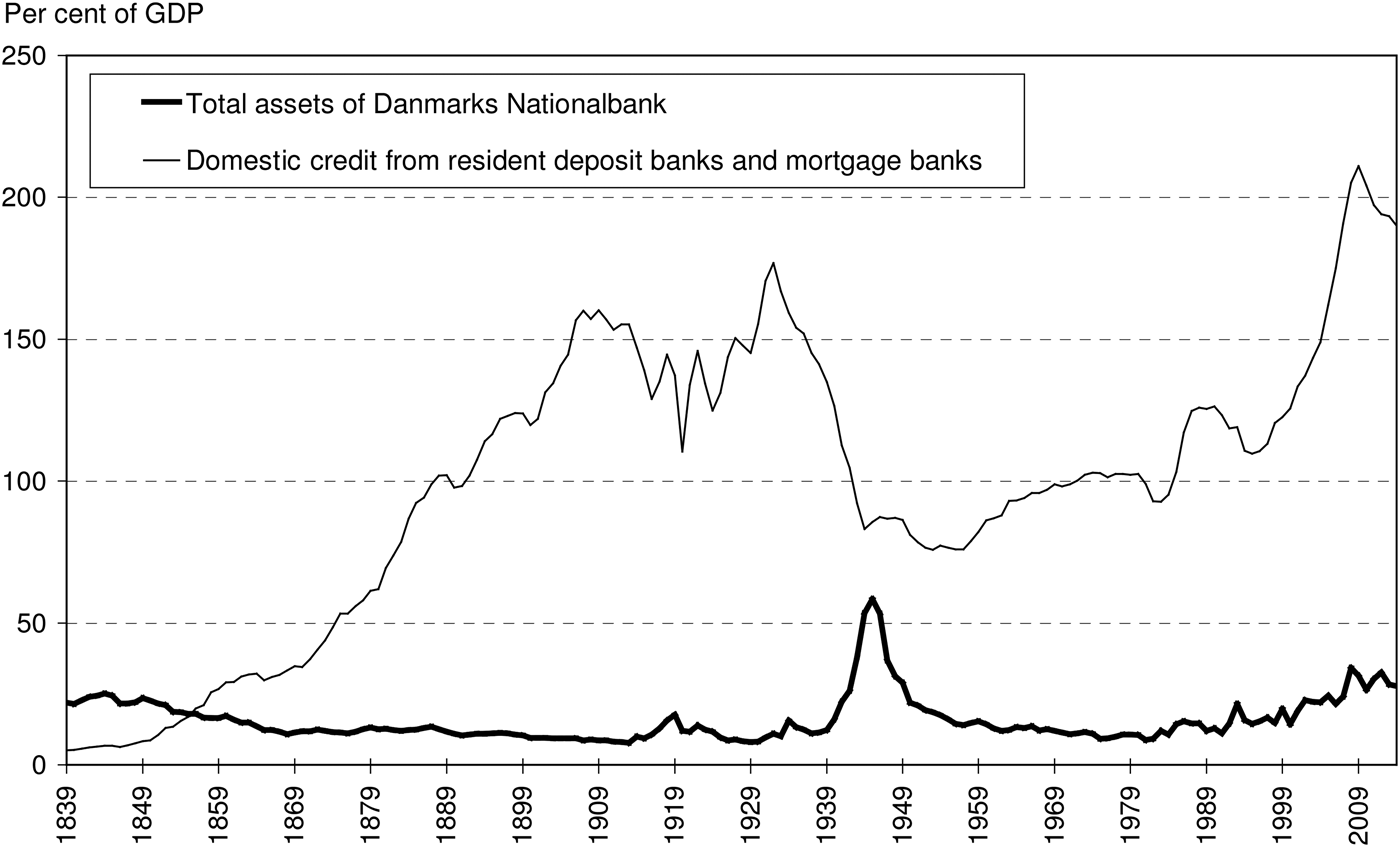
Figure 1 shows the total assets of Danmarks Nationalbank and domestic credit from resident banks since 1839 measured relative to the Gross Domestic Product (GDP). In the last quarter of the 1800s, resident banks had already developed into significant credit-supplying institutions. In most of the period since the late nineteenth century, the total assets managed by Danmarks Nationalbank were relatively small compared to credit from the banking system. Only the years around World War II and the period since the liberalisation of the financial sector and cross-border capital flows in the 1980s show a significant increase in the level of central-bank assets relative to GDP. The balance sheets of the banking sector also expanded significantly during the most recent decades, so the ratio of Danmarks Nationalbank's total assets to credit from resident banks remained fairly stable since the 1960s. In contrast, the size of the central bank's balance sheets declined relative to the size of the financial sector in many other countries in the decades preceding the most recent global financial crisis (Ferguson et al. Reference Ferguson, Schaab and Schularick2015). Today the Nationalbank's assets-to-GDP ratio is in line with the average in 12 advanced economies covered by Ferguson et al. (Reference Ferguson, Schaab and Schularick2015). However, it was higher than average during most of the twentieth century.
Total assets of Danmarks Nationalbank and credit from resident banks, 1839–2014

In the recent decades, there has been a significant expansion of the balance sheets of the banking sector in many countries. During the most recent crisis, the central banks had to provide lender-of-last-resort liquidity on a much larger scale compared, for instance, to the banking crises of the Great Depression in the early 1930s (Moessner and Allen Reference Moessner and Allen2011). Larger balance sheets of the banking sector do not necessarily imply larger balance sheets of central banks during non-crisis periods. However, the operational frameworks of central banks have to be sufficiently flexible to swiftly address situations with extraordinary liquidity needs in the financial sector.
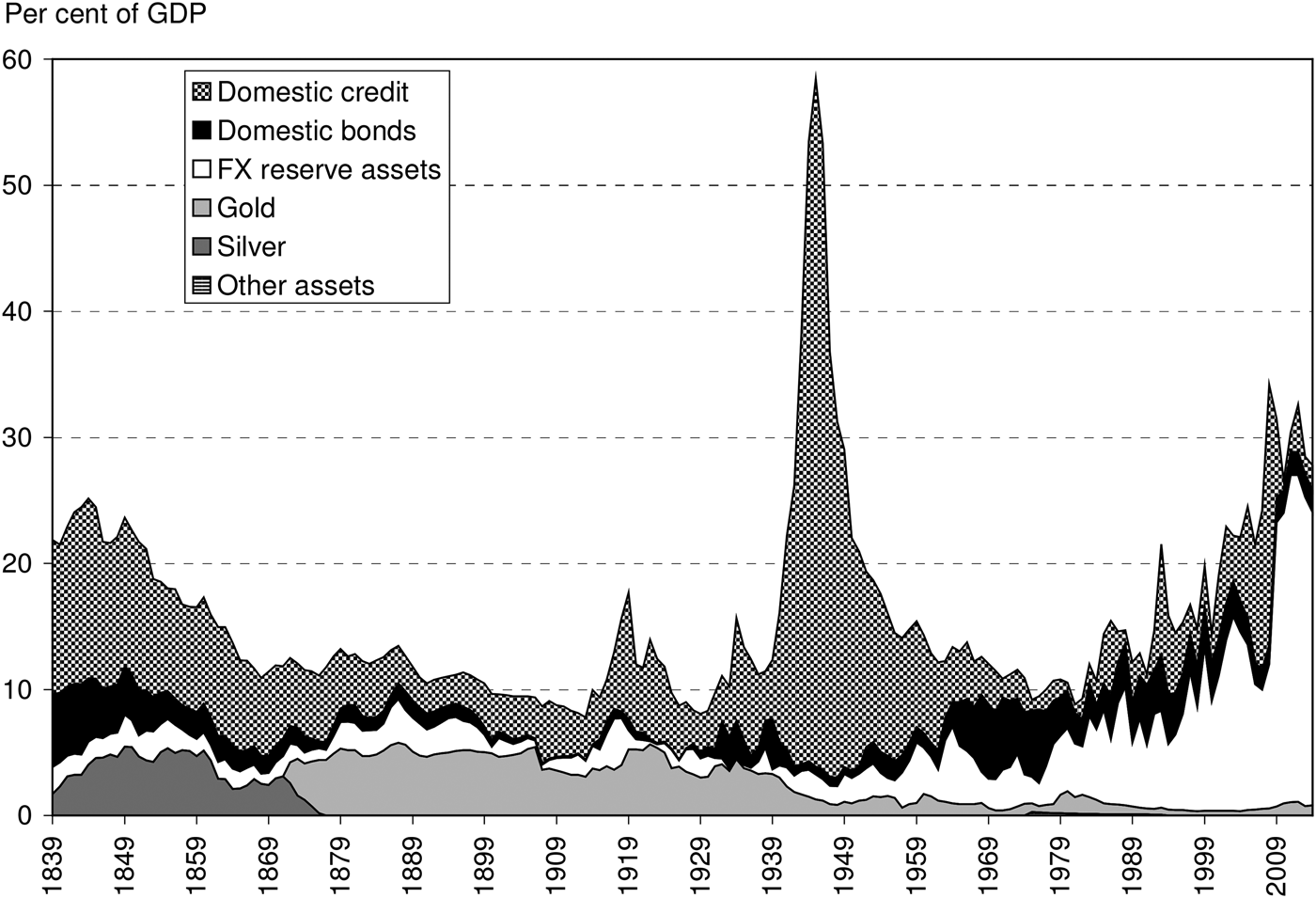
Figure 2 illustrates the composition of Danmarks Nationalbank's assets during the past 175 years. The temporary massive increase in the balance sheets around World War II was caused by the expenditures of the German occupation forces in Denmark in 1940–5. The expenditures were financed by drawing on the Nationalbank against a guarantee from the Danish central government and were never paid by Germany (Hoffmeyer and Olsen Reference Hoffmeyer and Olsen1968). The expenditures are therefore not included in the net foreign exchange exposure of the Nationalbank in Figure 2 but are treated as a claim on the Danish central government under the item ‘Domestic credit’.
Composition of Danmarks Nationalbank's assets, 1839–2014

Denmark followed a silver standard until the mid 1870s. A gold standard was adopted with the Coin Act of 1873, and Denmark participated in the pre-World War I classical gold standard as well as in the restored gold-exchange standard in the interwar period. Silver and gold holdings constituted therefore a significant share of Danmarks Nationalbank's assets prior to World War II.
A large number of countries subscribed to the gold standard in the decades prior to World War I, when the system reached its widest global coverage (Eichengreen and Flandreau Reference Eichengreen, Flandreau, De Macedo, Eichengreen and Reis1996). The Scandinavian countries were among the exceptions to the general tendency of unilateral adoption of the gold standard. Denmark, Sweden and Norway entered into an agreement to form a Scandinavian Currency Union (SCU) with a common currency system based on gold in December 1872. However, in May 1873, a narrow majority of the Norwegian parliament rejected the agreement. Later in May 1873, Denmark and Sweden concluded a new agreement on a bilateral currency union between the two countries following principles identical to the agreement of December 1872. By a supplementary protocol of October 1875, Norway joined the union with effect from January 1877 (Nielsen Reference Nielsen1917; Øksendal Reference Øksendal2007).
Danmarks Nationalbank, Sveriges Riksbank and Norges Bank concluded in 1885 an agreement on a trans-Scandinavian payment system within the SCU. This payment system provided the basis for more efficient interest-rate arbitrage among the countries and eliminated by and large the gold points between the currencies of the three countries in the SCU. As part of the payment system arrangement, the three central banks granted each other the right to have overdrafts on their reciprocal accounts. A central bank with a net credit position had the right to require settlement on demand in gold or foreign currency. A country with a net debit position had the right to settle the debt in Scandinavian gold coins at par value if no agreement regarding other means of settlement had been concluded. The net claims on Sveriges Riksbank and Norges Bank in relation to the trans-Scandinavian payment system are therefore included as part of the gold holdings of Danmarks Nationalbank in Figure 2.
During most of the post-World War II period Denmark has maintained its long-standing tradition of basing its monetary policy on an exchange-rate target. Denmark participated in the dollar-based fixed-exchange-rate system established after World War II under the auspices of the International Monetary Fund, the so-called Bretton Woods system. This system broke down in the early 1970s. Subsequently the Danish krone was linked to various European exchange-rate systems, initially the ‘Snake’ and since 1979 the Exchange Rate Mechanisms (ERM I and II).
Danmarks Nationalbank's gold exposure was relatively modest in the post-World War II period, whereas non-gold foreign exchange reserves increased significantly, particularly since the removal of the last restrictions on cross-border capital movements in 1988. With free capital movements, the Nationalbank needed larger foreign-exchange reserves in order to be able to manage the exchange rate in a world with a higher volume of cross-border capital flows (Abildgren Reference Abildgren2008).
The significant increase in Danmarks Nationalbank's balance sheets after 2007 reflected an increased level of non-gold foreign-exchange reserves as well as several new lending facilities established in order to provide the Danish banking sector with sufficient liquidity in Danish kroner, euro and US dollars during the global financial crisis (Abildgren and Thomsen Reference Abildgren and Thomsen2011). At the peak of the crisis in the autumn of 2008, the size of the Nationalbank's foreign-exchange reserves came into focus and the Danish krone experienced downward pressure vis-à-vis the euro. Rumours circulated that the foreign exchange reserves were insufficient to maintain the peg vis-à-vis the euro, especially since many Danish deposit banks in the years leading up to the crisis had developed a large customer funding gap based on funding in the international money and credit markets. Subsequently, the Nationalbank therefore increased the size of its foreign-exchange reserves in order to signal its commitment to the fixed-exchange-rate policy.
For a number of euro area member states with macroeconomic imbalances, the recent financial crisis developed into an outright sovereign debt crisis during 2010 and the years thereafter. The debt crisis led to increased demand for non-euro-denominated government securities with a high credit rating such as Danish government bonds. This demand was stimulated further by quantitative easing and very low long-term interest rates in the euro area. The resulting capital flows into Denmark led to a further increase in Danmarks Nationalbank's foreign-exchange reserves and upward pressure on the Danish krone vis-à-vis the euro. In July 2012, the Nationalbank introduced a negative rate of interest on its certificates of deposit to counter the sustained inflow of foreign exchange and the tendency for the krone to strengthen. This was the first time ever that one of the Nationalbank's key monetary-policy interest rates became negative.
Danmarks Nationalbank's exposures to domestic bonds were usually rather small. The largest exposures occurred in the 1960s, when the Nationalbank made use of outright transactions in domestic bonds in order to limit the rise in long-term bond yields (Mikkelsen Reference Mikkelsen1993). The liberalisation of capital flows in the course of the 1970s and first half of 1980s implied that the Nationalbank no longer was able to influence the long-term bond yields via purchase and sale of krone-denominated bonds in the market. Unlike countries that implemented large-scale purchases of government bonds in order to drive down long-term interest rates, there was no significant increase in the Nationalbank's holdings of domestic bonds in the most recent years.
VI
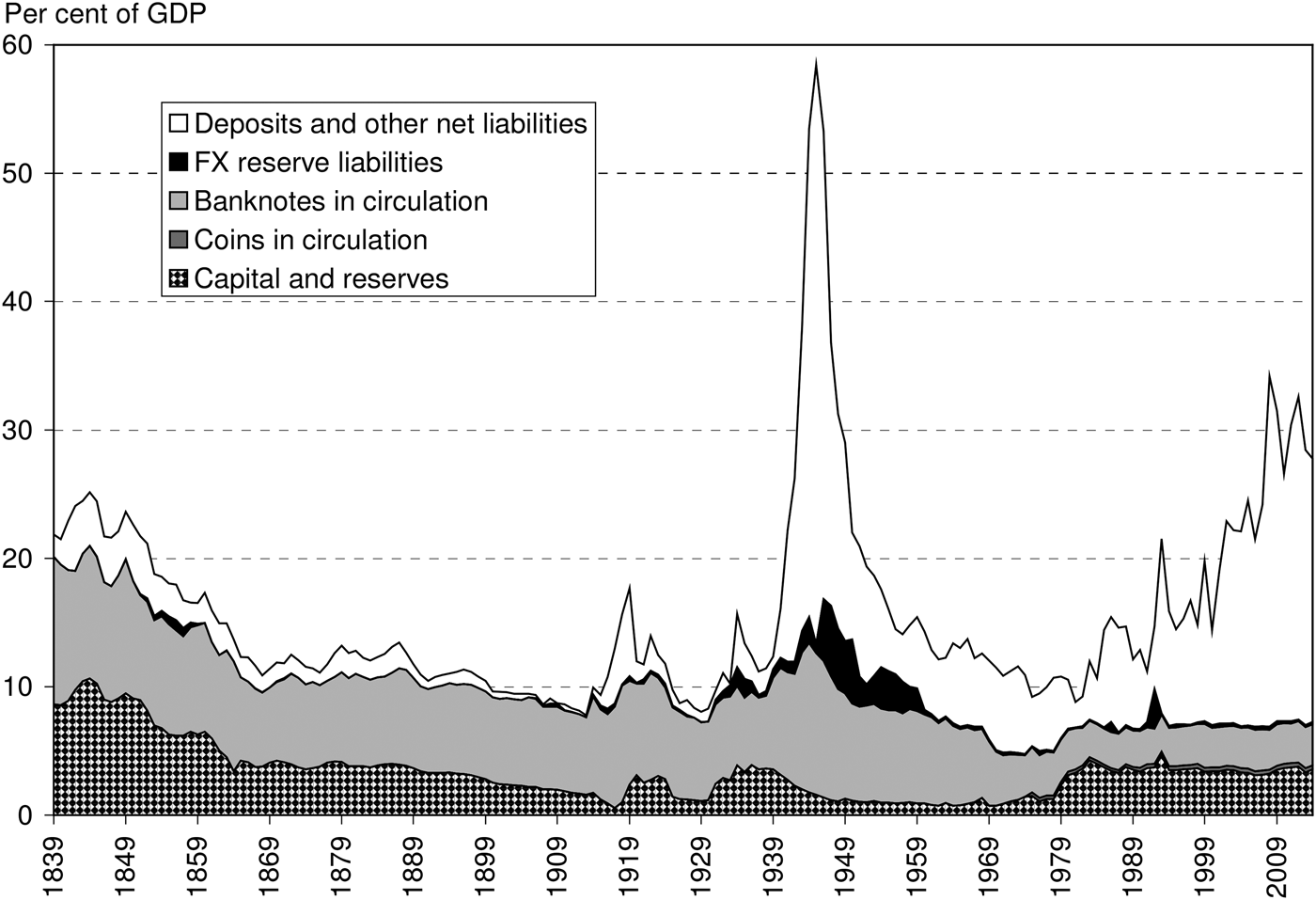
The composition of Danmarks Nationalbank's liabilities and equity is shown in Figure 3. Again, the episodes with ample liquidity during World War II and the period since the liberalisation of the financial sector in the 1980s are clearly visible. The latter reflects to a high degree the increase in the Nationalbank's foreign-exchange reserves, as the domestic currency proceeds of the Nationalbank's purchases of foreign exchange from banks are credited to their accounts with the central bank. Since 1993, there was also an agreement between the central government and the Nationalbank under which the kingdom of Denmark, should the need arise, can borrow in foreign currency in order to maintain an adequate level of foreign-exchange reserves at the Nationalbank (Abildgren et al. Reference Abildgren, Andersen and Thomsen2010, pp. 47–9). In this case, the Nationalbank's purchases of foreign exchange from the central government are credited to its account with the Nationalbank.
Composition of Danmarks Nationalbank's liabilities and equity 1839–2014

One might note that the outstanding amount of banknotes relative to GDP in general has declined over time in step with the development of close substitutes to cash offered by the banking system. There was, however, a temporary increase in banknotes relative to GDP during World War II.
Another observation from Figure 3 is that Danmarks Nationalbank's capital and reserves relative to GDP gradually declined significantly during the silver standard period in the 1800s and the pre-World War I classical gold standard period. The solvency ratio (i.e. capital and reserves relative to total assets) of the Nationalbank also declined markedly during this period. This high solvency level in the first half of the 1800s might reflect the need to gain credibility for a relatively new central bank with the objective of increasing the value of the currency. Parity of the Nationalbank's banknotes vis-à-vis silver coins was achieved in 1838, and in 1845 the notes were made convertible into silver coins on demand. As price stability was achieved during the silver and gold standard period, the need for a high level of solvency of the central bank might have diminished. However, neither the annual reports of the Nationalbank nor the archival records consulted indicate that the decline in the solvency level during the second half of the 1800s was the outcome of a conscious decision-making process. A formalised risk-management framework was only introduced much later (see Section vii).
The low levels of the Danmarks Nationalbank's capital and reserves relative to GDP in the interwar period reflected mainly value adjustments of gold holdings in connection with the Danish krone's return to gold at the pre-1913 parity level in 1927. Furthermore, the Nationalbank suffered significant losses on loans in connection with the failure of several banks during the 1920s (see again Section vii).
The level of capital and reserves relative to GDP as well as the solvency ratio were relatively low but also very stable from the early 1950s to the early 1960s. This period was characterised by pronounced stability of the banking sector and stable exchange rates due to Denmark's participation in the Bretton Woods system.
The increase in capital and reserves relative to GDP in the late 1970s and early 1980s reflected to a large extent exchange-rate adjustments due to devaluations of the Danish krone vis-à-vis the Deutsche mark within the European exchange-rate systems. In total, the Danish krone was devalued by around 30 per cent from 1976 to 1982. This period constitutes the most significant deviation from Denmark's long-standing tradition of basing its monetary policy on a fixed-exchange-rate strategy. There were also large market-value adjustments of the domestic bond portfolio in the first half of the 1980s due to a significant decline in the long-term bond yield (from more than 23 per cent in mid 1982 to less than 10 per cent at the end of 1985) following a switch to a more prudent fiscal policy and a reintroduction of the fixed-exchange-rate policy (Abildgren et al. Reference Abildgren, Andersen and Thomsen2010).
During the most recent decades, Danmarks Nationalbank's capital and reserves increased at a rate approximately equivalent to the growth rate of Denmark's nominal GDP, which also has been the guiding principle for the Nationalbank (Danmarks Nationalbank 2003, p. 21).
VII
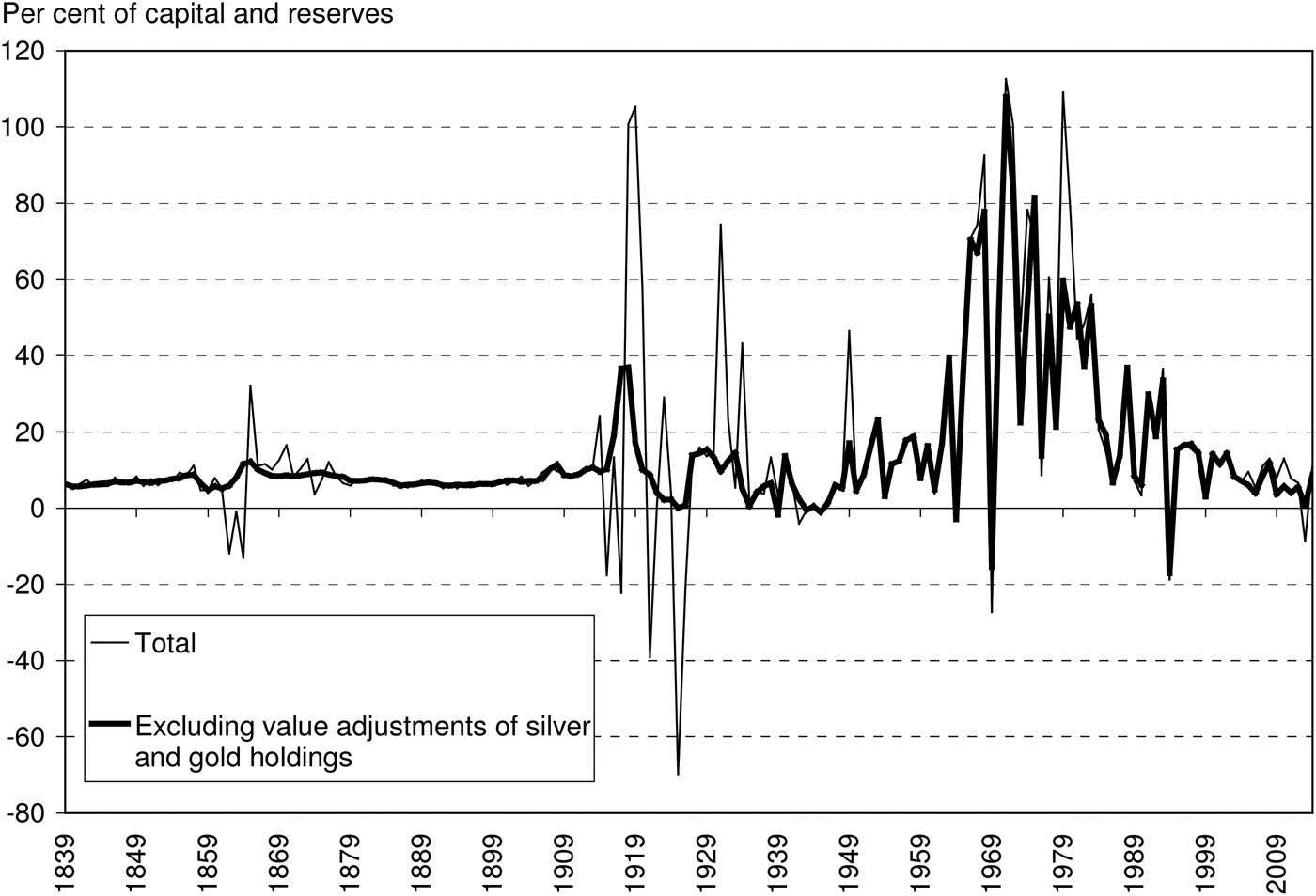
Figure 4 shows Danmarks Nationalbank's financial returns on equity, defined as profit from financial items as a percentage of capital and reserves.
Danmarks Nationalbank's financial return on equity, 1839–2014

On average, the financial return on equity has been 15.5 per cent per annum over the period 1839–2014 (or 13.7 per cent per annum excluding value adjustments of silver and gold holdings). The long-term nominal yield on Danish central government bonds has been 5.8 per cent per annum on average over the same period. A return on equity well above the yield on long-term government bonds should be expected due to the leveraged nature of a central bank. One might especially note that the very high level of (and volatility in) the Nationalbank's financial return on equity in the 1960s and 1970s to a large degree reflects a leverage effect. The solvency ratio of the Nationalbank was relatively low during this period and the return on equity exceeded the yield on long-term government bonds quite substantially (Abildgren Reference Abildgren2014).
A large part of the fluctuations in financial return on equity in the pre-World War II is related to the market valuation applied to the Nationalbank's silver and gold holdings. There were large fluctuations in the krone value of the Nationalbank's gold exposure following the suspension of the gold standard at the outbreak of World War I and in the decade immediately after the end of World War I, where the international monetary system was characterised by floating exchange rates. The same was the case after the breakdown of the interwar gold exchange standard in the early 1930s. Later, the volatility in the market value of gold measured in Danish kroner reflected the devaluation of the US dollars vis-à-vis gold in 1934 and the devaluation of Danish kroner vis-à-vis the US dollar in 1949 during the Bretton Woods period.
Fluctuations in gold prices were relatively modest from the mid 1980s to the mid 2000s. Since then, volatility has increased. There was a strong increase in gold prices from the mid 2000s to the end of 2012 followed by a substantial decline, and value adjustments of gold contributed significantly to the volatility of financial return on equity since the mid 2000s despite the relatively low exposure vis-à-vis gold.
Whether a central bank can avoid credit risk due to its role as lender of last resort vis-à-vis the domestic banking sector is a matter of debate. The classical view on last-resort lending dates back to Thornton and Bagehot in the 1800s (Bordo Reference Bordo1990; Humphrey Reference Humphrey1975, Reference Humphrey1989). It states that a central bank shall stand ready to safeguard financial system stability during waves of bank distress by supplying the necessary liquidity against good collateral at a penalty rate to illiquid but solvent banks. In practice, however, it might be difficult to distinguish between solvent and insolvent banks in periods of financial distress.
Danmarks Nationalbank's lender-of-last-resort activities and loan impairment charges were relatively limited during the silver and gold standard periods prior to World War I (Abildgren Reference Abildgren2017). During the monetary crisis of 1857–8, the Nationalbank failed to act as lender of last resort to the extent needed due to its banknote coverage rules. The government had therefore to establish a ‘Temporary Loan Fund’ that granted credit to deposit banks, local governments and trading houses. During the savings bank crisis of 1876–8, the Nationalbank had only to provide extraordinary loans to a few deposit banks. The loan impairment charges were somewhat larger – but still moderate – following the construction and banking crisis of 1907–8, where the Nationalbank together with the government and a number of large banks established a banking committee that provided guarantees for depositors and other creditors in crisis-stricken commercial banks.
In contrast, loan-impairment charges had a significant impact on the Nationalbank's profit and loss account in the 1920s, when many Danish banks ran into trouble. Several large commercial banks – including Scandinavia's largest bank, Landmandsbanken – received capital and/or liquidity support from the government and Danmarks Nationalbank (Hansen Reference Hansen1996). It is worth noting that the big banking crisis of the interwar period occurred in the 1920s in Denmark, whereas the banking sector in many other countries – including the US – suffered more during the Great Depression in the 1930s (Abildgren Reference Abildgren2016b).
Loan losses did not play any significant role in financial returns in the post-World War II period. Very few banks suffered financial distress until the 1980s, and Danmarks Nationalbank switched towards collateralised lending in its monetary-policy operations and extension of intraday credit during the late 1980s and the 1990s (Abildgren et al. Reference Abildgren, Andersen and Thomsen2010). Furthermore, the Nationalbank's involvement in special solution schemes for a few distressed banks in the early 1990s and during the most recent financial crisis took place against a guarantee from the central government.
In Figure 4 we can clearly identify three periods with relatively low volatility in Danmarks Nationalbank's financial returns on equity. The first was the period from the mid 1870s to World War I, when Denmark participated in the classical gold standard system. This resulted in stable gold prices and foreign-exchange rates measured in Danish kroner. The pre-World War I era was also characterised by a high degree of stability in long-term interest rates in Denmark and many other countries (Gerlach et al. Reference Gerlach, Scatigna and Ramaswamy2006). During this period the Nationalbank's financial return on equity was therefore only affected by relatively small value adjustments of financial items.
The second period runs from the early 1950s until the early 1960s. During this period Denmark and most of its main trading partners participated in the Bretton Woods system (Reinhart and Rogoff Reference Reinhart and Rogoff2004). This period was characterised by relatively stable foreign-exchange rates and long-term interest rates.
The third period runs from the mid 1990s until 2014. This period was characterised by the introduction of formalised financial risk management at Danmarks Nationalbank (Abildgren et al. Reference Abildgren, Andersen and Thomsen2010). The bank began to publish information on the interest-rate sensitivity of foreign exchange reserves and domestic bond portfolio in its Annual Report and Accounts in 1997; the publication of information on value-at-risk and the results of stress tests followed in 1999 and 2001 respectively.
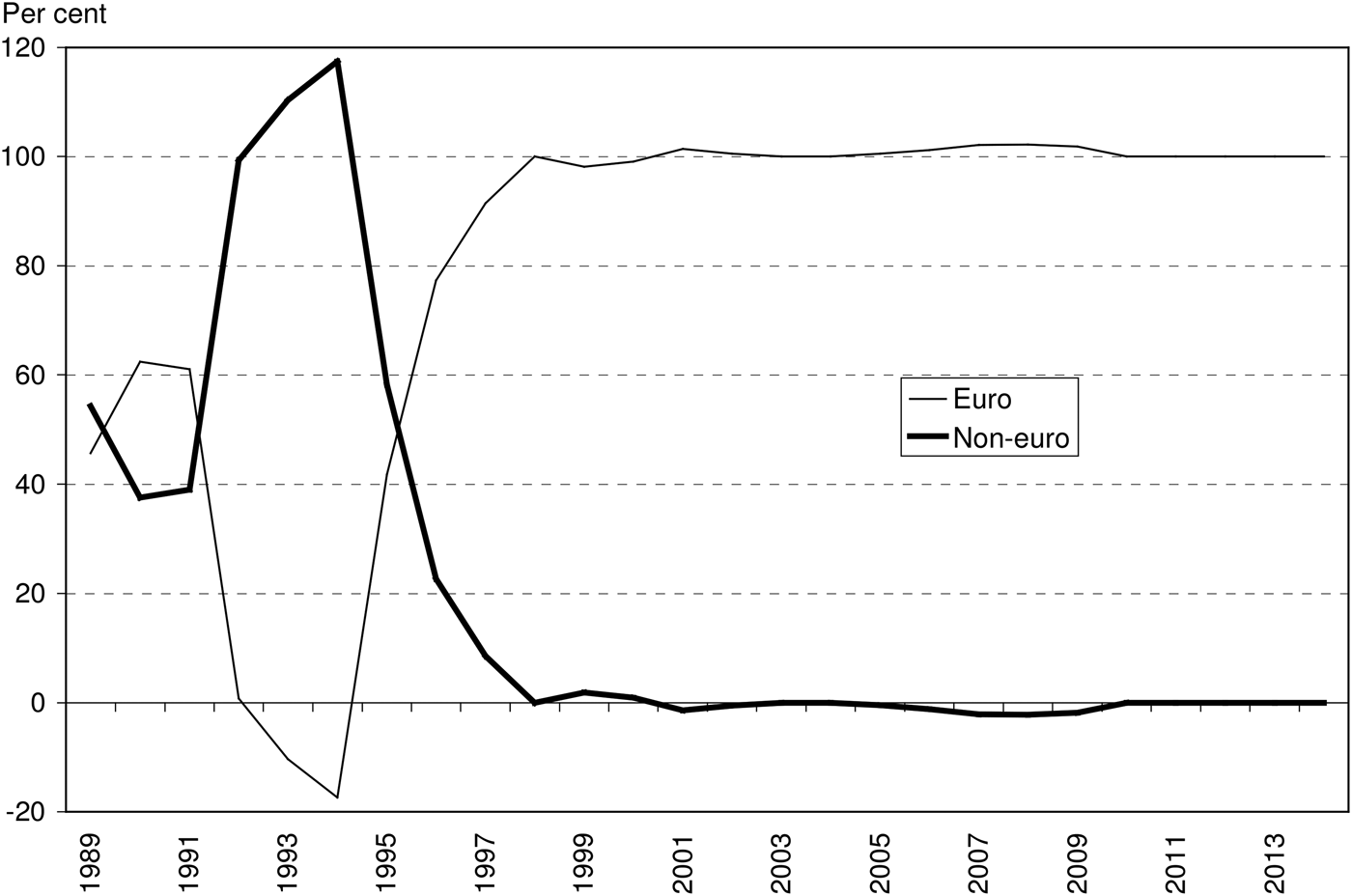
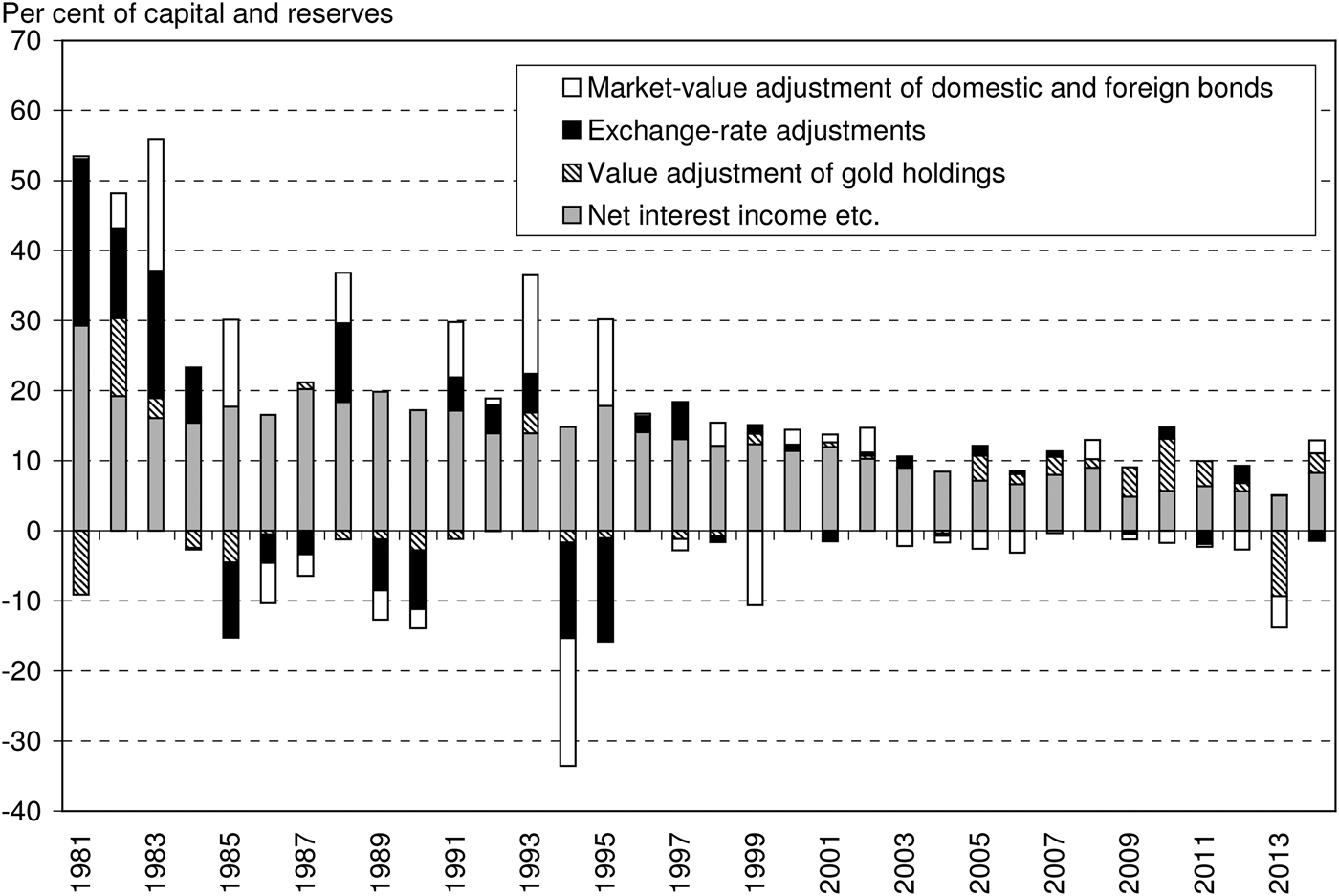
Furthermore, the Nationalbank has reduced its exchange-rate exposures in currencies other than the euro, to which the Danish kroner is pegged under the European Exchange Rate Mechanism, ERM II, since 1999 (see Figure 5). As a consequence, the impact of exchange-rate adjustments on the Nationalbank's financial return on equity decreased significantly (see Figure 6).
Currency composition of Danmarks Nationalbank's net foreign-exchange reserves, 1989–2014

Detailed composition of Danmarks Nationalbank's financial return on equity, 1981-2014

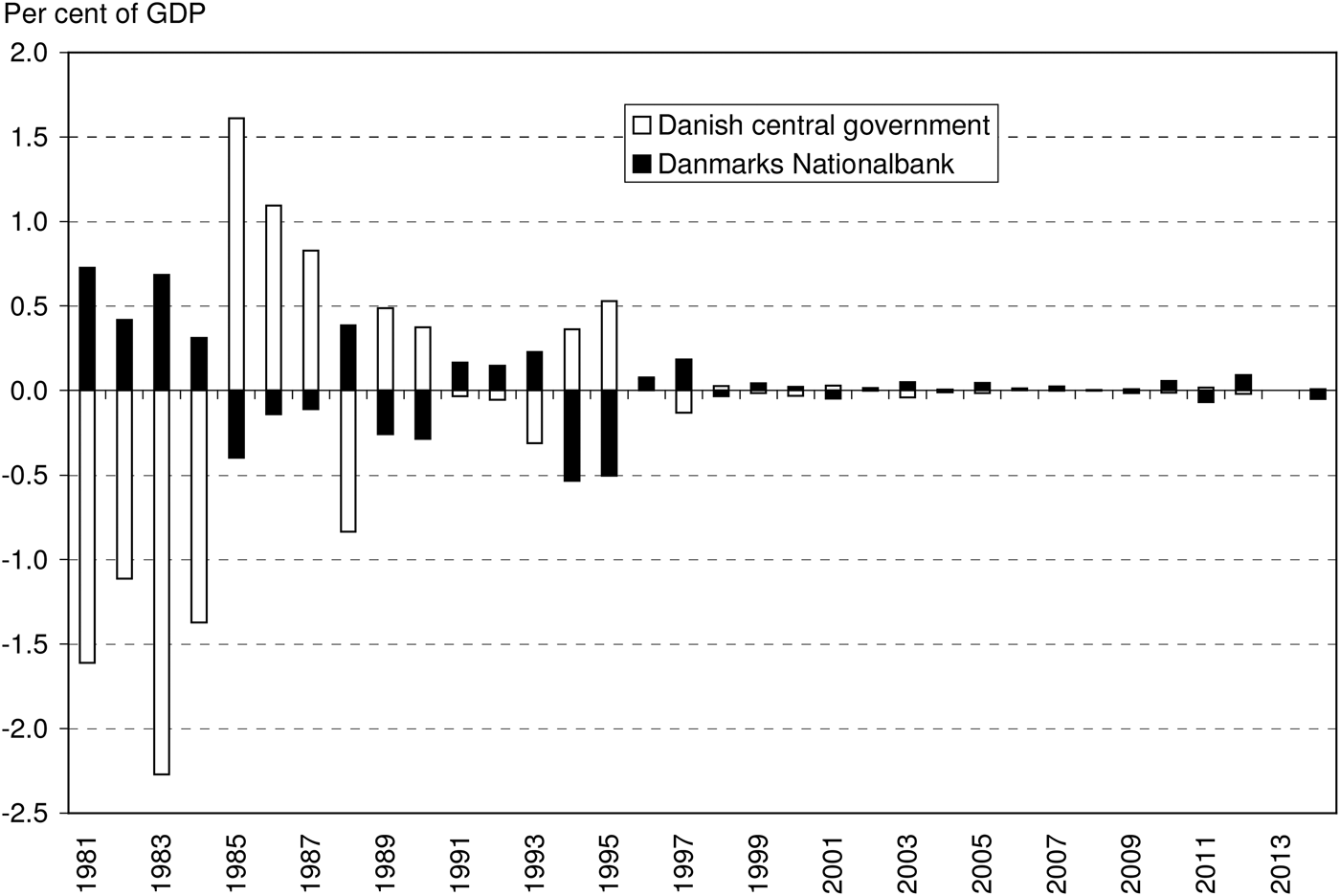
The large exposure vis-à-vis non-euro currencies in the first half of the 1990s (these include Deutsche mark, French franc, Netherlands guilder, Belgian francs and ECU prior to 1999) might seem surprising given that Denmark had participated in European exchange-rate co-operation since the early 1970s and had followed a hard peg vis-à-vis the Deutsche mark and the other core currencies within the ERM I since January 1987. However, this is explained by a co-ordinated management of net currency risk of Danmarks Nationalbank's foreign-exchange reserves and the central government's foreign debt, which was introduced in 1992 (Abildgren et al. Reference Abildgren, Andersen and Thomsen2010, pp. 270–3). During the 1980s, the Danish central government's foreign debt in US dollars, Japanese yen and Swiss francs far exceeded the Nationalbank's placements in the same currencies. The general objective of this co-ordinated management was to reduce overall exchange rate risk, as the Nationalbank's gains and losses would to a higher degree be offset by the central government's losses and gains, and vice versa (see Figure 7).
The Danish central government's and Danmarks Nationalbank's exchange-rate gains (+) and losses (−), 1981–2014

The combined net currency distribution of the central government and Danmarks Nationalbank was initially determined quarterly on the base of a mean-variance portfolio model to trade off expected currency risks and returns. However, the first couple of years of risk management showed that the gross currency exposures of the two institutions should also be taken into account. The government and the Nationalbank still published separate accounts, and unrealised value adjustments of foreign-exchange positions in the Nationalbank's accounts were reflected directly in the financial result. In 1994, positions were subject to considerable adjustments since the US dollar depreciated by approximately 10 per cent vis-à-vis the Danish krone. As a consequence the Nationalbank suffered a large exchange-rate loss, while the government had a large exchange-rate gain. Although the government's and the Nationalbank's overall exposure to the dollar was limited, it was difficult for the Nationalbank to accept a gross distribution of debt and foreign exchange reserves that entailed a risk of large losses. Ultimately this could have a negative impact on its reputation and the credibility of its monetary policy. Since neither the government nor the Nationalbank gained any particular benefits from gross risks of this magnitude, in 1995 they decided to co-ordinate the management of gross exposures, under which both significantly reduced their exposure vis-à-vis non-euro currencies. From 2001, with the bulk of both central government's foreign debt and the Nationalbank's reserve denominated in euro, a formal co-ordination of exchange-rate risk management was no longer required.
Since then the Nationalbank's gains and losses on non-gold foreign exchange reserves (denominated solely in euro) have been negligible. The euro area is Denmark's largest trading partner, and the euro accounts for 47.8 per cent of the current weighting basis of the official nominal effective exchange rate index. The effective exchange rate index has been very stable since the late 1990s. With 1980 = 100, the effective exchange rate index was 102.74 in December 1998 and 102.71 in December 2014. For the period 1999–2014 as a whole, therefore, exchange-rate adjustments would have been very similar if reserves had been linked to the effective exchange-rate index rather than denominated in euro. However, the decision to hold only euro reserves sent a much stronger message of commitment to the euro-peg.
The increased focus on formalised risk-management at the Nationalbank in the 1990s was in line with contemporaneous developments in the banking sector and among regulators, both in Denmark and abroad. The Basel I Accord of 1988 adopted by the Basel Committee on Banking Supervision (an international forum for central banks and financial supervisory authorities) recommended that banks’ capital adequacy should be measured against their risk-weighted assets. In 1999, the Basel Committee proposed a revision of capital-adequacy rules that incorporated recent developments in risk-management techniques (Jorion Reference Jorion1997; Abildgren et al. Reference Abildgren, Andersen and Thomsen2010). This in turn might also have influenced central banks, whose reputation and credibility could be damaged by inadequate risk-management strategies compared to those of the private banking sector (Bindseil et al. Reference Bindseil, González and Tabakis2009).
It should be stressed, however, that central banks are not subject to the Basel capital-adequacy rules. In fact the role of capital in central banks differs from the private banking sector. It can be argued that the solvency of a central bank should be measured in relation to the size of the economy (GDP) or the size of the balance sheet of the total financial sector due to is core function as monetary authority and lender of last resort. Indeed, whether central banks actually need any capital at all in order to perform their functions is a matter of debate, since they can always issue monetary liabilities (notes and deposits) or be recapitalised by the central government (Del Negro and Sims Reference Del Negro and Sims2015). However, the consensus is that a low (or negative) level of central-bank solvency might compromise independence in monetary policy implementation and hamper the ability to achieve the primary goal of price stability (Stella Reference Stella1997; Buiter Reference Buiter2008; Archer and Moser-Boehm Reference Archer and Moser-Boehm2013; Perera et al. Reference Perera, Ralston and Wickramanayake2013).
VIII
A number of existing studies used a simple asset/liability framework to analyse financial risks to which the Nationalbank was exposed in the last twenty years and the corresponding earnings (Hansen and Ølgaard Reference Hansen and Ølgaard2000; Danmarks Nationalbank 2003; Abildgren et al. Reference Abildgren, Andersen and Thomsen2010; Schrøder and Thamsborg Reference Schrøder and Thamsborg2012). Here I use a more general framework to assess the evolution of the Nationalbank's financial risks and returns over the past 175 years.
In principle, total profits from financial items of a central bank can be seen as the sum of three components. The first one is ‘core earnings’, defined as earnings generated by the basic risks that are necessarily related to the functions of a central bank. They consists of value adjustments of silver and gold holdings, interest income from placing all other assets in risk-free money market instruments without taking any additional interest-rate risk, and exchange-rate adjustments due to the need of holding liquid foreign exchange reserves. The second component is earnings that stem from charging an interest margin on loans to the domestic sector; this might be seen as an ‘intermediation fee’. The third component stems from assuming ‘additional risks’ after evaluating (either implicitly or explicitly) their expected risk-return trade-off. For instance, parts of a central bank's portfolio of domestic securities or exchange-rate reserves might be invested in instruments with long rather than short maturity, so the remuneration will also include a term premium as well as market-value adjustments. As a further example, the central bank might earn fees from lending gold or bonds to commercial banks or institutional investors. Earnings might also stem from assuming credit risks on domestic securities or foreign-exchange reserves, say, by investing in corporate bonds with lower credit rating than government bonds. As mentioned in Sections i and vii, it is debatable whether a central bank could avoid credit risk due to its role as lender of last resort vis-à-vis the domestic banking sector. However, here we assume that such risks can be addressed by appropriate collateral requirements. Finally, it must be noticed that for the central bank of a country that consistently pursued a fixed-exchange-rate policy, like Denmark during most of the period since 1839, exchange-rate adjustments of foreign exchange reserves could be moved from core earnings to earnings from additional risks, since under a successful fixed-exchange-rate policy adjustments can be eliminated if reserves are only denominated in the anchor currency.
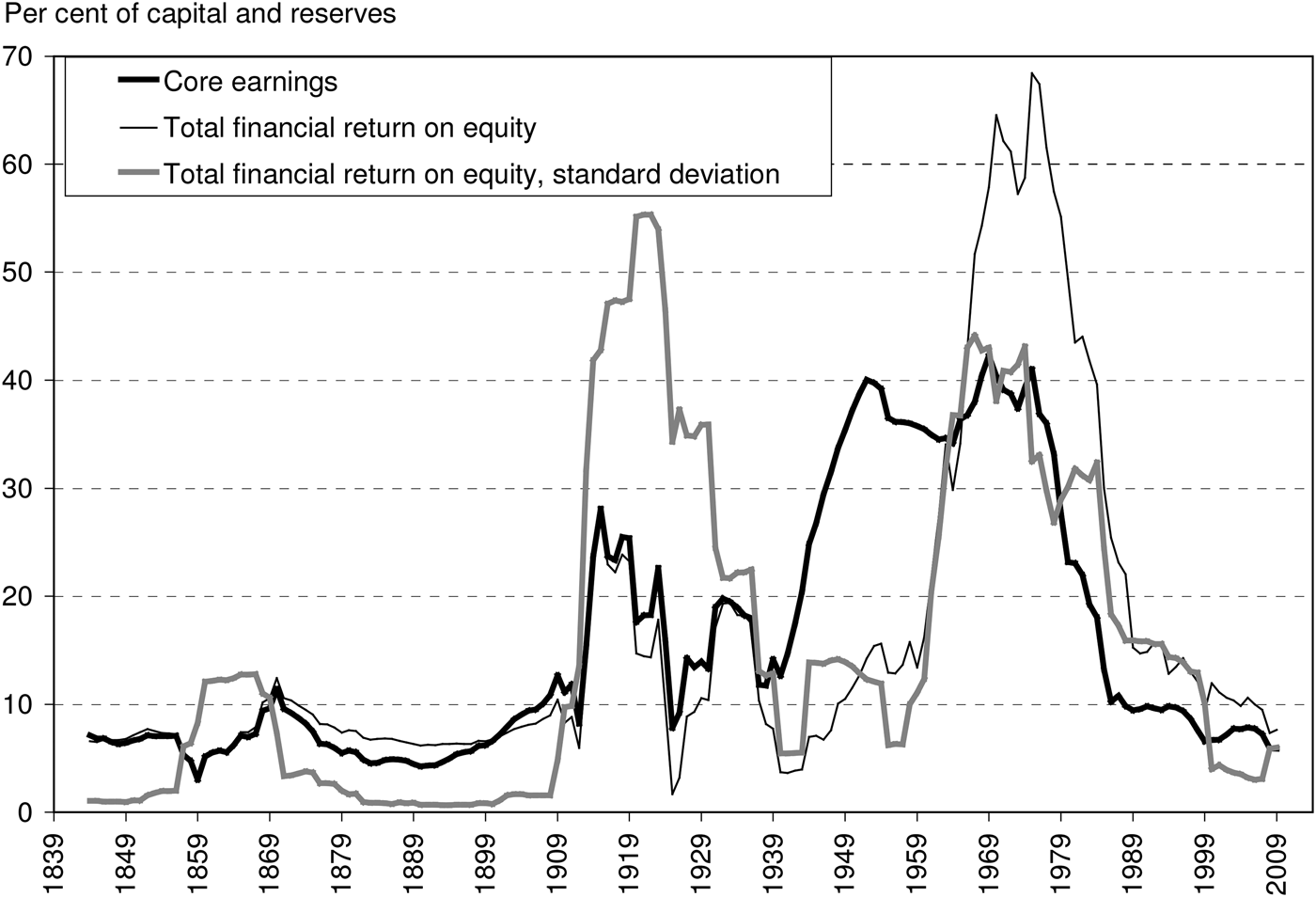
Figure 8 shows the Nationalbank's financial return on equity since 1839 as well as its core earnings based on the framework outlined above. The underlying calculations are based on a number of assumptions and simplifications and are naturally surrounded by an element of uncertainty. However, the figure provides a reliable picture in a secular perspective. The series have been smoothed by 11-year centred moving averages to eliminate short-term fluctuations. Figure 8 also shows the standard deviations of the total financial return on equity over the 11-year periods. These standard deviations can be seen as measures of the financial risks assumed by the Nationalbank. The background paper describes the compilation method, the underlying assumptions and data sources in detail (Abildgren Reference Abildgren2016a).
Danmarks Nationalbank's total financial return on equity and core earnings, 1839–2014

Core earnings have on average accounted for the bulk of the Nationalbank's earnings. It should also be noted that there was a downward trend in core earnings since the early 1980s in step with the general decline in the interest-rate level. Since a formalised risk-management framework was only adopted in the 1990s, the dominating role of core earnings is probably for most of the period since 1839 the result of a passive risk-management strategy where financial risks and returns just reflected the various functions assumed by the central bank.
Taking a more detailed look at Figure 8, it might be noted that there were on average substantial negative non-core earnings in the period from World War II to around 1970 followed by large positive non-core earnings in the 1970s and 1980s. The general rise in the level of long-term interest rates from the second half of the 1940s to 1970 resulted in negative market-value adjustments of domestic bond holdings. Negative market-value adjustments characterised domestic bond holdings also during the 1970s, but they were offset by positive value adjustments of foreign exchange reserves due to devaluations of the Danish krone. The large positive non-core earnings in the 1980s reflect to a large extent a substantial decline in long-term interest rates and the associated positive market-value adjustments of bond holdings. The large market-value adjustments of domestic bonds and foreign exchange reserves were reported and commented on in the annual reports of the Nationalbank. Neither the published annual reports of the Nationalbank nor the internal archival material that was consulted in relation to the work on this article contain any indications of an active management of the risks associated with non-core earnings prior to the 1990s.
The standard deviation of total financial return on equity indicates that the Nationalbank assumed substantial financial risks around World War I, in the interwar period and in the period from the mid 1960s to the mid 1980s. In these periods, the standard deviation was in the range of 25 to 55 per cent of the Nationalbank's equity capital. During the most recent decades, with a formalised risk-management framework, the level of financial risks has been substantially lower.
Like other central banks, Danmarks Nationalbank experienced lower returns on equity in the low-interest-rate environment of the 2000s (Bank for International Settlements 2009). In order to improve profitability and increase diversification, in 2013 it decided to build up a higher exposure towards new risk classes such as equity, corporate bonds and government bonds with lower credit ratings as well as to increase the share of bonds with longer maturities. However, the Nationalbank also noted that its future investment strategy would be conservative, by pursuing high liquidity and credit-quality requirements for the foreign-exchange reserve due to the fixed-exchange-rate policy (Danmarks Nationalbank 2014, p. 33, 2015, p. 20). At the end of 2016, the Nationalbank's exposure towards the new risk classes amounted only to around 3 per cent of the total assets.
IX
In order to perform their basic monetary policy functions, central banks hold substantial financial assets and liabilities on their balance sheets, and are therefore exposed to a variety of risks and returns. Beyond core earnings, by adopting profit-oriented investment strategies typical of private financial institutions, a central bank might seek extra earnings by taking up additional risks within acceptable limits. However, due to policy constraints derived from their primary objectives, central banks differ from private investors. This article explored long-term trends in risks and returns within central banking under different monetary and institutional regimes using Danmarks Nationalbank as a case study. It shows that core earnings accounted for most of the Nationalbank's financial returns over the past 175 years. For a long period, this was the outcome of a passive risk-management strategy under which risks and returns just reflected the core functions performed by the Nationalbank. A formalised risk-management framework with a deliberate and explicit trade-off between expected risks and returns emerged only in the 1990s.
APPENDIX
This appendix outlines the main valuation and accounting principles in my annual dataset on Danmarks Nationalbank's balance sheets and profits from financial items since 1839. Profit from financial items comprises net income from interest, commission and brokerage fees, dividend from holdings of shares, market-value adjustment of silver, gold and securities holdings, exchange-rate adjustment of net foreigh-exchange reserves and loan impairment charges.
All figures refer to the consolidated accounts of Danmarks Nationalbank and its branches. The ‘krone’ was only introduced as the Danish currency unit of account in 1875. However, all figures prior to 1875 have been converted to kroner using the official conversion rate.
The balance-sheet figures are as far as possible stated at market prices end of year (including items denominated in foreign currency). Figures prior to 1900 have been converted from an end-July to end-December basis by simple linear interpolations. It should, however, be mentioned that the accounting year of the branches prior to 1869 ended one month (30 June) before the accounting year of the main office in Copenhagen (31 July). This minor discrepancy between year-end at the main office and the branches has not been adjusted. Figures on profits from financial items prior to 1937 have been adjusted to follow the calendar year by simple linear interpolations of figures on accounting-year basis.
The silver holdings (which the Nationalbank had on its balance sheets prior to 1877) were not stated at market prices in the official annual accounts of the period. I have adjusted the silver holdings (and the liability item ‘Capital and reserves’) in the balance sheets to reflect market valuation of the silver stock. Furthermore, the value adjustments of silver have been added to the profits from financial items.
Gold holdings have been stated at market values in the balance sheets of the official annual accounts of Danmarks Nationalbank since 1988. Prior to 1969, the Nationalbank's gold stock was stated in the balance sheet at the krone's gold-parity value according to the Coin Act of 1873. From 1969 to 1978, the gold stock was booked at the parity notified to the International Monetary Fund. From 1979 to 1987, the gold stock was valued at the average market price for the last six months or at the market price at the penultimate working day of the year, whichever was the lower. This valuation principle implied that the gold stock de facto also was stated at market prices for the period 1983–7. For the period prior to 1983, the balance-sheet figures as well as the profits from financial items to reflect market valuation of the gold stock have been adjusted.
In 1975, the Royal Mint was transferred from the central government to Danmarks Nationalbank against a central-government guarantee for coins put into circulation prior to 1 January 1975. Coins are therefore only on the balance sheets of the Nationalbank's since 1975. In 1994, the European Monetary Institute found that the central-government guarantee was in conflict with the prohibition against monetary financing, as Danmarks Nationalbank held a non-negotiable claim with an indefinite maturity on the central government. Consequently, the guarantee was dissolved.
Prior to 1908, the holdings of banknotes by Danmarks Nationalbank's main office in Copenhagen and its branch offices were shown as asset items on the balance sheets in the official annual accounts. In my dataset, I show the banknotes in circulation on the liability side excluding the holdings of banknotes by Danmarks Nationalbank's main office and its branch offices.
Figures for total assets differ from the total assets stated in the official annual accounts of Danmarks Nationalbank due to the market valuation of silver and gold, the net treatment of certain asset and liability items, and the conversion of the pre-1900 figures to an end-December basis.