Internationally, an increased prevalence of dementia will bring with it significant financial and carer implications. In Australia, the prevalence of dementia is projected to almost double in the next two decades and then almost double again by 2050. With this will come a 364% increase in health and residential aged care expenditure between 2003 and 2033, with the dementia prevalence rate having the second greatest impact behind diabetes (Goss, Reference Goss2008). Alzheimer's Disease International reported that in 2010 US$604 billion was directed to dementia care and treatment, but with diagnoses projected to increase to 65.7 million people by 2030, present expenditure may increase greater than 85% worldwide (Alzheimer's Disease International 2010). Dementia was the third leading cause of death (6% of all deaths) in Australia in 2010, but recorded as an underlying or addition cause in 14% of all deaths in the same year. In addition, for those over 65 years of age, dementia is reported as the second leading cause of overall disease burden and the leading cause of total disability burden (AIHW, 2012). Given the growing prevalence, burden and health cost implications, significant breakthroughs in dementia are needed that will reduce incidence and improve outcomes for adults with this disease (Alzheimer's Disease International, 2010).
Exercise and physical activity as a treatment and/or preventative measure has received growing attention. A number of studies have demonstrated that increased levels of physical activity are associated to reduced incidents in dementia development (Laurin et al., Reference Laurin, Verreault, Lindsay, Macpherson and Rockwood2001; Barnes et al., Reference Barnes, Whitmer and Yaffe2007), suggesting that physical activity may play a key role in prevention. As for all people, evidence is also strong that with exercise a person with dementia can improve their aerobic, muscle strength, and physical performance capacity (Heyn et al., Reference Heyn, Abreu and Ottenbacher2004; Littbrand et al., Reference Littbrand, Stenvall and Rosendahl2011). While evidence is mixed over the ability of exercise to slow and/or stifle cognitive decline in people with dementia (Littbrand et al., Reference Littbrand, Stenvall and Rosendahl2011), a growing body of research supports that exercise can reduce behavioral fluctuations and agitation, and improve sleeping patterns, with the potential to reduce the need for psychotropic medications (Miranda-Castillo et al., Reference Miranda-Castillo, Woods and Orrell2010; Neville et al., Reference Neville, Henwood, Beattie and Fielding2014). However, in residential aged care, the setting in which the greatest prevalence of dementia is present, more work is needed to detail the benefits of exercise as well as the optimal method of prescription (Littbrand et al., Reference Littbrand, Stenvall and Rosendahl2011).
Pilot work by our group has demonstrated that among adults with dementia in the residential aged care setting, aquatic exercise is a feasible modality of activity with small but important benefits (Neville et al., Reference Neville, Henwood, Beattie and Fielding2014; Henwood et al., Reference Henwood, Baguley and Neville2015b). The Watermemories Swimming Club program was initially designed due to the older Australians familiarity to swimming, and in line with anecdotal evidence that aquatic exercise has important benefits for adults with dementia (Neville et al., Reference Neville, Clifton, Henwood, Beattie and Mckenzie2013; Smith, Reference Smith2003). When trialed, our pilot work revealed improvements in the behavioral and psychological symptoms among people with dementia as well as in grip strength and some physical performance measures (Neville et al., Reference Neville, Henwood, Beattie and Fielding2014; Henwood et al., Reference Henwood, Baguley and Neville2015b). Recognition of the programs value was significant from the regional aged care communities where the pilot occurred and, following the pilot, the program was implemented locally using council, aged care providers, and local business support. Nationally and internationally, the program sparked broad interest, with the research team receiving a number of requests for more information and for the program training manual (Neville and Henwood, Reference Neville and Henwood2013), an outcome of which was the team being invited to present the pilot as a keynote symposium during the 2012 World Congress on Active Ageing in Glasgow (Neville et al., Reference Neville, Henwood, Clifton and Beattie2012).
However, while feasibility was supported, during the pilot dropout rates, measure reliability and recruitment were all identified as factors that needed greater attention for successful program delivery (Henwood et al., Reference Henwood, Baguley and Neville2015b), as well as investigation among a larger representative group. Conscious of the challenges of research in residential aged care adults with moderate to severe dementia, learnings gained during the pilot study were employed to design a larger investigation. Specifically, the aim of this project was to establish the benefits of the Watermemories Swimming Club program among residential aged care adults with advanced dementia. Within this, our objectives included the evaluation of the physical and psychological benefits associated to program participation, as well as the feasibility and barriers to program delivery.
Method
Design and recruitment
The study was a controlled trial of residential aged care adults with moderate to severe dementia, conducted between February and December of 2013. Residential aged care facilities within Brisbane, the Gold Coast and Toowoomba, Queensland, Australia, were approached with an opportunity to participate in the Watermemories Swimming Club program. In recruiting facilities to this study, contact was made with facility service managers, the reputation of the program leveraged, the study explained in detail and it was established the facility had sufficient residents meeting the inclusion criteria.
Facilities that agreed to participate were purposeful selected to the Watermemories Swimming Club exercise or usual care control group based on (i) discussion with the facility about their capacity to transport participants to the pool for program attendance, (ii) whether they had staff availability to support participants during program attendance, and (iii) if they could supply other necessary resources including adult's incontinence swimwear and dressing gowns for participants to wear after leaving the water. In addition, facilities were matched by the organization running them (N = 3) to ensure similar practices and missions. To support participation, research funds were allocated to pay an instructor to deliver the program, the cost of entry to the pool for participants and for in-pool support equipment (pool noodles and floatation vests). A case-by-case discussion was entered into with the facility in the exercise group about funding support for taxiing participants to and from the pool and the incontinence swimwear.
Participant recruitment was based on the individual facilities’ Service Manager approval of residents meeting the eligibility criteria. Inclusion criteria for the study were a past history of swimming, residing in a residential aged care facility (low or high care), with a diagnosis of dementia, able to walk a minimum of 10 m self-ambulating or with a walking cane or wheelie walker, and able to gain substitute decision maker consent. Residents were excluded if they had an unstable or terminal illness, were wheel chair or bed bound, had dangerous or unpredictable behaviors, had a pacemaker, and were taking medications contradictory to exercise. Written informed proxy consent was obtained for all participants. This included consultation with the participant's substitute decision maker, and them signing the consent form directly or giving verbal assent for the facility Service Manager to sign the form in their absence. Prior to involvement, participant required a medical fitness clearance from both their facility and their General Medical Practitioner (GP). If participants were unable to obtain a medical clearance for exercise from their GP or if they decided they no longer wanted to participate in the intervention following baseline assessment, they were allocated into usual care group.
The study received ethical approval through the University of Queensland Human Research Ethics Committee and was registered on the Australian New Zealand Clinical Trials Registry (12613000503729).
Participants
Fifty-six residents from seven facilities in Brisbane (one facility; N = 16), Gold Coast (one facility; N = 9), and Toowoomba (five facilities; N = 31) were recruited into the study. Of these, 29 were allocated to the exercise group. Among facilities, four were members of Bupa Aged Care, two of Freedom Aged Care, and one of St Vincent's Health Services. Ten participants were lost to follow-up due to reasons unrelated to the research. These were; one participant had passed away, one was immobile and bedridden following a stroke, one was in hospital for an indefinite period, one was too agitated to complete the assessments, two refused to participate, and four participants were absent from the facility due to family outings. The final sample consisted of 18 men and 28 women. Twenty-seven participants had a dementia assessment using the Psychogeriatric Assessment Scales (PAS) (Jorm et al., Reference Jorm1995), with a group mean of 12.4 ± 4.1. Remaining participants had an assessment of moderate to severe dementia by the Functional Assessment Staging of Alzheimer's Disease (FAST) (Reisberg, Reference Reisberg1988) questionnaire.
Design modification and justification
Initially planned as a randomized controlled trial, this design required modification based on a low facility participation rate. In brief, of the 24 facilities initially approached within the 30 kilometer (km) catchment area of the aquatic center where delivery would occur, five could not be re-contacted after multiple telephone calls and emails, four could not get ethical approval, two were not interested, three had no eligible participants (either only mild dementia or had dementia but were immobile), six had staff/resource issues and were not in a position to provide support for the project, and three were interested, but were not able to obtain family consent for their eligible residents. One facility was recruited within the original catchment area. To ensure a control group for the recruited facility, a regional facility (Gold Coast, Australia) operating within the same organization was recruited into the study. To build participant numbers, facilities in the regional town of Toowoomba (Australia) were approached to participate. The strong program reputation gained during the pilot delivery ensured that of the five facilities approached in Toowoomba, all were recruited into the study.
Intervention
Participants who received usual care engaged in their normal facility activities for a 12-week period. Participants allocated to the Watermemories Swimming Club exercise group travelled by taxi to a heated, municipal swimming pool, twice-weekly for 12 weeks. Each exercise session, 45 minutes in duration, was delivered in the middle of the day, outside busy pool times and school holidays. A trained swimming instructor delivered the program from the side of the pool. Each session had a maximum of ten participants. In-pool support for participants was provided in a 1:1 or 1:2 arrangement by facility staff or nursing students recruited from a local university as part of the practical component of their nursing degree. In addition to in-pool assistance, participants used the pool lane rope, pool side, and pool floatation devices to maintain their balance. Participants were encouraged to follow the guidance of the instructor but at all times monitored for fatigue and told to rest if and when needed. Session attendance was recorded, and inclusion compliance set at attending ≥ 40% of all sessions.
The Watermemories Swimming Club intervention program was designed by an exercise physiologist with experience in program delivery for very old adults with physical and cognitive disease, in consultation with an aquatic exercise specialist and dementia experts. The program has achieved delivery feasibility and been shown safe and beneficial for the target cohort (Neville et al., Reference Neville, Henwood, Beattie and Fielding2014; Henwood et al., Reference Henwood, Baguley and Neville2015b). A manual has been produced detailing program delivery and considerations (Neville and Henwood, Reference Neville and Henwood2013). The program targets resistance, balance, flexibility, and aerobic activities, and includes a warm up and cool down. Exercises include walking, marching and weight transfer, and lower- and upper-body resistance activities. In brief, the program is structured as follows: a short warm up of water walking and toe raises, followed by 10 minutes of combined aerobic and balance exercises (high knee marching and butt kicks, tightrope walking, and weight transfer balance), then 15 minutes of upper- and lower-body resistance exercise (water squats, chest, and back arm swings through the water), and finished with stretching. Following each session, the program has a time allowance of up to 10 minutes for free swimming so participants can engage in playing or relaxing. Exercises can be tapered to cater for the group and individual's capacity. Initially, groups undertook a two-week conditioning phase, during which the total work load was reduced to approximately half and the rest periods increased. Following the conditioning phase, participants continue for ten weeks using the full program. Program delivery was accompanied by music and participants were encouraged to work at a moderate intensity.
Measures
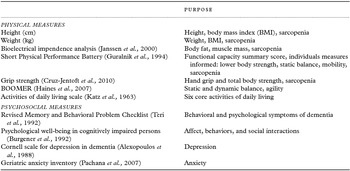
Physical and functional performance, behavioral and psychological data were collected for each participant at their facility before and after the 12-week study period. Data were collected using the same team and equipment at each facility by degree qualified health workers using tools validated for use among older adults with dementia. Facility records were consulted to provide demographic and cognitive impairment information. Data collected included date of birth, ethnic background, level of education, marital status, primary occupation, level of care based on the Australian Age Care Funding Instrument, falls history, length of stay in the facility, medical conditions and medications. Dependent on which tool the facility used, cognitive status was based on either the PAS or the FAST questionnaire. All measures collected by the research team are presented in Table 1.
Summary of measures collected during the study and their purpose

Prior to physical and functional performance assessment, participants were familiarized to the task and offered verbal encouragement and physical support to ensure their safety throughout. Height and weight were measured by stadiometer (Charder Electronic Co, Ltd., Taichung Hesin, Taiwan) and electronic scale (SECA Medical Scales and Measuring Systems, Birmingham, UK), respectively, using standardized methods. Body composition was measured by Bioelectrical Impedance Analysis (BIA) (Maltron 906, Maltron International Ltd., Rayleigh, UK). Participants lay supine during the test. Skeletal muscle mass (SMM) (kg) was calculated from the validated equation:
 $$\begin{eqnarray*}
&&{\rm{SMM}} = {\rm{[((height}}\,\left( {{\rm{c}}{{\rm{m}}^{\rm{2}}}} \right){\rm{/BIA}}\;{\rm{resistance}}\,{\rm{(}}\Omega {\rm{))}}\\
&&\quad \times \,{\rm{0}}{\rm{.401)}}\,{\rm{ + }}\,\left( {{\rm{gender}}\, \times \,{\rm{3}}{\rm{.825}}} \right)\,{\rm{ + }}\,{\rm{(age}}\,\left( {{\rm{years}}} \right)\\
&&\quad \times {\rm{ - 0}}{\rm{.071)]}}\,{\rm{ + }}\,{\rm{5}}{\rm{.102}}\,{\rm{(Janssen}}\,et{\rm{ }}\,al.,\,{\rm{2000}}).
\end{eqnarray*}$$
Then divided by the individual's height squared to calculate the skeletal muscle index (SMI) (kg/m2) (Cruz-Jentoft et al., Reference Cruz-Jentoft2010).
The Jamar dynamometer (Sammons Preston Roylan, Bolingbrook, USA) was used to measure hand grip muscle strength (kg). Participants were instructed to squeeze the dynamometer as hard as they could while seated, keeping their elbow at their side and flexed at 90° (Cruz-Jentoft et al., Reference Cruz-Jentoft2010). Both hands were measured.
Two standardized physical performance batteries were used to measure performance-related balance and functional capacity. The Balance Outcome Measure for Elder Rehabilitation (BOOMER) uses a step test (number of steps), timed up and go (TUG) (sec), functional reach (cm) and static standing test (sec) to measure agility, dynamic, and static balance (Haines et al., Reference Haines, Kuys, Morrison, Clarke, Bew and Mcphail2007). The Short Physical Performance Battery (SPPB) uses a standing balance (sec), 2.4-m walk (m/sec) and repeated chair rise test (sec) to assess functional well-being and mobility among older adults (Guralnik et al., Reference Guralnik1994). Each test can be analyzed separately or combined to provide an overall summary score, ranging from poor performance to high performance (0–12, respectively). Measures were collected in triplicate and the best outcome was used in analyses. Competency to complete measures was assessed on a case-by-case basis. Specifically, when an individual was unable to complete a measure or performed the measure with significant variation from the protocol, they were given opportunity for two more attempts before that measure was terminated and skipped. For the Repeated Chair Stand and TUG participants were consistently reminded of the protocol, but the larger percentage failed to perform the task as requested. Data for these measures have been included and coupled with data outlining the variation from the protocol.
In this cohort test–retest Interclass Correlations Coefficients (ICC) established by our group previously are anthropometric measures ≥ 0.925; grip strength ≥ 0.956; the BOOMER: step test 0.797, TUG 0.940, functional reach 0.586, and static standing 0.905; and the SPPB: standing balance 0.394, 2.4-m walk 0.719, and repeated chair rise 0.548.
Sarcopenic status was assessed according to the European Working Group on Sarcopenia in Older People (EWGSOP). A diagnosis of sarcopenia requires the presence of both low muscle mass and low muscle function (muscle strength or physical performance). In this study, (a) muscle mass was by SMI, (b) muscle strength by hand grip strength, and (c) physical performance by 2.4 m habitual walking speed. The cut-off point to define low muscle mass are ≥ 2 standard deviations below the norm of a young healthy population, low muscle strength > 30 and > 20 kg for men and women, respectively, and low muscle performance as a gait speed of > 0.8 m/sec (Cruz-Jentoft et al., Reference Cruz-Jentoft2010).
Ability to perform activities of daily living was assessed with the Activities of Daily Living Scale (Katz et al., Reference Katz, Ford, Moskowitz, Jackson and Jaffe1963). In brief, staff reported on the participant's ability to perform six activities; bathing, dressing, toileting, transferring, continence, and feeding, with each activity scored as “0” = can be performed independently, “1” = needs some assistance, or “2” = needs total assistance or cannot do the activity. Frequency of behavioral and psychological symptoms of dementia (BPSD) and reaction of staff to BPSD was recorded using the Revised Memory and Behavioural Problem Checklist (RMBPC) (Teri et al., Reference Teri, Truax, Logsdon, Uomoto, Zarit and Vitaliano1992). Changes in affect, behavior, and social interaction were measured with the 11 items Psychological Well-Being in Cognitively Impaired Persons (Burgener et al., Reference Burgener, Jirovec, Murrell and Barton1992). The 19-item Cornell Scale for Depression in Dementia (Alexopoulos et al., Reference Alexopoulos, Abrams, Young and Shamoian1988) was used to rate signs and symptoms of major depression, and anxiety was measured using the 20-item Geriatric Anxiety Inventory (Pachana et al., Reference Pachana, Byrne, Siddle, Koloski, Harley and Arnold2007). For all questionnaire tools, a high numerical outcome was indicative of a negative result.
Statistical analysis
Data were analyzed using IBM SPSS Statistics Version 21 (IBM Corporation, New York, USA). Descriptive and frequency analysis were conducted dependent on the variable status, continuous or categorical. Between group analysis was by independent sample t-test for continuous data and Pearson's Chi-squared test (χ 2) for categorical data at baseline. Post-intervention cohort analysis was by repeated measures analysis of covariance (ANCOVA) adjusted for baseline differences (Age, % body fat, SPPB summary score and TUG). For small sample or non-parametric repeated measure outcomes, the Wilcoxon Signed Rank Test (for pre–post comparisons) was used. Percent change was calculated on individual data, effect size was calculated from the Wilcoxon test statistic and the strength assumption based on Cohen interpretation (Cohen, Reference Cohen1988). All tests were two-tailed and an α of 0.05 was required for significance.
Results
Participants
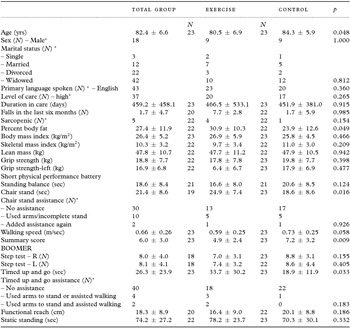
Ten participants were lost to follow-up, but no difference found between completer and non-completers. The final group (N = 46) were 82.4 ± 6.6 years of age with a BMI of 26.4 ± 5.2 kg/m2 and body fat of 27.4 ± 11.9%. Participants had been in residential aged care for 459.2 ± 458.2 days (Range 0–2079 days), and presented with below normal physical performance and muscle strength (walking speed 0.66 ± 0.25 m/sec; SPPB summary score 6.0 ± 3.0; muscle strength 18.8 ± 7.7 kg). Five of the group were sarcopenic. However, 37 and 34 individuals had below normal muscle strength and physical performance, respectively. At baseline, the exercise group (N = 23) were younger, had a high percent body fat, were slower in completing the TUG and the repeated chair stands task, and had a lower SPPB summary score (p ≤ 0.048). Cohort and group characteristics at baseline are presented in Table 2. The exercise group attended 63.2% ± 26.8% of all sessions, with greater attendance from Brisbane (87.5% ± 12.8%) than from Toowoomba (44.6% ± 18.1%) (χ 2 = 20.287, df = 13, p = 0.088).
Baseline group and between group characteristic, anthropometric, muscle strength, and physical performance data

Abbreviations: yrs – years; N – number; kg/m2 – kilogram/meter2; kg – kilograms; sec – seconds; cm – centimeters.
Values are mean ± standard deviation.
p – Exercise versus control by independent t-test, except variables denoted with a * which are by Pearson's chi-squared test.
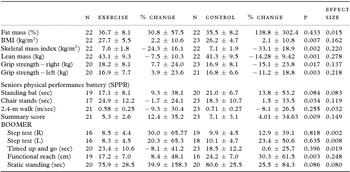
Post-intervention analysis revealed a significant Group × Time interaction for BMI, SMI, and lean mass (p ≤ 0.007). Within-group investigations revealed a decrease in SMI and lean mass for both groups (p < 0.001), but no statistical change in BMI. Grip strength achieved a Group × Time interaction (p ≤ 0.017), influenced by the significant within-group decrease among the control group (p ≤ 0.026). For measures of physical performance and balance, a significant Group × Time interaction was found for the SPPB summary score, chair stand, and functional reach task (p ≤ 0.034). However, a within-group analysis revealed no static difference in post-intervention scores. All post-intervention data are presented in Table 3. Sarcopenia prevalence increased in both groups. Specifically, at baseline, the exercise and control groups had four and one participant, respectively with a diagnosis of sarcopenia. In contrast, at follow-up frequency data revealed in the exercise group six participant had a diagnosis of sarcopenia (p = 0.038), while the control group increased substantially with nine diagnoses (p = 0.002) (χ 2 = 10.800, df = 2, p = 0.005).
Post-intervention anthropometric, physical, and functional performance measures and change in adults with dementia living in residential aged care facilities

Data are by analysis of covariance adjusted for age and the SPPB Summary score.
Abbreviations: yrs – years; N – number; kg/m2 – kilogram/meter2; kg – kilograms; sec – seconds; cm – centimeters
Values are mean ± standard deviation.
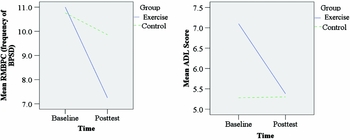
In relation to the behavioral and psychological measures, RMBPC between group analysis revealed baseline to post change approached significance (p = 0.06; effect size 0.07) (exercise group −3.8 ± 4.8 vs. usual care −0.9 ± 5.8). Similarly, for activities of daily living baseline to post change between group analysis approached significance (p = 0.06; effect size 0.07). These data are presented in Figure 1. Positive but non-significant trends were observed for staff reaction to BPSD, psychological well-being, anxiety, and depression (p > 0.05).
Revised Memory Behavioral Problems Checklist (RMBPC) and activities of daily living (ADL) pre to post-intervention scores for the exercise and control group.

Discussion
Results from this study support the benefits of participation in the Watermemories Swimming Club when compared to usual care for residential aged care adults with advanced dementia. Exercise participation reduced the transition into sarcopenia, and, while not significant, did lead to positive trends for balance, physical performance (as measured by the SPPB Summary Score), and grip strength. In addition, with exercise participants experienced positive trends across BSPD's, activities of daily living, psychological well-being, anxiety, and depression, as well as staff burden to BSPD's being reduced. Given that a diagnosis of dementia contributes to increased costs of care, distress and burden for carers, and severe disruption of social networks and institutional environments (Dewing, Reference Dewing2010; Miranda-Castillo et al., Reference Miranda-Castillo, Woods and Orrell2010), and that the prevalence and progression of dementia poses a significant problem for healthcare expenditure and utilization (Goss, Reference Goss2008), these outcomes are positive in contrast to the current models of care. Nevertheless, a number of barrier encountered in the delivery of this study suggest there is significant work to do before exercise participation becomes more available to the institutionalized dementia population.
Benefits of participation
When compared to the usual care controls, participant in the Watermemories Swimming Club experienced gains in a number of variables linked to capacity in activities of daily living. While it is disappointing there was not a greater demonstration of statistical significance, this is not uncommon in this setting or among this cohort. Littbrand et al. (Reference Littbrand, Stenvall and Rosendahl2011) reported only three of eight studies returned significant between group difference post exercise, and were unable themselves to show significant between groups following three months of high-intensity, supported exercise. This lack of change might be related to a number of factors including inter-cohort performance variability and attendance, as well as the significant delivery challenges encountered in undertaking this type of research. These difficulties were echoed by Brett et al. (Reference Brett, Traynor and Stapley2016) in their recent systematic review of the value of exercise among dementia residents in the aged care setting, who concluded that where evidence was positive, methodological rigor needed improving, and a number of barriers needed to be overcome.
These challenges aside, as both a preventative and treatment participation in physical activity and exercise regimes is building a strong reputation as an intervention of value for people with dementia (Barnes et al., Reference Barnes, Whitmer and Yaffe2007, Neville et al., Reference Neville, Clifton, Henwood, Beattie and Mckenzie2013). In support, Alzheimer's Australia New South Wales have most recently released a discussion paper encouraging adults with any level of dementia to become involved (Alzheimer's Australia NSW, 2014). Within this document, significance evidence is presented alongside numerous personal testimonials about the importance and breath of benefit from involvement. From our group, pilot work showed physical benefit coupled with psychological benefit from the Watermemories Swimming Club program (Neville et al., Reference Neville, Henwood, Beattie and Fielding2014; Henwood et al., Reference Henwood, Baguley and Neville2015b). The current study further supports the value of exercise participation as having psychosocial benefits (Teri et al., Reference Teri2003; Williams and Tappen, Reference Williams and Tappen2007). Given the side-effects of psychotropic medications, exercise to treat the behavior and agitation symptoms common with dementia would appear a significantly more desirable alternative (Thune-Boyle et al., Reference Thune-Boyle, Lliffe, Cerga-Pashoja, Lowery and Warner2012). In contrast, the implication of participation to physical well-being are more mixed, with some studies reporting the potential for gains becoming smaller with the increasing progression of the disease (Heyn et al., Reference Heyn, Abreu and Ottenbacher2004; Conradsson et al., Reference Conradsson, Littbrand, Bostrom, Lindelof, Gustafson and Rosendahl2013). Nevertheless, our study support that something is better than nothing for a cohort known to experience an accelerated downturn in well-being, with exercise participants leading to some small gains and a greater resistance to other physical losses such as the muscle mass (Hancock et al., Reference Hancock, Woods, Challis and Orrell2006). For the control group, the loss of muscle mass and grip strength was the driver of the large change in sarcopenia prevalence, which is suggestive of an increased risk of mortality, depression, and increasing disability (Cruz-Jentoft et al., Reference Cruz-Jentoft2010). While small, the benefits of participation were treasured by our Brisbane facility who self-funded an on-going delivery of the program after the study had finished and were awarded an Australian Government Aged Care Best Practice Award based on a reduction in the group's falls and emotional disturbances, and increase in positive interactions (Australian Government, 2014).
Barriers to delivery
The challenge of research delivery in the aged care setting has been widely acknowledged, with individual and review publications raising sampling issues that include recruitment, drop-out, and attendance (Ouslander et al., Reference Ouslander2011; Tilden et al., Reference Tilden, Thompson, Gajewski, Buescher and Bott2013). The list of challenges is complicated further when the participants have moderate to severe dementia (Littbrand et al., Reference Littbrand, Stenvall and Rosendahl2011; Burge et al., Reference Burge, Kuhne, Berchtold, Maupetit and Von2012). Facility recruitment proved a significant challenge to this project with 24 facilities within a 30-km distance of the delivery site approached, and only one agreeing to participate. This demonstrates that even with the program's reputation and proven benefit, and a commitment of financial support, under-resourcing, and under-staffing, a product of financial strain in the sector, are a significant preventative to participation (Tilden et al., Reference Tilden, Thompson, Gajewski, Buescher and Bott2013). These barriers were most pertinent among the not-for-profit facilities and were echoed by the ethics committees of the organizations approached (Henwood et al., Reference Henwood, Baguley and Neville2015a).
A further barrier to participants directly benefiting was the disparity between attendances. While our other facilities did not demonstrate a high level of investment, our Brisbane facility were proactive about preparing and delivering participants to the pool, and supported staff helping with the project. In turn, Brisbane had almost double the attendance rate (87.5% ± 12.8% vs. 44.6% ± 18.1%, respectively), which, as a product of dose related gains, may have increased the benefits of participants from this facility and therefore, their willingness to continue with the program. Definitely, personal testimonials from this facility spoke to the better behavior and well-being of participating clients.
Limitations
The challenges associated with recruitment in this setting and cohort are not uncommon; however, they do imply more work is needed to be conclusive about the value of the Watermemories Swimming Club for this population. Worth considering is that in this setting, structured exercise programs are resources and staff demanding, and this demand is leading to a lack of engagement, despite the benefits to residents. The implications of this are far reaching, and will potentially lead to bias and unrepresentative research work (Henwood et al., Reference Henwood, Baguley and Neville2015a). A further consideration for the current study was the reductions in skeletal muscle and lean mass in the presence of regular exercise. While more often positive gains are found (Fiatarone et al., Reference Fiatarone, Marks, Ryan, Meredith, Lipsitz and Evans1990), previous work has shown that nutritional insufficient in the presence of exercise can reduce muscle growth (Fiatarone et al., Reference Fiatarone1994). Diet was not controlled for in the present study.
Conclusion
Physical inactivity is a significant issue with deleterious health impacts for older adults with dementia (Scherder et al., Reference Scherder, Bogen, Eggermont, Hamers and Swaab2010). Our study shows participation in the Watermemories Swimming Club program brings a number of positive physical and psychosocial benefits. While many of the benefits occurred as positive trends, in contrast to an accelerating decline in health, our program is a valuable alternative to usual care. In addition, this study also reiterates the difficulties of doing research in the setting and among this population. We identified facility resources and engagement are among the greatest challenge in successful delivery, but that these can be overcome when the facilities and their staff are invested in the well-being of the resident even if the program in question is delivered off-site. As a practical learning of this investigation, we are adamant the incorporation of structured exercise programs into daily activities for this older vulnerable population is a better practice alternative than the current model of care, but for programs to succeed aged care providers need to embrace the opportunity and support their staff and residents in participation.
Conflict of interest
None.
Description of authors’ roles
Timothy Henwood and Christine Neville formulated the research question, designed and carried out the study, and proofed the paper. Chantelle Baguley was the research assistant on the project, and lead recruitment and coordinated trainings and assessment. Elizabeth Beattie assisted with the design of the study and proofed the paper.
Acknowledgments
The research was funded by an Alzheimer's Australia Dementia Research Foundation Project Grants. The trial was registered on the Australian New Zealand Clinical Trials Registry (ANZCTR): 12613000503729. The authors acknowledge the support of the residents, staff, families, and volunteers of Bupa Aged Care, Freedom Aged Care, and St Vincent's Health Services aged care facility Lourdes. In addition, we would like to acknowledge Alzheimer's Australia for their research support.