1 Introduction
Despite universal entitlements to the public hospital system, approximately half of the Irish population is covered by voluntary private health insurance. The market operates on the basis of community rating, whereby people pay the same premium for the same plan irrespective of the risk they represent to an insurer. Alongside this policy, open enrolment and lifetime cover also apply, ensuring that anyone who applies for health insurance must be accepted and insurers must renew cover.
In order to support community rating, the Irish government brought forward a risk equalisation scheme in 2003. This scheme was challenged in the Irish courts on numerous grounds, one of which was that community rating as defined in the legislation only referred to community rating within plans and not community rating across the health insurance market. The Irish Supreme Court set aside the risk equalisation scheme in 2008, on the basis of the interpretation of community rating in the legislation.
This raises questions about the application of community rating in the Irish private health insurance market, which may in turn have implications for the design of community rating in other markets.
This paper examines whether community rating can effectively operate in the absence of risk equalisation, with a particular application to the Irish market. Section 2 provides a background to the market, outlines the controversy that surrounded risk equalisation and examines the legal challenges thereto and the focus on the definition of community rating. Section 3 discusses the principle of community rating and its application in the Irish health insurance market, while Section 4 discusses the findings of the paper and policy implications.
2 The legal and policy context
2.1 Legislative foundation
The Irish private health insurance market was established with the passing of the Voluntary Health Insurance Act, 1957. This Act set up the Voluntary Health Insurance Board (VHI) as a not-for-profit, State-backed monopoly provider of voluntary health insurance. Initially, this was designed to give the top 15% of earners, who at that time were not entitled to free access to public hospitals, a means of covering their hospital expenses. However, since then access entitlements have been widened and now all Irish residents are entitled to treatment and accommodation in public hospitals either for free or subject to a modest copayment. Therefore, private health insurance in Ireland mostly provides supplementary cover (access to private hospitals, semi-private or private accommodation and faster access), although it also provides some complementary cover for primary care.Footnote 1
The market was opened up to competition following the passing of the European Third Non-Life Insurance Directive in 1992, which was reflected in the Health Insurance Act, 1994 (the 1994 Act) in Ireland.
In 1997, BUPA Ireland (a branch of the British United Provident Association) began selling health insurance in Ireland, and in 2004 VIVAS Health was established. Following takeover activity, these insurers are now trading as Quinn Healthcare and AVIVA, respectively. Having had a monopoly for 40 years, VHI (now trading as Vhi Healthcare) retains a majority of the market, although its market share has been eroded since the advent of competition. Recent survey evidence [Health Insurance Authority (HIA), 2010a] suggests that VHI has 60% market share, Quinn Healthcare 25% and AVIVA 13%, with the remaining 2% accounted for by restricted membership undertakings. These are relatively small undertakings providing health insurance for members of occupational or vocational schemes.
The 1994 Act, and associated regulations brought forward in 1996, gave legislative foundation to a number of principles that VHI had already been operating on a de facto basis. In particular, these instruments enshrined in legislation what have become known as the three ‘pillars’ of the Irish private health insurance market – community rating, open enrolment and lifetime cover.
Community rating in the Irish context means that insurers are not permitted to vary premiums or benefits between individuals on the same health insurance contract, subject to some exceptions.Footnote 2 Open enrolment means that insurers must accept any applicant,Footnote 3, Footnote 4 although they may impose age-related maximum waiting periods. Three types of waiting periods are permitted – an initial waiting period (for a first-time applicant or an applicant who has had a break in cover of 13 weeks or more), one for pre-existing conditions and one for upgrades in cover. Lifetime cover means that insurers may not refuse to renew cover for any insured person.Footnote 5 In addition to these measures, regulations were brought forward in 1996 specifying a set of minimum benefits that any eligible health insurance contract must provide.
Regulations were also introduced in 1996 specifying a risk equalisation scheme to operate between insurers. The aim of risk equalisation is to “equitably neutralise differences in insurers’ claim costs that arise due to variations in the health status of their members” (HIA, 2010b: 8). This is achieved by transfers of money from insurers with relatively low-risk membership profiles to insurers with relatively high-risk membership profiles. These regulations were revoked in 1999 during a period of consultation on the future of private health insurance, which led to the publication of a government White Paper in 1999 (Department of Health and Children, 1999).
Following on from this White Paper, the Health Insurance (Amendment) Act, 2001 (the 2001 Act) was passed. Among other provisions, this Act allowed for the Minister for Health and Children to introduce regulations specifying a new risk equalisation scheme. These were later introduced in 2003. It also made provisions for the establishment of HIA, an independent statutory body to regulate the private health insurance industry in Ireland, which was established on 1 February 2001.
2.2 Risk equalisation as a source of controversy
Risk equalisation has been one of the main sources of controversy in the Irish private health insurance market since the introduction of competition in the 1990s. Although a risk equalisation scheme was in place when it entered the market, BUPA Ireland opposed it on the basis that it would have to transfer money to the State-backed dominant insurer. Monetary transfers under the 1996 scheme were not made by the time its enabling regulations were revoked in 1999.
The 2001 Act and the Risk Equalisation Scheme, 2003, made provision for monetary transfers to take place between insurers and a risk equalisation fund, to be administered by the HIA. Claim costs would be equalised up to a given level, known as equalised benefits, which broadly equated to the level of cover provided by the most popular plans in the market.
Following a recommendation from the HIA, the Minister decided to commence payments under this scheme from 1 January 2006. BUPA Ireland immediately challenged the scheme in the Irish courts and a stay was put on payments under the scheme. It had already made a complaint to the European Commission that the scheme constituted illegal State aid, but the Commission ruled in 2003 that it did not. BUPA Ireland took the Commission to the European Court of First Instance, but in 2008 this Court dismissed BUPA Ireland's challenge to the Commission's decision.
In a High Court ruling in November 2006, BUPA Ireland's challenge was dismissed, but BUPA Ireland appealed this to the Supreme Court. It also announced in December 2006 that it was withdrawing from the market and its business was taken over in April 2007 by Quinn Insurance, which already operated in other non-life insurance markets in Ireland. In July 2008, the Supreme Court overturned the High Court decision and set aside the Risk Equalisation Scheme, 2003. Its decision was taken on the basis of the definition of community rating in the 1994 Act, as amended.
2.3 Community rating in the Irish context
These cases in the Irish courts have highlighted the importance of the definition of community rating in Irish legislation. One of the grounds for BUPA Ireland's injunction against the Risk Equalisation Scheme, 2003, was that its promulgation was ultra vires (beyond the powers of) the Minister, as community rating was operating in the market as prescribed by the Health Insurance Act, 1994, as amended.
At the time of the Supreme Court decision, Section 7 of the 1994 Act, as amended, specified that insurers may not vary premiums or benefits among people on the same health insurance contract. It went on to state “A health insurance contract that complies with [the conditions outlined in an earlier paragraph within that Section] shall be known as a community rated health insurance contract and ‘community rating’ shall be construed accordingly”.
The Risk Equalisation Scheme, 2003, was brought forward under the terms of Section 12 of the 1994 Act, as amended. This Section noted that, in forming its decision on whether to recommend to the Minister to trigger payments, the HIA needed to take into account “the best overall interests of health insurance consumers” and it went on to note that this “includes a reference to the need to maintain the application of community rating across the market for health insurance and to facilitate competition between undertakings” (emphasis added).
BUPA Ireland argued that the only valid definition of community rating was that contained in Section 7, which defined community rating within plans, and that therefore the Section 12 definition was invalid, which would invalidate the entire scheme.
The High Court judge noted that the definition of community rating was central to the case. He ruled that the Section 12 definition was reasonable, and that the Risk Equalisation Scheme, 2003, was not invalid as a result.
On appeal, the Supreme Court agreed that the definition of community rating was central to the case, but decided that the Section 12 definition could not be construed so differently from the Section 7 definition. The Chief Justice suggested that, if the Oireachtas (parliament) had wanted such a different interpretation to be given to the Section 12 definition then it would have made that clear. Therefore, it was the Supreme Court's view that Section 12 could only be interpreted as referring to the maintenance of community rated plans across the market.
On this basis, the Court ruled that the Risk Equalisation Scheme, 2003, as adopted by the Minister, “was founded on an erroneous interpretation of subsection 10(iii) in s. 12. That is to say the scheme was introduced on the basis that community rating meant community rating across the entire insured population and not as defined in the Act”. The Court therefore determined that the introduction of the 2003 scheme was ultra vires the Minister, and it should be set aside.
The Health Insurance (Miscellaneous Provisions) Act, 2009, further amended the definition of community rating in the 1994 Act, reflecting the issues highlighted in the Supreme Court judgment. In particular, the 2009 Act specifies “The principal objective of the Minister and the [Health Insurance] Authority in performing their respective functions under this Act is to ensure, in the interests of the common good, that access to health insurance cover is available to consumers of health services with no differentiation made between them…in particular as regards the costs of health services, based in whole or in part on the respective age range and general health status of the members of any particular generation (or part thereof)…”. This Act also amends the 1994 Act by entering a new definition of community rating in the latter, as well as defining a community rated health insurance contract as being one which complies with Section 7(1) of the 1994 Act (similar to the previous definition as discussed above). The definition of community rating in the 2009 Act is “measures which, whether in whole or in part, apply towards the achievement of the principal objective…[as outlined above]…”.
It should be noted that this definition of community rating (which views community rating as a tool to achieve equal premiums across consumers, rather than a goal in itself – see Van de Ven, Reference Van de Ven2010 for a discussion of this) could encompass risk-adjusted premium subsidies, which would be an alternative tool to community rating in achieving the principal objective (Van de Ven et al., Reference Van de Ven, van Vliet, Schut and Van Barneveld2000). It is also worth noting that the interim measures, which consist of a community rating levy and additional tax relief at source for older consumers, and which are discussed in more detail in Section 4, could be considered an example of risk-adjusted premium subsidies.
Following the setting aside of the Risk Equalisation Scheme, 2003, by the Supreme Court, concern was expressed that community rating could be undermined by market segmentation. It is therefore instructive to examine whether community rating can survive in a multiple-insurer market without risk equalisation.
3 Community rating in practice
3.1 General principle
The basic principle behind community rating is that high-risk insured lives pay the same as low-risk insured lives. If there is only one insurer in the market, practicing community rating, then inherently community rating applies across the market. However, if multiple insurers are operating in the market, each operating community rating its own members, community rating will apply across the market only if each insurer has the same proportion of high risk and low risks as the market average.
If risk profiles differ between insurers, and insurers charge premiums based on expected claim costs, then premiums will differ between insurers, leading to a situation where high-risk policyholders pay, on average, higher premiums than low-risk policyholders, thereby undermining community rating. This makes intuitive sense, but Turner and Shinnick (Reference Turner and Shinnick2012) present a model for readers who may be interested in the mechanics of this.
This model is a static one, which shows that community rating breaks down in the event of different risk profiles between insurers. However, of more practical interest is what would happen in a dynamic scenario.
In this regard, it makes intuitive sense that, if one insurer's premium is higher than that of the other insurer, some people will switch insurers to avail of the lower premium. Empirical evidence from other markets suggests that those who switch are more likely to be low risk consumers, who perceive their premiums with their former insurer to be too high.
If this were to happen, then it would magnify the difference between the risk profiles of the insurers. This in turn will magnify the difference between the insurers’ premiums and thus between the average premiums paid by high-risk and low-risk policyholders. The widening difference between the insurers’ premiums will cause further switching, which in turn will widen the gap between risk profiles, and so on. This is the classic situation known as an adverse selection death spiral (see, e.g. Altman et al., Reference Altman, Cutler and Zeckhauser1998).
This has been borne out in the Irish private health insurance market, where the level of switching has been relatively low, but where younger consumers have been found to be more likely than older consumers to have switched or to have seriously considered switching (HIA, 2003).
3.2 Application to the Irish market
This theory can be examined in the context of Ireland's private health insurance market, which, prior to the entry of BUPA Ireland, comprised a monopoly provider (VHI). It is not unreasonable to suggest that, under monopoly conditions, community rating was in operation, at least at each level of cover if not across the market.Footnote 6 After the entry of BUPA Ireland to the market, community rating across the market was not operating, as neither of the risk equalisation schemes (the first of which operated from 1996–1999 and the second of which was on the statute books from 2003–2008) has resulted in monetary transfers between insurers. However, if multiple insurers are operating in the market, each operating community rating among its own members, community rating will apply across the market only if each insurer has the same proportion of high risk and low risk lives as the market average.
This is similar to the situation outlined above, with the slight difference that, instead of a number of insurers operating community rating within their insured populations, the Irish case takes the form of a number of health insurance plans offered by competing insurers, each of which operates on a community rated basis, but without risk equalisation. There may be some informal risk adjustment between plans offered by the same insurer but there is no risk equalisation operating between insurers.
In this situation, it can be seen that, in the absence of some form of risk adjustment, although each plan in the market is community rated, community rating will not operate across the market. The result of this is that high-risk insured lives end up paying, on average, higher premiums than low-risk insured lives.
Since the setting aside of the Risk Equalisation Scheme, 2003, the only way that community rating could operate across the market for health insurance in Ireland is if each plan available in the market had exactly the same risk profile as the market average. This is theoretically possible, but highly unlikely.
In practice, it has already been confirmed that insurers operating in the market have different risk profiles. Under the Risk Equalisation Scheme, 2003, if a measure called the Market Equalisation Percentage (MEP), which is equal to the amount of monetary transfers under risk equalisation expressed as a percentage of the claims paid in the market subject to risk equalisation, were below 2%, no transfers would be made. If the MEP were between 2% and 10%, the HIA would be required to make a recommendation to the Minister on whether or not payments should be triggered, while if it were above 10% then the Minister would commence payments, unless, having consulted with the HIA the Minister felt that the commencement of risk equalisation payments would not be in the best overall interests of health insurance consumers (HIA, 2008a).
For each of the six-monthly periods from 1 July–31 December 2003 to 1 January–30 June 2005, the MEP was found to lie between 2% and 10% (HIA, 2005). If each plan had the same risk profile as the market average, then each insurer would, by definition, have the same risk profile as the market average, and the MEP would be equal to zero. Since this was not the case, it can be concluded that risk profile differences were evident and that therefore community rating was not operating across the market.
It is also worthwhile examining whether the presence of mandatory community rating without risk equalisation has led to any evidence of market failures in the Irish market.
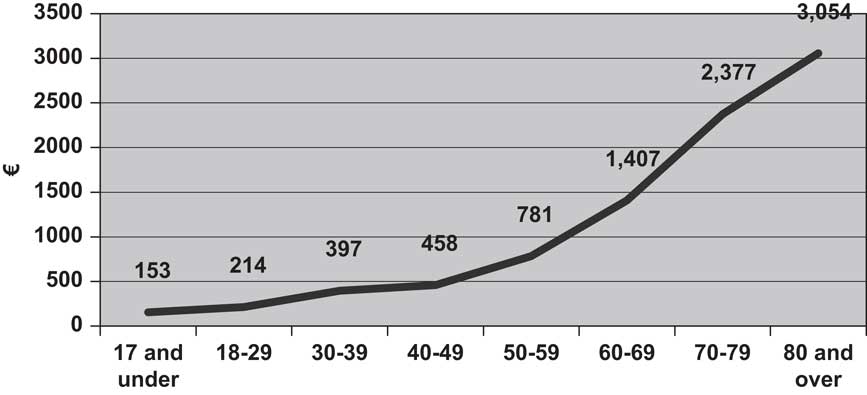
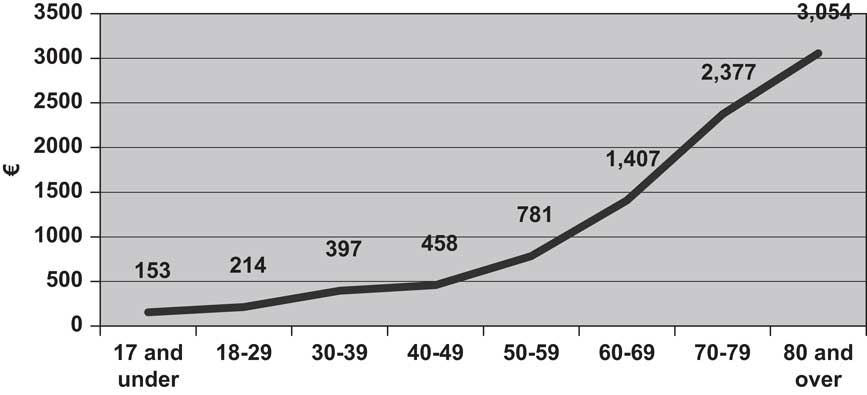
Although community rating and open enrolment reduce the opportunity for insurers to engage in risk selection, they increase the incentives for such behaviour, as insurers receive the same premium for high-risk lives as for low-risk lives, but the claim costs for the latter are significantly lower. This is borne out by data from the HIA (2011), which can be seen in Figure 1.
Claims cost per insured person, 2010. Source: HIA (2011).
Using data from 2003 and 2005, Turner and Shinnick (Reference Turner and Shinnick2008) found some evidence of risk selection in the Irish market, manifested as plans offered by BUPA Ireland having younger age profiles than plans offering similar levels of cover offered by VHI.
The Supreme Court judgment increases the possibility of risk segmentation, which would be detrimental to community rating in the Irish market. This problem was alluded to by the Minister when introducing the interim measures discussed in Section 4. Thomson and Mossialos (Reference Thomson and Mossialos2007) note that a large number of heterogeneous plans could potentially lead to confusion among consumers, mitigating the benefits of competition.
It would appear that market segmentation is also becoming a more significant problem in the Irish market. HIA (2008b) notes that the number of products available in the market stood at five in 1996, 18 in 2003 and over 100 by 2008. Since then the number of available products has doubled to around 200, with many of these plans targeted at consumers at different life stages and others targeted to corporate group schemes rather than to individuals (even though individuals are entitled to purchase any plan under open enrolment). More recently, the HIA noted, “Community rating came under increased strain after the Risk Equalisation Scheme was set aside in 2008. There was a significant increase in the number of lower cost health insurance plans that are not publicised by insurers. Instead these plans are sold directly to lower risk corporate groups. As a consequence, there has been further segmentation of the health insurance population by risk. Approximately half of the insured population now has a health insurance product that few older people have purchased” (HIA, 2010b: 2).
Risk selection and market segmentation can both lead to insurers making profits on the basis of a more favourable risk profile or on the basis of separating out the high-risk and low-risk lives into different plans and reflecting the relative risk profiles in the premiums charged for those plans. This could potentially lead to less intensive price competition than in a market where insurers could not make profits on the basis of risk profile.
Analysis carried out in HIA (2005) showed that, from the time BUPA Ireland entered the market until the then most recent round of price increases, both BUPA Ireland and VHI had increased prices eight times, with the total price increase being 98% in each case. An earlier report, by the York Health Economics Consortium (YHEC, 2003) showed a high degree of correlation between both insurers’ premium increases and concluded that the two insurers were “not participating in a price war” (YHEC, 2003: 33). Hence, while it would be expected that risk selection and a higher rate of switching among younger consumers would tend to widen risk differentials, and therefore premium differences, between insurers over time, the evidence of this could be masked by price following behaviour.
If risk selection and/or market segmentation allow insurers to achieve a favourable risk profile, then it is possible that an inefficient insurer could remain in the market, relying on risk profile rather than efficiencies to make profits. YHEC (2003) notes that competition based on the ability to attract a favourable risk profile (which it suggests would occur naturally for new entrants) is socially undesirable.
The issue of super-normal profits also arises in the context of the Irish private health insurance market. According to HIA (2005), BUPA Ireland stated that it made profits of 17.3% of earned premium in 2004. This was significantly higher than VHI's comparable figure of 0.2% in the year ending February 2005 (VHI, 2009). HIA (2005) goes on to suggest that “BUPA Ireland appears content to follow the price increases of Vhi Healthcare and to continue making very large profits. This is at the ultimate expense of the Irish health insurance consumer” (HIA, 2005: 63).
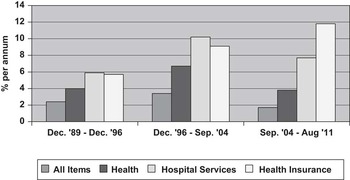
An examination of the Irish case proves interesting in the context of price competition. Figure 2 shows inflation data based on figures from the Central Statistics Office. These figures show that, between December 1989 and December 1996 – the last seven years of VHI's monopoly – health insurance inflation averaged 5.7% per annum, compared with an overall inflation rate of 2.4% per annum and inflation in the Health category of the Consumer Price Index (CPI) of 4.0% per annum. From December 1996 to September 2004 – the period during which VHI and BUPA Ireland had a duopoly – health insurance inflation accelerated to 9.1% per annum, compared with overall inflation of 3.4% per annum and inflation in the Health category of the CPI of 6.7% per annum. Since VIVAS Health entered the market, however, health insurance inflation has averaged 11.8% per annum, over 10 percentage points per annum ahead of overall inflation and eight percentage points per annum ahead of Health inflation.
Inflation in the consumer price index. Source: Central Statistics Office.

Part of the reason for the higher inflation rate in health insurance premiums in recent years was the previous Government's policy of moving towards charging the full economic cost for private beds in public hospitals, which has added to insurers’ costs.Footnote 7 However, Figure 2 shows that the rate of inflation in health insurance since September 2004 has exceeded the rate of inflation in the Hospital Services element of the CPI, the latter of which would reflect these charges for private beds in public hospitals.
It should be noted that the increases in health insurance premiums may reflect not just increases in the price of health care, but perhaps also quantity and quality.Footnote 8 In this context, it is worth pointing out that, for example, VHI (2011) notes that the health care delivered to its members increased by 8% in 2010. It should also be acknowledged that the cover provided under health insurance plans in Ireland has improved since the introduction of competition to the market. However, the increases in premiums would suggest that competition alone may not be sufficient to reduce the cost of health insurance and that, for such cost reductions to occur, reductions in the quantity of treatment delivered and/or limits in the amount of cover offered might be required. This will be of particular relevance in the context of the proposed move to universal health insurance in Ireland in the coming years.
Another measure that is likely to impact on costs in the coming months and years is a proposal announced in the budget in December 2011. Not only was there a proposal in this budget to increase the charges for private beds in public hospitals, but it was also proposed to begin charging insurers if their members are accommodated in public beds in public hospitals. A 2009 report suggested that around half of private patients in public hospitals were treated in either public or non-designated beds, for which insurers are not charged, although consultants treating these patients would be paid by the insurers (Comptroller and Auditor General, 2009). Thus, the proposal to begin charging insurers for the use of public beds would add significantly to claim costs, which would be reflected in increased premiums.
In this context, it is also worth noting that the numbers insured have been falling in recent years. Having peaked at 2.297 million at the end of 2008, the market has contracted by 134,000 people up to the end of 2011 (HIA, 2012). It should be pointed out however, that this represents less than a 6% drop from the peak. Given the scale of the economic slowdown in Ireland during this period, the figures point to significant resilience in demand for private health insurance, although there has been an increase in switching by consumers in order to reduce costs. In particular, this has affected VHI, which has lost 278,000 customers since 2008 (RTE, 2012). Anecdotal evidence suggests that increasing numbers of consumers are also switching plans within insurers in order to reduce costs.
A substantial further premium increase, such as that which would result from the charging for public beds in public hospitals, would likely lead to further numbers of consumers exiting the market. Matters could be further complicated if younger consumers were more likely to drop their cover, which could be the case if adverse selection were evident. According to survey evidence (HIA, 2010a), those aged 18–34 years accounted for a lower proportion of those insured than in the sample as a whole, while those aged 35–64 years accounted for higher proportions of those insured than in the sample as a whole and those aged 65 years and over representing the same proportion of those insured as in the overall sample. Although the profile of those discontinuing cover in recent years is not known, it was noted in HIA (2010a) that younger consumers were more likely than average to be unsure about their future plans for the maintenance of private health insurance.
It can be seen from the above discussion that, while community rating theoretically involves low-risk consumers cross-subsidising high-risk consumers, leading to both sets of consumers paying the same premium for the same cover, in practice this can be undermined – perfectly legally – if insurers have differing risk profiles and there is no risk adjustment mechanism to compensate for these differing profiles. The Irish experience is a case in point in this regard.
4 Discussion and policy implications
Community rating within plans in the Irish context could be described as quite a pure form of community rating. However, it is not, to continue with such terminology, 100% pure, as it allows for exceptions, such as for children aged under 18, dependent students aged 18–23 years and members of group schemes.
A pure form of community rating across the market for health insurance cannot operate in the absence of some form of risk adjustment mechanism.Footnote 9 However, the ‘impurities’ in community rating in Ireland mean that perhaps an ‘impure’ form of risk equalisation might suffice in the Irish context. Indeed, it has been argued that a risk adjustment mechanism need not be perfect, but just sufficient to ensure that the costs to insurers of engaging in risk selection outweigh the benefits (Van de Ven et al., Reference Van de Ven, van Vliet, van Barneveld and Lamers1994; Van de Ven, Reference Van de Ven2010).
An example of a less-than-pure form of risk adjustment is that operated in The Health Insurance Plan of California (The HIPC), as described by Shewry et al. (Reference Shewry, Hunt, Ramey and Bertko1996). Within The HIPC a risk assessment value (RAV) is calculated for each health plan, based on its enrolee mix compared with the overall enrolee mix of The HIPC. The RAV of The HIPC as a whole is always 1.0. Risk adjustment is implemented when at least one health plan has an RAV that is at least 5% above or below that of The HIPC (i.e. below 0.95 or above 1.05) and adjusts until the RAV of the outlier plan returns to within 5% of the RAV of The HIPC. Thus, some limited differences in risk profile are permitted.
Although parliamentary debates in Ireland suggest that there is broad political support for the idea of community rating across the market, it is unclear whether a less than pure form of community rating would be acceptable. However, the Supreme Court ruling on the Risk Equalisation Scheme, 2003, highlights the need to have an accurate definition in legislation of the type of community rating that is desired. In this regard, it is interesting to note the significant change to the definition of community rating contained in the 2009 Act (see Section 2.3).
Following the setting aside of the Risk Equalisation Scheme, 2003, the then Minister announced interim measures to be put in place while work is carried out on a new risk equalisation scheme. According to the Minister, the Government was of the opinion that, in the absence of some method of supporting the cost of health insurance for older consumers, such consumers could face significant increases in prices or reductions in benefits. She went on to state “If that happened, the chances we could ever re-establish a community rated market would have been severely diminished” (Department of Health and Children, 2008).
The interim measures comprise two elements. The first is a levy on health insurers for each person they insure, which has been set for 2012 at €285 for each adult and €95 for each child aged under 18 years (up from €205 and €66, respectively, in 2011). The second element is increased tax relief for older consumers, on a sliding scale (see Table 1). This is in addition to the 20% tax relief available to all purchasers. The 2009 and 2010 figures allowed for increased tax relief for consumers aged 50 years and over, but from 2011 onwards it only applies to consumers aged 60 years and over. The measures are designed to be revenue neutral.
Additional tax relief available under interim measures, 2012

Source: Department of Health.
Since tax relief on health insurance premiums is deductible at source, consumers pay the net premiums and insurers then claim back the tax relief for all of their members from the Revenue Commissioners. The additional tax relief will therefore accrue to the insurer.
The combination of the interim measures means that VHI, with a higher proportion of older members, receives more money in additional tax relief than it pays in the levy, while Quinn Healthcare and AVIVA, with lower proportions of older members, pay more money in the levy than they receive in additional tax relief.Footnote 10
However, it should be noted that the interim measures, since they are based on age only and do not take account of health status or health service utilisation, are not a sophisticated risk adjustment mechanism. Indeed, the Department of Health has acknowledged that the interim measures are designed to allow insurers to be compensated for no more than 65% of the additional costs of insuring older consumers.Footnote 11 Therefore, these measures do not eliminate the incentives for insurers to engage in risk selection. A more sophisticated risk equalisation scheme is anticipated in 2013.
However, the current hiatus might allow a renewed debate on the type, or level, of community rating that is desired in the Irish private health insurance market. In the interim, following the Supreme Court judgment, it is clear that community rating is not operating across the market. Instead, it is only mandated to operate within plans, leading to a situation that could be described as ‘communities rating’ rather than community rating – each plan being a distinct community.
Therefore, while high-risk consumers are paying the same as low-risk consumers for the same plan, on average high-risk consumers may be paying more than low-risk consumers for similar levels of cover as they may be on different plans or with different insurers.
This raises another issue. Given the large number of plans available in the market, with differing levels of cover, is it feasible to operate community rating across the market for health insurance? As well as being conceptually and mathematically difficult to equalise risk across heterogeneous plans, any such attempt can easily be made redundant if plan characteristics change, as they have done in Ireland. An alternative solution would be to have one standardised, community rated plan, providing minimum benefits, to be offered by all insurers as the cheapest plan available. This was suggested by BUPA Ireland (2002) during a consultation process on risk equalisation. Such a standardised plan might form the basis for a future solution to the problem of trying to effectively operate community rating across the market in the presence of multiple insurers offering multiple plans. Van de Ven and Ellis (Reference Van de Ven and Ellis2000) argue that a standardised plan is better than minimum benefits as it provides less opportunity for insurers to engage in market segmentation. It should be noted that a standardised benefits package has also been proposed by Ireland's new Government, elected in 2011 as part of proposals for a universal health insurance model to fund Ireland's health system.
In the meantime, as this paper has demonstrated, community rating within plans is very different from community rating across the market. In this context, the Supreme Court decision to set aside the Risk Equalisation Scheme, 2003, has significant implications for the operation of community rating in the Irish private health insurance market. This has already led to some changes, in the form of interim measures, pending the introduction of a new risk equalisation scheme. This opportunity should now be taken to review how community rating is to operate in the market, as this will have implications for the design of any future risk equalisation scheme. The Irish experience is also relevant for other health systems where community rated health insurance is either operating or being considered and could act as a cautionary tale for anyone considering the design of a community rated health insurance system.
Acknowledgement
The authors gratefully acknowledge the comments of two anonymous referees in the preparation of this article.