Introduction
An estimated 3 million people collect sea cucumbers globally (Purcell et al. Reference Purcell, Mercier, Conand, Hamel, Toral-Granda, Lovatelli and Uthicke2013). Unlike other high-value fisheries, sea cucumber fisheries tend to be decentralized and to rely on both men and women for their extraction, and they are found in almost every marine ecosystem worldwide (Anderson et al. Reference Anderson, Flemming, Watson and Lotze2011, Fröcklin et al. Reference Fröcklin, de la Torre-Castro, Håkansson, Carlsson, Magnusson and Jiddawi2014, Eriksson et al. Reference Eriksson, Conand, Lovatelli, Muthiga and Purcell2015). Sea cucumbers are deposit feeders critical to maintaining the balance of benthic microenvironments, the foundation of a highly productive and healthy marine ecosystem, including coral reefs (Uthicke Reference Uthicke2001, Máñez & Ferse Reference Máñez and Ferse2010). Sea cucumber overfishing has serious impacts on sediment health, water quality, nutrient recycling, seawater chemistry and energy transfers across the food chains in numerous marine systems globally (Lane & Limbong Reference Lane and Limbong2013, Conand Reference Conand2018).
Developing countries make up the majority of sea cucumber exports globally, and sea cucumber fishing in many of these countries is a primary source of income for small-scale fishers (de la Torre-Castro et al. Reference de la Torre-Castro, Ochiewo, Kithakeni Mbaga and Pinault2007, Conand Reference Conand and Toral-Granda2008, Anderson et al. Reference Anderson, Flemming, Watson and Lotze2011, Carleton et al. Reference Carleton, Hambrey, Govan, Medley and Kinch2013, Pakoa & Bertram Reference Pakoa and Bertram2013, Purcell et al. Reference Purcell, Mercier, Conand, Hamel, Toral-Granda, Lovatelli and Uthicke2013). While sea cucumbers have been harvested by many cultures for centuries, overfishing became apparent at the end of the twentieth century, when demand for luxury seafood consumption increased in Asian countries (Fabinyi Reference Fabinyi2012), more people began to participate in sea cucumber fishing across the globe (Máñez & Ferse Reference Máñez and Ferse2010) and the use of highly efficient technologies such as compressor diving and drag-netting spread (Purcell Reference Purcell2010, Eriksson et al. Reference Eriksson, Conand, Lovatelli, Muthiga and Purcell2015). The lucrative nature of sea cucumber fishing has led to near depletion or even local extinction of certain species in numerous regions globally; notable cases include areas in Egypt, Indonesia and Malaysia (Anderson et al. Reference Anderson, Flemming, Watson and Lotze2011). An estimated 38% of the world’s sea cucumber fisheries are deemed ‘overexploited’, 20% ‘depleted’ and another 14% ‘fully exploited’ (Purcell et al. Reference Purcell, Mercier, Conand, Hamel, Toral-Granda, Lovatelli and Uthicke2013). Similarly, the Food and Agriculture Organization of the United Nations (FAO) reported that a total of 81% of sea cucumber fisheries were in decline due to overfishing (Anderson et al. Reference Anderson, Flemming, Watson and Lotze2011). Concern for the sustainability of this lucrative fishery has led to an increase in information sharing and management efforts globally (Purcell Reference Purcell2010).
An estimated 90% of sea cucumbers harvested worldwide are imported and consumed in Southeast Asia and the Far East (Ferdouse Reference Ferdouse2004). The main import markets are traditionally China, Hong Kong Special Administrative Region, Singapore and Taiwan; recently, however, demand has been rising in other Southeast Asian countries and in countries with a large Asian diaspora, such as the USA (Purcell Reference Purcell2010). Currently, one of the larger exporters of sea cucumbers is Indonesia, while other leading exporters include Sri Lanka, Madagascar and Mexico. Prior to 2009, additional major exporting countries included Fiji, Papua New Guinea, Tonga, Tanzania, Philippines and New Caledonia (Anderson et al. Reference Anderson, Flemming, Watson and Lotze2011). The Central West Pacific region is the main exporter of sea cucumbers, with a mean of 7000 tonnes in dry weight exported yearly (Conand, Reference Conand2018). Papua New Guinea, Fiji and the Solomon Islands were previously among the largest exporters of this region; however, landings and exports have declined in these countries since the 1990s, possibly due to overexploitation (Govan Reference Govan2017, Conand Reference Conand2018). New fisheries in surrounding countries are therefore responsible for high landings in the region. Tracing the exact origin of sea cucumbers within the global trade network is difficult. Globally, reported exports are less than half of reported imports (Anderson et al. Reference Anderson, Flemming, Watson and Lotze2011). Lack of consistent and reliable export data makes international trade difficult to accurately quantify (Ferdouse Reference Ferdouse2004). Severe underreporting of fisheries exports is common, but is particularly problematic in developing countries.
Given the array of challenges endemic to this fishery, efforts to better understand and more successfully manage sea cucumbers are proliferating (Toral-Granda et al. Reference Toral-Granda, Lovatelli and Vasconcellos2008, Purcell et al. Reference Purcell, Mercier, Conand, Hamel, Toral-Granda, Lovatelli and Uthicke2013, Conand Reference Conand2018). Here, we build on previous reviews that focus on sea cucumber management strategies globally (Friedman et al. Reference Friedman, Purcell, Bell and Hair2008a, Purcell Reference Purcell2010) and investigate different wild sea cucumber fisheries management strategies specifically for developing countries. We use ‘developing country’ here to mean countries with emerging economies with relatively low gross national incomes per capita and low scores on the United Nations Human Development Index, including nations of Africa, Asia and Latin America. In particular, we highlight underexplored opportunities for sea cucumber managers to focus regulatory solutions on narrowed parts of the value chain, serving as monitoring and enforcement leverage points for other nodes of the value chain. Finding ways to improve regulatory efficiency is particularly important in a developing country context, where financial and human resources are often scarce.
While there is some documented success of sea cucumber management strategies working in industrialized countries such as the USA, Canada and in French-governed territories and departments (Uthicke et al. Reference Uthicke, Welch and Benzie2004, Hamel & Mercier Reference Hamel, Mercier, Toral-Granda, Lovatelli and Vasconcellos2008, Eriksson et al. Reference Eriksson, Conand, Lovatelli, Muthiga and Purcell2015), evidence of successful sea cucumber management in developing countries is scarcer. Sea cucumber fishery management in developing countries presents unique challenges, including the decentralized nature of the sea cucumber production and processing, limited resources and personnel dedicated to marine resource governance and high economic dependency on this lucrative fishery for small-scale fishers (Eriksson et al. Reference Eriksson, Conand, Lovatelli, Muthiga and Purcell2015). In this review, we focus on both management and governance. While management primarily involves operational decisions or the means and actions required to achieve specific fisheries and biodiversity conservation objectives, governance refers to the broader processes through which individuals and institutions make management decisions (Armitage et al. Reference Armitage, de Loë and Plummer2012, Borrini-Feyerabend & Hill Reference Borrini-Feyerabend, Hill, Worboys, Lockwood, Kothari, Feary and Pulsford2015). Some of the governance processes we highlight here include accountability, transparency, representation, inclusiveness, equity, integration and coordination.
Methods
The articles included in this review were identified from September 2017 to November 2018 by three mechanisms: keyword search in Google Scholar, the Pacific Community’s (SPC) Beche-de-Mer Information Bulletin archives (http://coastfish.spc.int/en/publications/bulletins/beche-de-mer) and by reviewing the references of the articles identified from these databases. Combinations of the keywords ‘sea cucumber’ and ‘management’ were used to identify relevant articles. Only articles written in English were included in the review. No constraints were made for the year of article publication; however, newer articles with updated management strategies concerning a particular nation were prioritized over older articles about the same nation. Similarly, articles including information on nations not included in previous reviews were prioritized. A variety of articles were incorporated, including peer-reviewed articles, governmental documents, nongovernmental documents, FAO reports, news articles and notes written in the ‘communication’ section of SPC’s archive.
Results
A total of 93 documents were identified in the initial review, 37 of which were excluded based on duplicate information or inadequate explanation of sea cucumber management strategies used in a particular country. The remaining 56 articles were read with particular attention to the strategies used specifically to manage sea cucumber stocks.
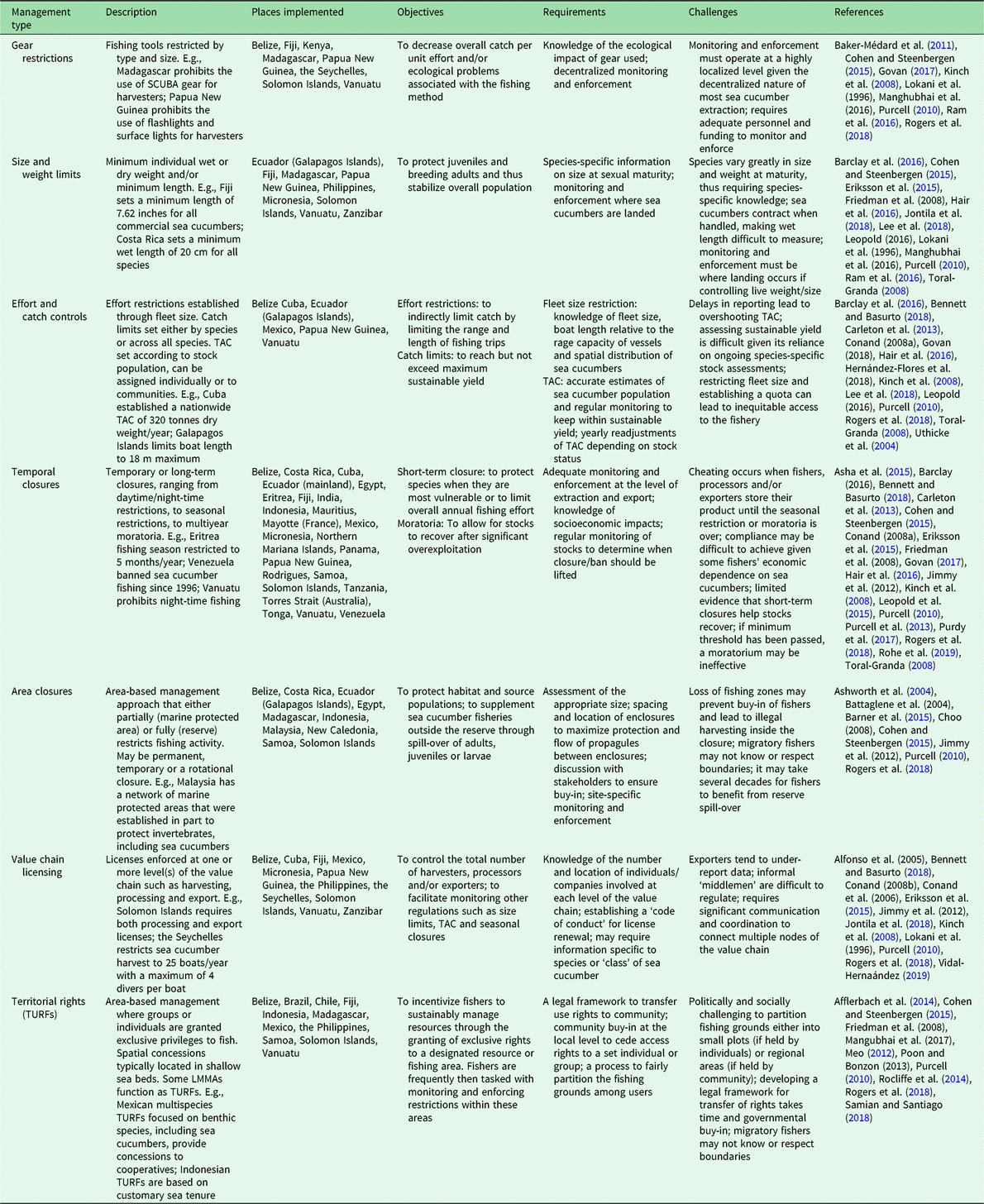
The review uncovered seven categories of sea cucumber management used in developing countries globally. While these categories are not exhaustive, they capture the general categories of wild sea cucumber management, including: gear restrictions; size and weight limits; effort and catch controls; temporal closures; area closures; value chain licensing; and territorial rights assignment. These categories broadly align with those found in previous reviews (Friedman et al. Reference Friedman, Purcell, Bell and Hair2008a, Purcell Reference Purcell2010); however, we de-aggregated territorial use rights in fisheries (TURFs) from other area-based management strategies (e.g., marine protected areas (MPAs)) in order to emphasize the potential for TURFs to align with customary marine tenure regimes. Aquaculture is an increasingly important strategy being used in developing countries and has immense potential to help wild populations recover and maintain production. However, we decided to exclude aquaculture from our review, given that the technical considerations (e.g., habitat suitability, hatchery requirements, finding adequate broodstock) and institutional issues (e.g., land disputes, control and enforcement, technology transfer, marketing) associated with this particular management strategy merit a much deeper analysis than that which we could provide here (see Hair et al. Reference Hair, Pickering and Mills2012 for a comprehensive overview). Furthermore, the development of strategies for managing wild populations is an important concern independent of sea cucumber aquaculture (Purcell et al. Reference Purcell, Mercier, Conand, Hamel, Toral-Granda, Lovatelli and Uthicke2013).
Gear
Most countries where sea cucumber fishing exists employ some kind of gear restrictions. The most common gear restrictions include: underwater breathing apparatuses (UBAs; e.g., hookah, SCUBA gear); dredge nets; and the use of lights (flashlights or torches) at night. Banning UBAs is thought to help protect deeper-dwelling sea cucumber populations and generally to reduce the catch per unit effort of collectors. One example in Kenya shows that gear restrictions, when paired with other methods like small area closures, can increase fisher incomes (McClanahan Reference McClanahan2010). Monitoring and enforcement of gear restrictions, however, are key challenges in numerous developing countries (Purcell Reference Purcell2010). For gear restrictions to be effective, adequate personnel and funding are needed at a highly localized level. For example, in Madagascar, Papua New Guinea and Fiji, UBAs are banned for sea cucumber fishing, yet infractions are very common (Maillaud Reference Maillaud1999, Kinch et al. Reference Kinch, Purcell, Uthicke, Friedman and Toral-Granda2008, Baker-Médard et al. Reference Baker-Médard, Rasoanandrasana and Saula2011, Mangubhai et al. Reference Mangubhai, Lalavanua and Purcell2017a). Additionally, because UBA use is illegal, many divers are not properly trained and UBA-related accidents are common. In north-western Madagascar, a region known for a high level of illegal SCUBA gear use, approximately one sea cucumber diver dies per week (Ruffez Reference Ruffez2014). In one village surveyed in north-western Madagascar, approximately one in every ten young men suffers a SCUBA diving-related accident (Baker-Médard et al. Reference Baker-Médard, Rasoanandrasana and Saula2011). Legalizing SCUBA gear, however, may not improve the rate of injuries and deaths associated with the fishery. In Nicaragua, among the Miskito, where SCUBA gear is permitted while harvesting sea cucumbers, the diver fatality rate is approximately 1 per every 500 people in fishing communities (Barratt & Van Meter 2004); one to three injuries or deaths may be occurring daily (Rogers et al. Reference Rogers, Hamel and Mercier2017).
In the Seychelles, SCUBA gear is restricted to licensed harvesters. As a result, illegal use of the equipment and the associated accident rate are lower than in other Indian Ocean countries where sea cucumber diving is prevalent (Aumeeruddy & Conand Reference Aumeeruddy, Conand, Toral-Granda, Lovatelli and Vasconcellos2008, Laurence Reference Laurence2017).
Size and weight
Size and weight restrictions in fisheries are based on the understanding that larger and older individuals of a species contribute more to stock productivity and stability compared to younger and smaller individuals. The potential benefit of this management strategy is that it can be fairly simple to enforce at multiple points in the value chain and it can help fishers earn more for each sea cucumber they catch (Purcell Reference Purcell2014, Govan Reference Govan2017). Lee et al. (Reference Lee, Govan, Wolff and Purcell2018) demonstrate, for the three species they assessed, that if minimum size limits are adequately enforced, long-term harvest will likely increase by 97% and revenue for fishers could increase by up to 144%.
Size and weight restrictions are popular management strategies for many other types of fisheries, but they pose some problems for sea cucumber management. One issue is that sea cucumbers vary widely in length depending on species. To ensure effective management, species-specific data of size at sexual maturity are required, but such data are difficult to obtain (Purcell Reference Purcell2010). Even if there were species-specific size restrictions, sea cucumbers contract while handled, which makes it difficult for fishermen to effectively measure live-caught sea cucumbers. Weight restriction relates to how sea cucumbers are marketed globally, but sea cucumbers also vary widely in weight across species and can lose wet weight quickly as they expunge excess water while being held. Weight restrictions are similarly complex for ‘dried’ specimens, where different processing and drying methods influence the dry weight. In some cases, poorly dried product must be further dried or reprocessed before export (Friedman et al. Reference Friedman, Purcell, Bell and Hair2008a, Hair et al. Reference Hair, Foale, Kinch, Yaman and Southgate2016). While many countries have official size limits, there is often a lack of communication about these laws with local fishers, as well as a lack of enforcement. In Philippines, not one of the 79 fishers interviewed in 2018 was aware of a 5-cm size limit implemented in 2013 (Jontila et al. Reference Jontila, Monteclaro, Quinitio, Santander-de Leon and Altamirano2018). Size-based management is also used in Papua New Guinea, where a suite of species-specific minimum live lengths (ranging from 15 to 45 cm) and dry lengths (ranging from 8 to 15 cm) exist (PNG Government 2016). Previously in Papua New Guinea, this size restriction has had little to no impact on the extraction of undersized sea cucumbers because of a lack of communication with local fishers about size limits and a lack of enforcement efforts (Kinch et al. Reference Kinch, Purcell, Uthicke, Friedman and Toral-Granda2008, Barclay et al. Reference Barclay, Kinch, Fabinyi, Waddell, Smith and Sharma2016). As of 2016, new species-specific labelling mandates for all sea cucumber exports may facilitate closer monitoring of undersized exports; however, the efficacy of this strategy has yet to be determined (Hair et al. Reference Hair, Foale, Kinch, Yaman and Southgate2016, PNG Government 2016). In Yap (Micronesia), in a management plan developed in 2008 to introduce weight restrictions (Friedman et al. Reference Friedman, Ropeti and Tafileichig2008b), sea cucumber species were designated as either ‘standard’ or ‘premium’ with species-specific official wet and dry weight restrictions. To enhance the ease of inspections, sea cucumbers had to be in 10-kg single-species packages for export, for which the total number of sea cucumbers was also regulated. Success is yet to be documented, as the process of implementing the management plan has been slow to start; however, researchers are optimistic (Pakoa & Bertram Reference Pakoa and Bertram2013).
Effort and catch restrictions
Management strategies that use quotas, or ‘total allowable catch’ (TAC), have been fairly successful in large-scale fisheries, but can be both inequitable and difficult to enforce in small-scale fisheries (Pomeroy Reference Pomeroy2012). For this reason, primarily larger countries with more resources are currently implementing this management strategy. The potential benefits of some TAC-based strategies are that they can alleviate the competitive pressures for fishers to maximize revenue by trying to harvest as much of a resource as possible before others can attain it. Shares of the TAC allocated to individual fishers or boats are therefore often put in place as a way to prevent the ‘race to fish’ (Emery et al. Reference Emery, Hartmann, Green, Gardner and Tisdell2014). Papua New Guinea implemented a species-specific TAC system applied to each province. While initially promising, the success of this management strategy was negligible given gaps in reporting and delays in enforcement at the provincial level (Kinch et al. Reference Kinch, Purcell, Uthicke, Friedman and Toral-Granda2008, Barclay et al. Reference Barclay, Fabinyi and Kinch2017). New legislation in Papua New Guinea maintains a similar province-level approach to reporting TAC; however, it introduced more frequent reporting requirements at more nodes of the value chain (PNG Government 2016). The efficacy of this approach has yet to be determined. Similarly, Cuba has a TAC that applies to the total tonnage collected (320 tons/year dry weight), as well as total number of boats (a related but different form of control focused on capacity) allowed to collect sea cucumbers (Toral-Granda Reference Toral-Granda, Toral-Granda, Lovatelli and Vasconcellos2008). The impact of Cuba’s TAC regulation has been positive on higher-quality (referred to as ‘class A’) sea cucumbers, and they now make up a larger percentage of total exports (Toral-Granda Reference Toral-Granda, Toral-Granda, Lovatelli and Vasconcellos2008).
Another difficulty in implementing this management strategy is that it requires ongoing reliable estimates of total stocks and distributions of sea cucumber populations. The significant economic and human resources required for in-water stock assessments make this strategy especially challenging in a developing country context. However, new methods for assessing sea cucumber stocks may help overcome these challenges. For example, Carleton et al. (Reference Carleton, Hambrey, Govan, Medley and Kinch2013) found that modelling stock and maximum sustainable yield was possible using size and species-specific export data combined with habitat-specific sea cucumber density mapping.
Value chain licensing
Licensing requirements have great potential to help manage sea cucumber stocks in a developing country context; however, multiple challenges exist to successfully implement this strategy. Licensing has been shown to be an effective sea cucumber management strategy in the Seychelles. Individual fishers are eligible for licences and are required to fill out forms detailing their catch; the renewal of licences is contingent on regular reporting and compliance with the broader set of management rules (Aumeeruddy & Conand Reference Aumeeruddy, Conand, Toral-Granda, Lovatelli and Vasconcellos2008). Similarly, sea cucumber processors are required to keep information about purchases in logbooks and random inspections are frequently carried out in processing facilities (Aumeeruddy & Conand Reference Aumeeruddy, Conand, Toral-Granda, Lovatelli and Vasconcellos2008). The benefit of this management strategy is that it has built-in incentives to help ensure sustainable fishing practices, given that the renewal of fishing licences is contingent on good fishing practices and proper reporting. In Papua New Guinea, similar reporting requirements are attached to licensing. Previously, individual-level licensing was difficult to adequately monitor and enforce in Papua New Guinea (Kinch et al. Reference Kinch, Purcell, Uthicke, Friedman and Toral-Granda2008); however, in 2016, the country established mandates for more frequent reporting at more nodes of the value chain (PNG Government 2016), the success of which has yet to be determined (Hair et al. Reference Hair, Foale, Kinch, Yaman and Southgate2016). Unlike in the Seychelles, where there is a centralized processing facility, in many developing countries sea cucumber processors are also very decentralized; processing is often done by the fishers themselves or by local middlemen (Mangubhai et al. Reference Mangubhai, Nand, Ram, Fox, Tabunakawai-Vakalalabure, Vodivodi, Mangubhai, Lalavanuam and Purcell2017b). However, licensing requirements for exporters are already present in most developing countries, and greater control over this smaller group of people might be a more feasible approach to licensing. The existence of exporter licences without associated capture licences, or a quota-based system for export, will have little impact on the sustainable management of sea cucumber fisheries as a whole.
Seasonal restrictions and moratoria
Short-term closures of a fishery are often used to protect species during a vulnerable period, such as during the breeding season. For many sea cucumber species, however, this biological reasoning for short-term closures does not apply because there is no specific ‘breeding season’ (Purcell Reference Purcell2010). Furthermore, the increased harvest pressure that may occur prior to a closure could result in a lower overall breeding biomass, thus being more detrimental to sea cucumber populations than having no closure at all (Purcell Reference Purcell2010). Nonetheless, numerous countries use this strategy to manage their sea cucumber populations. For example, prior to the 2009 moratorium in Papua New Guinea, sea cucumber fishing was closed seasonally from 1 October to 15 January each year, but this had no strong impact on the sustainability of the sea cucumber harvest, likely due to out-of-season extraction, pre-season overfishing of the breeding stock (Kinch et al. Reference Kinch, Purcell, Uthicke, Friedman and Toral-Granda2008) or the inefficiency of seasonal closures as a management strategy (Purcell Reference Purcell2010). As of 2016, Papua New Guinea extended their closed season by 2 months until 31 March (PNG Government 2016); however, it remains to be seen whether this will help better protect sea cucumber stocks.
Over 25 of the countries included in this review have resorted to or regularly rely on long-term closures, or moratoria, to restore depleted stocks (Purcell Reference Purcell2010, Carleton et al. Reference Carleton, Hambrey, Govan, Medley and Kinch2013, Purcell & Pomeroy Reference Purcell and Pomeroy2015, Purdy et al. Reference Purdy, Hadley, Kenter and Kinch2017). The main benefit of using this all-or-nothing management strategy is that bans are relatively easy to monitor and implement for small-scale fisheries compared to other management types. These are most often only put in place out of necessity, when the stocks have been significantly overexploited and will not return to a healthy size unless all fishing immediately ceases. In one atoll of the Solomon Islands (Ontong Java), during 1972–1994, there is evidence that frequent year-long moratoria, where even years were open and odd years were closed, worked to maintain sea cucumber populations; fisheries production and profit stayed relatively stable during this time (Christensen Reference Christensen2011). Similarly, after conducting detailed studies on the health of sea cucumber stocks in Mayotte (West Indian Ocean), officials concluded that the significant decline in numbers, paired with a lack of knowledge on how to effectively manage the fishery, warranted a long-term closure; closure of the fishery led to rises in stocks and species diversity (Eriksson et al. Reference Eriksson, Conand, Lovatelli, Muthiga and Purcell2015). After a ban on sea cucumber fishing for 6 years in Torres Strait, similar evidence of adult population rebound exists (Friedman et al. Reference Friedman, Purcell, Bell and Hair2008a).
While there is evidence of some successful restoration of sea cucumber populations via moratoria, this extreme measure is not ideal and should only be used as a last resort (Purcell & Pomeroy Reference Purcell and Pomeroy2015). Illegal fishing is a common occurrence, undermining the potential efficacy of seasonal bans and moratoria (Toral-Granda Reference Toral-Granda, Toral-Granda, Lovatelli and Vasconcellos2008, Purcell Reference Purcell2010, Asha et al. Reference Asha, Johnson, Ranjith, Vivekanandan, Subin and Sheik Mohamed2015, Eriksson et al. Reference Eriksson, Conand, Lovatelli, Muthiga and Purcell2015, Ram et al. Reference Ram, Chand and Southgate2016). Additionally, long-term closures of a fishery can have significant negative impacts on those who economically depend on sea cucumber fishing as a primary source of income, ultimately reducing the likelihood of their compliance with the regulation (Asha et al. Reference Asha, Johnson, Ranjith, Vivekanandan, Subin and Sheik Mohamed2015, Purdy et al. Reference Purdy, Hadley, Kenter and Kinch2017). Furthermore, depending on the relative level of depletion of the population, a single season or even a single year may be insufficient to rebuild a viable sea cucumber fishery. In one case in Chuuk (Micronesia), after 50 years of no sea cucumber fishing (from 1938 to 1988), sea cucumber populations failed to recover (Richmond Reference Richmond and Birkeland1997, Battaglene & Bell Reference Battaglene, Bell, Bartley and Leber2004, Carleton et al. Reference Carleton, Hambrey, Govan, Medley and Kinch2013), which indicates that using moratoria to manage sea cucumber stocks is a risky strategy given the difficulty of estimating when the smallest viable population threshold has been crossed and a population cannot recover. For relatively well-resourced developing countries where strong monitoring mechanisms are in place, year-long or multiyear moratoria might be a viable management option. Moreover, fishers must also have access to alternative livelihoods in order to sustain year-long or multiyear moratoria (Asha et al. Reference Asha, Johnson, Ranjith, Vivekanandan, Subin and Sheik Mohamed2015, Purdy et al. Reference Purdy, Hadley, Kenter and Kinch2017).
Area closures
Spatially related management strategies are also among some of the easiest to monitor and implement and are therefore a favoured management strategy for under-resourced countries with small-scale sea cucumber fisheries. Like many other strategies, however, they have their challenges and limits in effectiveness. MPAs may be a useful strategy in many developing countries in order to replenish stocks, but they have limitations (De Santo Reference De Santo2013). The benefits of enclosing an area in order to replenish stocks outside of it are contingent on the size and spacing of the enclosures (Gaines et al. Reference Gaines, White, Carr and Palumbi2010), source–sink dynamics in the ecosystem (Palmer et al. Reference Palmer, Allan and Butman1996), predator–prey dynamics (Baskett et al. Reference Baskett, Micheli and Levin2007) and the relative strength of boundary enforcement (Bergseth et al. Reference Bergseth, Russ and Cinner2015). In the Great Barrier Reef, DNA fingerprinting showed that only a few Pacific black teatfish (Holothuria nobilis) made a 90-m migration between two study sites in the period of a year (Uthicke et al. Reference Uthicke, Welch and Benzie2004). The relatively sedentary nature of sea cucumbers therefore makes them extremely vulnerable to local extinction, and they are unable to effectively recover from intense local fishing pressure (Purcell Reference Purcell2010). The Great Barrier Reef study of H. nobilis, which included surveys of populations across 23 reefs corresponding to varying degrees of protection over time, indicates that even under strict monitoring and enforcement, area closures may help stabilize stocks only after several decades (Uthicke et al. Reference Uthicke, Welch and Benzie2004). While enclosure might help populations stabilize by seeding adjacent areas through gamete dispersal, MPAs are unlikely to help increase adjacent fisheries production through density-dependent spill-over (Purcell Reference Purcell2010). There is some cursory evidence of sea cucumber populations stabilizing due to the existence of MPAs in New Caledonia (Friedman et al. Reference Friedman, Purcell, Bell and Hair2008a). Similarly, in Malaysia, high densities of sea cucumbers exist within a network of 40 MPAs (Comley et al. Reference Comley, Walker, Wilson, Ramsay, Smith and Raines2004). However, as has been found in a case study of Egypt, depending on the predator–prey dynamics coupled with the dominant pressure from local fisheries, the abundance of sea cucumbers may actually decrease within an MPA (Ashworth et al. Reference Ashworth, Ormond and Sturrock2004).
Only in some cases may the establishment of MPAs help stabilize or increase sea cucumber populations in the long term (Purcell Reference Purcell2010, Barner et al. Reference Barner, Lubchenco, Costello, Gaines, Leland and Jenks2015). The cases where MPAs have been somewhat successful tend to be in developed or higher-income developing countries (Comley et al. Reference Comley, Walker, Wilson, Ramsay, Smith and Raines2004, Friedman et al. Reference Friedman, Purcell, Bell and Hair2008a), indicating that where fishers are particularly poor and enforcement capacity is low, relying on MPAs as a management strategy might be risky (Purcell et al. Reference Purcell, Mercier, Conand, Hamel, Toral-Granda, Lovatelli and Uthicke2013). Additionally, while a long-term payoff might be possible in some cases, waiting for the payoff is in and of itself a barrier to using MPAs as a sea cucumber management strategy. Insufficiency of funding for enforcement and a lack of incentive to avoid fishing in the closed areas are common in developing countries (Barner et al. Reference Barner, Lubchenco, Costello, Gaines, Leland and Jenks2015). One potential solution to this problem is rotational closures. Belize and Vanuatu are among the countries that have attempted this management strategy (Léopold et al. Reference Léopold, Ham, Kaku, Gereva, Raubani and Moenteapo2015, Rogers et al. Reference Rogers, Hamel, Baker and Mercier2018). The advantage of rotational area closures is that they allow for shorter-term investment in site-specific monitoring and enforcement where resources are limited.
Assigning property
TURFs are a management strategy that has been used to incentivize fishers to independently and sustainably manage resources (Afflerbach et al. Reference Afflerbach, Lester, Dougherty and Poon2014). This management strategy’s main benefit is that it grants exclusive rights to a community to use a designated resource or area, meaning that if it is well implemented, it does not rely primarily on a centralized authority for its success, instead relying on local resource users’ self-interest to monitor and enforce rules concerning the fishery from which they derive direct benefit. It has been implemented in many areas, but its success is dependent on several factors. Firstly, TURFs are more likely to succeed in managing low-mobility species (Nguyen Thi Quynh et al. Reference Nguyen Thi Quynh, Schilizzi, Hailu and Iftekhar2017), and thus are potentially suitable for sea cucumbers. Secondly, and very importantly, the nation in which the territorial rights will be used must have a legal framework that allows property to be designated to an individual or collective in the ocean (Costello & Kaffine Reference Costello and Kaffine2010, Afflerbach et al. Reference Afflerbach, Lester, Dougherty and Poon2014). While terrestrial property rights are well developed globally, only some nations (notably Indonesia and some Pacific Islands) have clear avenues through which to recognize customary marine tenure and/or designate marine property to communities or individuals (Cinner & Aswani Reference Cinner and Aswani2007, McCay & Jones Reference McCay and Jones2011, Meo Reference Meo2012, Cohen & Steenbergen Reference Cohen and Steenbergen2015). Thirdly, TURFs are best suited for communities where there is little fisher migration (Nguyen Thi Quynh et al. Reference Nguyen Thi Quynh, Schilizzi, Hailu and Iftekhar2017). For example, in Madagascar, a form of community TURF is being explored through locally managed marine areas (LMMAs) (Rocliffe et al. Reference Rocliffe, Peabody, Samoilys and Hawkins2014). One of the key challenges to implementing these TURFs is addressing the seasonal mobility of the fishing population. Ensuring that migrant fishers respect the resource-use rules and rights of local fishers is a perennial challenge (Cripps & Gardner Reference Cripps and Gardner2016). In smaller and more isolated fishing communities where traditional fishing grounds are already socially and politically embedded, however, this management strategy is feasible (Johannes Reference Johannes2002, Aburto et al. Reference Aburto, Gallardo, Stotz, Cerda, Mondaca-Schachermayer and Vera2013, Cohen & Steenbergen Reference Cohen and Steenbergen2015). LMMAs are being used in Fiji to manage sea cucumber fishing within customary fishing grounds (qoliqoli) (Meo Reference Meo2012). Seasonal closures within these LMMAs constitute one of the most commonly used marine management tools. However, while densities were generally higher inside LMMAs, most species had densities below regional reference values, suggesting that area closures alone are insufficient to maintain or restore depleted populations (Mangubhai et al. Reference Mangubhai, Lalavanua and Purcell2017a). Research from both the Solomon Islands and Indonesia shows the importance of TURFs aligning with pre-existing local governance and social structures (Cohen & Steenbergen Reference Cohen and Steenbergen2015). In Indonesia, several fairly successful TURFs that have been established to protect known sea cucumber spawning sites are governed in part with customary rules restricting sea cucumber harvest, called sasi-teripang (Cohen & Steenbergen Reference Cohen and Steenbergen2015, Samian & Santiago Reference Samian and Santiago2018) (Table 1).
Compendium of sea cucumber management strategies organized into the seven dominant categories used in developing countries globally.

LMMA = locally managed marine area; TAC = total allowable catch; TURF = territorial use rights in fisheries.
Discussion
A fairly wide diversity of sea cucumber management strategies exists globally; however, sea cucumber fishing moratoria remain a dominant strategy across developing countries. Given the challenges of managing a decentralized fishery in a developing country context, where centralized management capacity is often low, it is not surprising that an outright ban is one of the most commonly employed strategies. Bans may be a useful stop-gap measure, but if used repeatedly over time, they ultimately lead to a boom–bust dynamic in the fishery and high rates of illegal fishing (Pakoa & Bertram Reference Pakoa and Bertram2013). It is harder for fishers, processors and exporters to adapt to the highs and lows of no-ban/bans as a management strategy. Additionally, a ban on sea cucumber fishing will not help stocks to be replenished if a minimum viable population threshold is crossed or if monitoring and enforcement is inadequate to stem ongoing illegal extraction (Battaglene & Bell Reference Battaglene, Bell, Bartley and Leber2004, Purcell et al. Reference Purcell, Mercier, Conand, Hamel, Toral-Granda, Lovatelli and Uthicke2013). Although it is more logistically and financially challenging for countries at multiple levels of governance, moving towards perennial reliance on a diverse suite of management strategies is likely to be better for livelihood stability, sea cucumber stock stability and long-term capacity building for management.
There is a high degree of reliance on centralized authorities for the inception, implementation and enforcement of sea cucumber management strategies, and this is not often successful. Given the decentralized nature of sea cucumber fishing, evidence from sea cucumber and other fisheries indicates that having local resource users participate in management improves resource-use rule compliance (Ostrom Reference Ostrom1990, Johannes Reference Johannes2002, Berkes Reference Berkes2007). A small-scale fishery management model will be strongest if it distributes management responsibility and allows for clear communication exchanges across all stakeholders. Specifically, providing avenues for local fishers to inform sea cucumber management policy at the national level, as well as devolving some management authority to local fishers, will likely improve management outcomes (Eriksson et al. Reference Eriksson, Conand, Lovatelli, Muthiga and Purcell2015, Jontila et al. Reference Jontila, Monteclaro, Quinitio, Santander-de Leon and Altamirano2018, Rogers et al. Reference Rogers, Hamel, Baker and Mercier2018). Regular feedback between officials and fishers and efforts being made to build strong relationships between governing officials and fishers are essential for trust and compliance.
An analysis of the relationship between national marine legislation and customary marine resource-use rules in the Pacific Islands shows that, despite the recognition of customary fishing grounds and the involvement of traditional authorities in sea cucumber management, compliance and enforcement in these regions suffer due to a lack of communication and collaboration within the governing structures across multiple scales (Rohe et al. Reference Rohe, Govan, Schlüter and Ferse2019). By increasing communication and integrating regulations across multiple nodes of the value chain, the frequent disconnect between state and non-state actors (e.g., community-based associations, private companies, conservation non-governmental organizations) has a better chance of transitioning from indifference or antagonism to accommodation and mutual support.
Additionally, given the scale at which key ecological processes function for sea cucumbers (e.g., most sea cucumbers are broadcast spawners and depend on adequate regional connectivity of populations for fertilization; Bruckner et al. Reference Bruckner, Johnson and Field2003), some regional coordination of local management strategies is necessary (Cohen et al. Reference Cohen, Evans, Govan, Jentoft and Chuenpagdee2015). Similarly, networks of actors engaged in illegal sea cucumber harvest also operate at regional and national scales, requiring coordination across multiple locales to help address this problem (Baker-Médard et al. Reference Baker-Médard, Rasoanandrasana and Saula2011, Rogers et al. Reference Rogers, Hamel and Mercier2017). A management strategy that integrates the interests and efforts of local fishers as well as regional governmental and commercial actors would also help maintain a two-way flow of information and likely help coordinate monitoring and enforcement efforts.
In Yucatán (Mexico), local sea cucumber fishers and collectors created a set of local rules that were informed by, but did not readily align with, government policy (Bennet & Basurto Reference Bennett and Basurto2018). Instead, the local rules were determined primarily by relations of production such as patron–client relationships and the existence or absence of fishing cooperatives. These findings indicate that local modes of production and strategies of market access must be considered alongside broader governmental resource management goals. Ultimately, Bennet and Basurto (Reference Bennett and Basurto2018) argue that regulations should focus on trade and commercialization in addition to resource harvesting, and focusing on trade is less costly and more effective than harvest-level controls. This assertion aligns with what we see as a missed management opportunity in many developing countries.
Licensing, specifically licensing the processing and exportation of sea cucumbers, has immense potential to change overharvest dynamics in the industry (Barclay et al. Reference Barclay, Kinch, Fabinyi, Waddell, Smith and Sharma2016). Developing countries where processing happens to be more centralized present a management opportunity that is ripe for intervention. For example, in Belize, the majority of sea cucumber processing occurs at plants owned and operated by exporters (Rogers et al. Reference Rogers, Hamel, Baker and Mercier2018). A narrowing of the value chain to just a handful of exporters located in just a few locations also exists in Papua New Guinea (Barclay et al. Reference Barclay, Fabinyi and Kinch2017).
This narrowing of the value chain from many fishers to just a few exporters provides an opportunity for integrating regulations at multiple nodes of the value chain. Vidal-Hernaández et al. (Reference Vidal-Hernández, Canto-Lugo, Carmona-Escalante, Huerta-Quintanilla, Garza-Lagler and López-Rocha2019) demonstrated this narrowing of the sea cucumber value chain in Yucatan, where 82% of regional trade flows through a single permit-holder. This highlights an opportunity for managers to focus regulatory solutions on these narrowed parts of the value chain, serving as leverage points to influence regulations at other nodes of the value chain. Finding leverage points within the broader value chain is particularly important when managing sea cucumbers in a developing country context, where financial and human resources are often scarce. Licensing, specifically when coupled with other management strategies, has immense potential to influence harvest practices. Upstream regulations (e.g., TAC, size or weight restrictions) integrated into regulations at the point of export (e.g., purchasing data) are likely to be easier to implement given that fewer individuals and organizations operate as exporters. Furthermore, given that downstream nodes of the value chain have de facto control over upstream nodes, it is likely to be more efficient to manage the industry using integrated cross-scale regulations.
For example, licensing sub-collectors (operating at the regional level) as well as exporters (operating at the national level) could be done in tandem with quota controls, seasonal restrictions, and size/weight restrictions. Recently, Papua New Guinea has taken this approach; provincial-level collectors are restricted from purchasing sea cucumbers once the TAC is met in each province, and similarly, exporters must comply with species-specific minimum lengths, seasonal closures and closures once a provincial TAC has been met (PNG Government 2016). Furthermore, Papua New Guinea has established management advisory committees at multiple levels of governance (local, provincial and national) with liaisons between them in an attempt to cooperatively implement a multilevel integrated management strategy (PNG Government 2016). What Papua New Guinea regulations lack are integrated multilevel controls for monitoring and enforcing no-take zones and gear restrictions. Under a cooperative model where there is an emphasis on local monitoring and enforcement, the vertical integration of harvesting, processing and export may help incentivize adherence to harder-to-monitor regulations such as no-take zones and gear restrictions. Bennet and Basurto (Reference Bennett and Basurto2018) found that the higher market value of sea cucumbers associated with cooperatives helped reinforce the collective action required to maintain the cooperative. If a no-take zone is recognized and valued by a cooperative, then the opportunity costs associated with the restricted zone will likely be offset in the short term by the higher market value, and by spill-over in the long term.
Sustainability certification for wild sea cucumber fisheries is a strategy that remains underutilized in a developing country context. Places like Western Australia and British Columbia are currently pursuing sustainability certification or review as a sea cucumber management strategy (Lindop Reference Lindop2017, Marine Stewardship Council 2018). While the potential for third-party sustainability certification to succeed in a developing country context faces multiple barriers related to expense and efficacy (Purcell et al. Reference Purcell, Crona, Lalavanua and Eriksson2017, Wakamatsu & Wakamatsu Reference Wakamatsu and Wakamatsu2017), its feasibility may be enhanced by coupling it with a spatial management strategy such as a TURF or MPA system. Placing a premium on certified sea cucumbers harvested from TURFs or from communities that also manage MPAs could help incentivize compliance with TURF or MPA regulations, while also ensuring that the sea cucumbers extracted from these areas were harvested sustainably.
While demand for sustainably harvested sea cucumbers is not currently high, there is a strong demand for high-quality products in China and other countries importing sea cucumbers for consumption (Fabinyi et al. Reference Fabinyi, Barclay and Eriksson2017). It is likely that sustainability certification in and of itself could improve product quality; furthermore, if the certification process was coupled with training and workshops to improve processing methods, fishers would benefit from price premiums for their higher-quality product (Friedman et al. Reference Friedman, Purcell, Bell and Hair2008a, Barclay et al. Reference Barclay, Fabinyi and Kinch2017). Additionally, research has shown that going through the process of obtaining sustainability certification in a developing country context helps empower communities, increase communication and learning across multiple sociopolitical scales and generally improve the functioning and efficacy of the regulatory network (Carlson & Palmer Reference Carlson and Palmer2016). These secondary benefits of sustainability certification are critically important to sea cucumber management in a developing country context, where capacity constraints limit the ability to develop and effectively implement integrated management strategies across multiple levels of organization (Purcell Reference Purcell2010).
No simple or single solution exists for regulating sea cucumber fishing. There is a need for an increase in long-term, empirical studies documenting the effectiveness of the variety of management strategies being used in developing countries. An exchange of information through published research and international forums is necessary in order for countries to analyse the benefits and drawbacks of each management system, to learn from other case studies and to identify which strategy may be appropriate for each region’s particular needs.
Conclusion
Managing sea cucumbers in a developing country context faces multiple challenges, ranging from highly decentralized harvesting and processing to limited financial and human resources dedicated to management. However, unique opportunities also exist in terms of engaging fishing communities in resource management and leveraging regulatory pressures at narrowed parts of the value chain. We argue that improving sea cucumber management in developing countries would benefit from not only focusing on these narrowed nodes of the value chain, but also coupling production-based management strategies with processing and export regulations. Additionally, communities that are highly reliant on the sea cucumber industry for their livelihoods stand to benefit the most from successful sea cucumber management; thus, as Barclay et al. (Reference Barclay, Kinch, Fabinyi, Waddell, Smith and Sharma2016) argue, community interests and development needs should be considered alongside fisheries management objectives.
Author ORCIDs
Merrill Baker-Médard 0000-0002-3724-8320
Acknowledgements
We would like to extend our deep gratitude to Naunau Belu, Myron Baker and two anonymous reviewers for their invaluable critiques and suggestions. All errors and shortcomings remain our own.
Financial support
This research was supported by National Science Foundation BCS-1103332 (MB-M), and the Fulbright African Regional Scholar Program (MB-M).
Conflict of interest
None.
Ethical standards
None.