Introduction
The integrity and functionality of the gastrointestinal tract (GIT) are a prerequisite for achieving efficient performance in poultry production, in particular since the European Union banned the use of antibiotic growth promoters in animal feed (Choct, Reference CHOCT2009). Nutritionists and feed manufacturers have long been searching for new strategies to promote, maintain and restore gut health so as to ensure the stability and safety of egg and poultry meat production. One of the most promising research areas is the influence of whole grain inclusion in poultry diets on GIT development and the growth performance of birds (Amerah et al., Reference AMERAH, PERON, ZAEFARIAN and RAVINDRAN2011; Singh et al., Reference SINGH, AMERAH and RAVINDRAN2014a). Some studies have reported that feeding whole grains to poultry improves gut health and the welfare of birds (Ferket, Reference FERKET2000; Banfield and Forbes, Reference BANFIELD and FORBES2001; Gabriel et al., Reference GABRIEL, MALLET, LECONTE, FORT and NACIRI2003a). This is an important consideration in view of the increasing incidence of wet litter syndrome caused by various insufficiently investigated nutritional factors (Francesch and Brufau, Reference FRANCESCH and BRUFAU2004: Mayne et al., Reference MAYNE, ELSE and HOCKING2007).
Whole grain, primarily wheat grain, is incorporated into poultry diets to stimulate the development of the gizzard (Engberg et al., Reference ENGBERG, HEDEMANN, STEENFELDT and JENSEN2004; Amerah et al., Reference AMERAH, RAVINDRAN, LENTLE and THOMAS2007; Reference AMERAH, RAVINDRAN, LENTLE and THOMAS2008), prevent potentially pathogenic bacteria from entering the intestine (Engberg et al., Reference ENGBERG, HEDEMANN, STEENFELDT and JENSEN2004) and improve the growth rate and feed conversion of birds (Plavnik et al., Reference PLAVNIK, MACOVSKY and SKLAN2002; Ravindran et al., Reference RAVINDRAN, WU, THOMAS and MOREL2006; Biggs and Parsons, Reference BIGGS and PARSONS.2009; Amerah et al., Reference AMERAH, PERON, ZAEFARIAN and RAVINDRAN2011). However, research findings published to date only partially confirm these expectations associated with feeding whole grains to broiler chickens. Experiments involving turkeys remain scarce, and their results are inconsistent and inconclusive.
Nutrient concentrations are significantly higher in diets for young turkeys in comparison with diets for broiler chickens (NRC, 1994). Thus, growing turkeys (up to 12 weeks of age) may be more sensitive to dietary dilution with whole grains and unbalanced daily rations offered free-choice. The rearing period is longer in turkeys (up to 24 weeks) than in chickens, which allows the use of different strategies of whole grain feeding. In view of the above, the objective of this review article was to summarise the findings of published studies investigating the response of the gastrointestinal tract of turkeys to feeding of whole grains, which are fewer than experiments involving chickens.
Effect of dietary whole grain on gizzard development and function
The structure and function of the gizzard in poultry have been discussed in numerous studies conducted mostly on chickens, and their results have been summarised in recent scientific papers (Svihus, Reference SVIHUS2011; Reference SVIHUS2014; Gjevre et al., Reference GJEVRE, KALDHUSDAL and ERIKSON2013; Singh et al., Reference SINGH, AMERAH and RAVINDRAN2014a). Similar experiments involving turkeys are scarce and rather obsolete (Duke et al., Reference DUKE, ECCLESTON, KIRKWOOD, LOUIS and BEDBURY1984; Duke, Reference DUKE1992). One of the topical issues in turkey research is gizzard erosion and ulceration (Kaldhusdal et al., Reference KALDHUSDAL, HETLAND and GJEVRE2012; Gjevre et al., Reference GJEVRE, KALDHUSDAL and ERIKSON2013).
The gizzard contains strongly myolinated muscles and has a koilin layer, which will aid in the grinding process due to its sand-paper-like surface (Svihus, Reference SVIHUS2014). As discussed in detail in a review article by Singh et al. (Reference SINGH, AMERAH and RAVINDRAN2014a), chickens raised under conventional feeding regimes where WG is ground before incorporation into feed showed that the gizzard can be relatively underdeveloped because finely ground, pelleted diets are rapidly moved down the gut. As a result, within 30 min of feeding, considerable amounts of feed bypass the gizzard and enter the small intestine (Svihus et al., Reference SVIHUS, HETLAND, CHOCT and SUNDBY2002). Feed material may more easily bypass the gizzard when this region is empty. In an experiment where growing turkeys were fed a finely ground diet after a 10-h fasting period, the small intestine was filled with feed within 25 min from commencement of feeding (Jackson and Duke, Reference JACKSON and DUKE1995).
It is believed that feeding WG to poultry improves gut health (Ferket, Reference FERKET2000; Banfield and Forbes, Reference BANFIELD and FORBES2001; Gabriel et al., Reference GABRIEL, MALLET, LECONTE, FORT and NACIRI2003a) and reduces the incidence of gizzard erosion and ulceration in chickens and turkeys (Kaldhusdal et al., Reference KALDHUSDAL, HETLAND and GJEVRE2012; Gjevre et al., Reference GJEVRE, KALDHUSDAL and ERIKSON2013). The latter condition is caused by a number of predisposing and environmental factors, and one of the prevention strategies relies on a diet rich in insoluble fibre from cereals (Kaldhusdal et al., Reference KALDHUSDAL, HETLAND and GJEVRE2012).
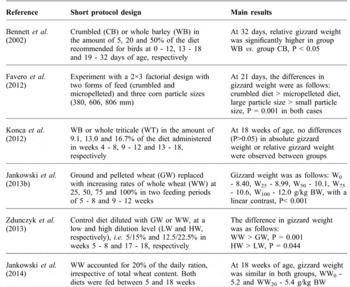
The results of recent experiments revealed that a relatively empty gizzard was heavier in broilers fed mash than in broilers fed crumbled or pelleted diets (Serrano et al., Reference SERRANO, FRIKHA, CORCHERO and MATEOS2013), and gizzard tissue weight was considerably increased by the inclusion of coarse ground corn in mash (Xu et al., Reference XU, STARK, FEREKT, WILLIAMS and BRAKE2015). In broiler chickens, gizzard development may be stimulated by WG inclusion in the diet (Engberg et al., Reference ENGBERG, HEDEMANN, STEENFELDT and JENSEN2004; Gabriel et al., Reference GABRIEL, MALLET, LECONTE, TRAVEL and LALLES2008). In a comprehensive review of gizzard functionality, Svihus (Reference SVIHUS2011) concluded that at least 20% of grain particles larger than 1.5-2.0 mm in size in the diet are needed to stimulate gizzard development in broilers. Such recommendations for formulating turkey diets have not been established. The results of studies investigating the effect of the physical form of feed, including diet dilution with WG, on gizzard development in turkeys are summarised in Table 1 .
Influence of WG or large-sized feed particle on gizzard development in turkeys.

In the experiment performed by Bennett et al. (Reference BENNETT, CLASSEN, SCHWEAN and RIDDELL2002), for the treatment where whole barley was introduced on day 0, gizzard pH decreased at 18 days of age, and gizzard weight increased at 32 days of age, in comparison with the group fed crumbled barley. Gizzard weight increased (P>0.05) in young turkeys (21 days of age) when a micropelleted diet was replaced with a crumbled diet, or a diet containing large-sized feed particles (Favero et al., Reference FAVERO, MAIORKA, FISCHER DA SILVA, DE PAULA VALLE, DOS SANTOS and MURAMATSU2012). A similar effect was observed in older turkeys (five to 12 weeks of age) in which higher dietary inclusion levels of WW led to a linear increase in gizzard weight (Jankowski et al., Reference JANKOWSKI, ZDUNCZYK, MIKULSKI, PRZYBYLSKA-GORNOWICZ, SOSNOWSKA and JUSKIEWICZ2013b). In other experiments performed on 18-week-old turkeys, the increase in gizzard weight was statistically significant when 20% WW was added to pelleted diets (Zdunczyk et al., Reference ZDUNCZYK, JANKOWSKI, MIKULSKI, PRZYBYLSKA-GORNOWICZ, SOSNOWSKA and JUSKIEWICZ2013), whereas the pre-pelleting inclusion of 20% WW had no effect on gizzard size (Jankowski et al., Reference JANKOWSKI, MIKULSKI, ZDUNCZYK, JUSKIEWICZ and LICHTOROWICZ2014). The above results indicate that large-sized feed particles or WG may stimulate an increase in gizzard weight in turkeys provided that the WW content of diets exceeds 20% and the grain has not been pre-pelleted.
Effect of dietary whole grain on small intestine development and functionality
The majority of studies performed on chickens, whose results were summarised in a review article by Singh et al. (Reference SINGH, AMERAH and RAVINDRAN2014a), revealed no changes in the relative weight and length of intestinal segments when GW was replaced with WW. However, in some experiments, the substitution of WW for GW resulted in lower duodenal weight (Gabriel et al., Reference GABRIEL, MALLET and LECONTE2003b) or higher duodenal length (Taylor and Jones, Reference TAYLOR and JONES2004).
In most of the experiments presented in Table 1 (Bennett et al., Reference BENNETT, CLASSEN, SCHWEAN and RIDDELL2002; Favero et al., Reference FAVERO, MAIORKA, FISCHER DA SILVA, DE PAULA VALLE, DOS SANTOS and MURAMATSU2012; Konca et al., Reference KONCA, KIRKPINAR, MERT and ATAC2012; Zdunczyk et al., Reference ZDUNCZYK, JANKOWSKI, MIKULSKI, PRZYBYLSKA-GORNOWICZ, SOSNOWSKA and JUSKIEWICZ2013; Jankowski et al., Reference JANKOWSKI, MIKULSKI, ZDUNCZYK, JUSKIEWICZ and LICHTOROWICZ2014), WG had no effect on the development and function of the small intestine in turkeys. However, in some studies, WG inclusion in the diet significantly affected the viscosity of the small intestinal contents. Palander et al. (Reference PALANDER, NÄSI and JÄRVINEN2005) reported that 50% whole barley (WB) in the basal diet increased jejunal viscosity in turkeys. A similar effect was noted in one of the experiments with turkeys, where the replacement of GW with WW caused with a linear increase in small intestinal viscosity (Jankowski et al., Reference JANKOWSKI, ZDUNCZYK, MIKULSKI, PRZYBYLSKA-GORNOWICZ, SOSNOWSKA and JUSKIEWICZ2013b).
It has been estimated that the mean retention time of digesta in the gizzard varies between 30 and 60 minutes (Svihus et al., Reference SVIHUS, HETLAND, CHOCT and SUNDBY2002; Svihus, Reference SVIHUS2014). It appears that larger-sized feed particles may be selectively retained in the gizzard (Hetland et al., Reference HETLAND, SVIHUS and KROGDAHL2003), and that the grinding activity of the gizzard enhances in response to WG feeding, which increases the retention time of feed particles (Roche, Reference ROCHE1981; Svihus, Reference SVIHUS2011). The results of experiments with broiler chickens indicate that WG inclusion had no effect on particle size distribution in the duodenal digesta (Svihus et al., Reference SVIHUS, HERSTAD, NEWMAN and NEWMAN1997; Hetland et al., Reference HETLAND, SVIHUS and KROGDAHL2003), and that the digesta passing through the gizzard had a consistent particle size distribution, with the majority of particles being smaller than 40 µm regardless of the original feed structure (Hetland et al., Reference HETLAND, SVIHUS and OLAISEN2002).
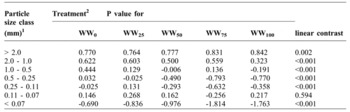
Table 2 shows the results of a study that investigated the effect of a different WW content of the diet on feed particle size in the intestinal contents of growing turkeys. After four weeks of feeding, the size of feed particles that left the gizzard and reached the duodenal digesta was determined in turkeys aged eight weeks. It was found that an increased amount of whole grains in the diet resulted in a linear increase in particles larger than 2 mm (P = 0.002) and a linear decrease in particles ranging in size from 1 to 2 mm and smaller than 0.071 mm (P = 0.001 excluding particles ranging in size from 0.106 to 0.071 mm) in the duodenal digesta. These results were consistent with those of Amerah et al. (Reference AMERAH, RAVINDRAN, LENTLE and THOMAS2007) who demonstrated that a high number of particles larger than 0.500 mm transited the duodenum without breaking down, when coarser feed was administered. The results of experiments on turkeys (Jankowski et al., Reference JANKOWSKI, MIKULSKI, ZDUNCZYK and JUSKIEWICZ2013a), as well as experiments on chickens (Svihus et al., Reference SVIHUS, HERSTAD, NEWMAN and NEWMAN1997; Hetland et al., Reference HETLAND, SVIHUS and KROGDAHL2003; Svihus, Reference SVIHUS2011) indicated that feed with WW was effective in breaking down in the gizzard, however, the feed particles are bigger and coarser than those produced in the grinding process.
Feed particle size in the intestinal contents of growing turkeys fed diets with a different WW content1 (Jankowski et al., Reference JANKOWSKI, MIKULSKI, ZDUNCZYK and JUSKIEWICZ2013a).

1The particle size distributions of diets and duodenal digesta (feed particle fraction - digesta particle fraction/feed particle fraction) were determined by wet sieving, as described by Lentle et al. (Reference LENTLE, RAVINDRAN, RAVINDRAN and THOMAS2006).
2W0, W25, W50, W75, W100 - 0, 25, 50, 75 and 100% of wheat included in the diet at 50% was replaced with WW.
It has been found that enhancing feed grinding efficiency would increase the exposure of nutrients to digestive fluids, thus improving nutrient digestion (Ferket, Reference FERKET2000; Ravindran et al., Reference RAVINDRAN, WU, THOMAS and MOREL2006). In the experiment performed by Jankowski et al. (Reference JANKOWSKI, MIKULSKI, ZDUNCZYK and JUSKIEWICZ2013a), no differences were found in the digestibility coefficients of dry matter and crude fibre or the coefficients of nitrogen retention between groups. Therefore it can be concluded that although the presence of WW in the diet increased the amount of coarse particles in the digesta leaving the gizzard, neither apparent digestibility of dry matter and crude fibre nor nitrogen retention were negatively affected.
Effect of WG on caeca development and functionality
effect of WG feeding on the amount and properties of the caecal digesta
According to Svihus et al. (Reference SVIHUS, CHOCT and CLASSEN2013), due to the anatomical and physiological adaptations of the caeca, only small and/or soluble particles can be refluxed into the caeca together with uric acid and digestive fluids. Therefore, an important question arises as to what dietary inclusion level of WG affects caecal function.
In broiler chickens, the weight of the caecal digesta increased linearly with dietary inclusion rates of WG (Wu et al., Reference WU, RAVINDRAN, THOMAS, BIRTLES and HENDRIKS2004; Wu and Ravindran, Reference WU and RAVINDRAN2004; Ravindran et al., Reference RAVINDRAN, WU, THOMAS and MOREL2006; Amerah and Ravindran, Reference AMERAH and RAVINDRAN2008). Similar results were reported for turkeys fed WW along with a protein-mineral-vitamin concentrate (PC) or complete diet (CD) (Jankowski et al., Reference JANKOWSKI, ZDUNCZYK, MIKULSKI, PRZYBYLSKA-GORNOWICZ, SOSNOWSKA and JUSKIEWICZ2013b and Zdunczyk et al., Reference ZDUNCZYK, JANKOWSKI, MIKULSKI, PRZYBYLSKA-GORNOWICZ, SOSNOWSKA and JUSKIEWICZ2013, respectively). The bulk caecal digesta effect was not observed when turkeys were fed a diet supplemented with 20% WW before pelleting (Jankowski et al., Reference JANKOWSKI, MIKULSKI, ZDUNCZYK, JUSKIEWICZ and LICHTOROWICZ2014). Interestingly, pre-pelleting inclusion of WW in turkey diets resulted in significantly higher concentrations of caecal short-chain fatty acids (SCFAs), in comparison with the control group (P<0.001).
Previous experiments (Gabriel et al., Reference GABRIEL, MALLET, LECONTE, FORT and NACIRI2003a; Reference GABRIEL, MALLET and LECONTE2003b; Reference GABRIEL, MALLET, LECONTE, TRAVEL and LALLES2008; Taylor and Jones, Reference TAYLOR and JONES2004; Biggs and Parsons, Reference BIGGS and PARSONS.2009) demonstrated that the WG content of chicken diets had no effect on SCFA concentrations in the caecal digesta. According to Gabriel et al. (Reference GABRIEL, MALLET, LECONTE, TRAVEL and LALLES2008), WW grains improve gizzard function and nutrient digestibility, thus reducing the amount of substrate available for the proliferation of intestinal microbiota and the amount of fermentation products in the caeca. In an experiment with turkeys, significantly higher concentrations of caecal SCFAs were noted if the CD was diluted with WW at 22.5% in the final phase of feeding (Zdunczyk et al., Reference ZDUNCZYK, JANKOWSKI, MIKULSKI, PRZYBYLSKA-GORNOWICZ, SOSNOWSKA and JUSKIEWICZ2013). In another experiment (Jankowski et al., Reference JANKOWSKI, ZDUNCZYK, MIKULSKI, PRZYBYLSKA-GORNOWICZ, SOSNOWSKA and JUSKIEWICZ2013b), significantly lower SCFA concentrations in the caecal digesta were noted when GW was completely replaced with WW. This is consistent with the findings of Gabriel et al. (Reference GABRIEL, MALLET, LECONTE, TRAVEL and LALLES2008) who reported that through improved gizzard function and nutrient digestibility, WG inclusion might also be associated with a reduced amount of substrate available for the proliferation of intestinal microflora, thus suppressing intestinal fermentation processes.
effect of WG feeding on caecal microbiota
In poultry, the pair of caeca is located at the junction of the ileum and colon as elongated blind sacs directed along the ileum (McLelland, Reference MCLELLAND1989). In turkeys, the caeca are distinctly longer than in chickens, and a highly fibrous diet increases the dry matter content of caeca (Duke et al., Reference DUKE, ECCLESTON, KIRKWOOD, LOUIS and BEDBURY1984). The functionality of caeca has been found to be largely affected by fermentation-prone dietary carbohydrates such as fructans, raffinose family oligosaccharides and pectins (Juskiewicz et al., Reference JUSKIEWICZ, ZDUNCZYK, JANKOWSKI and KROL2002; Reference JUSKIEWICZ, JANKOWSKI, ZDUNCZYK and MIKULSKI2006).
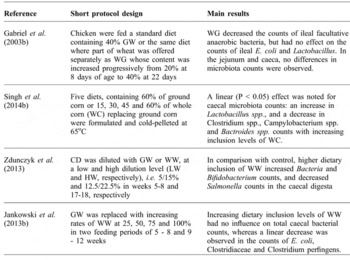
Digestive tract microbiota of broilers and turkeys fed diets with and without WG.

As shown in Table 3 , the dietary inclusion of WG influenced the microbial ecology of the gastrointestinal tract of poultry, in both broilers and turkeys. In experiments involving chickens (Singh et al., Reference SINGH, RAVINDRAN, WESTER, MOLAN and RAVINDRAN2014b) and turkeys (Jankowski et al., Reference JANKOWSKI, ZDUNCZYK, MIKULSKI, PRZYBYLSKA-GORNOWICZ, SOSNOWSKA and JUSKIEWICZ2013b; Zdunczyk et al., Reference ZDUNCZYK, JANKOWSKI, MIKULSKI, PRZYBYLSKA-GORNOWICZ, SOSNOWSKA and JUSKIEWICZ2013), positive trends included a decrease in the counts of Clostridium spp., Campylobacter and/or Escherichia coli, and an increase in the counts of Lactobacillus spp. and/or Bifidobacterium. In other studies of broilers, the dietary inclusion of WW has been shown to decrease intestinal Salmonella spp. colonisation (Bjerrum et al., Reference BJERRUM, PEDERSEN and ENGBERG2005; Santos et al., Reference SANTOS, SHELDON, SANTOS and FERKET2008) and the counts of C. perfringens (Bjerrum et al., Reference BJERRUM, PEDERSEN and ENGBERG2005), and increase the counts of beneficial microbiota such as Lactobacillus spp. (Gabriel et al., Reference GABRIEL, MALLET, LECONTE, FORT and NACIRI2006). According to Singh et al. (Reference SINGH, RAVINDRAN, WESTER, MOLAN and RAVINDRAN2014b), WG may encourage the colonisation of commensal bacteria and discourage the growth of pathogenic and harmful bacteria in the gastrointestinal tract through competitive exclusion, hydrochloric acid secretion, the grinding action of the gizzard or a combination of all those factors.
Effect of WG feeding on intestinal morphology
The results of a few experiments performed on chickens to determine the effect of dietary inclusion of WG on intestinal morphology are ambiguous. Wu et al. (Reference WU, RAVINDRAN, THOMAS, BIRTLES and HENDRIKS2004) found no effects of a diet containing 20% WW on the morphology of the gizzard and small intestine, including the thickness of the tunica muscularis layer in the gizzard or villus height, crypt depth, the number of goblet cells and epithelial thickness in the ileum. Similarly, Gabriel et al. (Reference GABRIEL, MALLET and LECONTE2003b) reported that the inclusion of WW in the diet did not evoke any changes at the cellular level causing no differences in cell size, tissue activity, ribosomal capacity or the rate of mitosis. In contrast, Gabriel et al. (Reference GABRIEL, MALLET, LECONTE, TRAVEL and LALLES2008) observed that feeding WW to chickens resulted in increased duodenal villus to crypt length and surface ratios due to lower crypt depth and a numerically smaller crypt area.
Zdunczyk et al. (Reference ZDUNCZYK, JANKOWSKI, MIKULSKI, PRZYBYLSKA-GORNOWICZ, SOSNOWSKA and JUSKIEWICZ2013) demonstrated that the physical form of wheat in turkey diets had relatively minor effects on the morphology of intestinal mucosa; an increase in the thickness of the muscularis externa, a decrease in crypt depth in the duodenum, and a linear decrease in villus height in the caeca were noted, but the differences were not statistically significant. In another experiment (Jankowski et al., Reference JANKOWSKI, ZDUNCZYK, MIKULSKI, PRZYBYLSKA-GORNOWICZ, SOSNOWSKA and JUSKIEWICZ2013b), an increase in dietary WW levels was accompanied by a tendency towards a linear increase in the thickness of muscularis externa and a decrease in crypt depth in the duodenum, and a significant linear decrease in caecal villus height.
Conclusions
Published studies investigating the effects of WG in growing turkeys are scarce, amounting to only a dozen in comparison with over 110 experiments related to chicken nutrition, whose findings have been summarised in a review article by Singh et al. (Reference SINGH, AMERAH and RAVINDRAN2014a). The results of experiments performed on turkeys indicate that, similarly to chickens, gizzard weight increases in response to an increase in feed particle size or incorporation of WG into the diet. The presence of WG in the diet leads to an increase in the amount of coarse particles in the digesta leaving the gizzard, with no negative effects on the apparent digestibility of dry matter and crude fibre or nitrogen retention values. The dietary inclusion of WG can reduce the populations of pathogenic microbiota and increase the counts of beneficial bacteria in the lower gut. Further research should be aimed at determining the dietary inclusion rate of WG required to increase gizzard weight and induce desirable changes in microbiota populations and fermentation processes in the lower GIT.