Introduction
In recent years, healthcare systems have increasingly adopted genomic sequencing of healthcare-associated infections (HAIs) even when there is no suspicion of an outbreak.
Reference Sundermann, Chen and Miller1
This proactive approach, known as genomic surveillance, while not yet a widely accepted practice, has the potential to transform infection prevention by revealing transmission events and outbreaks that would otherwise go undetected.
Reference Sundermann, Chen and Miller1
As more institutions implement these tools, outbreaks are identified more frequently, and the standards for what constitutes actionable evidence are evolving.
Reference Sundermann, Chen and Miller1–Reference Sundermann, Rosa and Harris3
However, in some cases indicated by genomic evidence, there may be no readily identifiable epidemiologic link connecting patients and, in turn, suggesting a pathway of transmission. Genomics may link patient isolates based on achievement of a genetic threshold of similarity; however, without supporting epidemiologic evidence, it remains uncertain whether these represent true transmission-related cases as part of an outbreak.
Reference Sundermann, Kumar and Griffith4
Drawing on published literature, including patient interviews, we develop a harms matrix illustrating the physical, psychological, and ethical harms patients may suffer depending on detection and disclosure status. Our analysis maps ethical principles to notification strategies and provides structured tables and figures to guide healthcare institutional decision-making. Based on this analysis, we offer recommendations regarding adoption of genomic surveillance and patient notification.
Part I: ethical frameworks and traditional outbreak surveillance
Centers for Disease Control and Prevention (CDC) framework
In 2020, the CDC’s Division of Healthcare Quality Promotion published a framework for determining when to notify patients about healthcare-associated outbreaks or infection control breaches.
Reference Schaefer, Perkins, Link-Gelles, Kallen, Patel and Perz5
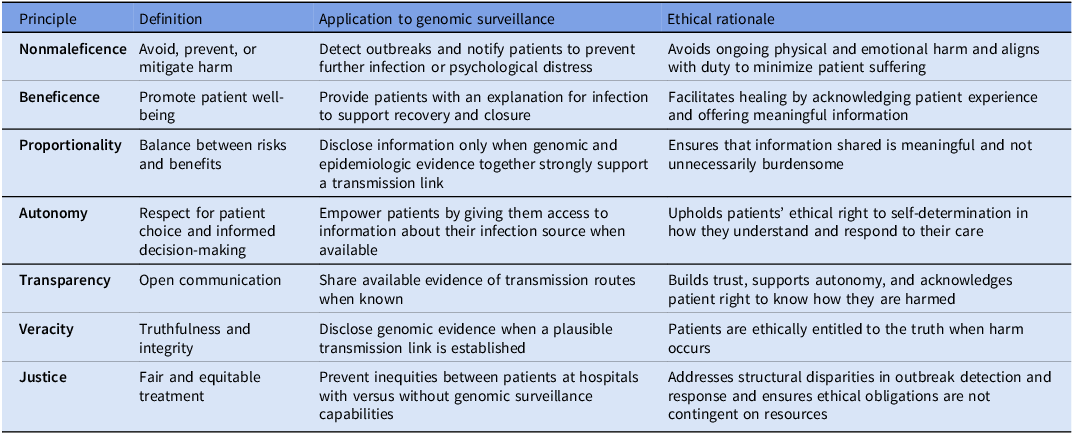
The CDC framework is grounded in nonmaleficence, and transparency (Table 1). It takes a proactive approach and identifies three primary triggers for notification of a patient (or the patient’s family): 1) a patient has experienced harm (eg, developed an infection), 2) a patient may need information to identify or mitigate a potential harm (eg, announcing an outbreak prompts elimination of the infection source), or 3) a patient’s care is altered as a result of the outbreak (eg, a patient’s surgery is delayed).
Table 1.
Ethical principles and application to genomics for transmission and outbreaks

Table 1. Long description
A table with six rows and five columns. The columns are labeled Principle, Definition, Application to genomic surveillance, and Ethical rationale. The rows are labeled Nonmaleficence, Beneficence, Proportionality, Autonomy, Transparency, Veracity, and Justice. Row 1: Principle, Nonmaleficence; Definition, Avoid, prevent, or mitigate harm; Application to genomic surveillance, Detect outbreaks and notify patients to prevent further infection or psychological distress; Ethical rationale, Avoids ongoing physical and emotional harm and aligns with duty to minimize patient suffering. Row 2: Principle, Beneficence; Definition, Promote patient well-being; Application to genomic surveillance, Provide patients with an explanation for infection to support recovery and closure; Ethical rationale, Facilitates healing by acknowledging patient experience and offering meaningful information. Row 3: Principle, Proportionality; Definition, Balance between risks and benefits; Application to genomic surveillance, Disclose information only when genomic and epidemiologic evidence together strongly support a transmission link; Ethical rationale, Ensures that information shared is meaningful and not unnecessarily burdensome. Row 4: Principle, Autonomy; Definition, Respect for patient choice and informed decision-making; Application to genomic surveillance, Empower patients by giving them access to information about their infection source when available; Ethical rationale, Upholds patients’ ethical right to self-determination in how they understand and respond to their care. Row 5: Principle, Transparency; Definition, Open communication; Application to genomic surveillance, Share available evidence of transmission routes when known; Ethical rationale, Builds trust, supports autonomy, and acknowledges patient right to know how they are harmed. Row 6: Principle, Veracity; Definition, Truthfulness and integrity; Application to genomic surveillance, Disclose genomic evidence when a plausible transmission link is established; Ethical rationale, Patients are ethically entitled to the truth when harm occurs. Row 7: Principle, Justice; Definition, Fair and equitable treatment; Application to genomic surveillance, Prevent inequities between patients at hospitals with versus without genomic surveillance capabilities; Ethical rationale, Addresses structural disparities in outbreak detection and response and ensures ethical obligations are not contingent on resources.
Employing this framework, hospitals generally notify patients only when a clearly defined, large outbreak or serious infection control breach is recognized, often through limited reactive sequencing, and when the associated exposure or harm is evident.
Reference Baker, Huang and Letourneau6
Consequently, these notifications have remained relatively infrequent. Notably, the CDC framework emphasizes that the frequency or operational burden of notification should not be a factor in the decision to notify; rather, the ethical obligation to promote patients’ well-being should take precedence.
EIPAC framework
Recently, the Ethical Infection Prevention and Control (EIPAC) framework, developed by Canadian infection prevention and ethics experts, was proposed to guide ethical decision-making in infection control though a structured process of identifying facts, weighing ethical principles, exploring options, and acting on the most justifiable option. The process evaluates options in light of seven ethical principles (Table 1).
As pathogen genomic surveillance becomes increasingly adopted in healthcare settings to identify outbreaks earlier and with greater precision, these existing frameworks can provide a foundation for addressing ethical questions that emerge regarding patient notification, institutional responsibility, and health equity.
Part II: notifying patients of outbreaks detected by genomics
Hypothetical Scenario #1. Patient A is a admitted to the hospital for a lung transplant. The transplant is a success, but the patient is monitored and has a bronchoscopy procedure to check for signs of organ rejection. Soon after, the patient develops pneumonia and has another bronchoscopy culture positive for multidrug-resistant Klebsiella pneumoniae. The infection is sequenced and found to be very closely genetically related to an infection in Patient B who also had just undergone bronchoscopy with the same endoscope and developed pneumonia. Both patients are treated for their hospital-acquired pneumonia.
Application of CDC ethical considerations: The primary trigger for patient notification is the patient having experienced harm due to an established outbreak. In this hypothetical scenario, because genomic sequencing is performed connecting the patients’ infections, epidemiologic evidence of an outbreak may be sought, perhaps discovering that bronchoscope is the likely source of both infections. Patient notification would then be clearly warranted.
In cases where genomic data suggest transmission but an outbreak has not been clearly confirmed due to limited or absent epidemiologic evidence, under the CDC framework, the decision to notify must be carefully considered, including weighing epidemiologic and genomic evidence (Figure 1). Notification may not be warranted in cases where a genetic threshold of pathogen similarity may be too high, indicating a false positive. However, in cases of closely related infections for which no common link can be found it remains critical to consider the possibility of, for example, a common environmental reservoir that has not been identified. Not only the likelihood of a causal transmission, but also ethical considerations should influence the decision of whether to notify patients of a probable outbreak in the absence of convincing epidemiologic evidence.
Figure 1.
Scenarios for ethical considerations in patient notifications for outbreaks detected by genomic surveillance.
Application of EIPAC framework: Regarding the hypothetical scenario, the four-step EIPAC framework directs us to:
-
1. Identify the information: Both patients developed pneumonia following bronchoscopy with genetically related bacteria, suggesting a common transmission source given the temporality, directionality, and strength of association. Endoscopes are well known to cause outbreaks through contamination.
Reference Kakoullis, Economidou and Mehrotra7
The same bronchoscope was used on both patients three days apart and was not cultured.
-
2. Weigh the relevant ethical principles: The CDC framework emphasizes that operational burden should not factor into notification decisions, as patient-centric considerations are paramount.
Reference Schaefer, Perkins, Link-Gelles, Kallen, Patel and Perz5,Reference Tan, Ofner and Candon8
Four ethical principles inform the appropriate course of action.
The principles of nonmaleficence and beneficence support patient notification of an outbreak when warranted by both genomic and epidemiologic evidence, as this may alleviate psychological harm by informing patients of the suspected route of transmission and benefit them by providing them peace. According to one qualitative study, patients who develop HAIs often experience psychological harm such as distress and confusion while questioning how and why they became infected.
Reference Mitchell, Northcote and Rickett9
Patients expressed a desire for clearer explanations about how their HAIs were acquired. In a separate qualitative study, patients reported more positive healthcare experiences when healthcare workers openly acknowledged HAIs, compared to not discussing the probable cause at all.
Reference Mbamalu, van Tonder and Useh10
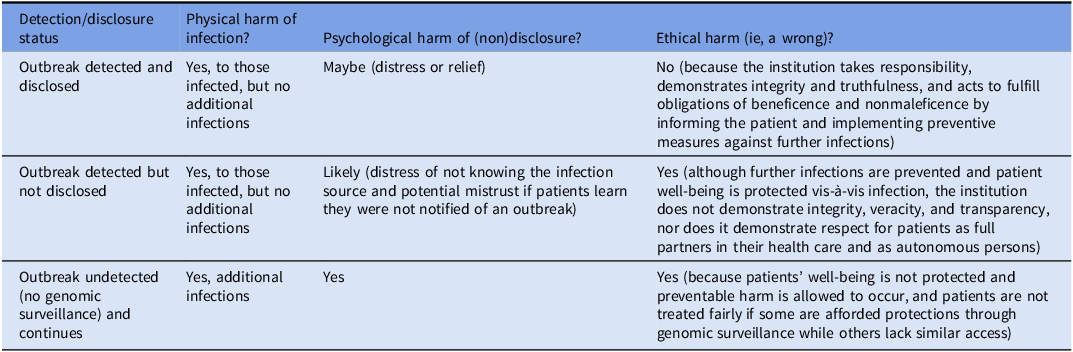
However, in genomic contexts absent an identifiable source or clear epidemiologic link, particularly when the meaning or implications of genomic findings are unclear, notifying a patient that they were part of an “outbreak” may introduce confusion or distress and would not afford the benefit of providing them information about a compensable harm. Table 2 outlines the physical, psychological, and ethical harms patients may experience depending on whether outbreaks are detected and disclosed. The principle of proportionality requires weighing both potential benefits and potential harms of notification and the possible harms of withholding information.
Table 2.
Patient harm matrix for types of harm in detected versus undetected transmission events
Table 2. Long description
A table comparing patient harm in detected and undetected infection outbreaks. The table has four rows and four columns. The columns are labeled Detection/disclosure status, Physical harm of infection, Psychological harm of (non)disclosure, and Ethical harm (ie, a wrong). The rows are labeled Outbreak detected and disclosed, Outbreak detected but not disclosed, and Outbreak undetected (no genomic surveillance) and continues. Row 1: Outbreak detected and disclosed, Yes, to those infected, but no additional infections, Maybe (distress or relief), No (because the institution takes responsibility, demonstrates integrity and truthfulness, and acts to fulfill obligations of beneficence and nonmaleficence by informing the patient and implementing preventive measures against further infections). Row 2: Outbreak detected but not disclosed, Yes, to those infected, but no additional infections, Likely (distress of not knowing the infection source and potential mistrust if patients learn they were not notified of an outbreak), Yes (although further infections are prevented and patient well-being is protected vis-à-vis infection, the institution does not demonstrate integrity, veracity, and transparency, nor does it demonstrate respect for patients as full partners in their health care and as autonomous persons). Row 3: Outbreak undetected (no genomic surveillance) and continues, Yes, additional infections, Yes, Yes (because patients’ well-being is not protected and preventable harm is allowed to occur, and patients are not treated fairly if some are afforded protections through genomic surveillance while others lack similar access).
Transparency and veracity support notifying patients when evidence indicates a harm was caused, and patients have expressed expectations that healthcare workers discuss HAI acquisition openly.
Reference Mbamalu, van Tonder and Useh10,11
Moreover, sharing accurate information with patients respects their autonomy, their capacity to make decisions to protect their own interests. However, genomic similarity alone, though accurate, may not be truthful in the relevant sense, as genomic findings without an identified transmission route cannot explain to a patient how they were infected or guide infection prevention and control (IP&C) action. These principles therefore warrant notification only when genomic and epidemiologic evidence together point toward a plausible transmission route (Figure 1).
-
3. Explore the options: One option is to disclose to both patients individually that their infection appears genetically linked to another patient’s infection likely originating from the same bronchoscope. This option fulfills demands of transparency and veracity, may reduce psychological distress by offering a plausible explanation, and has been associated with justifiably increasing patient trust in the disclosing institution.
Reference Prouty, Foglia and Gallagher12
Alternatively, withholding notification is perhaps tempting given the absence of confirmed epidemiologic evidence. However, this would compromise veracity and transparency, leave patients unaware of the source of their harm, and risk eroding trust if patients later learn of the outbreak.
-
4. Take action: In the scenario described, the likely source of transmission is a bronchoscopy procedure. Informing the patients is supported by the five aforementioned ethical principles. The same ethical reasoning should be applied whether the suspected transmission route involves a shared hospital unit, a healthcare worker, or another environmental or procedural source. Regardless of the route of transmission, when genomic and epidemiologic evidence together suggest healthcare-associated transmission, the obligation to notify remains ethically consistent.
Part III: evaluating disparities of healthcare genomic capabilities
Hypothetical Scenario #2: At Hospital A, a transplant patient develops a bloodstream infection from a rare, multidrug-resistant organism (Figure 1). The hospital IP&C department participates in a real-time genomic surveillance program, and sequencing reveals a genetically related infection occurring in another patient within the same intensive care unit. Genomic and epidemiologic investigation identifies a failure to clean shared medical equipment as a contributing factor for transmission. The hospital intervenes, provides education and auditing of equipment cleaning, and notifies the two affected patients about the outbreak and its remediation. At Hospital B, two similar transplant patients develop bloodstream infections with the same organism. However, although it has an equally skilled IP&C department, Hospital B does not conduct genomic surveillance. The patients are clinically treated for their infection, the beginning of the cluster remains undetected due to not having the tool of genomic surveillance, and the patients are not informed about any possible outbreak because the hospital itself remains unaware. Several weeks later, due to lack of detection and intervention, additional patients in the same unit develop similar infections, resulting in preventable harm.
Application of EIPAC framework:
-
1. Identify relevant information: In both hospitals, patients develop the same type of infection. However, only Hospital A detects an outbreak through genomic surveillance and is able to take action to prevent further harm. Hospital B, lacking such capabilities, fails to detect the cluster, resulting in additional cases and no patient notification.
-
2. Determine relevant ethical principles: In addition to the considerations presented in scenario #1, this scenario also involves the principle of justice, which requires that similar patients be treated similarly. In situations where genomic surveillance could detect a cluster that would otherwise go undetected, patients in Hospital B do not benefit from the same safety protections as those at Hospital A, even though patients in both institutions are relevantly similar and entitled to the standard of care. Patients in both hospitals are owed duties of beneficence and nonmaleficence; patients in both could benefit from being notified and from genomic surveillance that enables prevention of further harm, but these benefits are inaccessible without the adoption of genomic surveillance. In Hospital B, transparency and veracity are compromised, not due to withholding information, but because the institution lacks the ability to generate the relevant information in the first place.
The ethical tension here is created by institutional choices about adoption of the genomic technology itself, rather than patient-facing choices about (non)disclosure of a detected outbreak.
13
Hospitals facing resource and expertise constraints may find themselves in a difficult position, where adopting genomic surveillance could require redirecting limited resources from other patient safety priorities, potentially creating different inequities while addressing others. The inaccessibility of genomic surveillance in resource-limited settings reflects a systemic obligation to expand equitable access rather than a failure of any single institution. Ethical principles of justice and beneficence suggest that individual institutions and the broader healthcare system should work toward reducing these disparities between institutions over time.
-
3. Explore the options (for Hospital B): One option is for Hospital B to acknowledge the disparity in care and begin exploring implementation of genomics and genomic surveillance to better detect and intervene in outbreaks, thereby promoting long- term patient safety and institutional equity. Another is to continue current practices without genomic surveillance in Hospital B, preserving the operational status quo but perpetuating informational inequities and disparities in health care.
-
4. Take action: Although current operational feasibility in implementing genomic surveillance varies along with other disparities in health care, ethical principles suggest hospitals should seek ways to reduce inequities in outbreak detection and response, prevent harm, and promote patient well-being. Hospitals unable to implement genomic sequencing should work toward interim solutions to promote patient safety, justice, and beneficence, including via collaborations with other hospitals or academic institutions with capacity in genomics.
Limitations
One limitation of this analysis is that the psychological impacts and patient viewpoints referenced were drawn from studies examining general experiences with HAIs, regardless of whether those infections occurred in the context of an identified outbreak. To better understand the ethical implications of notification in the setting of genomically detected outbreaks, future research should include qualitative interviews with affected patients to explore their perspectives on notification, perceived harm, and institutional responsibility.
A second limitation of this analysis is its focus on real-time, prospective genomic surveillance in which sequencing results are available to guide timely IP&C interventions and notification decisions. We acknowledge that many institutions apply WGS retrospectively or reactively to confirm or characterize prior transmission events, sometimes months or years after infections occurred. The ethical principles discussed here remain applicable regardless of when transmission is identified; however, time delay introduces additional nuance. When notifying patients of genomically detected transmission that occurred in the past, clinicians and institutions must also communicate the rationale for the delay in a transparent and patient-centered manner, similar to how evolving clinical findings are disclosed as new information becomes available.
Conclusion and recommendations
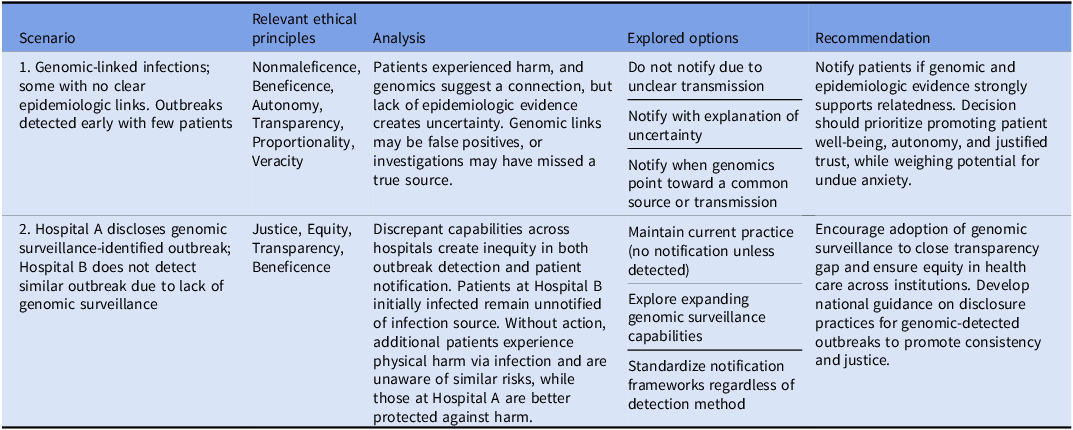
Genomic surveillance reveals healthcare-associated transmission events and outbreaks that traditional methods often miss, introducing new ethical questions for institutions and society (Table 3). Principles of veracity, transparency, nonmaleficence, and beneficence must guide notification decisions when evidence supports a likely transmission route. Disparities in care may arise between hospitals with and without genomic surveillance. Patients in healthcare settings lacking genomic surveillance may suffer preventable harm without awareness of its source, raising concerns of justice as well as concern for their well-being.
Table 3. Long description
A table with two rows and five columns analyzing genomic surveillance detected outbreak scenarios using the EIPAC framework. The columns are labeled Scenario, Relevant ethical principles, Analysis, Explored options, and Recommendation. Row 1 discusses genomic-linked infections with no clear epidemiologic links, highlighting principles of nonmaleficence, beneficence, autonomy, transparency, proportionality, and veracity. It analyzes the uncertainty due to lack of epidemiologic evidence and explores options like notifying patients with explanations of uncertainty or when genomics point toward a common source. The recommendation is to notify patients if genomic and epidemiologic evidence strongly supports relatedness, prioritizing patient well-being and trust. Row 2 discusses a scenario where Hospital A discloses a genomic surveillance-identified outbreak, and Hospital B does not detect a similar outbreak due to lack of genomic surveillance. It highlights principles of justice, equity, transparency, and beneficence, analyzing the inequity in outbreak detection and patient notification. Explored options include maintaining current practice, exploring expanding genomic surveillance capabilities, and standardizing notification frameworks. The recommendation is to encourage the adoption of genomic surveillance to close the transparency gap and ensure equity in healthcare across institutions, developing national guidance on disclosure practices.
We recommend that professional societies—including those focused on infectious disease research and prevention and those supporting healthcare institutions in their organizational structure, management, and fiscal and ethical responsibilities—should address the ethical concerns we raise. Professional societies supporting healthcare institutions should add disparities in surveillance and management of HAIs to the disparities in health care about which they advocate to policymakers, politicians, and the public. They should advocate for addressing disparities in genomic capacity across institutions.
Those professional organizations with expertise in infectious disease and outbreak prevention should prioritize defining ethical thresholds of genomic similarity that warrant notification to inform institutional practice and help ensure consistent practices in disclosure. Without such unified guidance, institutions risk adopting inconsistent or inequitable practices where some patients are informed of transmission events while others are left unaware due to resource limitations or lack of institutional will.
Although financial and infrastructural barriers currently prevent widespread implementation of genomic surveillance, developing this ethical guidance now would help to ensure that institutions will be prepared to act responsibly as adoption expands.
Reference Sundermann, Rosa and Harris3
By addressing these challenges now, we can ensure that the expanding use of genomic surveillance is accompanied by the ethical clarity needed to maintain trust, accountability, and patient-centered health care.







 You have
Access
Introduction
In recent years, healthcare systems have increasingly adopted genomic sequencing of healthcare-associated infections (HAIs) even when there is no suspicion of an outbreak. Reference Sundermann, Chen and Miller1 This proactive approach, known as genomic surveillance, while not yet a widely accepted practice, has the potential to transform infection prevention by revealing transmission events and outbreaks that would otherwise go undetected. Reference Sundermann, Chen and Miller1 As more institutions implement these tools, outbreaks are identified more frequently, and the standards for what constitutes actionable evidence are evolving. Reference Sundermann, Chen and Miller1–Reference Sundermann, Rosa and Harris3 However, in some cases indicated by genomic evidence, there may be no readily identifiable epidemiologic link connecting patients and, in turn, suggesting a pathway of transmission. Genomics may link patient isolates based on achievement of a genetic threshold of similarity; however, without supporting epidemiologic evidence, it remains uncertain whether these represent true transmission-related cases as part of an outbreak. Reference Sundermann, Kumar and Griffith4
Drawing on published literature, including patient interviews, we develop a harms matrix illustrating the physical, psychological, and ethical harms patients may suffer depending on detection and disclosure status. Our analysis maps ethical principles to notification strategies and provides structured tables and figures to guide healthcare institutional decision-making. Based on this analysis, we offer recommendations regarding adoption of genomic surveillance and patient notification.
Part I: ethical frameworks and traditional outbreak surveillance
Centers for Disease Control and Prevention (CDC) framework
In 2020, the CDC’s Division of Healthcare Quality Promotion published a framework for determining when to notify patients about healthcare-associated outbreaks or infection control breaches. Reference Schaefer, Perkins, Link-Gelles, Kallen, Patel and Perz5 The CDC framework is grounded in nonmaleficence, and transparency (Table 1). It takes a proactive approach and identifies three primary triggers for notification of a patient (or the patient’s family): 1) a patient has experienced harm (eg, developed an infection), 2) a patient may need information to identify or mitigate a potential harm (eg, announcing an outbreak prompts elimination of the infection source), or 3) a patient’s care is altered as a result of the outbreak (eg, a patient’s surgery is delayed).
Ethical principles and application to genomics for transmission and outbreaks
Table 1. Long description
A table with six rows and five columns. The columns are labeled Principle, Definition, Application to genomic surveillance, and Ethical rationale. The rows are labeled Nonmaleficence, Beneficence, Proportionality, Autonomy, Transparency, Veracity, and Justice. Row 1: Principle, Nonmaleficence; Definition, Avoid, prevent, or mitigate harm; Application to genomic surveillance, Detect outbreaks and notify patients to prevent further infection or psychological distress; Ethical rationale, Avoids ongoing physical and emotional harm and aligns with duty to minimize patient suffering. Row 2: Principle, Beneficence; Definition, Promote patient well-being; Application to genomic surveillance, Provide patients with an explanation for infection to support recovery and closure; Ethical rationale, Facilitates healing by acknowledging patient experience and offering meaningful information. Row 3: Principle, Proportionality; Definition, Balance between risks and benefits; Application to genomic surveillance, Disclose information only when genomic and epidemiologic evidence together strongly support a transmission link; Ethical rationale, Ensures that information shared is meaningful and not unnecessarily burdensome. Row 4: Principle, Autonomy; Definition, Respect for patient choice and informed decision-making; Application to genomic surveillance, Empower patients by giving them access to information about their infection source when available; Ethical rationale, Upholds patients’ ethical right to self-determination in how they understand and respond to their care. Row 5: Principle, Transparency; Definition, Open communication; Application to genomic surveillance, Share available evidence of transmission routes when known; Ethical rationale, Builds trust, supports autonomy, and acknowledges patient right to know how they are harmed. Row 6: Principle, Veracity; Definition, Truthfulness and integrity; Application to genomic surveillance, Disclose genomic evidence when a plausible transmission link is established; Ethical rationale, Patients are ethically entitled to the truth when harm occurs. Row 7: Principle, Justice; Definition, Fair and equitable treatment; Application to genomic surveillance, Prevent inequities between patients at hospitals with versus without genomic surveillance capabilities; Ethical rationale, Addresses structural disparities in outbreak detection and response and ensures ethical obligations are not contingent on resources.
Employing this framework, hospitals generally notify patients only when a clearly defined, large outbreak or serious infection control breach is recognized, often through limited reactive sequencing, and when the associated exposure or harm is evident. Reference Baker, Huang and Letourneau6 Consequently, these notifications have remained relatively infrequent. Notably, the CDC framework emphasizes that the frequency or operational burden of notification should not be a factor in the decision to notify; rather, the ethical obligation to promote patients’ well-being should take precedence.
EIPAC framework
Recently, the Ethical Infection Prevention and Control (EIPAC) framework, developed by Canadian infection prevention and ethics experts, was proposed to guide ethical decision-making in infection control though a structured process of identifying facts, weighing ethical principles, exploring options, and acting on the most justifiable option. The process evaluates options in light of seven ethical principles (Table 1).
As pathogen genomic surveillance becomes increasingly adopted in healthcare settings to identify outbreaks earlier and with greater precision, these existing frameworks can provide a foundation for addressing ethical questions that emerge regarding patient notification, institutional responsibility, and health equity.
Part II: notifying patients of outbreaks detected by genomics
Hypothetical Scenario #1. Patient A is a admitted to the hospital for a lung transplant. The transplant is a success, but the patient is monitored and has a bronchoscopy procedure to check for signs of organ rejection. Soon after, the patient develops pneumonia and has another bronchoscopy culture positive for multidrug-resistant Klebsiella pneumoniae. The infection is sequenced and found to be very closely genetically related to an infection in Patient B who also had just undergone bronchoscopy with the same endoscope and developed pneumonia. Both patients are treated for their hospital-acquired pneumonia.
Application of CDC ethical considerations: The primary trigger for patient notification is the patient having experienced harm due to an established outbreak. In this hypothetical scenario, because genomic sequencing is performed connecting the patients’ infections, epidemiologic evidence of an outbreak may be sought, perhaps discovering that bronchoscope is the likely source of both infections. Patient notification would then be clearly warranted.
In cases where genomic data suggest transmission but an outbreak has not been clearly confirmed due to limited or absent epidemiologic evidence, under the CDC framework, the decision to notify must be carefully considered, including weighing epidemiologic and genomic evidence (Figure 1). Notification may not be warranted in cases where a genetic threshold of pathogen similarity may be too high, indicating a false positive. However, in cases of closely related infections for which no common link can be found it remains critical to consider the possibility of, for example, a common environmental reservoir that has not been identified. Not only the likelihood of a causal transmission, but also ethical considerations should influence the decision of whether to notify patients of a probable outbreak in the absence of convincing epidemiologic evidence.
Scenarios for ethical considerations in patient notifications for outbreaks detected by genomic surveillance.
Application of EIPAC framework: Regarding the hypothetical scenario, the four-step EIPAC framework directs us to:
1. Identify the information: Both patients developed pneumonia following bronchoscopy with genetically related bacteria, suggesting a common transmission source given the temporality, directionality, and strength of association. Endoscopes are well known to cause outbreaks through contamination. Reference Kakoullis, Economidou and Mehrotra7 The same bronchoscope was used on both patients three days apart and was not cultured.
2. Weigh the relevant ethical principles: The CDC framework emphasizes that operational burden should not factor into notification decisions, as patient-centric considerations are paramount. Reference Schaefer, Perkins, Link-Gelles, Kallen, Patel and Perz5,Reference Tan, Ofner and Candon8 Four ethical principles inform the appropriate course of action.
The principles of nonmaleficence and beneficence support patient notification of an outbreak when warranted by both genomic and epidemiologic evidence, as this may alleviate psychological harm by informing patients of the suspected route of transmission and benefit them by providing them peace. According to one qualitative study, patients who develop HAIs often experience psychological harm such as distress and confusion while questioning how and why they became infected. Reference Mitchell, Northcote and Rickett9 Patients expressed a desire for clearer explanations about how their HAIs were acquired. In a separate qualitative study, patients reported more positive healthcare experiences when healthcare workers openly acknowledged HAIs, compared to not discussing the probable cause at all. Reference Mbamalu, van Tonder and Useh10
However, in genomic contexts absent an identifiable source or clear epidemiologic link, particularly when the meaning or implications of genomic findings are unclear, notifying a patient that they were part of an “outbreak” may introduce confusion or distress and would not afford the benefit of providing them information about a compensable harm. Table 2 outlines the physical, psychological, and ethical harms patients may experience depending on whether outbreaks are detected and disclosed. The principle of proportionality requires weighing both potential benefits and potential harms of notification and the possible harms of withholding information.
Patient harm matrix for types of harm in detected versus undetected transmission events
Table 2. Long description
A table comparing patient harm in detected and undetected infection outbreaks. The table has four rows and four columns. The columns are labeled Detection/disclosure status, Physical harm of infection, Psychological harm of (non)disclosure, and Ethical harm (ie, a wrong). The rows are labeled Outbreak detected and disclosed, Outbreak detected but not disclosed, and Outbreak undetected (no genomic surveillance) and continues. Row 1: Outbreak detected and disclosed, Yes, to those infected, but no additional infections, Maybe (distress or relief), No (because the institution takes responsibility, demonstrates integrity and truthfulness, and acts to fulfill obligations of beneficence and nonmaleficence by informing the patient and implementing preventive measures against further infections). Row 2: Outbreak detected but not disclosed, Yes, to those infected, but no additional infections, Likely (distress of not knowing the infection source and potential mistrust if patients learn they were not notified of an outbreak), Yes (although further infections are prevented and patient well-being is protected vis-à-vis infection, the institution does not demonstrate integrity, veracity, and transparency, nor does it demonstrate respect for patients as full partners in their health care and as autonomous persons). Row 3: Outbreak undetected (no genomic surveillance) and continues, Yes, additional infections, Yes, Yes (because patients’ well-being is not protected and preventable harm is allowed to occur, and patients are not treated fairly if some are afforded protections through genomic surveillance while others lack similar access).
Transparency and veracity support notifying patients when evidence indicates a harm was caused, and patients have expressed expectations that healthcare workers discuss HAI acquisition openly. Reference Mbamalu, van Tonder and Useh10,11 Moreover, sharing accurate information with patients respects their autonomy, their capacity to make decisions to protect their own interests. However, genomic similarity alone, though accurate, may not be truthful in the relevant sense, as genomic findings without an identified transmission route cannot explain to a patient how they were infected or guide infection prevention and control (IP&C) action. These principles therefore warrant notification only when genomic and epidemiologic evidence together point toward a plausible transmission route (Figure 1).
3. Explore the options: One option is to disclose to both patients individually that their infection appears genetically linked to another patient’s infection likely originating from the same bronchoscope. This option fulfills demands of transparency and veracity, may reduce psychological distress by offering a plausible explanation, and has been associated with justifiably increasing patient trust in the disclosing institution. Reference Prouty, Foglia and Gallagher12 Alternatively, withholding notification is perhaps tempting given the absence of confirmed epidemiologic evidence. However, this would compromise veracity and transparency, leave patients unaware of the source of their harm, and risk eroding trust if patients later learn of the outbreak.
4. Take action: In the scenario described, the likely source of transmission is a bronchoscopy procedure. Informing the patients is supported by the five aforementioned ethical principles. The same ethical reasoning should be applied whether the suspected transmission route involves a shared hospital unit, a healthcare worker, or another environmental or procedural source. Regardless of the route of transmission, when genomic and epidemiologic evidence together suggest healthcare-associated transmission, the obligation to notify remains ethically consistent.
Part III: evaluating disparities of healthcare genomic capabilities
Hypothetical Scenario #2: At Hospital A, a transplant patient develops a bloodstream infection from a rare, multidrug-resistant organism (Figure 1). The hospital IP&C department participates in a real-time genomic surveillance program, and sequencing reveals a genetically related infection occurring in another patient within the same intensive care unit. Genomic and epidemiologic investigation identifies a failure to clean shared medical equipment as a contributing factor for transmission. The hospital intervenes, provides education and auditing of equipment cleaning, and notifies the two affected patients about the outbreak and its remediation. At Hospital B, two similar transplant patients develop bloodstream infections with the same organism. However, although it has an equally skilled IP&C department, Hospital B does not conduct genomic surveillance. The patients are clinically treated for their infection, the beginning of the cluster remains undetected due to not having the tool of genomic surveillance, and the patients are not informed about any possible outbreak because the hospital itself remains unaware. Several weeks later, due to lack of detection and intervention, additional patients in the same unit develop similar infections, resulting in preventable harm.
Application of EIPAC framework:
1. Identify relevant information: In both hospitals, patients develop the same type of infection. However, only Hospital A detects an outbreak through genomic surveillance and is able to take action to prevent further harm. Hospital B, lacking such capabilities, fails to detect the cluster, resulting in additional cases and no patient notification.
2. Determine relevant ethical principles: In addition to the considerations presented in scenario #1, this scenario also involves the principle of justice, which requires that similar patients be treated similarly. In situations where genomic surveillance could detect a cluster that would otherwise go undetected, patients in Hospital B do not benefit from the same safety protections as those at Hospital A, even though patients in both institutions are relevantly similar and entitled to the standard of care. Patients in both hospitals are owed duties of beneficence and nonmaleficence; patients in both could benefit from being notified and from genomic surveillance that enables prevention of further harm, but these benefits are inaccessible without the adoption of genomic surveillance. In Hospital B, transparency and veracity are compromised, not due to withholding information, but because the institution lacks the ability to generate the relevant information in the first place.
The ethical tension here is created by institutional choices about adoption of the genomic technology itself, rather than patient-facing choices about (non)disclosure of a detected outbreak. 13 Hospitals facing resource and expertise constraints may find themselves in a difficult position, where adopting genomic surveillance could require redirecting limited resources from other patient safety priorities, potentially creating different inequities while addressing others. The inaccessibility of genomic surveillance in resource-limited settings reflects a systemic obligation to expand equitable access rather than a failure of any single institution. Ethical principles of justice and beneficence suggest that individual institutions and the broader healthcare system should work toward reducing these disparities between institutions over time.
3. Explore the options (for Hospital B): One option is for Hospital B to acknowledge the disparity in care and begin exploring implementation of genomics and genomic surveillance to better detect and intervene in outbreaks, thereby promoting long- term patient safety and institutional equity. Another is to continue current practices without genomic surveillance in Hospital B, preserving the operational status quo but perpetuating informational inequities and disparities in health care.
4. Take action: Although current operational feasibility in implementing genomic surveillance varies along with other disparities in health care, ethical principles suggest hospitals should seek ways to reduce inequities in outbreak detection and response, prevent harm, and promote patient well-being. Hospitals unable to implement genomic sequencing should work toward interim solutions to promote patient safety, justice, and beneficence, including via collaborations with other hospitals or academic institutions with capacity in genomics.
Limitations
One limitation of this analysis is that the psychological impacts and patient viewpoints referenced were drawn from studies examining general experiences with HAIs, regardless of whether those infections occurred in the context of an identified outbreak. To better understand the ethical implications of notification in the setting of genomically detected outbreaks, future research should include qualitative interviews with affected patients to explore their perspectives on notification, perceived harm, and institutional responsibility.
A second limitation of this analysis is its focus on real-time, prospective genomic surveillance in which sequencing results are available to guide timely IP&C interventions and notification decisions. We acknowledge that many institutions apply WGS retrospectively or reactively to confirm or characterize prior transmission events, sometimes months or years after infections occurred. The ethical principles discussed here remain applicable regardless of when transmission is identified; however, time delay introduces additional nuance. When notifying patients of genomically detected transmission that occurred in the past, clinicians and institutions must also communicate the rationale for the delay in a transparent and patient-centered manner, similar to how evolving clinical findings are disclosed as new information becomes available.
Conclusion and recommendations
Genomic surveillance reveals healthcare-associated transmission events and outbreaks that traditional methods often miss, introducing new ethical questions for institutions and society (Table 3). Principles of veracity, transparency, nonmaleficence, and beneficence must guide notification decisions when evidence supports a likely transmission route. Disparities in care may arise between hospitals with and without genomic surveillance. Patients in healthcare settings lacking genomic surveillance may suffer preventable harm without awareness of its source, raising concerns of justice as well as concern for their well-being.
Ethical analysis of genomic surveillance detected outbreak scenarios using the EIPAC framework Reference Tan, Ofner and Candon8
Table 3. Long description
A table with two rows and five columns analyzing genomic surveillance detected outbreak scenarios using the EIPAC framework. The columns are labeled Scenario, Relevant ethical principles, Analysis, Explored options, and Recommendation. Row 1 discusses genomic-linked infections with no clear epidemiologic links, highlighting principles of nonmaleficence, beneficence, autonomy, transparency, proportionality, and veracity. It analyzes the uncertainty due to lack of epidemiologic evidence and explores options like notifying patients with explanations of uncertainty or when genomics point toward a common source. The recommendation is to notify patients if genomic and epidemiologic evidence strongly supports relatedness, prioritizing patient well-being and trust. Row 2 discusses a scenario where Hospital A discloses a genomic surveillance-identified outbreak, and Hospital B does not detect a similar outbreak due to lack of genomic surveillance. It highlights principles of justice, equity, transparency, and beneficence, analyzing the inequity in outbreak detection and patient notification. Explored options include maintaining current practice, exploring expanding genomic surveillance capabilities, and standardizing notification frameworks. The recommendation is to encourage the adoption of genomic surveillance to close the transparency gap and ensure equity in healthcare across institutions, developing national guidance on disclosure practices.
We recommend that professional societies—including those focused on infectious disease research and prevention and those supporting healthcare institutions in their organizational structure, management, and fiscal and ethical responsibilities—should address the ethical concerns we raise. Professional societies supporting healthcare institutions should add disparities in surveillance and management of HAIs to the disparities in health care about which they advocate to policymakers, politicians, and the public. They should advocate for addressing disparities in genomic capacity across institutions.
Those professional organizations with expertise in infectious disease and outbreak prevention should prioritize defining ethical thresholds of genomic similarity that warrant notification to inform institutional practice and help ensure consistent practices in disclosure. Without such unified guidance, institutions risk adopting inconsistent or inequitable practices where some patients are informed of transmission events while others are left unaware due to resource limitations or lack of institutional will.
Although financial and infrastructural barriers currently prevent widespread implementation of genomic surveillance, developing this ethical guidance now would help to ensure that institutions will be prepared to act responsibly as adoption expands. Reference Sundermann, Rosa and Harris3 By addressing these challenges now, we can ensure that the expanding use of genomic surveillance is accompanied by the ethical clarity needed to maintain trust, accountability, and patient-centered health care.
Financial support
NIH NIAID K01AI190052-01.
Competing interests
AJS is a consultant to Next Gen Diagnostics.