1 Introduction
Since future-generation aeroplanes must exploit the characteristics of supersonic flow in high-speed airstreams, it is essential to deploy delta wings. Several decades ago, vortex breakdown over delta wings and in pipe flows was discovered as a sudden bursting of swirling flows. Wing-tip vortex breakdown over delta wings is detailed in Nelson & Pelletier (Reference Nelson and Pelletier2003). Vortex breakdown manifests as a sudden increase in core size, a large adverse pressure gradient, a stagnation point formed near the axis, flow reversal and a highly unstable structure (Hall Reference Hall1972; Leibovich Reference Leibovich1978; Escudier Reference Escudier1988; Delery Reference Delery1994; Lucca-Negro & O’Doherty Reference Lucca-Negro and O’Doherty2001). Vortex breakdown has also been viewed as a fold catastrophe (Shtern & Hussain Reference Shtern and Hussain1999). In many incompressible flow studies, the onset of vortex breakdown was found to be governed by the swirl strength, i.e. the swirl number or the Rossby number. In contrast, a few studies on compressible vortex breakdowns have yielded contradictory results. In some studies, the critical swirl number in subsonic flows was found to increase with Mach number (Visbal & Gordnier Reference Visbal and Gordnier1995; Rusak & Lee Reference Rusak and Lee2002; Herrada, Pérez-Saborid & Barrero Reference Herrada, Pérez-Saborid and Barrero2003). Other studies have reported the opposite result, such as shock-induced breakdown (Keller Reference Keller1994; Mahesh Reference Mahesh1996; Luginsland & Kleiser Reference Luginsland and Kleiser2015). Furthermore, in shock-free supersonic flows, where the Mach number is greater than unity, the outbreak mechanism of vortex breakdown remains to be identified.
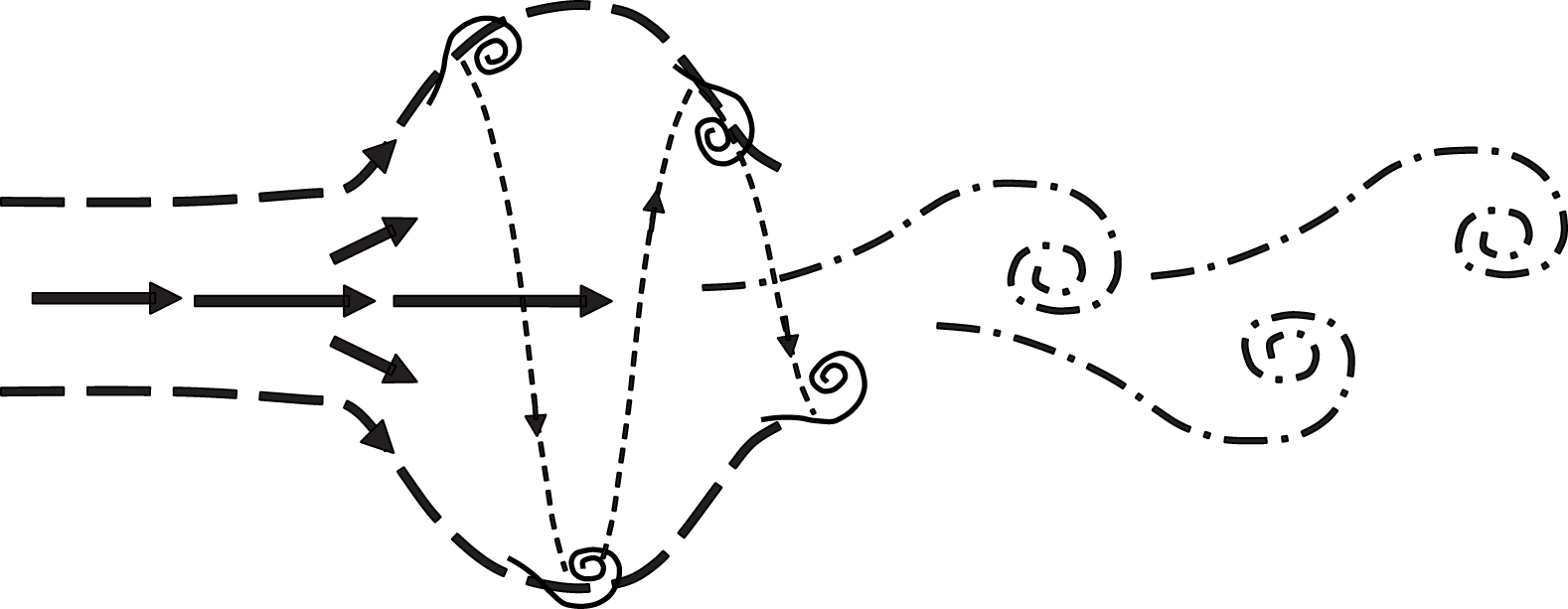
The critical conditions for vortex breakdown have been studied in various theoretical frameworks. Assuming that vortex breakdown occurs by a similar process to hydraulic jumps and shockwaves, Benjamin (Reference Benjamin1962) proposed that vortex breakdown represents a transition from supercritical to subcritical flows under bounded flows. A supercritical flow supports only downstream travelling waves, whereas a subcritical flow supports both upstream and downstream travelling waves. Mager (Reference Mager1972) and Ruith et al. (Reference Ruith, Chen, Meiburg and Maxworthy2003) applied Benjamin’s analysis to radially unbounded flows. Escudier (Reference Escudier1988) proposed a two-stage transition when the angular momentum is conserved along the stream surfaces. Keller (Reference Keller1994) extended this method to the compressible case. By observing the size of the vortex core, Darmofal et al. (Reference Darmofal, Khan, Greitzer and Tan2001) estimated the breakdown conditions by a quasi-one-dimensional approach using the flux-averaged stagnation pressure in confined and unconfined geometries. Assuming axial momentum conservation along the vortex axis, Mahesh (Reference Mahesh1996) derived critical swirl numbers from the pressure rise in supersonic flows. From the connection between spiral-type instabilities and vortex breakdown, it was also shown that the axial deceleration developed into a stagnation point (Ruith et al. Reference Ruith, Chen, Meiburg and Maxworthy2003; Broadhurst & Sherwin Reference Broadhurst and Sherwin2008). Thus, it is believed that axial deceleration into a stagnation point precedes vortex breakdown in both subsonic and supersonic flows. However, when the stagnation point was assumed in theoretical investigations of breakdown onset, the verifications in compressible cases (including supersonic flows) were unsatisfactory. Indeed, the axial velocity is thought to accelerate during vortex breakdown in supersonic flows, as shown in figure 1 (Hiejima Reference Hiejima2017). To seek the onset condition of comprehensive vortex breakdown without a stagnation point, it becomes necessary to consider the occurrence of vortex breakdown as the momentum variation response to the pressure rise as well as the increased velocity. This clarification is the theme of the present paper.
The purpose of this study is to estimate the onset conditions of vortex breakdown in supersonic flows. To this end, the present study proposes a new condition for shock-free supersonic vortex breakdown based on the axial momentum rise along the vortex axis, without assuming a stagnation point. The theoretical condition is verified in three-dimensional numerical simulations.
Schematic of streamwise vortex breakdown with axial velocity acceleration in supersonic cases. Reprinted with permission from Hiejima, Phys. Fluids 29, 054102 (2017). Copyright 2017 American Institute of Physics.

2 Basic flows
To investigate breakdown of supersonic streamwise vortices, Batchelor vortices (Batchelor Reference Batchelor1964) are applied because their profiles are compatible with many swirling flows. The radial, azimuthal and axial velocities (
 $u_{r}$
,
 $u_{\unicode[STIX]{x1D703}}$
and
 $u_{x}$
) of the Batchelor vortex are, respectively, given by
 $$\begin{eqnarray}\displaystyle & \displaystyle u_{r}(r)=0,\quad u_{\unicode[STIX]{x1D703}}(r)=\displaystyle \frac{q}{r}[1-\exp (-r^{2})],\quad u_{x}(r)=1-\unicode[STIX]{x1D707}\exp (-r^{2}), & \displaystyle\end{eqnarray}$$
where
 $q$
and
 $\unicode[STIX]{x1D707}$
denote the swirl intensity (circulation) and axial velocity deficit, respectively, and their ratio defines the swirl parameter
 $\unicode[STIX]{x1D6F7}=q/\unicode[STIX]{x1D707}$
, which presents a similarity feature in instability (Hiejima Reference Hiejima2013). The density
 $\unicode[STIX]{x1D70C}(r)$
and pressure
 $p(r)$
required for supersonic conditions in a basic inviscid steady flow are, respectively, given by
 $$\begin{eqnarray}\displaystyle & \displaystyle \frac{\text{d}p}{\text{d}r}=\unicode[STIX]{x1D70C}\frac{{u_{\unicode[STIX]{x1D703}}}^{2}}{r},\quad \frac{\text{d}\unicode[STIX]{x1D70C}}{\text{d}r}=\frac{\unicode[STIX]{x1D70C}}{\unicode[STIX]{x1D6FE}}\left(\frac{1}{p}\frac{\text{d}p}{\text{d}r}-\frac{\text{d}s}{\text{d}r}\right), & \displaystyle\end{eqnarray}$$
where
 $s$
is the entropy and
 $\unicode[STIX]{x1D6FE}$
is the ratio of the specific heats. The entropy gradient in (2.2) is described by the Crocco equation on the assumption that the stagnation temperature is uniform (Hiejima Reference Hiejima2013).
3 Onset conditions for vortex breakdown
Although the swirl intensity at the upstream is an important condition for vortex breakdown, the swirl number is upper-bounded because the static pressure is positive in a compressible flow. A strong swirl causes low pressure along the axis and results in momentum reduction there. An axial velocity deficit can also create a similar effect to momentum reduction. The occurrence of vortex breakdown seems to be related to low momentum on the upstream vortex axis. From a momentum perspective, a pressure rise and an increased axial velocity at the downstream are regarded as an increase in momentum. This is a key for the onset condition of universal vortex breakdown. The momentum increase caused by vortex breakdown can be interpreted as follows. In cylindrical polar coordinates, the conservation of mass equation is
 $$\begin{eqnarray}\displaystyle & \displaystyle \frac{\unicode[STIX]{x2202}(\unicode[STIX]{x1D70C})}{\unicode[STIX]{x2202}t}+\frac{1}{r}\frac{\unicode[STIX]{x2202}(r\unicode[STIX]{x1D70C}u_{r})}{\unicode[STIX]{x2202}r}+\frac{1}{r}\frac{\unicode[STIX]{x2202}(r\unicode[STIX]{x1D70C}u_{\unicode[STIX]{x1D703}})}{\unicode[STIX]{x2202}\unicode[STIX]{x1D703}}+\frac{\unicode[STIX]{x2202}(\unicode[STIX]{x1D70C}u_{x})\unicode[STIX]{x1D70C}u_{x}}{\unicode[STIX]{x2202}x}=0. & \displaystyle\end{eqnarray}$$
According to Darmofal (Mahesh Reference Mahesh1996), vortex breakdown is regarded as an inviscid transition at Reynolds number above 300. In terms of the axial momentum
 $J$
, the conservation of momentum equation becomes
 $$\begin{eqnarray}\displaystyle & \displaystyle \frac{\unicode[STIX]{x2202}(\unicode[STIX]{x1D70C}u_{x})}{\unicode[STIX]{x2202}t}+\frac{1}{r}\frac{\unicode[STIX]{x2202}(r\unicode[STIX]{x1D70C}u_{r}\,u_{x})}{\unicode[STIX]{x2202}r}+\frac{1}{r}\frac{\unicode[STIX]{x2202}(r\unicode[STIX]{x1D70C}u_{\unicode[STIX]{x1D703}}\,u_{x})}{\unicode[STIX]{x2202}\unicode[STIX]{x1D703}}+\frac{\unicode[STIX]{x2202}J}{\unicode[STIX]{x2202}x}=0. & \displaystyle\end{eqnarray}$$
Inviscid vortex breakdown is a transition between two conjugate flow states (Benjamin Reference Benjamin1962; Mager Reference Mager1972). Brown & Lopez (Reference Brown and Lopez1990) derived the physical mechanism of incompressible vortex breakdown from the momentum equation. In steady flows where
 $u_{\unicode[STIX]{x1D703}}(0)\approx 0$
along the axis, the axial momentum gradient can be approximated by integrating (3.2) with respect to
 $x$
and disregarding the unimportant terms using (3.1). The resulting approximation is
 $$\begin{eqnarray}\displaystyle & \displaystyle J_{2}-J_{1}\simeq \int _{1}^{2}\!u_{x}\frac{\unicode[STIX]{x2202}(-\unicode[STIX]{x1D70C}u_{r})}{\unicode[STIX]{x2202}r}\,\text{d}x. & \displaystyle\end{eqnarray}$$
Here, the indices 1 and 2 denote the upstream and downstream points, respectively. This expression describes a momentum increase caused by the radial spread of
 $u_{r}$
.
Because a transition induces a large momentum increase in the streamwise direction, the momentum variation along the axis is crucially important. If the momentum difference between the upstream and downstream exceeds a certain fraction of the difference between the maximum and upstream momenta, then vortex breakdown is assumed to occur. The onset condition of vortex breakdown is given by
 $$\begin{eqnarray}\displaystyle & \displaystyle J_{2}-J_{1}-\unicode[STIX]{x1D6FC}\,(J_{\mathit{max}}-J_{1})>0, & \displaystyle\end{eqnarray}$$
where the axial momentum is defined as
 $J_{i}=\unicode[STIX]{x1D70C}_{i}u_{i}^{2}+p_{i}=p_{i}(\unicode[STIX]{x1D6FE}M_{i}^{2}+1)$
and the Mach number is
 $M_{i}=u_{i}/\sqrt{\unicode[STIX]{x1D6FE}p_{i}/\unicode[STIX]{x1D70C}_{i}}$
. The maximum momentum can be reasonably assumed as
 $J_{\mathit{max}}\simeq J_{\infty }$
. The subscript
 $\infty$
denotes a point at infinite radius (i.e. the free-stream state). As a comprehensive approach to the condition, the coefficient
 $\unicode[STIX]{x1D6FC}$
is determined from the critical swirl number of incompressible vortex breakdown.
In incompressible vortex breakdown with a stagnation point, assuming
 $u_{2}=0$
and constant density, equation (3.4) becomes
 $$\begin{eqnarray}\displaystyle & \displaystyle p_{2}-(p_{1}+\unicode[STIX]{x1D70C}u_{1}^{2})-\unicode[STIX]{x1D6FC}\,(p_{\infty }+\unicode[STIX]{x1D70C}u_{\infty }^{2}-p_{1}-\unicode[STIX]{x1D70C}u_{1}^{2})>0. & \displaystyle\end{eqnarray}$$
As is commonly assumed, the stagnation pressure at incompressible vortex breakdown was taken as
 $p_{2}=p_{\infty }+1/2\unicode[STIX]{x1D70C}u_{\infty }^{2}$
.
 $$\begin{eqnarray}\displaystyle & \displaystyle (1-\unicode[STIX]{x1D6FC})(p_{\infty }-p_{1})>(1-\unicode[STIX]{x1D6FC})\unicode[STIX]{x1D70C}u_{1}^{2}+(\unicode[STIX]{x1D6FC}-{\textstyle \frac{1}{2}})\unicode[STIX]{x1D70C}u_{\infty }^{2}. & \displaystyle\end{eqnarray}$$
Integrating the radial momentum equation (2.2) at the upstream, we obtain
 $$\begin{eqnarray}\displaystyle & \displaystyle p_{\infty }-p_{1}=\unicode[STIX]{x1D70C}\int _{0}^{\infty }\frac{u_{\unicode[STIX]{x1D703}}^{2}}{r}\,\text{d}r=\unicode[STIX]{x1D70C}\,q^{2}\int _{0}^{\infty }\frac{1-\exp (-r^{2})}{r^{3}}\,\text{d}r=\unicode[STIX]{x1D70C}\,q^{2}I(\infty ). & \displaystyle\end{eqnarray}$$
Substituting (3.7) into (3.6), we then obtain
 $$\begin{eqnarray}\displaystyle & \displaystyle q^{2}>\frac{u_{\infty }^{2}}{I(\infty )}\left[(1-\unicode[STIX]{x1D707})^{2}+\frac{2\unicode[STIX]{x1D6FC}-1}{2(1-\unicode[STIX]{x1D6FC})}\right]. & \displaystyle\end{eqnarray}$$
In accordance with previous theoretical works, we assume uniform axial velocity of the primary flow (i.e.
 $\unicode[STIX]{x1D707}=0$
). The critical swirl intensity is then given by
 $$\begin{eqnarray}\displaystyle & \displaystyle q>q_{c}=\frac{u_{\infty }}{\sqrt{2(1-\unicode[STIX]{x1D6FC})I(\infty )}}. & \displaystyle\end{eqnarray}$$
Here,
 $q_{c}$
denotes the critical swirl intensity and
 $r_{c}$
is the site of maximum azimuthal velocity. In many investigations into incompressible vortex breakdown, the critical swirl number
 $S_{c}=q_{c}/(r_{c}\,u_{\infty })$
was determined as
 $1.4$
(see, for instance, Delery Reference Delery1994). From (3.9) and setting
 $r_{c}=1.121$
for the Batchelor vortex in (2.1), we obtain
 $\unicode[STIX]{x1D6FC}=0.7066\simeq 1/\sqrt{2}$
at vortex breakdown.
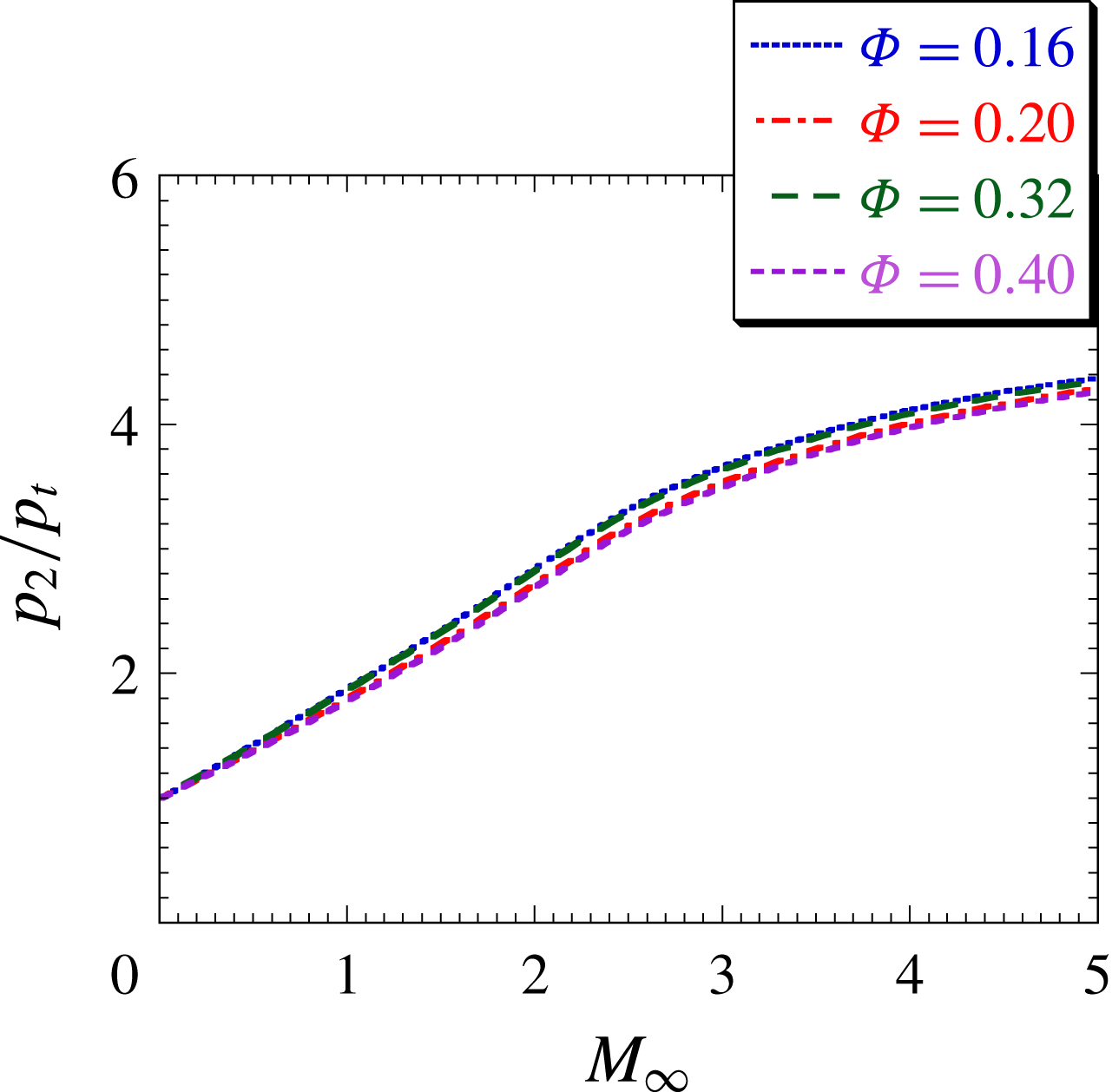
Downstream stagnation pressure necessary for vortex breakdown calculated by (3.10) as a function of
 $M_{\infty }$
for
 $\unicode[STIX]{x1D6F7}=0.16,0.20,0.32$
and
 $0.40$
.

Note that the downstream momentum
 $J_{2}$
is unknown in (3.4). First, consider a vortex breakdown in which a stagnation point occurs under the above onset condition. The critical pressure
 $p_{2}$
is obtained by substituting
 $M_{2}=0$
into (3.4) as follows:
 $$\begin{eqnarray}\displaystyle & \displaystyle \frac{p_{2}}{p_{t}}=\unicode[STIX]{x1D6FC}\frac{1+\unicode[STIX]{x1D6FE}M_{\infty }^{2}}{1+\displaystyle \frac{\unicode[STIX]{x1D6FE}-1}{2}M_{\infty }^{2}}+(1-\unicode[STIX]{x1D6FC})\frac{p_{1}}{p_{\infty }}\frac{1+\unicode[STIX]{x1D6FE}M_{1}^{2}}{1+\displaystyle \frac{\unicode[STIX]{x1D6FE}-1}{2}M_{\infty }^{2}}, & \displaystyle\end{eqnarray}$$
where
 $p_{t}=p_{\infty }(1+((\unicode[STIX]{x1D6FE}-1)/2)M_{\infty }^{2})$
. The downstream stagnation pressures necessary for vortex breakdown, obtained from (3.10), are plotted as functions of
 $M_{\infty }$
in figure 2. Here
 $\unicode[STIX]{x1D6F7}$
ranges from 0.16 to 0.40. Although
 $p_{2}=p_{t}$
in incompressible cases (at most
 $p_{2}<1.8\,p_{t}$
in subsonic cases), the downstream pressure
 $p_{2}$
required for breakdown increases several-fold as the Mach number increases. The required
 $q$
deduced from the pressure difference at high stagnation pressure exceeds the maximum swirl number in compressible flows, which is limited as mentioned above. This suggests that vortex breakdown with a stagnation point cannot occur in supersonic flows.
Next, consider a vortex breakdown without stagnation points. In supersonic vortex breakdown, the axial velocity accelerates along the vortex axis. In vortex breakdown without stagnation points, suppose that
 $p_{2}\simeq p_{1}$
because
 $\unicode[STIX]{x2202}p/\unicode[STIX]{x2202}x$
exerts a weak effect (Hiejima Reference Hiejima2017, figure 7). Applying
 $p_{2}=p_{1}$
to (3.4), the critical downstream Mach number
 $M_{2}$
is expressed as
 $$\begin{eqnarray}\displaystyle & \displaystyle F(M_{2})=\frac{M_{2}^{2}-\unicode[STIX]{x1D6FD}M_{1}^{2}}{M_{\infty }^{2}}-\frac{\unicode[STIX]{x1D6FC}\hat{I} (\infty )}{p_{1}}\left(1+\frac{1}{\unicode[STIX]{x1D6FE}M_{\infty }^{2}}\right)q^{2}, & \displaystyle\end{eqnarray}$$
 $$\begin{eqnarray}\displaystyle & \displaystyle p_{\infty }-p_{1}=q^{2}\hat{I} (\infty )=\int _{0}^{\infty }\unicode[STIX]{x1D70C}\frac{u_{\unicode[STIX]{x1D703}}^{2}}{r}\,\text{d}r, & \displaystyle\end{eqnarray}$$
where
 $\unicode[STIX]{x1D6FD}=1-\unicode[STIX]{x1D6FC}$
. Equation (3.11) is constant independent of
 $M_{\infty }$
for various
 $\unicode[STIX]{x1D6F7}$
(
 $q=0.08{-}0.32$
,
 $\unicode[STIX]{x1D707}=0.2{-}1.0$
);
 $F(M_{2})=\unicode[STIX]{x1D6FC}$
. Therefore, the critical
 $M_{2}$
for supersonic vortex breakdown can be simply expressed.
4 Supersonic vortex breakdown obtained from numerical simulations
To verify the onset condition in § 3, the breakdowns of streamwise vortices were numerically investigated at various Mach numbers
 $1.5$
–
 $5.0$
. The governing equations were the three-dimensional, unsteady compressible Navier–Stokes equations in general coordinates and were discretised by a finite difference scheme. The normalisation of the physical variables and the numerical method are described in Hiejima (Reference Hiejima2017). The Reynolds number based on the sonic velocity is 4500 and the Prandtl number is 0.72. The physical domain was a rectangular box with sides
 $L_{x}=300$
and
 $L_{y}=L_{z}=40$
. The spatial resolutions were
 $N_{x}=901$
and
 $N_{y}=N_{z}=171$
, which proved sufficient for observing the transition process of streamwise vortices in previous work (Hiejima Reference Hiejima2017). The inflows were fixed Batchelor vortices (described in § 2) with the addition of random noise. The maximum noise amplitude was set to be 3 % that of the magnitude of the free-stream variables. The parameters in (2.1) were set as follows:
 $\unicode[STIX]{x1D6F7}=0.16\,(q=0.08,\unicode[STIX]{x1D707}=0.5)$
,
 $\unicode[STIX]{x1D6F7}=0.20\,(q=0.16,\unicode[STIX]{x1D707}=0.8)$
,
 $\unicode[STIX]{x1D6F7}=0.32\,(q=0.16,\unicode[STIX]{x1D707}=0.5)$
, and
 $\unicode[STIX]{x1D6F7}=0.40\,(q=0.32,\unicode[STIX]{x1D707}=0.8)$
. Symmetry conditions were imposed at the boundary surfaces in the
 $Y$
–
 $Z$
cross-section. The outflow condition (where the flows were supersonic) was extrapolated to zeroth order.
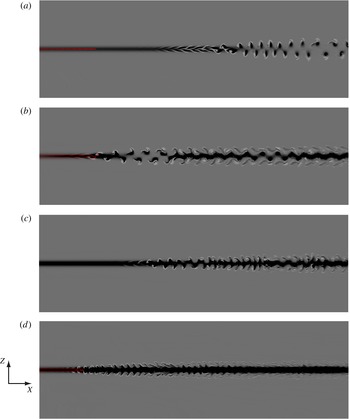
Transition processes of the streamwise vortices, described by the helicity density contours in the cross-sections through the vortex axis: (a)
 $\unicode[STIX]{x1D6F7}=0.16$
, (b)
 $0.20$
, (c)
 $0.32$
and (d)
 $0.40$
at
 $M_{\infty }=2.5$
. Positive and negative helicities are rendered in black and white, respectively. Black regions indicate the main vortical structure in the swirling flows; the red lines enclose the subsonic domain.

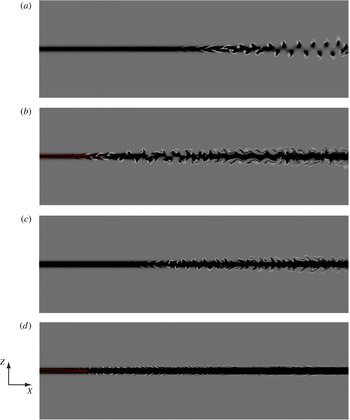
Transition processes of the streamwise vortices, described by the helicity density contours in the cross-sections through the vortex axis; (a)
 $\unicode[STIX]{x1D6F7}=0.16$
, (b)
 $0.20$
, (c)
 $0.32$
and (d)
 $0.40$
at
 $M_{\infty }=3.5$
. Positive and negative helicities are rendered in black and white, respectively. Black regions indicate the main vortical structure in the swirling flows; the red lines enclose the subsonic domain.

To begin with, to visualise the presence or absence of supersonic vortex breakdown, the helicity density contours were computed in the
 $X$
–
 $Z$
cross-sections through the vortex axis for various
 $\unicode[STIX]{x1D6F7}$
. The results for
 $M_{\infty }=2.5$
and
 $3.5$
are presented in figures 3 and 4, respectively. Note that the black part expresses the main vortical structure in swirling flows and the areas inside the red lines represent the subsonic domain. Spiral structures induced by the transitions develop around each main vortex, as observed in incompressible cases (Abid Reference Abid2008; Broadhurst & Sherwin Reference Broadhurst and Sherwin2008). Note that, in figures 3(a,b) and 4(a), there are regions with no vortex axis, indicating that the vortices have broken down. Remarkably, in figure 4(a), breakdown occurs in the absence of subsonic regions with a pure supersonic state, and the disturbances are not propagated upstream. As the parameters
 $\unicode[STIX]{x1D6F7}$
and
 $M_{\infty }$
increase, the vortex axes are sustained downstream, and the vortical structures are not disrupted.
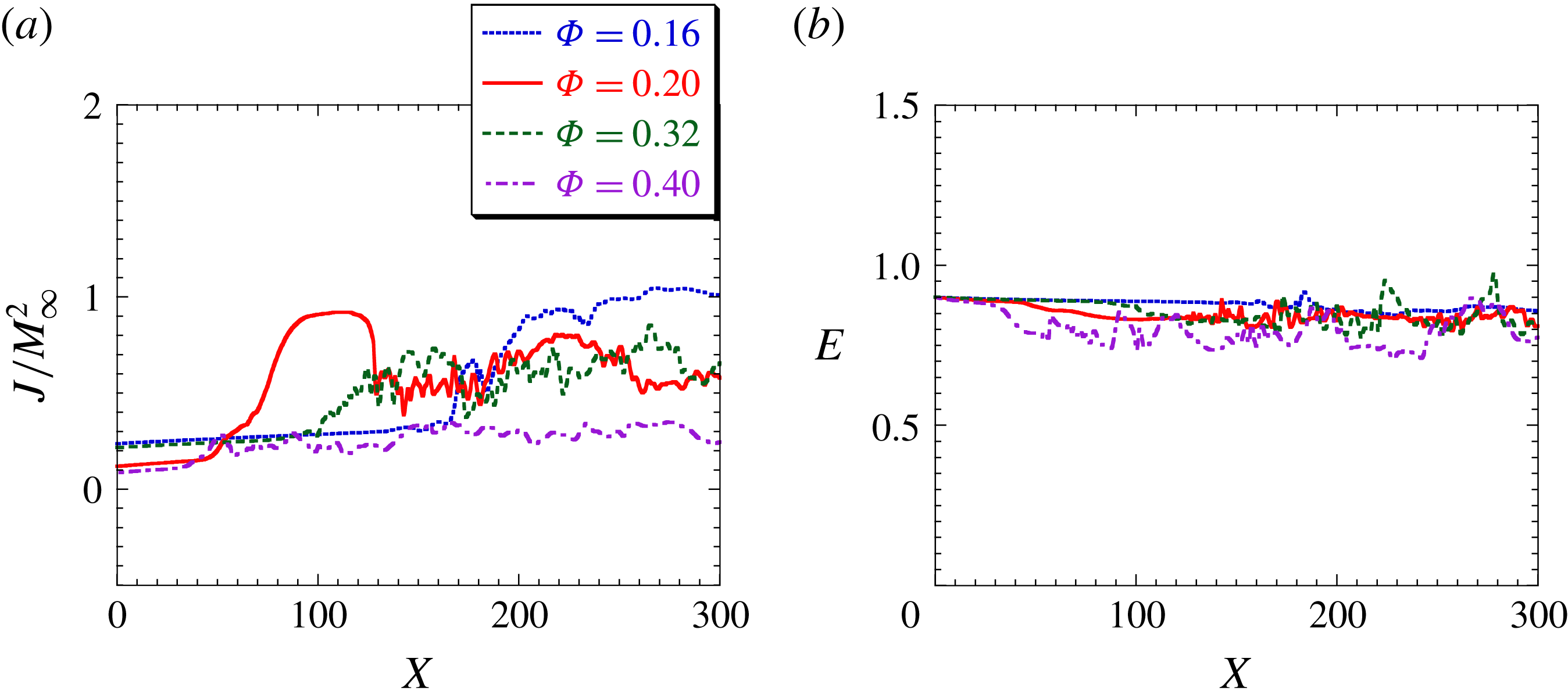
Spatial variations of (a) axial momentum and (b) energy (4.1) along the
 $X$
-axis in the numerical simulations with
 $\unicode[STIX]{x1D6F7}=0.16,0.20,0.32$
and
 $0.40$
at
 $M_{\infty }=2.5$
.

Next, the momentum variation along the axis was checked. Figure 5(a) shows the streamwise variations in axial momentum
 $J/M_{\infty }^{2}$
at
 $M_{\infty }=2.5$
. The momentum increases are slight during normal transition (based on instabilities) but very large during vortex breakdown (strong transition). At
 $\unicode[STIX]{x1D6F7}=0.16$
and
 $0.20$
, vortex breakdown is evidenced by two features in the momentum distributions: a steep rise and a steady zone. The steep rise of the axial momentum is similar to the feature of incompressible breakdowns caused by the large pressure rise (Benjamin Reference Benjamin1962; Ruith et al.
Reference Ruith, Chen, Meiburg and Maxworthy2003). The steady distribution was observed in earlier studies of vortex breakdown (Hiejima Reference Hiejima2016, Reference Hiejima2017). Thus, the momentum increases along the axis can be reasonably attributed to the occurrence of vortex breakdown. Figure 5(b) shows the streamwise energy variations along the axis at
 $M_{\infty }=2.5$
, calculated as follows:
 $$\begin{eqnarray}\displaystyle & \displaystyle E=\frac{1}{2}u_{k}u_{k}+\frac{\unicode[STIX]{x1D6FE}}{\unicode[STIX]{x1D6FE}-1}\frac{p}{\unicode[STIX]{x1D70C}}. & \displaystyle\end{eqnarray}$$
According to this figure, the energies are conserved from upstream to downstream even when breakdowns occur (
 $\unicode[STIX]{x1D6F7}=0.16$
and
 $0.20$
). This result is also important for theoretical formulations because the downstream state is usually unknown.
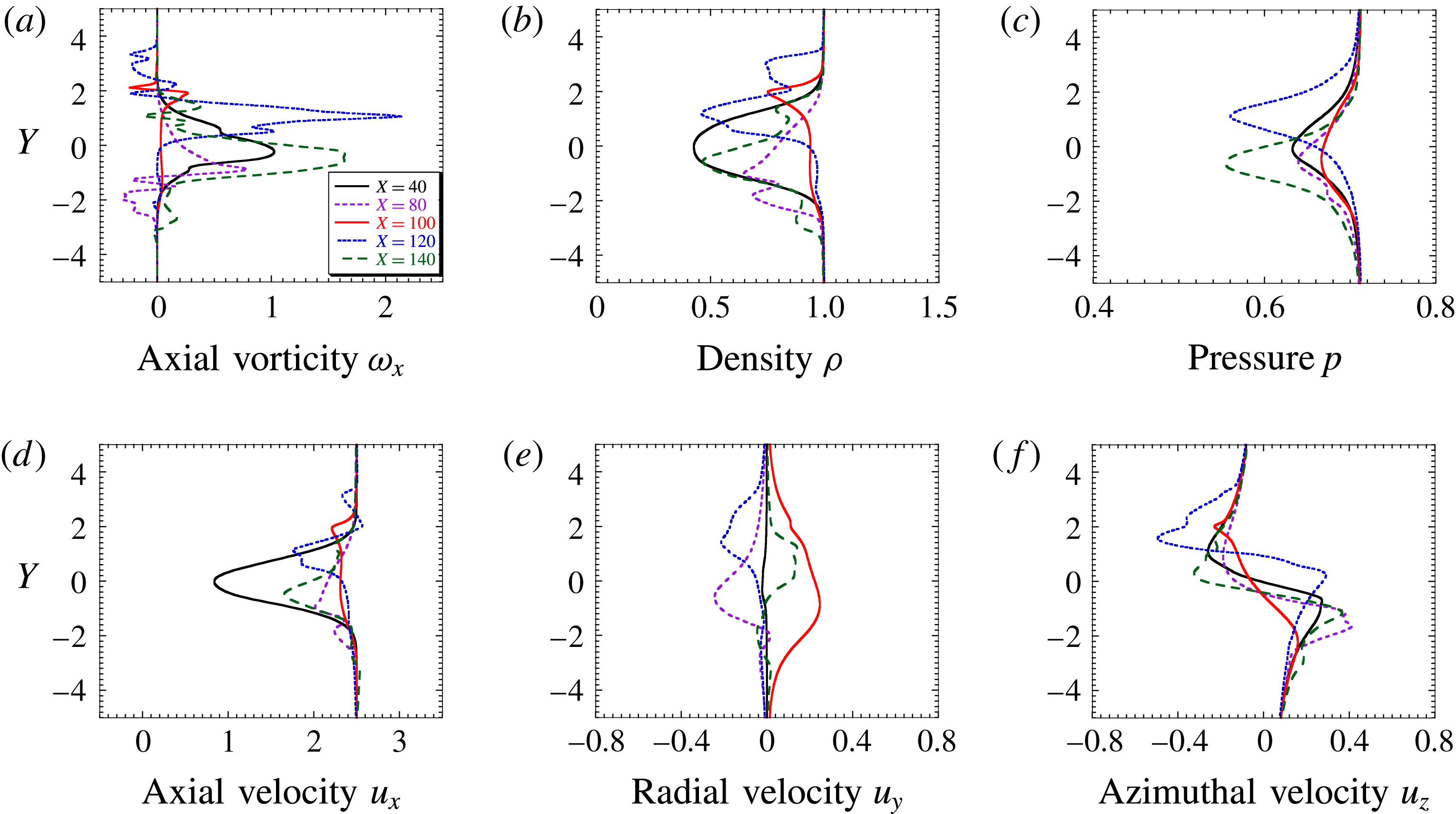
Figure 6 shows the axial vorticity and primitive variables in various planes perpendicular to the mainstream flow at
 $M_{\infty }=2.5$
and
 $\unicode[STIX]{x1D6F7}=0.20$
(note that the vortex breaks down around
 $X=100$
). The non-zero
 $u_{y}$
corresponding to the radial velocity indicates that vortex breakdown induces flow expansion. The axial velocity becomes steady at
 $X=100$
, where the axial vorticity vanishes, weakening
 $u_{z}$
corresponding to the azimuthal velocity. The pressure and density profiles are also steady there. Mager (Reference Mager1972) stated that vortex breakdown distorts both the axial and the azimuthal velocity profiles, and almost equalises the static pressure in the core. Supersonic vortex breakdown is characterised not by a large pressure rise but by increased axial density; this finding has not been previously reported. Furthermore we find that when breakdown occurs, the momentum increase satisfies (3.3) because
 $\unicode[STIX]{x2202}u_{y}/\unicode[STIX]{x2202}y\approx \unicode[STIX]{x2202}u_{r}/\unicode[STIX]{x2202}r<0$
, which numerically checks that the neglected terms in the right-hand side are small. (Note that
 $u_{r}$
is almost zero from upstream to the onset point at the axis.) Another feature of vortex breakdown is the sign change in the azimuthal vorticity
 $\unicode[STIX]{x1D714}_{\unicode[STIX]{x1D703}}$
near the axis (Brown & Lopez Reference Brown and Lopez1990). In incompressible flows, this sign change occurs when the axial velocity profile alters from jet-like to wake-like and vice versa (Oberleithner et al.
Reference Oberleithner, Paschereit, Seele and Wygnanski2012). For the Batchelor vortex in (2.1),
 $\unicode[STIX]{x1D714}_{\unicode[STIX]{x1D703}}=-\unicode[STIX]{x2202}u_{x}/\unicode[STIX]{x2202}r$
at the upstream. If a positive
 $\unicode[STIX]{x2202}u_{r}/\unicode[STIX]{x2202}x$
term appears at the downstream, the term produces the opposite sign in the azimuthal vorticity because
 $\unicode[STIX]{x1D714}_{\unicode[STIX]{x1D703}}=\unicode[STIX]{x2202}u_{r}/\unicode[STIX]{x2202}x-\unicode[STIX]{x2202}u_{x}/\unicode[STIX]{x2202}r$
. In the present case, the
 $u_{r}$
component occurs around the breakdown site. As can be seen from the helicity density contours in figure 3(b), the opposite sign in
 $\unicode[STIX]{x1D714}_{\unicode[STIX]{x1D703}}$
is described as a white part at the outer region of the vortex core, where
 $\unicode[STIX]{x1D714}_{x}$
is very small. Thus, the present breakdown also indicates the sign change.
Axial vorticity and primitive variables (density
 $\unicode[STIX]{x1D70C}$
, pressure
 $p$
and velocities
 $u_{x},u_{y}$
and
 $u_{z}$
) in various planes perpendicular to the mainstream flow at
 $M_{\infty }=2.5$
and
 $\unicode[STIX]{x1D6F7}=0.20$
.

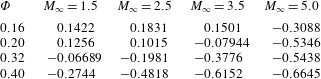
Signs of (3.4) under vortex breakdown conditions, obtained from results in the numerical simulations.

To evaluate the appropriateness of the onset condition in § 3, equation (3.4) was numerically computed for various
 $\unicode[STIX]{x1D6F7}$
and
 $M_{\infty }$
. The results are tabulated in table 1. A positive momentum change indicates the onset of breakdown. Observing this table, it is found that the breakdown condition is fulfilled when
 $\unicode[STIX]{x1D6F7}$
is small. As flow fields in vortex breakdown are subjected to modes with low azimuthal wavenumbers (Ruith et al.
Reference Ruith, Chen, Meiburg and Maxworthy2003; Herrada & Fernandez-Feria Reference Herrada and Fernandez-Feria2006; Oberleithner et al.
Reference Oberleithner, Paschereit, Seele and Wygnanski2012; Hiejima Reference Hiejima2017), the low wavenumber of an unstable mode for small
 $\unicode[STIX]{x1D6F7}$
might be an important determiner of breakdown. The five positive results of (3.4) are also consistent with the visualisation results in figures 3 and 4, which reveal regions with no main vortex axis. Therefore, the axial momentum variation calculated by (3.4) can reliably discriminate the presence or absence of vortex breakdown. To enhance further understanding of vortex breakdowns, it might be also necessary to validate the onset condition in vortices other than the Batchelor vortex.
Finally, the threshold
 $M_{2}$
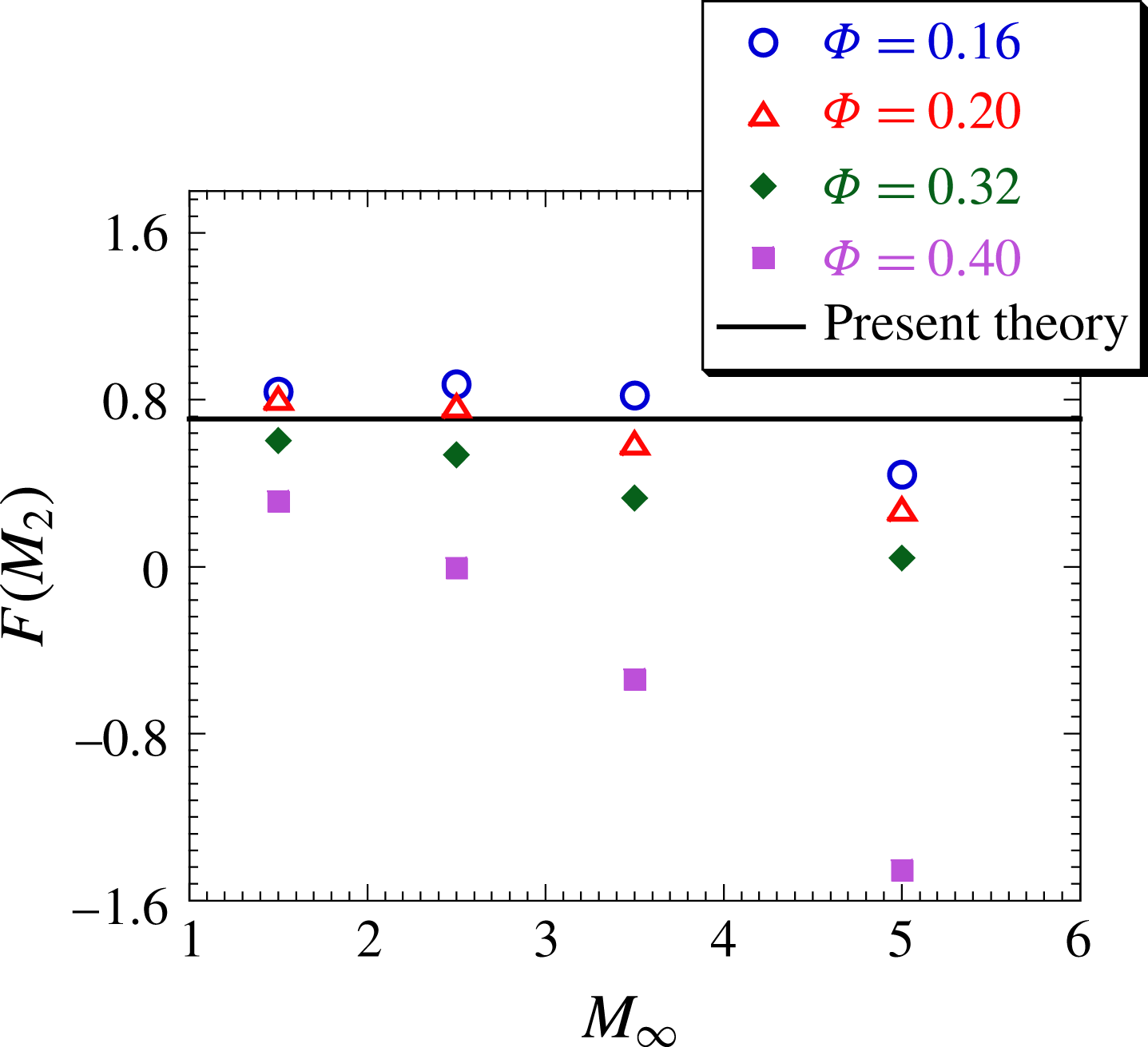
needed for supersonic vortex breakdown was calculated by (3.11). When
 $F(M_{2})>\unicode[STIX]{x1D6FC}$
, vortex breakdown occurs. The numerical results for various
 $M_{\infty }$
and
 $\unicode[STIX]{x1D6F7}$
are summarised in figure 7. In the numerical calculations,
 $M_{2}$
was taken as the maximum at the downstream. This stringent condition was chosen because the momentum increases after transition or breakdown. The development of vortex breakdown was suppressed by large swirl parameters
 $\unicode[STIX]{x1D6F7}$
and was stabilised by compressibility effects at large
 $M_{\infty }$
. The same effects were observed in transitions of streamwise vortices (Hiejima Reference Hiejima2014). As shown in figure 7, the five positive cases in table 1 satisfy the requirement of
 $M_{2}$
for vortex breakdown, confirming that (3.11) can usefully estimate the threshold
 $M_{2}$
of vortex breakdown without stagnation points. It follows that supposing a downstream pressure in (3.11) is also reasonable.
Comparison of the theoretical value calculated by (3.11) with the upstream conditions and the values of
 $F(M_{2})$
obtained from numerical simulations for
 $\unicode[STIX]{x1D6F7}=0.16,0.20,0.32$
and
 $0.40$
. When the longitudinal axis exceeds the theoretical threshold value
 $\unicode[STIX]{x1D6FC}$
, vortex breakdown occurs.

5 Concluding remarks
Vortex breakdown comprises a transition between two conjugate states of flow (Benjamin Reference Benjamin1962; Mager Reference Mager1972; Escudier Reference Escudier1988). The axial momentum is not conserved along the axis because the breakdown induces a radial velocity component (Brown & Lopez Reference Brown and Lopez1990). A supersonic breakdown configuration appears without a stagnation point, i.e. a spiral-type configuration, accompanied by axial velocity acceleration (Hiejima Reference Hiejima2017). From the accumulated knowledge, this study proposes a universal onset condition of vortex breakdowns derived from the axial momentum variation and verifies the condition using three-dimensional numerical simulations of swirling wakes (Batchelor vortices). The theoretical expression is independent of the basic flows and accounts for the increasing momentum in the streamwise direction, which is largely contributed by the breakdown phenomenon. The theoretically predicted and numerically simulated breakdowns were consistent for swirl parameters ranging from 0.16 to 0.40 and Mach numbers ranging from 1.5 to 5.0. Supersonic breakdown occurred when
 $\unicode[STIX]{x1D6F7}$
and
 $M_{\infty }$
were small, confirming that the derived condition can discriminate the presence or absence of vortex breakdown. Moreover, the expression suggests that bubble breakdown with a stagnation point is unlikely to occur under supersonic conditions (
 $M_{\infty }>1$
). The threshold of the downstream Mach number required for supersonic breakdown was also theoretically derived and verified by numerical results. Therefore, the present condition is extensively applicable to the onset of vortex breakdown for a range of speeds.
Acknowledgements
This work was partly achieved through the use of large-scale computer systems SX-ACE at the Cybermedia Centre, Osaka University and was supported by JSPS KAKENHI grant no. JP17K05145. The author expresses his gratitude to the anonymous referees for helping to improve the paper.