1. Introduction
With global warming becoming today's reality, many countries have implemented various programmes for reduction of greenhouse gas emissions, development of green technologies, or replacement of fossil fuels with eco-friendly substitutes. Government-driven stimulation of the production and consumption of renewable energy – typically, wind power, solar energy, and biofuels – has become part of national climate mitigation agendas. These efforts are encouraged by internationally pursued initiatives. The Kyoto Protocol to the United Nations Framework Convention on Climate Change (UNFCCC) recognizes that emission reductions may be achieved through promotion of ‘new and renewable forms of energy, of carbon dioxide sequestration technologies and of advanced and innovative environmentally sound technologies’.Footnote 1 In December 2010, the United Nations General Assembly declared 2012 as the ‘International Year of Sustainable Energy for All’.Footnote 2
For most countries, subsidies in the renewable energy sector are subject to the World Trade Organization (WTO) disciplines of the Agreement on Subsidies and Countervailing Measures (SCM). Subsidies for some biofuels (e.g. bioethanol) – classified as agricultural productsFootnote 3 – are also covered by the provisions of the Agreement on Agriculture. But due to the expiry of the ‘peace clause’, public support for agro-based renewables is no longer immune from legal challenges under the SCM Agreement.Footnote 4
This article will examine the state of play in anti-subsidy actions on renewable energy and argue that the SCM Agreement should be amended to prevent the escalation of trade tensions in this sphere. For this purpose, we will first review, in a general way, domestic policies of energy promotion that affect fossil fuels and renewables. Then, we will consider both WTO disputes and countervailing duty investigations, and offer some proposals that we believe would make the SCM rules more lenient towards the government support for renewable energy.
2. State of play in energy promotion policies
Subsidies in the energy sector lower the cost of energy production, raise the price received by producers, or lower the price paid by consumers. They affect carbon emissions in different ways depending on the target source of energy. As fossil fuels – oil, natural gas, and coal – account for about 80% of worldwide emissions,Footnote 5 subsidies in this segment contribute to the furthering of air pollution. Experts forecast that elimination of such subsidies by 2020 would reduce global greenhouse gas emissions in 2050 by 10%.Footnote 6 In contrast, subsidies on renewable energy – often called ‘green’ or ‘clean’ energy for their climate-friendly impacts – enable many economic operators to shift towards low-carbon production through the use of renewables and deployment of related technologies.
According to the International Energy Agency (IEA), fossil fuel subsidies amounted to $523 billion in 2011.Footnote 7 Subsidies to fossil fuel consumption are mostly motivated by social or political goals to reduce energy poverty or redistribute national resource wealth, while subsidies to fossil fuel production are driven by other rationales, such as increasing domestic production, maintaining employment, or encouraging technology development.Footnote 8 A recent report of the Organisation for Economic Co-operation and Development (OECD) on its members’ over 550 fossil fuel support measures (2005–2011) provides useful insights into subsidization patterns.Footnote 9 With respect to producers, these measures took the form of various government interventions in markets affecting costs or prices, selective tax preferences, fund transfers, assumption of part of production risks, and undercharging for the use of goods or assets supplied by the government.Footnote 10 As for consumption-level support, OECD countries exercised consumer-friendly price controls and provided direct financial transfers as well as tax reliefs and rebates on purchases of energy products.Footnote 11 Most measures directly targeted the extraction or end-use of fossil fuels, with fewer affecting the intermediate stages – transportation, refining, and processing – along the supply chain. The public incentives benefited crude oil and other petroleum products (70% in 2011) more than natural gas (18%) and coal (12%).Footnote 12
In light of the growing significance of combating climate change, the geography of countries with green energy policies has greatly expanded. As of early 2013, at least 138 countries had policy targets for development and deployment of renewable energy technologies; 127 countries pursued renewable energy support policies, with two-thirds of them being developing or emerging economies.Footnote 13 According to the IEA, the estimated amount of renewable energy subsidies in 2011 stood at $88 billion, with $64 billion going to electricity and the remainder to biofuels. Solar photovoltaic (PV) received more than any other green technology for electricity generation ($25 billion), followed by wind power ($21 billion) and bioenergy ($15 billion). The size of all renewable energy subsidies is projected to increase significantly over the next two decades at least.Footnote 14
Public stimuli either create demand for renewable energy and technologies as part of ‘market-pull policies’, or encourage supply or innovation under ‘technology-push policies’; but in practice governments tend to resort to both policies through combinations of incentive tools.Footnote 15
Products under the market-pull policies are created in response to market needs (demand) stimulated by government measures. The market-pull support for renewable energy includes: (i) price incentives for renewable-energy-generated electricity, (ii) quota obligations and tradable renewable certificates, (iii) incentives for deployment of certain technologies, and (iv) disincentives in relation to non-renewable energy. The first category typically embraces feed-in tariff (FIT) schemes that offer long-term guaranteed prices for electricity generated from clean energy sources and fed into the grid.Footnote 16 As of early 2013, 71 countries and 28 local states or provinces had FITs in place.Footnote 17 Under the second category, governments impose on electric utilities an obligation to provide or purchase a specified amount of electricity from renewables. This system – called under certain jurisdictions ‘renewable portfolio standards’ – is operated in more than 20 countries.Footnote 18 The quota obligations are usually accompanied with renewable energy certificates or credits. The latter are used as proof of renewable energy use and are normally tradable between green energy producers and electricity suppliers.Footnote 19 The third and fourth categories take the form of tax measures or other instruments that stimulate deployment of related equipment or discourage energy-related carbon emissions, respectively.Footnote 20
Technology-push incentives consist of various financial tools or equity investments for technological research, development, and manufacturing. They are aimed at the creation of new technologies in their early development stages that could, in cases of success, eventually be commercialized.Footnote 21 In other words, public support of the supply side is provided in the absence of the real demand in the marketplace. In most OECD countries, research, development, and demonstration programmes relating to renewable energy are implemented individually or in cooperation with other countries. Developing countries that are not able to invest in such programmes at the initial stages of technological development normally provide benefits to foreign enterprises to launch production within their borders with a view to securing a technology transfer.Footnote 22
In the 2009 and 2012 summits, the Group of Twenty (G-20) leaders acknowledged that inefficient fossil fuel subsidies ‘encourage wasteful consumption, distort markets, impede investment in clean energy sources and undermine efforts to deal with climate change’, and committed to rationalize and phase out these subsidies over the medium term.Footnote 23 Members of the Asia-Pacific Economic Cooperation (APEC) also released a similar statement.Footnote 24 But, so far, there has been only a modest progress in implementing these commitments.Footnote 25 There could be several reasons for this. First, many countries have faced certain barriers to reforming fossil fuel subsidies, such as opposition from interest groups, concerns over domestic producers’ international competitiveness, lack of information on the magnitude and drawbacks of these subsidies, or poor administrative capacity of the subsidizing government.Footnote 26 Second, the lack of tailor-made multilateral trade rules that would effectively restrict fossil fuel subsidies as such may also disincentivize reforms in this field. It is arguably not easy to apply the SCM disciplines to successfully block fossil fuel subsidies. For instance, quite common energy dual pricing schemes – where national authorities charge lower prices for fuel in the domestic market than for the export market – can hardly be curbed by the WTO subsidy law.Footnote 27 The reason is that these schemes are normally applied across all economic sectors – which makes them non-specific – and for social policy purposes without any purposive export promotion plans – which may insulate them from authorized actions under the SCM Agreement against export subsidies.Footnote 28 Last but not least, as noted by former WTO Director-General Pascal Lamy, the discussion on reforming fossil fuel subsidies ‘has largely bypassed the WTO’, and the absence of this issue in the WTO agenda is a ‘missed opportunity’ – something that contrasts with the case of environmentally harmful fisheries subsidies, which are specifically dealt with in the current Doha Round.Footnote 29
Although climate-harmful fossil fuel subsidies are about six times the size of climate-friendly subsidies to renewables, it is ironic that only the latter have been challenged in the WTO. This current WTO litigation trend and domestic restrictive actions – both discussed in the following section – may discourage, to some extent, the international fight against global warming and question the soundness of the present subsidy disciplines.
3. Legal actions against renewable energy subsidies
Green subsidies often benefit renewable energy goods (energy itself and related technologies), but may also confer some advantages to other goods where, for instance, such subsidies pass through from producers of renewables to downstream industries,Footnote 30 or the scope of a green subsidy is broad enough to embrace both renewable energy goods and non-related products. In other words, what can be characterized as a renewable energy subsidy may not necessarily be confined to renewables alone.Footnote 31 For convenience, we will consider here only cases where renewables and associated technologies/equipment were direct target products. Our examination in this section will cover developments up to the end of 2013.
3.1 WTO disputes
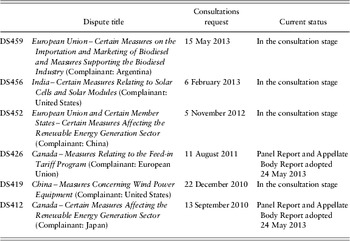
As of 31 December 2013, there were 102 dispute cases brought under the SCM Agreement,Footnote 32 and only six in Table 1 concerned renewables. All six cases – four with no actual litigation conducted and two with final decisions adopted – were triggered from 2010 onwards vis-à-vis green subsidies contingent upon the use of local content. At issue were government incentives granted in relation to renewable energy (e.g. biodiesel) and/or power generating inputs and equipment (e.g. solar cells). In the context of the SCM Agreement, the allegations in all cases were about the bestowal of import substitution subsidies within the meaning of Article 3, but some also pointed out the occurrence of adverse effects in the sense of Article 5 (DS456 and DS459). The United States additionally complained about the respondent's failure to fulfil its transparency obligations, such as notification of subsidies (DS419 and DS456) and translation of domestic legislation into the WTO official language(s) (DS419).Footnote 33
WTO subsidy disputes on renewable energy (as of 31 December 2013)

Source: Drawn up by the author from WTO, http://www.wto.org.
Two disputes, jointly referred to in this article as Canada–Renewable Energy/Canada–Feed-In Tariff Program (DS412 and DS426), dealt with the same subject matter and resulted in the adopted rulings that, in our view, have far-reaching implications for national clean energy and climate policies.Footnote 34 The main controversy here was about Canada's FIT programme under which a public organization paid to generators of electricity, produced from wind power and solar energy, fixed prices that were intended to cover generators’ costs and reasonable amounts of return. The programme was launched in Canada's Ontario in 2009 with the aim to: ‘(i) “increase capacity of renewable energy supply to ensure adequate generation and reduce emissions”; (ii) “introduce a simpler method to procure and develop generating capacity from renewable sources of energy”; (iii) “enable new green industries through new investment and job creation”; and (iv) “provide incentives for investment in renewable energy technologies”.’Footnote 35 To enjoy the FIT prices, the producers of green electricity have had to meet local content levels for qualified energy generation equipment of domestic origin.Footnote 36
With respect to subsidy issues, the Appellate Body admitted that the same measure can, in principle, fall under more than one of the types of financial contributions listed under Article 1.1(a)(1) of the SCM Agreement, but eventually agreed with the characterization of the FIT programme as a government purchase of goods (electricity in the present case).Footnote 37 As for the benefit determination, the Appellate Body started with identifying the relevant market for price comparisons. In this respect, it stressed the importance of supply-side factors – those that impact supply substitutability of products – and concluded that ‘important differences in cost structures and operating costs and characteristics among generating technologies’ prevent suppliers from switching from conventional energy to renewable sources.Footnote 38 While producers of renewable energy cannot compete in the electricity market due to these factors, it is, the Appellate Body said, the government's energy supply-mix policy that enables them to operate in the market.Footnote 39 Despite the demand-side factors that preclude consumers from distinguishing electricity based on its source of generation (be it renewable or conventional energy), the Appellate Body stressed the supply-side factors to conclude that the benefit comparison should be conducted not within the entire electricity market, but exclusively within wind-power- and solar-energy-generated electricity markets.Footnote 40 Under this market definition, prices for clean energy paid by the government cannot be compared with prices of conventional energy – which are typically lower than the former – to find an advantage (in the SCM specific terms, ‘more than adequate remuneration’) to green electricity generators. Furthermore, the Appellate Body held:
[A] distinction should be drawn between, on the one hand, government interventions that create markets that would otherwise not exist and, on the other hand, other types of government interventions in support of certain players in markets that already exist, or to correct market distortions therein. Where a government creates a market, it cannot be said that the government intervention distorts the market, as there would not be a market if the government had not created it. While the creation of markets by a government does not in and of itself give rise to subsidies within the meaning of the SCM Agreement, government interventions in existing markets may amount to subsidies when they take the form of a financial contribution, or income or price support, and confer a benefit to specific enterprises or industries.Footnote 41
In short, this interpretation suggests that government action towards the creation of a new market (a renewables-based electricity market in the present case) does not, in itself, amount to a subsidy. To complete the benefit analysis, the Appellate Body recognized that FIT wind-power prices could, in principle, be compared to wind-power prices under certain Canadian renewable energy schemes that had preceded the current FIT programme. Such a price comparison seemed to the Appellate Body to show the existence of a FIT-benefit for wind-power generators, but the factual evidence on the record was not enough to prove it. As for solar energy, no appropriate data were available. Thus, the Appellate Body could not find any FIT-attributable benefit, and hence a subsidy. As a result, it was unable to decide on whether the FIT programme constituted an import substitution subsidy inconsistent with Article 3 of the SCM Agreement.Footnote 42
As we concluded elsewhere,Footnote 43 the appellate interpretations concerning the FIT programme deserve praise as they carve out some policy space for governments promoting clean energy. In particular, the narrowed definition of the relevant market and the exclusion of the government's market-creating role from the definition of ‘subsidy’ will make it more difficult for one to secure legal remedies against many renewable energy programmes, particularly where only government intervention can make high-cost and economically inefficient green projects implementable. It is also quite interesting to note that the Appellate Body failed to find a FIT-based benefit even in the case at hand where the existence of the pre-FIT renewable energy programmes could, in principle, suggest that Canada's green energy segment was at a relatively advanced (rather than infant) level of development. To put it differently, one may say that even in the circumstances of this case, where the prior programmes seem to have already established the renewable energy market in Canada, the Appellate Body was somewhat reluctant to characterize the FIT as a WTO-regulated ‘subsidy’ in apparent recognition of its importance in tackling carbon emission problems.
3.2 Countervailing duty cases
As with the WTO litigation trend, renewables-related subsidies have been challenged through countervailing duty investigations only recently.Footnote 44 In this section, we will consider relevant practices of the United States and the European Union – two most frequent users of the countervailing mechanism.Footnote 45 In all respective cases below, each of them has also conducted parallel anti-dumping investigations on the same target products, and applied quite high anti-dumping duties in addition to the countervailing duties imposed. But the anti-dumping cases are beyond the scope of this study.
(1) US cases
As seen from Table 2, the United States investigated, as of the end of 2013, two countervailing duty cases on renewable energy goods, namely Chinese solar cells and wind towers. The investigation on solar cells was initiated in 2011 by the petition of Solar World Industries America Inc. – the largest US producer of crystalline silicon PV products. The Department of Commerce (DOC) confirmed subsidization of solar cells and consequently assigned final countervailing duties ranging from 14.78% to 15.97%.Footnote 46 The second investigation conducted during 2012 at the request of the Wind Tower Trade Coalition determined the countervailing duty rates to be 21.86%, 34.81%, and 28.34%.Footnote 47 Following the International Trade Commission's affirmative injury determinations, the DOC issued duty orders in each case.
US countervailing duty cases: original investigations (as of 31 December 2013)

Source: International Trade Administration, US DOC, http://trade.gov/enforcement/ (accessed 2 January 2014).
Both investigations dealt with a huge number of governmental programmes with several of them found to be countervailable subsidies. In accordance with the general calculation methodology, the DOC here added subsidy rates of all countervailable programmes together to define total (or net) subsidy rates for the target companies concerned. The total rates, in turn, defined the amount of countervailing duties.
Most typical forms of the countervailable subsidies in two cases were grants, preferential loans, tax benefits, and provision of certain goods (inputs, electricity, and land) at below-market prices. The DOC concluded that they were specific to certain enterprises or their groups, a renewable energy industry or particular regions (such as special zones). It is noteworthy that some of these subsidy schemes – e.g. the Golden Sun Demonstration Programme or the Policy Lending to the Renewable Energy Industry – were designed specifically for renewable energy, whereas others – e.g. the Value Added Tax and Tariff Exemptions on Imported Equipment – were available to a broader scope of projects.Footnote 48
On 31 December 2013, Solar World Industries America Inc. made an official request for a new investigation on solar PV products from China and Taiwan in order, it says, to ‘close a loophole’ in the earlier DOC's decision on Chinese solar cells that allegedly allowed Chinese producers to circumvent the established duties. In particular, the petitioner claims that because the previous investigation covered solar cells and panels manufactured in China but not panels assembled in China from cells produced elsewhere, the Chinese producers changed their production models in order to export to the United States with no need to pay the imposed duties.Footnote 49
(2) EU cases
Prior to the discussion of EU cases, two distinctive features of EU's countervailing duty law that existed at the time of writing are worth noting. Unlike the US DOC, the European Commission calculates injury margins – numeric levels sufficient to eliminate injury caused by subsidized imports – in addition to subsidy margins (rates). Then, in line with the WTO's non-binding ‘lesser duty’ rule, it chooses the lower margin for the determination of the amount of countervailing duties. Moreover, the European Commission additionally considers whether the application of countervailing duties is not against the Community interest, including the interests of consumers.
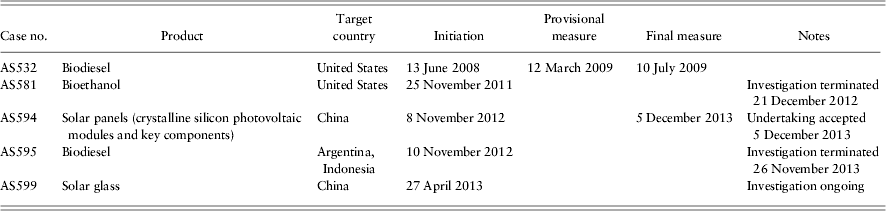
Compared to the United States, the European Union launched a larger number of investigations, with three on imports of renewable energy as such (biodiesel and bioethanol) and two on green-energy-generating products (solar panels and solar glass). As is evident from Table 3, the scope of target countries was broader as well. As of 31 December 2013, only the cases on US biodiesel and Chinese solar panels resulted in the actual imposition of final duties. Countervailing duty proceedings on US bioethanol were terminated in light of the withdrawal of a main subsidization measure and the de minimis level of the subsidy amount under remaining programmes.Footnote 50 The investigation on biodiesel from Argentina and Indonesia was terminated at the complainant's request,Footnote 51 whereas the case on China's solar glass was still pending.
EU countervailing duty cases: original investigations (as of 31 December 2013)
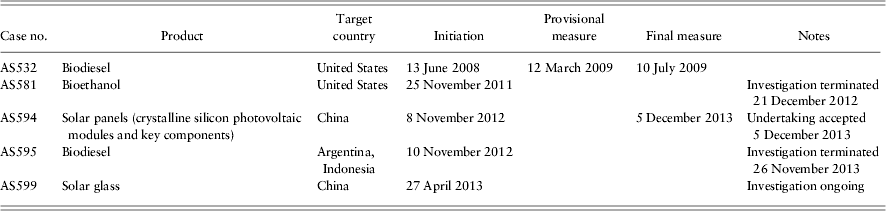
Source: European Commission, http://trade.ec.europa.eu/tdi/completed.cfm (accessed 2 January 2014).
The case on US biodiesel was initiated by the European Commission following a complaint by the European Biodiesel Board over various federal and state schemes – mostly tax incentives tailored to a biodiesel industry. In addition to subsidy and injury determinations, the European Commission considered the interests of the industry concerned, raw material suppliers, importers and users of the product under consideration. It confirmed the existence of injurious subsidies and concluded that there were no compelling reasons of Community interest against the imposition of countervailing duties. As a result, the Council of the European Union imposed fixed-amount duties of €211.2–237 per tonne net, which corresponded to the established subsidy margins of 29.1–41.1%.Footnote 52 As a subsequent investigation found circumvention of the definitive countervailing duties through transhipment of biodiesel via Canada, the Council of the European Union decided to extend the duties to biodiesel imports from Canada.Footnote 53
As for China's solar panels, the investigation looked into a variety of subsidy programmes, including preferential loans and insurance schemes, grants, tax credits, and provision of goods for less than adequate remuneration, with many of them being also examined in the US case on Chinese solar cells above. Some of the financial support under consideration was provided by state-owned commercial and policy banks found to be ‘public bodies’ or by private banks found to be ‘entrusted or directed’ by the Chinese government. A lengthy examination of the Community interest revealed that the overall positive impact of the duties on the domestic producers outweighed the likely negative effects for consumers and other interested parties. As with the case on US biodiesel, the European Commission here determined the countervailing duties on the basis of subsidy margins rather than higher injury margins. The Council of the European Union imposed definitive countervailing duties ranging from 0% and 3.5% to 11.5% on Chinese exporters, except companies whose undertaking was formally accepted by the European Commission.Footnote 54 According to a press release, roughly 75% of the solar panel imports from China are covered by the undertaking and are thus exempt from the definitive duties.Footnote 55
3.3 Implications
Trade conflicts on renewable energy subsidies began to develop just a few years ago showing an emerging wave of friction in this field. WTO disputes have so far dealt with renewable energy stimuli linked to local content requirements that would, if proven, make them prohibited subsidies. On the one hand, the avoidance of local content or export-linked conditions would definitely place subsidizing governments on a safer footing, as in this case complainants would bear an additional (and sometimes heavy) burden of proof for, inter alia, specificity and adverse effects in order to win their claims on the existence of harmful actionable subsidies.Footnote 56 On the other hand, legal attacks against actionable green subsidies cannot be ruled out altogether, as the competition among the product suppliers concerned will grow with the passage of time. Indeed, as mentioned above, the complainants in two non-adjudicated disputes cited Article 5 of the SCM Agreement on adverse effects, together with Article 3. Moreover, actionable subsidy issues have already been raised in domestic investigations, as many programmes considered in the US and EU countervailing duty cases did not have any ‘red light’ conditionality within the meaning of Article 3.
Therefore, renewable energy subsidies are always exposed, albeit with different probability, to a risk of external counteractions via multilateral or domestic proceedings. In the next section, we will see if there is any way to ‘green’ the WTO's current anti-subsidy approach that would reduce such a risk.
4. A search for ‘greening’ options
Renewable energy subsidies – that will enlarge over time as mentioned above – deserve special treatment under WTO law for several reasons. First, economic theory generally justifies them in light of a market failure. That is, when deciding whether to produce renewable energy and associated technologies, companies will compare their private costs with private benefits. Since they will not consider environmental benefits to society – ‘positive externalities’ – they will under-produce or under-invest due to production costs exceeding private benefits. Government subsidies that directly or indirectly reduce the production costs would thus correct this market failure.Footnote 57 As acknowledged in Canada–Renewable Energy/Canada–Feed-In Tariff Program, the government indeed plays an important role in the formation of a low-carbon market.Footnote 58 Second, subsidies are comparatively easier to implement to cause a price-cutting effect on clean energy. In fact, carbon taxes – special charges on the carbon content of products – would probably be economically more efficient, but, as former Chairman of the Appellate Body James Bacchus rightly notes, in virtually all parts of the world, subsidies tend to be ‘the only practical political alternative for producing renewable energy competitively’.Footnote 59 Indeed, many authorities prefer to confer a benefit via green subsidies than a cost on emitters through publically sensitive taxes.Footnote 60 Furthermore, elimination or reduction of customs duties on clean energy goods greatly facilitates trade in this sphere, but it is still questionable if this measure alone would make renewables sufficiently price-competitive, as countries continue to subsidize even though they can abolish such tariff barriers unilaterally or through negotiations.
Green subsidies can, in principle, be temporarily exempted from WTO rules through the waiver procedures. The Ministerial Conference may waive a member's obligation in ‘exceptional circumstances’.Footnote 61 For prohibited subsidies, it seems to be unlikely for the Ministerial Conference to accept any waiver request, because subsidization of renewable energy is possible without localization or export-oriented preconditionsFootnote 62 – a fact that may downplay any requesting party's ‘exceptional’ case. Actionable subsidies for renewables are so commonly used across the globe that any waiver granted to one country may cause a domino effect by generating a multitude of similar waiver requests. In any event, governments tend to apply for a waiver when they are sure that the measure concerned definitely violates WTO law. But, as far as actionable subsidies are concerned, it is not easy (if not impossible) for the subsidizing member to predict or assess the external negative effects attributable to its subsidies. Without full knowledge of these effects, there is no reason for it to make a waiver request. Notwithstanding its availability, the general waiver option may thus face certain practical constraints. This probably explains why no waiver has so far been granted in the WTO to any particular subsidy.Footnote 63 Thus, ‘greening’ the SCM Agreement through law reforms is arguably the most efficient way to appropriately accommodate climate mitigation actions.Footnote 64
4.1 Exemption of renewable energy subsidies from legal challenges
Originally, the SCM Agreement treated certain subsidies as non-actionable, i.e. immune from multilateral and domestic remedies,Footnote 65 provided they met strictly defined conditions. In particular, currently inoperative Article 8 distinguished three categories of permissible (‘green light’) subsidies, with environmental, and research and development (R&D) subsidies among them being directly relevant to green energy stimuli. Non-actionable environmental subsidies – public assistance to promote firms’ adaptation to new environmental regulations – consisted in a one-time non-recurring measure covering up to 20% of the cost of adaptation and satisfying other cost-related requirements.Footnote 66 Non-actionable R&D subsidies – assistance for research activities by firms or higher education or research organizations – had the cost ceiling of 75% for ‘industrial research’ and 50% for ‘pre-competitive development activity’ and could cover only the specified types of costs.Footnote 67 Article 8 subsidies were subject to ex ante and ex post notification requirements, as well as reviews by the SCM Committee, binding arbitration, or bilateral consultations, where appropriate.Footnote 68 However, not a single subsidy has ever been notified under Article 8 because of burdensome procedures, fear of potential WTO-consistency reviews and legal challenges.Footnote 69 Moreover, as a notification per se was not a prerequisite for members to rely on the green light defence, there was no incentive to notify.Footnote 70 Last but not least, the overly strict eligibility criteria significantly narrowed the scope of non-actionable environmental or R&D programmes, so that Article 8 was not helpful to WTO members.Footnote 71 Article 8 was effective until 31 December 1999, and could not be extended because of the persistent disagreement among members.Footnote 72
Since the ‘safe harbour’ under the Article 8 provisions was never utilized, the revival of these provisions in their original form would barely help to shield clean energy subsidies today. Instead, we suggest that members negotiate an interim but extendable renewables-specific ‘due restraint’ clause that would prevent anti-subsidy challenges on both multilateral and domestic fronts.Footnote 73 This clause should not apply to renewable energy measures that are classifiable as prohibited subsidies. Otherwise, the shelter for e.g. a local content green subsidy would make no sense, as the associated localization requirement could be disputed under national treatment provisions of other WTO agreements. On the other hand, the proposed clause would benefit actionable subsidies on green energy that, as noted in section 3.3 of this article, have already been targeted through relevant proceedings.
As elaborated in the following paragraphs, in order to minimize possible distortive effects on trade, the due restraint should only apply to: (i) products that are directly tied to renewable energy and (ii) members that certainly deserve such a treatment.
With respect to the product coverage, the due restraint should apply to a specified list of renewable energy goods. In the Doha negotiations on environmental goods and services, the Chairman identified, on the basis of member-proposed lists, 408 environmental goods falling under any of the six categories: (i) air pollution control, (ii) renewable energy, (iii) waste management and water treatment, (iv) environmental technologies, (v) carbon capture and storage, and (vi) others.Footnote 74 Referring mainly to the second and fourth categories, a recent study offered a list of 39 narrowly defined ‘sustainable energy’ goods.Footnote 75 This short list could also be considered as a baseline for further scoping of goods for the due restraint.
As for eligible countries, the suggested clause should apply to members differently depending on their green development level – be it countries with an infant or advanced renewable energy industry. For instance, it could set forth specific criteria for defining competitiveness of each member's product concerned to determine its inclusion in and graduation from the due restraint protection. Similar to the Agreement on Agriculture, the due restraint of the SCM Agreement could apply to the bound amounts of renewable energy subsidies to be cut over time. In addition, more favourable conditions could be foreseen for the WTO members that have assumed emission reduction obligations under the Kyoto Protocol regime.Footnote 76 The flexibility of this kind is worth exploring as it would strengthen coherence in global governance over trade and climate change issues.Footnote 77
The due restraint on renewables could be negotiated under the present Doha mandate for rules negotiations and eventually be reflected in a revised text of the SCM Agreement. It is not implausible to believe that such a revision could be achieved. On the contrary, the fact that the recent Ministerial Conference in Bali (2013) managed to agree on a highly controversial due restraint on some agricultural subsidies should rather encourage members to seek it.Footnote 78
Should, however, this agenda fail to draw the necessary support in multilateral negotiations, it could be pursued under plurilateral negotiations on an Environmental Goods Agreement (EGA) that were launched in the WTO in 2014 by a group of members with a view to eliminating tariffs on environmental goods and addressing certain legal issues.Footnote 79 The talks build on a list of 54 environmental goods adopted by the APEC in 2012, with the participating countries accounting for nearly 90% of world trade in the covered goods.Footnote 80 As with the case of the Information Technology Agreement (ITA), the ultimate results of this plurilateral initiative are expected to apply on a most-favoured-nation basis.Footnote 81 In our view, the due restraint on subsidies for renewables – a subset of environmental goodsFootnote 82 – could well become a potential legal issue to be dealt with under the EGA. If inserted, the due restraint rule would not only prevent, de jure, intra-EGA challenges, but also preclude, de facto, legal actions by non-parties in light of the EGA's critical mass principle. Sceptics may argue that carving out such a policy space for subsidies which themselves create non-tariff barriers is somewhat contradictory to the EGA's general goal to remove obstacles to green trade. But one may rightly object by saying that this approach would simply follow the established practice in the WTO (and beyond) of liberalizing trade on the one hand and injecting appropriate derogations or exceptions on the other.
4.2 Relaxation of the countervailing mechanism
If the outright due restraint for domestic anti-subsidy measures on renewable energy goods is not accepted for some reasons, there is still a room for softening certain elements of the countervailing mechanism. First, WTO members could agree to green the current requirements for termination of investigations in case of de minimis subsidies and negligible imports.Footnote 83 Under the SCM Agreement, the amount of a subsidy is de minimis if it is less than 1% ad valorem (or 2% and 3% for designated developing countries);Footnote 84 negligible volumes of subsidized imports are specified only for developing countries at a level of less than 4% of total imports.Footnote 85 But the members could increase these numeric thresholds for imports of renewable energy and associated equipment, subject to eligibility criteria they may define for target products and countries. In this case, in line with the general methodology of the calculation of subsidization rates, all countervailable subsidy programmes covered by the same investigation would typically be counted towards the determination of such an increased de minimis level. Furthermore, the members could also establish a separate de minimis level for each subsidy programme considered in a single investigation on renewables. For instance, the general practice of the US DOC is to disregard any governmental programme or scheme with the subsidy rate of 0.005% or less, and consequently to not include it in the net subsidy (hence, countervailing duty) rate calculations.Footnote 86 Similarly, the European Union also ignores ‘insignificant’ subsidy programmes.Footnote 87 Curtailing a restrictive impact on imports, this kind of treatment of minor programmes, albeit not explicitly provided for by the SCM Agreement, does not run afoul of it. If members take the US practice as a benchmark, they could set out a programme-specific de minimis margin at a level higher than 0.005% for imports of renewable energy goods.
Second, Article 19.2 of the SCM Agreement states that it is ‘desirable’ for members to have domestic procedures for public interest and lesser duty considerations that would precede the imposition of countervailing duties. These procedures are optional, but their actual application may certainly relax the countervailing mechanism. In the Doha talks on rules, the proposal to make public interest and lesser duty procedures mandatory for anti-dumping matters has faced diametrically opposed reactions among negotiators.Footnote 88 Given procedural similarities between anti-dumping and countervailing duty investigations, we expect that this proposal would also encounter similar constraints if it were discussed in the context of SCM rules. Thus, at the outset, members could agree to limit this initiative to renewable energy subsidy cases. If this experiment succeeds, it could then be extended to other cases as well.
4.3 Application of Article XX flexibilities
Whether general exceptions under Article XX of the General Agreement on Tariffs and Trade (GATT) for e.g. protection of human, animal or plant life, or health and conservation of exhaustible natural resources can be invoked in relation to green subsidies is a controversial question.Footnote 89 The original text of the SCM Agreement struck a balance between the obligation of members to avoid prohibited subsidies and harmful actionable subsidies and their right to subsidize for some socially desirable goals. With the termination of the green light provisions, this balance has been disturbed. Yet, it is still unclear whether this mere fact will justify Article XX invocations in the SCM context. Even if one assumes that footnote 56 to Article 32.1 of the SCM Agreement does not rule out the Article XX application, this would work only for anti-subsidy measures rather than the use of subsidies.Footnote 90 In this section, we will argue that Article XX is not likely to apply to renewable energy subsidies, so members should undertake appropriate rule reforms.
(1) Multilateral agreements on trade in goods
Three non-GATT texts under Annex 1A of the WTO Agreement make clear references to Article XX. In particular, the Agreement on Trade-Related Investment Measures (TRIMs) accepts ‘[a]ll exceptions under GATT 1994’ and bans illegal TRIMs ‘[w]ithout prejudice to other rights and obligations under GATT 1994’.Footnote 91 The Agreement on the Application of Sanitary and Phytosanitary (SPS) Measures refers to Article XX(b) and uses Article XX-like language.Footnote 92 Since the SPS Agreement itself elaborates Article XX(b), an SPS-violation cannot be justified through Article XX(b) as such.Footnote 93 The Agreement on Preshipment Inspection allows deviations from some transparency obligations ‘in emergency situations of the types addressed by Articles XX and XXI of GATT 1994’.Footnote 94 In contrast, Article XX is not referenced in the Customs Valuation Agreement, the Safeguards Agreement, the Agreement on Rules of Origin, and the Agreement on Import Licensing Procedures. The latter explicitly accepts only security exceptions under GATT Article XXI.Footnote 95
Article 18.1 of the Anti-dumping Agreement forbids any ‘specific action against dumping … except in accordance with the provisions of GATT 1994 [i.e. Article VI], as interpreted by this Agreement’. Footnote 24 to Article 18.1 adds that this requirement does not ‘preclude action under other relevant provisions of GATT 1994, as appropriate’. Pursuant to the appellate interpretation, this implies that a GATT-consistent action – other than ordinary anti-dumping measures – which is not ‘specific’ in the sense of Article 18.1 but is related to dumping is not prohibited.Footnote 96 The same is true, mutatis mutandis, for footnote 56 to Article 32.1 of the SCM Agreement which is analogous to footnote 24 above.Footnote 97 In US–Shrimp (Thailand)/US–Customs Bond Directive, the Appellate Body merely assumed arguendo that the Article XX defence was available for unlawful specific actions against dumping within the meaning of Article 18.1. Thus, it effectively avoided the Article XX applicability issue in the anti-dumping context.Footnote 98 Whether Article XX can apply under Article 32.1 of the SCM Agreement is similarly an open question.
The Agreement on Technical Barriers to Trade (TBT) contains Article XX-like language in several provisions,Footnote 99 but no single general exceptions clause. Furthermore, Article XX flexibilities have been reflected in the judicial interpretation of the concept ‘less favourable treatment’ under Article 2.1 of the TBT Agreement – the non-discrimination rule that itself is silent on such flexibilities.Footnote 100 Given the explicit or implicit presence of the Article XX flexibilities in various TBT provisions, GATT Article XX per se will hardly serve as a legal defence here.Footnote 101
The Agreement on Agriculture makes Members’ scheduled commitments on domestic support and export subsidies ‘an integral part of GATT 1994’, but stipulates that the GATT and other multilateral trade agreements on goods apply ‘subject to the provisions of this Agreement’.Footnote 102 Since the binding obligation on subsidies and relevant exceptions are subjected solely to the provisions of the Agreement on Agriculture,Footnote 103 Article XX will arguably not justify a breach of this obligation.Footnote 104
(2) Other instruments
The General Agreement on Trade in Services (GATS) has its own clauses on general and security exceptions analogous to GATT Articles XX and XXI.Footnote 105 The Agreement on Trade-Related Aspects of Intellectual Property Rights (TRIPS) contains a separate security clauseFootnote 106 and Article XX-like flexibilities under several provisions,Footnote 107 but no single Article XX-like provision. In the EC–Trademarks and Geographical Indications case dealing with national treatment claims under the GATT and the TRIPS Agreement, the panel held that the absence in the latter of a single clause comparable to Article XX has no impact on its analysis of national treatment under the TRIPS Agreement. The panel stressed that the TRIPS Agreement and the GATT apply cumulatively without being in a hierarchical relationship, and that consistency with one covered agreement does not necessarily imply consistency with remaining covered agreements.Footnote 108 It is also remarkable that the absence of the general exceptions clause is contrasted sharply with the presence of the security exceptions clause in the TRIPS Agreement. Thus, GATT Article XX cannot be applied to TRIPS violations.
With respect to plurilateral agreements, Article XX is not applicable under the Agreement on Government Procurement due to the existence of the lex specialis on general exceptions.Footnote 109 The Agreement on Trade in Civil Aircraft as amended by the 2001 Protocol seems to preclude the application of Article XX to re-imposition of duties once eliminated, by stating that nothing in the Agreement or Protocol affects a signatory's rights and obligations under other WTO agreements ‘[e]xcept with respect to requiring duty-free treatment for products covered by this Protocol’.Footnote 110 The ITA requires that each party's measure to bind and eliminate duties and charges ‘within the meaning of [GATT] Article II:1(b)’ on covered products be incorporated in its GATT schedule of concessions, making it part of the GATT.Footnote 111 As the ITA does not indicate otherwise, Article XX could, in principle, be invoked in case of a reintroduction of duties on scheduled products for Article XX-listed legitimate objectives.
In three disputes, the Article XX issue arose in the context of accession obligations. In China–Publications and Audiovisual Products, China invoked the Article XX(a) defence vis-à-vis paragraph 5.1 of its Accession Protocol. The panel decided to assess, on an arguendo basis, the merits of China's defence before judging whether Article XX(a) was available to China's breach. Although this sequence of inquiries was exactly what the Appellate Body itself had followed in US–Shrimp (Thailand)/US–Customs Bond Directive, the Appellate Body this time disapproved of this approach for being, inter alia, ‘at odds with the objective of promoting security and predictability through dispute settlement’ and decided first to see if the Article XX defence was available and then to proceed with the merits of this defence.Footnote 112 Paragraph 5.1 of the Accession Protocol obliges China to ‘progressively liberalize the availability and scope of the right to trade’ – so that all Chinese enterprises could freely import and export goods – ‘[w]ithout prejudice to China's right to regulate trade in a manner consistent with the WTO Agreement’. Given that the ‘WTO Agreement’ embraces the GATT, and consistency with the WTO Agreement can be achieved, inter alia, through justification by GATT Article XX, the Appellate Body confirmed China's right to rely on the public moral exception under Article XX(a).Footnote 113
In contrast, the availability of Article XX was rejected vis-à-vis another Chinese commitment. In China–Raw Materials, at issue was paragraph 11.3 of China's Accession Protocol that reads: ‘China shall eliminate all taxes and charges applied to exports unless specifically provided for in Annex 6 of this Protocol or applied in conformity with the provisions of Article VIII of the GATT 1994.’ The Appellate Body concluded that China could not rely on the Article XX defence for several reasons including, inter alia: (i) the omission of Article XX in that particular part of the Protocol, on the one hand, and the explicit reference to GATT Article VIII therein, on the other; (ii) the emergence of China's obligation to eliminate export charges exclusively from the Accession Protocol and not from the GATT; (iii) the absence in paragraph 11.3 of the ‘without prejudice’ language, which is used in paragraph 5.1 of the Accession Protocol above; and (iv) the practice of WTO members to incorporate, ‘by cross-reference’, Article XX into other covered agreements.Footnote 114 But, in China–Rare Earth, China asked the panel to depart from this appellate finding. Although the panel majority dismissed China's request for the lack of any ‘cogent reason’,Footnote 115 a dissenting panellist disagreed on some interpretative points. This panellist noted that the WTO Agreement and its components, including the accession documents, constitute a single undertaking to be interpreted holistically. Having become part of the GATT as a ‘WTO-plus’ provision, paragraph 11.3 must, in the dissenter's view, be read together with GATT Articles II and XI on border tariff measures. Eventually, the dissenting panellist concluded that China's right to invoke Article XX under the accession commitment in question could not be denied as the Protocol does not contain explicit language to the contrary.Footnote 116
(3) Legal implications for the SCM agreement
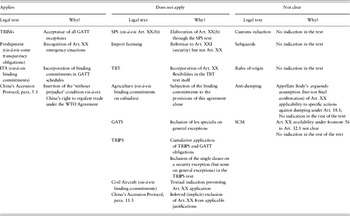
Although most of the multilateral agreements on goods, including the SCM rules, develop or are otherwise relevant to certain GATT provisions, this fact alone does not suffice to properly address the question of Article XX applicability. As is evident from the observations above, this requires a case-by-case examination. Table 4 divides the WTO texts roughly into three categories with different regimes on this issue. The uncertainty about the status of Article XX in the third category that comprises the subsidy rules could be minimized with the use of the arguendo technique, but the appellate finding in China–Publications and Audiovisual Products unequivocally rejected this approach.
Applicability of GATT Article XX within WTO Law

Source: Drawn up by the author.
The WTO jurisprudence has accepted the invocability of Article XX only in the presence of a specific textual basis. This approach coincides with the judicial treatment of the applicability of another exception under the GATT – Article XXIV on regional trade arrangements – to a non-GATT text – the Agreement on Textiles and Clothing. Specifically, in Turkey–Textiles, the right to invoke Article XXIV was upheld in light of a textual link in that particular agreement.Footnote 117 Although the dissenting opinion in China–Rare Earth reinterpreted the rules to accommodate general exceptions where legal ambiguity existed, its legal effect is rather limited.
It follows from this analysis that renewable energy subsidies are not eligible for the GATT general exceptions. To change the status quo, genuine legislative improvements are required. In particular, WTO members should amend the SCM Agreement in a manner that would preclude actions against Article XX-justifiable green subsidies. Alternatively, they could even take bolder steps to make the exceptions under GATT Article XX (and Article XXI) common to all WTO obligations. To this end, they could, for instance, adopt a new instrument (e.g. ministerial decision or declaration) that would reiterate the text of Articles XX and XXI and stipulate that these provisions would apply in the WTO across the board without prejudice to comparable exceptions and flexibilities under other trade rules in force.Footnote 118 This would make the use of the general and security exceptions – which appear to be equally important – more consistent, thereby rectifying the puzzling situation where some WTO agreements explicitly mention Article XXI but omit Article XX. The words ‘without prejudice’ would arguably prevent any overlap with existing exceptions and flexibilities. The proposed blanket clause would fill a lacuna where the text is silent on the applicability of the GATT provisions in question, and thus cover climate mitigation subsidies if the SCM Agreement itself is not revised accordingly. But in a long term, there is a need to revisit, if not rewrite, all existing exceptions and flexibilities to make them more harmonious throughout the whole WTO system and more responsive to current challenges.
5. Conclusion
Governments subsidize the renewable energy sector to reduce dependence on climate-threatening fossil fuels. But the recent wave of trade tensions over validity of these subsidies will likely intensify, as the world market of renewables is growing. To date, subsidized renewable energy goods have been subjected to several import-restrictive investigations of big economies. In parallel, an increasing number of WTO disputes in this field have taken place as well.
Fortunately, the first WTO ruling on public incentives on renewables seems to have sent an encouraging signal to many national authorities pursuing a low-carbon policy agenda. In Canada–Renewable Energy/Canada–Feed-In Tariff Program, the Appellate Body interpreted the concept ‘subsidy’ in a way that broadens the scope of SCM-exempt government responses to global warming. But judicial interpretations have only case-specific binding or ‘precedential’ effects on disputing parties where relevant. The ball is now in members’ court. As decision-makers, they have to quickly undertake meaningful law reforms to relax the WTO's normative attitude towards green subsidies and better adapt the multilateral trading system to the rapidly changing realities of worldwide importance. With the missed opportunity to effectively restrain fossil fuel subsidies under the WTO system, expanding the policy space for the clean energy promotion remains a more practical solution to make renewables competitive.