Introduction
The Echinococcus granulosus metacestode, the aetiological agent of cystic echinococcosis, is an important medical, veterinary and economic problem worldwide (Thompson, Reference Thompson2008). During the past 40 years, several variants have been described within the species (Thompson & McManus, Reference Thompson and McManus2002). Recognition of these strains and genoypes is important for the formulation and development of vaccines, diagnosis, epidemiology, therapeutics and prevention and control of hydatid disease (McManus & Thompson, Reference McManus and Thompson2003).
Investigations using mitochondrial DNA (mtDNA) sequences have characterized ten genotypes (G1–G10) within E. granulosus sensu lato (Scott et al., Reference Scott, Stefaniak, Pawlowski and McManus1997; Lavikainen et al., Reference Lavikainen, Lehtinen, Meri, Hirvela-Koski and Meri2003). These comprise two sheep strains (G1 and G2), two bovid strains (G3 and G5), a horse strain (G4), a camel strain (G6), two pig strains (G7 and G9) and cervid strains (G8 and G10) (McManus & Thompson, Reference McManus and Thompson2003; Lavikainen et al., Reference Lavikainen, Lehtinen, Laaksonen, Agren, Oksanen and Meri2006). Since the taxon E. granulosus sensu lato is paraphyletic (Moro & Schantz, Reference Moro and Schantz2009), a taxonomic revision established that there are four valid species in the E. granulosus complex: E. granulosus sensu stricto (G1–G3), E. equinus (G4), E. ortleppi (G5) and E. canadensis (G6–G10) (Nakao et al., Reference Nakao, Yanagida, Okamoto, Knapp, Nkouawa, Sako and Ito2010).
Echinococcosis is endemic in Iran (Ahmadi & Dalimi, Reference Ahmadi and Dalimi2006) with hydatid cysts prevalent in sheep, cattle, camels and goats throughout the country (Mobedi et al., Reference Mobedi, Madadi and Arfaa1970; Rokni, Reference Rokni2009). Adult worms have been reported in dogs, wolves and jackals (Eslami & Hosseini, Reference Eslami and Hosseini1998; Maleky & Moradkhan, Reference Maleky and Moradkhan2000; Dalimi et al., Reference Dalimi, Motamedi, Hosseini, Mohammadian, Malaki, Ghamari and Ghaffari Far2002; Rokni, Reference Rokni2009). Human cases are regularly reported in medical centres in Iran (Ahmadi & Dalimi, Reference Ahmadi and Dalimi2006; Rokni, Reference Rokni2009). Ardabil Province is among the most important areas of echinococcosis infection, due to the nomadic lifestyle of its inhabitants which brings humans and dogs into close contact.
The genetic pattern of E. granulosus has been determined in most parts of Iran ((Sharbatkhori et al., Reference Sharbatkhori, Mirhendi, Harandi, Rezaeian, Mohebali, Eshraghian, Rahimi and Kia2010; Hajialilo et al., Reference Hajialilo, Harandi, Sharbatkhori, Mirhendi and Rostami2011; Pour et al., Reference Pour, Hosseini and Shayan2011), but there are no data from Ardabil Province. The aim of this study was to identify the population genetic structure and genetic variability of E. granulosus isolated from livestock and humans by sequencing cytochrome c oxidase subunit 1 (cox1) and NADH dehydrogenase subunit 1 (nad1) mitochondrial genes.
Materials and methods
Collection and examination of hydatid cysts
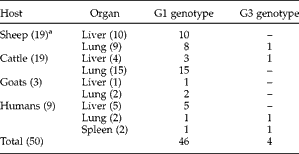
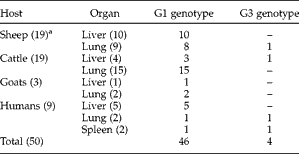
Ardabil Province is located in north-western Iran bordering the Republic of Azerbaijan and the provinces of East Azerbaijan and Zanjan. The Talesh mountain range to the east separates Ardabil from Gilan Province. Ardabil covers an area of 18,050 km2 and is divided into nine counties. During 2010, hydatid cysts of 19 sheep, 21 cattle and 4 goats were collected from a slaughterhouse in Ardabil Province. Isolates were also obtained from 11 hydatid cysts of patients who underwent surgery for hydatidosis (see table 1). Protoscoleces and laminated layers of cysts were washed three times with sterile phosphate-buffered saline (PBS), and stored in 70% ethanol at 4°C until DNA extraction.
Echinococcus granulosus genotypes in Ardabil Province, north-western Iran, identified by mitochondrial sequence analyses.
a (n) = number examined
DNA extraction and PCR amplification
The ethanol was removed by washing all samples twice with PBS. DNA was extracted using a High Pure PCR Template Preparation Kit (Roche, Mannheim, Germany) according to the manufacturer's protocol. The genomic DNA was stored at − 20°C until polymerase chain reaction (PCR) amplification.
Two mitochondrial loci were amplified from distinct genomic DNA by PCR. The primers and PCR conditions were as described previously by Bowles et al. (Reference Bowles, Blair and McManus1992) for the cox1 gene and Sharbatkhori et al. (Reference Sharbatkhori, Mirhendi, Jex, Pangasa, Campbell, Kia, Eshraghian, Harandi and Gasser2009) for the nad1 gene. The PCR products were separated by electrophoresis in 1.5% (w/v) agarose gel and visualized by ethidium bromide staining.
DNA sequencing
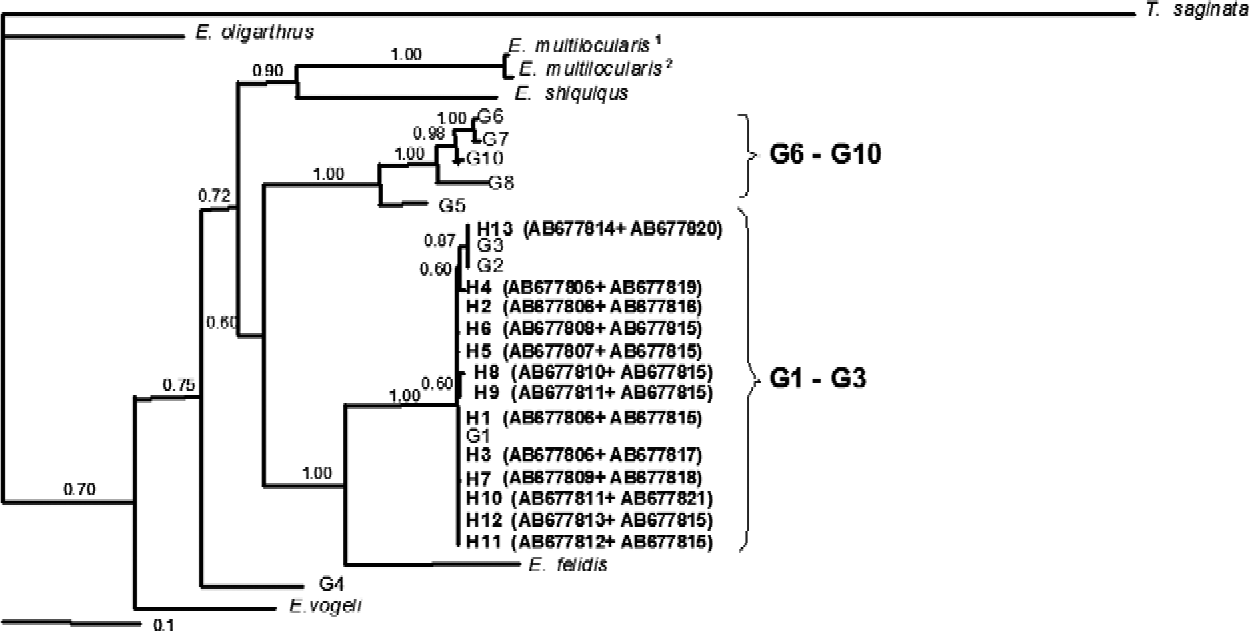
Each band was cut from the gel and purified using the QIA quick Gel Extraction kit (QIAgen, Germany), according to the manufacturer's instructions and was sequenced in two directions by Bioneer Company (Korea). The sequences were compared to one another and with reference sequences using the BLAST system (http://www.ncbi.nlm.nih.gov/) and BioEdit software (Hall, Reference Hall1999) and adjusted manually. Phylogenetic analyses were carried out applying concatenated cox1 and nad1 sequence data from this study as well as reference sequences of all identified E. granulosus genotypes (G1–G10) and Echinococcus species, with Taenia saginata as the outgroup (see fig. 1) (Bowles et al., Reference Bowles, Blair and McManus1992; Bowles & McManus, Reference Bowles and McManus1993, Reference Bowles and McManus1994; Gasser et al., Reference Gasser, Zhu and McManus1999). The sequence-based Bayesian inference (BI) method was used for the analyses. BI was executed using the program MrBayes v.3.1.2 (http://mrbayes.csit.fsu.edu/index.php). Posterior probabilities (pp) were planned for 2,000,000 generations (ngen: 2,000,000). The TreeviewX v.0.5.0 Program (Page, Reference Page1996) was used to create the consequence tree.
Phylogenetic tree of E. granulosus isolates from Ardabil Province, Iran and reference sequences for E. granulosus sensu lato and other species of Echinococcus (Bowles et al., Reference Bowles, Blair and McManus1992; Bowles & McManus, Reference Bowles and McManus1993; Gasser et al., Reference Gasser, Zhu and McManus1999; Nakao et al., Reference Nakao, McManus, Schantz, Craig and Ito2007; Huttner et al., Reference Huttner, Nakao, Wassermann, Siefert, Boomker, Dinkel, Sako, Mackenstedt, Romig and Ito2008; Lavikainen et al., Reference Lavikainen, Haukisalmi, Lehtinen, Henttonen, Oksanen and Meri2008) created using the Bayesian inference (BI) method. The relationships were obtained according to phylogenetic analyses of concatenated cox1 and nad1 sequence data using BI (haplotypes 1–13 in bold type). The accession numbers of cox1 and nad1 genes of all haplotypes are given in parentheses, respectively. Haplotypes 1–13 represent genotypes G1–G3 (G1–G3 complex, E. granulosus sensu stricto). The scale bar indicates distance. Nodal support is given as a posterior probability (pp) value.

Results
The cox1 gene and nad1 gene amplicons produced by PCR were 450 and 400 bp long, respectively. The consensus lengths of cox1 gene and nad1 gene sequences were 366 bp and 378 bp, respectively. A total of 55 isolates were sequenced, of which five failed (table 1).
The sequence alignments of the isolates displayed nine characteristic profiles in cox1 sequences and eight characteristic profiles in nad1 sequences. Sequence profiles for cox1 and nad1 were submitted to GenBank with accession numbers AB677806–AB677814 and AB677815–AB677822, respectively. A dendrogram based on the phylogenetic analyses of cox1 and nad1 sequences, and a consensus tree of the concatenated data, revealed two distinct clusters. One cluster contained a G1–G3 complex (pp = 1.00), and the other clustered with G6–G10 complex (pp = 1.00). Thirteen haplotypes (H1–H13) were found in the G1–G3 cluster (fig. 1). Forty-six isolates (92%) were recognized as G1 or G1 variations (haplotype 1–12) and 4 isolates (8%) identified as G3 genotypes (haplotype 13).
Discussion
Ardabil Province has a mountainous climate and suitable pastures for traditional rearing of domestic animals, including those of migrating tribes. The presence of stray dogs infected with E. granulosus creates the potential for transfer of parasites. The reported prevalence of hydatid cyst in the province is 74.4% in sheep, 38.3% in cattle, 20% in goats and 11.9% in buffalo (Daryani et al., Reference Daryani, Alaei, Arab, Sharif, Dehghan and Ziaei2007). This is the first extensive genotyping investigation of E. granulosus infected intermediate hosts in Ardabil Province using mtDNA sequencing.
Studies using various techniques have documented the existence of G1, G3 and G6 genotypes in Iran (Zhang et al., Reference Zhang, Eslami, Hossein and McManus1998; Harandi et al., Reference Harandi, Hobbs, Adams, Mobedi, Morgan-Ryan and Thompson2002; Ahmadi & Dalimi, Reference Ahmadi and Dalimi2006; Karimi & Dianatpour, Reference Karimi and Dianatpour2008; Rostami Nejad et al., Reference Rostami Nejad, Nazemalhosseini Mojarad, Nochi, Fasihi Harandi, Cheraghipour, Mowlavi and Zali2008; Sharbatkhori et al., Reference Sharbatkhori, Mirhendi, Jex, Pangasa, Campbell, Kia, Eshraghian, Harandi and Gasser2009, Reference Sharbatkhori, Mirhendi, Harandi, Rezaeian, Mohebali, Eshraghian, Rahimi and Kia2010, Reference Sharbatkhori, Fasihi Harandi, Mirhendi, Hajialilo and Kia2011; Kia et al., Reference Kia, Rahimi, Sharbatkhori, Talebi, Fasihi Harandi and Mirhendi2010; Hajialilo et al., Reference Hajialilo, Harandi, Sharbatkhori, Mirhendi and Rostami2011; Parsa et al., Reference Parsa, Haghpanah, Pestechian and Salehi2011; Pour et al., Reference Pour, Hosseini and Shayan2011). The results of this investigation demonstrated that the G1 genotype (sheep strain), in addition to being in sheep (95%), was also in cattle (95%), goats (100%) and humans (80%). The G3 genotype (buffalo strain) was also detected in sheep, cattle and human isolates. This is the first report of the G3 genotype of E. granulosus in humans in Ardabil Province of Iran.
The G3 genotype was described as an Indian buffalo strain by Bowles & McManus (Reference Bowles and McManus1993). However, there have been many reports of the existence of the E. granulosus G3 genotype in intermediate hosts such as humans, sheep, cattle, water buffalo, the Nile lechwe (Kobus megaceros) and pigs (Busi et al., Reference Busi, Snabel, De Libelato and D'Amelio2004, Reference Busi, Snabel, Varcasia, Garippa, Perrone, De Liberato and D'Amelio2007; Pednekar et al., Reference Pednekar, Gatne, Thompson and Traub2009). Moreover, some researchers have demonstrated the presence of the G3 genotype in intermediate hosts such as camel, buffalo, cattle and sheep in parts of Iran (Sharbatkhori et al., Reference Sharbatkhori, Mirhendi, Harandi, Rezaeian, Mohebali, Eshraghian, Rahimi and Kia2010; Hajialilo et al., Reference Hajialilo, Harandi, Sharbatkhori, Mirhendi and Rostami2011; Pour et al., Reference Pour, Hosseini and Shayan2011).
Our results are in agreement with previous studies in Iran showing G1 to be the predominant E. granulosus genotype in livestock and humans. As all of the cysts were infertile in cattle, it seems that sheep play a significant role in E. granulosus transmission to dogs, providing an important source for human infection in this area.
Although there are many reports about the intermediate hosts of E. granulosus, limited information is available about infections in dogs and other canids. Further study should focus on identifying E. granulosus strains in canids in order to develop appropriate methods for prevention and control of the disease.
Acknowledgements
We thank Dr F. Pourfarzi, Chancellor of Ardabil University of Medical Sciences. The authors are extremely grateful to Mr S. Moosavi of the Fatemi Hospital, Mr F. Amiri in Emam-Khomeini Hospital of Ardabil city and Mr Z. Zarei in Meshkin-Shahr Research Station of Ardabil Province for their kind assistance in collecting samples. This investigation was supported by a grant from Tehran University of Medical Sciences and Health Services (grant P/900). This work represents the PhD thesis of A.P.