


Introduction
Cognitive behavioral therapy (CBT) has been proven to be an effective treatment in a range of psychiatric disorders, such as anxiety and depression (e.g. Butler, Chapman, Forman and Beck, Reference Butler, Chapman, Forman and Beck2006) . In the last two decades, CBT has been increasingly applied in the treatment of psychotic disorders and has been recommended by the PORT guidelines as an evidence-based treatment for schizophrenia (Michon, van Weeghel, Kroon and Schene, Reference Michon, van Weeghel, Kroon and Schene2005). In addition, the UK National Institute for Health and Clinical Excellence guidelines (NICE, 2009) state that CBT should be offered to all persons with schizophrenia. Accordingly, CBT for psychosis (CBTp) has been associated with improvements in many areas such as delusional beliefs, distorted beliefs about hallucinations, self-defeating thoughts about oneself, and negative symptoms (Rathod, Kingdon, Weiden and Turkington, Reference Rathod, Kingdon, Weiden and Turkington2008; Turkington, Dudley, Warman and Beck, Reference Turkington, Dudley, Warman and Beck2004). More recently, studies have begun to address the effects of CBTp on functional outcomes with mixed results, some demonstrating benefits whereas others have not (e.g. Wykes, Steel, Everitt and Tarrier, Reference Wykes, Steel, Everitt and Tarrier2008).
The inconsistency in findings regarding psychosocial functioning across studies is important to examine; one plausible explanation is that many studies assessed functional outcomes very distal to the focus of the CBT intervention. In other words, CBT interventions address an array of maladaptive thoughts, some of which are not directly linked with functional outcomes. For instance, successfully challenging persecutory beliefs that others have malicious intent will not necessarily impact the quality or quantity of one's social network or improve one's social skills. Consequently, CBT interventions have begun to arise that place a greater emphasis on correcting unhelpful beliefs and that feature behavioral interventions directly relevant to everyday functioning. For example, interventions have been designed that combine CBTp with social skills training with positive results on social functioning (e.g. Granholm et al., Reference Granholm, McQuaid, McClure, Auslander, Perivoliotis and Pedrelli2005). However, few CBT interventions exist in other functional domains.
In response, Davis and colleagues (Davis, Lysaker, Lancaster, Bryson and Bell, Reference Davis, Lysaker, Lancaster, Bryson and Bell2005) developed a CBT program targeting thoughts that are directly related to work, a major functional goal for people with schizophrenia (McQuilken et al., Reference McQuilken, Zahniser, Novak, Starks, Olmos and Bond2004). A randomized comparison of this CBT program (the Indianapolis Vocational Intervention Program) to a support condition found a positive impact of CBT on hours worked and work performance in VA work programs over 6 months (Lysaker, Davis, Bryson and Bell, Reference Lysaker, Davis, Bryson and Bell2009). In another analysis, the authors found that participants in the CBT group also had enhanced levels of hope and self-esteem over time compared to controls who deteriorated in these areas (Lysaker, Bond, Davis, Bryson and Bell, Reference Lysaker, Bond, Davis, Bryson and Bell2005). This study shed light on the positive impact of CBT on vocational and non-vocational outcomes, yet the factors that lead to successful treatment response remain unknown. That is, some consumers receiving CBT excelled at work, whereas others struggled and worked very little. Moreover, a dearth of research exists in this area, as no prior studies have investigated factors associated with treatment response in CBT offered alongside a work placement. Related studies investigating CBT focused on improving clinical outcomes (e.g. symptoms) in persons with schizophrenia have found several factors predicting treatment response, such as gender (Brabban, Tai and Turkington, Reference Brabban, Tai and Turkington2009), a history of fewer psychiatric hospitalizations, cognitive flexibility regarding delusions (Garety et al., Reference Garety, Fowler, Kuipers, Freeman, Dunn and Bebbington1997), clinical insight (Naeem, Kingdon and Turkington, Reference Naeem, Kingdon and Turkington2008), cognitive insight (Perivoliotis et al., Reference Perivoliotis, Grant, Peters, Ison, Kuipers and Beck2010), and degree of memory impairment (Penadés et al., Reference Penadés, Catalán, Pujol, Puig, Guarch and Masana2010). A related but separate issue is that of treatment engagement, which is usually demonstrated by attendance rates. No prior published work has examined predictors of treatment acceptance in CBTp targeting functional outcomes. Extant psychotherapy literature has struggled to identify a consistent set of predictors for CBT engagement; however, there is tentative evidence that among them are symptom level, age, educational attainment (Salmoiraghi and Sambhi, Reference Salmoiraghi and Sambhi2010), and baseline expectations about treatment (Westra, Dozois and Boardman, Reference Westra, Dozois and Boardman2002).
Another relevant body of literature is that addressing predictors of vocational success in persons with schizophrenia. Given that the primary outcome of CBT interventions targeting work is vocational success, it is important to understand key factors that may independently impact work outcomes. Studies have largely failed to identify a consistent set of predictors with regard to participant background characteristics. One exception, work history, has been identified as a strong predictor of future work success (Tsang, Leung, Chung, Bell and Cheung, Reference Tsang, Leung, Chung, Bell and Cheung2010). Further, findings regarding the link between psychological and neurocognitive factors and future work outcomes have also been somewhat inconsistent; generally, better verbal memory and learning and fewer negative symptoms predict more positive employment outcomes across time (Evans et al., Reference Evans, Bond, Meyer, Kim, Lysaker and Gibson2004; Razzano et al., Reference Razzano, Cook, Burke-Miller, Mueser, Pickett-Schenk and Grey2005).
The current study sought to address the need for a greater understanding of factors that predict treatment engagement versus non-engagement and full versus partial response in CBT targeting work. We reasoned that factors leading to treatment engagement compared to full versus partial treatment benefit might be different for a range of reasons. For instance, it is possible that certain deficits lead persons to anticipate no benefit to treatment, while for others CBT may produce less favorable changes in symptoms or self-esteem over time, leading to drop out. Findings from this study may suggest methods for engaging consumers who are more likely to reject treatment and work and may help to identify patterns that might trigger persons to discontinue treatment. These results may also allow for greater customization of CBT and vocational services that take into account multiple facets of the individual, such as personal background, level of cognitive impairment, symptom profile, and beliefs about the self.
In this study, we have explored predictors of treatment engagement and treatment response in a randomized controlled trial of CBT focused on enhancing work function. Specifically, we examined the baseline characteristics of participants who engaged versus those who did not engage in CBT and a concurrent vocational placement. Engagement was defined by attendance of a minimum of seven CBT sessions. Next, in an examination of work outcomes, we explored relationships with symptoms, self-esteem, and neurocognitive functioning of participants who engaged in the intervention and a concurrent work program to varying degrees. The baseline neurocognitive variables we chose to explore have been linked with community functioning in prior studies, including cognitive flexibility, e.g. set shifting (Green, Reference Green1996) and aspects of intelligence (verbal ability, working memory, visual spatial ability, visuospatial processing speed). We also investigated variables that have a conceptual link with work and those amenable to CBT, including self-esteem, given the empirical evidence of the benefits of CBT on self-esteem in people with schizophrenia (e.g. Gumley et al., Reference Gumley, Karatzias, Power, Reilly, McNay and O'Grady2006; Lysaker et al., Reference Lysaker, Bond, Davis, Bryson and Bell2005), as self-defeating expectations and beliefs about failure at work are changed (Lysaker et al., Reference Lysaker, Bond, Davis, Bryson and Bell2005). Finally, we examined demographic and work history variables that have been associated with employment outcomes in prior studies of vocational services for people with schizophrenia (Tsang et al., Reference Tsang, Leung, Chung, Bell and Cheung2010) as discussed above.
To examine predictors of engagement in CBT and a concurrent work program, we classified 50 participants who were randomized to the CBT condition as engagers if they attended at least seven or more CBT sessions and classified participants as non-engagers if they attended less than seven sessions. To examine full versus partial success in the CBT program and a vocational placement, we classified all those who engaged in the CBT as fully successful if they worked at least 95% of all scheduled weeks (at least 25 out of a possible 26 weeks) and as partially successful if they worked in 92% or fewer of all scheduled weeks (24 or less out of a possible 26 weeks).
Given the tentative findings of the literature noted above, we anticipated that participants who engaged in CBT and a concurrent work placement might have lower levels of symptoms and higher educational attainment. Given links between neurocognitive impairments and function in general (Green, Reference Green1996), we also anticipated that poorer performance on neurocognitive assessments might also predict difficulty engaging. Concerning full versus partial treatment success among those who engaged in CBT and work, we hypothesized that fully successful participants would have lower levels of symptoms and higher levels of self-esteem at treatment outset, and overall, over the course of treatment. Here we propose two possibilities: first, it might be that higher symptom levels and lower self-esteem represent barriers to success in CBT in terms of vocational outcomes. Alternatively, it may be that for some participants, participation in CBT is associated with relatively poorer levels of self-esteem and function over time, which leads to poorer work outcomes. Perhaps for some participants, as insight is gained over time, there comes great pain and, accordingly, graver struggles with function. Finally, we expected participants with better executive functioning and better neuropsychological functioning to respond better to treatment and work longer.
Method
Overall design
The parent study was a randomized controlled study comparing the Indianapolis Vocational Intervention Program (IVIP) to a control condition on work performance in adults with schizophrenia-spectrum disorders (Lysaker, Davis et al., Reference Lysaker, Davis, Bryson and Bell2009). IVIP is a cognitive-behavioral therapy intervention designed to address maladaptive thoughts that interfere with work, including modules that cover the following topics: cognitive distortions, self-defeating thoughts, problem solving, coping with emotions, expressing oneself, accepting and learning from feedback, and realistic self-appraisal regarding vocational functioning. IVIP is comprised of weekly group and individual sessions: the group intervention includes skills training and didactic content, whereas the individual intervention involves personalized and active application of group material to beliefs about work experiences. (A complete description of services provided in the IVIP have been described in Davis et al., Reference Davis, Lysaker, Lancaster, Bryson and Bell2005). Participants were randomized and then placed into part-time jobs at a Veteran Affairs Medical Center. The program spanned 26 weeks and assessments were made at baseline and monthly thereafter. The current study examines longitudinal data from participants who completed the IVIP program and achieved work.
Participants
Participants with a schizophrenia-spectrum disorder who were receiving medication management services were recruited from an outpatient clinic of a VA psychiatry service (Full sample: N = 37, 74.0%; Engagers: N = 30, 75.0%; Non-engagers: N = 7, 70.0%) and a community mental health center (Full sample: N = 13, 26.0%; Engagers: N = 10, 25.0%; Non-engagers, N = 3, 30.0%). Eligible participants were in a stable phase of illness as defined by having no hospitalizations or changes in psychotropic medication or housing in the month before entering the study. Participants had to express interest in working to be included in the study. Study exclusion criteria were a diagnosis of mental retardation or another neurological disorder. Forty participants successfully completed the IVIP program and were considered treatment “engagers”.
Ten participants randomized to IVIP did not attend a minimum number of sessions designated as adequate receipt of the program (i.e. 7 or fewer sessions) and were considered non-engagers to the program. Participants were 42 (84%) men and 8 (16%) women, including 27 (54 %) African Americans, 22 (44%) Caucasians, and 1 (2%) Latino. Psychiatric diagnoses included schizophrenia (N = 31, 62%) and schizoaffective disorder (N = 19, 38%). The mean age of the sample was 45.9 years (SD = 10.4) and the mean years of education was 12.7 (SD = 2.4). The majority of participants were receiving government entitlements (N = 40, 80%) and the mean monthly income was $905.53 (SD = 805.64). Participants averaged 7.9 years (SD = 8.4) since their last full-time job prior to the study. In the past, participants’ longest job held averaged 5.6 years (SD = 5.8) in duration.
Measures
The Positive and Negative Syndrome Scale (PANSS; Kay, Fiszbein and Opler, Reference Kay, Fiszbein and Opler1987), a 30-item rating scale that assesses psychiatric symptoms, was completed by the trained interviewers following a chart review and semi-structured interview. Items are rated on a 7-point scale ranging from “Absent” to “Extreme”. We used a 5-factor solution comprised of the following subscales: Positive Syndrome, Negative Syndrome, Emotional Discomfort, Hostility (or poor impulse control), and Cognitive Symptoms (Bell, Lysaker, Beam-Goulet, Milstein and Lindenmayer, Reference Bell, Lysaker, Beam-Goulet, Milstein and Lindenmayer1994). The total PANSS score is obtained by summing item ratings on all 30 items (Kay et al., Reference Kay, Fiszbein and Opler1987, p. 274). Inter-rater reliability assessed for raters in this study found good to excellent intraclass correlations on all scale scores, with correlations ranging from .82 to .93.
The Rosenberg Self Esteem Scale (RSES; Rosenberg, Reference Rosenberg1965) is a 10-item self-report questionnaire that assesses self-esteem. The RSES asks participants to indicate their agreement or disagreement with statements about their self-esteem and self-deprecation. Items are summed into a total score such that a higher score indicates greater self-esteem. Examples of items include: “I wish I could have more respect for myself” and “I feel that I have a number of good qualities.” While widely used in community samples, other literature suggests that persons with schizophrenia can also reliably complete the RSES (Wykes, Reeder, Corner, Williamson and Everitt, Reference Wykes, Reeder, Corner, Williamson and Everitt1993). Reliability coefficients from previous studies of clients with SMI found internal consistency coefficients (Cronbach's alpha) exceeding .80 and test-retest reliability of .87 (Torrey, Mueser, McHugo and Drake, Reference Torrey, Mueser, McHugo and Drake2000).
The Wechsler Adult Intelligence Scale III (WAIS-III; Wechsler, Reference Wechsler1997) is a widely used battery of tests used to assess intellectual function and generates age corrected scaled scores where the expected population mean is a “10”. For the purposes of this study, four subtests were administered: Vocabulary, Block Design, Arithmetic, and Digit Symbol. The Vocabulary subtest assesses participants’ global verbal intellectual function and is believed to tap premorbid intelligence in schizophrenia. The Block Design subtest assesses visual spatial processing and is often used as a non-verbal measure of intelligence. The Arithmetic subtest assesses working memory and the Digit Symbol subtest assesses participants’ visuomotor processing speed.
The Wisconsin Card Sorting Test (WCST; Heaton, Reference Heaton1993) assesses aspects of executive functioning. The WCST asks participants to sort cards that vary according to shape, color and number of objects depicted. Subjects are told to match cards to “key” cards but are not told the matching principle that changes after 10 correct responses. This study utilized two scores: the total number of categories correct (a score that can range from “0” to “6”) which reflects the participant's ability to grasp, hold and shift when necessary, and the number of perseverative responses that suggests a tendency to have difficulty shifting sets.
Procedures
Following written informed consent, baseline assessments were conducted by trained research staff that included the WAIS-III, PANSS and WCST. The RSES was completed via participant self-report. Study staff were available to read or discuss items when necessary. After the baseline assessment, participants were placed into either the IVIP or a standard support program using a block randomization. All were offered and accepted a 26-week non-competitive job placement at $3.50 per hour in entry-level medical center positions supervised by the regular job site supervisors. Job placements were located at sites such as the escort service, housekeeping, and medical administration; regularly scheduled hours (between 10 and 20 per week) were determined by participant preferences. Efforts were made to match the work placements with participants’ interests and skills. While all participants were guaranteed a placement, placements could be terminated for failure to follow rules on the work site or for substandard performance as determined by the job site supervisor.
Data analyses
Preliminary analyses involved inspecting the data for normality and adherence to statistical assumptions. We also examined Pearson's correlations between predictor variables to assess for multicollinearity; the predictors were not significantly correlated with the exception of WCST scores and scores on the arithmetic and digit symbol subscales of the WAIS-III. These variables were only modestly (all variables except the WAIS subscales) to moderately correlated (only digit symbol and arithmetic, r = 0.53); therefore multicollinearity was not judged to be a major issue impacting the findings. Next, we used descriptive statistics and independent groups t-tests to characterize and compare the employment outcomes of the engagers vs. non-engagers groups and partially successful vs. successful groups within the engager group. In the first part of the primary analyses, we examined the baseline predictors of CBT engagement by comparing participants who were “engagers” with participants termed “non-engagers” (defined as participation in fewer than 7 group sessions) using discriminant analysis to predict group membership. The baseline predictor variables entered into the discriminant model included variables that had significant bivariate relationships with engagement, including educational attainment PANSS scores, RSES scores, WCST scores, and the WAIS subscales reflecting working memory components (i.e. digit symbol, arithmetic).
In the second part, we looked at the baseline predictors of employment success in the engagers sample using Cox Proportional-Hazards model survival analysis This technique modeled employment success as a log linear function of predictors. Specifically, we examined the point at which participants first dropped out of work as an indicator of employment success. We chose this outcome because of the nature of the work programs (i.e. all participants were placed into protected work positions with set, regular work hours). We purported that this outcome would be a meaningful indicator because it represents the time frame in which problems arose and the participant first chose to stop working or was terminated. Predictor variables in the survival analysis were demographic variables and the variables entered in the discriminant analysis examining treatment engagement described above.
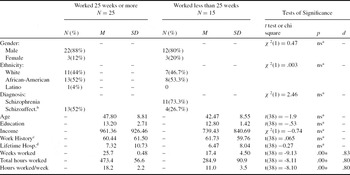
In the third part of the data analysis, we inspected the frequency distribution of total weeks worked across the study period. We noticed (1) the data were negatively skewed and (2) there was a sharp division between participants who worked nearly all of the time (25 or 26 weeks; N = 25, 62.5%), and those who worked less than 25 weeks (N = 15, 37.5%). These two groups significantly differed on total weeks worked, total hours worked, and hours worked per week (see Table 2).Considering the engager sample, we created two groups based on these observations and then conducted discriminant analysis to determine which variables significantly predicted group membership. We termed the engager participants who worked 25 or 26 weeks as “successful” participants and those working less than 25 weeks as “partially successful”. The same predictors described in parts one and two of the data analysis were entered into this model as assessed over the course of the study (variables were aggregated across assessment intervals during the last 9 weeks of the study), with the exception of baseline demographics. We chose to aggregate psychological variables over the last 9 weeks of the study rather than assessing these variables earlier in the study period to account for changes that are slow to develop; research has demonstrated that changes in persons with schizophrenia occur in small increments and may not be detectable for significant periods of time (Strauss and Carpenter, Reference Strauss and Carpenter1977). As shown in Table 2 and noted in the Results section, the successful and partially successful groups significantly differed on employment outcomes across the study period as characterized by large effect sizes based on the standards set by Cohen (Reference Cohen1992). All tests were two-tailed and p values were set at .05.
Results
Employment outcomes
In the treatment engager sample (N = 40), participants worked an average of 22.6 (SD = 4.9) out of the possible 26 weeks. The average total hours worked across the 26 weeks period was 473.4 (SD = 56.6) and participants worked a mean of 15.5 hours per week (SD = 4.5). In contrast, participants in the non-engager sample had significantly worse employment outcomes across the study; participants in the non-engaged sample worked a mean of 3.1 (SD = 3.1) out of the possible 26 weeks, t(48) = −11.9, p = .00; and a mean of 42.1 total hours (SD = 49.2) across the study period, t(48) = −15.0, p = .00. They worked an average of 1.9 hours per week (SD = 1.6), t(48) = −15.0, p<.00.
Treatment engagement outcomes
Overall, participants attended a mean of 20.9 (SD = 5.3) group sessions and 20.1 (SD = 5.4) individual sessions. The treatment engagers attended an average of 20.9 (SD = 5.3) group sessions versus 3.0 (SD = 3.0) for non-engagers: t(48) = -10.24, p = .00. The engagers attended a mean of 20.1 (SD = 5.4) individual sessions compared to 2.4 (SD = 2.0) attended by non-engagers: t(48) = -10.11, p = .00.
Predictors of treatment engagement
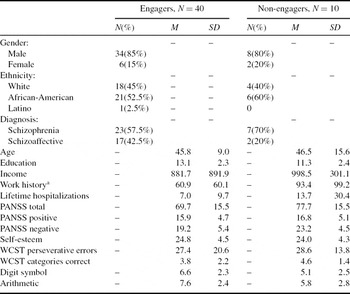
Descriptive statistics for baseline variables according to engagement group are presented in Table 1. Treatment engagement was not associated with gender, ethnicity, psychiatric diagnosis, age, income level, history of psychiatric hospitalizations, or work history as assessed at baseline. The exception was years of education in which engagers had a higher educational attainment than non-engagers, t(48) = 2.14, p = .04. A discriminant analysis model generated one significant function, such that participants with higher digit symbol scores, higher arithmetic scores, and less severe negative symptoms assessed at baseline were more likely to engage and attend treatment, Λ = .841,χ 2 (3, N = 50) = 8.06, p = .04. The strongest predictor of treatment engagement was negative symptoms, F(1,48) = 5.38, p = .02; second was arithmetic scores, F(2,47) = 3.81, p = .03; and third was digit symbol scores, F(3,46) = 2.90, p = .04. No other variables were significant in the model explaining group membership (i.e. engager vs. non-engager).
Descriptives for demographic and predictor variables at baseline according to engagement status

a Longest full-time job held prior to the study
Engagement group: fully successful vs. partially successful outcomes
As shown in Table 2, the successful participants in the engager group worked a significantly greater number of total weeks, worked more hours per week in their jobs, and worked more total hours across the study period compared to the partially successful participants in the engager group. The partially successful participants had their first work stoppage (i.e. week at which participants were terminated by employers or voluntarily stopped coming to work) on average at week 12 (M = 11.8, SD = 6.8). Successful and partially successful participants did not significantly differ on background variables assessed at baseline.
Differences in demographics and work outcomes among the engager sample according to degree of treatment success

Notes: *p < .01; anonsignificant, p>.05; bSchizoaffective disorder; cLongest full time job held prior to the study;
dNumber of lifetime hospitalizations prior to the study
Predictors of work outcomes: baseline characteristics
Baseline scores on the Arithmetic subtest of the WAIS-III and age significantly predicted the week at which participants stopped working: χ 2 (3) = 13.36, p = .00. Specifically, participants with poorer Arithmetic scores (Wald = 8.01, p = .00) and those who were younger (Wald = 7.31, p = .00) were more likely to drop out of work sooner than their counterparts. No other neuropsychological, symptom, self-esteem, or demographic variables assessed at baseline significantly predicted the week of work stoppage.
Predictors of work outcomes: factors evolving over the course of treatment
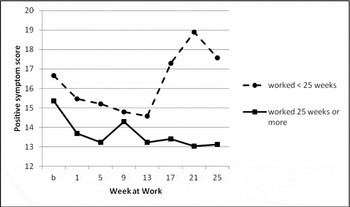
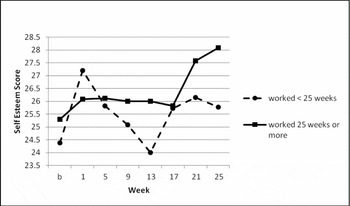
Next, discriminant analyses revealed that, compared with successful participants, the partially successful group had more severe positive symptoms and lower self-esteem over the last 9 weeks of the study (as averaged across weeks 17 to 25; Model: Λ = .715, χ 2(2, N = 40) = 9.04, p = .01). Positive Symptoms were the strongest predictors in the model explaining group membership, F(1,28) = 7.91, p = .008; followed by self-esteem F(2,27) = 5.37, p = .01 (see Figures 1 and 2, respectively). The successful and partially successful groups did not significantly differ over time on cognitive flexibility (WCST), subscales of intelligence, or other symptom domains (i.e. negative symptoms, depressive symptoms).
PANSS positive symptom scores across time comparing successful participants to partial success participants

Self-esteem scores across time comparing successful participants to partial success participants

Discussion
The goal of this study was twofold: first we sought to identify predictors of engagement in CBT and a concurrent work placement, and second, we aimed to identify the factors associated with work outcomes in people with schizophrenia. Our results suggest a differential pattern of predictors for engagement in treatment and a concurrent vocational placement versus treatment benefit. Specifically, we found that two different aspects of intellectual functioning – working memory and visuospatial processing speed – were important predictors of whether participants engaged in CBT and a concurrent vocational placement. Interestingly, more severe negative symptoms were also associated with lack of engagement. Whilst studies have found that persons with prominent negative symptoms can benefit from CBT (Rathod et al., Reference Rathod, Kingdon, Weiden and Turkington2008), these findings suggest that they may be harder to engage at the outset of treatment. This notion is consistent with extant literature citing lack of motivation as a primary reason for dropping out of CBT in depressed patients (Bados, Balaguer and Saldana, Reference Bados, Balaguer and Saldana2007), as well as studies demonstrating the role between negative symptoms and less favorable work outcomes in persons with schizophrenia (e.g. Razzano et al., Reference Razzano, Cook, Burke-Miller, Mueser, Pickett-Schenk and Grey2005). Thirdly, participants with lower educational attainment (i.e. those who on average did not complete high school) engaged in the CBT program and work placement less often than participants who, on average, had completed some college. While IVIP was developed for consumers with lower levels of education (e.g. lower reading level) and lower overall functioning, the challenges imposed by a manualized CBT program may have impacted decisions to drop out. This finding is in agreement with an earlier study linking lower education attainment with tendency to drop out from CBT for panic disorder (Keijsers, Kampman and Hoogduin, Reference Keijsers, Kampman and Hoogduin2001) and vocational studies identifying a relationship between prior education and future employment status (see Tsang et al., Reference Tsang, Leung, Chung, Bell and Cheung2010 for a review); however, future work is needed to better understand this relationship in consumers with schizophrenia.
With regard to treatment response and work outcomes, we found that baseline variables, including symptoms, largely did not predict work success. A notable exception was age, in which older participants were more likely to stay longer in employment. It may be that, compared to younger participants, older participants had more realistic expectations for work based on a more extensive work history or higher work-related self-efficacy. Another possibility is that older participants were more “work ready” and had more refined work skills, although in this sample employment history did not significantly relate to success in work. Second, we found that the arithmetic subscale of the WAIS-III, which assessed working memory, predicted the point at which participants dropped out of work. It may be that this cognitive ability is an important factor in an individual's ability to sustain work long-term, a notion that is consistent with the literature demonstrating an association between working memory and functional outcomes in schizophrenia (e.g. McGurk and Mueser, Reference McGurk and Mueser2006). Working memory appears to play a role in the ability to fully engage in CBT and succeed in a vocational placement. Unexpectedly, we did not find relationships between other aspects of cognitive functioning, such as cognitive flexibility, and later work outcomes. In addition, negative symptoms assessed at baseline and during follow-up were unrelated to work outcomes, in contrast to previous research findings (e.g. Thomas, Rossell, Farhall, Shawyer and Castle, Reference Thomas, Rossell, Farhall, Shawyer and Castle2011). The explanation(s) for these findings is unclear; future research is needed to understand these relationships, possible moderating variables, and the effects on treatment response dictated by concurrent participation in CBT and vocational services.
Our results indicate that persons with poorer response to CBT for work are likely to have worsening positive symptoms and lower levels of self-esteem at later stages of treatment compared to participants who achieved successful work outcomes. The successful participants remained relatively stable in symptom domains over time and demonstrated improved self-esteem in the final weeks of the study whereas the partially successful group did not experience the same gains in self-esteem toward the end of the study. It is possible that severe positive symptoms and low self-esteem are related, as some past studies have found a negative association between these variables in persons with schizophrenia (e.g. Barrowclough et al., Reference Barrowclough, Tarrier, Humphreys, Ward, Gregg and Andrews2003); hence, it may be that participants experiencing a sharp increase in positive symptoms suffered from both worsening self-esteem and poorer work outcomes as a result. Moreover, the finding that self-esteem rose in the fully successful group is in agreement with extant findings (e.g. Arns and Linney, Reference Arns and Linney1993) and warrants future study to better understand the dynamic process of self-esteem change and vocational functioning over time.
The finding that self-esteem sharply declined in the partially successful group around the average time of the initial work stoppage (as assessed at week 13) provides further evidence linking employment problems with a poor concept of the self; it may be that self-esteem suffered as a result of work stoppage or that the complex event of a work stoppage was influenced in part by failing self-esteem in addition to a host of other factors.
Overall, considering self-esteem and positive symptoms together, it is possible that persons with schizophrenia who display this set of problems have difficulty engaging in CBT treatment and a concurrent work placement. It also may be that the IVIP program did not attend to and buffer against increasing self-esteem threats and worsening positive symptoms, given the primary focus on work-related themes. Moreover, while rival explanations exist, some have speculated that the process of recovery may lead to grief and distress as familiar patterns of behavior are disrupted (Wittmann and Keshavan, Reference Wittmann and Keshavan2007) or as individuals become more aware of the realities of living with a mental illness and may internalize stigma and stereotyped beliefs (Lysaker, Yanos and Roe, Reference Lysaker, Yanos and Roe2009). This explanation is in line with findings evidencing an increase in depression following improved illness insight (Rathod, Kingdon, Smith and Turkington, Reference Rathod, Kingdon, Smith and Turkington2005) and more hopelessness for persons with insight and high levels of internalized stigma (Lysaker, Roe and Yanos, Reference Lysaker, Roe and Yanos2007).
Clinical implications of these findings are worthy of note. Differential profiles of persons who may (1) have difficulty engaging in CBT treatment and a work placement and (2) have sub-optimal responses to CBT focused on improving community functioning have been identified. First, intense efforts should be made to engage participants who are at risk of dropping out of CBT programming, and adaptations should be made when necessary (e.g. present modules at a slower pace to compensate for the effects of neurocognitive deficits, low education level, or substantial negative symptoms; add weekly individual sessions and/or cognitive remediation). Cognitive strategies and compensatory strategies should also be utilized at the job site to buffer against poor engagement in work. Second, these results imply that in order to enhance functional outcomes and protect against negative psychological consequences in later stages of treatment, it is important to focus therapeutic efforts on work-related themes and those relevant to increasing illness awareness and self-esteem, and correcting delusional beliefs and maladaptive thoughts about hallucinations. In a similar vein, this study suggests that, once engaged, even people with significant negative and depressive symptoms can benefit from CBT targeting work, as these symptom domains were not associated with degree of employment success. In addition, this study indicates that persons with schizophrenia may be in danger of losing motivation once minor problems occur on the job. To protect against job loss, CBT combined with appropriate therapeutic interventions (e.g. motivational interviewing strategies, acceptance and commitment therapy) may be helpful. Lastly, a CBT environment that provides a forum in which consumers can deepen personal narratives and make sense of difficulties both in the work place and life in general will likely be beneficial to functional ability and recovery as a whole (Chadwick, Reference Chadwick2006).
Limitations of this study include the correlational design; we were unable to randomly assign to the condition of work success, introducing threats to internal validity and preventing the formation of causal conclusions. The majority of the sample was middle aged to older males of African-American or white ethnicity, thus limiting generalizability of the results. A threat to the generalizability of our results regarding treatment success involves the tendency for non-engagers to drop-out of the study; the majority of the non-engagement group did not complete follow-up assessments, and therefore this group was not accounted for when examining factors associated with work success. That is, we were unable to examine variables that evolved over time in this non-engagement group, which prevented more nuanced analyses comparing non-engagers with the partial and full success groups. Third, the analyses were underpowered due to the small sample size, particularly in the non-engager sample, preventing the use of multivariate analyses that would allow us to perform more sophisticated between groups analyses and examine the trajectory of variables of interest over time. Fourth, missing data existed at the time period in which some participants dropped out of work, preventing an examination of change in important variables (e.g. symptoms, self-esteem) during that critical period. Fifth, this study did not include persons experiencing their first psychotic episode; therefore, we do not know how our findings apply to this group. In addition, because this is a secondary data analysis, we are constrained regarding the outcomes measured; for instance, while the Rosenberg self-esteem scale has been widely used to assess levels of self-esteem in persons with schizophrenia, it does have notable limitations (e.g. insensitivity to life changes). The WAIS-III was used to measure working memory; factor analytic studies have found that it loads onto a working memory factor, however it also loads onto a verbal factor (Tulsky and Price, Reference Tulsky and Price2003). The verbal skills required to perform well on this test may act as a confound in the current study seeking to understand the role of working memory on CBT engagement and success. Other variables that may have influenced level of treatment engagement were unmeasured, e.g. medication side effects such as sedation. Lastly, given that participants in this study were outpatients who were not experiencing acute episodes of illness, restriction of range may be an issue in some psychological domains.



Comments
No Comments have been published for this article.