Startling news reaches us from Ashanti that Dr. B. Knowles, European Medical Officer, shot his wife with a pistol at Bekwai on the 20th October. Mrs. Knowles was brought to Kumasi for medical treatment of her wounds on the next day, but succumbed early Tuesday morning the 23rd October. Her remains were buried at the Government Cemetery Kumasi along Road A 1 at 4:30 p.m. the same day attended by a large number of sympathizing Europeans and Africans from Bekwai and Kumasi. Dr. Knowles, who was immediately placed under police supervision, was brought before the Court on Monday the 22nd October and was remanded for a week. Since then he has been in custody of the Prison Department.Footnote 1
This was the briefly worded first report in the Gold Coast Independent of what was arguably the most important murder case in colonial Ghana during the interwar years. In contrast to the better known ‘Kibi murder case’, the implications of this case went beyond the issue of guilt and the appropriateness of punishment.Footnote 2 The Knowles murder case subjected the system of criminal adjudication for capital offenses in colonial Ghana to searching scrutiny, and ‘created a wave of judicial reform’.Footnote 3 This particularly affected the Colony of Ashanti (hereafter Ashanti), where the murder was committed and Knowles was tried. There were two important legal issues that made this case of such importance: Knowles was tried before a circuit judge, without a jury trial, and he was not allowed counsel, as lawyers were barred from representing clients in all the courts in Ashanti. After a trial that lasted 11 days he was found guilty of murder and sentenced to death. No appeal was allowed for judgments handed down by the courts in Ashanti.
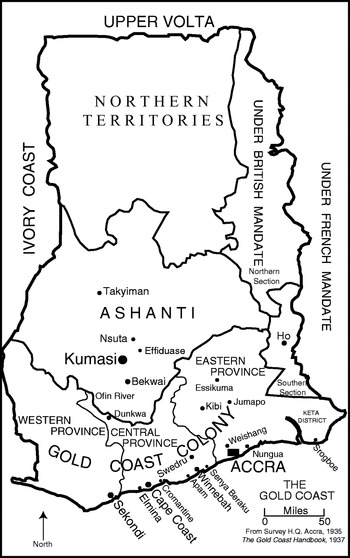
Colonial Ghana, 1935.

Apart from the draconian nature of a justice system that denied an ‘Englishman’ something as basic as ‘the right to trial by jury’, the case also possessed considerable ‘human interest’.Footnote 4 The special correspondents of metropolitan evening papers cabled long reports back to the United Kingdom on the progress of the trial in Kumasi.Footnote 5 In 1933, shortly after the case was finally resolved, the editors of Notable British Trials and War Crimes included it in this series of publications, together with such celebrated cases as the Trial of Mary Queen of Scots (1586), the Trial of Captain Kidd (1701), and the H.M.S. Bounty Mutineers (1792).Footnote 6 To some commentators in the metropole, the case might have seemed ‘a minor and rather sordid one not worth putting on permanent record’.Footnote 7 Undoubtedly it was the salacious details about the marital relationship between Dr Knowles and his wife that whetted the metropolitan public's interest in this murder: there was speculation in the press as to whether the marriage had been a bigamous relationship;Footnote 8 both partners were heavy drinkers and clearly intoxicated on the afternoon when the shooting occurred; and Dr Knowles was also under the influence of prescription drugs. The case may have suggested how West Africa was capable of demoralizing Europeans, particularly in the testing conditions of up-country stations such as Bekwai.
People in colonial Ghana found the highly unusual spectacle of a white colonial official on trial for murdering his wife every bit as engrossing as did the metropolitan audience. However, most significantly for the educated elite in the coastal towns – who owned and edited the newspapers that played a major role in shaping public opinion – the case also indicated how much the judicial system in Ashanti needed reform. In 1903, a year after Ashanti had been annexed to the Gold Coast Colony, a Chief Commissioner's Court and District Commissioner's Courts of civil and criminal justice had been set up, similar to those in the Colony.Footnote 9 However, the British administrators felt that, given the limited level of literacy in Ashanti and the very small pool of jurors that would be available, jury trial was not practical. Neither did it seem wise ‘to introduce among a primitive race argumentative, and sometimes dishonest and ignorant legal practitioners [who could be] … an agency for serious mischief’.Footnote 10 No appeal was possible for criminal convictions from any of these courts.Footnote 11
This ran very much counter to practice in the Gold Coast Colony (hereafter the Colony), where the court system was closely patterned after that in the metropole. This development had been formalized after the signing of what came to be known as The Bond of 1844 with what were then known as the ‘Protected Tribes’. It stipulated that ‘murders, robberies and other crimes and offences [should] be tried and inquired of before the Queen's judicial officers and the chiefs of the district, moulding the customs of the country to the general principles of British law’.Footnote 12 As part of this ‘moulding of customs’, jury trial became formally established in the colony. The Supreme Court Ordinance of 1853 stipulated that criminal cases were to be tried before a jury of six men whose verdict had to be unanimous.Footnote 13 When the Supreme Court was reestablished in 1866 the law stipulated a jury of between six and twelve men in criminal cases.Footnote 14 Getting twelve jurors together for cases proved a daunting challenge for the district commissioners, who were charged with keeping a jurors list. Eventually, in 1898, the colonial government passed an ordinance that created the unusual system of seven-man juries composed entirely of special jurors, if possible.Footnote 15
Representation by counsel also had a long history in the coastal area under British control, extending back to the 1860s, when what were known as ‘country advocates’ began to represent clients in cases before the Settlement's Supreme Court.Footnote 16 Initially these attorneys were the source of ongoing controversy, as both governors and chief justices of the Supreme Court sought unsuccessfully to bar them from its proceedings.Footnote 17 By the middle of the 1880s qualified lawyers from Sierra Leone and England were practicing in what had then become the Gold Coast Colony. In 1887, John Mensah Sarbah of Cape Coast became the first Gold Coast African to qualify for the bar. He was followed by other Africans, as law soon became one of the most attractive and remunerative of the professions in the colony. By the 1920s, there were active bar associations in Accra, Cape Coast, and Sekondi that contained mostly African lawyers, but officials who were qualified barristers were also members.Footnote 18
For these Africans, who dominated the political life of the Colony's coastal towns, the issue of legal reform was already of great concern before the Knowles murder case. They were troubled that the colonial government seemed bent on undermining the system of jury trial all over the colonial territory. In 1916, the government had amended the 1898 ordinance so that the attorney general could ‘apply for an order for trial with the aid of assessors in a case normally triable by a jury if he considered that “a more fair and impartial trial” would result hereby’.Footnote 19 One of the resolutions passed by the first session of the National Congress of British West Africa (NCBWA), held in Accra in 1920, called for the ‘right of citizens to trial by Jury in Criminal cases … [which] should be regulated in accordance with English Common and Statute Laws’, and specifically demanded the abolition of the Assessors Ordinance.Footnote 20 The Congress was also critical of the appellate system ‘in which Judges [sat] on their Judgments’ and called for an appellate court with ‘experienced judges from outside the British West African Judiciary’; and it objected to political officers holding judicial appointments, wanting all ‘duly qualified and experienced men … [to] hold judicial appointments either as Judges of the Supreme Court, or as magistrates, or as Commissioners’. Finally, the Congress wished to see all judicial appointments opened to ‘African practitioners’.Footnote 21 These were changes that would have financially benefitted the lawyers who dominated the NCBWA.
Under these circumstances it was not surprising that the Knowles case triggered extensive criticism in the local press of what the Gold Coast Independent described as the ‘unsavory and galling reports’ about ‘the administration of justice in Ashanti’.Footnote 22 The same editorial lamented the continuing presence of ‘martial law’ in Ashanti 27 years after it had been annexed by the Crown, and maintained that it was ‘incompatible with British justice and the rights and liberties of British subjects to be tried in an uncertain and arbitrary manner as [was] being done in Ashanti’. The editorial concluded by calling on Britain to extend to the ‘devoted Ashantis a closer and automatic connection with the Supreme Court and to share such judicial benefits as are enjoyed by their brethren in other parts of the colony’. The following week the editor returned to this ‘grievous matter’ and the ‘necessity for reform’. He reiterated the need for a closer and automatic connection with the Supreme Court of the Gold Coast, and added that ‘it was high time that the territory [was] opened to lawyers so that the unfortunate [Ashanti] peoples [might] enjoy the full benefits of their status as British subjects’.Footnote 23
Coverage in the metropole, in both the London and the provincial daily press, was also critical of the ‘patriarchal character’ of the judicial system in Ashanti.Footnote 24 However, not surprisingly, the focus in the United Kingdom was more on what was perceived to be the injustice done to Dr Knowles by not trying him ‘in a way more consonant with practice in his home country’.Footnote 25 The Daily Express, which published full cables of the trial, asked ‘whether a man who leaves these islands in the service of the Empire is not fairly entitled to the same legal safeguards that would have protected him had he remained at home’.Footnote 26The Observer editorialized on ‘the remarkable judicial system established in the West African Protectorates’, where on appeal the chief justice made recommendations to the governor based on ‘evidence tendered by witnesses not subject to the traditional English procedure of cross-examination by counsel’.Footnote 27 The liberal Manchester Guardian, more critical of colonial rule in general and with greater sensitivity toward African opinion in colonial Ghana, hoped that
British public opinion, shocked to find that within the British Empire a man may be sentenced to death without a trial by jury and without appearance of counsel, will grasp the fact that many hundreds of British subjects of African race have gone to their deaths under precisely the same procedure.Footnote 28
In the metropole, all capital sentences were automatically reviewed by the home secretary, who could confirm or commute the sentence.Footnote 29 The governor, sitting with his executive committee, performed the same review function in the colonies. Unfortunately for Governor Slater, who rapidly found himself at the center of this case, the chief justice (an important member of the executive committee) was on leave and not available to provide direction. With protest mounting both in the colony and in the metropole it was obvious that justice could not take its usual swift course.Footnote 30 The day before Knowles's hanging was to take place, the governor – who obviously believed that a crime had been committed – commuted his sentence to life imprisonment.Footnote 31 Several months later, Knowles was sent to England to serve his sentence, in keeping with the practice at that time for dealing with European offenders.Footnote 32 Even before this time, the Privy Council had granted him leave to appeal the sentence passed on him in Kumasi. However, raising funds for this proved to be a significant challenge and it was not until 19 November 1930, more than a year after the case in Kumasi, that the Privy Council heard the appeal.
As an indication of how important the case had become in Britain, it was the first time that the Privy Council had agreed to hear an appeal from a criminal conviction from West Africa.Footnote 33 The Council had heard such appeals going back as far as 1878 from other British colonies, including India, Canada, New South Wales, Hong Kong, and Bechuanaland, but these cases had usually involved constitutional questions or points of law. Knowles's lawyers tried to follow this precedent by basing his appeal on the claim that his case should have been referred to the Supreme Court of the Gold Coast and tried by a jury, with the defendant entitled to be represented by counsel.Footnote 34 However, this argument failed to convince the law lords, as they recognized that the trial had taken place in compliance with the law sanctioned by the Crown for Ashanti. Instead, they based their intervention in the case on another precedent established as far back as 1887 (when the court had ruled on an appeal from British Honduras that involved perjury and disbarment of a solicitor), that the Privy Council's intervention was justified if there had been ‘a disregard of the forms of legal process or by some violation of the principles of natural justice, or otherwise, substantial and grave injustice [had] been done’.Footnote 35
Their lordships did agree that the ‘story of an accident could not be substantiated’, and came to ‘the conclusion that the shot was fired by the appellant’; but nevertheless deemed that the acting circuit judge, by not considering the possibility of manslaughter, had ‘deprive[d] the accused of the substance of a fair trial’.Footnote 36 Their lordships went to some pains to review the evidence and felt that there was enough indication that the case might have been one of manslaughter, which the judge had failed to consider. He had made ‘no attempt to face the question of whether the standard of proof required to prove murder as against manslaughter [had] in this case been reached’, and the law lords were ‘clearly of the opinion’ that it had not. Since ‘a conviction for manslaughter … [was] not before their lordships … they humbly advised His Majesty to quash the conviction’.Footnote 37 Knowles was released from prison, and shortly afterward he formally retired from the colonial service and had his pension restored. He had been in poor health even before his conviction, which his trial and imprisonment further undermined, and in 1933, four years after his release, he died at the age of 48.Footnote 38
Undoubtedly the ‘public’ in the metropole received the verdict of Knowles's acquittal with ‘a feeling of sincere relief’.Footnote 39 Apart from his record of service in the colonial medical service, he had also served with distinction during the First World War. Revelations in the press about Mrs Knowles's death had cast considerable doubt as to whether the standard of malice aforethought had been reached to justify a capital conviction. She had been ‘a well-known pantomime and music-hall performer’ in the metropole before her marriage, and had not been able to adjust to the strains of life in an up-country colonial station.Footnote 40 The marriage had been characterized by a long history of ‘nagging’ on the part of this ‘hysterical woman’, who shortly before the shooting had inflicted blows with an Indian club on her husband.Footnote 41 Dr Knowles also claimed during the trial that in the past she had twice fired shots at him with the revolver they kept beside their bed.Footnote 42 Nevertheless, there was considerable affection between the pair, and after the shooting she had tried to cover up for her husband by claiming, before she died, that she had been shot in the buttocks when she accidentally sat on the revolver in their bedroom.Footnote 43
There was clearly tremendous metropolitan pressure placed on their lordships to find a judicially acceptable way to quash the conviction. However, among the Gold Coast elite there was considerable disappointment that
the results and findings of this inquiry had turned out contrary to the expectations of many who had all the time been waiting … in great hopes that they might have rendered necessary changes in the criminal procedure in the Crown Colonies and particularly in Ashanti.Footnote 44
According to the Gold Coast Independent, the judgment had been more than a missed opportunity, as it seemed to accept and legitimize the colonial administration's argument that jury trial was unsuitable for Ashanti. Coming from a well-informed member of the Gold Coast elite, this criticism was a rather surprising misunderstanding of the Privy Council's role as an appeal court with no mandate to make judicial reform recommendations. In reality, it was more a reaction against what the editor realized was a widely held opinion in the metropole about colonies that were ‘not a white man's home’ and for which it was ‘inadvisable to transplant complicated pieces of the mechanism of civilization’.Footnote 45 As an editorial in The Times expressed it, ‘the methods of English Courts [were] often unsuitable and sometimes quite wide of the mark among the populations of the Crown Colonies’.Footnote 46 This was even more true for Ashanti, where a long history of bitter conflict with the British had left the indelible impression on the public in the metropole that they were a particularly cruel, savage, and backward people.Footnote 47
The editor of the Gold Coast Independent attempted to challenge this vision of Ashanti as an ‘anachronism’ and pointed out that there were ‘over 40,000 educated Africans and about 500 Europeans’ in the region who were British subjects and subject to the ‘present irregular and questionable legal system’ that had almost sent Dr Knowles to the gallows.Footnote 48 Ashanti was ‘not a dark place’ but had ‘been marching with the times’, and its people were no longer ‘warlike’. The conditions that ‘rendered the introduction of [oppressive laws] had died out’, and ‘it was only reasonable that the laws themselves [should] be abrogated’.Footnote 49 Instead, the editorial called for an inquiry ‘so that the more than questionable system obtaining in Ashanti [could] be revised and amended’.Footnote 50
REFORMING CRIMINAL JUSTICE IN THE COLONY
Criticism of the criminal justice system in Ashanti eventually reached Parliament in the United Kingdom, making the Colonial Office sensitive to the need for the kind of inquiry for which the Gold Coast Independent called.Footnote 51 Early in 1931 it sent Mr. G. H. Bushe, legal adviser to the Colonial Office, to West Africa to inquire into the administration of justice in all the British colonies and to ‘effect such judicial reforms as may be found necessary’.Footnote 52 To the Gold Coast Independent, more than just the criminal law in Ashanti needed the long-overdue ‘radical reform’ that the NCBWA had formally requested in 1920. Most of all, the paper's editor felt that the time had come to separate the judiciary from the executive. Instead of political officers presiding over courts, ‘deserving African barristers’ should be appointed as police magistrates, which would serve the additional purpose of being more economical than the ‘large hosts of district commissioners who [were] not legal men [and handled] cases for which they [did] not have the necessary qualifications’.Footnote 53
The editorial was also highly critical of the appeal court system. In 1930, the West African Court of Appeal (WACA) had come into being to hear both civil and criminal appeals from the Gold Coast, Sierra Leone, and the Gambia.Footnote 54 Undoubtedly influenced by the Knowles murder case, both civil and criminal cases from Ashanti could be appealed before this court, even before lawyers were allowed to represent clients in Ashanti cases.Footnote 55 Nevertheless, it appeared to be more ‘makeshift’ than really effective, as in many instances the appeal judges were members of the same bench, and likely to ‘be influenced by considerations of sympathy and personal regards for one of their own’.Footnote 56 The Knowles case clearly indicated the need for an independent appeal court for criminal cases.
A case involving another European, Captain Barrett, which came to prominence while the Knowles case was being appealed, graphically underscored this situation. Like Knowles he was a veteran of the First World War and the beneficiary of sympathy on this ground. In 1921 he was convicted of fraud by an assize court in Accra and sentenced to three years' imprisonment. He appealed but his case came before the same judge who had sentenced him in the first instance, and eventually he ended up serving his sentence in the United Kingdom. Like Knowles, he was fortunate to have support in the metropole, and eventually his solicitor, who worked for six years on the case without a fee, was able to get the Colonial Office to overturn his conviction, and the governor of the Gold Coast was obliged to grant him a free pardon as well as provide compensation for his imprisonment.Footnote 57
The Knowles case had revealed the absence of appeal in Ashanti. The Barrett case indicated how poorly the system in place in the Gold Coast worked, and gave urgency to the need for what the editor of the Gold Coast Independent believed should be ‘an independent court … to be composed of judges who should travel around the West African colonies to hear appeals only in both civil and criminal cases’.Footnote 58 However, with the colonies' finances struggling in the Depression, there was little chance for such a reform.
Instead, Bushe's recommendations were restricted to reforms in individual colonies. In the Gold Coast he called for a unification of legislation governing the Colony, Ashanti, and the Northern Territories, and that ‘the jurisdiction of the Supreme Court of the Gold Coast Colony should be extended to embrace within its ambit Ashanti and the Northern Territories’.Footnote 59 Even before the passage of legislation in 1934 to implement these recommendations, there were important changes in the operation of the justice system in general in Ashanti. In January 1933 the colonial government opened up Ashanti to legal practitioners.Footnote 60 In April of the same year the government appointed C. E. Woolhouse Bannerman as Acting Circuit Judge for Kumasi. In 1919 he had been the first African to be appointed a police magistrate and had subsequently acted on many occasions as a puisne judge. In 1924 he had been awarded an OBE.Footnote 61 His appointment represented a significant concession to advance ‘deserving sons of the country’ in the judiciary, and clearly was also very much in keeping with the Gold Coast Independent's desire to see the judiciary separated from the executive.Footnote 62
These reforms were long-standing demands on the part of the Gold Coast elite. However, to the Colony's lawyers the introduction of jury trial was the sine qua non for any meaningful change in the operation of criminal justice in Ashanti. Around the time of the Knowles trial, Dr J. B. Danquah, who had recently returned from his legal studies in Britain to practice law in colonial Ghana, sought to demonstrate in a letter to the Gold Coast Independent how the ‘atrophied remainder of the cave man's justice [that had] been suffered to exist for so long in a peaceful and advanced British Protectorate’ had made life much cheaper in Ashanti than in the Colony.Footnote 63 He pointed out that the Prison Report for 1927–8 indicated that far more people were condemned to death in Ashanti than in the Colony (23 to 6), even though the population in the former was about a third the size. In contrast, twice as many criminals were convicted of manslaughter in the Colony as in Ashanti (12 to 6). To Danquah, the ‘explanation’ for this discrepancy lay in ‘the greater advantage of being defended by learned counsel … trained in the intricacies of English law’ that accused persons enjoyed in the Colony as opposed to Ashanti.Footnote 64
Shortly after, Casely Hayford, the doyen of the Gold Coast Bar, in a letter to West Africa, indicated in more detail how the ‘discrepancy’ worked in practice. He mentioned a case from ‘some years back’ where three men charged with committing a murder on the Ashanti side of the Offin River had tried to have their case tried in Dunkwa, in the Central Province, where they would have been given a jury trial and the right to have counsel. Instead, they were tried in Kumasi, without either benefit, and ‘convicted and sentenced to death’. He also cited the more recent case of the murder of the Omanhen of Takyiman, which was also tried in Ashanti, with seven men found guilty and executed
off the reel one morning at Sekondi prison and about seven others sentenced to imprisonment for life, one of whom, a tottering old man, was allowed to die in prison, though obviously too ill and feeble to stand six months imprisonment.Footnote 65
It was understandable that colonial officials would have preferred to have such cases tried in Ashanti. Securing convictions in the Colony for any homicide connected with internecine strife, especially if there were any political ramifications, had become all but impossible in the 1920s. As far back as 1919, the editor of the Cape Coast newspaper, the Gold Coast Leader, had observed, in regard to the periodic bloody asafo riots that were an all too common feature of towns and villages in the Colony, there had ‘been a tendency in recent administrations to regard bloodshed in riot cases with leniency’.Footnote 66 ‘[I]n the past rioters were punished for murder or manslaughter … [but] in recent times the crown [had] sometimes gone out of its way to enter nolle prosequi [even] where the facts warranted a trial by jury’.Footnote 67
Some of these riots, which were triggered through trivial incidents but fueled by bitter conflicts over control of local institutions, could result in serious loss of life. According to the Gold Coast Leader, in the small fishing village of Senya Beraku 98 people lost their lives in one such riot in 1914.Footnote 68 If anything, these riots became even more frequent and sometimes equally bloody in the 1920s, as Terence Johnson's analysis of southern Gold Coast riots indicates.Footnote 69 In 1930 there were two such extremely bloody riots. In the inland town of Essikuma (now also spelled Asikuma), a ‘regular battle’ between the ohene's supporters and those who wanted to destool him had resulted in ‘more than a hundred slain’.Footnote 70 Several months later there was another ‘pitched battle’ in the coastal fishing village of Apam, in which 42 were killed including a policeman.Footnote 71 On this occasion it had been the display of insulting and objectionable flags and symbols that had precipitated the riot.Footnote 72
The Gold Coast Independent could not help ‘wondering’ if the frequency and violence of these ‘deplorable tragedies’ was linked to the introduction of the Native Administration Ordinance of 1927.Footnote 73 Undoubtedly the ordinance had added important political and ideological components to what had previously been essentially factional disputes in which members of factions ‘were primarily linked by … materialistic transactional considerations’.Footnote 74 The ordinance divided the colony's educated elite into two camps that came to be known as the Cooperators and the Non-cooperatorsFootnote 75. The Non-cooperators were led by the Cape Coast lawyer W. E. G. Sekyi, who sought to disrupt the functioning of the new provincial council of chiefs by supporting chiefs or factions in the indigenous states who refused to participate in them.Footnote 76 In turn, those factions in the indigenous states that had transactional disputes with opponents joined with either the Cooperators or the Non-cooperators, from whom they expected support. Sekyi was effective in winning support in the indigenous states by defending rioters brought before the colonial courts. Lawyers in the Colony had a long history of doing this; the longest-serving chief justice, Sir William Brandford Griffith, began his career as a lawyer in Cape Coast in 1884 by representing ten men charged with murder during the course of a riot in the coastal village of Cormantine.Footnote 77 By the late 1920s, getting convictions for murder – or even manslaughter – committed during what were major law and order breakdowns was all but impossible, as the Cape Coast riot of 1932 revealed. According to official figures, 6 men were killed and 28 wounded in a classic example of an asafo confrontation that was intimately linked to opposition to colonial policies. The 1925 introduction of a new municipal ordinance had split Cape Coast into Cooperators and Non-cooperators even before the passage of the Native Administration Ordinance of 1927. The town's seven asafos had lined up on different sides of this conflict, which precipitated a major struggle among them to control the position of tufuhen, or commander of the asafos. The riot developed out of an attempt by one faction to march through the town with its candidate, George Moore, leading the parade.
Cape Coast was the capital of the Central Province, not a relatively insignificant up-country village like Essikuma or a small-scale fishing village like Apam, and there was a swift reaction on the part of the colonial government: 931 persons were taken into custody, 356 were put on trial, 133 were acquitted, and 63 were sentenced to serve between six months and two years, while the remaining 160 were fined £1,059 and ordered to pay an additional £960 in court costs.Footnote 78 Moore, who had played a central role in the riot, was charged with two counts: having provoked and participating in a riot. On appeal, the latter conviction was overturned. He subsequently appealed the first conviction all the way to the Privy Council. He was unsuccessful and ended up serving one year in prison, but emerged as a hero to his supporters, who maintained that his ‘bravery under fire’ was an indication of how suitable he was to be the tufuhen.Footnote 79
In this highly politicized environment the functioning of the jury system was called into question. There had always been complaints about how jurors functioned, and the move to seven-man juries was an attempt to make it easier to find suitable members to impanel. The small jury pool in a society with large extended families made the likelihood of links between jurors and those charged with criminal activity a constant possibility. In writing about this situation in 1930, the Gold Coast Independent maintained that this was the case for Cape Coast, the site of the Colony's second most important judiciary and arguably the most politicized of its towns, where there had developed
a certain class of people who swarm the Law Courts, especially when sensational criminal cases are on trial. These gentry, living by their wits and without scruple as to how and by what means they get money, are engaged as feelers by equally unscrupulous lawyers. In this way they attempt to tamper and in some cases actually succeed in tampering with jurors. Flagrantly distorted verdicts are returned by such jurors, and judges are in many cases constrained to pass severe strictures.Footnote 80
The editorial called for a ‘through revision of the jury list’ and the inclusion of only ‘gentlemen of known integrity and having some visible means of support’ so as to avoid the introduction of ‘the comparatively tyrannical Assessors Ordinance’, which the NCBWA in 1920 had requested be abolished.Footnote 81 With so much dissatisfaction with how the jury system worked in the Colony it was not surprising that when the colonial government opened up Ashanti to lawyers in 1933 it turned instead to the assessor system, in which three assessors sat with the trial judge, who was not bound by their opinions. Six jurors did participate in the inquests that were held after all judicial hangings.
The decision not to introduce jury trial in Ashanti came as a ‘big shock’ to the Colony's legal establishment who had ‘confidently anticipated that it would have been brought into being … on the return of the chief justice’.Footnote 82 The Privy Council had granted leave to appeal in the Knowles case on the grounds ‘that it was against the law for a judge to try a capital case without a jury’.Footnote 83 Meanwhile, the assumption on the part of the Colony's lawyers had been that the Bushe mission would bring Ashanti completely into line with practice in the Colony by introducing jury trial. The claim on the part of the government ‘that it [was] difficult to find or secure sufficiently educated and intelligent people in Ashanti who [could] be empanelled as jurors’ had a particularly hollow ring because, shortly before, the government had passed legislation to make it possible for civil servants to serve on juries.Footnote 84 Nevertheless, in spite of the emotions raised by the Knowles trial, the imperfect record of jury trials in the Colony was enough to hold up their introduction into Ashanti and to introduce a system that made only minimal concessions to trial by a jury of one's peers.
THE CONTINUATION OF ‘CAVE MAN'S’ JUSTICE IN ASHANTI
As one of the less publicized results of the Knowles murder case, the colonial secretary established a special file to keep records of homicide cases that were tried in the assize courts of the Colony, Ashanti, and the Northern Territories.Footnote 85 The file, CSO 15/3, begins in 1930 with cases from all three areas of colonial Ghana; but for Ashanti and the Northern Territories it ends in 1941, while for the Colony it extends to 1948. Altogether there are about 220 cases in the file, with 173 from the Colony and 47 from Ashanti and the Northern Territories.Footnote 86 These cases represent only a small fraction of the total number of homicides reported to the police from 1930 to 1948, and probably less than 20 per cent of the murder cases that were tried in colonial Ghana's superior courts.Footnote 87 The Gold Coast Independent, which was the only local newspaper to appear consistently over these years, reported 107 murder and manslaughter cases for this period.Footnote 88 Comparison of press reports with the homicide cases in the CSO 15/3 file suggests that the file gives us a good cross-section of homicide and how it was adjudicated in the post-Knowles era of the 1930s and 1940s.
Before 1933, when the government introduced reforms in the criminal adjudicative system, the CSO 15/3 file indicated that a higher percentage of convictions in Ashanti resulted in hangings than was the case in the Colony (77 per cent as opposed to 65 per cent). These statistics do lend some support to Danquah's jibe about ‘cave man's justice’.Footnote 89 However, after 1933 this no longer seems to have been the case, despite the lack of jury trial in homicide cases. In general, the percentage of hangings declined in both areas, slightly more for Ashanti and the Northern Territories, where it went down to 55 per cent as compared to 58 per cent for the Colony. In both areas of colonial Ghana, a man murdering a woman was significantly more likely to be hanged: there are only five such cases in CSO 15/3 for Ashanti before 1933 and they all ended with hangings; for the Colony there were 13 cases and 11 ended with hangings.Footnote 90 For these cases there was also a significant decline in hangings after 1933, from 100 to 67 per cent for Ashanti and the Northern Territories and from 85 to 71 per cent for the Colony.
Political considerations play little if any role in providing an explanation for these declines. After 1933 there were still riots and political confrontations that resulted in deaths, but in general they were far less bloody than they had been in the years before.Footnote 91 None of the cases in the Ashanti and Northern Territories file were linked to political issues. Of the 47 cases in the file, 14 involved men killing women and 33 men killing men. In the former cases, the murderers were usually husbands or lovers who accused their wives, or lovers, of infidelity. Men killed men during quarrels – sometimes over women, sometimes over money – or in the course of robberies, or for unrecorded reasons. For the 173 murder cases in the Colony, only 4 of them had political implications.Footnote 92 In general, most of these cases were very similar to those in Ashanti and the Northern Territories.
Instead, an important reason for the overall decline in the percentage of hangings was appeal to the WACA, beginning in 1931 for the Colony and 1932 for Ashanti. After 1933 the process became fairly standard in Ashanti and the Northern Territories and nearly all convictions were appealed in this fashion.Footnote 93 From the admittedly rather small sample of cases, especially for Ashanti and the Northern Territories, 6 of the 23 appeals were successful. As indicated in CSO 15/3, appeal to the WACA remained fairly haphazard in the Colony until 1937, and even after this time was less likely to be successful. Out of the 108 cases appealed, only 13 were successful. A more important reason for the commutation of capital sentences in the Colony continued to be the governor and his executive council's review of such sentences. This happened for around a quarter of convictions in the Colony and in Ashanti and the Northern Territories. In both areas of colonial Ghana, commutations became more frequent after 1933, particularly in Ashanti and the Northern Territories.
Harder to measure but extremely important for bringing execution rates in Ashanti and the Colony into line with one another was the colonial government's unification of judiciaries. Regular rotation meant that many judges served in both the Colony and Ashanti, and this undoubtedly played an important role in standardizing judicial decisions. When the Supreme Court was formally extended to Ashanti and the Northern Territories in 1935, the chief justice promoted Woolhouse Bannerman from circuit to puisne judge. Much of his subsequent career was spent in Kumasi, but on a number of occasions he did act as the chief justice of colonial Ghana in Accra.Footnote 94 Both defense and prosecuting attorneys were also from the same pool, with most of them coming from the three main coastal centers, Accra, Cape Coast, and Sekondi. Not surprisingly, the defenses that lawyers used in the Colony, Ashanti, and the Northern Territories were very similar. Invariably there was little doubt about the guilt of the accused, and attempts to discredit confessions to the police as forced were seldom successful.Footnote 95 Instead, defense lawyers tried to prove provocation or homicides committed in self-defense when the accused was drunk.Footnote 96 The physically violent nature of these crimes – ‘butcherings’ committed with cutlasses, axes, or knives, which had been sharpened shortly before the homicide – undermined the effectiveness of these defenses.Footnote 97
Defenses based on either temporary or permanent insanity were more effective. Along with youthfulness, lunacy was the most important reason for commutation of the death sentence. Criminal justice in colonial Ghana was heavily influenced by the M'Naghten Rules that had been laid out in the British Criminal Lunatics Act of 1884. In the metropole, a prisoner under sentence of death who was suspected of being insane had to be examined by ‘two or more legally qualified medical practitioners’, and if the accused was found to be insane the death sentence was commuted and the person removed ‘to an appropriate institution’.Footnote 98 In colonial Ghana, the prison warden played an important role in making this determination by observing the prisoner's behavior. Local medical officers also offered their opinions, but if the person was incarcerated in Accra the alienist (psychiatrist) at the Accra Psychiatric Hospital provided a professional opinion that was often based on phrenology.Footnote 99 Invariably the governor and his executive council went along with such judgments, even after the WACA had turned down appeals. Prisoners found to be insane were committed for life in the lunatic asylum in Accra.
Ironically, it may well have been the presence of juries – and most of all their composition – that helps to explain the somewhat higher percentage of hangings in the Colony in contrast to Ashanti and the Northern Territories. For the assizes in the Colony, which were held primarily in the main towns (Accra, Cape Coast, and Sekondi), juries were made up of Africans and Europeans. The latter were usually agents who worked for the metropolitan firms that dominated the Colony's trade; it was not unusual for one of them to be the jury's foreman. The African members came from the educated elite of these towns: men who had attained a Standard Seven education, as they had to be fluent in English, the language of the court. In contrast, the accused were often farmers from small, up-country bush villages, day laborers, and often northerners with a particularly unsavory reputation for violent irrational behavior. Juries were hardly juries of peers. In the press, murderers were referred to as ‘poor illiterates’, ‘roughs’, and even ‘savages’.Footnote 100 The regular stream of lurid reports in the Colony's press about murders, burglaries, and riots served to underscore the distance between accused and jurors who, like Dr Knowles and his wife, lived in constant trepidation of being victims of this lower-class violence.
In Ashanti and the Northern Territories the distance between accused and their judges was even greater than it was for the Colony. The judges were often Europeans, and even when they were Africans, such as Woolhouse Bannerman, they were not from the region. Three assessors sat with these judges, and could also be Europeans but more typically were locals who could have been Twi- as well as English-speakers. They came from a pool not unlike that from which jurors in the Colony were selected. However, almost half of those charged with murder in the CSO 15/3 file for Ashanti were northerners or from neighboring colonies such as Upper Volta or Nigeria.Footnote 101 In general they were attracted to colonial Ghana by work on cocoa farms and in mining, but more so to Ashanti than other regions. It is easy enough to identify them, for in keeping with the practice of the court all the accused had to have surnames even if they came from cultures where this was not the case. To satisfy this convention, ethnic identities became surnames, so that they appeared in court as Seidu Grunshie, Mama Mamprusi, Abulasi Moshie, and so on.
As immigrants they were even lower on the social scale than most of the accused in the Colony, and there was considerable prejudice against them. According to the attorney general, ‘Lobis [were] probably the wildest of the tribes in the Northern Territories’,Footnote 102 while Dagartis could be ‘high grade imbeciles’.Footnote 103 The first Ashanti lawyer, E. O. Asafu Ajaye, recognized that, particularly for Moshies, ‘every man's hand was against them in Twi country’.Footnote 104 Supposedly they had a callous ‘attitude of a primitive people to human life’.Footnote 105 According to an editorial in the Gold Coast Independent, many of these people were ‘habitual criminals’ who made up a ‘big percentage’ of the populations in the central prisons of Accra, Kumasi, and Sekondi.Footnote 106 Invariably the origins of such criminals were prominently identified by the press in lurid reports such as: ‘burglar of Lagos extraction shot dead’; ‘Hausaman, ex soldier, strangles lorry driver’; ‘tall, haggard and sinister man of Moshie extraction … kills market woman’; and ‘Dagarti man runs amok’.Footnote 107
Not surprisingly, such people were more likely to be hanged than other convicted murderers but, in keeping with overall statistics, slightly less so in Ashanti and the Northern Territories than in the Colony: 64·7 to 66·7 per cent. Ironically, the greater distance between these northerners and their judges in Ashanti and the Northern Territories as opposed to the accused in the Colony very likely worked to the formers' advantage. The motives for many of the crimes they were accused of often seemed inscrutable to their judges. In contrast, jurors in the Colony, who spoke local languages, were in a far better position to understand motivation and determine guilt, and less likely to consider the accused ‘lunatics’ even if they were northerners.Footnote 108
After 1933, the ‘discrepancy’ that Danquah had identified in criminal justice between Ashanti and the Colony shifted slightly in the opposite direction, according to the CSO 15/3 evidence, thereby making the case for jury trial in Ashanti less pressing. Lawyers were now an integral part of the Ashanti judicial system, and in criminal cases they functioned both as defense lawyers and as prosecutors.Footnote 109 As an indication of how little financial gain was involved in defending accused persons, who were often little better than indigent, it was often the court who assigned them to such cases. They tended to be younger lawyers, who were less likely to get the more remunerative land case disputes that had become ‘a most fruitful source of expensive litigation’ with the expansion of cocoa farming.Footnote 110 Wealthy farmers or powerful stool families could afford to pursue such cases though the court system, but this was not possible for the impoverished small farmers or migrant workers who were typically accused of murder.
For example, in 1937 E. O. Asafu Adjaye tried to have the death sentence that had been imposed on three men whom he had defended overturned by appealing to the Privy Council. He went as far as retaining counsel in the metropole.Footnote 111 However, financing the appeal turned out to be impossible, especially after the executive council refused leave to appeal.Footnote 112 Neither could lawyers in general expect much help from the Privy Council, which in the 1930s continued to display little enthusiasm for being a regular court of criminal appeal. It was not until 1944 that this changed, when it became possible for individuals from the colonies with criminal convictions to appeal to the Privy Council, as the court extended to them what in the United Kingdom was known as the ‘poor person procedure’.Footnote 113
While lawyers were becoming an integral part of the criminal trial system in Ashanti, and thus less likely to be critical of its working, there was a perception during the Depression years that crime in general was increasing, which blunted the appeal for any new reforms.Footnote 114 In the 1920s, the murder rate for colonial Ghana averaged 2·76 per 100,000 people with significant fluctuations. For the years between 1931 and 1937 (for which there are also Blue Book statistics), the homicide rate increased slightly to 3·12 per 100,000, also with fluctuations. In contrast, homicide rates in the metropole during the 1920s and 1930s declined slightly, from 0·38 to 0·33 per 100,000 people, one of the lowest for any society in the world at that time.Footnote 115 There was little incentive to tamper with a swift and retributive justice system that seemed best suited to maintaining what to both the elite and the colonial authorities must have seemed a fragile Pax Britannica in difficult economic circumstances. Many obviously believed that, in a country where ‘the people were not remarkable for their self-restraint or powers of self-control’, capital punishment had a powerful deterrent effect on the potential for violence on the part of the lower classes.Footnote 116 In these circumstances it must have indeed seemed as though ‘the methods of English Courts’ were ‘often unsuitable and sometimes quite wide of the mark among the populations of the Crown Colonies’.Footnote 117
CONCLUSION
The Bond of 1844 had stipulated that the intent of British overrule was to mold the customs of colonial Ghana to the general principles of British law. The Knowles murder case gave impetus to this process, and the deliberate pace of change that followed underscored how influential the Bond continued to be nearly a century after its signing. However, the case also demonstrated that, in some instances, not molding the customs of the country to the general principles of British law was also an option for colonial authorities. It was not until 1953, in the waning years of colonial rule, that the Convention People's Party government of Kwame Nkrumah finally introduced jury trial into Ashanti. The extent to which criminal adjudication in both areas of colonial Ghana had become almost indistinguishable clearly contributed to the ease with which the Colony's Assembly was able to take this ‘wholly acceptable step’.Footnote 118 Seven years later, the Criminal Procedure Code of 1960 extended jury trial to the entire country, but it was not until 1972 that the National Redemption Council government made jury duty obligatory for all Ghanaians, from the age of 25 to 60 regardless of gender.Footnote 119
Clearly festina lente has characterized the evolution of Ghanaian criminal law and finds resonance in Ghanaian traditions epitomized by the Akan proverb Öbawemma hwé ade-dada so yé foforö Na önto ade-dada ntwene nyé foforö (A wise person does not throw away the old before making the new).