

Introduction
Frugivorous birds are important seed dispersers of various plant species (Loiselle and Blake Reference Loiselle and Blake1991) and play a fundamental role in the maintenance of plant diversity, especially in tropical forests (Fleming et al. Reference Fleming, Breitwisch and Whitesides1987). The extinction or decline of frugivorous bird populations may have severe effects on forest vegetation, producing changes in plant abundance, dominance, and diversity (Da Silva and Tabarelli Reference Da Silva and Tabarelli2000). The Cracidae is a Neotropical seed-dispersing bird family comprising 55 described species (BirdLife International 2021), particularly guans and chachalacas. This family is of special interest since it includes large individuals that play an important role in the regeneration of tropical forests (Brooks and Strahl Reference Brooks and Strahl2000, Thornton et al. Reference Thornton, Branch and Sunquist2012). Cracidae is one of the most threatened bird families worldwide due to habitat loss and hunting pressure (Del Hoyo Reference Del Hoyo, Del Hoyo, Elliott and Sargatal1994, Brooks and Strahl Reference Brooks and Strahl2000). The Southern Yungas of Argentina are home to two cracid species, Penelope dabbenei and P. bridgesi.
The Yungas Guan Penelope bridgesi, a cracid endemic to the Southern Yungas ecoregion of Argentina and Bolivia, was recently split from Dusky-legged Guan Penelope obscura and recognized as a new species (Evangelista-Vargas and Silveira Reference Evangelista-Vargas and Silveira2018, Remsen et al. Reference Remsen, Areta, Bonaccorso, Claramunt, Jaramillo, Lane, Pacheco, Robbins, Stiles and Zimmer2021). This recent change in taxonomy at the species level shows the urgent need to assess the conservation status of the Yungas Guan; this is especially important, since this endemic species, like many Guans, could be threatened by hunting pressure and habitat loss. The Yungas Guan has been recorded from 700 to 2,200 m asl (BirdLife International 2021), although it is rarely found above 1,000 m (Chalukian Reference Chalukian, Strahl, Beaujon, Brooks, Begazo, Sedaghatkish and Olmos1997). Ecological and habitat information for the Yungas Guan is almost inexistent. It feeds on leaves, flowers and, in the winter, mainly on fruits of Celtis iguanea, C. pubesccens, Smilax campestris and Acacia aroma (Chalukian Reference Chalukian, Strahl, Beaujon, Brooks, Begazo, Sedaghatkish and Olmos1997). Although the home range size is not known for the Yungas Guan, there is information for Penelope superciliaris jacupemba, a Guan of similar size (De la Peña Reference De la Peña1992, Del Hoyo Reference Del Hoyo, Del Hoyo, Elliott and Sargatal1994) that has an estimated home range of 11 ha (Guix and Ruiz Reference Guix and Ruiz1997), and both species could have similar habitat and home range requirements. Information for the related Dusky-legged Guan in the Paraná River shows that it is associated with forests, mainly along rivers and streams (Malzof et al. Reference Malzof, Bolkovic, Thompson and Quintana2012).
The Southern Yungas is a mountain forest distributed along the eastern slopes of the Andes, from southern Bolivia to north-western Argentina (Tortorelli Reference Tortorelli1956, Hueck Reference Hueck1978). This ecoregion harbours endemic and threatened species at the global and national levels and is considered a biodiversity hotspot at a global scale (Myers et al. Reference Myers, Mittermeier, Mittermeier, da Fonseca and Kent2000). In addition, these forests provide ecosystem services, such as water provision for urban centres and crops (Politi and Rivera Reference Politi and Rivera2019). In Argentina, the Southern Yungas covers an area of approximately 5,000,000 ha, of which about 30% have already been transformed to other land uses (Malizia et al. Reference Malizia, Pacheco, Blundo and Brown2012). The most common human activities in these forests are logging and extensive livestock farming. Many threatened and endemic species have suffered reductions in their abundances mainly due to the transformation and degradation of the forest by anthropogenic activities (Perovic et al. Reference Perovic, de Bustos, Rivera, Arguedas Mora and Lizárraga2015, Pidgeon et al. Reference Pidgeon, Rivera, Martinuzzi, Politi and Bateman2015).
Despite the important ecological role of the Yungas Guan and its potential importance as a source of protein for people, basic information on its abundance, distribution, and habitat use is not available. The objective of our work was to determine the potential distribution and assess the influence of environmental and anthropogenic covariables on habitat use of the Yungas Guan in the Southern Yungas of Argentina, in the provinces of Salta and Jujuy.
Methods
Camera trap occurrence records provide essential input for species distribution modelling (SDM) (Paglia et al. Reference Paglia, Rezende, Koch, Kortz and Donatti2012). Species distribution models allow estimates of potential geographical distribution of a species and are fundamental for ecological studies (Bezerra et al. Reference Bezerra, de Almeida Simões, de Araújo, Machado, Maia, Alves and de Araujo2019). Occupancy modelling allows inferences to be made about the spatial distribution and habitat use of rare or elusive species whose behaviour hinders their detection, as is the case of cracids (MacKenzie et al. Reference MacKenzie, Nichols, Royle, Pollock, Bailey and Hines2006, O’Connell and Bailey Reference O’Connell and Bailey2011). These models estimate the probability of occupancy and detection of a species at a site through repetitive sampling (MacKenzie and Royle Reference MacKenzie and Royle2005, MacKenzie et al. Reference MacKenzie, Nichols, Royle, Pollock, Bailey and Hines2006). Our approach was similar to a hierarchical framework (Pearson and Dawson Reference Pearson and Dawson2003) and consisted of fitting a model at a larger scale to define potential habitat for the species based on bioclimatic variables and with low resolution in Maxent (Phillips et al. Reference Phillips, Anderson and Schapire2006), followed by occupancy modelling that includes environmental and human influence co-variables at a local scale and with a higher resolution (MacKenzie et al. Reference MacKenzie, Nichols, Royle, Pollock, Bailey and Hines2006).
Study area
We carried out the study in the Southern Yungas of Argentina, in the provinces of Salta and Jujuy. The Southern Yungas in Argentina extends latitudinally between 22° and 29°S and altitudinally between 400 and 2,500 m (Cabrera Reference Cabrera1976) on the eastern slopes of the Andes Mountains. The climate is subtropical, with a marked dry season (April to October) and occasional snowfall in the cold months. Three national parks (Baritu, Calilegua, and El Rey) protect the high biodiversity of these forests, although human activities have already transformed 75% of the lower and flatter parts of the forests into agriculture (Brown and Malizia Reference Brown and Malizia2004).
Camera trap records
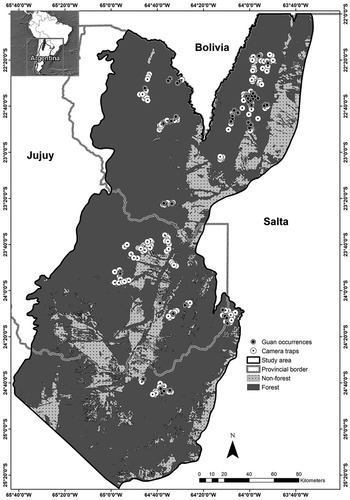
To determine the locations of individual Yungas Guans, we placed 233 camera traps (BUSHNELL, Model Trophy Camera Aggressor) along the latitudinal distribution of the Southern Yungas of the provinces of Salta and Jujuy, including private properties and national protected areas (Fig. 1). We deployed camera traps along forest trails used by animals. We georeferenced the location of each camera trap with a Garmin etrex® model geo-positioner. The mean distance from a camera-trap to its nearest one was 1.69 ± 0.77 km. Because the Yungas Guan is associated with forests, we placed the camera traps inside continuous forests with a mimimum distance of 100 m from forest edges. We attached camera traps to a tree at a height of 30 cm from the ground and set them to take photos 24 hours a day; cameras remained active for 30 consecutive days between May and October in 2016, 2017 and 2018. We conducted sampling in blocks of 5–20 camera traps, and then relocated them within the study area. We analyzed the photographs to identify individuals of the Yungas Guan.
Location of camera traps with presence of Yungas Guan (black circles) and without presence of the species (white circles) in the study area within the Southern Yungas of Argentina.

Potential habitat distribution
We used MaxEnt software version 3.4.1 (Phillips et al. Reference Phillips, Anderson and Schapire2006) to generate a map of the potential distribution of Yungas Guan. We used the occurrence data from camera traps as presence data in the model. To minimize the sample bias due to double counting of individuals, we used only the records of Yungas Guans that were more than 2 km apart with the assumption that the home range of P. bridgesi would be similar to that of P. superciliaris (Guix and Ruiz Reference Guix and Ruiz1997). We carried out a correlation analysis of 19 bioclimatic variables (Table S1 in the online supplementary material) of 1-km resolution, representing the conditions between 1970 and 2000 (Hijmans et al. Reference Hijmans, Cameron, Parra, Jones and Jarvis2005). Only five variables were retained and used as predictors: mean diurnal range (mean of monthly max temp-min temp) (BIO 2), temperature seasonality (BIO 4), temperature annual range (BIO 7), precipitation of wettest month (BIO 13), and precipitation of warmest quarter (BIO 18). We did not include topographic data in the species model because climate and elevation are often highly correlated (Martinuzzi et al. Reference Martinuzzi, Rivera, Politi, Bateman, los Llanos, Lizárraga, de Bustos, Chalukian, Pidgeon and Radeloff2018). We generated data for model training in MaxEnt with 10,000 pseudo-absences and selected 50 km for pseudo-absence locations because at that buffer distance the model produced the most accurate and biologically significant results compared to other buffer sizes (VanDerWal et al. Reference VanDerWal, Shoo, Graham and Williams2009, Martinuzzi et al. Reference Martinuzzi, Rivera, Politi, Bateman, los Llanos, Lizárraga, de Bustos, Chalukian, Pidgeon and Radeloff2018). When running MaxEnt, we set all the other options to default (Schank et al. Reference Schank, Mendoza, Vettorazzi, Cove, Jordan, O‘Farrill and Leonardo2015) and evaluated the performance of the model using the bootstrap technique (Bateman et al. Reference Bateman, VanDerWal and Johnson2012) and the area under the receiver operation curve (AUC). AUC measures the ability of a model to discriminate between sites where a species is present and those where it is absent (Hanley and McNeil Reference Hanley and McNeil1982). The AUC ranges from 0 to 1, with 1 indicating perfect discrimination and 0.5 a predictive discrimination that is no better than a random guess (Elith et al. Reference Elith2006). AUC values can be interpreted as indicating the probability that, when a presence site and an absence site are drawn at random from the population, the former will have a higher predicted value than the latter (Elith et al. Reference Elith2006). Additionally, we used the test of binomial probabilities to assess ommission rates for the models. These are 1-sided p-values for the null hypothesis that test points are predicted no better than by a random prediction with the same fractional predicted area (Phillips Reference Phillips2017). We transformed the MaxEnt predictions using the logistic threshold for the presence of the tenth percentile into a suitable versus inadequate binary habitat map to create a potential distribution map of the species. Since the Yungas Guan is a forest-associated species, we removed the transformed non-forest areas from the potential distribution map of the species, by overlapping the potential distribution maps with a land cover map (Martinuzzi et al. Reference Martinuzzi, Rivera, Politi, Bateman, los Llanos, Lizárraga, de Bustos, Chalukian, Pidgeon and Radeloff2018). Then, we calculated the total area of potential habitat available for the species in the study area.
Occupancy models
We performed an occupancy analysis to estimate the proportion of area occupied by the Yungas Guan (MacKenzie et al. Reference MacKenzie, Nichols, Royle, Pollock, Bailey and Hines2006). Because close cameras may record the same individual, producing non-independent records, we consider that occupancy (ψ) represents habitat use of the species (MacKenzie et al. Reference MacKenzie, Nichols, Royle, Pollock, Bailey and Hines2006). Occupancy analyses require successive sampling at points over short periods within which the population is considered demographically closed (MacKenzie et al. Reference MacKenzie, Nichols, Royle, Pollock, Bailey and Hines2006). To meet this condition, we partitioned the detection history of each 30-day camera-trap period into 5-day blocks, producing a maximum of six repeated surveys at each site. We included the following environmental and anthropogenic variables that may influence the detection and occupancy of cracid species in the occupancy models: distance to rivers, elevation, distance to small human households, distance to urban areas, distance to roads, and distance to transformed areas (Chalukian Reference Chalukian, Strahl, Beaujon, Brooks, Begazo, Sedaghatkish and Olmos1997, Pereira-Ribeiro et al. Reference Pereira-Ribeiro, Ferreguetti, Tomas, Bergallo, Rocha and Brooks2018, Zalazar et al. Reference Zalazar, Benitez and Di Giacomo2018). We obtained spatial data sets on human settlements, roads, and rivers from government databases in Geographic Information Systems (IGN 2016). We obtained data on transformed areas from Martinuzzi et al. (Reference Martinuzzi, Rivera, Politi, Bateman, los Llanos, Lizárraga, de Bustos, Chalukian, Pidgeon and Radeloff2018). Human settlements were of two types: “puestos”, i.e. isolated small households inhabited by one person or a few people, in some cases inhabited only seasonally, and urban areas (IGN 2016). To assess the probability of detection, we used the Occasion variable (Dias et al. Reference Dias, Lima Massara, de Campos and Henrique Guimarães Rodrigues2019), which was defined as the follow-up period in consecutive 5-day blocks, totalling six blocks (Occasion 1-6). We calculated the linear distance (km) from the camera traps to urban areas, transformed areas, roads, rivers and puestos in ArcGIS 10.4.1 and normalized the variables by converting them to Z values (Donovan and Hines Reference Donovan and Hines2007). To avoid collinearity between covariates, we calculated the Pearson’s correlation coefficient and did not include distance to transformed areas in the rest of the analyses, since it presented a correlation >0.65 with urban areas (Figure S1) (McDonald et al. Reference McDonald, Griffiths, Nano, Dickman, Ward and Luck2015, Steenweg et al. Reference Steenweg, Whittington, Hebblewhite, Forshner, Johnston, Petersen, Shepherd and Lukacs2016). We developed 16 a priori hypotheses or models to estimate the influence of the variables on the habitat use of the Yungas Guan (Table S2). We evaluated two parameters in the occupancy models (MacKenzie et al. Reference MacKenzie, Nichols, Royle, Pollock, Bailey and Hines2006): detectability (p) and probability of occupancy (ψ). To run the analyses, we used packages “Unmarked” (Fiske et al. Reference Fiske, Chandler, Miller, Royle and Kery2013), “AICcmodavg” (Burnham and Anderson Reference Burnham and Anderson2002), MuMIn, and “Lubridate” (Garrett and Hadley Reference Garrett and Hadley2011), in the R program version 3.5.0 (R Core Team 2018). The 16 models with the occupancy and detection covariates included null and full models. We evaluated the degree of fit of the full occupancy model using the MacKenzie and Bailey (Reference MacKenzie and Bailey2004) goodness-of-fit test. Instead of choosing a single model with the lowest ΔAIC value, we estimated the average of the first eight models that summed an Akaike Information Criterion relative model weight (AIC wt) of 0.95 as an acceptable maximum cutoff to select models (Barton Reference Barton2013). We also evaluated the relative importance of each covariate and the magnitude of their effect on the probability of occupancy. We calculated the 95% confidence intervals of the β coefficients through the adjustment function “model.avg” of the “MuMIn” package (Burnham and Anderson Reference Burnham and Anderson2002) and the “confint” function. When the confidence interval did not include zero, we considered the effect of the covariate as significant (Manly et al. Reference Manly, McDonald, Thomas, McDonald and Erickson2002). We constructed a spatially explicit map of the likelihood of habitat use of the Yungas Guan, based on model averaging. To generate the map of habitat use probability, we established a grid of hexagonal cells of 0.5 km apothem length over the study area to determine the distance between the centroid of the cell and the explanatory variables and to allocate a probability value to the cell. With these values, we built a matrix of 48,719 cells for the study area and predicted the occupancy for each cell using the predict function (Burnham and Anderson Reference Burnham and Anderson2002). We overlapped the spatially explicit map of habitat use with the potential habitat distribution map of the species.
Results
The sampling effort produced 88 independent photographic records of Yungas Guan from 6,990 camera trap nights. The mean distance from the camera traps to the nearest urban area, road, puesto and river was 24.53 ± 18.07 km, 5.20 ± 3.50 km, 7.41 ± 3.50 km, and 1.35 ± 1.63 km, respectively. Camera traps were deployed along an elevation range of 372–2,148 m asl. The Yungas Guan was recorded within an elevation range of 410–2,148 m.
Potential habitat distribution of Yungas Guan
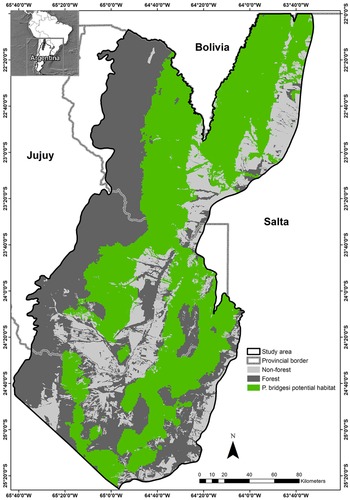
We used 44 records of the Yungas Guan to model its potential distribution. The AUC value of the potential distribution model of the Yungas Guan was 0.91. The average binomial test of omissions (P = 0.0037) showed the statistical significance of the predictions. Three variables contributed 90.1% of the explanatory power of the potential distribution model of Yungas Guan: 45.4% precipitation of warmest quarter (BIO 18); 37% mean diurnal range (mean of monthly (max temp-min temp)) (BIO 2), and 7.7% temperature seasonality (BIO 4). The total area of Yungas Guan potential distribution was 21,256 km2 (Figure S2). Of this area, 9% of the potential habitat was transformed to another type of land cover, resulting in 19,344 km2 of current potential distribution (Fig. 2).
Distribution of the potential habitat of the Yungas Guan in the Southern Yungas of Argentina.

Habitat use of Yungas Guan
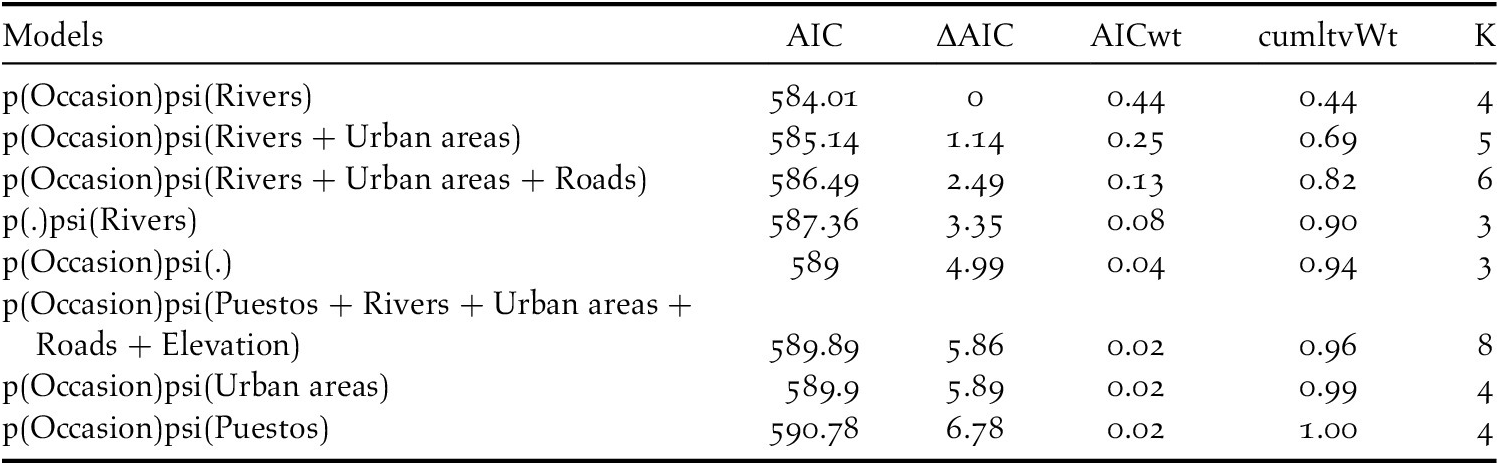
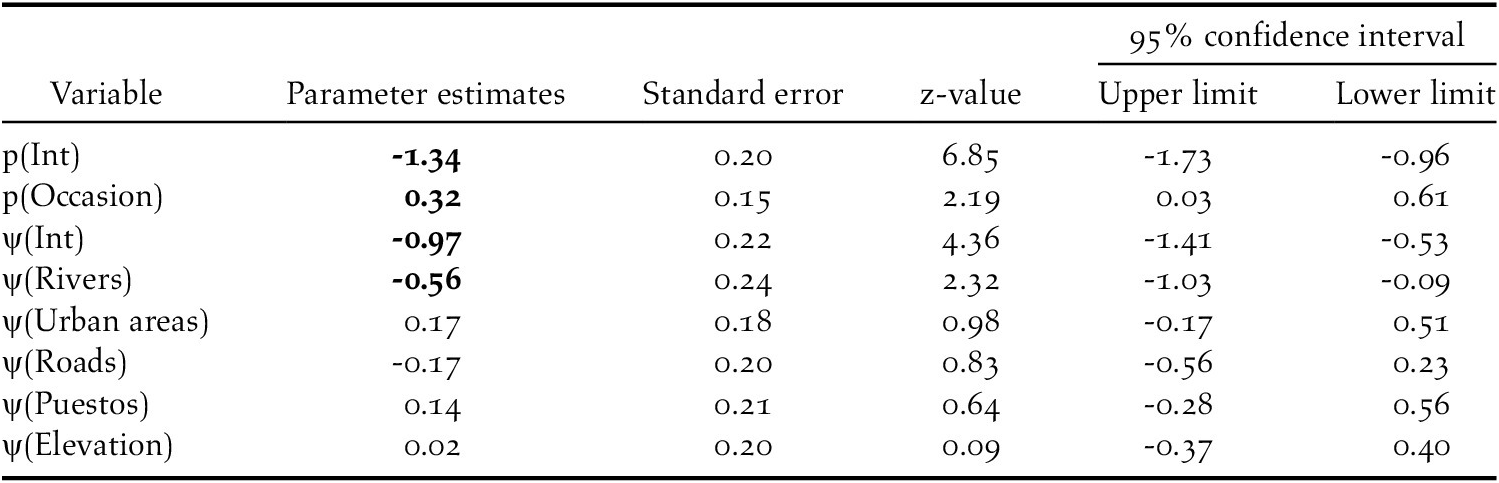
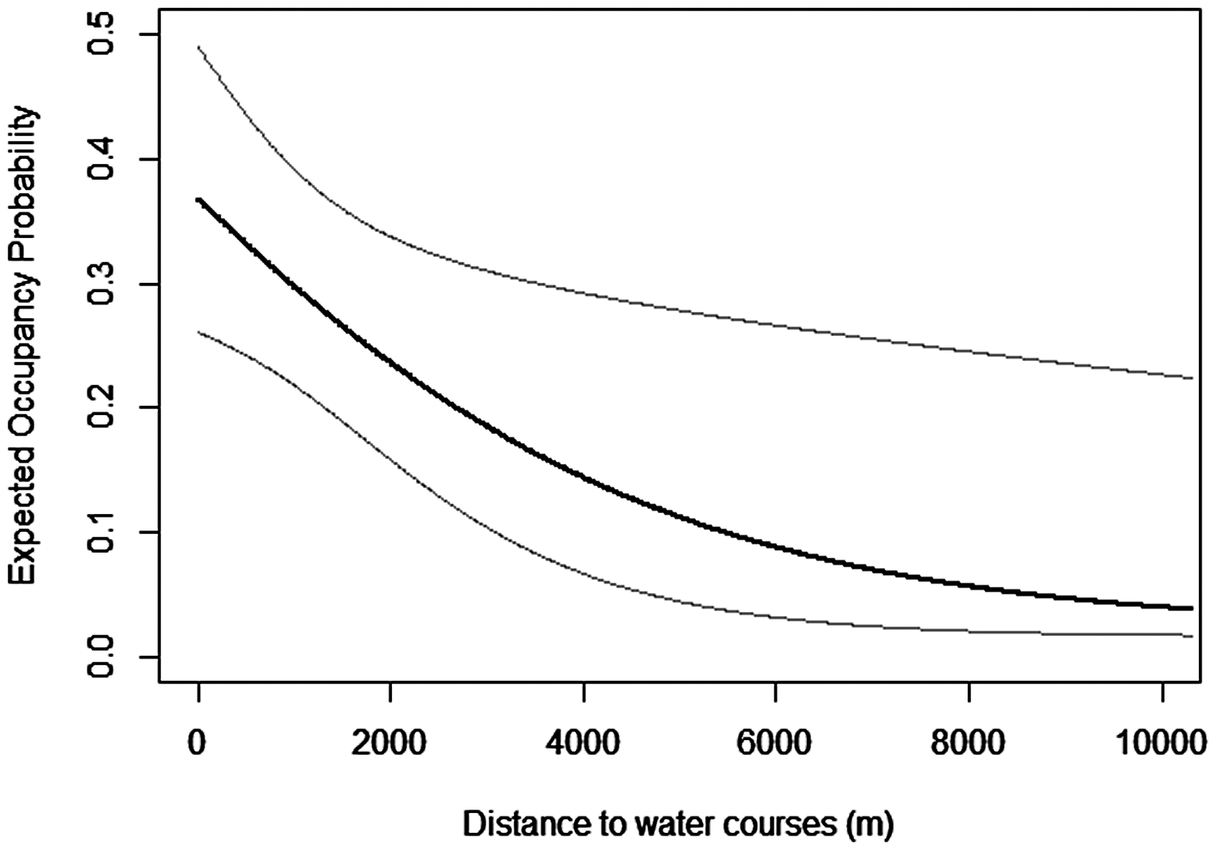
The estimated naive occupancy of Yungas Guan was 0.21. Our single-season model produced an estimated habitat use by the Yungas Guan for the entire study area of Ψ = 0.44 (β ± SE = -0.56 ± 0.24), with a probability of detection of p = 0.44 (β ± SE = - 0.34 ± 0.14). For the best model, habitat use (Table 1) ranged from 0.02 to 0.42, with an average of 0.27. The full model was not the most parsimonious (Table 1) and the c-hat estimator presented a value of 3.15. The variables that were included in the averaged model were distance to rivers, distance to puestos, distance to urban areas, distance to roads, elevation and Occasion. The variable that was most strongly associated with probability of habitat use was distance to rivers (Table 2). The probability of habitat use by the Yungas Guan decreased significantly with increasing distance from rivers (Fig. 3, Table 2). The probability of detection (p) was significantly and positively associated with the variable Occasion (Table 2).
Models used to determine the habitat use of the Yungas Guan in the Southern Yungas of Argentina.

Abbreviations: AIC = Akaike Information Criterion, ΔAIC = difference in AIC from the highest ranked model, AIC wt = relative model weight, k = number of model parameters, cumltvWt: cumulative weight. Ψ: probability of habitat use; p: probability of detection; Urban areas: distance from the camera trap to the closest city or town, Roads: distance from the camera trap to the nearest road, Rivers: distance from the camera trap to the nearest river, Puestos: distance from the camera trap to the nearest small household, Elevation: vertical distance of a point on earth from sea level, Occasion: time calculated in five-day periods.
Beta values of the model averaging, standard errors, and 95% confidence intervals for the variables that affected the probability of habitat use (ψ) and the probability of detection (p) of Yungas Guan in the Southern Yungas of Argentina.

ψ : probability of habitat use; p: probability of detection; Urban areas: distance from the camera trap to the closest city or town, Roads: distance from the camera trap to the nearest road, Rivers: distance from the camera trap to the nearest river, Puestos: distance from the camera trap to the nearest small household, Elevation: vertical distance of a point from the earth to the sea level, Occasion: time calculated in five-days periods. Terms in bold indicate 95% confidence intervals that do not include zero.
Probability of expected habitat use (bracketed by 95% CI in grey) of Yungas Guan in the Southern Yungas as a function of distance to rivers. This variable explained 44% of the variation in probability of habitat use.

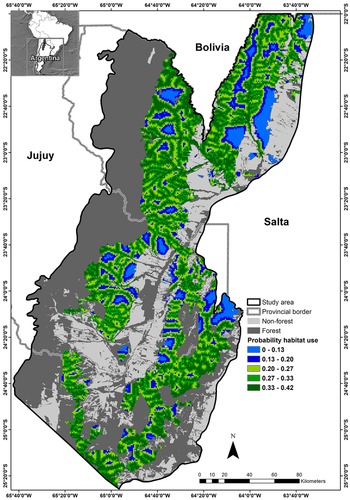
The spatially explicit map of estimated habitat use showed that 81% of the species’ potential distribution (i.e., 15,781 km2) has a probability (0.20–0.42) of habitat use near rivers (Fig. 4).
Distribution of the potential habitat and probability of habitat use of the Yungas Guan in the Southern Yungas of Argentina.

Discussion
The Yungas Guan is strongly associated with rivers in the Southern Yungas. Riparian forests are restricted habitats, with high levels of food resources that may be important for the reproduction and movement of numerous bird species (Palmer and Bennett Reference Palmer and Bennett2006, Gomez et al. Reference Gomez, Rivera, Politi and Ruggera2016). A similar pattern of association with riparian forests was recorded for the Dusky-legged Guan in the Paraná River Delta, in central-eastern Argentina (Malzof et al. Reference Malzof, Bolkovic, Thompson and Quintana2012), for Penelope superciliaris in the Atlantic Forest of Brazil (Pereira-Ribeiro et al. Reference Pereira-Ribeiro, Ferreguetti, Tomas, Bergallo, Rocha and Brooks2018), and for other cracid species (Luna-Maira et al. Reference Luna-Maira, Alarcón-Nieto, Haugaasen and Brooks2013). Studies on Crax globulosa suggested that the strong association with water might reflect feeding dependency on the seasonal availability of small fish, insect larvae and crustaceans (Bennett and Franco-Maya Reference Bennett, Franco-Maya, Renfijo, Franco-Maya, Amaya-Espinel, Kattan and López-Lanús2002, Alarcón-Nieto and Palacios Reference Alarcón-Nieto and Palacios2008). We found that for the Yungas Guan, the riparian forests represent a critical forest type, at least in the dry season, although this pattern needs to be confirmed for the rainy season. If the species relies on resources in riparian forests, then the conservation of this forest type should be a priority.
We did not find a significant relationship between the probability of Yungas Guan occurrence and human influence; this result is in contrast to previous findings (Malzof et al. Reference Malzof, Bolkovic, Thompson and Quintana2012, Zalazar et al. Reference Zalazar, Benitez and Di Giacomo2018) reporting both positive and negative associations. For example, the influence of human settlements was reported in the Brazilian Atlantic Forest, where guans suffer high hunting pressure by both the locals and people from urban centres, with drastic reductions in their populations (Pereira-Ribeiro et al. Reference Pereira-Ribeiro, Ferreguetti, Tomas, Bergallo, Rocha and Brooks2018). However, in the Southern Yungas, hunting pressure on this species is apparently low (S. Tejerina pers. obs.). It has been suggested that hunting could be an important mortality factor for the Yungas Guan in the Southern Yungas (Ministerio de Ambiente y Desarrollo Sustentable and Aves Argentinas 2017); however, we found no published quantitative information about this topic.
Our estimated occupancy value was lower than that reported for other cracid species. For P. superciliaris in the Atlantic Forest of Brazil, the probability of occupancy (Ψ) was 0.64, with an increase in occupancy as the distance to roads increased (Pereira-Ribeiro et al. Reference Pereira-Ribeiro, Ferreguetti, Tomas, Bergallo, Rocha and Brooks2018). The occupancy value (Ψ) for Crax fasciolata throughout the gallery forests of the humid Chaco rivers of Argentina was 0.47, and distance to rivers was less important than distance to human settlements, probably due to high hunting pressure and selective logging of woody species near human settlements (Zalazar et al. Reference Zalazar, Benitez and Di Giacomo2018).
The probability of detection obtained in our work would make feasible to monitor this species with camera traps. Beaudrot et al. (Reference Beaudrot, Ahumada, O’Brien and Jansen2019) suggested that changes of up to 15% in the probability of occupancy within a period of up to three years and using 90 camera traps could be detected. Our work shows the usefulness of camera traps as a sampling tool to study the Yungas Guan. Previous works found this technique to be useful for studying habitat use, occupancy, potential distribution, and behavioural aspects, among other types of data relevant to the study and management of cracid species (O’Brien and Kinnaird Reference O’Brien and Kinnaird2008, Srbek-Araujo et al. Reference Srbek-Araujo, Silveira and Chiarello2012, Blake et al. Reference Blake, Mosquera and Salvador2013, Reference Blake, Mosquera, Loiselle, Swing and Romo2017, Michalski et al. Reference Michalski, Norris, de Oliveira and Michalski2015, Pérez-Irineo and Santos-Moreno Reference Pérez-Irineo and Santos-Moreno2017).
The global population size of Yungas Guan has not been quantified. However, in a previous assessment of the former Dusky-legged Guan that included Yungas Guan and two other subspecies (P. o. obscura and P. o. bronzine) (Del Hoyo and Kirwan Reference Del Hoyo, Kirwan, Del Hoyo, Elliott, Sargatal, Christie and de Juana2013), the species was described as “frequent” (Stotz et al. Reference Stotz, Fitzpatrick, Parker and Moskovits1996) in its range. In addition, at the time of the assessment, Dusky-legged Guan was considered far from the thresholds for the IUCN Red List population reduction criteria. For these reasons, the Dusky-legged Guan was categorized as Least Concern (BirdLife International 2021). However, the recognition of Yungas Guan as a separate species implies it is endemic and more vulnerable to different threat factors, since species with restricted distribution are generally habitat specialists or depend on some resource that limits them spatially (Brown Reference Brown1984, Gaston et al. Reference Gaston, Blackburn and Lawton1997). Additionally, we show that its potential habitat has been reduced by 9% mainly due to land conversion, and that the species has a relatively low probability of habitat use. Therefore, a first assessment of the Yungas Guan’s conservation status is urgently needed.
Supplementary Material
To view supplementary material for this article, please visit https://doi.org/10.1017/S0959270921000563
Acknowledgements
We thank the owners of private lands that allowed us to carry out fieldwork on their properties, the Administration of National Parks of Argentina and the CEBio Foundation for providing the necessary equipment and logistical support for fieldwork. We are grateful to Jorgelina Brasca for improving the English and Fabio David Alabar for his help with the analyses. YT and SB are CONICET doctoral fellows. Funding for this work was provided by Rufford Small Grants, IDEA WILD, National Agency for Scientific and Technological Promotion (PICT- 2014-1388), CONICET-UNJU (PIO 1402014100133), and UNJU (SECTER B 046/2016).