




No CrossRef data available.
Article contents
Factors moderating neuropsychological outcomes following mild traumatic brain injury: A meta-analysis
Published online by Cambridge University Press: 04 May 2005
Abstract
There continues to be debate about the long-term neuropsychological impact of mild traumatic brain injury (MTBI). A meta-analysis of the relevant literature was conducted to determine the impact of MTBI across nine cognitive domains. The analysis was based on 39 studies involving 1463 cases of MTBI and 1191 control cases. The overall effect of MTBI on neuropsychological functioning was moderate (d = .54). However, findings were moderated by cognitive domain, time since injury, patient characteristics, and sampling methods. Acute effects (less than 3 months postinjury) of MTBI were greatest for delayed memory and fluency (d = 1.03 and .89, respectively). In unselected or prospective samples, the overall analysis revealed no residual neuropsychological impairment by 3 months postinjury (d = .04). In contrast, clinic-based samples and samples including participants in litigation were associated with greater cognitive sequelae of MTBI (d = .74 and .78, respectively at 3 months or greater). Indeed, litigation was associated with stable or worsening of cognitive functioning over time. The implications and limitations of these findings are discussed. (JINS, 2005, 11, 215–227.)
Information
- Type
- Research Article
- Information
- Journal of the International Neuropsychological Society , Volume 11 , Issue 3 , May 2005 , pp. 215 - 227
- Copyright
- © 2005 The International Neuropsychological Society
INTRODUCTION
Traumatic brain injury (TBI) is a leading cause of death and disability (Centers for Disease Control and Prevention, 2003). Each year an estimated 1.5 million people in the United States alone sustain a nonfatal brain injury (Sosin et al., 1996). Approximately 80% of these injuries are classified as mild (Kraus & Nourjah, 1988), involving only a brief loss or alteration of consciousness. Increasingly, mild traumatic brain injury (MTBI) has been recognized as a major public health concern with an annual worldwide incidence ranging from 100 to 550 per 100,000 (Andersson et al., 2003; Duus et al., 1991; Evans, 1992; Thornhill et al., 2000). The economic impact of MTBI is substantial, accounting for about 44% of the 56 billion dollar annual cost of TBI in the United States (Thurman, 2001).
Although it is clear that most patients suffer at least some acute cognitive difficulties, the nature and course of postacute cognitive recovery remains an area of intense controversy. While most cases of MTBI recover completely within the first 3 months (Dikmen et al., 1986, 1995; Gentilini et al., 1985; Gronwall & Wrightson, 1974; Levin et al., 1987; Rutherford et al., 1979), a significant minority continue to report distressing symptoms for months (Alves et al., 1993; Dikmen et al., 1986; Hartlage et al., 2001; Powell et al., 1996) or years postinjury (Alexander, 1992; Deb et al., 1999; Hartlage et al., 2001). The prevalence of persistent symptoms varies across studies from 7–8% (Binder et al., 1997) to 10–20% (Alexander, 1995) to 33% (Rimel et al., 1981). Frequently these complaints involve a constellation of physical, emotional, and cognitive symptoms collectively known as postconcussion syndrome (PCS). Common symptom complaints include headaches, balance problems, dizziness, fatigue, depression, anxiety, irritability, and memory and attention difficulties, often without demonstrable structural changes to the brain (Eisenberg & Levin, 1989) or neuropsychological dysfunction (Dikmen et al., 1986; Levin et al., 1987). Some have suggested that persistent PCS reflects subtle neurological dysfunction beneath the detection threshold of routine diagnostic procedures such as computed tomography (CT), magnetic resonance imaging (MRI), and electroencephalography (EEG) conducted shortly after injury (Hayes & Dixon, 1994; Miller, 1996; Povlishock & Coburn, 1989). Others contend, however, that persisting symptoms are the result of psychological mechanisms such as poor coping styles (Marsh & Smith, 1995), emotional reactions to an adverse event (Bryant & Harvey, 1999), or expectations of symptoms that may occur following a MTBI (Mittenberg et al., 1992). While PCS has been recognized for at least the last few hundred years (Evans, 1992), the debate over the persistence of symptoms following MTBI in a minority of individuals has led to PCS being a particularly controversial diagnosis in the medical-legal arena.
Because objective evidence of cognitive impairment is part of the Diagnostic and Statistical Manual–4th Edition (DSM–IV) diagnostic criteria for PCS (American Psychiatric Association, 1994), documenting neuropsychological deficits is one approach used to help establish the validity of symptom complaints, particularly in the medical-legal arena. However, the extent to which neuropsychological impairment persists is controversial. Three meta-analytic reviews have been published on neuropsychological outcomes in MTBI. The first, by Binder and colleagues (1997), included only participants at least 3 months postinjury who had been selected due to a history of mild head trauma rather than symptom complaint (i.e., population-based or unselected samples). These authors calculated a total of 11 effect sizes from eight different studies and found the sample-size weighted overall effect to be quite small (g = .07). When effect sizes were calculated for specific neuropsychological domains, only attention had an effect size significantly greater than zero (g = .17).
In contrast, a subsequent meta-analysis by Zakzanis et al. (1999) included 12 studies. There is no indication regarding study selection criteria, other than MTBI. Thus, this study differed from the Binder et al.'s study (1997) by including both clinic-based/referred samples and the unselected samples of Binder and colleagues. An overall effect size was not reported. Instead, effect sizes were reported for specific neuropsychological tests and then for those tests grouped into seven cognitive domains. The results of this domain analysis revealed moderate to large effect sizes for all cognitive domains, with the largest for cognitive flexibility/abstraction (d = .72) and the smallest for manual dexterity (d = .44). However, it is impossible to know whether these larger effect sizes reflect the inclusion of more acutely injured participant samples, as time since injury was not specified, or reflect the inclusion of clinic-based samples.
A recent meta-analysis (Schretlen & Shapiro, 2003) attempted to clarify these disparate results by examining both MTBI studies and moderate-to-severe studies and including only population-based or unselected samples. Based on 15 studies, the overall neuropsychological effect size (d) for MTBI was .24, while the effect size for moderate/severe TBI was .74. These findings suggest that it was the inclusion of studies with clinic-based symptomatic participants that resulted in the larger effect sizes in the Zakzanis and colleagues (1999) meta-analysis. Further, these investigators grouped studies of MTBI into 4 time-since-injury intervals, < 7 days, 7–29 days, 30–89 days, and > 89 days, and found significant differences across these intervals (d = .41, .29, .08, and .04, respectively). The neuropsychological effect size associated with MTBI was not significantly different from zero by 30–89 days postinjury. However, these investigators did not report effect sizes by different neuropsychological domains, and it is certainly possible that some domains may show residual impairments not captured by the overall effect size [e.g., the Binder et al. (1997) findings of a significant effect size only for the attention/concentration domain].
The purpose of this study was to determine the magnitude of impairment in MTBI participants across multiple cognitive domains. Of primary interest was whether there are differences in effect sizes based on several dimensions: cognitive domain (e.g., attention, memory, etc.), time since injury, and the nature of the study participants (litigation versus clinic-based versus unselected samples).
METHOD
Search Strategy and Selection Criteria
Articles published between 1970 to March 2004 were identified through a literature search of online databases (PUBMED and PsychINFO). The search was limited to articles published in the English language using human participants. The key words were “cognition,” “neuropsychological,” “minor,” “head injury,” “brain injury,” “mild,” “traumatic brain injury,” and “concussion.” In addition, we examined the reference sections of previous meta-analyses, as well as the reference sections of retrieved empirical studies to locate additional studies. This was done to minimize the possibility of overlooking any studies missed in the computerized database searches.
To be included in the analysis, studies had to meet several criteria which were implemented to ensure a reasonably homogeneous set of studies and to allow for the calculation of effect sizes pertaining to the potential cognitive sequelae of MTBI. First, participants had to have sought medical attention for mild head injury. As such, studies of sports-related injuries were excluded due to the potential differences between participants in these types of samples (i.e., athletes usually do not seek medical attention at a facility but rather are assessed during and immediately after the sporting event). Also, those studies that did not suggest brain injury per se (i.e., whiplash) were excluded. Second, participants with mild head injury had to be compared to some control group. Although the definition of MTBI differed among studies, there had to be some attempt to define participants by level of severity. Those studies that did not separate their findings by severity level were excluded from the study. Third, participants had to be compared on cognitive measures, either clinically validated tests or experimental measures. Fourth, the studies had to include sufficient statistical information to allow for calculation of effect sizes. Fifth, participants had to be adults or adolescents, as children may have different cognitive sequelae following MTBI (Borg et al., 2004; Capruso & Levin, 1992). Finally, as we are interested in changes in cognitive functioning over time following MTBI, we only included studies that reported time since injury.
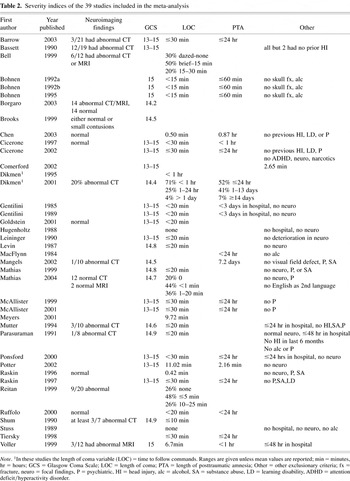
We examined a total of 133 studies from which 39, with a total of 41 effect sizes, met inclusion criteria (see asterisked studies in the reference section). Of note, the Levin et al.'s study (1987) contributed three separate effect sizes, as results were presented by three separate geographic sites. If multiple time points or multiple severity groups (within the context of MTBI) were presented, an average effect size was calculated. As Mangels et al. (2002) used the same participants as Levine et al. (1998), we only included the Mangels et al.'s study. Finally, although McAllister et al. (2001) used 6 participants and 8 controls from the McAllister et al. (1999) study, we considered these studies independent and therefore included an effect size for each. The 39 studies contributed a total of 1463 cases of MTBI and 1191 control cases. The basic characteristics of each of the included studies are displayed in Table 1, including the overall unweighted effect size (d) for each study. The frequency of various unweighted effect sizes are presented in a histrogram in Figure 1. The unweighted effect sizes were utilized to visually depict the most frequent effect sizes associated with MTBI independent of sample size. The severity of injury data for each study are presented in Table 2.
Characteristics of the 39 studies included in the meta-analysis


Frequency of 41 unweighted effect sizes across 39 studies.
Severity indices of the 39 studies included in the meta-analysis

Cognitive Outcome Measures
The outcome measures were tests of cognitive performance for MTBI cases and controls. These tests were grouped into nine broad domains of functioning, based upon the typical grouping seen in the neurological and neuropsychological literature (Lezak, 1995; Spreen & Strauss, 1998). For experimental tasks (i.e., tasks not validated for clinical use), we relied upon the authors' domain assignment. Measures included within the nine domains are: global cognitive ability—Wechsler Adult Intelligence Scales (Wechsler, 1987a, 1997a), National Adult Reading Test (Nelson & Willison, 1991), and the General Neuropsychological Deficit Scale from the Halstead-Reitan Neuropsychological Test Battery (Reitan & Wolfson, 1993); attention—Trail Making Test-Part A (Reitan & Wolfson, 1985), Paced Auditory Serial Addition Task (Gronwall, 1977; Levin, 1983), Digit Span, Arithmetic, Digit Symbol, and the Letter-Number Sequencing subtest from the Wechsler Intelligence Scales (Wechsler, 1974, 1987a), Test of Everyday Attention (Robertson et al., 1994), Consonant Trigrams Test (Peterson & Peterson, 1959), Sentence Repetition Test (Meyers et al., 2000), Continuous Performance Test (Conners, 1995), simple and choice reaction time tasks, experimental tasks of selective attention, n-back tasks, attention subscale of the BNI Screen for Higher Cortical Function (Prigatano et al., 1995), Digit Span and Visual Span subtests from the Wechsler Memory Scales (Wechsler, 1987b, 1997b), serial addition by 3's, and the Seashore Rhythm Test (Reitan & Wolfson, 1993); executive functioning—Trail Making Test-Part B (Reitan & Wolfson, 1985), Stroop Color and Word Test interference score (Golden, 1978), Category Test from the Halstead-Reitan Battery (Reitan & Wolfson, 1993), and the Wisconsin Card Sorting Test (Heaton, 1981; Heaton et al., 1993); fluency—Controlled Oral Word Association Test (Benton & Hamsher, 1976), Ruff Figural Fluency Test (Evans et al., 1985), and semantic fluency (Goodglass & Kaplan, 1972); memory acquisition—learning trials or immediate recall trials from the following tests: California Verbal Learning Test (Delis et al., 1987), Benton Visual Retention Test (Benton, 1974), Wechsler Memory Scale (Wechsler, 1987b, 1997b), Selective Reminding Test (Buschke, 1973; Mattis & Kovner, 1978), Rey-Osterrieth Complex Figure (Osterrieth, 1944), Rey Auditory Verbal Learning Test (Schmidt, 1996), BNI Screen for Higher Cerebral Functions (Prigatano et al., 1995), Standardized Assessment of Concussion (McCrea et al., 1997), Continuous Recognition Memory (Hannay & Levin, 1988), and experimental word recognition tasks; delayed memory—delayed recall portions from the following tests: California Verbal Learning Test (Delis et al., 1987), Wechsler Memory Scales (Wechsler, 1987b, 1997b), Rey-Osterrieth Complex Figure (Osterrieth, 1944), Rey Auditory Verbal Learning Test (Schmidt, 1996), BNI Screen for Higher Cerebral Functions (Prigatano et al., 1995), Standardized Assessment of Concussion (McCrea et al., 1997), and the Mattis-Kovner Verbal Learning and Memory Test (Mattis & Kovner, 1978); language—Boston Naming Test (Kaplan et al., 1983), speech/language subscale of the BNI Screen for Higher Cortical Function (Prigatano et al., 1995), Speed and Capacity of Language Processing Test (Baddeley et al., 1992), and the Vocabulary and Similarities subtests from the Wechsler Adult Intelligence Scales (Wechsler, 1987a, 1997a); visuospatial ability—the Block Design, Picture Completion and Picture Arrangement subtests from Wechsler Scales (Wechsler, 1987a, 1997a), the visuospatial portions of the BNI Screen for Higher Cerebral Functions (Prigatano et al., 1995), the copy portion of the Benton Visual Retention Test (Benton, 1974), and the Rey-Osterrieth Complex Figure (Osterrieth, 1944); and motor abilities—finger tapping and name writing (Reitan & Wolfson, 1993).
Data Extraction and Statistical Analysis
Effect sizes were calculated using techniques espoused by Hunter and Schmidt (Hunter & Schmidt, 1990; Hunter et al., 1982). Calculated from the data reported in each study was the effect-size estimate, d (i.e., the control group mean minus the TBI group mean, divided by the pooled standard deviation). Thus, d represents the standardized difference between the two groups within each study, with a positive effect size indicative of better performance by the control group. In studies where more than one dependent measure was present for a cognitive domain (e.g., multiple tests of fluency), an averaged effect size was calculated for the overall analysis to avoid one study dominating the results. For example, if a study had tests with both nonverbal and verbal fluency, these effect sizes were averaged to generate the overall effect size for fluency. For the effect sizes reported in this study, the averaged d values are weighted by each study's sample size. Finally, we identified potential outliers using funnel plots (Makdissi et al., 2001) and eliminated one effect size that was clearly an outlier. Funnel plots place emphasis on both sample size and deviancy of effect size.
Moderator Variables
We also calculated the Q statistic to examine homogeneity of effect sizes across studies. The null hypothesis of homogeneity among obtained effect sizes suggests that the observed results represent a single population effect and differences among the obtained effect sizes are due to sampling error. If a significant Q value is observed, on the other hand, this indicates heterogeneity of results and potential moderator effects. Q is computed by dividing the variance of the sample-weighted d by the sampling error variance and this quantity is then multiplied by the number of data points or samples (see formula on page 428, Hunter & Schmidt, 1990). The Q statistic is evaluated on the chi-square distribution at k − 1 degrees of freedom, where k equals the total number of samples. If Q exceeds the upper-tail critical value of the chi-square distribution, then the null hypothesis of homogeneity is rejected and potential moderators of the effect size may be explored. We examined the influence of potential categorical moderating variables including cognitive domain, time since injury (<90 days versus ≥90 days) and selection context of the study participants (in litigation versus symptomatic/clinic-based versus unselected samples). Studies were coded as involving litigation if the authors mentioned that some or all participants were seeking compensation or were involved in litigation. Two studies that had only one litigating participant were not considered litigation studies. Clinic-based studies were coded as such if patients were specifically characterized as symptomatic or if patients were exclusively referred to long-term rehabilitation facilities. Unselected samples were coded as such if participants were recruited prospectively, if they were not selected based on symptomatology, and/or if the samples were unsymptomatic. If a study included more than one patient selection type (e.g., litigation and clinic-based), effect sizes were examined separately for each type. These moderator variables were first coded by a doctorate-level practicing neuropsychologist and independently re-coded by a neuropsychology postdoctoral fellow. Agreement was perfect for time since injury. Agreement on selection context and cognitive domain was good (kappa = .99 for both variables). In those instances where the raters disagreed, consensus was reached collectively.
RESULTS
Overall Effect Size
The overall effect (d) of MTBI on neuropsychological performance was 0.54 (p < .05) based on 39 studies, Q (40) = 5291, p < .05. The interrater reliability of this value was calculated using a Pearson's correlation (r = 1.00, p < .0001) between overall effect size calculations for each study as determined by two raters. Because null findings are typically not reported in the literature, meta-analyses are frequently criticized as containing a biased sample of all studies conducted. That is, meta-analyses reflect only statistically significant findings, while studies with null results remain unpublished and stored in a researcher's file drawer. To address this issue, we conducted a file-drawer analysis. Essentially, a file-drawer analysis estimates how many studies with null results would need to exist to render the effect size of the current meta-analysis trivial (Rosenthal, 1979). Results suggest that 172 unpublished studies with an effect size of <.1 would be needed to eliminate the overall effect size.
Overall Effect Sizes by Cognitive Domain
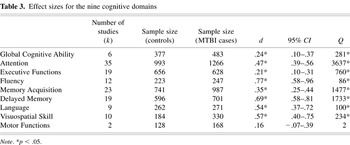
Effect sizes for the nine cognitive domains are displayed in Table 3. MTBI was associated with statistically significant deficits in all domains except motor functions (only two studies included motor functions). Most effect sizes were moderate to large (Cohen, 1988) with fluency and delayed memory having the largest overall effect sizes. Smallest overall effects were found on motor and executive measures.
Effect sizes for the nine cognitive domains

As can be seen in Table 3, significant heterogeneity was apparent in all domains except motor functioning. We therefore examined the influence of several additional potential moderating variables in all domains except motor functioning. Potential moderators examined included time since injury and sample selection context (in litigation versus clinic-based sample versus unselected samples). These variables were selected for further investigation based on the MTBI literature and because the number of studies including these variables was generally sufficient to permit these additional analyses.
Time Since Injury
The results of the time-since-injury moderator analysis are presented in Table 4. In 7 of the 8 cognitive domains examined, the effect of MTBI on neuropsychological functions was an average of .23 standard deviation units less when measured postacutely (i.e., ≥90 days) relative to acutely (i.e., <90 days). In contrast, the visuospatial domain showed an increase in the effect size with greater time since injury. However, from Table 4, it is apparent that there is still significant heterogeneity across cognitive domains. We therefore conducted further moderator analyses based on sample selection context.
Moderator analyses—time since injury by cognitive domain

Sample Selection Context
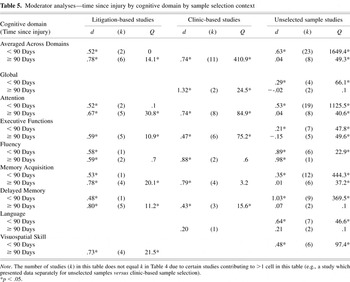
Given that cognitive outcomes were clearly related to time since injury, subsequent moderator analyses of sample selection context were stratified on time since injury. As can be seen in Table 5, selection context clearly affected effect sizes. The effect sizes reported in Table 5 are independent (i.e., the clinic-based column does not contain litigation cases and the unselected sample column does not contain litigation or clinic-based cases). In order to be able to compare current findings with previous meta-analytic studies, Table 5 also presents overall effect sizes averaged across domains for the three different sample selection contexts.
Moderator analyses—time since injury by cognitive domain by sample selection context

Studies with participants in litigation and studies with unselected samples had a similar overall effect size at <90 days (d = .52 versus .63, respectively). However, the average effect size associated with litigation increased from <90 days to an average of 13 months postinjury. This finding stands in marked contrast to the findings of studies using unselected samples in which the neuropsychological outcome of MTBI participants was equal to control participants by ≥90 postinjury (d = .04). There were no studies with clinic-based samples with outcomes <90 days postinjury, but clinic-based and litigation-based samples were essentially the same at ≥90 days postinjury (d = .74 and .78, respectively).
Litigation status also explains a discrepant finding with regard to time since injury seen in Table 4. Visuospatial skill was the only domain with an increasing effect size across time, but all visuospatial studies conducted at ≥90 days involved participants in litigation, while those studies conducted at < 90 days were all unselected samples.
When neuropsychological outcomes for the 8 cognitive domains were examined based on unselected samples, the largest acute effect sizes (<90 days since injury) were for fluency and delayed memory (d = .89 and 1.03, respectively). In contrast, studies of participants in litigation had similar acute effect sizes across cognitive domains (d ranging from .48 to .58), which generally increased across time (d ranging from .59 to .80 at ≥ 90 days). In an effort to determine if the larger litigation effect sizes could be explained by inadequate effort or malingering, litigation study effect sizes were compared based on the presence or absence of validity tests. Litigation studies that included effort screening had an average effect size of .50 (p > .05, k = 2, Q = 0, p > .05) while those that did not include effort screening had an average effect size of .66 (p < .05, k = 5, Q = 17.6, p < .05). These two effect sizes are homogenous, Q = .91, p > .05.
DISCUSSION
Our meta-analysis provides a more up-to-date and comprehensive review of the MTBI literature and includes more studies than previous meta-analyses of neuropsychological outcomes. In addition, we examined the effects of moderator variables, some of which have not been examined in prior studies. Results from those studies using unselected samples suggest that there is an effect of MTBI within the first 90 days with mild neuropsychological impairments across domains, but with specific and relatively large deficits in fluency (d = .89) and delayed memory recall (d = 1.03). However, this acute effect is essentially zero by 3 months postinjury, replicating the findings of Schretlen and Shapiro (2003). These findings extend the results of this prior meta-analytic study (Schretlen & Shapiro, 2003) by examining not only the overall effect size, but the effect sizes for specific cognitive domains. In the studies using unselected samples by 90 days postinjury, no individual cognitive domain was significantly different from zero, with the exception of fluency which was an outlier finding based on only one study (Mangels et al., 2002). Although not an outlier in other domains, within the fluency domain, this study produced results that were clearly different than other domains by 90 days postinjury. This study was atypical in that the MTBI group had an average of 7.2 days posttraumatic amnesia (PTA) which exceeds standard criteria for MTBI (American Congress of Rehabilitation Medicine, 1993). In addition, the sample size was quite small (n = 11 MTBI). Overall, however, the results of this meta-analysis suggest that for the MTBI unselected sample at large, there is full neuropsychological recovery by 3 months postinjury. This is consistent with literature suggesting that most cognitive deficits associated with MTBI resolve in the first 3 months (Dikmen et al., 1986, 1995; Gentilini et al., 1985; Gronwall & Wrightson, 1974; Levin et al., 1987; Rutherford et al., 1979).
Moderator analyses demonstrated the importance of considering sample selection context when examining the cognitive sequelae of MTBI. Participants in litigation had an overall acute effect size (d = .52 at < 90 days since injury) comparable to unselected samples (d = .63). However, the acute neuropsychological profile of specific difficulties with fluency and delayed memory recall was not present for participants in the litigation-based samples. In addition, unlike participants in unselected samples, those in litigation do not improve with time and actually get worse. These findings are consistent with the literature suggesting that the effect of financial incentive on outcome following MHI is quite large (Binder & Rohling, 1996) and that sampling method (i.e., clinic-based versus unselected samples) is paramount (Binder et al., 1997; Dikmen et al., 1992).
It is tempting to attribute these neuropsychological litigation effects, particularly in the postacute phase (≥ 90 days postinjury), to test invalidity, symptom exaggeration, or malingering. However, moderator investigation of differential effect sizes when symptom validity indices were used in litigation-based studies failed to eliminate the findings (no validity screening d = .50; validity screening d = .66). In addition, in the postacute phase of recovery, participants in clinic-based samples had comparable moderate to large neuropsychological effect sizes to those of participants in litigation-based samples. The underlying cause of these ongoing cognitive difficulties in litigation and clinic samples is not clear from the current meta-analytic study. Further research will be necessary to determine whether this ongoing adverse effect is due to subtle and lasting brain dysfunction or to psychological factors such as secondary gain (Binder & Rohling, 1996), implicit beliefs or self-expectation (Mittenberg et al., 1992), poor coping styles (Marsh & Smith, 1995), emotional reactions to an adverse event (Bryant & Harvey, 1999), or other factors.
Our results suggest that the effect sizes reported in previous meta-analyses may be confounded by sampling context and time since injury. For example, Binder et al. (1997) reported an effect size for attention of g = .17. Our results suggest that this effect size is reduced to essentially zero by 3 months or greater when litigating and symptomatic participants are removed. Our time since injury findings are consistent with Schretlen & Shapiro (2003) in that effect sizes associated with MTBI decrease over time. However, these investigators did not report effect sizes by different neuropsychological domains. Our data suggest that the time since injury effect is generalizable across most cognitive domains. Performance on measures of global cognition, attention, executive functions, fluency, memory acquisition, delayed memory, and language was intact for individuals with MTBI at 3 months or more postinjury as compared with performance at less than 3 months postinjury.
There are several limitations to this study, some of which are inherent to conducting a meta-analysis. Differential criteria for establishing MTBI were averaged in this analysis. Previous research has demonstrated the importance of stringency in defining MTBI, as well as the importance of demographic variables (Dikmen et al., 2001), neither of which was investigated in this meta-analysis. Other potential moderators include “diagnosis threat” (Suhr & Gunstad, 2002) and psychiatric variables (Levin et al., 2001). Examining the effect of MTBI across many cognitive domains and across potential moderators necessarily entailed a small number of studies in some cells. So, for example, the effect sizes of MTBI on fluency (d = .98) or on language (d = .21) at 90 days or greater for unselected samples comes from only one and two studies, respectively. Clearly, more postacute studies using unselected samples in these domains are necessary. Other more frequently investigated domains (e.g., attention) probably reflect more stable findings. Furthermore, among the studies included in the analysis, few had information on all of the ability domains targeted. It should be noted that we obviously could only code studies as including litigating participants when the authors mentioned this variable. It is likely that some studies failed to exclude participants in litigation, particularly the clinic-based studies, but did not mention this in their study. As such, effect sizes associated with clinic-based samples may be artificially inflated. Finally, it was impossible to compare clinic-based versus unselected samples across time in this analysis, as clinic-based studies were exclusively conducted at greater than 90 days postinjury. Clearly, these variables are inextricably confounded with one another due to the lack of variability. As such, the effect sizes associated with these analyses may not reflect the actual amount of variance accounted for by time since injury and sample selection.
Finally, the Q values were still significant even after moderator analyses. Exceptions were global cognition at 90 days or greater, language at 90 days or greater, and delayed memory at 90 days or greater, all of which were comprised of only 1 to 3 studies. As Q is susceptible to artificial variance inflation when the number of studies is large (Hunter & Schmidt, 1990), it is difficult to know whether nonsignificant Q values were due to few studies, and in turn if the significant Q values were due to a greater number of studies. Also, as we were unable to control for potential artifacts (e.g., reliability of the neuropsychological measures), an inflation of Type I error is likely (Schmidt & Hunter, 2003). Therefore, there remain important as-yet-unidentified moderators.
Despite these limitations, this meta-analysis provides compelling evidence that MTBI has little to no effect on neuropsychological function by 3 months or greater postinjury in the MTBI population at large. Participants in litigation, on the other hand, remain stable or get worse with time. Further research is necessary to clarify these findings in certain, less-studied cognitive domains (e.g., motor functioning, language, etc.).
ACKNOWLEDGMENTS
The research reported here was supported by the Department of Veterans Affairs, Veterans Health Administration (VHA). Further support was provided by the Defense and Veterans Brain Injury Center, the James A. Haley Veterans' Hospital, and a grant (#MDA 905-03-2-0003) through the Henry Jackson Foundation. The views expressed herein are those of the authors and do not necessarily reflect the views of the Department of Veterans Affairs.
References
REFERENCES (Note. References marked with an asterisk “*” indicate studies included in the meta-analysis.)
Alexander, M.P.
(1992).
Neuropsychiatric correlates of persistant postconcussive
syndrome.
Journal of Head Trauma Rehabilitation,
8,
60–69.Google Scholar
Alexander, M.P.
(1995).
Mild traumatic brain injury: Pathophysiology, natural history, and
clinical management.
Neurology,
45,
1253–1260.Google Scholar
Alves, W.,
Macciocchi, S.N., &
Barth, J.T.
(1993).
Postconcussive symptoms after uncomplicated mild head injury.
Journal of Head Trauma Rehabilitation,
8,
48–59.Google Scholar
American Congress of Rehabilitation Medicine.
(1993).
Definition of mild traumatic brain injury.
Journal of Head Trauma Rehabilition,
8,
86–87.Google Scholar
American Psychiatric Association.
(1994).
Diagnostic and Statistical Manual of Mental Disorders:
DSM–IV
(4th ed.).
Washington, DC:
American Psychiatric Association.
Andersson, E.H.,
Bjorklund, R.,
Emanuelson, I., &
Stalhammar, D.
(2003).
Epidemiology of traumatic brain injury: A population based study in
western Sweden.
Acta Neurologica Scandinavica,
107,
256–259.Google Scholar
Baddeley, A.,
Emslie, H., &
Nimmo-Smith, I.
(1992).
The Speed and Capacity of Language Processing Test: Manual.
Bury St. Edmunds, Suffolk:
Thames Valley Test Company.
*Barrow, I.M.,
Hough, M.,
Rastatter, M.P.,
Walker, M.,
Holbert, D., &
Rotondo, M.F.
(2003).
Can within-category naming identify subtle cognitive deficits in the
mild traumatic brain-injured patient?
Journal of Trauma,
54,
888–895;
discussion 895–887.Google Scholar
*Bassett, S.S. &
Slater, E.J.
(1990).
Neuropsychological function in adolescents sustaining mild closed
head injury.
Journal of Pediatric Psychology,
15,
225–236.Google Scholar
*Bell, B.D.,
Primeau, M.,
Sweet, J.J., &
Lofland, K.R.
(1999).
Neuropsychological functioning in migraine headache, nonheadache
chronic pain, and mild traumatic brain injury patients.
Archives of Clinical Neuropsychology,
14,
389–399.Google Scholar
Benton, A.L.
(1974).
The Revised Visual Retention Test: Clinical and experimental
applications,
4th ed.
New York:
The Psychological Corporation.
Benton, A.L. &
Hamsher, K.D.
(1976).
Multilingual Aphasia Examination.
Iowa City, IA:
University of Iowa.
Binder, L.M. &
Rohling, M.L.
(1996).
Money matters: A meta-analytic review of the effects of financial
incentives on recovery after closed-head injury.
American Journal of Psychiatry,
153,
7–10.Google Scholar
Binder, L.M.,
Rohling, M.L., &
Larrabee, J.
(1997).
A review of mild head trauma. Part I: Meta-analytic review of
neuropsychological studies.
Journal of Clinical and Experimental Neuropsychology,
19,
421–431.Google Scholar
*Bohnen, L.,
Jolles, J.,
Twijnstra, A.,
Mellink, R., &
Sulon, J.
(1992a).
Coping styles, cortisol reactivity, and performance on vigilance
tasks of patients with persistant postconcussive symptoms after mild head
injury.
International Journal of Neuroscience,
64,
97–105.Google Scholar
*Bohnen, N.,
Jolles, J., &
Twijnstra, A.
(1992b).
Neuropsychological deficits in patients with persistent symptoms six
months after mild head injury.
Neurosurgery,
30,
692–695;
discussion 695–696.Google Scholar
*Bohnen, N.I.,
Jolles, J.,
Twijnstra, A.,
Mellink, R., &
Wijnen, G.
(1995).
Late neurobehavioural symptoms after mild head injury.
Brain Injury,
9,
27–33.CrossRefGoogle Scholar
Borg, J.,
Holm, L.,
Cassidy, J.D.,
Peloso, P.M.,
Carroll, L.J.,
von Holst, H.,
Paniak, C., &
Yates, D.
(2004).
Diagnostic procedures in mild traumatic brain injury: Results of the
WHO Collaborating Centre Task Force on Mild Traumatic Brain Injury.
Journal of Rehabilitation Medicine,
43S,
61–75.Google Scholar
*Borgaro, S.R.,
Prigatano, G.P.,
Kwasnica, C., &
Rexer, J.L.
(2003).
Cognitive and affective sequelae in complicated and uncomplicated
mild traumatic brain injury.
Brain Injury,
17,
189–198.Google Scholar
*Brooks, J.,
Fos, L.A.,
Greve, K.W., &
Hammond, J.S.
(1999).
Assessment of executive function in patients with mild traumatic
brain injury.
Journal of Trauma,
46,
159–163.Google Scholar
Bryant, R.A. &
Harvey, A.G.
(1999).
Postconcussive symptoms and posttraumatic stress disorder after mild
traumatic brain injury.
Journal of Nervous and Mental Disease,
187,
302–305.CrossRefGoogle Scholar
Buschke, H.
(1973).
Selective reminding for analysis of memory and learning.
Journal of Verbal Learning and Verbal Behavior,
12,
543–550.CrossRefGoogle Scholar
Capruso, D.X. &
Levin, H.S.
(1992).
Cognitive impairment following closed head injury.
Neurologic Clinics,
10,
879–893.Google Scholar
Centers for Disease Control and Prevention.
(2003).
TBI report to Congress on mild traumatic brain injury in the United
States: Steps to prevent a serious public health problem.
National Center for Injury Prevention and Control. Atlanta,
GA:
National Center for Injury Prevention and Control.
*Chen, S.H.,
Kareken, D.A.,
Fastenau, P.S.,
Trexler, L.E., &
Hutchins, G.D.
(2003).
A study of persistent post-concussion symptoms in mild head trauma
using positron emission tomography.
Journal of Neurology, Neurosurgery and Psychiatry,
74,
326–332.Google Scholar
*Cicerone, K.D.
(1997).
Clinical sensitivity of four measures of attention to mild traumatic
brain injury.
The Clinical Neuropsychologist,
11,
266–272.CrossRefGoogle Scholar
*Cicerone, K.D. &
Azulay, J.
(2002).
Diagnostic utility of attention measures in postconcussion
syndrome.
Clinical Neuropsychologist,
16,
280–289.CrossRefGoogle Scholar
Cohen, J.
(1988).
Statistical power analysis for the behavioral sciences
(2nd ed.).
New Jersey:
Lawrence Erlbaum.
*Comerford, V.E.,
Geffen, G.M.,
May, C.,
Medland, S.E., &
Geffen, L.B.
(2002).
A rapid screen of the severity of mild traumatic brain
injury.
Journal of Clinical and Experimental Neuropsychology,
24,
409–419.Google Scholar
Conners, C.K.
(1995).
Conners' Continuous Performance Test.
Toronto, Canada:
Multi-Health Systems.
Deb, S.,
Lyons, I., &
Koutzoukis, C.
(1999).
Neurobehavioural symptoms one year after a head injury.
British Journal of Psychiatry,
174,
360–365.Google Scholar
Delis, D.C.,
Kramer, J.H.,
Kaplan, E., &
Ober, B.A.
(1987).
California Verbal Learning Test: Adult Version.
San Antonio, TX:
The Psychological Corporation.
*Dikmen, S.,
Machamer, J., &
Temkin, N.
(2001).
Mild head injury: Facts and artifacts.
Journal of Clinical and Experimental Neuropsychology,
23,
729–738.Google Scholar
*Dikmen, S.,
Machamer, J.E.,
Winn, H.R., &
Temkin, N.R.
(1995).
Neuropsychological outcome at 1-year post head injury.
Neuropsychology,
9,
80–90.Google Scholar
Dikmen, S.,
McLean, A., &
Temkin, N.
(1986).
Neuropsychological and psychosocial consequences of minor head
injury.
Journal of Neurology, Neurosurgery and Psychiatry,
49,
1227–1232.Google Scholar
Dikmen, S.,
Reitan, R.M.,
Temkin, N.R., &
Machamer, J.E.
(1992).
Minor and severe head injury emotional sequelae.
Brain Injury,
6,
477–478.Google Scholar
Duus, B.R.,
Kruse, K.V.,
Nielsen, K.B., &
Boesen, T.
(1991).
Minor head injuries in a Copenhagen district. 1.
Epidemiology.
Ugeskr Laeger,
153,
2111–2113.Google Scholar
Eisenberg, H.M. &
Levin, H.S.
(1989).
Computed tomography and magnetic resonance imaging in mild to
moderate head injury.
In
H.S. Levin,
H.M. Eisenberg, &
A.L. Benton (Eds.),
Mild head injury (pp.
133–141).
New York:
Oxford University Press.
Evans, R.W.
(1992).
The postconcussion syndrome and the sequelae of mild head
injury.
Neurologic Clinics,
10,
815–847.Google Scholar
Evans, R.W.,
Ruff, R.M., &
Gualtieri, C.T.
(1985).
Verbal fluency and figural fluency in bright children.
Perceptual and Motor Skills,
61,
699–709.Google Scholar
*Gentilini, M.,
Nichelli, P., &
Schoenhuber, R.
(1989).
Assessment of attention in mild head injury. In
H.S. Levin,
H.M. Eisenberg, &
A.L. Benton (Eds.),
Mild head injury (pp.
163–175).
New York:
Oxford University Press.
*Gentilini, M.,
Nichelli, P.,
Schoenhuber, R.,
Bortolotti, P.,
Tonelli, L.,
Falasca, A., &
Merli, G.A.
(1985).
Neuropsychological evaluation of mild head injury.
Journal of Neurology, Neurosurgery and Psychiatry,
48,
137–140.Google Scholar
Golden, C.
(1978).
Stroop Color and Word Test: A manual for clinical and experimental
use.
Chicago, Illinois:
Stoelting.
*Goldstein, F.C. &
Levin, H.S.
(2001).
Cognitive outcome after mild and moderate traumatic brain injury in
older adults.
Journal of Clinical and Experimental Neuropsychology,
23,
739–753.Google Scholar
Goodglass, H. &
Kaplan, E.
(1972).
Assessment of aphasia and related disorders.
Philadelphia, Pennsylvania:
Lea & Febiger.
Gronwall, D. &
Wrightson, P.
(1974).
Delayed recovery of intellectual function after minor head
injury.
Lancet,
2,
605–609.Google Scholar
Gronwall, D.A.
(1977).
Paced Auditory Serial Addition Task: A measure of recovery from
concussion.
Perceptual and Motor Skills,
44,
367–373.Google Scholar
Hannay, H.J. &
Levin, H.S.
(1988).
The Continuous Recognition Memory Test.
Houston, Texas:
Neuropsychological Resources.
Hartlage, L.C.,
Durant-Wilson, D., &
Patch, P.C.
(2001).
Persistent neurobehavioral problems following mild traumatic brain
injury.
Archives of Clinical Neuropsychology,
16,
561–570.Google Scholar
Hayes, R.L. &
Dixon, C.E.
(1994).
Neurochemical changes in mild head injury.
Seminars in Neurology,
14,
25–31.Google Scholar
Heaton, R.K.
(1981).
Wisconsin Card Sorting Test manual.
Odessa, Florida:
Psychological Assessment Resources.
Heaton, R.K.,
Chelune, G.J.,
Talley, J.L.,
Kay, G.G., &
Curtiss, G.
(1993).
Wisconsin Card Sorting Test Manual: Revised and expanded.
Odessa, Florida:
Psychological Assessment Resources.
*Hugenholtz, H.,
Stuss, D.T.,
Stethem, L.L., &
Richard, M.T.
(1988).
How long does it take to recover from a mild concussion?
Neurosurgery,
22,
853–858.Google Scholar
Hunter, J.E. &
Schmidt, F.L.
(1990).
Methods of meta-analysis: Correcting error and bias in research
findings.
Newbury Park, California:
Sage.
Hunter, J.E.,
Schmidt, F.L., &
Jackson, G.B.
(1982).
Meta-analysis: Cumulating research findings across studies.
Beverly Hills, California:
Sage.
Kaplan, E.,
Goodglass, H., &
Weintraub, S.
(1983).
The Boston Naming Test
(2nd ed.).
Philadelphia, Pennsylvania:
Lea and Febiger.
Kraus, J.F. &
Nourjah, P.
(1988).
The epidemiology of mild, uncomplicated brain injury.
Journal of Trauma,
28,
1637–1643.Google Scholar
*Leininger, B.E.,
Gramling, S.E.,
Farrell, A.D.,
Kreutzer, J.S., &
Peck, E.A., III
(1990).
Neuropsychological deficits in symptomatic minor head injury
patients after concussion and mild concussion.
Journal of Neurology, Neurosurgery and Psychiatry,
53,
293–296.Google Scholar
Levin, H.S.
(1983).
The Paced Auditory Serial Addition Task–Revised.
University of Texas at Galveston
(unpublished).
Levin, H.S.,
Brown, S.A.,
Song, J.X.,
McCauley, S.R.,
Boake, C.,
Contant, C.F.,
Goodman, H., &
Kotrla, K.J.
(2001).
Depression and posttraumatic stress disorder at three months after
mild to moderate traumatic brain injury.
Journal of Clinical and Experimental Neuropsychology,
23,
754–769.CrossRefGoogle Scholar
*Levin, H.S.,
Mattis, S.,
Ruff, R.M.,
Eisenberg, H.M.,
Marshall, L.F.,
Tabaddor, K.,
High, W.M., &
Frankowski, R.F.
(1987).
Neurobehavioral outcome following minor head injury: A three-center
study.
Journal of Neurosurgery,
66,
234–243.Google Scholar
Levine, B.,
Stuss, D.T.,
Milberg, W.P.,
Alexander, M.P.,
Schwartz, M., &
Macdonald, R.
(1998).
The effects of focal and diffuse brain damage on strategy
application: Evidence from focal lesions, traumatic brain injury and
normal aging.
Journal of the International Neuropsychological Society,
4,
247–264.Google Scholar
Lezak, M.D.
(1995).
Neuropsychological assessment
(3rd ed.).
Oxford, UK:
Oxford University Press.
*MacFlynn, G.,
Montgomery, E.A.,
Fenton, G.W., &
Rutherford, W.
(1984).
Measurement of reaction time following minor head injury.
Journal of Neurology, Neurosurgery and Psychiatry,
47,
1326–1331.Google Scholar
Makdissi, M.,
Collie, A.,
Maruff, P.,
Darby, D.G.,
Bush, A.,
McCrory, P., &
Bennell, K.
(2001).
Computerised cognitive assessment of concussed Australian Rules
footballers.
British Journal of Sports Medicine,
35,
354–360.CrossRefGoogle Scholar
*Mangels, J.A.,
Craik, F.I.,
Levine, B.,
Schwartz, M.L., &
Stuss, D.T.
(2002).
Effects of divided attention on episodic memory in chronic traumatic
brain injury: A function of severity and strategy.
Neuropsychologia,
40,
2369–2385.Google Scholar
Marsh, H.V. &
Smith, M.D.
(1995).
Post-concussion syndrome and the coping hypothesis.
Brain Injury,
9,
553–562.Google Scholar
*Mathias, J.L.,
Beall, J.A., &
Bigler, E.D.
(2004).
Neuropsychological and information processing deficits following
mild traumatic brain injury.
Journal of the International Neuropsychological Society,
10,
286–297.Google Scholar
*Mathias, J.L. &
Coats, J.L.
(1999).
Emotional and cognitive sequelae to mild traumatic brain
injury.
Journal of Clinical and Experimental Neuropsychology,
21,
200–215.Google Scholar
Mattis, S. &
Kovner, R.
(1978).
Different patterns of mnemonic deficits in two organic amnestic
syndromes.
Brain and Language,
6,
179–191.Google Scholar
*McAllister, T.W.,
Saykin, A.J.,
Flashman, L.A.,
Sparling, M.B.,
Johnson, S.C.,
Guerin, S.J.,
Mamourian, A.C.,
Weaver, J.B., &
Yanofsky, N.
(1999).
Brain activation during working memory 1 month after mild traumatic
brain injury: A functional MRI study.
Neurology,
53,
1300–1308.Google Scholar
*McAllister, T.W.,
Sparling, M.B.,
Flashman, L.A.,
Guerin, S.J.,
Mamourian, A.C., &
Saykin, A.J.
(2001).
Differential working memory load effects after mild traumatic brain
injury.
Neuroimage,
14,
1004–1012.Google Scholar
McCrea, M.,
Kelly, J.P.,
Kluge, J.,
Ackley, B., &
Randolph, C.
(1997).
Standardized assessment of concussion in football players.
Neurology,
48,
586–588.Google Scholar
Meyers, J.E.,
Morrison, A.L., &
Miller, J.C.
(2001).
How low is too low, revisited: Sentence repetition and
AVLT-recognition in the detection of malingering.
Applied Neuropsychology,
8,
234–241.Google Scholar
Meyers, J.E.,
Volkert, K., &
Diep, A.
(2000).
Sentence Repetition Test: Updated norms and clinical utility.
Applied Neuropsychology,
7,
154–159.CrossRefGoogle Scholar
Miller, L.
(1996).
Neuropsychology and pathophysiology of mild head injury and the
postconcussion syndrome: Clinical and forensic considerations.
The Journal of Cognitive Rehabilitation,
14,
8–23.Google Scholar
Mittenberg, W.,
DiGiulio, D.V.,
Perrin, S., &
Bass, A.E.
(1992).
Symptoms following mild head injury: Expectation as
aetiology.
Journal of Neurology, Neurosurgery and Psychiatry,
55,
200–204.CrossRefGoogle Scholar
*Mutter, S.A.,
Howard, J.H., Jr., &
Howard, D.V.
(1994).
Serial pattern learning after head injury.
Journal of Clinical and Experimental Neuropsychology,
16,
271–288.Google Scholar
Nelson, H.E. &
Willison, J.R.
(1991).
National Adult Reading Test (NART): Test manual
(2nd ed.).
Windsor, UK:
NFER-Nelson.
Osterrieth, P.A.
(1944).
Le test de copie d'une figure complex: Contribution a
l'etude de la perception et de la memoire.
Archives de Psychologie,
30,
286–356.Google Scholar
*Parasuraman, R.,
Mutter, S.A., &
Molloy, R.
(1991).
Sustained attention following mild closed-head injury.
Journal of Clinical and Experimental Neuropsychology,
13,
789–811.CrossRefGoogle Scholar
Peterson, L. &
Peterson, M.
(1959).
Short-term retention of the individual verbal items.
Journal of Experimental Psychology,
58,
193–198.Google Scholar
*Ponsford, J.,
Willmott, C.,
Rothwell, A.,
Cameron, P.,
Kelly, A.M.,
Nelms, R.,
Curran, C., &
Ng, K.
(2000).
Factors influencing outcome following mild traumatic brain injury in
adults.
Journal of the International Neuropsychological Society,
6,
568–579.CrossRefGoogle Scholar
*Potter, D.D.,
Jory, S.H.,
Bassett, M.R.,
Barrett, K., &
Mychalkiw, W.
(2002).
Effect of mild head injury on event-related potential correlates of
Stroop task performance.
Journal of the International Neuropsychological Society,
8,
828–837.Google Scholar
Povlishock, J.T. &
Coburn, T.H.
(1989).
Morphopathological change associated with mild head injury.
In
H.S. Levin,
H.M. Eisenberg, &
A.L. Benton (Eds.),
Mild head injury (pp.
37–53).
New York:
Oxford University Press.
Powell, T.J.,
Collin, C., &
Sutton, K.
(1996).
A follow-up study of patients hospitalized after minor head
injury.
Disability and Rehabilitation: An International Multidisciplinary
Journal,
18,
231–237.Google Scholar
Prigatano, G.P.,
Amin, K., &
Rosenstein, L.
(1995).
Validity studies on the BNI screen for higher cerebral
functions.
BNI Quarterly,
9,
2–9.Google Scholar
*Raskin, S.A.
(1997).
The relationship between sexual abuse and mild traumatic brain
injury.
Brain Injury,
11,
587–603.Google Scholar
*Raskin, S.A. &
Rearick, E.
(1996).
Verbal fluency in individuals with mild traumatic brain
injury.
Neuropsychology,
10,
416–422.Google Scholar
Reitan, R.M. &
Wolfson, D.
(1985).
The Halstead-Reitan Neuropsychological Test Battery.
Tucson, Arizona:
Neuropsychology Press.
Reitan, R.M. &
Wolfson, D.
(1993).
The Halstead-Reitan Neuropsychological Test Battery: Theory and
clinical interpretation
(2nd ed.).
Tucson, Arizona:
Neuropsychology Press.
*Reitan, R.M. &
Wolfson, D.
(1999).
The two faces of mild head injury.
Archives of Clinical Neuropsychology,
14,
191–202.Google Scholar
Rimel, R.W.,
Giordani, B.,
Barth, J.T.,
Boll, T.J., &
Jane, J.A.
(1981).
Disability caused by minor head injury.
Neurosurgery,
9,
221–228.Google Scholar
Robertson, I.H.,
Ward, T.,
Ridgeway, V., &
Nimmo-Smith, I.
(1994).
The test of everyday attention.
Bury St. Edmonds, Suffolk, UK:
Thames Valley Test Company.
Rosenthal, R.
(1979).
The “file drawer problem” and tolerance for null
results.
Psychological Bulletin,
85,
188–193.Google Scholar
*Ruffolo, L.F.,
Guilmette, T.J., &
Willis, G.W.
(2000).
Comparison of time and error rates on the trail making test among
patients with head injuries, experimental malingerers, patients with
suspect effort on testing, and normal controls.
Clinical Neuropsychologist,
14,
223–230.Google Scholar
Rutherford, W.H.,
Merrett, J.D., &
McDonald, J.R.
(1979).
Symptoms at one year following concussion from minor head
injuries.
Injury,
10,
225–230.Google Scholar
Schmidt, F.L. &
Hunter, J.E.
(2003).
Meta-analysis. In
J.S. Schinka &
W.F. Velicer (Eds.),
Handbook of psychology, Vol. 2 (pp.
533–554).
Hoboken, New Jersey:
John Wiley & Sons.
Schmidt, M.
(1996).
Rey Auditory Verbal Learning Test: A handbook.
Los Angeles, California:
Western Psychological Services.
Schretlen, D.J. &
Shapiro, A.M.
(2003).
A quantitative review of the effects of traumatic brain injury on
cognitive functioning.
International Review of Psychiatry,
15,
341–349.Google Scholar
*Shum, D.H.,
McFarland, K.,
Bain, J.D., &
Humphreys, M.S.
(1990).
Effects of closed-head injury on attentional processes: An
information-processing stage analysis.
Journal of Clinical and Experimental Neuropsychology,
12,
247–264.Google Scholar
Sosin, D.M.,
Sniezek, J.E., &
Thurman, D.J.
(1996).
Incidence of mild and moderate brain injury in the United States,
1991.
Brain Injury,
10,
47–54.Google Scholar
Spreen, O. &
Strauss, E.
(1998).
A compendium of neuropsychological tests
(2nd ed.).
London, UK:
Oxford University Press.
*Stuss, D.T.,
Stethem, L.L.,
Hugenholtz, H.,
Picton, T.,
Pivik, J., &
Richard, M.T.
(1989).
Reaction time after head injury: Fatigue, divided and focused
attention, and consistency of performance.
Journal of Neurology, Neurosurgery and Psychiatry,
52,
742–748.Google Scholar
Suhr, J.A. &
Gunstad, J.
(2002).
“Diagnosis Threat”: The effect of negative expectations
on cognitive performance in head injury.
Journal of Clinical and Experimental Neuropsychology,
24,
448–457.CrossRefGoogle Scholar
Thornhill, S.,
Teasdale, G.M.,
Murray, G.D.,
McEwen, J.,
Roy, C.W., &
Penny, K.I.
(2000).
Disability in young people and adults one year after head injury:
Prospective cohort study.
British Medical Journal,
320,
1631–1635.Google Scholar
Thurman, D.J.
(2001).
The epidemiology and economics of head trauma. In
L. Miller &
R. Hayes (Eds.),
Head trauma: Basic, preclinical, and clinical directions (pp.
327–348).
New York:
John Wiley & Sons.
*Tiersky, L.A.,
Cicerone, K.D.,
Natelson, B.H., &
DeLuca, J.
(1998).
Neuropsychological functioning in chronic fatigue syndrome and mild
traumatic brain injury: A comparison.
The Clinical Neuropsychologist,
12,
503–512.Google Scholar
*Voller, B.,
Benke, T.,
Benedetto, K.,
Schnider, P.,
Auff, E., &
Aichner, F.
(1999).
Neuropsychological, MRI and EEG findings after very mild traumatic
brain injury.
Brain Injury,
13,
821–827.Google Scholar
Wechsler, D.
(1974).
WISC–R Manual, Wechsler Intelligence Scale for
Children–Revised.
New York:
The Psychological Corporation.
Wechsler, D.
(1987a).
Wechsler Adult Intelligence Scale–Revised.
New York:
The Psychological Corporation.
Wechsler, D.
(1987b).
Wechsler Memory Scale–Revised.
San Antonio, Texas:
The Psychological Corporation.
Wechsler, D.
(1997a).
Wechsler Adult Intelligence Scale–Third Edition:
Administration and Scoring Manual.
San Antonio, Texas:
Harcourt Brace.
Wechsler, D.
(1997b).
Wechsler Memory Scale–III Administration and Scoring
Manual.
San Antonio, Texas:
The Psychological Corporation.
Zakzanis, K.K.,
Leach, L., &
Kaplan, E.
(1999).
Mild traumatic brain injury. In
Neuropsychological differential diagnosis (pp.
163–171).
Exton, Pennsylvania:
Swets & Zeitlinger.

Characteristics of the 39 studies included in the meta-analysis

Frequency of 41 unweighted effect sizes across 39 studies.
Severity indices of the 39 studies included in the meta-analysis
Effect sizes for the nine cognitive domains

Moderator analyses—time since injury by cognitive domain
Moderator analyses—time since injury by cognitive domain by sample selection context
 You have
Access
- 541
- Cited by