Introduction
Exercise (structured and planned activities) may be considered to be one of the main determinants to influence the ageing process (Chodzko-Zajko, Schwingel and Park Reference Chodzko-Zajko, Schwingel and Park2009), and the health benefits from regular exercise participation (i.e. decreased risk for cardiovascular disease, diabetes, hypertension, cancer and all-cause mortality, improved quality of life and independent living) are well documented (Barnett et al. Reference Barnett, Smith, Lord, Williams and Baumand2003; DiPietro Reference DiPietro2001; Lim and Taylor Reference Lim and Taylor2005; McAuley et al. Reference McAuley, Elavsky, Jerome, Konopack and Marquez2005; Netz et al. Reference Netz, Wu, Brecker and Tenenbaum2005; White, Wöjcicki and McAuley Reference White, Wöjcicki and McAuley2009). Moreover, an abundance of research on exercise suggests that when people are more autonomously motivated to exercise, they are most likely to do so (e.g. Ingledew, Markland and Medley Reference Ingledew, Markland and Medley1998). Nevertheless relatively few studies on regular exercise participation have been published about individuals over the age of 65 years in comparison to middle-aged and younger adults (Brunet and Sabiston Reference Brunet and Sabiston2011). Participation in exercise tends to increase slightly at retirement (age 60–65 years) but begins a downward slope a few years after, reaching the lowest activity rates of the ageing population (Hughes, McDowell and Brody Reference Hughes, McDowell and Brody2008; Slingerland et al. Reference Slingerland, Van Lenthe, Jukema, Kamphius, Looman, Giskes, Huisman, Venkat Narayan, Mackenbach and Brug2007). Although some declines with age are inevitable, considerable evidence indicates that physically active older individuals maintain healthy functioning longer than do sedentary peers (Landi et al. Reference Landi, Onder, Carpenter, Cesari, Soldato and Bernabei2007). In this sense, identifying levels of motivation for exercise in an advanced active population is beneficial.
Self-determination theory
Commensurate with contemporary research in exercise settings, the present research is guided by the theoretical tenets of self-determination theory (SDT; Deci and Ryan Reference Deci and Ryan1985, Reference Deci, Ryan, Deci and Ryan2002; Ryan and Deci Reference Ryan and Deci2000). According to SDT, behaviours such as participation in exercise are regulated by motives that reside along a self-determination continuum which is anchored at the extremes by controlling (e.g. to please other people, satisfy contingent self-esteem) and autonomous (e.g. personal importance of the behaviour, enjoyment of the activity, social relationships) reasons for participation (Deci and Ryan Reference Deci and Ryan1985, Reference Deci, Ryan, Deci and Ryan2002). Research using this framework supports the view that individuals show different motivations for a given context and that they can be, to a certain extent, intrinsically motivated, extrinsically motivated or amotivated (Deci and Ryan Reference Deci and Ryan1985, Reference Deci and Ryan2000; Vallerand Reference Vallerand and Zanna1997). According to Deci and Ryan (Reference Deci, Ryan and Dienstbier1991), intrinsic motivation and identified regulation represent increasingly autonomous, self-determined forms of motivation because they refer to behaviours performed by choice. Conversely, introjected regulation, external regulation and amotivation are viewed as increasingly controlling, non-self-determined motivational states because they refer to situations where the individual lacks a sense of autonomy and choice.
In the present study we adopted a person-centred rather than variable-centred approach to identify motivational profiles of older adults. Some researchers have indicated that all types of motivation were considered to be present within an individual to different degrees (Deci and Ryan Reference Deci, Ryan and Dienstbier1991; Vallerand Reference Vallerand and Zanna1997), and individuals could report both self-determined and non-determined forms of motivation for a given domain (Fairchild et al. Reference Fairchild, Horst, Finney and Barron2005). It appears interesting to understand how different types of motivation are combined to produce distinct motivational profiles and to identify homogeneous groups of individuals who share similar motivational characteristics providing insights into the complexity of motivation (Ratelle et al. Reference Ratelle, Guay, Vallerand, Larose and Senecal2007). To date, few researchers have identified the motivational profiles of older adults involved in exercise programmes (e.g. Stephan, Boiché and Le Scanff Reference Stephan, Boiché and Le Scanff2010). Understanding distinctive combinations of motivation among older adults ‘practising’ a regular exercise programme would have important implications for gaining insight into ageing.
Health-related quality of life
Maintaining a high level of quality of life into older age is a growing public health concern given that the older adult population continues to increase (Acree et al. Reference Acree, Longfors, Fjeldstad, Fjeldstad, Schank, Nickel, Montgomery and Gardner2006). The changing demographic profile of the world's population towards old age and the improvement of both the quality and the number of years of healthy life highlight the importance of addressing quality of life assessment issues for older people. Quality of life is frequently measured in investigations to evaluate the health of both clinical and general populations (Rejeski and Mihalko Reference Rejeski and Mihalko2001), and is termed health-related quality of life (HRQoL). HRQol is a multi-dimensional construct that reflects aspects of a person's life in direct relation to health, and assesses physical and social functioning, emotional wellbeing, role activities and individual health perceptions (Rejeski and Mihalko Reference Rejeski and Mihalko2001).
The Medical Outcomes Study 36-Item Short Form Health Survey (SF-36) is one of the most widely used instruments for assessing HRQoL. It has been constructed as a generic measure ensuring coverage of the full spectrum of physical and mental health (Ware and Sherbourne Reference Ware and Sherbourne1992). In a literature review of exercise and HRQoL in older adults, Brown et al. (Reference Brown, Balluz, Heath, Moriarty, Ford, Giles and Mokdad2003) found that adults who attained the recommended amounts of exercise had higher HRQoL than their less active counterparts. Wendel-Vos et al. (Reference Wendel-Vos, Schuit, Tijhuis and Kromhout2004) found that both healthy women and men showed a positive relationship between exercise and social functioning, and moderately intense physical activities were associated with general health perceptions. Moreover, previous research has shown that some socio-economic variables such as educational level, employment status and income were positively correlated with regular participation in exercise among middle-aged adults (Breuer et al. Reference Breuer, Hallmann, Wicker and Feiler2010; Trost et al. Reference Trost, Owen, Bauman, Sallis and Brown2002) and with HRQoL (Huguet, Kaplan and Feeny Reference Huguet, Kaplan and Feeny2008), but they were not a significant predictor of exercise adherence among adults over 65 years (Jette et al. Reference Jette, Rooks, Lachman, Lin, Levenson, Heislein, Giorgetti and Harris1998). However, less is known regarding HRQoL and its relationship with motivational profiles for exercise in older age.
Purpose and hypotheses
The purpose of this study was to provide a better understanding of the motivation used by adults aged 70 years and older for exercise and to link this information with the health-related quality of life. A first purpose was to use cluster analysis in order to examine the motivational profiles based on SDT types of motivation among a cohort of French older adults who regularly participated in exercise. A second purpose was to relate the motivational profiles for exercise to HRQoL measures and to investigate how these different groups of older adults differed on HRQoL measures. It was hypothesised that the most self-determined group would have higher HRQoL measures in both physical and mental domains than those less self-determined.
Method
Participants
Participants were French older adults belonging to sports clubs which offer different structured and planned activities such as ‘gymnastics, swimming, dance, golf, archery or endurance activities (skiing, cross-county walking, cycling and rambling)’. To be included in the study, participants must (a) be 70 years of age or older; (b) reside at home in an urban area and not in an institution, and (c) participate in organised exercise programmes of moderate intensity in their clubs for more than one hour per week (Acree et al. Reference Acree, Longfors, Fjeldstad, Fjeldstad, Schank, Nickel, Montgomery and Gardner2006). Exclusion criteria were medical conditions. To participate in exercise programmes in French sports clubs, participants must undergo a physical and medical examination determining their degree of disability and their capability to do exercise. Participants were informed about this study by an advertisement. Of a possible 300 participants who met the criteria, 170 indicated a willingness to participate. A final sample included 100 subjects randomly selected by number generator software (57 women, 43 men; mean age = 75.34 years, standard deviation = 4.89). Prior to investigation, each subject completed a written informed consent. Sixteen per cent were artisans/shopkeepers, 42 per cent were middle executives and 42 per cent were top executives. With respect to participants' education level, 43 were university graduates (43%), 42 had reached high school level (42%) and 15 participants had reached elementary school level (15%). Permission to conduct the study was granted by the University of Human Research Ethics Committee. Questionnaire data were collected and administered by face-to-face interviews by the first author and two students.
Materials and procedure
Motivation for exercise
The French version of the Sport Motivation Scale (SMS; Brière et al. Reference Brière, Vallerand, Blais and Pelletier1995) was used to assess older adults' reasons for practising sporting activities regularly. This scale consists of seven subscales which measure three types of intrinsic motivation, three forms of regulations for extrinsic motivation and amotivation. Three subscales assessed intrinsic motivation to experience stimulation (four items, e.g. ‘for the excitement I feel when I am really involved in the activity’), to know (four items, e.g. ‘for the pleasure that I feel while learning training techniques that I have never tried before’) and to accomplish things (four items, e.g. ‘for the pleasure that I feel while executing certain difficult movements’). Three subscales assessed extrinsic motivation: identified regulation (four items, e.g. ‘because, in my opinion, it is one of the best ways to meet people’), introjected regulation (four items, e.g. ‘because I must do sports regularly’), external regulation (four items, e.g. ‘to show others how good I am at this sport’), and one subscale assesses amotivation (four items, e.g. it is not clear to me anymore; I really don't think my place is in sport’). Participants were requested to respond to each item on a seven-point Likert scale ranging from 1 (strongly disagree) to 7 (strongly agree). Cronbach's alphas were 0.81, 0.90, 0.86, 0.77, 0.80, 0.80 and 0.51 for intrinsic motivation to experience stimulation, intrinsic motivation to know, intrinsic motivation to accomplish things, identified regulation, introjected regulation, external regulation and amotivation, respectively. Past research has confirmed the validity and reliability of the SMS with older adult samples (Stephan, Boiché and Le Scanff Reference Stephan, Boiché and Le Scanff2010).
HRQoL
The French version of the SF-36 was used to assess HRQoL (Leplege et al. Reference Leplege, Ecosse, Pouchot, Coste and Perneger2001). It measures eight domains of HRQoL including physical functioning (ten items), role limitations due to physical health (role physical, four items), bodily pain (two items), general health (five items), vitality (four items), social functioning (two items), role limitations due to emotional health (role emotional, three items) and mental health (five items). These subscales show the following characteristics. Physical functioning (PF) measures how health limits vigorous, moderate and easy activities. Role physical (RP) covers an array of role limitations related to physical health including (a) limitations in regular daily activities, (b) reductions in the amount of time spent on usual activities and (c) accomplishing less than desired. Bodily pain (BP) measures the intensity of bodily pain and how much pain interferes with activities. General health (GH) includes a rating of health (excellent to poor) and four items addressing the respondents' views and expectations of his or her health. Vitality (VT) captures differences in subjective wellbeing and social functioning (SF) assesses the impact of physical health and emotional problems on social activities. Role emotional (RE) assesses role limitations related to mental health in terms of the amount of time spent on regular daily activities and the care with which activities were performed. Mental health (MH) includes at least one item of four major mental health dimensions (anxiety, depression, loss of emotional control and psychological wellbeing). Moreover, four subscales (PF, RP, BP and GH) contribute to the scoring of the physical component summary (PCS) measure and the VT, MH, RE and SF subscales contribute to the scoring of the mental component summary (MCS) measure (Ware and Sherbourne Reference Ware and Sherbourne1992). The survey has been administrated requesting responses in terms of recall activities or feelings in the previous four weeks. Raw scores were computed by summing the item-scores in each domain and were transformed to a 0–100 scale, with the higher scores indicating a better self-reported HRQoL score.
Sporting activity
In line with the American College of Sports Medicine guidelines (Pate et al. Reference Pate, Pratt, Blair, Haskell, Macera, Bouchard and King1995), participants were asked to report their weekly participation frequency in exercise programmes, to evaluate the average number of hours spent each week and the duration of each session. For older people, it is easier to think in terms of frequency and volume devoted to physical activity rather than in terms of energy expenditure (Landi et al. Reference Landi, Onder, Carpenter, Cesari, Soldato and Bernabei2007). The exercise frequency component is considered as leading to a higher estimate of exercise behaviour (Colley et al. Reference Colley, Garriguet, Janssen, Craig, Clarke and Tremblay2011) and volume of exercise is related to the magnitude of improvement of HRQol (Powell, Paluch and Blair Reference Powell, Paluch and Blair2011). The product of total time spent each week and duration of each session was computed, and gives an indicator of total participation in exercise per week in minutes.
Demographic data
Participants filled out a questionnaire gathering demographic data (age, gender, education level, marital status and employment status). Level of education was coded in three categories according to the highest certification obtained (primary school, high school, university or equivalent). Employment status was coded in three categories (artisan/shopkeeper, middle executives and top executives). To define their marital status, subjects were asked if they were unmarried, married, widowed or separated/divorced. Body mass index (BMI) was computed as weight in kilograms divided by the square of height in metres. Participants were weighed on a digital balance scale and measured without shoes using a vertical ruler on a one-to-one basis with the first researcher.
Data analysis
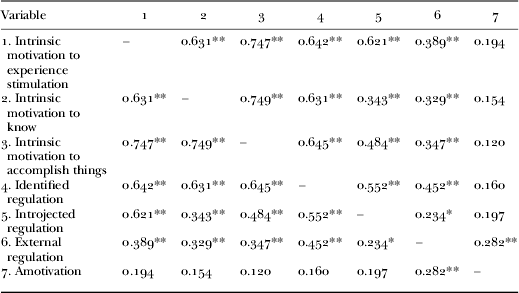
Analyses were performed with SPSS version 11.5 for Windows, and statistical significance was set at p = 0.05. First, a cluster analysis was conducted in order to identify the motivational profiles of the participants. The clustering variables were intrinsic motivation to experience stimulation, intrinsic motivation to know, intrinsic motivation to accomplish things, identified regulation, introjected regulation, external regulation and amotivation. This analysis was conducted using the procedure recommended by Hair et al. (Reference Hair, Anderson, Tatham and Black1998). First, all the variables included in this analysis shared the same metrics. Second, given that no case with a distance from the mean greater than three times the value of the standard deviation was found, no outliers had to be excluded. Finally, given that no Pearson correlation was higher than 0.90, there was no problem of multicollinearity (Table 1).
Bivariate correlations among motivational variables

Significance levels:* p<0.05
** p <0.01.
After these criteria were met, a hierarchical cluster analysis was performed, using Ward's method with squared Euclidian distance as a similarity measure. The agglomeration schedule and the dendogram were used to determine the number of clusters. Then, a multivariate analysis of variance (MANOVA) was used to identify the motivational content of each cluster. Second, we performed MANOVAs with demographic variables entered as dependent variables to explore differences between cluster groups. Third, a multivariate analysis of covariance (MANCOVA) was conducted to determine whether the motivational profile groups differed significantly in participation in exercise in minutes per week and HRQoL measures. Partial eta-squared (η 2p) was calculated as a measure of effect size for all variables between and within group differences.
Results
Cluster analysis
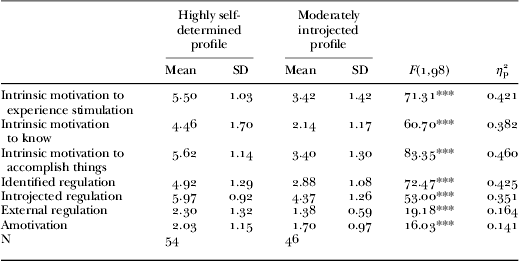
Results suggested a two-cluster solution and descriptive statistics for the two clusters are reported in Table 2. The first cluster was labelled the ‘highly self-determined’ group (HSD) and represented 54 per cent of the sample (N = 54). Participants in this cluster showed high levels of self-determined motivation and introjected regulation as well as low levels of external regulation and amotivation. The second cluster was labelled the ‘moderately introjected’ group (MI) and represented 46 per cent of the sample (N = 46). Participants in this cluster had low levels of self-determined motivation, moderate level of introjected regulation and low levels of external regulation and amotivation.
Means, standard deviations (SD) and statistics tests related to motivational dimensions for the two clusters
Note: The effect size is indicated by η 2p.
Significance level:*** p< 0.001.
A MANOVA was conducted on the seven motivational constructs as a function of group membership to test whether motivation scores differed across the clusters. Results revealed a significant effect of cluster membership on motivation, Wilks' Lambda = 0.34, F(7,92) = 25.05, p < 0.001, η 2p=0.66 (large effect size). Follow-up analyses of variance indicated that each construct differed as a function of profile (see Table 2). So these results provide support for the distinctiveness of the two motivational profiles.
Cluster group differences on demographic variables, on participation in exercise and on HRQoL
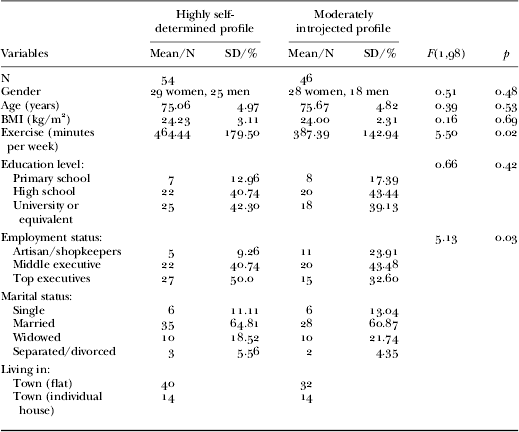
Demographic variables for the two clusters are shown in Table 3. All participants live in their own home and information on marital status shows that the majority of participants are married (see Table 3). A MANOVA was conducted to determine if cluster group differences existed on demographic variables. We examined differences on the basis of age, gender, educational level, employment status and BMI. There was no significant effect of cluster membership, Wilks' Lambda = 0.93, F(5,94) = 1.56, p=0.18. No significant differences were found among the two groups for age, gender, BMI, educational level except for employment status (see Table 3). The HSD group is composed of a lower percentage of shopkeepers and a higher percentage of top executives in comparison with the MI group.
Socio-economic variables and participation in exercise in minutes per week of study subjects
Notes: SD: standard deviation. BMI: body mass index.
A MANCOVA including employment status as covariate was used to examine if cluster group differences existed on participation in exercise. Analyses revealed a significant effect of cluster membership on participation in exercise in minutes per week, F(2,97) = 4.82, p=0.03, η 2p = 0.047 (medium effect size). The members of the HSD group showed a higher level of participation in exercise in minutes per week compared to those from the MI group (see Table 3).
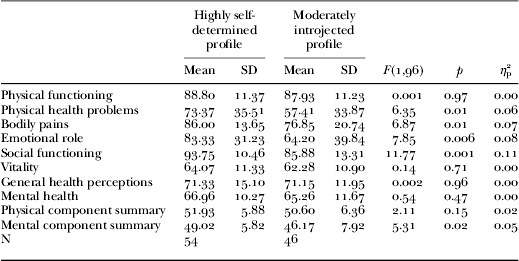
Descriptive statistics were computed for each dimension of SF-36 and are reported in Table 4. A MANCOVA including participation in exercise in minutes per week and employment status as covariates was used to examine differences in dimensions of SF-36. Results revealed a significant effect of cluster membership on HRQoL scores, Wilks' Lambda = 0.78, F(10,87) = 2.49, p = 0.01, η 2p = 0.223 (medium effect size). Follow-up ANCOVAs with participation in exercise in minutes per week and employment status included as covariates revealed that RP, BP, RE, SF and MCS differed in function of motivational profile (see Table 4). The members of th HSD group had higher values in these four domains of HRQoL and MCS than the MI group. These results indicated that HSD members reported less discomfort due to their physical state in daily activities, less interference from body pain, less limitation of social activities due to health problems and less discomfort due to psychological problems in daily activities than the MI group. The two groups did not differ in measures of self-reported physical function, vitality and general health perceptions.
Means, standard deviations (SD) and statistics tests related to SF-36 dimensions for the two clusters
Notes: SF-36: Medical Outcomes Study 36-Item Short Form Health Survey. The effect size is indicated by η 2p.
Discussion
A first purpose of the present study was to use cluster analysis in order to examine the motivational profiles that are naturally emerging among older adults practising exercise regularly. Two clusters emerged. The ‘highly self-determined’ group represented older adults with high levels of intrinsic motivation and identified regulation, which are considered to be self-determined types of motivation, a high level of introjected regulation and low levels of external regulation and amotivation. The ‘moderately introjected’ group represented older adults with low levels of intrinsic motivation and identified regulation, a moderate level of introjected regulation and low levels of external regulation and amotivation.
Results show that the participants of this study are highly educated individuals and there is no difference in education level among the two groups. Some researchers have indicated that higher levels of education provide advantages for the individual in promoting participation, even in the face of age-related changes in abilities, and increasing knowledge about its benefits and allowing a stronger sense of personal control and self-efficacy for exercise (Adabonyan et al. Reference Adabonyan, Loustalot, Kruger, Carlson and Fulton2010; McAuley et al. Reference McAuley, Konopack, Morris, Motl, Hu, Doerksen and Rosengren2006). In the present study, only employment status is an indicator of differentiation between the two groups and suggests monetary resources available for paying for physical activities. One could suggest that our random sample is a specific socio-economical group and health conscious (Tessier et al. Reference Tessier, Vuillemin, Bertrais, Boini, Le bihan, Oppert, Hercberg, Guillemin and Briançon2007), and this present study provides some interesting results with regard to their motivational profiles.
All participants can be classified as highly active (>300 minutes per week; Adabonyan et al. Reference Adabonyan, Loustalot, Kruger, Carlson and Fulton2010). Nevertheless, the participants of the ‘highly self-determined’ group practise exercise with greater frequency and longer duration than those in the ‘moderately introjected’ group. According to SDT, individuals are intrinsically motivated when they engage in activities for the inherent feelings of pleasure and satisfaction gained from participation. With regard to the motivational profile of the ‘highly self-determined’ group, results suggest these participants consider exercise as a pleasurable experience with a sense of achievement, and perform by choice. Titze, Stronegger and Owen (Reference Titze, Stronegger and Owen2005) found that individuals who enjoyed exercise were far more likely to continue. Duncan et al. (Reference Duncan, Hall, Wilson and Jenny2010) indicated that individuals who exercise at greater frequency tended to score higher on identified regulation. Identified regulation occurs when an individual engages in an activity that he/she deems personally valuable and important to attain a desired outcome. In this case, a person endorses the behaviour and performs it with a high degree of perceived autonomy. Accordingly, intrinsic motivation and identified regulation form the most self-determined type of regulation and are the strongest predictors of maintaining exercise behaviour in both males and females. Our findings were consistent with SDT.
Few studies have reported that introjected regulation was associated with low and high levels of self-determined motivation in physically active older adults. Although this type of regulation is considered controlling in nature rather than autonomous, some recent studies showed a positive relationship between introjected regulation and exercise (Duncan et al. Reference Duncan, Hall, Wilson and Jenny2010; Edmunds, Ntoumanis and Duda Reference Edmunds, Ntoumanis and Duda2006; Thøgersen-Ntoumani and Ntoumanis Reference Thøgersen-Ntoumani and Ntoumanis2006). According to Gillison et al. (Reference Gillison, Osborn, Standage and Skevington2009), introjected regulation would give an advantage in supplementing more self-determined regulations (i.e. a buffering effect). The present findings contribute to a debate because SDT posits that autonomous motivation reflects the highest quality of regulation, whereas controlled motivation and amotivation reflect the intermediate and lower ends of the quality of continuum. This study suggests that introjected regulation might serve to keep older adults engaged in exercise for motives which are not chosen by self-determined motives alone. For example, it is possible that older adults engage in exercise to satisfy self-imposed pressures to obtain and/or maintain a desired physical appearance and body shape or control their weight. In line with Henwood et al. (Reference Henwood, Tuckett, Edelstein and Bartlett2011), perceived health benefits of exercise would have an effect on self-esteem and body image. Accordingly, some reasons for being physically active would be more conducive to autonomous regulations and other reasons more conducive to controlled regulations (Ingledew and Markland Reference Ingledew and Markland2008). Individuals would have multiple and simultaneous motives for exercise maintenance that collectively would determine the overall quality of motivation (Ryan and Deci Reference Ryan, Deci, Hagger and Chatzirarantis2007). This research shows the increasing interest in assessing complex models of the simultaneous multiple motives that individuals demonstrate towards any given behaviour. As suggested by Gillison et al. (Reference Gillison, Osborn, Standage and Skevington2009), other research must be directed into exploring the potential for introjected regulation to boost, sustain or buffer the effects of self-determined forms of motivation for exercise in physically active older adults.
The second purpose of the present study was to relate the motivational profiles to health-related quality of life measures. Health-related quality of life encompasses the perceived health attributes such as the sense of comfort or wellbeing, the ability to maintain good physical, emotional and intellectual functions, and the ability to satisfactorily take part in social activities. In the present study, employment status and participation in weekly exercise have been controlled for assessing the independent effect of motivational profiles on health-related quality of life. Results showed that the highly self-determined group had greater values in four of the domains of health-related quality of life related to physical health (i.e. role limitations due to physical health and bodily pain), to mental health (i.e. social functioning and role limitations due to emotional health) and a higher score of mental component summary than the ‘moderately introjected’ group. Our findings show that a high level of autonomous motivation and introjected regulation towards exercise are positively linked with some indices of wellbeing. Health-related quality of life is reflective of more global perceptions of one's overall health/wellbeing (Bize, Johnson and Plotnikoff Reference Bize, Johnson and Plotnikoff2007; Rejeski and Mihalko Reference Rejeski and Mihalko2001) whereas autonomous regulation toward exercise operates at a contextual level. In line with Standage et al. (Reference Standage, Gillison, Ntoumanis and Treasure2012), motivation experienced at a lower (e.g. contextual) level may impact on the higher (e.g. global) level, and engagement in regular exercise for autonomous reasons may impact one's more global autonomous motivation. The present study suggests that motivation in exercise can play a role in health-related quality of life.
Some limitations of the present study need to be addressed. First, this study provides some insight into the link between motivation in exercise and health-related quality of life. Although questionnaire data were administered by face-to-face interviews, the results must be interpreted with some degree of caution and particularly the participation in exercise per week in minutes. Self-reports of numbers of hours spent each week and volume devoted to exercise could be overestimated. More objective exercise measures are needed to give more verifiable results. Second, among those over 70 years old, these subjects constitute a particular sub-group of that population and these data are not generalisable. Third, by choosing a cross-sectional design, we do not attempt to infer the direction of the association between motivation and health-related quality of life. Prospective longitudinal studies, which involve repeated observation of the same individuals over time, are needed to determine trends in motivational regulations and health-related quality of life across the lifespan.
Notwithstanding these limitations, this study has a number of strengths which provide some insights for future research. The present study identifies motivational profiles by adopting a person-centred approach which complements the variable-centred approach that is often used in motivational research (Vansteenkiste et al. Reference Vansteenkiste, Soenes, Sierens, Luyckx and Lens2009). From an applied social perspective, it is instructive to gain insight into the percentages of older adults characterised by the same motivational profile.
The issue of encouraging older adults to be physically active is complex and exercise and its relationship with ageing was strongly analysed from demographic and socio-economical perspectives in the literature (for a review, see Breuer et al. Reference Breuer, Hallmann, Wicker and Feiler2010). The present study provides support to the motivational factors as an important determinant of exercise. Kuvaja-Köllner et al. (Reference Kuvaja-Köllner, Valtonen, Komulainen, Hassinen and Rauramaa2012) have indicated that the amount of time individuals allocate to physical exercise depends on the cost of time and their motivation. When the motivation for exercise is high in older adults, the cost of time used for exercise may be lower and individuals have more adherence or interest to engage in it for more hours compared to individuals with a low motivational level. This increase in time spent on physical exercise has positive effects on health outcomes, such as improvement in the physical and mental components of quality of life and a decrease in the metabolic risk factor score.
Lastly, the results of the present work provided support for a better understanding of the association between motivation towards exercise and health-related quality of life by documenting the motivational advantages of being autonomously motivated. Further research is needed to extend these findings and to provide a better understanding of motivational processes in older adults to maintain a healthy lifestyle.
Acknowledgements
The authors gratefully acknowledge the contributions to data collection of Sandra and Mariette Nasarre, students in University of Lyon 1 and 2. The authors thank Jan Riordan for her help in correcting the English-language manuscript.