What are the consequences of being the victim of crime for political participation? The answer to this question is of great substantive and theoretical importance. Understanding how citizens respond to experienced trauma and injustice is an essential first step towards grasping their ability – or lack thereof – to channel such grievances into political action. On a theoretical level, citizens' responses to crime – ostensibly a salient experience – can be viewed as a key test of the general proposition that personal experiences shape political behavior (Egan and Mullins Reference Egan and Mullin2012).
Bateson (Reference Bateson2012), in a now seminal study, finds that self-reported crime victimization increases levels of a broad range of manifestations of political engagement in virtually every region of the world. Victims were up to 8 percentage points more likely than non-victims to participate in community action, protest, and political and town meetings, and were more likely to report an interest in politics, engage in political conversations and attempt to persuade others. Viewed through a broader lens, Bateson's findings resonate with work in the civil war and conflict literatures, which have found that ‘[in] case after case, people exposed to…violence go on to behave more cooperatively and altruistically’, and ‘tend to increase their social participation by joining more local social and civic groups or taking on more leadership roles in their communities’ (Bauer et al. Reference Bauer2016, 250). Although the precise causal mechanism underlying the effects of exposure to crime are not yet completely understood, with possibilities including instrumental (crime prevention or retaliation) concerns (Bateson Reference Bateson2012); victims' ‘post-traumatic growth’ (Blattman Reference Blattman2009), anger or the cathartic effects of participation in alleviating psychic distress (Morrison and Rockmore Reference Morrison and Rockmore2016); and the social affirmation of in-group identity, empathy and solidarity through participation (Dorff Reference Dorff2017; Grosjean Reference Grosjean2014; Hartman and Morse Reference Hartman and Morse2018), the empirical regularity seems clear: ‘victimization is always associated … with increases in the probability that an individual will engage in high levels of political activity’ (Bateson Reference Bateson2012, p.575).
Curiously, this ‘regularity’ is far from settled in the field of voter turnout, the most prevalent form of political participation in virtually every established and emerging democracy in the world. Some work does find that victimization increases voting, voter registration or vote intentions (Bellows and Miguel Reference Bellows and Miguel2009; Berens and Dallendörfer Reference Berens and Dallendörfer2019; Blattman Reference Blattman2009), but a large swath of other research suggests that victimization has a negative effect on turnout in both national and local elections, presumably due to a withdrawal from public life and a loss of faith in institutions (Trelles and Carreras Reference Trelles and Carreras2012; Ley Reference Ley2018). Malone (Reference Malone2013) and Ley (Reference Ley2018), for example, show that self-reported victimization leads to lower levels of turnout in Mexico. Similarly, Coupe and Obrizan (Reference Coupe and Obrizan2016) report negative effects of experiencing physical violence on individual-level turnout in Ukraine. Relatedly, several studies show negative effects of self-reported exposure to electoral violence or intimidation on subsequent turnout (for example, Bratton Reference Bratton2008; Collier and Vicente Reference Collier and Vicente2014). In short, the existing evidence suggests that, in contrast to the consistent positive patterns seen for other indicators of political engagement, victimization has a much less clear effect on voter turnout.
In addition to the inconsistent results and limited geographic scope, it is also the case that previous turnout studies have been based on suboptimal data and research designs. More specifically, they have relied exclusively on self-reported survey measures of both victimization and turnout, most likely resulting in biased estimates given that both constructs are measured with considerable random and systematic error due to, for example, recall bias and social desirability bias (Bernstein, Chadha and Montjoy Reference Bernstein, Chadha and Montjoy2001; Skogan Reference Skogan1981), and given the existence of systematic non-response as victims may be less likely to respond to surveys in the first place (Elliott and Ellingworth Reference Elliott and Ellingworth1997). Another shortcoming is the failure of many previous studies to differentiate between different types of crime, most pertinently whether the crime is violent or not. The ‘severity’ of the crime is of fundamental importance for the health-related and psychological consequences of crime (Lurigio Reference Lurigio1987), and therefore there are good reasons to expect differential effects of violent and non-violent crimes in terms of political impacts as well (Berens and Dallendörfer Reference Berens and Dallendörfer2019; Coupe and Obrizan Reference Coupe and Obrizan2016).
Aside from being vulnerable to these problems of conceptualization, measurement, and non-response, previous turnout studies have all been based on cross-sectional data, with clear deficiencies in terms of causal identification. Even after including a range of control variables, it is impossible, using this design, to rule out the possibility that victimized and non-victimized individuals differ on unobserved factors – for example, in the composition of their social network, in their lifestyle or in their personality – which also influence their likelihood of turning out to vote. This possibility is buttressed by previous studies reporting significant negative relationships between prior political engagement and subsequent crime victimization (Bateson Reference Bateson2012; Morrison and Rockmore Reference Morrison and Rockmore2016).
Given these shortcomings in previous studies, we argue that the true impact of crime victimization on voter turnout remains essentially unknown. What is needed to provide a credible causal estimate is a study that simultaneously (a) measures actual voter turnout and crime victimization rather than relies on individual self-reports, (b) is free from biases due to non-response, (c) distinguishes between victims of violent and non-violent crime and (d) accounts for systematic pre-existing (that is, pre-victimization) differences in the likelihood of turning out to vote between crime victims and non-victims (that is, handles ‘selection’ into victimization).
In this article, we satisfy each of these requirements via a panel analysis of official government registry data for the entire population of eligible voters residing in a subset of Danish municipalities between 2009 to 2013. The registry data contain information on both individual-level turnout in the 2009 and 2013 municipal elections and victimization from various types of crime before, between and after these elections. We identify the causal effect of victimization by comparing changes in turnout from the municipal election in 2009 to the one in 2013 for those victimized between the two elections and two different counterfactual groups: (1) non-victims in the general population and (2) individuals who were victimized within a year after the 2013 election. The analysis shows that victimization from violent crime between the two elections increases the propensity to vote by approximately 2 to 3 percentage points, while victimization from non-violent crime does not affect turnout.
We further show that the positive within-individual effect of violent crime on turnout contrasts markedly with a large negative between-individual effect, indicating that previous cross-sectional studies have likely been marred by substantial selection bias. The direction and consistency of the effects fit squarely with the view that exposure to violence has ‘pro-social’, positive consequences on political participation of all kinds. At the same time, the Danish context – a high-trust society with high-quality institutions and little of the organized crime, gang-related violence and ethnic conflicts found in other parts of the world – places possible limits on the external generalizability of the findings; we discuss these issues and implications for further work on crime victimization in the concluding section.
Research Design, Data And Measurement
Our analysis relies on fine-grained individual-level administrative panel data from the official Danish population registries, which contain longitudinal information for everyone residing in Denmark, and which can be linked using (anonymized) official identification numbers.Footnote 1 We utilize highly reliable data on verified turnout in Danish municipal electionsFootnote 2 in 2009 and 2013 as well as data on crime victimization and other covariates. Using registry-based population data eliminates or minimizes methodological concerns marring studies based on survey data. Importantly, non-response (including, in our case, panel attrition), which is inherent to survey research – and which likely biases the estimated relationship between crime victimization and turnout – is not an issue. Further, various measurement problems are significantly reduced. Official data on voter turnout is patently a more valid indicator than survey-based measures, which are prone to systematic and random measurement error due to various biases including recall bias and social desirability bias (Bernstein, Chadha and Montjoy Reference Bernstein, Chadha and Montjoy2001). Some of the same advantages apply to official government data on crime victimization. However, because crime victimization is not observed directly, but rather is reported to the police, government crime data does not pick up unreported crime. This is unlikely to be a major problem in the Danish context (at least comparatively speaking), where trust in the police and the quality of state institutions, which presumably covaries with the likelihood of reporting crime, is very high, and among the highest in Europe (Kääriäinen Reference Kääriäinen2007).
Data on individual turnout is registered at each polling station in each municipality. We obtained access to turnout data from forty-four of ninety-eight Danish municipalities in 2009 and from all municipalities in 2013. This implies that our panel sample comprises the entire population of residents who were eligible to vote in 2009 and 2013, and who lived in one of the forty-four municipalities included in 2009. There are no significant differences between the municipalities included and not included in the data in 2009, although the former are slightly more populous, and inhabited by residents with somewhat higher socio-economic status (Bhatti, Danckert and Hansen Reference Bhatti, Danckert and Hansen2017). The overall turnout rate was 65.8 per cent in 2009 and 71.9 per cent in 2013, with virtually identical trends in turnout rates between the included and excluded municipalities (5.8 vs. 5.9 percentage point increase). This means that our results are likely to be generalizable to the entire Danish population of eligible voters. Appendix A in the online supplement describes the sample in further detail.
We measure crime victimization using a population-wide registry that records all crime incidents (including the identity of the victim) that were reported to the police from 2005 until 2014. The crime registries hold two essential qualities in relation to our research design. First, they index the type of crime in question in granular detail (see Appendix B for further information). We therefore know if someone has been the victim of a non-violent crime, for example fraud or pickpocketing, or a violent crime such as assault, robbery or a sexual offence. This enables us to examine the effect of violent and non-violent crime separately. The second key feature of the crime registers for our purposes is that they contain the exact date a given crime was committed, and whether it took place before, between or after the municipality elections we analyze. To eliminate the potential confounding from prior victimization and to control for other selection effects, we focus exclusively on those who were not victimized (from 2005 onwards) prior to the first election in 2009 (see Appendix A for details, and Visconti (Reference Visconti2019) for a similar measurement approach).
We analyze the two-wave panel data using an individual and time (‘two-way’) fixed effect estimator, which is identical to a difference-in-differences estimator.Footnote 3 In the first set of analyses, we compare changes in electoral turnout over time for those who were victimized between 2009 and 2013 and those who were not victimized during 2009–2013 or in subsequent years. Comparing changes, rather than differences in levels between the two groups at a given point in time, strengthens causal inference considerably, as it controls for stable unobserved pre-existing differences between those who were and those who were not victimized. The model identifies the causal effect of victimization under the assumption of parallel time trends for the two groups. That is, had they not been victimized, crime victims would have followed the same trend in turnout from 2009 to 2013 as non-victims. We buttress the plausibility of the parallel-trends assumption in these models by including standard time-varying variables as controls (all measured through the administrative registries): education, employment, income, citizenship and aggregate municipality victimization (see Appendix C for measurement details).
The parallel-trends assumption would be violated if some unobserved factor that is correlated with victimization also led to differential changes in turnout for the victims over time. To guard against this possibility, we estimate a second set of analyses using a different (smaller) comparison group – individuals who were victimized just after the 2013 election (until the end of 2014). This ‘soon-to-be victimized’ group provides a nearly ideal counterfactual group for those who were victimized before the last election, as they are presumably identical save for the plausibly random timing of their victimization. This means they are likely to have nearly identical values on all unobservables, even those that could conceivably produce violations of the parallel-trends assumption in a comparison of victims to non-victims in the general population.
We estimate the effects using a linear probability model, similar to many prominent studies of turnout (for example, Gerber, Green and Larimer Reference Gerber, Green and Larimer2008). In a panel setup like ours, the linear probability model is preferable over a binary model because the latter excludes individuals without temporal variation on the turnout variable.
Results
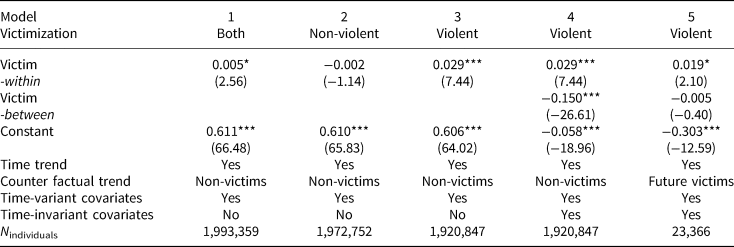
Table 1 presents the fixed effects estimates of the effect of crime victimization on the change in turnout in municipal elections in Denmark between 2009 and 2013 (coefficients for the control variables are reported in Appendix D). The within estimates reported in Table 1 are the predicted changes in turnout from 2009 to 2013 for those who were victimized between 2009 and 2013, over and above the changes among non-victims in the general population. Hence, a positive coefficient signifies that the trend for the victims is more positive (or less negative) than the trend for the control group. Model 1 displays the estimated effect of crime victimization in general, whereas Models 2 and 3 show the effect on violent and non-violent crime, respectively.
The effect of crime victimization on municipal election turnout

Note: t statistics in parentheses; two-sided tests. See Appendix A for details on sample sizes for each model, and Appendix D for the full results. * p < 0.05, ** p < 0.01, *** p < 0.001
Model 1 shows a significant positive effect of crime victimization in general, with turnout rising by about half a percentage point. However, Models 2 and 3 make it clear that this effect is entirely driven by victimization from violent crime. The effect for violent crime reported in Model 3 is highly significant and amounts to an increase in turnout of almost 3 percentage points. By contrast, the effect of non-violent crime is virtually zero, not significantly different from zero, and significantly smaller than the estimate for violent crime. The estimated 3-percentage-point increase in turnout for violent crime is substantial, and roughly similar in magnitude to the effects of victimization on other indicators of political engagement reported by Bateson (Reference Bateson2012, 576).
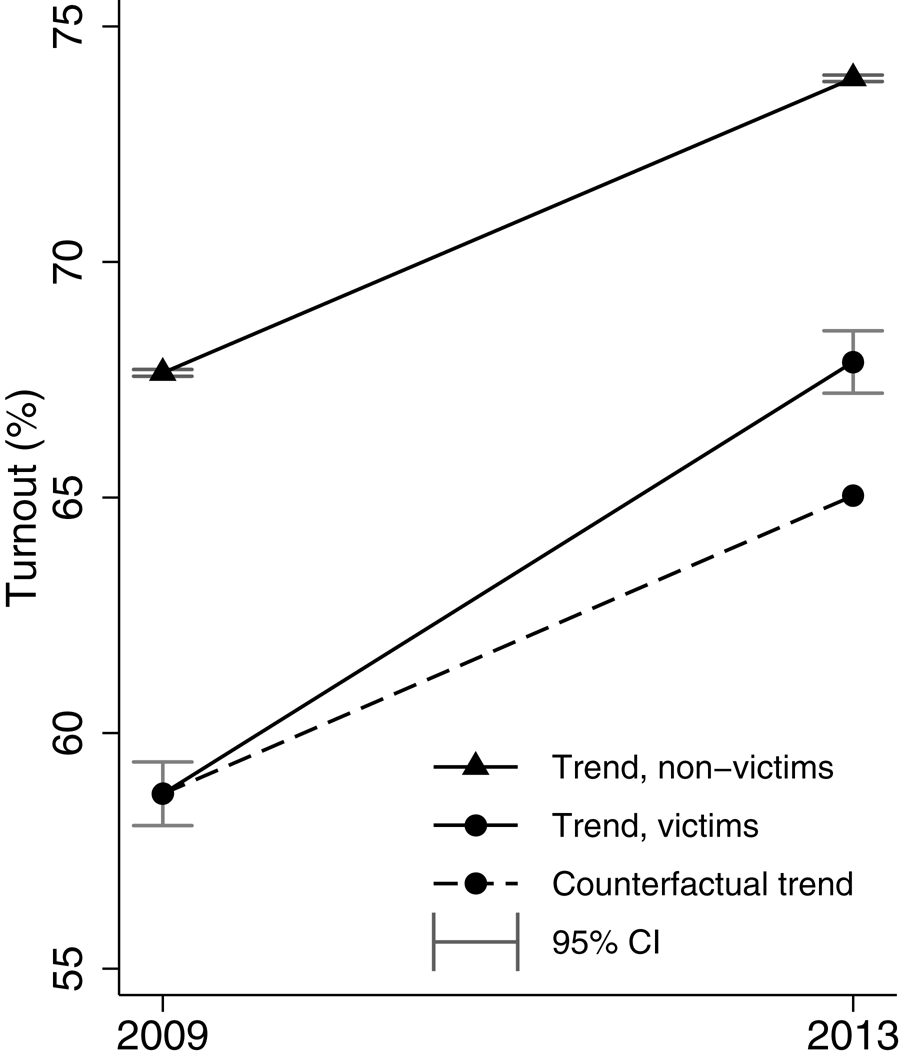
Model 4 replicates the within estimate for violent crime victimization using the random effects hybrid model (Bell and Jones Reference Bell and Jones2015), which allows for the simultaneous estimation of both within- and between-individual effects.Footnote 4 Based on these results, Figure 1 shows the effect of violent crime by means of the predicted turnout levels in 2009 and 2013 for those victimized and not victimized between the two elections.Footnote 5 From Figure 1 it is evident that while turnout increased in general from 2009 to 2013, it increased significantly more for those who were victims of violent crime between the two elections than for the group that was not victimized.
Estimated trends in turnout
Note: based on the estimates from Model 4.

Model 4 and Figure 1 also indicate that the within-individual approach may account for why our results differ from some previous cross-sectional studies of the relationship between violent crime victimization and turnout. In contrast to the positive within-individual effect, the between-individual relationship is strongly negative: across the two elections, victims of violent crime are approximately 7 percentage points less likely to vote than non-victims, controlling for all other covariates in the model (including time-invariant controls typically used in cross-sectional studies). This strongly suggests that much previous cross-sectional research has not sufficiently accounted for the differential turnout likelihood among individuals who experience violent crime; once these (unobserved) between-individual differences are taken into account, victimization from violent crime has a stimulating effect on subsequent voter turnout.
As described above, we also employ an alternative, and plausibly more similar, counterfactual group to those victimized in the 2009–2013 period – those who were victimized after the 2013 election (until the end of 2014). Model 5 in Table 1 shows the difference-in-differences estimate of the change in turnout for those who were victims of a violent crime between the two elections compared to the change among the ‘soon-to-be’ victimized group, with the same control variables included as in the other models. We again find a positive and significant within-individual effect (1.9 percentage points) of being the victim of a violent crime on turnout. Further, the negligible between effect of victimization estimated using this counterfactual suggests that the two groups are indeed highly comparable. The robustness of the result using this plausibly identical counterfactual group gives strong confidence to the turnout-enhancing effect of violent crime victimization.
We probed the robustness of the effects of violent crime victimization in four ways (all reported in Appendix E). First, some citizens change locations between elections, and features of the new environment may confound exposure to crime. To assess this possibility, we restricted our sample to non-movers. Secondly, we allowed for the effect of all covariates in Models 3 and 5 to vary across the two waves of the panel (that is, interacting the 2013 time dummy with all variables in the model). These models guard further against possible biases due to non-parallel trends in turnout between the victimized and non-victimized groups. Thirdly, it may be that victims are geographically concentrated in certain municipalities that, for unrelated reasons, show differential trends in turnout relative to areas with fewer victims. We therefore estimate a model that includes municipality fixed effects interacted with time, which allows for municipality-specific changes in turnout (Appendix Tables E1.3 and E2.3). Lastly, for reference, Appendix Tables E1.4 and E2.4 additionally report the results of Models 3 and 5 estimated without covariates. In all of these models, the effect of violent victimization remains positive, significant and highly similar to the results reported in Table 1. Our analyses thus provide consistent support for our main finding – that being the victim of a violent crime increases electoral turnout – as the effect is robust to alternative model specifications, samples and comparison groups.
Conclusion
Employing administrative panel data from the Danish population registries, we have shown that victimization from violent crime has a substantial positive effect on voter turnout. Our findings are consistent with the results from much previous work on political engagement aside from voting, but also add the important qualification that differentiating between types of crime is critical, as victimization from non-violent crime has virtually no effect. More broadly, our findings regarding victimization from violent crime provide further support for the emerging view that exposure to violence can have pro-social, positive participatory consequences for ordinary individuals (Bauer et al. Reference Bauer2016). Our results also highlight the benefits of using panel data as opposed to cross-sectional data to study the effect of crime victimization on political participation since this, as we have shown, leads to drastically different results. The large negative between-individual effect of victimization found here strongly suggests that much previous research in the field has failed to adequately address selection effects in the victimization–turnout relationship.
While the analysis has succeeded in identifying the direction and magnitude of the causal effect of crime victimization on voter turnout, we cannot yet pinpoint the specific mechanism underlying this effect. However, consistent with Bateson (Reference Bateson2012), our results suggest that instrumental (self-interest) concerns are not a key mechanism. From an instrumental perspective, the positive effect on turnout in municipal elections squares poorly with the fact that immediate crime-sanctioning mechanisms – law enforcement and sentencing policies – are not subject to local-level decisions in Denmark. Furthermore, given the difference between the consequences of violent and non-violent crime victimization that we identify here, mechanisms related to post-traumatic growth and anger appear to be more plausible candidates. Exploring how these processes, along with those related to identity affirmation and social solidarity, mediate the relationship between violent crime victimization and voter turnout are important tasks for future research.
While we have argued that our design constitutes a significant improvement over previous studies, it does have its own limitations. We have only examined victimization from crime incidents that were reported to the police, which does not take unreported crimes into account. We argued above, though, that under-reported victimization is not likely to be a major problem in Denmark; further, unless unobserved victimization both varies between our control and treatment groups and relates to changes in turnout, this should not result in biased estimates. A more significant concern is whether our results generalize to other types of elections and geographical settings. Given the relatively high salience of local elections in Denmark, we speculate that the effects found here are likely to hold for national elections as well; it may even be the case that the effects would be enhanced in those contexts, given victims' possible mobilization due to instrumental concerns or changes in their crime-oriented policy preferences that could be enacted politically at the national level (Visconti Reference Visconti2019). More generally, it seems reasonable to expect our findings from Denmark – from what we believe to be the first study of the effects of crime victimization on turnout in advanced democratic contexts – to be generalizable to similar types of crimes in other relatively low-crime Western societies with relatively well-functioning state institutions.
However, the results may travel less comfortably to settings where crime is of a different nature (for example, organized crime, crime originating in civil conflict or crime related to electoral violence), or where state–citizen relations are more strained: both factors might plausibly condition the effect of victimization on electoral turnout. We note that positive effects of victimization on registration and turnout have been found in several previous studies from conflict-laden contexts (for example, Bellows and Miguel Reference Bellows and Miguel2009; Blattman Reference Blattman2009), but more rigorous research on this question in a variety of contexts is clearly needed in order to assess the generalizability of the turnout-enhancing effects of (violent) crime victimization reported here. Further, departing from our study's two-wave panel setup, future studies could be strengthened further via multi-wave analyses that can accommodate individually varying pre-victimization turnout trajectories, and attempt to account more fully for possible biases due to unobserved time-varying confounders.
Finally, our results inescapably raise the provocative and seemingly paradoxical question of whether violent crime is good for democracy. Such a conclusion would be premature and too simplistic. For one, increased participation may not be accompanied by more democratic attitudes – in fact, sometimes the opposite (Bateson Reference Bateson2012, p. 583). Yet, in our view, this is not the most fruitful way of framing the question. Instead, a more reasonable – and sanguine – conclusion is that people are apparently willing and able to act politically, based on the hardships they experience.
Supplementary material
Access to the data is legally restricted under Danish law. Statistics Denmark must grant permission to an authorized Danish research institution to access its secure servers. The code used to analyze the data is available from the authors upon request. Online appendices are available at https://doi.org/10.1017/S0007123420000162.
Acknowledgements
The authors would like to thank Junghyun Lim for research assistance as well as discussants and participants at the meeting of the American Political Science Association in 2018, and participants at presentations at University of Copenhagen and Aarhus University.