

Introduction
A growing body of literature evaluates the effects of fiscal institutions on fiscal outcomes. The contention is that the way a country decides its budget has concrete effects on fiscal outcomes, particularly when the outcomes are defined in terms of fiscal sustainability. Most of this work has been concentrated on the European Union, the United States, or Latin America. Moreover, much has assumed that one set of fiscal rules, namely those that centralize the budget process, are applicable in all countries. Another branch of the literature, which classifies sets of fiscal norms, rules, and institutions according to forms of ‘fiscal governance,’ argues that different forms are appropriate to different political settings. In particular, a delegation form of fiscal governance delegates powers during the budget process to one central player, usually to a finance minister, while a contracts form of fiscal governance has political parties reach agreement on multi-annual fiscal plans. The finance minister's role in this case is reduced to executing the pre-agreed plan.
This paper considers whether such fiscal institutions affected policy outcomes in Central and East Europe over the time period 1998–2008. So far, three studies have considered the effects of fiscal institutions in these countries – Gleich (Reference Gleich2003), Fabrizio and Mody (Reference Fabrizio and Mody2006), Yläoutinen (Reference Yläoutinen2005). All are informative and well-argued. Our paper adds to the first two by explicitly considering fiscal governance, and in particular the role of multi-annual fiscal plans in a region where we predict that these sorts of plans will be especially useful. The first part of the paper explains in further detail what we mean by ‘fiscal governance,’ and it makes predictions about what form of fiscal governance fits what form of government. The second part examines electoral and party systems, and the third part documents the various norms, rules, and institutions in place. Finally considered are the effects of the relative development of fiscal governance in different countries on fiscal outcomes in the form of changes in gross debt burden as well as in the budget balance.
Fiscal Institutions and Fiscal Governance
Most of the fiscal institutions literature focuses on what is known as the common pool resource (CPR) problem. Traditionally, the ‘commons’ was a strip of land where all members of a given community were able to take what they could, be it firewood or hunted animals. The usual outcome was that people would deplete the resources more on this land than on their own. In budgeting, the ‘common pool’ is conceived of as the overall tax take. When decision-makers consider how much money they would like to spend, they consider both the benefits and costs of that spending for the people they care most about, or their constituency. Their constituency almost inevitably represents only part of the whole group that will bear the costs. This means that they do not realize the full costs of their decisions when they decide how much they want to spend. They do, however, usually include the full benefits for their constituency.
This discussion suggests that the way that a decision is reached has a strong impact on the eventual outcome. One can try to devise a set of rules that means that policy-makers consider the full tax implications of their decisions and this lowers the level of spending. The literature on fiscal rules and institutions has two tracks. The first assumes that fiscal rules that require fiscal goals be met somehow reduce this problem. In Poland, for example, the Constitution set an overall debt limit (The European Commission 2007). Such formal rules have their use, but they say nothing about how the decision-making process is structured. The CPR problem is greater when decision-makers have no reason to include the full tax burden in their decision-making. Moreover, while the imposition of a formal rule may have a short-term effect, over the medium term decision-makers are resourceful in devising ways to get around such formal rules. The second strand of work focuses directly on the decision-making process. While such rules can appear in constitutions, more frequently laws establish them, remaining in place until a government wants to pass legislation to change them. Work on West European countries suggests that they remain relatively sticky, that is, most rules concerning the budget process remain in place over successive governments, but there are marked periods of reform.
At the executive planning stage, the purpose of such elements is to promote agreement on budget guidelines (spending and deficit targets) among all actors involved, ensuring fiscal discipline. Elements of centralisation at this stage should foster consistent setting of such guidelines and ensure that they constrain executive decisions effectively. A key element concerns the way conflicts are resolved. Uncoordinated and ad hoc conflict resolution involving many actors simultaneously promotes logrolling and reciprocity and, hence, fragmentation. Centralisation is increased if conflict resolution is the role of senior cabinet committees or the prime minister.
At the legislative approval stage, elements of centralisation control the debate and voting procedures in the legislature. Because of the much larger number of decision makers involved, the common pool problem is even larger in the legislature than in the executive. Fragmentation is rampant when there are no limits to the changes that parliament can make to the executive's budget proposal, when spending decisions are made in legislative committees with narrow and dispersed authorities, and when there is little guidance of the parliamentary process either by the executive or by the speaker of the legislature.
At the implementation stage, elements of centralisation ensure that the budget law effectively constrains the spending decisions of the executive. One important element is strengthening the finance minister's ability to monitor and control spending flows during the fiscal year. Other important elements are strict limitations on changes to the budget law during the year.
Throughout the budget process, greater transparency promotes better fiscal outcomes. It makes it easier for policymakers to understand the consequences of their actions, and it increases the accountability of politicians to voters. Empirical studies (Alt and Lassen Reference Alt and Lassen2006; Tanzi and Schuknecht Reference Tanzi and Schuknecht2000, Chapter 8) have found that countries with more transparent fiscal institutions have lower levels of debt.
In two of the studies of Central and Eastern Europe countries (CEEC), Gleich (Reference Gleich2003) and Fabrizio and Mody (Reference Fabrizio and Mody2006) follow this approach, assuming that one set of fiscal rules and institutions is desirable in all countries. There are certainly some rules and institutions that are beneficial regardless of the environment in which the budget process is run. There may be rules and institutions, however, which depend upon other institutions in a given political system in order to function well, for example, a scenario in which the finance minister can centralize the process during the execution of the budget. One can imagine a scenario, however, where coalition partners do not want to strengthen the finance minister's hand. This key minister can come from only one party, and who is to say if he is not making deals that will hurt other parties in the coalition?
For this reason, the fiscal governance approach (e.g., von Hagen and Harden Reference von Hagen and Harden1995; Hallerberg, Strauch, and von Hagen Reference Hallerberg, Rolf and von Hagen2009) argues that centralisation in practice can follow one of two basic approaches. In the delegation approach, the budgeting process vests special authority in a fiscal entrepreneur whose function it is to set the broad parameters of the budget and to ensure that all other participants in the process observe these constraints. To be effective, this entrepreneur should have the ability to monitor the other members of the executive and to use selective punishments against possible defectors. Among the cabinet members, the entrepreneur is typically the finance minister. Drafting the budget proposal is mainly the responsibility of the finance ministry, which monitors the individual bids, negotiates directly with the spending departments, and approves the bids submitted to the final cabinet meeting. Unresolved conflicts between spending ministers and the finance minister are typically arbitrated by the prime minister.
At the legislative stage, the delegation approach gives large agenda-setting powers to the executive over parliament. One important instrument here is to limit the scope of amendments parliamentarians can make to the executive's budget proposal. In France, for example, amendments cannot be proposed unless they reduce expenditures or create a new source of public revenues. A second element concerns the voting procedure. In the United Kingdom, the executive can make the vote on the budget a vote of confidence, considerably raising the stakes for a rejection. At the implementation stage, centralisation requires that the finance minister be able to monitor and control the flow of expenditures during the year. This may take the form of requiring that the spending departments obtain the finance minister's authorisation to disburse funds during the year.
The second approach is based on contracts. The budgeting process starts with an agreement on a set of binding fiscal targets negotiated among the members of the executive. Emphasis here is on the bargaining process as a mechanism to reveal the externalities involved in budget decisions and on the binding nature of the targets. In contrast to the hierarchical structure created by delegation, the contract approach relies on a more equal distribution of strategic powers in the executive. A prime example is the Dutch budgeting process, which since 1982, has started with negotiations among the cabinet members to fix spending limits for each spending department. These spending limits are derived from medium-term fiscal programs or the coalition agreement among the ruling parties.
At the legislative stage, the contract approach places less weight on the executive's role as an agenda setter and more weight on the role of the legislature as a monitor of the faithful implementation of the fiscal targets. Institutionally, this means that the contract approach relies less on the executive branch of government controlling parliamentary amendments and more on the legislature's ability to monitor the fiscal performance of the executive. It assumes that parliament keeps the bargain negotiated in the contracts; if it does not, the contract is reopened for negotiation and is nullified. The formal rules for passage of the budget are therefore much less relevant than in the delegation case. At the implementation stage, the contract approach resembles more closely the delegation approach in emphasising the monitoring and control powers of the finance minister. At the same time, there are also additional mechanisms that are included in fiscal contracts to deal with unanticipated growth shocks. These mechanisms determine ex ante how the government will respond to revenue and expenditure shocks. This eliminates the need for re-negotiations if and when shocks occur. Belgium, for example, has the ‘golden hamster’ rule that states that any revenues collected above the amount forecast must be used to reduce the debt level.
Institutional Design of the Budgeting Process
Based on the discussion above, we can predict the political environment in which either delegation or contracts are likely to thrive. While the delegation approach relies on hierarchical structures within the executive and between the executive and the legislature, the contracts approach builds on a more even distribution of authorities in government. In democratic settings, hierarchical structures typically prevail within political parties, while relations between parties are more even. This suggests that the key to the institutional choice between the two approaches lies in the number of parties in government. In the parliamentary systems found in Europe, delegation is the proper approach to centralisation for single-party governments or governments where the ideological profiles of any coalition partners are quite close, while contracts are the proper approach for multiparty majority governments and for minority governments.
First, members of the same political party are more likely to have similar political views regarding the basic spending priorities than members of different political parties. Spending ministers in a one-party government can, therefore, be fairly sure that the finance minister holds more or less the same spending preferences as they do. Disagreement will be mainly a result of the common pool problem, that is, the perceived cost of distributive policies. In a coalition government, by contrast, cabinet members are likely to have more diverging views regarding the distribution of government spending to different groups of recipients. Agreement on a budget therefore involves a compromise between the coalition partners. For a coalition government, delegation of strategic powers to the finance minister would create a new principal-agent problem. A strong finance minister might abuse his or her powers and unduly promote the political interests of his or her own party.
Second, delegation and contracts rely on different enforcement mechanisms for the budget agreement. In one-party governments, the ultimate punishment for a spending minister reneging on the budget agreement is dismissal from office. Such punishment is heavy for the individual minister who overspends but generally light for the government as a whole. It can be used because the prime minister is typically the strongest cabinet member in one-party governments and has the authority to select and replace cabinet members. In coalition governments, by contrast, punishments cannot be applied easily to defecting ministers. The distribution of portfolios is set by the coalition agreement. The most important punishment mechanism in coalition governments is the threat of breaking up the coalition if a spending minister reneges on the budget agreement. This punishment is heavy for the entire coalition, as it leads potentially to the death of the government rather than the dismissal of a single individual. The point is illustrated by the fact that fiscal targets are often part of the coalition agreement.
To summarise, the contracts approach is more likely to be found in countries where coalition governments are the norm, while the delegation approach is more likely in countries where the government is typically formed by a single party. Contracts are also appropriate for minority governments, including governments that have difficulties maintaining discipline in parliament. While coalition partners negotiate the fiscal contract in majority governments, one or more opposition parties agree to a contract with the government party or parties in minority governments. The most effective way to guarantee a fiscal contract in that case is to make it legally binding. The targets then become the legal status quo, and it takes a majority of parliament to overturn them. Fiscal contracts written under Swedish minority governments represent the classic example. Note that this method is especially useful when party discipline is weak, which is the case across most of Central and Eastern Europe. It may be possible to get a majority to pass a given set of fiscal targets, and those will probably remain in place if the governing party (or parties) has difficulties keeping its parliamentary members behind the coalition.
Electoral and party systems in the choice of fiscal institutions
One-party majority governments are most appropriate for delegation to a strong finance minister while multi-party coalition governments or governments that have minority status are most appropriate for fiscal contracts. Duverger (Reference Duverger1954) described how electoral rules shape a nation's political party system. He argued that high thresholds favour large parties against small ones. The electoral system with the highest threshold is plurality, or first-past-the-point, and ‘Duverger's Law’ states that plurality electoral systems lead to a two-party system. Low threshold systems, which are usually some form of proportional representation, encourage multi-partyism. A criticism of Duverger is that he has the direction of causality backwards; electoral systems are themselves endogenous and the party system can shape electoral institutions. Social cleavages are also critical for party formation (Cox Reference Cox1997). Examples of such cleavages include ethnic, religious, language, and socio-economic differences. If a country has only one cleavage, for example a socio-economic left-right cleavage, it is more likely that this country has only two main party blocks each promoting ideology that mirrors this cleavage (Lipset and Rokkan Reference Lipset and Rokkan1967). Both of these views have an effect on party formation and are relevant for our purposes. Neto and Cox (Reference Cox1997) indicate that cleavages and electoral systems interact, making the number of parties a product of both of these factors.
If a country has only one dominant cleavage, or if it employs an electoral system with majoritarian elements, it is likely that two main parties compete in elections and the delegation approach is expected to work best. If there is more than one dominant cleavage that is combined with a PR system, one expects coalition governments with different ideological views, and this set-up favours a contracts form of fiscal governance.
Electoral and party systems and the choice of fiscal institutions in the CEECs
Central and East European countries rely on variations of PR systems that are conducive multi-party governments (Rose and Munro Reference Rose and Munro2009). Only Hungary and Lithuania employ a mixed system, which incorporates some elements of majoritarian systems. Based on the dominance of the PR systems, the contracts approach should be the norm. But, cleavage structures also matter for party formation. They encourage ideological polarisation between government parties which, in turn, affects their willingness to delegate fiscal powers to a single actor within the government.
Some attempts have been made also to classify parties and cleavage structures within the CEECs. Hellén, Berglund and Aarebrot Reference Berglund, Tomas and Aarebrot1998 have formed patterns of post-communist cleavage types for the period at the beginning of our study. Their work demonstrates that all of the countries have multi-dimensional cleavage spaces which, together with the dominance of PR systems, suggest diverse party systems. Furthermore, the party systems in the CEECs have been to some extent in turmoil. Several studies have established that party system volatility is higher in these countries compared, for example, to their Western-European counterparts (Olson Reference Olson1998, Birch Reference Birch2003, Rose and Munro Reference Rose and Munro2009, Tavits Reference Tavits2005, Reference Tavits2008).
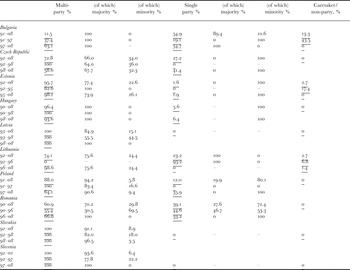
A comparison of government types – whether they have regular one-party, multi-party, and/or minority governments – suggests that CEECs have developed stable patterns of government (see appendix 1). Only Hungary has had exclusively majority multi-party governments, and in Estonia, Latvia, Poland, Slovak Republic and Slovenia multi-party governments have clearly been dominant. Bulgaria, Czech Republic, Lithuania and Romania seem to present less stable patterns. However, the breakdown of the post-communist period into earlier and later periods reveal some important patterns. Partly these patterns reflect the fact that the degree of political stability in these countries has increased as time has passed. One clear sign of this is that the portion of caretaker or non-party governments, which can be regarded as temporary solutions employed in times of political restlessness, are virtually non-existent from the latter part of 1990s, or the time period we cover herein.
From 1998 to 2008, only Hungary had the type of government most effective for the delegation form of fiscal governance. The rest of the countries would seem to be ideal candidates for fiscal contracts. They had majority or minority multi-party governments or single party minority governments. Some words of caution are in order. In particular, the figures in the table do not make a distinction between party blocks and more uniform parties. Similarly, the figures do not reveal what is the degree of cooperation between the government parties. As the examples of France and Germany indicate, delegation can function well so long as political parties are close to one another ideologically and they run as partners together in elections. Post-communist Bulgaria saw the emergence of two main political blocks through the 2001 elections as well as periods of one-party rule. Strmiska (Reference Strmiska2000) noted that the Bulgarian party system had been most often classified as a limited multipartyism or as a ‘two and a half’ party system. After 2001, however, the block dynamic dissolved. Multi-party coalition governments have existed since then. For the reason, we classify Bulgaria as ‘delegation’ 1998–2001 and ‘contracts’ for the period thereafter. In Hungary, two blocks have generally faced each other with Fidesz on one side and the Socialists on the other. Despite the expectation that the PR component of Hungary's mixed system would be able to sustain multipartyism, its party system has been steadily converging towards two parties We characterize Hungary as an expected delegation country for the entire time period. The rest of the countries are expected contracts countries.
Fiscal rules and institutions in Central and Eastern Europe
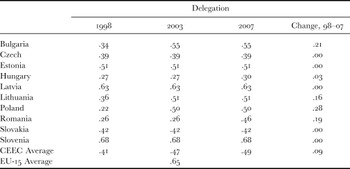
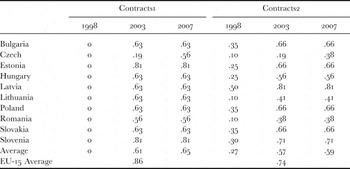
Building on the initial work done by von Hagen (Reference von Hagen1992) we have investigated different stages of the budget process – namely formulation of a budget proposal within the executive, the presentation and approval of the budget in the legislature, and the implementation of the budget by the bureaucracy. We use the data included in Yläoutinen (Reference Yläoutinen2005) and Gleich (Reference Gleich2003) to form indices for 1998 and 2003, and based on a new set of surveys and interviews we conducted, we have obtained information on these fiscal institutions in 2007Footnote 1 (Hallerberg and Yläoutinen, Reference Hallerberg and Yläoutinen2008; Hallerberg, Strauch, and von Hagen Reference Hallerberg, Rolf and von Hagen2009). We present in Table 1 consolidated data in the form of two types of indices. The delegation index measures features of the budget system that strengthen the finance minister's ability to direct the budget while the second measures fiscal contracts in a given country.Footnote 2
Aggregate Scores for delegation and contracts

The possible scores range from 0, the country has no rules/norms associated with delegation, to 1, the country has all rules/norms. Figures for the EU-15 are from 2004 and come from Hallerberg, Strauch, and von Hagen (Reference Hallerberg, Rolf and von Hagen2009).

The contracts1 variable included only the planning stage: multi-annual targets, planning horizon, Nature of Plan, Degree of Commitment. The contracts2 variable includes the following: Planning Stage: multi-annual targets, planning horizon, nature of plan, degree of commitment, implementation stage: finance minister can block expenditures, limits to transfers. Figures for the EU-15 are from 2004 and come from Hallerberg, Strauch, and von Hagen (Reference Hallerberg, Rolf and von Hagen2009).
Most of the CEECs should be contract states because of the prevalence of multi-party coalition governments. As indicated above, Hungary and Bulgaria prior to 2002 are the only countries in the group where one would expect delegation. The aggregate scores first for delegation and then for the two contract indices are presented below.
Many countries have made improvements to their fiscal frameworks in the run-up to the EU accession but there has been virtually no change since. In most cases the improvement comes from the establishment of multi-annual frameworks, which were previously missing. But despite frequent turnover of governments since 2004 in the region the fiscal rules themselves that structure how the budget is passed have remained remarkably stable. Compared to the EU-15, the Central and Eastern European Countries have weaker fiscal institutions. This is particularly true for the contract index as practically all countries are below the EU-15 average. Interestingly, the first country from this group to join the euro, Slovenia, has, on average, the highest score. Moreover, Hungary, the only delegation country in this group, has in fact the lowest score for the delegation index. This suggests that the country should have particular problems maintaining fiscal discipline.
Budgetary institutions and fiscal performance
The expectation is that countries with higher scores of the various indices will perform better and that there will be differences in the effectiveness of institutions based upon which form of fiscal governance is expected in a given country. In the expected delegation countries of Bulgaria before 2002 and Hungary, the delegation index will matter most. That is, if one of these countries has little support for delegation to its finance minister, it will have more acute fiscal problems than if it had had institutional support that strengthened the position of the finance minister.
To test this argument, we first examine change in the gross debt level. This is the variable used in most analyses of fiscal policy because the gross debt burden is most comparable across countries. The mean for this variable is −.84 with a standard deviation of 4.4. As von Hagen and Wolff (Reference von Hagen and Wolff2006) indicate for EU-15 countries, however, there is a lower correlation between deficits and changes in debt levels before the introduction of the euro than after it. The reason, they argue, is that the European framework focuses especially on the deficit level of 3 per cent rather than the debt level. Accounting ‘tricks’ can be used to reduce the deficit level. There may very well be a similar phenomenon going on in our dataset – the correlation between the change in the budget balance and in the debt burden is only −.495.Footnote 3 The second dependent variable is the general government budget balance as a per cent of GDP. This is the more visible measure in the media, and the one that is considered to be more important in practice under the European fiscal framework. Fabrizio and Mody (Reference Fabrizio and Mody2006), who have produced the most recent work on fiscal institutions in CEEC countries, also use a variation of this variable (i.e., primary balance as a per cent of GDP). The mean for the general government budget balance is −2.9 with a standard deviation of 3.0.Footnote 4
In all regressions we include a lagged dependent variable both to deal with autocorrelation and because we think that the value in the previous year affects policy in the current year. Standard macro-economic variables are also expected to have an effect, such as change as a per cent of gross domestic product, the unemployment rate, and the inflation rate. We also include a variable for the ‘debt burden,’ which is the debt burden times the short-term interest rate in a given year and is another way to deal with the issue of interest payments on the national debt. The government does not directly control the interest payments. Political variables in addition to our indices include a dummy variable for years where a country was an EU-accession country, a dummy variable if there was a national election that year, and the number of changes in government.
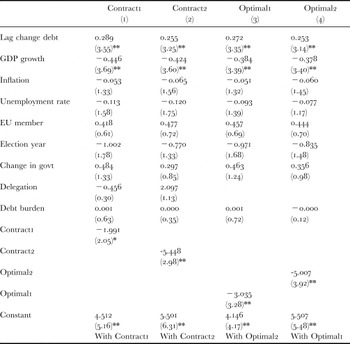
The first set of regressions in Table 2 includes one variable for delegation and one of the two variants for contracts in order to test whether centralisation of the budget process along either of these lines improves fiscal discipline. When we include a series of interaction terms about whether a country is expected to have one type of fiscal governance or another, the standard errors blow up because of multicollinearity. We instead create another variable, ‘optimal,’ which reflects what should be the optimal set of fiscal institutions for a given country. This means that the delegation index is used for Hungary and for Bulgaria when it is an expected delegation country and the respective contracts index is used in the remaining cases.
Change in Debt Burden as Per cent of GDP Regression

The regression covers the time period 1998–2007 with 86 observations across 10 countries. z statistics in parentheses
* significant at 5%;
** significant at 1%
Our standard equation is as follows:
Change in debt/deficitit = l.Change in debt/deficitit + growthit + inflationit +unemploymentit +EUMemberit +electionit +debtburdenit +govtchangesit +delegationindexit +contractindexit
In Table 2 we use a panel-corrected standard error regression for the change in debt burden. Our theoretical expectation is that the contract index will be statistically significant and it is, while the delegation variable is not. There is almost no variation in the delegation index, however, and given that most of the countries in the sample are expected contract states, this finding fits the argument. Also important for interpreting the contract index is the constant term, which is positive and statistically significant. This suggests that, if the other variables are set at zero, that there is an increase in the debt level. While it depends upon the values of other variables, one can interpret this constant roughly as the ‘debt bias’ that arises, and, we would argue, that arises due to the CPR problem. In the regression with the variant of the contracts index that includes both the multi-annual planning and the implementation components, the coefficients on ‘contracts’ and ‘constant’ almost exactly cancel one another out. The substantive meaning is that a country that had all fiscal institutions of what we expect a contracts form of fiscal governance to have will have no debt bias. The change in GDP variable is statistically significant as anticipated and debt varies according to the health of the economy when the contract fiscal governance scores are high. To our surprise, finances did not deteriorate in electoral years, and changes in government also did not have the expected effect of increasing debt.
We anticipate that the contract index be associated with higher fiscal discipline in expected contract countries and the delegation index having the same effect in expected delegation states. A more direct test is to consider the ‘optimal’ institutions for a given country, which means that Hungary and Bulgaria have the delegation index included in cases where they are expected delegation states. We have too few cases to consider whether the coefficients are significantly different from one another in statistical terms, but comparing the results with the optimal codings to those that have separate delegation and contract indices it is noteworthy that the coefficient becomes more negative while the z scores increase. Note as well that the control variables continue to have the expected signs, with economic growth and the lagged dependent variable both significant at the p<.01 level.
Table 3: Regression Using Change in Debt Burden as Per cent of GDP
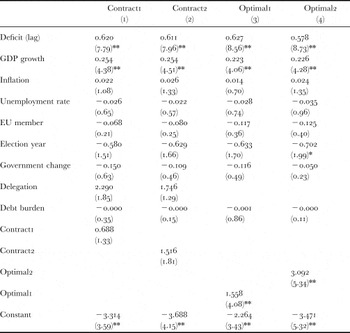
In Table 3 budget balance is the dependent variable, and the results are broadly similar. In the regressions where both delegation and contracts indices are included, both variables have the expected signs but neither is statistically significant. When one looks at just the ‘optimal’ version of the variable, however, they have the expected positive, and statistically significant, coefficients. This again suggests that the underlying governmental form affects the relative effectiveness of a given set of fiscal institutions. The budget balance regression that includes the first coding of the ‘optimal’ variable is the only one of the eight considered here where an electoral year has the expected negative impact on the health of the budget, but even so the size of the coefficient suggests that the change is not that great, or only 0.7 per cent of GDP. The consistently weak finding on the effects of elections is consistent with previous work done on the EU-15. (Hallerberg, Strauch, and von Hagen Reference Hallerberg, Rolf and von Hagen2009). One reason is that it is unclear which party benefits electorally from an expansion when there are multi-party coalitions, while under the one-party governments common in delegation states the benefactors from the expansion are clear. Moreover, fiscal expansions are not expected when exchange rates are flexible, and most countries in the region continued to have such exchange rates through 2007.
Budget Balance Regressions

The regression covers the time period 1998–2007 with 86 observations across 10 countries. z statistics in parentheses.
* significant at 5%;
** significant at 1%
Institutional differences lead to differences in fiscal policy outcomes in Central and East European countries. In countries where the political conditions mean that contract fiscal governance would lead to tighter fiscal discipline, we find that debt leads to better fiscal discipline. The results are also consistent with the argument that the effectiveness of a given form of fiscal governance varies according to the underlying form of government in place. That is, places where there are one-party majority governments or where there are two parties in government who are closely aligned to one another are appropriate for a delegation approach. Conversely, where there are multi-party coalition governments or minority government contracts generally work best. Institutions should not be examined in isolation from broader political context.
The more traditional ways of centralising the process, which include a focus on increasing the powers of the finance minister, are not necessary to increase fiscal discipline in countries that have multi-party coalition governments and/or where minority governments are common. Strengthening multi-annual planning can have real benefits in these states. Moreover, the European Union's framework under Economic and Monetary Union requires Member States to make multi-annual fiscal plans, and it provides one type of watchdog that can report when a government does not stick to its pre-agreed contract.
An implication of our research for the financial crisis that has subsequently hit Central and Eastern Europe is that countries that plan well during normal times are in a better position when the crisis does strike. Strengthening the overall fiscal governance structure reduces the risk of ‘debt bias’ by ensuring that fiscal easing during a downturn is balanced by tightening during expansions. Robust medium-term fiscal frameworks could therefore bolster the credibility and the effectiveness of fiscal stimulus (see e.g. IMF 2008). The second is that countries with established contract procedures, such as the Netherlands, often write into the terms of the contract what the settlement mechanism will be in the event that projections do not meet expectations. In practice, this does not always work as well as one would like, but it does reduce the inevitable transaction costs that arise when budget contracts need to be renegotiated.
Government types in CEEC, 1991–2008