Introduction
The biota of late Eocene Rovno amber remains poorly known (Bukejs et al., Reference Bukejs, Háva and Alekseev2020) in spite of 21 years of study (Martynova et al., Reference Martynova, Perkovsky, Olmi and Vasilenko2019; Mamontov et al., Reference Mamontov, Atwood, Perkovsky and Ignatov2020; Colombo et al., Reference Colombo, Perkovsky, Waichert and Azevedo2021; Perkovsky and Nel, Reference Perkovsky and Nel2021; Radchenko et al., Reference Radchenko, Perkovsky and Vasilenko2021). This amber is very important for understanding the formation of European biodiversity in the Eocene.
Curculionoid beetles are rare in the Rovno amber; eighteen species have been described, constituting 3.6% of beetles (Gratshev and Perkovsky, Reference Gratshev and Perkovsky2008; Petrov and Perkovsky, Reference Petrov and Perkovsky2008, Reference Petrov and Perkovsky2018; Nazarenko and Perkovsky, Reference Nazarenko and Perkovskу2009, Reference Nazarenko and Perkovskу2016; Nazarenko et al., Reference Nazarenko, Legalov and Perkovskу2011; Legalov et al., Reference Legalov, Nazarenko and Perkovsky2018, Reference Legalov, Nazarenko and Perkovsky2019, Reference Legalov, Nazarenko and Perkovsky2021a, Reference Legalov, Nazarenko and Perkovskyb; Bukejs and Legalov, Reference Bukejs and Legalov2019a, Reference Bukejs and Legalovb, Reference Bukejs and Legalov2020). Descriptions of several new species are being prepared. Here, we describe a new species of the genus Ceutorhynchus Germar, Reference Germar1823, from Rovno amber, expanding our knowledge of the European Eocene fauna.
Materials and methods
Specimen SIZK VT-135 was found at the Velyki Telkovichi locality (Varash District) in the Rovno region of Ukraine near the Voronki locality. In recent years, these sites have yielded many species and genera not known from the Klesov locality (Perkovsky and Olmi, Reference Perkovsky and Olmi2018; Radchenko and Perkovsky, Reference Radchenko and Perkovsky2018, Reference Radchenko and Perkovsky2020; Ignatov et al., Reference Ignatov, Lamkowski, Ignatova, Kulikovskiy, Mamontov and Vasilenko2019; Legalov et al., Reference Legalov, Nazarenko and Perkovsky2019; Martynova et al., Reference Martynova, Perkovsky, Olmi and Vasilenko2019; Perkovsky and Makarkin, Reference Perkovsky and Makarkin2019, Reference Perkovsky and Makarkin2020; Makarkin and Perkovsky, Reference Makarkin and Perkovsky2020; Perkovsky et al., Reference Perkovsky, Olmi, Vasilenko, Capradossi and Guglielmino2020; Jałoszyński and Perkovsky, Reference Jałoszyński and Perkovsky2021; Perkovsky and Nel, Reference Perkovsky and Nel2021; Tshernyshev and Perkovsky Reference Tshernyshev and Perkovsky2021; etc.).
Images were taken with a Leica M165C stereomicroscope at the Schmalhausen Institute of Zoology, National Academy of Sciences of Ukraine, Kiev. Morphological terminology follows Lawrence et al. (Reference Lawrence, Beutel, Leschen and Ślipiński2010) and Oberprieler et al. (Reference Oberprieler, Anderson, Marvaldi, Leschen and Beutel2014). We follow the systematics of Prena at al. (Reference Prena, Colonnelli, Hespenheide, Leschen and Beutel2014) and Legalov (Reference Legalov2018).
Repository and institutional abbreviation
The specimen is deposited in the Schmalhausen Institute of Zoology of the National Academy of Sciences of Ukraine, Kiev (SIZK), amber collection.
Systematic paleontology
Coleoptera Linnaeus, Reference Linnaeus1758
Family Curculionidae Latreille, Reference Latreille1802
Subfamily Conoderinae Schoenherr, Reference Schoenherr1833
Supertribe Ceutorhynchitae Gistel, Reference Gistel1848
Tribe Ceutorhynchini Gistel, Reference Gistel1848
Genus Ceutorhynchus Germar, Reference Germar1823
Type species
Curculio assimilis Paykull, Reference Paykull1792.
Ceutorhynchus zerovae new species
Figures 1–5
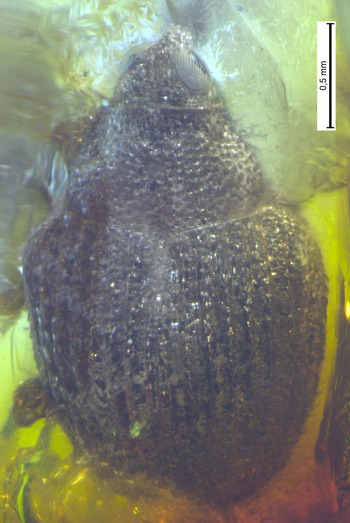
Habitus, dorsal view of Ceutorhynchus zerovae n. sp., SIZK VT-135, in Rovno amber.

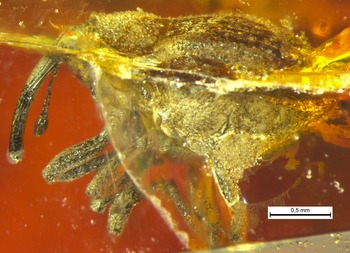
Habitus, lateral view of Ceutorhynchus zerovae n. sp., SIZK VT-135, in Rovno amber.

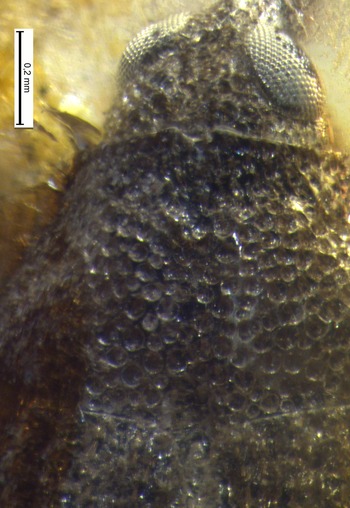
Head, pronotum, and scutellum, dorsal view of Ceutorhynchus zerovae n. sp., SIZK VT-135, in Rovno amber.

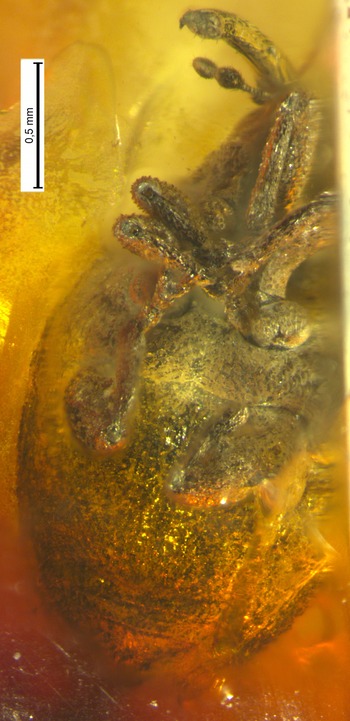
Habitus, ventral view of Ceutorhynchus zerovae n. sp., SIZK VT-135, in Rovno amber.

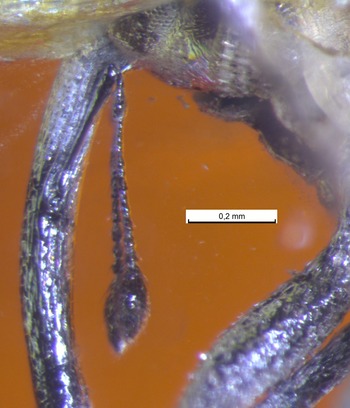
Antenna and rostrum, lateral view of Ceutorhynchus zerovae n. sp., SIZK VT-135, in Rovno amber.

Holotype
SIZK VT-135, Velyki Telkovichi, Rovno amber, late Eocene, adult specimen (complete); sex unknown.
Occurrence
Velyki Telkovichi, Varash District.
Diagnosis
The new species is very close to C. electrinus Legalov, Reference Legalov2016b, from Baltic amber, but differs in its coarse punctate pronotum, elytral interstriae with one row of tubercles (1–2 rows in C. electrinus), wider rostrum (8.2 times as long as wide medially; 10.8 times as long as wide medially in C. electrinus), shorter distance between apex of scape, apical margin of eye (0.07 times as long as scape, 0.12 times as long as scape in C. electrinus). It differs from C. succinus Legalov, Reference Legalov2013, from Baltic amber in elytral interstriae with row of tubercles (only punctate in C. succinus), coarse punctate pronotum. Distinguished from Baltic amber C. alekseevi Legalov, Reference Legalov2016b, by pronotum lacking deep medial groove, shorter tarsi, pronotum weakly narrower than elytral base (0.8 times as wide as rostrum base wide, 0.6 times as wide as rostrum base wide in C. alekseevi).
Description
Body length (without rostrum), 2.4 mm; rostrum length, 1.0 mm. Body black, lustrous, with brown, short, quite narrow, curved scales (Fig. 1). Rostrum long, cylindrical, weakly curved, 1.3 times as long as pronotum, 8.2 times as long as wide medially, finely rugosely punctate, narrower than profemora (Fig. 2). Mandible with 3 teeth. Anntennal scrobe directed under eye (Fig. 5). Forehead wide, ~2.0 times as wide as rostrum base width, flat, densely punctate. Eyes large, rounded, convex, 1.3 times as wide as rostrum basally. Vertex weakly convex, densely punctate (Fig. 3). Temples short, punctate. Antennae geniculate, long, almost reaching middle of pronotum, inserted before middle of rostrum (Fig. 5). Funicle 7-segmented. Antennomere I (scape) elongate, not reaching eye, 7.7 times as long as wide. Antennomeres II–VIII conical. Antennomere II 3.1 times as long as wide, 0.3 times as long as and 0.8 times as wide as scape. Antennomere III 3.3 times as long as wide, 0.7 times as long as and 0.7 times as wide as antennomere II. Antennomere IV 1.8 times as long as wide, 0.8 times as long as and 1.5 times as wide as antennomere III. Antennomere V 1.2 times as long as wide, 0.7 times as long and 1.1 times as wide as antennomere IV. Antennomere VI 1.2 times as long as wide, 1.1 times as long and 1.1 times as wide as antennomere V. Antennomere VII equal in length and wide, 0.9 times as long and subequal in width to antennomere VI. Antennomere 8 a little shorter than wide, shorter and wider than antennomere VII.
Antennal club compact, 2.4 times as long as wide, 0.5 times as long as funicle. Pronotum 1.1 times as long as wide at apex, 0.7 times as long as wide in middle, 0.6 times as long as wide at base, bell-shaped, without teeth on each side. Apical margin with small triangular cut (Fig. 3). Base weakly angularly extended to scutellum. Disc densely, rather coarsely punctate, without medial longitudinal groove. Punctation rounded, coarse. Distance between punctures smaller than puncture diameter. Pronotal constriction distinct. Sides of pronotum convex medially. Pronotum with base slightly angularly elongate towards scutellum, not protruding as tooth. Scutellum almost oval, 2.1 times as long as wide at base.
Elytra wide, weakly flattened, 2.4 times as long as pronotum, 1.1 times as long as wide at base and middle, 1.5 times as long as wide in apical quarter, without spots or stripes of scales (Fig. 1). Humeri weakly convex. Wider oval scales located near scutellum. Striae regular, distinct, and deep, with small, rounded, sparse punctures. Interstriae weakly convex, with row of semierect, quite wide scales, inserted usually on small tubercles, 3.0–4.0 times as wide as striae. Interstria 1 with 2–3 rows of scales. Apices of elytra rounded separately.
Prosternum with postocular lobes, rostral channel, coarsely punctate. Precoxal portion of prosternum elongate, 1.3 times as long as procoxal cavity length. Procoxal cavities rounded, separated by prosternal process. Postcoxal portion of prosternum short. Mesocoxal cavities rounded. Mesepimeron enlarged, visible between bases of prosternum, elytra without wide pale scales (Fig. 1). Metaventrite 1.3 times as long as mesocoxal cavity length, 1.2 times as long as metacoxal cavity length. Metanepisternum 3.1 times as long as wide, covered with large punctures. Metacoxal cavities dilated, barely separated by apex of ventrite I (Fig. 4). Abdomen convex, coarsely, rather sparsely punctate (Fig. 4). Ventrites I–V oriented in one plane. Ventrites I and II elongate, fused. Ventrite II ~1.2 times as long as ventrite I. Posterior angle of ventrite II extended towards ventrite III. Ventrite III 0.3 times as long as ventrite II. Ventrite IV 0.8 times as long as ventrite III. Ventrite V 1.6 times as long as ventrite IV.
Pygidium exposed. Legs long. Femora weakly swollen, punctate, with rather large teeth. Profemur 4.1 times as long as wide. Mesofemur 4.8 times as long as wide. Metafemur 4.6 times as long as wide. Tibiae curved, weakly flattened, weakly dilated apically, with black apical setae, lacking mucro, uncus. Metatibia 8.4 times as long as wide in middle. Tarsi long, with pulvilli on underside. Tarsomeres I and II conical. Tarsomere III bilobed. Tarsomere IV very short. Tarsomere V elongate. Claws large, with small teeth. Metatarsi: tarsomere I 1.6 times as long as wide; tarsomere II 0.9 times as long as wide, 0.7 times as long as and 1.1 times as wide as tarsomere I; tarsomere III 0.7 times as long as wide, 1.3 times as long as and 1.7 times as wide as tarsomere II; tarsomere V 3.7 times as long as wide, 1.1 times as long as and 0.2 times as narrow as tarsomere III.
Etymology
The species epithet is formed from the surname of Prof. Marina D. Zerova (1935–2021), who helped the last author a lot.
Remarks
The new species was placed in the family Curculionidae based on its geniculate antennae, ventrites I and II elongate and fused, and ventrites I–V oriented in one plane. It belongs to the subfamily Conoderinae because its mesepimeron is enlarged and visible between bases of the prosternum, and the elytra and posterior angle of ventrite II are extended towards ventrite III. The uncus of tibiae is absent. The exposed pygidium and prosternum with postocular lobes are diagnostic characters of the supertribe Ceutorhynchitae. The claws with two teeth, the pronotum base not protruding as a tooth, weakly swollen metafemora, and elongate rostrum confirm the assignment of the species to the tribe Ceutorhynchini. The combination of the pronotum base slightly angularly elongate towards the scutellum, the elytra without spots or stripes of scales, the rostrum narrower than the profemora and curved, mesepimera without wide pale scales, 7-segmented funicle, and claws with teeth show that the species belongs to the genus Ceutorhynchus.
Discussion
The most widely used genetic model in botany is Arabidopsis thaliana (Linnaeus, Reference Linnaeus1753) (Brassicaceae) (Beilstein et al., Reference Beilstein, Nagalingum, Clements, Manchester and Mathews2010 and references therein), and Brassicaceae in general are used as an evolutionary model (Huang et al., Reference Huang, Sun, Hu, Zeng, Zhang, Cai and Zhang2016). Understanding the evolutionary history of the family is, therefore, highly important, although it is currently controversial. Fossil beetles may allow progress in this.
The oldest fossil Brassicaceae is Thlaspi primaevum Becker, Reference Becker1961, from the Ruby Basin Flora of southwestern Montana, known by its angustiseptate winged fruits (Franzke et al., Reference Franzke, Lysak, Al-Shehbaz, Koch and Mummenhoff2011), a fruit form that appears to have evolved independently multiple times within the family (Al-Shehbaz and Mummenhoff, Reference Al-Shehbaz and Mummenhoff2005). However, among extant Brassicaceae, the combination of angustiseptate fruit with concentrically striated seeds is unique to species of Thlaspi (Beilstein et al., Reference Beilstein, Nagalingum, Clements, Manchester and Mathews2010).
The Ruby Basin Flora often has been incorrectly cited as 30.8–29.2 Myr (e.g., Beilstein et al., Reference Beilstein, Nagalingum, Clements, Manchester and Mathews2010; Franzke et al., Reference Franzke, Lysak, Al-Shehbaz, Koch and Mummenhoff2011). Becker (Reference Becker1960, Reference Becker1961) based this age on correlation with allied floras that are currently considered late Eocene/early Oligocene (Meyer and Manchester, Reference Meyer and Manchester1997; Meyer, Reference Meyer2003), and on associated Chadronian mammal fossils, then considered Oligocene (Kuenzi and Fields, Reference Kuenzi and Fields1971) but now interpreted as late Eocene (Prothero, Reference Prothero1985, Reference Prothero1994, Reference Prothero1995; Lloyd et al., Reference Lloyd, Worley-Georg and Eberle2008). The age of the flora is currently estimated to be late Eocene, ca. 34 Ma (Kuenzi and Fields, Reference Kuenzi and Fields1971; Lielke et al., Reference Lielke, Manchester and Meier2012). This is consistent with a similarly xeric regional late Eocene community at Florissant, Colorado, which shares the same or similar species of Cercocarpus, Mahonia, Pinus, and Quercus. This indicates a regional dry-adapted plant community in the northern Rocky Mountains at that time (Lielke et al., Reference Lielke, Manchester and Meier2012).
Analysis of the Arabidopsis thaliana genome provided evidence of three ancient whole-genome duplications, the last of these specific for core Brassicaceae (all recent lineages except the monotypic tribe Aethionemeae) (Franzke et al., Reference Franzke, Lysak, Al-Shehbaz, Koch and Mummenhoff2011, and references therein) and is thought to have occurred in the late middle Eocene, ca. 40 Ma, although younger estimates also have been proposed (see Franzke et al., Reference Franzke, Lysak, Al-Shehbaz, Koch and Mummenhoff2011).
Many molecular phylogenies have been inconsistent with a late Eocene age of T. primaevum, indicating a Miocene origin of 15 Ma for core Brassicaceae (Franzke et al., Reference Franzke, German, Al-Shehbaz and Mummenhoff2009, Reference Franzke, Lysak, Al-Shehbaz, Koch and Mummenhoff2011; Esmailbegi et al., Reference Esmailbegi, Al-Shehbaz, Pouch, Mandáková, Mummenhoff, Rahiminejad, Mirtadzadini and Lysak2018; etc.) or Oligocene (32.4 Ma: Hohmann et al., Reference Hohmann, Wolf, Lysak and Koch2015). According to these authors, T. primaevum does not belong to the tribe Thlaspideae and its supposed diagnostic traits of Brassicaceae result from homoplasy. Huang et al. (Reference Huang, Sun, Hu, Zeng, Zhang, Cai and Zhang2016) estimated the divergence time of core Brassicaceae as Oligocene (29–30 Ma) without T. primaevum or as terminal Eocene–early Oligocene (32–35 Ma) with implementation of the Oligocene age of T. primaevum. Couvreur et al. (Reference Couvreur, Franzke, Al-Shehbaz, Bakker, Koch and Mummenhoff2010), however, dated the origin of core Brassicaceae as 37.6 Ma, consistent with T. primaevum as its earliest known member and the work of Beilstein et al. (Reference Beilstein, Nagalingum, Clements, Manchester and Mathews2010), based on a molecular clock model, even with supposed Oligocene age of T. primaevum-dated crown node age of the Brassicaceae of ca. 54 Ma (early Eocene).
A number of phytophagous insect genera specializing in feeding on Brassicaceae have their oldest known occurrences in the late Eocene. Four similar species of Ceutorhynchus are known from late Eocene amber. They belong to the C. inaffectatus-group, characterized by the laterally convex pronotum without lateral teeth, elytra with smoothed apical tubercles, claws with teeth, and the body covered with uniform scales (Korotyaev, Reference Korotyaev1980; Colonnelli, Reference Colonnelli2003). A species from the C. inaffectatus-group is also known from the late Oligocene of Germany (Heyden and Heyden, Reference Heyden and Heyden1866). This group includes over 24 extant species, distributed mainly in the Western Palaearctic, but some have been found in Siberia and Central Asia (Dieckmann, Reference Dieckmann1963; Korotyaev, Reference Korotyaev1980, Reference Korotyaev2002; Korotyaev and Gültekin, Reference Korotyaev and Gültekin2001; Colonnelli, Reference Colonnelli2003, Reference Colonnelli2004, Reference Colonnelli2005, Reference Colonnelli2011). These species develop in fruits or, less often, the stems or galls of Brassicaceae (Dieckmann, Reference Dieckmann1972). The genus Ceutorhynchus is associated only with this family (Colonnelli, Reference Colonnelli2004), but several species, as exceptions, develop only on Resedaceae and Linaceae, or in addition to crucifers associated with Capparaceae and Tropaeolaceae (Korotyaev, Reference Korotyaev1980, Reference Korotyaev2008; Colonnelli, Reference Colonnelli2004).
The earliest known beetles of the supertribe Ceutorhynchitae are early Eocene: one, probably of the tribe Ceutorhynchini, is known from the early Eocene of Green River Formation (Scudder, Reference Scudder1893; Legalov, Reference Legalov2015) and an elytron attributed to the genus Ceutorhynchus was described by Cockerell (Reference Cockerell1920) from the early Eocene of Peckham, England. In the late Eocene, a species of the extinct genus Baltocoeliodes Legalov and Bukejs, Reference Legalov and Bukejs2018, three species of Ceutorhynchus (Legalov, Reference Legalov2013, Reference Legalov2016b; Legalov and Bukejs, Reference Legalov and Bukejs2018), and one species of Rhinoncus Schoenherr, Reference Schoenherr1825 (Phytobiini), are known from Baltic amber (Klebs, Reference Klebs1910), and one species of the tribe Cnemogonini is known from Florissant, Colorado, USA (Scudder, Reference Scudder1893). Ceutorhynchini species not belonging to the genus Ceutorhynchus are also described from Florissant (Scudder, Reference Scudder1893; Wickham, Reference Wickham1916), the Eocene/Oligocene boundary of France (Förster, Reference Förster1891), the late Oligocene of Germany (Legalov and Poschmann, Reference Legalov and Poschmann2020), and the Neogene of France (Piton and Théobald, Reference Piton and Théobald1935). A species of the tribe Phytobiini is known from the Oligocene of Germany (Théobald, Reference Théobald1937).
All fossil Ceutorhynchus species from Baltic and Rovno amber belong to the C. inaffectatus-group, and because all of its extant species are monophagous or strictly oligophagous feeders on core Brassicaceae, these fossils may be used as proxies to indicate the presence of the latter. Members of the inaffectatus group never feed on Aethionema, sister to core Brassicaceae. Only two Ceutorhynchus species have been reported on Aethionema from five eastern localities in Turkey (Colonnelli, Reference Colonnelli2005), and one from Armenia (Korotyaev, Reference Korotyaev1992), based on two supposed Aethionema species. Aethionema species in Turkey are the most common and diverse (up to 51 from 57 known species; Moazzeni et al., Reference Moazzeni, Al-Shehbaz, German, Assadi, Müller, Joharchi and Memariani2018), nevertheless, there are only two species (1.4% from 106 Turkish species) of Ceutorhynchus recorded. Both of the Ceutorhynchus species are very small (1.6–1.7 mm) and could easily be preserved in amber, which preserves larger Ceutorhynchus (2.2–2.6 mm long).
It is conservative to assume that amber Ceutorhynchus fed on core Brassicaceae, which was likely sufficiently diverse by the middle of the late Eocene (36.4–36.8 Ma) (Iakovleva, Reference Iakovleva2017; Iakovleva et al., Reference Iakovleva, Mychko and Aleksandrova2021) to support the existence of at least four monophagous or oligophagous species in the Northern and Eastern European amber forests, three of which are found in Baltic amber. It is interesting that the extant Ceutorhynchus granulicollis Thomson, Reference Thomson1865, is monophagous on Thlaspi arvense (Dieckmann, Reference Dieckmann1972) and that Ceutorhynchus granulicollis from European Russia, Caucasus, Transcaucasia, Western Siberia, and Northern, Central, and Eastern Europe (Colonnelli, Reference Colonnelli2004; Legalov, Reference Legalov2020) is close to amber species.
Butterflies of the subfamily Pierinae are also presumed to have diversified on Brassicaceae at least by the beginning of the late Eocene (Braga et al., Reference Braga, Janz, Nylin, Ronquist and Landis2020) and they also are present at Florissant; Oligodonta florissantensis Brown, Reference Brown1976, has hind wing venation characteristic of the subfamily (Pljustch, personal communication, Reference Esmailbegi, Al-Shehbaz, Pouch, Mandáková, Mummenhoff, Rahiminejad, Mirtadzadini and Lysak2021; but see Kawahara, Reference Kawahara2013). Phyllotreta Chevrolat, Reference Chevrolat1836 leaf beetles are unknown in the Eocene (Nadein and Perkovsky, Reference Nadein and Perkovsky2018), but species of Psyllototus Nadein and Perkovsky, Reference Nadein and Perkovsky2010, thought to be the direct ancestors of the genus Psylliodes Latreille, Reference Latreille and Cuvier1829 were common and diverse in the late Eocene (Nadein and Perkovsky, Reference Nadein and Perkovsky2010; Nadein et al., Reference Nadein, Perkovskу and Moseyko2016). They apparently shifted host plant twice to Brassicaceae (Letsch et al., Reference Letsch, Gottsberger, Metzl, Astrin, Friedman, McKenna and Fiedler2018).
Of the 21 extant species of the inaffectatus-group with known hosts (Colonnelli, Reference Colonnelli2004), 19 are from forest, segetal, or ruderal hosts (Ignatov, personal communication, Reference Heyden and Heyden2021). We therefore presume that they and their associated insects likely were less affected by the Eocene/Oligocene climatic and biotic turnover (Radchenko and Perkovsky, Reference Radchenko and Perkovsky2021).
All of these lines of evidence support a likely appearance of core Brassicaceae and their insect guild in the Eocene, then persisting through climatic change in the Oligocene to the present day.
This is not the first instance of using Curculionoidea or other beetles as proxies for plants not found in amber. For example, a species of Oxycraspedus Kuschel, Reference Kuschel1955 (Legalov, Reference Legalov2016a), is an obligate feeder on Araucaria (Marvaldi et al., Reference Marvaldi, Lyal, Oberprieler, Bradbury and Anderson2006), a species of Heterhelus (Kateretidae) is an obligate feeder on Sambucus (Kupryjanowicz et al., Reference Kupryjanowicz, Lyubarsky and Perkovsky2021), and species of the genus Dorytomus (Legalov, Reference Legalov2016a, Reference Legalovb; Bukejs and Legalov, Reference Bukejs and Legalov2019c; Legalov et al., Reference Legalov, Nazarenko and Perkovsky2019, Reference Legalov, Nazarenko and Perkovsky2021b) is an obligate feeder on Salix, Populus, and Chosenia (Dieckmann, Reference Dieckmann1986; Korotyaev, Reference Korotyaev1996).Thus, the amber Ceutorhynchus show that core Brassicaceae were present in the late Eocene of Northern and Eastern Europe. The diversification of Brassicaceae and their more prominent appearance in fossil assemblages in the Miocene (Franzke et al., Reference Franzke, Lysak, Al-Shehbaz, Koch and Mummenhoff2011) were apparently associated with the appearance of more open spaces than where their host plants could grow on forest edges. However, the Ruby River flora was dryer than their neighboring floras and presumably had such open habitats in the late Eocene that combined deciduous forest and shrubland (Wing, Reference Wing1987). There is reason to assume that the Rovno amber forest was more open than the Baltic amber forest (Lyubarsky and Perkovsky, Reference Lyubarsky and Perkovsky2011; Dietrich and Perkovsky, Reference Dietrich and Perkovsky2020; Mitov et al., Reference Mitov, Perkovsky and Dunlop2021; Dietrich et al., Reference Dietrich, Dmitriev and Perkovskyin press), especially northwest and north of the Rovno region (Dietrich et al., Reference Dietrich, Dmitriev and Perkovskyin press). A comparative analysis of the abundance and diversity of Ceutorhynchus in the large, representative collections of Baltic amber should further increase understanding of the early stages of Brassicaceae evolution.
Acknowledgments
We are grateful to B.A. Korotyaev (Russia: Saint-Petersburg) for the opportunity to study comparative material deposited in the Zoological Institute RAS; A.P. Rasnitsyn (Paleontological Institute, Moscow) for valuable discussion; S.B. Archibald (Simon Fraser University, Burnaby, Canada) for discussion and editing of the English; A.P. Vlaskin (Institute of Zoology, National Academy of Sciences of Ukraine, Kiev) for cutting and polishing the sample; and to N.R. Khomich (Rovno) for help in obtaining inclusions from Velyki Telkovichi.