INTRODUCTION
The clam Mya arenaria (Linnaeus 1758) is one of the oldest marine invaders of European coasts (Reise et al., Reference Reise, Gollasch and Wolff1999). This invasive clam species is widespread throughout European seas (Strasser, Reference Strasser1999; Gollasch, Reference Gollasch2006). Thus, M. arenaria is well established in the White Sea (Maximovich & Guerassimova, Reference Maximovich and Guerassimova2003), Norway (Winther & Gray, Reference Winther and Gray1985), the Swedish coast (Möller & Rosenberg, Reference Möller and Rosenberg1983; Flach, Reference Flach2003), the Baltic (Boström et al., Reference Boström, O'Brien, Roos and Ekebom2006; Zettler et al., Reference Zettler, Schiedek and Bobertz2007), the German coast (Strasser et al., Reference Strasser, Walensky and Reise1999), in estuaries of The Netherlands (Ysebaert et al., Reference Ysebaert, Meire, Coosen and Essink1998), Belgium (Kerckhof et al., Reference Kerckhof, Haelters and Gollasch2007), the British isles (Seaward, Reference Seaward1990; Hughes et al., Reference Hughes, Lloyd, Ball and Emson2000), Ireland (Seaward, Reference Seaward1990; Healy, Reference Healy1997) and the Atlantic coast of France (Nicolas et al., Reference Nicolas, Le Loc'h, Désaunay, Hamon, Blanchet and Le Pape2007). The clam has been described in the Basque Country, on the Spanish coast of the Bay of Biscay (Borja, Reference Borja1988; Borja & Muxika, Reference Borja and Muxika2001). It has also been recorded south of this area in the Tagus estuary and in the Lima estuary (Conde et al., Reference Conde, Novais and Domínguez2010, Reference Conde, Novais and Domínguez2011a), both of which are in Portugal. There is also some evidence of the occurrence of established populations of M. arenaria in other north-western areas of the Iberian Peninsula, such as the Douro estuary in Portugal (Oliveira, Reference Oliveira2007) and Rianxo, in the Ria de Arousa, Spain (Rolán & Acuña, Reference Rolán and Acuña2008). Mya arenaria does not outcompete the native fauna on the European coast where it coexists with endemic bivalve species (Bocher et al., Reference Bocher, Piersma, Dekinga, Kraan, Yates, Guyot, Folmer and Radenac2007; Conde et al., Reference Conde, Novais and Domínguez2011a).
The invasive clam is also established in the Mediterranean Sea, with records in France (Gulf of Lyon: see Stora et al., Reference Stora, Arnoux and Galas1995; Zenetos et al., Reference Zenetos, Gofas, Russo and Templado2004), Italy (Sacca di Goro Lagoon: see Crocetta, Reference Crocetta2011, Reference Crocetta2012; Crocetta & Turolla, Reference Crocetta and Turolla2011) and the eastern Mediterranean Sea (Greece and Turkey: Zenetos et al., Reference Zenetos, Gofas, Russo and Templado2004; Çinar et al., Reference Çinar, Bilecenoğlu, Öztürk, Katağan, Yokeş, Aysel, Dağli, Açik, Özcan and Erdoğan2011; Crocetta & Turolla, Reference Crocetta and Turolla2011), as well as in the Black Sea (Gomoiu & Petran, Reference Gomoiu and Petran1973), where it had been suggested to be able to outcompete the native bivalve Lentidium mediterraneum (O.G. Costa, 1829) along the Romanian shores (Gomoiu, Reference Gomoiu1981).
The occurrence of M. arenaria in the Ria de Aveiro has never been formally recognized. It has only been cited in the abstract of a note devoted to the macrofauna inhabiting local salt ponds (Vieira & Amat, Reference Vieira and Amat1997) and listed within the fauna sampled during the 2006 summer season (Nunes et al., Reference Nunes, Coelho, Cardoso, Pereira, Duarte and Pardal2008). However, in the salt ponds, the salinity reaches as high as 54.4–220 g l−1 (Vieira & Amat, Reference Vieira and Amat1997), and is thus much higher than the range of tolerance of 0–30.5 g l−1 reported for the species by Matthiessen (Reference Matthiessen1960), while the record of Nunes et al. (Reference Nunes, Coelho, Cardoso, Pereira, Duarte and Pardal2008) was not confirmed in later extensive studies carried out in the area (Quintino et al., Reference Quintino, Sangiorgio, Mamede, Ricardo, Sampaio, Martins, Freitas, Rodrigues and Basset2011; Rodrigues et al., Reference Rodrigues, Quintino, Sampaio, Freitas and Neves2011).
The aim of the present study was to find evidence of the current occurrence of M. arenaria in the Ria de Aveiro by surveying an area close to the sampling site described by Nunes et al. (Reference Nunes, Coelho, Cardoso, Pereira, Duarte and Pardal2008).
MATERIALS AND METHODS
Study site
The Ria de Aveiro (northern Portugal) is a marine lagoon, which is linked to the Atlantic Ocean through an artificial inlet and is characterized by several narrow channels due to the existence of small river basins that drain into the ria. There is a commercial port close to the lagoon inlet. The large ria encompasses different habitats, such as intertidal sand flats, mud flats and salt marshes.
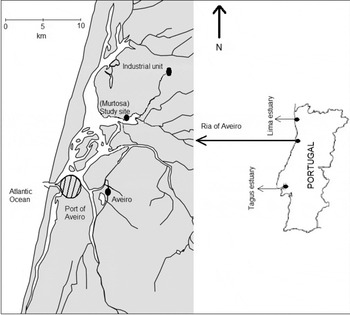
The study site is close to that described by Nunes et al. (Reference Nunes, Coelho, Cardoso, Pereira, Duarte and Pardal2008) and is located in the north-western part of the lagoon (Figure 1), close to the village of Murtosa. The salinity fluctuates seasonally in this part of the lagoon, with conditions ranging from mesohaline to euhaline (Nunes et al., Reference Nunes, Coelho, Cardoso, Pereira, Duarte and Pardal2008). The site is subject to anthropogenic pressure in the form of heavy metal pollution derived from an electrochemical plant located at the top of the Estarreja Channel (Pereira et al., Reference Pereira, Duarte, Millward, Abreu and Vale1998) (Figure 1).
Map of the Ria de Aveiro showing the location of the study site. The Tagus and the Lima estuaries are also shown on the right hand side of the figure.

Field, laboratory procedures and data analysis
Sampling was carried out, during ebb tide, at the end of April 2012. A search for empty shells was conducted on an area of 2000 m−2 during 60 minutes, as described by Conde et al. (Reference Conde, Aira, Novais and Domínguez2011b). Interpretation of the historical evolution of populations of M. arenaria using empty shells followed the methods of Strasser et al. (Reference Strasser, Walensky and Reise1999) and Palacios et al. (Reference Palacios, Armstrong and Orensanz2000). Collection of live individuals of M. arenaria was carried out when key-like holes were observed on the sediment surface. Random searches were conducted to find juvenile specimens of M. arenaria, by digging the sediment to a depth of 8 cm. The clams were transported in a cooled container and stored at 4°C until measurements were made later in the laboratory. Finally, macrobenthic species that were easily recognized by visual inspection within the search area were registered.
Shell length was measured in the left valve, with a Vernier caliper, to the nearest 1 mm. The fresh weight of live individuals was determined after blotting the clams on absorbent paper one day after collection. The M. arenaria specimens were grouped into size-classes with intervals of 10 mm. Empty shells of M. arenaria from the Ria de Aveiro were compared with those collected in the Tagus and Lima estuaries by Conde et al. (Reference Conde, Aira, Novais and Domínguez2011b). As the data were not normally distributed, a Wilcoxon's signed-rank test (W) was used for the comparisons. Empty shells from the Tagus and the Lima estuaries were collected in May 2010. It was assumed that empty shells from the Ria de Aveiro belong to dead animals at that time. The relationship between shell length and fresh weight was established by linear regression. Shell length and clam weight are expressed as mean ± standard deviation.
RESULTS
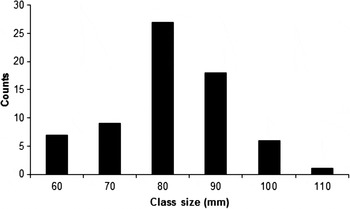
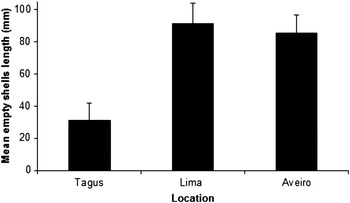
A total of 68 empty M. arenaria shells were collected from the mid-upper part of the intertidal region. Most of the shells collected belonged to dead clams stuck in the sediment in a life-like position. The density of the dead population, calculated over three random plots of 1 m2, was at least 2.33 ± 0.47 ind m−2. The mean shell length of empty clams was 85.32 ± 11.31 mm. Maximum and minimum lengths of the empty shells were 119.3 mm and 60.6 mm respectively (Figure 2). The mean length of empty shells from the Ria de Aveiro is larger than the mean length of shells from the Tagus estuary (31.23 ± 10.81 mm; W = 2992, P < 0.001) and smaller than those from the Lima estuary (91.59 ± 12.45 mm; W = 353, P = 0.0299) (Conde et al., Reference Conde, Novais and Domínguez2011a; Figure 3). A similar conclusion was reached after carrying out a two-sample Kolmogorov–Smirnov test.
Size-class distribution of empty shells of Mya arenaria.

Mean (±standard deviation) lengths of empty shells of Mya arenaria from three different locations in Portugal.

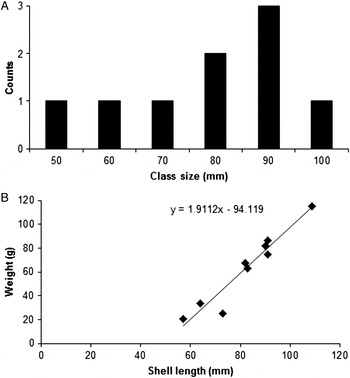
Signs of live individuals of M. arenaria on the sediment were scarce. In total, nine individuals were collected, and six of these were caught in an area of approximately 40 m2, indicating a low density of 0.15 ind m−2. All live individuals of M. arenaria were collected at approximately 70 cm from the mean high tide water mark. This intertidal location was slightly higher than the position occupied by dead assemblages of clams. Signs of the invasive clam were also observed at this intertidal position within seagrass (Zoostera sp.) meadows, but no attempts were made to collect specimens and the habitat was not disturbed. The mean shell length of M. arenaria was 82.22±14.85 mm. Maximum and minimum shell lengths were 109.2 mm and 57.6 mm respectively (Figure 4A). The mean fresh weight of the clams was 63.03 ± 29.49 g. The length–weight relationship was linear and fitted well to the linear predictor (R2 = 0.92; F1,7 = 88.38, P < 0.001), except in the case of one specimen (Figure 4B).
(A) Size-class distribution of Mya arenaria and (B) length–weight relationship for the clams.

No juvenile specimens of M. arenaria were observed in the intertidal zone. The accompanying fauna observed by visual inspection at the survey site comprised the polychaetes Diopatra neapolitana Delle Chiaje, 1841 and Hediste diversicolor (O.F. Müller, 1776), the bivalves Cerastoderma edule (Linnaeus, 1758) and Scrobicularia plana (da Costa, 1778), the gastropod Hydrobia ulvae (Pennant, 1777) and the decapod Carcinus maenas (Linnaeus, 1758).
DISCUSSION
The occurrence of M. arenaria in the Ria de Aveiro increases records of this invasive clam to three confirmed locations on the Portuguese coast, apart from the invasions reported in the Tagus estuary (Conde et al., Reference Conde, Novais and Domínguez2010) and in the Lima estuary (Guimarães & Galhano, Reference Guimarães and Galhano1988; Conde et al., Reference Conde, Aira, Novais and Domínguez2011b).
The mean size of the empty shells suggests that the invasion occurred earlier in the Ria de Aveiro than in the Tagus estuary (Conde et al., Reference Conde, Novais and Domínguez2010). Therefore, the invasion on the Portuguese coast may have begun in the north of the country because the populations from the Lima estuary are also older than those from the Tagus estuary (Conde et al., Reference Conde, Aira, Novais and Domínguez2011b; Figure 3). Vieira & Amat (Reference Vieira and Amat1997) and Nunes et al. (Reference Nunes, Coelho, Cardoso, Pereira, Duarte and Pardal2008) described M. arenaria from among the fauna observed in their studies carried out in the Ria de Aveiro. However, a low density and a restricted distribution of the invasive clam may explain the absence of references to M. arenaria in other studies within the Ria de Aveiro (Quintino et al., Reference Quintino, Sangiorgio, Mamede, Ricardo, Sampaio, Martins, Freitas, Rodrigues and Basset2011; Rodrigues et al., Reference Rodrigues, Quintino, Sampaio, Freitas and Neves2011). The invasive clam is found among estuarine macrobenthic assemblages on the Portuguese coast (Nunes et al., Reference Nunes, Coelho, Cardoso, Pereira, Duarte and Pardal2008; Conde et al., Reference Conde, Novais and Domínguez2010, Reference Conde, Aira, Novais and Domínguez2011b) and on the northern coast of Europe (Ysebaert et al., Reference Ysebaert, Meire, Coosen and Essink1998; Hughes et al., Reference Hughes, Lloyd, Ball and Emson2000).
The difference between the sizes of the empty M. arenaria shells suggests different years of recruitment. Nonetheless, it may be argued that these shells belong to individuals of the same cohort that died at different ages. However, a difference of 51.6 mm was also found between the maximum and the minimum shell length of the M. arenaria individuals collected from the study site. The growth rate of M. arenaria (Brousseau, Reference Brousseau1979) indicates that the latter difference may only be explained by different recruitment times. Therefore, reproductive populations of the invasive clam appear to be established in the Ria de Aveiro.
The existence of dead assemblages of M. arenaria in the same position as live specimens also suggests that the invasion is not a recent event. Factors other than predation and wash out (Strasser et al., Reference Strasser, Walensky and Reise1999) may have caused mass mortality of the population of M. arenaria in the Ria de Aveiro. Water quality and the thermal tolerance of the clam (Strasser, Reference Strasser1999) may account for mass mortalities of southern populations.
One of the most common causes of marine invasions (Carlton, Reference Carlton1985) is transportation via ballast water. However, the occurrence of M. arenaria in three different locations of the Portuguese coast appears to be the result of intentional introduction, at least in some of these cases. This was suspected in Italian waters (Crocetta, Reference Crocetta2012). The use of invasive species as bait and their use for aquaculture, ornamental and even scientific purposes have been suggested as means of introduction of such species in marine waters (Gollasch, Reference Gollasch2006).
ACKNOWLEDGEMENTS
The first author was funded by the Portuguese Foundation for Science and Technology (SFRH/BD/48928/2008). We are especially grateful to Dr Fabio Crocetta for valuable comments and suggestions that helped improve an earlier version of the manuscript.