Economic crises have been widely accepted as a key trigger of democratic transition.Footnote 1 This belief is based on two lines of reasoning. First, the ‘coalition thesis’, an elite-based approach, contends that economic crises break down the ruling coalition of an authoritarian regime by depleting the resources on which the regime had relied to pay allies of the business class, the middle class and the organized labor forces. Secondly, the ‘legitimacy thesis’ contends, from a mass-based approach, that economic crises undermine the legitimacy basis of authoritarian regimes.Footnote 2 This is primarily because authoritarian regimes rely heavily on economic performance for public support and claim to rule ‘generally based upon…socioeconomic performance, or what has been called “social eudaemonic” legitimation’.Footnote 3
A brief review of post-war history, however, shows that the actual political consequences of economic crises vary. Although the breakdown of authoritarian regimes and the transition to democracy have been preceded by economic turmoil in a number of countries, in many cases economic crises have not led to regime change, let alone democratic transition. For example, although Argentina, Bolivia, Brazil and some other Latin American countries experienced democratic transitions during economic crises, many African authoritarian rulers, such as Zimbabwe’s Mugabe and Togo’s Eyadema, managed to stay in power during their countries’ protracted economic crises.Footnote 4 By contrast, Suharto’s Indonesian regime collapsed during the Asian financial crisis of 1998, but Mahatir’s rein stayed intact in Malaysia until 2003.Footnote 5 In one of the few systematic studies on this issue, Gasirowski found that, although economic crises help trigger democratic breakdown, they had no definite effect on democratic transition.Footnote 6 Overall, scholars have not found a consistent pattern in regard to the relationship between economic crises and democratic transition.
This study examines the conditions under which economic crises are more likely to cause democratic transition and highlights the importance of economic structure under authoritarian rule. Specifically, we argue that whether economic crises engender democratic transition is conditioned by the authoritarian state’s engagement in the economy (that is, how much the government meddles in various economic activities). Government involvement in the economy increases the probability of democratic transition during economic crises for two reasons. First, state economic engagement politicizes the economy and economic crises by making the authoritarian regime liable for economic failure. It amplifies the effect of both coalition-driven and legitimacy-driven democratic transitions. While state economic engagement helps the authoritarian regime during an economic boom, when the economy turns bad, social forces (that is, the business class and the masses) call for changes in the political system. Secondly, state engagement in the economy aggravates the economic loss for both the business class and the masses during economic crises. This is because, as the stakeholders of the state economy, the ruling elites have both the incentives and the capacities to preserve the returns from state business at the expense of the non-state classes. We formally prove that during economic crises, if authoritarian elites control a higher share of the state economy, this entails greater disparity in terms of economic loss between political elites and social forces. As a consequence, when a crisis happens, the business class is more likely to defect from the coalition with the regime, the masses are more likely to withdraw support for the regime and engage in a revolt directed at political change, and the business class and the masses are more likely to form a cross-class alliance against the authoritarian regime.
We test the conditionality of the effect of economic crises as determined by state economic engagement by analyzing the panel data of 106 countries during the period 1970 to 2007. Our empirical analyses consistently show that economic crises are significantly and positively associated with democratic transition only when the level of state engagement in the economy is relatively high. This finding is robust against different measurements of primary variables including economic crises, the economic engagement of the state and democracy.
This research contributes to the literature in three regards. First, it expands the pool of the theories and facts of the economic origins of democracy by highlighting how short-term economic shock intersects with long-term economic structure in triggering democratic transition. The structuralist tradition of the comparative democratization literature has paid the most scholarly attention to economic factors such as economic development and economic inequality.Footnote 7 The effect of short-term economic shocks on democratic transition has been relatively less studied. Secondly, the research enriches our understanding of the economic role of the state. While the economic implications of the variant roles of the state have been thoroughly discussed,Footnote 8 their political implications have received much less attention. The current study examines the implication that state engagement in the economy not only makes a difference in economic output but also shapes the incentives of different political actors, which, in turn, leads to variant political equilibriums after crises. Finally, compared to previous works that focus on the link between economic crises and regime breakdown, this study goes further and provides a theory of how crises lead to democratic transition. Regime breakdown does not equal democracy. We establish a causal link between crises and democratic transition by providing not only an account of the calculation of social forces in their relationships with the regime, but also an explanation of why an alliance between the business class and the masses is likely to occur after a crisis.
THE RELEVANCE OF THE ECONOMIC ENGAGEMENT OF THE STATE
Scholars have long noted the impact of the state’s economic role on economic performance. The literature on varieties of capitalism has found that advanced industrialized democracies vary substantially with regard to the extent of state engagement in their national economy.Footnote 9 For developing countries, the variation of the economic role of the state is even larger.Footnote 10 The governments of developing countries get involved in economic activities for various reasons. Most notably, the elites in late developers believed that state engagement was necessary to jumpstart the economy and to protect infant national industries. Those countries faced a tough international environment of economic competition in which production was already industrialized and differentiated, the global market was highly integrated and the domestic market was subject to the invasion of global capital.Footnote 11 National private businesses in those countries, therefore, cannot accumulate capital and strength independently. In addition, many developing countries that are dependent on natural resources often have a high degree of state engagement in the economic sector. Nationalist sentiment, and the push by domestic forces for national control over natural resources in the post-war period, have caused the governments in a number of countries to become the biggest stakeholders in their economies. Finally, in communist countries the state was closely tied to economic production, as it directly owned a large portion of the economic resources and enterprises.
Whatever the reasons behind the economic engagement of the authoritarian state, aside from its apparent impact on the economy, its very existence entails important political implications. In the context of this research, state economic engagement determines the authoritarian political elites’ stake in the performance of the national economy, which in turn shapes the incentives of both political elites and social forces during economic crises. The following two subsections describe two reasons why state economic engagement makes economic crises more likely to engender political transitions in authoritarian countries.
State Engagement and Politicized Crisis
State engagement increases the probability of democratic transition after economic crises because the higher economic stake of authoritarian elites amplifies the effect of both the coalition and legitimacy mechanisms of crisis-engendered democratization, as presumed by extant theories. Both the business class and the masses hold the authoritarian state or political elites accountable for economic performance under any circumstances. Greater state involvement in the economy makes them more likely to do so when economic crises occur.
The coalition thesis contends that the most direct consequence of economic contraction is the depletion of the resources that the regime can use to maintain the ruling coalition. Economic crises thus reduce political elites’ bargaining power and ability to give supporters access to opportunities and resources.Footnote 12 This argument presumes that there had been an effective coalition between the business class and political elites before the crises, and that the state relies on economic spoils to ensure the cooperation of the business class in order to maintain authoritarian rule. A close relationship between authoritarian elites and the business class thus serves to benefit the regime during an economic boom. Under authoritarian rule, the most effective way for the state to build the ruling coalition with non-regime elites, especially the business class, is to monopolize economic resources or participate in economic production. This is so because, first, through active engagement, the state is able to secure the material basis that can be used to provide rents and benefits to its supporters among the social forces. For the business groups, these benefits include low-cost bank loans and direct government subsidies.Footnote 13 Secondly, by controlling the economy, the state can also secure the support of the business class through preferential manufacturing and trade policies.Footnote 14 These policies are essential for the recipient business groups to gain investment, capital and market in developing countries, where their independent growth is unlikely. Through the manipulative and targeted use of these benefits, the authoritarian state can build authoritarian networks of support and buy off social discontent.
The need for state sponsorship and the connection with the state force entrepreneurs into a relationship of dependency and make them hesitant about democratization, on the one hand, and incapable of challenging the regime, on the other hand. The capital forces of Indonesia, for instance, accepted that a repressive state is essential for economic success, and thus were allied with it throughout the 1980s and 1990s.Footnote 15 Likewise, in South Korea until the mid-1980s, the patrimonial rule of Park Chung-hee and Chun Doo-hwan secured the support of business elites through the preferential allocation of government-controlled resources. Several studies have demonstrated that in contemporary China, where the government is heavily engaged in the economy, entrepreneurs are generally supportive of the regime.Footnote 16
However, the authoritarian rule built on material incentives is likely to collapse when dictators can no longer provide sufficient resources to sustain political support as the result of economic crises.Footnote 17 The same relationship of dependency between the state and the business class can endanger the fate of the authoritarian regime during an economic bust. In times of economic crisis, business elites hold the regime accountable for the economic failure, and thus seek to alter political arrangements. During the financial crises of the early 1980s, for example, ‘[t]he business interests and foreign investors that had rallied to authoritarian military regimes in the 1960s (in Latin America) began to see these overly statist and apparently unaccountable governments as a source of danger rather than of protection, so they withdrew their support’.Footnote 18 This rationale for authoritarian collapse also conforms to the history of African countries, where economic contraction in the late 1980s facilitated democratization in countries such as Benin and Zambia.Footnote 19 Only with a certain level of engagement with the state can the business class find the authoritarian state necessary for their economic benefit and the politics relevant to their economic returns. For the same reason, when crisis occurs, the business class sees the need to change politics.
From a more mass-based approach, the legitimacy thesis contends that economic crises undermine the legitimacy basis of regimes, particularly authoritarian ones.Footnote 20 A key conclusion of studies of popular support is that political institutions strongly moderate the impact of economic performance on regime durability.Footnote 21 Specifically, greater competitive opportunities tend to make economic performance less important. Democratic regimes are therefore inherently less vulnerable than their authoritarian counterparts to economic performance setbacks. Authoritarian regimes, which lack power sharing and government alternation, rely heavily on economic performance for public support. Further, citizens under authoritarian rule tend to associate economic performance with regime legitimacy and do not differentiate between exogenous shocks and good economic management when assessing the effect of economic growth on their incomes.Footnote 22 The centrality of this instrumental rationale in political support thus makes authoritarian regimes vulnerable to economic downturns.
Authoritarian vulnerability to economic downturns is further reinforced by the very existence of state engagement in the economy. As seen in China, Vietnam and Singapore, in authoritarian countries where the state is considerably engaged in economic activities, the regime is more likely to attribute economic success to its governance and to boast about its effectiveness and legitimacy based on extraordinary economic performance. And since ordinary citizens’ income is more likely to be influenced by how well the state manages economic production, their political attitudes are more likely to be influenced by their economic well-being. As various country-based studies have shown, in such authoritarian countries when the economy develops well, citizens extend relatively high levels of political support to the regime. However, this link between economic performance and regime legitimacy also makes regime stability more sensitive to the economic situation. When an economic crisis occurs, and the government stops delivering the economic benefits based on which ordinary people support it, the regime becomes politically liable for their economic misfortune. Thus regimes that are significantly engaged in the economic sector cannot afford an economic crisis, which is often not in their control in this age of economic and financial globalization.
In sum, for both the business class and the masses, if the state plays a minimal role in the economy, it is considered either irrelevant or too weak to be useful. The potential gains from political actions are therefore insignificant. In other words, if there is no state engagement in the economy, regime change is not a viable solution to economic problems. As the critics of economic liberalization have observed, a free market in authoritarian countries or new democracies leads to the atomization of social interests by putting them in competition with each other, and to the depoliticization of social economic development by cutting the scope (and, hence, the relevance) of policy decisions.Footnote 23 In essence, in a relatively state-free economy, political change is not necessary because politics is not perceived as the cause of economic failure. In such a situation, political interest in democracy – even during an economic crisis – would be difficult to increase.
State Engagement, Business Defection, Mass Revolt and Cross-Class Alliance
If a significant portion of the economy is run by the authoritarian state, economic crises will not only disrupt the dependent relationship between the state and various social forces but will also, more critically, cause a greater disparity between the economic losses of state elites and those of the business class and the masses. Compared to political elites, non-state classes take a disproportionately greater hit during economic crises because political elites have the incentive and means to preserve their economic interests and to mitigate economic loss. In this section, we show that if the state elites have control over a higher share of the economy, the disadvantage of non-state classes is even greater, because the stakeholders of the privileged economy are more motivated (and more able) to protect their economic returns and, in fact, shift their losses to the business class and the masses. Further, higher levels of state engagement in the economy tend to reduce the relative income gap between the two social classes during economic crises and, hence, help remove barriers to a cross-class alliance. We build a theoretical model to demonstrate that economic crises constitute a trigger that disrupts the existing authoritarian equilibrium, and that the economic engagement of the state further facilitates democratization by making (1) the business class more likely to defect from the coalition with political elites, (2) the masses more likely to engage in revolt aimed at regime change and (3) the two forces more likely to form a cross-class alliance against the regime.
Given the existence of the state’s assets, there are two kinds of people in the society, the masses (m) and the privileged (p), as defined by their access to the revenues generated by the state-owned assets, G. Among the privileged, there are two discernible groups, the political elites (e) and the business class or economic elites (b), defined by their power to distribute the revenues generated by the state-owned assets. Because political elites have a motivation to maximize their material interest and at the same time to maintain a ruling coalition, they take an amount (K) from the revenues generated by the state-owned assets and provide the business with an amount (R) of the revenues as rent. We assume K>R, as the wealth generated from the privileged assets is held more by political elites than by the business class.
By differentiating between the business class and political elites, our model differs from the conventional elite-mass (or rich-poor) two-player models such as those of Boix and Acemoglu and Robinson.Footnote 24 Our theory is, to a greater extent, in agreement with Bueno de Mesquita et al.’s theory that differentiates between three sections of the population: the political elites (leadership), the members of coalition and the selectorate.Footnote 25 We concur with these authors that authoritarian regimes rely on the support of a group of people in society that enjoys preferential treatment by the regime in return for their loyalty. Moreover, similar to Bueno de Mesquita et al., we differentiate between two types of goods: the public goods that everybody receives and the private goods that the regime offers exclusively to a group of allies.Footnote 26 In essence, political outcomes are driven by the calculations of different groups with regard to their relative gains or losses in receiving public and private goods. Yet, we depart from Bueno de Mesquita et al. by specifying a type of coalition member: the business class.Footnote 27 Further, the private goods with which we are concerned, in particular, are the economic returns that the political elites obtain from state-owned assets and provide to the business class.
In authoritarian countries, political elites are often involved in economic activities. The elite cohesion is particularly strong when dictators are willing to share the spoils of office. The division between political elites and the business class is thus a simplification. Although it is a simplification, we find it both necessary and beneficial to differentiate between political elites and the business class. First, as suggested in the literature, there are important differences between political and economic elites, and their relationship is crucial for the survival of authoritarian regimes. Few dictators can govern without the support of their allies in society, especially that of economic elites such as private entrepreneurs, business leaders and international traders. Recent research, in particular, has argued that whether the authoritarian regime has established institutions that can broaden its political base affects its stability.Footnote 28 Institutions such as elections and legislatures in authoritarian countries can promote the survival of dictatorships by co-opting potential opposition forces, especially economic elites, thus strengthening the credibility of authoritarian power sharing and incentivizing the co-operation of elites. Such studies imply the separation between the ruling political elites and socio-economic elites and the need to model their relationship in order to explain the dynamics of regime change.
Secondly, and more importantly with regard to the impacts of economic crises, the distinction between political and economic elites can reveal important differences among key players in a given society, particularly their conflicting preferences and different capacities. During normal times, authoritarian political elites and private economic elites are often connected under the authoritarian rule and collude to extend their interests. Elite cohesion based on material benefits, however, is vulnerable to economic contractions. ‘Patronage may ensure elite cooperation during normal times, but it often fails to do so during crises’.Footnote 29 During economic crises, political and economic elites have rather different utility calculations and capacities, which cause them to play different roles in the ensuing political changes. The political elites are motivated and, at the same time, monopolize the political means to protect their assets when crises occur. They can do so either by shrinking the special benefits for the business groups and other social groups or by raising the extent of economic extraction to continue to pay for political support. The choices include an increase in the tax rate (for example, Bolivia), the physical seizure of land and private assets (for example, Zimbabwe), or the reduction of subsidies for specific sections of the economy (for example, Burma, Iran).Footnote 30
The business class, in contrast, does not directly have the political power to protect its interests, but it has the alternative of defecting from the ruling coalition with the political elites.Footnote 31 When crises make the coalition members believe that continued loyalty to the regime threatens their inclusion in a future coalition, they defect to the opposition. For instance, as Haggard and Kaufman noted,Footnote 32 after the economic crises of the 1980s, business elites and social organizations in authoritarian states such as Peru, the Philippines, Argentina and Brazil – which had depended on government protection – withdrew their support for the authoritarian regimes. In Zambia and Kenya, businessmen even actively formed opposition political forces in the wake of crises, which ultimately contributed to democratic transitions.Footnote 33
The strength of the willingness of the business class to defect from the regime coalition is contingent on how severely the special interests that have kept it in the coalition are appropriated by the state, which is in turn determined by the economic structure. This, as presented in the following formal model, constitutes a driving force behind regime transition. We denote α as the privileged group’s income as a share of the total income, β as the population share of the privileged (p) among all population N, θ as the elite income share within the privileged, δ as the population share of the elite (e) among the privileged population N
p
,
 $$\bar{y}$$
as the average income for everyone in the economy based on a constant technology, and
 $\bar{y}_{p} $
as the average income among the privileged. In the initial authoritarian equilibrium, (1) α>1/2 (that is, the two relatively privileged groups, political elites and the business class) receive a higher share of income than do the masses; (2) β<1/2, that is, the number of privileged individuals is smaller than the number of individuals in the masses; (3) θ>1/2, that is, the political elites receive more than the business class and (4) δ<1/2, that is, the number of political elites is smaller than the number of individuals in the business class. These conditions capture the key characteristics of an authoritarian regime. In particular, (1) and (3) specify that the two privileged classes get more than the masses, and that the political elites retain most of the income generated by state assets. In our theory, an authoritarian regime is thus defined by the unequal access to privileged incomes and the monopoly of power to distribute those incomes by the political elites. If these conditions fail to exist, the regime is no longer authoritarian in nature.
Based on these specifications, we have the per capita income for the masses
 $$y^{m} ={{1{\minus}\alpha } \over {1{\minus}\beta }}\bar{y}$$
, the privileged
 $$y^{p} ={\alpha \over \beta }\bar{y}{\plus}g$$
, the political elites
 $y^{e} ={{\rm \theta } \over \delta }\bar{y}_{p} {\plus}k$
and business class
 $$y^{b} ={{1{\minus}\theta } \over {1{\minus}\delta }}\bar{y}_{p} {\plus}r$$
.
Provision pact and coalition defection
The following proof shows that a sudden economic shock disrupts the existing equilibrium, and when the authoritarian elites have a higher share of state-owned assets, economic crises are more likely to cause the business class to defect from the coalition. Suppose that, when an economic crisis occurs in a country, it affects the masses and business class alike by decreasing their respective income by λ. Due to the greater capability of political elites to protect the returns from the state economy, they suffer a lesser degree of loss. They can, as noted above, protect their interests during crises through various means, including imposing higher levels of tax rates and cutting the preferential benefits that they previously offered in return for loyalty. Political elites can also provide selective help for the business in which they have vested economic interest, while ignoring most other business groups. Starting in 1979, for instance, the Korean economy, particularly the manufacturing sectors, was strongly hurt by crises. The government, which was handpicked by military generals, aided only the large chaebols, from which politicians received kickbacks. The results included the large-scale bankruptcy of the owners of small and middle-sized businesses and, subsequently, widespread protests.
It should be noted that political elites’ gains from state assets are by no means insulated from crises. Yet, as discussed above, elites can use various tools to protect themselves or to pass on the loss to other societal groups. During economic crises, political elites are hurt disproportionately less than are other groups. In order to simplify the presentation of our formal model, we assume that economic crises do not affect the income of political elites. Mathematically, assuming that political elites suffer some (but less) loss from crises than do other groups (for example, a ρ portion of the loss of the masses, 0<ρ<1) will yield the same result. In Appendix 1, we present the simplified model; the derivation of the more complicated model in which political elites also lose a share of income is available upon request.
The business class has the option to defect from a coalition at a cost of μ. If the defection is successful, the business class will appropriate all the income of the elites and distribute it among themselves. This is another simplification, as the business elites might appropriate only a portion of the political elites’ income. The same can be said of the masses in the next subsection. Such simplification does not change the results. The defection constraint for the business class is that the per capita business income after successful defection (and after discounting the cost) is higher than the per capita business income under the authoritarian coalition and without defection cost.
 $$\left( {1{\minus}\mu } \right)\left( {y^{{es}} {\plus}y^{{bs}} } \right)\gt \,y^{{bs}} $$
To satisfy this defection constraint, we find that the following three conditions are required.Footnote 34 First, 1−μ−δ>0; that is, the destruction of defection is less than the population share of the business class within the privileged. Were this to happen, this could be regarded as a catastrophic defection. Secondly, 2θ−1>0; that is, the income share of political elites among the privileged is more than half, which, by assumption, is true. Thirdly, kδ>r(1−δ); that is, the distribution of total privileged income among the privileged is such that the mean political elite dividend is more than the mean business rent. This is also true by assumption, K>R. In sum, as long as the coalition defection is not self-destructive for the business class, it is motivated to break away from the existing coalition with the political elites when there is an economic crisis.
We further show how the share of the state-owned assets in the national economy is associated with the defection constraint for the business class. Suppose that there are two countries that are otherwise identical, but one has a larger privileged economy than the other, G1<G2. At the per capita level, for scenario G1, k 1 δ>r 1(1−δ), and for scenario G2, k 2 δ>r 2(1−δ). We determine whether k 2 δ>r 2(1−δ) is more likely to hold than k 1 δ>r 1(1−δ). This is true, as the condition kδ>r(1−δ) is equivalent to K>R. This suggests that when political elites take most of the returns generated by the state-owned economy, a higher share of state control over the national economy makes the business class more likely to defect from the coalition with the regime when economic crises occur.
Social pact and mass rebellion
In this subsection, we present the revolt constraint for the masses during economic crises. Again, economic crises affect the masses and business class alike by decreasing their respective income by λ. For simplification, we again assume that the economic crisis will not affect the income of the political elites. Assuming that elites lose a portion (ρ) of the economic loss of the masses will yield the same results. The masses engage in revolt and, if successful, will appropriate the income that belongs to the privileged. However, revolt will destroy a μ m (0<μ m <1) portion of all income that the masses will receive. The rebellion constraint for the masses obtains when the per capita income of the masses, after a successful revolt and after discounting the cost, is higher than the per capita mass income under the existing regime.
 $$\left( {1{\minus}\mu _{m} } \right)\left( {y^{{ms}} {\plus}y^{{ps}} } \right)\gt y^{{ms}} $$
After expansion and substitution, we get this relationship:
 $$\eqalignno{ & \theta \bar{y}_{p} (1{\minus}\mu _{m} )(1{\minus}\delta )(1{\minus}\beta ){\plus}\delta k(1{\minus}\mu _{m} )(1{\minus}\delta )(1{\minus}\beta ){\plus}\delta \bar{y}_{p} (1{\minus}\mu _{m} )(1{\minus}\theta )(1{\minus}\lambda ) \cr & {\plus}\delta r(1{\minus}\mu _{m} )(1{\minus}\delta )(1{\minus}\beta )(1{\minus}\lambda ){\minus}\delta \bar{y}\mu _{m} (1{\minus}\delta )(1{\minus}\alpha )(1{\minus}\lambda )\gt 0 $$
We are able to prove that, if given the no-catastrophe condition, μ m <1/2, this relationship holds. That is, similar to our conclusion about the coalition defection constraint for the business class, as long as the rebellion is not self-destructive, economic crises motivate the masses to revolt against the privileged.
We further show how the extent of state economic engagement affects the masses’ motivation to revolt. That is, we would like to know whether a greater G makes (3) more likely. This is so because a greater G means a greater k or r with a constant population composition, which makes the left side of inequality (3) greater. Therefore, this proof suggests that, with a higher share of state economy and resultant greater advantage of the privileged classes, economic crises are more likely to induce the masses to revolt for political change.
Cross-class alliance between the masses and business class
Democracy does not naturally follow business defection or mass revolt. The business class might turn to an oligarch, which would give them the power to dictate, and the masses might establish a socialist system. Although we are not seeking the necessary and sufficient conditions for democratic transition, we believe that democracy is more likely to occur when the business class and the masses are more willing to co-operate with each other. In this subsection, we explore whether economic crises increase the willingness to co-operate between the two social classes, and how the share of the state economy further increases the probability of a cross-class alliance.
Once an economic crisis occurs, the inequality level between the masses and the business class will change. The post-crisis inequality level will become:
 $$\eta ^{s} ={{Y^{{bs}} } \over {Y^{{bs}} {\plus}Y^{{ms}} }}.$$
As shown in Appendix 1,
 $${{d\eta ^{s} } \over {d\lambda }}\lt \,0$$
That is, given the participation of the state in the economy, as the economic crisis becomes more severe, inequality between the business class and the masses declines. Several important studies have argued that, as the inequality between the rich (the business class in our model) and the poor (the masses) decreases, the probability of democratic transition increases.Footnote 35
We are further able to provide alternative proof that economic crises and the ensuing decreased inequality between the business class and the masses increase the willingness of the two social classes to ally with each other. The condition for alliance is that, after a crisis, when the combined (per capita) pay-off of a cross-class alliance is greater than the combined (per capita) pay-off for the business class and the masses under the authoritarian regime, given the cost of the cross-class alliance, μ c ,
 $$(1{\minus}\mu _{c} ){{(1{\minus}\lambda )Y} \over {N_{m} {\plus}N_{b} }}\gt {{Y^{{bs}} {\plus}Y^{{ms}} } \over {N_{m} {\plus}N_{b} }}.$$
This inequality is assured if we assume, first,
 $$g\gt {{(1{\minus}\delta )} \over {(1{\minus}\mu _{c} {\plus}\lambda \mu _{c} )}}r$$
, which is almost always true, when considering that r is a fraction of g and, secondly,
 $$\mu _{c} \lt {{\theta \alpha } \over {1{\minus}\lambda }}$$
. This means that, as long as the cross-class alliance cost is not prohibitively high, the cross-class alliance constraint is binding.
Finally, we examine whether a higher share of the state economy and a greater extent of economic exploitation of political elites make the cross-class alliance constraint more binding during economic crises. Intuitively, this can be understood in the following way. A larger share of state assets means more wealth for the political elites. The larger the elites’ privileged wealth, the larger the returns and the greater the incentive to form a cross-class alliance for the masses and the business class, with an arrangement to share the returns. Formally, from (6), we take the first-order derivative with respect to k, and we have:
 $$(1{\minus}\mu _{c} )(1{\minus}\lambda )N\beta \delta {\plus}\lambda \delta N\beta \,\gt \,0$$
This first-order condition suggests that the larger the state economy, as represented by a larger size of political elites’ take from the privileged assets, the more binding is the cross-class alliance constraint.
Before presenting our empirical analysis, we should note that our argument about the effect of economic crises on regime outcome is different from that of Bueno de Mesquita et al.Footnote 36 Their derivation shows that although economic growth improves the prospects of regime survival for all leaders, it is less relevant for the survival of leaders who depend on small winning coalitions, which applies to authoritarian regimes. Leaders with small winning coalitions can survive economic disasters because, on the one hand, the probability of exclusion from a future coalition is high. On the other hand, Bueno de Mesquita et al.’s model assumes economic growth as a public good that does not influence the private goods of coalition members.
We are able to get a different result, however. By incorporating state economic engagement into the model and differentiating between political elites and the business class, we argue that economic crises not only influence the public goods that the masses receive but also the private goods that the business class enjoys in return for its political support. That is, when crises occur, the business class receives less income from the existing regime, and thus sees less benefit from staying in the coalition. Moreover, its perceived probability of exclusion from a future coalition is decreased by a lower level of income inequality between the business class and the masses, as theorized above, and the resultant higher possibilities of a cross-class alliance. Therefore, including state economic engagement helps us identify additional motivations for defection among the coalition members and reveal a more complex process of political changes during economic crises.
VARIABLES, MEASUREMENT AND DATA
The outcome of interest is democracy. Our theoretical argument relates to the political transition ‘from autocracy to democracy’, not the change from a low level of democracy to higher levels of democracy, nor the change from a certain level of autocracy to another level. That is, our theory of democratic transition adopts a binary conception of democracy. We therefore follow the standard practice in the field of democratic transition and use a dichotomous (rather than continuous) measurement of democracy in our main analyses.Footnote 37 In most of our analyses, we use the measurement provided in the Democracy and Dictatorship (DD) dataset developed by Przeworski et al. and updated by Cheibub et al. DD categorizes a polity as a democracy if the executive is elected via the legislature or if the legislature is directly elected, there is more than one party and executive power alternates.Footnote 38 We also use the Polity IV measurement of democracy as a robustness check.Footnote 39 To directly check the robustness of the findings of analyses that use DD’s dichotomous measurement, we first transform this continuous measurement into a dichotomous one. For that purpose, we recode this measurement so that a country with a Polity score of 6 or higher is a democracy (1=a democracy; 0=an autocracy). The cut-off point of 6 is suggested by the data’s authors and has been used in other studies. We conduct this transformation because our theory holds a binary conception of democracy; accordingly, our empirical model is a probit model that requires a dichotomous measurement. The summary statistics of this and other variables are reported in Appendix 2. Appendix 3 lists all the events of democratic transitions in our sample.
Our primary independent variable is economic crisis. We measure crisis based on various transformations of the two-year backward-moving average of the growth rate of GDP per capita; that is, the average of the growth rate of the current year and the past year. Measuring crises based on moving-average growth rate is a standard practice in the field.Footnote 40 We follow this practice because we believe that political actors’ calculations are based on their assessments of economic situations not only during the current time but also in recent history.Footnote 41 Including the lag values of economic growth when creating the variable of economic crises helps alleviate potential endogeneity problems in the relationship between economic crises and political transition, because the moving averages cover mainly the time preceding the regime changes. From the moving-average growth rate, we create a dichotomous measurement of crises (1=negative two-year moving average; 0=positive two-year moving average). This measurement tells whether a country has been hit by an economic crisis; that is, it has no growth or has economic decline in its most recent history. We use this dichotomous measurement in the main analysis. As a robustness check, we use the original two-year moving average. We also check the sensitivity of our findings by using a three-year moving average.
We measure the economic engagement of the state using the ‘government enterprises and investment’ indicator drawn from the Economic Freedom of the World (EFW) dataset. This indicator records the percentage of government investment in the national economy on a yearly basis. Government public investment is the most active aspect of a state’s role in the economy that indicates public ownership. Such a measurement of ‘state engagement’ focuses on state participation in actual economic production; it is not a comprehensive measurement that provides a summary of other relevant aspects of the state role, such as strategic planning, operational support, absorbing foreign investment or regulating business activities. We believe, however, that this indicator captures an essential aspect of the state’s stake in the economy. It is an objective dimension that is less problematic for measurement than other aspects such as regulation and management, which lack cross-national yearly data.
Most importantly, this dimension of state economic engagement more closely pertains to our theoretical argument. In our theory, as set forth in previous sections, we specifically argue that it is the economic holdings of the political elites in the economy that influences how economic crises affect political changes. The investment of the authoritarian government serves as a good proxy for authoritarian political elites’ stake in the economic system, and thus captures a key feature of authoritarian economic structure. The regulatory and managerial roles of the state in the economy might influence how the social forces attribute economic responsibility to the government. However, compared to government investment and elites’ holding of assets, those roles are less relevant to the issue at hand because they involve no recalculation of economic interests for either political elites or social forces during economic crises as depicted in the formal model. Yet we still alter the measurement of state engagement by using a more comprehensive indicator of the state’s role in the economy provided by EFW, ‘size of government: expenditures, taxes, and enterprises’. This indicator ranks countries (yearly) based on the extent of government intervention in the economy in the following forms: general government consumption spending as a percentage of total consumption, transfers and subsides as a percentage of GDP, government enterprises and investment, and top marginal income and payroll tax rates. The scale ranges from 0–10 and is recoded such that a higher score indicates a greater level of economic involvement in the economy.
Building on the extant literature, we include a set of variables that may affect democratic transition. In particular, we include the level of economic development, a factor that has been extensively studied in comparative democratization.Footnote 42 Development is measured by real GDP per capita, and the data are acquired from the Penn World Table. We then control for the effect of institutional factors. The first factor is military regime. It is argued that military regimes are more vulnerable to economic crises than other types of regimes because poor economic performance is more likely to precipitate splits among military rulers.Footnote 43 The second factor is elective legislature. Power-sharing institutions such as legislatures promote the survival of dictatorships by broadening the basis of political support and alleviating commitment and monitoring problems.Footnote 44 Thirdly, we include a variable that indicates the importance of oil exports in the economy, since some scholars have argued that oil-rich authoritarian regimes are less likely to collapse in economic crises.Footnote 45 Other variables included in our full models are: ethnic fragmentation (percent), percentage of population that is Muslim, British colonial history (0 vs. 1) and economic openness (the percentage of the value of exports and imports in national GDP). A discussion of the relevance of these factors is omitted for brevity. Limited mainly by the availability of data for the state economy variable, the sample contains 106 countries. The time period is from 1970 to 2007.
ANALYSES AND RESULTS
Because we are examining the transition from autocracy to democracy, a dynamic probit model is appropriate for our analysis. Following a series of important studies on democratic transition, we employ the first-order Markov transition model,Footnote 46 which is specified as:
 $$\Pr (y_{{it}} ={\rm 1\!\mid\,}y_{{it{\minus}{\rm 1}}} ,x_{{it}} )=\Phi (\beta 'x_{{it}} {\plus}\alpha 'x_{{it}} y_{{it{\minus}{\rm 1}}} ),$$
where Φ is the standard normal cdf and x it is a vector of explanatory variables. The transition model estimates the conditional probability of the change in democracy (a binary variable) from one state to another in the current year given the value of democracy in the previous year. It does so by including an interaction term between the lag of the dependent variable (that is, democracy of the previous year, y t−1) and each of the explanatory variables, including economic crises. Because it is a requirement to include all constitutive terms when specifying interaction models, we also include y t−1 as a covariate in the transition model.Footnote 47 The transition model is useful particularly because it distinguishes between the probability of moving away from autocracy (democratic transition) and of moving away from democracy (democratic collapse). Because our theoretical argument concerns only democratic transition, we focus on the change from y t−1=0 to y t =1 and report only the analytical results of β coefficients.Footnote 48 Except for the variables of economic crises, which capture the lag patterns of economic growth, all other independent and control variables are lagged by one year to alleviate the problem of endogeneity.
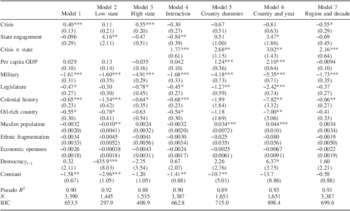
In our main analyses, democracy is measured by DD, economic crises are measured as a binary variable that is transformed from a two-year moving average of growth rate and economic engagement of the state is measured by the share of government investment. The results of these main analyses are presented in Table 1. Model 1 includes all variables in an additive sense. It shows that economic crises are positively associated with the probability of democratic transition. In Model 2, we analyze the cases in which the share of government investment is below the mean value of the sample (35.7 per cent), and in Model 3 we analyze the cases in which the share is above the mean value. A comparison of the two models indicates that economic crises are positively associated with regime transition only for cases with relatively higher levels of government investment in the economy. Splitting the global sample based on the share of state economy yields results consistent with our theoretical expectation about the conditional effect of economic crises.
The Effect of Economic Crises on Democratic Transition

Model: first-order Markov transition. Only β coefficients are reported; α coefficients are omitted. Robust standard errors in parentheses; *p<0.10, **p<0.05, ***p<0.01; coefficients for dummies of countries, regions, years and decades are not reported.
To more rigorously test the conditioning effect of state economic engagement, in Model 4 we include an interaction term between government investment and economic crises. The insignificant coefficient of crisis itself indicates that when the share of government investment is 0, economic crises have no effect on democratic transition. The significant and positive coefficient of the interaction term, however, indicates that with a higher level of government investment in the economy, the contribution of economic crises to democratic transition becomes greater. For instance, when the government share of investment is 80 per cent, the effect of economic crises is 1.12 (−0.30+0.8×1.77) with statistical significance at p=0.01.Footnote 49
In Models 5–7, we conduct the same analyses and include different sets of dummy variables to control for the confounding effect of unobserved variables. For brevity, the coefficients of dummies are not reported. In Model 5, we include country dummies. Although we believe that we have identified and included a sufficient number of explanatory variables in our model, the inclusion of country dummies is equivalent to fixed-effects estimation and controls for the effect of other unidentified country-specific factors. In Model 6, we further add dummies for years to control for the effect of time-variant variables. Although these two models effectively solve the potential problem of omitted variable bias, they retain a much smaller number of cases in the analysis because the inclusion of country and year dummies greatly consumes the degrees of freedom and drops observations that are perfectly predicted. Therefore in Model 7, we turn to region dummies to control for region-specific effects and decade dummies for time-specific patterns. These analyses consistently yield the same pattern: the democratizing effect of economic crises increases with higher levels of state engagement in the economy. Appendix 5 provides more analyses for a robustness check.
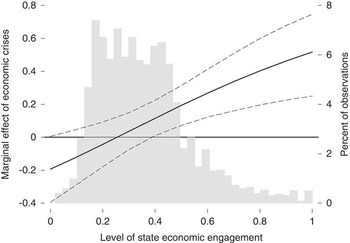
Both statisticians and political scientists have noted that the estimation of coefficients in non-linear models with an interaction effect cannot be directly interpreted, as in linear models.Footnote 50 We provided a brief interpretation of the existence of the moderating effect of crises above for straightforwardness. To develop a more accurate and substantively informative interpretation, we followed the most recent application in political science and plotted, as seen in Figure 1, the marginal effect of economic crises on the probability of regime transition based on Model 7 in Table 1.Footnote 51 The marginal effect (represented by the solid line) is calculated as the change in the predicted probability of democratic transition (that is, P(democracy t−1=0 to democracy t =1)), at each value of government investment, when an economic crisis occurs (that is, the value of crisis changes from 0 to 1). This calculation takes into account both the non-linear nature of the model and the interactive effect. From the plot, we can tell that the democratizing effect of economic crises increases with the level of state economic engagement. Further, if the state holds less than 40 per cent of the national investment, the effect of economic crises is insignificant, which indicates that economic crises do not lead to regime changes. Where the state holds a significant share of the national economy, the effect of economic crises is positive and significant, which means that economic crises are more likely to engender democratic transitions in such countries or in such time periods. For instance, if the share of government investment is 50 per cent, an economic crisis increases the probability of democratic transition by about 20 per cent. And if the share of government investment is 80 per cent, a crisis increases the probability of democratic transition by about 40 per cent.
Marginal effect of economic crises on democratic transition at all levels of state economic engagement (% government investment in total investment) Note: dependent variable is predicted probability that democratic transition will occur (Pr (democracy t−1=0 → democracy t =1)) in a country when it experiences an economic crisis (crisis changes from 0 to 1). Other variables are held at their mean values.

CONCLUDING REMARKS
In order for an authoritarian regime to have any significant political change, both triggering events that disrupt the original equilibrium under the authoritarian arrangement and certain structural factors that magnify the effect of these events are required.Footnote 52 In this study, we argue that economic crises constitute a necessary condition for democratic transition because the elites’ protection of their interests breaks both the provisional pact between the regime and business interests and the social pact between the regime and the masses. By disrupting the balance of power, an economic crisis provides an opening for political change.Footnote 53 Moreover, the effect of economic crises on politics is moderated by the economic structure. On the one hand, in an economic structure with a higher level of state engagement, economic crises become more politically relevant by making the authoritarian state liable for economic failures. On the other hand, economic crises inflict a greater economic loss on both the business groups and the masses within an economy that has been heavily engaged by the state. That, in turn, makes the former more likely to defect from the coalition with the regime, the latter more likely to rebel for regime change and the two social classes more likely to form a cross-class alliance.
This argument and the analytical findings suggest that state engagement in the economy is a double-edged sword for the authoritarian elites. Their share in the economy certainly helps buttress their political authority and gain the resources to buy support from social forces for the regime. Yet their engagement with the economy is a Faustian deal. While the authoritarian regime may benefit from this deal in good times, it must pay with regime collapse when the economy turns bad. To some extent, this is a destiny of doom for the authoritarian regime rather than a consequence that the regime elites can avoid. Given the self-interests of regime elites and the pressure to buy off political support, authoritarian states have an intrinsic need to engage in the economy. However, this economic involvement jeopardizes their political reign.
Of course, if the authoritarian political elites realize the detrimental effects of state economic engagement during economic downturns, they may provide a higher proportion of the payout from state ownership to the business class and the masses in order to buy their compliance. Transfers from the political elites make them poorer and social groups richer. Transfers will lower the temptation to defect or revolt, as the spoils of redistribution after a successful regime change will be smaller. That is, elites can internalize the cost of crises that social forces face. In this research, we did not attempt to derive the optimal strategy for elites in terms of the amount of their payout, given a certain income loss for social classes caused by crises. Nor were we interested in what political elites should do. Instead, our theoretical focus was on what political elites should fear when a crisis occurs, and how the threat to the regime is conditional on economic structure. We have identified the necessary conditions under which social classes may do certain things. In other words, using a theoretical model, we have raised important possibilities about how regime transition may occur.
The state might do whatever it deems necessary for regime survival, but the mechanism identified in our theory constitutes a fundamental underlying driving force for political change. When the political elites who face economic difficulties are willing to compromise, by either restraining predatory policies or including social forces in the ruling coalition, they can provide an opportunity for political changes such as a peaceful democratic transition. If the increased transfer is small, it will not be enough to prevent defections or revolts. If, however, the transfer is large enough, it is equivalent to a silent coup. This is because our definition of authoritarian regime is that political elites have a high share of returns from state assets and monopolize the power to distribute those returns. Therefore, the relaxation of these conditions would indicate the lessening of authoritarianism. In fact, democratic transitions occurred in this way in a number of Asian countries, such as Taiwan, Korea and Indonesia, where the authoritarian states had heavily engaged in the economy. When the once-strong economy suffered from economic shocks, the ruling parties in these countries conceded to democracy in the hopes of retaining offices in the post-transition government.Footnote 54
Some caveats should be noted before we conclude. First, there are significant outliers in our analysis, as is seen in other studies. For instance, North Korea is an authoritarian state with absolute control over an economy that has been deteriorating in recent decades. As such, more factors are at play in the economic origins of regime transitions, which are not fully captured in our model. Presumably, in the case of North Korea, factors such as a low level of development and modernization, a revolutionary history and a tight control of the national border could all have played a role in inhibiting political changes. Secondly, in this research, both of our theoretical and empirical foci are economic factors. Although our models controlled for the effect of various social factors, such as colonial history, ethnic fragmentation and religion, we largely omitted a discussion of the social origins of democratic transition and how they might interact with economic factors. A more comprehensive study of the issue can be conducted by including more factors, in general, and considering the confounding effect of social components, in particular.