Introduction
During the course of herbarium-based studies of Andean Begonia L. (Begoniaceae) a new xerophytic species was identified from northern Peru, near the town of Cajamarca. This very distinctive species is morphologically most similar to a group of species that are currently classified within the polyphyletic Begonia sect. Knesebeckia (Klotzsch) A.DC. (Doorenbos et al., Reference Doorenbos, Sosef and De Wilde1998) but which are intermediate between the northern Andean members of that section and the Andean members of Begonia sect. Eupetalum (Lindl.) A.DC. These species of Begonia sect. Knesebeckia are B. bifurcata L.B.Sm. & B.G.Schub., B. compacticaulis Irmsch., B. parcifolia C.DC., B. serotina A.DC., B. triramosa Irmsch., and B. asympeltata L.B.Sm. & Wassh., the last of which was only doubtfully placed in this section by Doorenbos et al. (Reference Doorenbos, Sosef and De Wilde1998). These six species, along with the new species, are geophytic. They possess large, thickened, and often lignified rootstocks, or in the case of Begonia bifurcata a tuber, that enable them to grow geophytically, usually in semi-arid habitats. Within Begonia, geophytic xerophytes are geographically widespread, being found, for example, in parts of Madagascar and Africa as well as in Andean South America. However, relatively few of the roughly 1500 Begonia species show this specialisation, and those that do typically have tubers, rather than swollen woody rhizomes. The vast majority of Begonia species occupy humid rainforest habitats (Tebbitt, Reference Tebbitt2005).
These species are also unusual in Begonia in that the tepals of their female flowers do not fall off following pollination but instead remain attached to the mature capsules. Among the Andean species, this feature has not previously been reported in the literature and apparently is otherwise only found in the new species and in Begonia lutea L.B.Sm. & B.G.Schub. (a Colombian species doubtfully placed in Begonia sect. Eupetalum by Doorenbos et al., Reference Doorenbos, Sosef and De Wilde1998), and the Begonia octopetala species complex (Begonia sect. Eupetalum), suggesting that these geophytic Andean species form an evolutionary lineage, despite currently being classified in two sections.
Species Description
Begonia gorgonea Tebbitt, sp. nov.Fig. 1.
Begoniae asympeltatae L.B.Sm. & Wassh. et B. serotinae A.DC. similis, sed foliis pubescentibus et ovariis obovatis et caulis subterranei forma differt. – Type: Peru, Cajamarca Province, Alrededores de Sangel Alto (carretera Chilete–San Pablo), 26 xii 1970, Lopez & A. Sagastegui 7627 (holo NY).
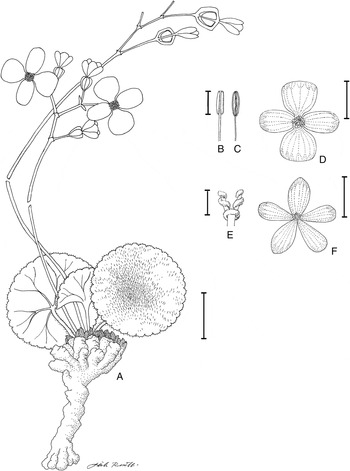
Begonia gorgonea Tebbitt. A, habit; B, stamen, front view; C, stamen, side view; D, male flower; E, style and stigma; F, female flower. Drawn from Sánchez Vega 2716. Scale bars: A = 2 cm; B–C = 1.25 mm; D, F = 1.5 cm; E = 2 mm.

Acaulescent herb, with a thick woody rhizome. Rhizome for most of its length growing in a vertical plane, this portion irregularly shaped, at least 7 cm long, and producing few to several branches in a cluster towards its apex, the apices of the 1–1.5 cm long terminal branches situated close to ground level, with the leaves and inflorescences arising from their tips. Stipules oblong-ovate, 0.4–1 × 0.3–0.8 cm, both surfaces glabrous, apex acute, margin ciliate, persistent. Leaves 3–4, peltate; petiole 2.5–6 cm long, moderately to densely pubescent; lamina asymmetric, orbicular, 4–7 cm in diameter, apex indistinct, margin crenulate, ciliolate, veins radiating out from a central point, lamina moderately to densely pubescent on both surfaces. Inflorescence 1–3, subsymmetric, cymose, up to thrice-branched, c.5–8-flowered; peduncle 30–40 cm long, sparsely pubescent; male pedicels c.1.2–3 cm long, sparsely to moderately pubescent; female pedicels 0.6–1.2 cm long, glabrous; bracts ovate, 0.6–2.1 × 0.2–1.8 cm, apex acute to rounded, margin fimbriate, tardily deciduous. Male flowers: tepals 4, white, sometimes flushed pink; outer pair of tepals oblong-elliptic, c.1.6–2.8 × 1.1–1.8 cm, apex obtuse, base rounded to tapering, margin entire, glabrous; inner pair of tepals oblong-obovate, c.1.6–2.7 × 1.3 cm, apex obtuse, base cuneate, margin entire; stamens 75–90, arranged on a slightly raised receptacle, filaments 2–5 mm long, free, anthers narrowly oblong, 1–1.5 mm long, dehiscing via slits along sides of locules, connectives not projecting, symmetrically basifixed to filaments. Female flowers: bracteoles absent; tepals 5, white, sometimes flushed pink, glabrous, persisting in fruit, outer two tepals elliptic, 1.5–1.6 × 0.75–0.8 cm, apex obtuse, base cuneate, margin entire; inner three tepals obovate, c.1.4–1.5 × 1.2–1.5 cm, apex obtuse, base tapering, margin entire; ovary elliptic to obovate, 5–7 × 4.5–6 mm, glabrous, 3-winged, wings more or less equal and rib-like, c.1 mm tall, wings running along length of each locule and extending past their bases for c.1 mm; 3-locular, placentae axile, bifid, ovules arranged on both surfaces; styles 3, c.4 mm tall, bifid from c.2 mm from base, branches more or less erect, stigmatic papillae in a once spiralled band. Fruiting pedicels to 2 cm long, very slightly curved towards the apex. Fruit obovate, to 1.3 × 1.2 cm, glabrous, wings to 3 mm tall, 1.5 cm long, apex of wings obtuse.
Phenology. Flowering in the wet season, at least from late November to late December.
Distribution and habitat. A narrow endemic found about 20 miles west of the town of Cajamarca, Peru (Cajamarca Province), at 1700–1800 m, where it has been collected from a ravine between the towns of Chilete and San Pablo, and also close to Chilete on a stony slope next to Route 8.
Proposed IUCN conservation category. Vulnerable (VU D2). This highly distinctive species is currently known from just two collections, likely made within a c.10-mile radius of each other. Since all available Begonia specimens from AAU, B, BKL, BM, BR, BRIT, C, CAS, E, F, G, GB, G-DC, GH, GOET, K, LIL, MO, NY, OXF, P, S, SEL, TEX, UC, US, W, and Z were consulted in this study it must be assumed, at least until fieldwork targeting this species is conducted, that this species has a very restricted area of occupancy that does not fall within any legally protected reserves. In addition, one of the collections was made close to Route 8, which is the main road between the towns of Pacasmayo and Cajamarca, further suggesting that the population may be prone to the effects of human activities that could be detrimental to the species’ survival (IUCN Standards and Petitions Subcommittee, 2010).
Additional specimens examined. Peru. Cajamarca: San Juan District, Puente los Naranjos, km. 128 de la carretera Pacasmayo–Cajamarca, 28 xi 1981, Sánchez Vega 2716 (F, MO).
Begonia gorgonea is morphologically isolated from its closest relatives in Begonia sect. Knesebeckia (B. asympeltata, B. bifurcata, B. compacticaulis, B. parcifolia, B. serotina, B. triramosa), making it difficult to determine to which of these six species it is most closely related. Its thick woody rhizomes are particularly distinctive, consisting of a vertical, underground stem from which arise several short gnarled and twisted terminal branches, hence the proposed specific epithet, gorgonea, alluding to the stem’s similarity to the snake-headed Gorgons of Greek myth. This unusual stem morphology is found in no other Andean Begonia. Begonia gorgonea is also unusual in having peltate leaves, a feature only found in two other Peruvian species of Begonia sect. Knesebeckia, B. serotina and B. erythrocarpa A.DC., the latter of which is otherwise morphologically very dissimilar to the new species. Peltate leaves are also found in the morphologically similar Begonia asympeltata, from Ecuador. However, the shape and pubescence of the leaves of Begonia gorgonea differ markedly from those of both B. serotina and B. asympeltata (as shown in the identification key), suggesting that while these two species are most similar to the new species in terms of this conspicuous characteristic, they may not be its closest relatives. If fresh or silica dried material becomes available for sequence analysis then it is expected that molecular data will help shed more light on the species’ affinities within this group. In the meantime, to help distinguish these species, an identification key is provided.
Identification key to the geophytic Andean members of Begonia sect. Knesebeckia with persistent female tepals
1a. Leaves peltate 2
1b. Leaves basifixed 4
2a. Plant densely covered with hairs; leaf apex indistinct; ovary obovate; Peru (Cajamarca) B. gorgonea
2b. Plant glabrous or sparsely puberulent; leaf apex distinct though sometimes short; ovary broadly elliptic 3
3a. Leaves asymmetric, ovate, apex long acuminate, margin notched towards base where a sinus would be located; Ecuador (Los Rios) B. asympeltata
3b. Leaves subsymmetric, orbicular-ovate, apex abruptly acuminate, margin never notched towards base; Ecuador (Manabi, Cotopaxi, Los Rios, Chimborazo, Guyas) and Peru (Tumbes) B. serotina
4a. Leaf margin irregularly and conspicuously lobed, lobes to 4.5 cm deep; Ecuador (Chimborazo) B. triramosa
4b. Leaf margin usually not lobed, and when present lobes inconspicuous, to 2 cm deep 5
5a. Plant with a short, slender, upright aerial stem to 0.5 cm across; stem never woody; leaves always present at anthesis; Peru (Piura) B. bifurcata
5b. Plant lacking a stem, or if stem present then upright to prostrate and woody, and 2.5–5 cm in diameter; leaves present or absent at anthesis 6
6a. Inflorescence 1- to 2-branched; bracteoles absent; ovary wings unequal; Ecuador (Loja) and Peru (Tumbes) B. parcifolia
6b. Inflorescence 4- to 6-branched; bracteoles present at base of ovary; ovary wings equal; Ecuador (Manabi, Cotopaxi, Chimborazo) B. compacticaulis
Acknowledgements
I thank the curators of the herbaria AAU, B, BKL, BM, BR, BRIT, C, CAS, E, F, G, GB, G-DC, GH, GOET, K, LIL, MO, NY, OXF, P, S, SEL, TEX, UC, US, W, and Z for loaning me material or allowing me to work in their herbarium. I am also grateful for the artwork provided by Adèle Rossetti Morosini.