In Ezek 37:15–28 the prophet Ezekiel is instructed to inscribe two “sticks” (Hebrew  ), one for Judah and one for Joseph, and to unite them in a visual display meant to signify God's intention to reunite the former kingdoms of Judah and Israel. This intended meaning is made clear in the accompanying oracle (vv. 21–28), which explicitly proclaims this interpretation of the act. This form of prophetic announcement, in which a conspicuous action is followed by an oracle that is, in part or in whole, an interpretation of it, is often referred to as a symbolic action, or “sign act.”Footnote 1 Whereas other sign acts in the Hebrew Bible strive for a simple and clear relationship between the act and the prophecy that they introduce, this one is more complex, both in its form and in the hermeneutical relationship between the act and its interpretation.
An appreciation of this unusual degree of complexity has led some critics to posit multiple stages of textual growth. Gustav Hölscher, for example, found three layers of composition in these fourteen verses.Footnote 2 Many of these proposals have assigned Ezek 37:25–28—a section of the text that, as I shall show, should largely be understood as part of the original composition—to a later writer.Footnote 3 In this article I will offer a new explanation of the textual development of Ezek 37:15–28. I will argue that this passage developed in two main stages: an earlier composition by the prophet Ezekiel was later revised by a redactor with an interest in expanding messianic aspects of its portrait of the coming restoration. The redactor, I will show, was partly motivated in this work by an interpretation of the earlier version and sought to achieve a new balance and interpretive relationship between the act and its interpretation in this edition—an effort that is carried further in the Targum of Jonathan and the lxx.
Tensions Within Ezekiel 37:15–28
Three aspects of Ezek 37:15–28 suggest that it has been subject to a process of textual growth. First among these is the unusual complexity of its structure in comparison with other sign acts. I analyze this passage as being comprised of five sections: 1) a command to perform the sign act (vv. 15–17), 2) a prediction of an audience's inquiry about its meaning (v. 18), 3) a first interpretation (v. 19), and 4) a re-presentation of the sticks (v. 20) in preparation for, 5) a second interpretation (vv. 21–28).Footnote 4 This structural complexity stands out in comparison with other sign acts in the Hebrew Bible, which are more typically comprised of two main sections: a commission to perform the act, which includes a description of it, and an accompanying oracle that interprets it.Footnote 5 In some rare instances sign acts lack an accompanying interpretation section (e.g., Ezek 4:1–3), but where this section is attested the messenger formula usually introduces it.Footnote 6 Uniquely, in Ezek 37:15–28 two occurrences of the messenger formula appear, in v. 19 and v. 21, which, by comparison with other sign acts, seem to mark the introductions to two separate interpretation sections, and both verses clearly engage in some kind of interpretation of the act in vv. 16–17.Footnote 7 Another unique feature is found in v. 20, which reintroduces the initial act so that each of the two interpretation sections (sections 3 and 5 above) are preceded by mention of the act. Ezekiel 37:15–28, therefore, presents the reader with a double sequence of act-interpretation-act-interpretation unparalleled in other sign acts. These observations on the structural idiosyncrasies of our passage do not yet suggest which parts were added later; they only help to suggest the likelihood of textual growth and pinpoint where some irregularities lie.Footnote 8 Other factors can be used to complement this picture and help build the case that the structural complexity of this passage is related to its transmission history. Here, the irregularity is found, clearly, in the presence of two acts and two interpretations.
One noteworthy difference between the sign act in vv. 15–17 and the first interpretation in v. 19 (3 above) also points to textual growth and begins to suggest the motivations for it. Whereas v. 17 commands that the two sticks be united as one, v. 19 says that the stick of Judah is to be put over / on top of ( ) the stick of Joseph and its associated tribes.Footnote 9 This slight revision was likely meant to insert a visual and symbolic element into the act that could serve as a reference point for those portions of the second interpretation that stress Judean leadership and the expectation of a restored Davidic dynasty (vv. 24–25). One may also suspect that the phrase
 was chosen because it is an idiomatic way of expressing the installation of political leadership.Footnote 10 The revision of the joining language of the original act (
 ) in v. 17, then, is heavily laden with political implications—both in terms of the visual image that it offers and its semantic connections—and shifts the focus of interest from tribal unity to the political configuration of the future state. In addition, it introduces a hierarchical distinction not envisioned in vv. 16–17.Footnote 11 On a literary level, it is also important to notice how v. 19 complicates the more usual and straightforward relationship between the sign act and the accompanying interpretive oracle. The messianic portions of the second interpretation (vv. 24–25), as I have just mentioned, take their inspiration from the emended description of the act in v. 19 rather than from the initial sign act in vv. 16–17. Verse 19, therefore, does more than simply adjust the content of this passage: it also reworks its symbolism and introduces a new set of interpretive dynamics, all of which suggests a later hand.
Another reason for suspecting textual growth arises from the second interpretation in vv. 21–28. Opinions about the structure and compositional unity of this section vary, and I will discuss these issues in greater depth below in section 2. Here it may be noted that it contains three main movements of thought, which are arranged as follows: vv. 21–22 provide an interpretation of the original sign act and treat the themes of the coming ingathering and reunification of Israel as one nation under one king; vv. 23–24, with the exception of 24a, discuss the future cleansing of Israel and contain an idealized description of its covenantal fidelity in the coming era; and vv. 25–28 contain a vision of Israel's life in the newly settled land, including a new covenant and sanctuary. Within this section, v. 24a most clearly interrupts the train of thought of its subsection (vv. 23–24) by introducing the theme of Davidic kingship into lines that are otherwise concerned with purity and ethical/covenantal resolve, giving rise to the suspicion that it is a secondary insertion. While the mention of Davidic rulership in v. 25b does not interrupt the train of thought of the surrounding verses as drastically, it nevertheless appears to be an afterthought there. Moreover, as I have said above, vv. 24a and 25b look back to v. 19 rather than vv. 16–17 and expound its emended portrait of the act, which stresses Judean rule in the coming days. Both of these half-verses, therefore, appear to be secondary insertions, and it will emerge from the discussion below that these two additions have obfuscated important aspects of the original passage as well.
The points that I have outlined above suggest two main layers of composition in Ezek 37:15–28. The original composition, I will argue, was a more structurally conventional sign act with three main sections: a command to perform the sign act, an audience inquiry, and an oracle that provides an interpretation of the act. I will refer to this original literary edition of the “Two Sticks” sign act, which I understand to have been composed by the prophet Ezekiel, as TS1 for the remainder of this essay. This early edition was later expanded with vv. 19, 24a, and 25b, which transformed the symbolism of the original sign act and emended its interpretation in order to insert messianic expectations into the passage. These additions made the structure of the passage more complex than the typical sign act and account for its current form. They also add an additional and more complex hermeneutical relationship between act and interpretation. The redactor responsible for this second edition, which is roughly equivalent to the mt, will be designated TSR (= Redactor of the Two Sticks sign act), and I will occasionally refer to this second edition as TS2.
TS1 and Its Vision of Restoration
TS1 articulates a vision of restoration that takes Ezekiel's uniting of the sticks as its point of departure. It is a carefully crafted unit that makes subtle use of literary structuring and allusion to communicate its message—indeed, it reflects a deep engagement with parts of the Pentateuch, especially Leviticus 26, which inform its author's understanding of the shape that the restoration must take. Before we discuss this further, however, it must first be noted that, in addition to TSR's insertions of vv. 19, 24a, and 25b, it seems likely that v. 20 may either be an additional insertion to go along with v. 19 or a displaced part of the original sign act. I have tentatively opted for the latter, supposing this verse to have originally occurred before v. 17, where a display of the two sticks would seem appropriate. By this reconstruction, TS1 can be analyzed as having three sections: 1) a command to perform the sign act (vv. 15–16, 20, and 17), 2) a report of the audience's inquiry about its meaning (v. 18),Footnote 12 and 3) an interpretation section (vv. 21–23, 24b–25a, and 26–28).Footnote 13
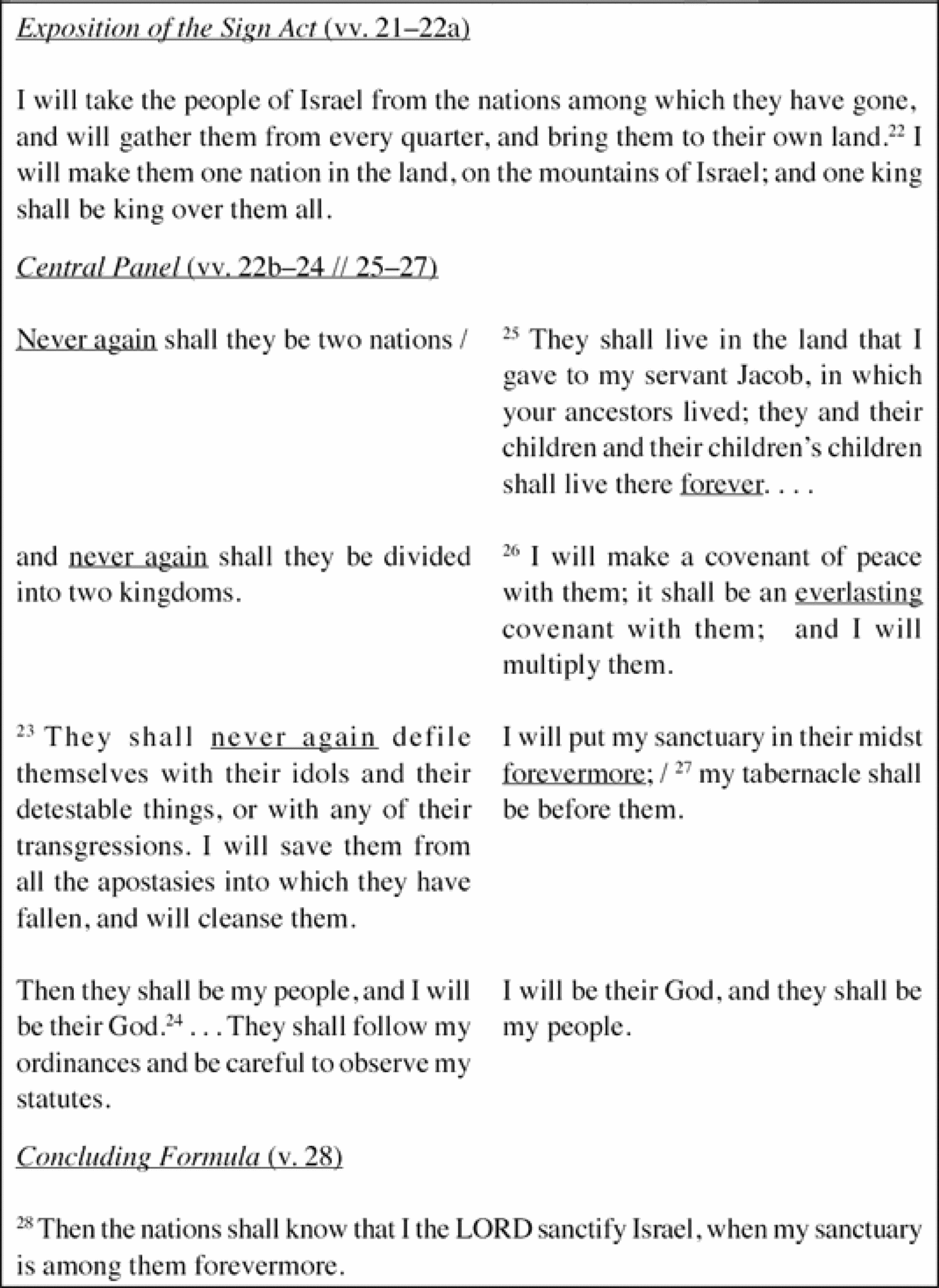
Although several scholars have doubted the originality of parts of the interpretation section (section 3 above), especially vv. 24b–28,Footnote 14 I suggest that this entire section can be appreciated as a well-organized and intricately balanced whole as it is found in TS1 (see fig. 1). It is comprised of three main subsections: a) vv. 21–22a; b) vv. 22b–23, 24b–25a, 26–27; and c) v. 28. The first, vv. 21–22a, provides an explanation of the act's symbolic meaning. In v. 17, this act is encapsulated by the verbs  (to take) and
 in the Piel (to draw together). In explaining its meaning, vv. 21–22a dissect and amplify these actions as signifying four coming events: Yahweh will take Israel (
 ), gather it (
 ), bring it (
 ) back to its land, and make it one nation.Footnote 15 The main interpretive dynamics of TS1 are found in this relationship between vv. 16–17 and vv. 21–22a, putting the issue of unification into central focus along with the requisite gathering of Israel and return to its land, which are necessary to bring this unification about.
The Structure of the Interpretation Section in TS1Footnote 16

The exposition of the act in vv. 21–22a is followed by a central panel comprising vv. 22b–23, 24b–25a, and 26–27.Footnote 17 I analyze this section as containing two balanced halves, each concluding with a form of the covenant formula.Footnote 18 Each of the two halves uses a Leitwort three times: the first half (vv. 22b–23, 24b) repeats, in some form, the phrase “never again” ( ) and the second half (vv. 25a, 26–27) repeats the word “forever” (
 ).Footnote 19 The three “never again” statements in the first half of the panel pair with the three “forever” statements in the second half to form three sets of oppositions in the central panel, which are illustrated in fig. 1: a) never again will Israel be two nations // Jacob's children will live in the land forever; b) never again will Israel be two kingdoms // Yahweh will make an “everlasting covenant” (
 ) with Israel; and c) never again will Israel be defiled // Yahweh will set his sanctuary among the Israelites forever.Footnote 20
The final section, in v. 28, closes the unit with a recognition formula but also points to another important structural aspect of TS1. This verse raises again the issue of Yahweh's sanctuary among his people, which, when present, will signify to the nations that he has sanctified Israel. These two elements—sanctuary and sanctification—take up again the final opposition found between v. 23a and vv. 26b–27a, this time making more explicit that the presence of the former necessitates the latter. A similar feature is also found between the initial exposition of the act in vv. 21–22a and the first opposition in the central panel (v. 22bα // v. 25a). Here, one of the predictions that explains the initial act in v. 22—namely, that Yahweh will make Israel “one nation in the land” ( )—becomes the subject of the first opposition, where it is expounded further: in v. 22bα, Israel will never again be “two nations” (
 ) and in v. 25a, Jacob's children will live “in the land” (
 ). Thus, this initial exposition of the sign act in vv. 21–22a and the concluding line of the oracle in v. 28 enclose and look inward upon the central panel, acknowledging its structural balance between “never again” and “forever” statements. This structuring device, moreover, contributes to the creation of a tripartite thematic sequence in the oracle. As I have discussed briefly above, vv. 21–22, which are thematically united by the connection between the exposition of the act (vv. 21–22a) and the central panel just discussed (vv. 22b–23, 24b–25a, and 26–27), attend to the themes of the coming ingathering and reunification of Israel as one nation under one king; vv. 23 and 24b envision the future cleansing of Israel and its covenantal obedience in the coming era; and vv. 25–28 contain a vision of Israel's life in the newly settled land, with special attention to the new covenant and sanctuary.
An appreciation of these organizational features of the oracle in TS1 adds significantly to its interpretation, not least by showing how vv. 24b–28 are an integral part of this unit. In conjunction with these structural features, references to the Pentateuch in TS1 play an important role in shaping its vision of a future unification. In v. 16, the two sticks are given designations that have both tradition-historical and territorial overtones: the first is inscribed, “For Judah, and the children of Israel associated with it,” and the second, “For Joseph [the stick of Ephraim] and all the house of Israel associated with it.”Footnote 21 Though the territorial associations of the names Judah and Joseph are not completely absent, it is their patriarchal associations that are primarily in view.Footnote 22 This becomes especially clear in light of v. 25, where the restored existence of the people is described as being “in the land that I gave to my servant Jacob, in which your ancestors lived.” This description of the land as belonging to “my servant Jacob” and “your ancestors” is deliberate and functions to color and deepen the picture of reunification that is being described: not only will two once-separated parties be reunited, but Israel's children will once again realize their common ancestry, identity, and inseparability in Jacob.Footnote 23 By connecting the reunification of the sons of Jacob to the theme of the return to the land, TS1 may seek to characterize the coming return as a fulfillment of the promise to Jacob as found, for example, in Gen 48:4: “I will give this land to your offspring after you as an eternal possession.” At the very least, it is clear that the prophet's vision of restoration is indebted to traditional and idealized notions of the patriarchal period at this point.
Several scholars have argued compellingly that what I am calling TS1 also shows a dependence on the Holiness Code (Leviticus 17–26).Footnote 24 In particular, it has been shown that substantial portions of vv. 26–27 refer to Lev 26:11–12.Footnote 25 The first clear reference, found in vv. 26b–27a, alludes to Lev 26:11a, but the significance and the rhetorical techniques employed in Ezekiel's reference have not been sufficiently explained. Ezekiel 37:26b–27a forms a poetic parallelism,Footnote 26 the second half of which is typically recognized as invoking Lev 26:11a.
A close comparison between the source-text and Ezek 37:27a reveals that these lines share only one locution in common:

(my tabernacle). The other two terms from Lev 26:11a—

(I will put) and

(in your midst)—form part of the first half of the couplet, Ezek 37:26b, allowing for the change from second to third person.Footnote 27 In this way, TS1 indicates its technique of extending and distributing the language of its source through the two halves of this parallelism.Footnote 28 This technique makes room for TS1 to suggest how it understands the significance of its source and why it is relevant here. TS1 associates its source's use of “my tabernacle” (

) with “my sanctuary” (

), thus making it clear that it understands Leviticus to speak about the reestablishment of the temple in the coming era—a subject that Ezekiel ponders a great dealFootnote 29—and not merely the priestly tabernacle of Israel's wilderness wandering.Footnote 30
Two more connections with the Pentateuch should be mentioned. First, Lev 26:12 has had an impact on the phraseology of the covenant formula in Ezek 37:27b, which forms the conclusion of the second half of the central panel.Footnote 31 Instead of repeating the formula as it appears in the first half of the central panel (Ezek 37:23b), Ezek 37:27b repeats Leviticus almost verbatim here, changing only the pronominal suffixes from the second person to the third person. Second, the promise in v. 26a—“I will multiply them” ( )—likely draws from Leviticus 26 and other pentateuchal traditions. The verb
 in the Pentateuch is associated with the recurring command to be fruitful and multiply and with the promise to the patriarchs that God will multiply their seed.Footnote 32 Leviticus 26:9 is almost certainly in view here since Ezekiel's interest in that passage in TS1 has already been demonstrated, but there is no reason why the reference should be exclusively to Leviticus given Ezekiel's broader awareness of the tradition. In Leviticus 26, as in Ezek 37:26, the promise is closely tied to making or upholding the covenant. In Deut 30:5 and 16 this promise is associated with Israel's entrance into the promised land, and it is possible, therefore, that these lines are in view as well.
With this series of allusions, then, TS1 shapes its view of the future reunification in terms that closely resemble various lines in the Pentateuch. The majority of these allusions—at least, the ones that I have been able to identify with some reasonable degree of confidence—are clustered in the second half of the central panel, where the oracle expounds its vision of life in the restored land. It would not be too much to describe TS1 as an attempt to depict the actualization of the covenantal blessings of Leviticus 26 as the prophet saw it. Leviticus 26, after all, directly engages the subject of exile and describes the conditions that are necessary to reverse it and allow life to be sustained in the land, among them being the reestablishment of the covenant with the ancestors (Lev 26:9, 42), obedience to its terms (Lev 26:15), and the divine presence (Lev 26:2, 11–12). All of these are included in TS1, which translates the promises of Leviticus 26 into concrete predictions.
One final feature of TS1 that remains to be examined is its hope that “one king [ ] shall be king over them all” (v. 22). Whereas many have understood this line as a messianic reference to go alongside vv. 24a and 25b,Footnote 33 which I assign to TSR, I contend that what is intended in TS1 is better understood in light of Ezekiel 20—in particular, its expectation that Yahweh will be king of the restored land in 20:33.Footnote 34 TS1 has several similarities with Ezekiel 20, in fact, and their number and distinctiveness would seem to recommend that they share this feature in common as well.Footnote 35 Both passages describe Yahweh gathering (
 ) the people of Israel together out of the lands where they are scattered. Both envision that the exile will conclude with a cleansing and covenant renewal and that the restored community will dwell near Yahweh's sanctuary. Ezekiel 37:25 and 20:5 comprise two of only four references to the patriarch Jacob in the book of Ezekiel. In Ezek 20:39 and 37:23, the primary impediment to Israel's former covenant fidelity is seen as its idols (
 ). In terms of usage, 20:7 and 37:23 are the only two passages in Ezekiel that pair idols (
 ) and detestable things (
 ).Footnote 36 Both use the verb
 in the Niphal to describe the result of Israel's former sinfulness, and both describe Israel's future residence in connection with mountains—“the mountains of Israel” in 37:22 and “my holy mountain, the mountain height of Israel” in 20:40.Footnote 37 Other, less significant parallels could be added.
Thus, in light of the impressive and, occasionally, exclusive parallels between these two passages, it is reasonable to suspect that TS1, like Ezekiel 20, does not involve messianic hopes but rather echoes Yahweh's statement in 20:33: “I will be king over you” ( ). This conclusion sheds light on what may be intended by the second and central of the three oppositions that I have discussed above: never again will Israel be two kingdoms // Yahweh will make an everlasting covenant with Israel. This juxtaposition, I suggest, is intended to relate something about Yahweh in his role as the head of a new nation, namely, that the reestablishment of the covenant is integrally related to the bringing together of the formerly separate kingdoms as one polity. The referent of the term “king” (
 ) was understood differently by TSR, as we shall see further below. In TS1, restoration is characterized by unity, firm covenantal bonds, and existence in the promised land around the temple of Yahweh with Yahweh reigning as king.Footnote 38
TS2: Its Interpretive Character and Messianic Vision
With the addition of vv. 19, 24a, and 25b and the rearrangement of v. 20 to its final position, TSR transformed the structure of the text from a fairly simple sign act comprised of three sections in TS1 to one with five sections in TS2.Footnote 39 It also added new interpretive dynamics to this passage and reworked the symbolism and content of TS1. I have discussed above how v. 19 has adjusted the language used to describe the union of the sticks, using  instead of
 (v. 17), and how this adjustment allows the act to be interpreted as depicting Judean preeminence in the coming political arrangement—an implication that is developed later through the insertion of vv. 24a and 25b. One other change in v. 19 complements this picture. In v. 16, TS1 has each of the two sticks represent a main party—Judah and Joseph—along with their compatriots, who are described, respectively, as “the children of Israel his companions” and “all of the house of Israel his companions.” In v. 19 TSR realigns these coalitions, envisioning a party consisting solely of Judah, the “stick of Judah” (
 ), and another party consisting of the remaining tribes: the “stick of Joseph, [which is in the hand of Ephraim] and the tribes of Israel, his companions.”Footnote 40 With these two small changes, TSR has substantially reworked the symbolism of TS1: instead of two sticks (symbolizing two sets of tribal confederations) being joined as one to represent unity, in TS2 the stick representing Judah alone is “put upon” the stick that represents the remaining tribes with the implication that Judah alone will lead in the future union. In this, the explanation offered in v. 19 introduces a symbolic valence into the act that promotes a messianic interpretation.
This symbolic and thematic reworking of the original act is carried further by the insertion of vv. 24a and 25b into the second interpretation (vv. 21–28). The use of four messianic epithets in these verses serves several strategic functions in TS2. The first, “my servant David,” reinforces the assertion that the government of the restored Israel will be led by Judah, as v. 19 has already insisted, and suggests that it will be typologically like that of the former united monarchy.Footnote 41 The use of the title “king” ( ) is significant in that it repeats the term for divine rule in TS1 (v. 22) and applies it to the messianic ruler. This repetition identifies the unnamed king of TS1 and is, therefore, instrumental in shifting its meaning from divine king (as I have argued above) to human messiah. The function of the title
 further characterizes this role as an archaic and, perhaps, limited one.Footnote 42 Finally, the title “shepherd” (
 ) is related to v. 19 and its association between Judean preeminence and the image of the stick; in this sense, it can be understood as a play on the more widespread connection between ruler/scepter and shepherd/staff.Footnote 43 In addition to their immediate function in this passage, these four titles also look beyond it and connect it with Ezek 34:23–24, where all of them are used with reference to a Davidic messiah, thus forming an inclusio of sorts around Ezekiel 34–37.Footnote 44
The later additions create a more complex relationship between act and interpretation in TS2 than is found in the earlier edition. With the addition of direct messianic references in vv. 24a and 25b, the second interpretation becomes an interpretation of both the original sign act in vv. 16–17 and its expanded interpretation in v. 19, from which it derives the messianic relevance of the symbolic act. Without the reworking of the act in v. 19, the messianic content in the second interpretation would have no basis in the sign act.Footnote 45
The LXX and the Targum of Jonathan: Two Early Attempts to Make Sense of TS2
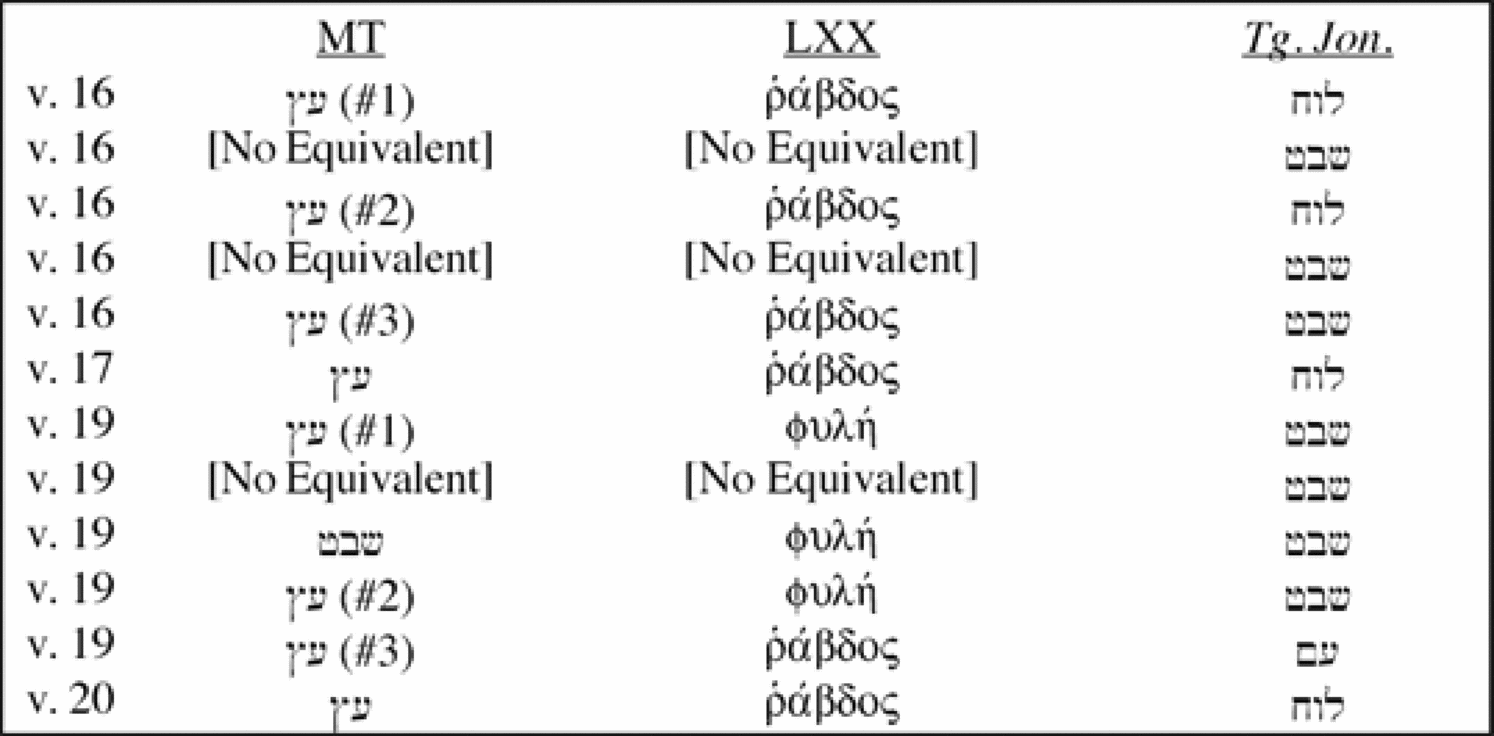
The lxx and the Targum of Jonathan (Tg. Jon.) attest to two different attempts to comprehend the stick imagery in Ezek 37:15–28,Footnote 46 and both seek to remedy the fact that v. 19, instead of offering a plainly worded interpretation of the sign act, retains its symbolic imagery.Footnote 47 As the figure below illustrates, the lxx translates six of the eight occurrences of the Hebrew word  in this passage—namely, those in vv. 16, 17, 20, and the final occurrence in v. 19—with the Greek word
 , which often simply means “rod,” but which can also take on the more technical nuances of “scepter” or “shepherd's staff.”Footnote 48 Whichever of these meanings is more appropriate here, it is clear that the lxx deliberately avoids a hyper-literal translation (e.g., “wood”) in favor of one that clarifies the nature of the image.Footnote 49 In proposing that the
 is, in fact, a
 , the lxx, it seems, is attempting to strengthen the connection between the sign act and its messianic interpretation in vv. 21–28. A hint of this interest can also be observed in the lxx of v. 19, which has the tribes of Joseph and the remaining tribes of Israel being given over to the tribe of Judah so that they may become “one
 in the hand of Judah.” The change from “my [= God’s] hand” of the mt to the lxx's “the hand of Judah” strengthens the insistence on Judean power in the future political arrangement and sets the stage for the later prophecy of the return of David or a Davidic ruler.Footnote 50 Moreover, to the degree that
 takes on the meaning “shepherd's staff,”Footnote 51 it is clearly intended to connect the sign act with the messianic title “shepherd” (
 ) in v. 24a. To the degree that it connotes the scepter of a ruler,Footnote 52 it alludes to the later description of David as king (v. 24a) and prince (v. 25b).Footnote 53 I suspect, therefore, that the choice of
 was intended to play upon both of these connections.Footnote 54
Equivalents to  and
 (MT) in the LXX and the Targum of Jonathan
The two remaining occurrences of  , which are both found in v. 19, are translated using the Greek ϕυληϖ (tribe). This translation was most likely influenced by the phrase “and the tribes [
 ] of Israel” in the same verse, for which the lxx also uses ϕυληϖ. While this may seem like a forced translation, it could also point to a more subtle interpretive move whereby
 was understood as a cipher for
 , which can mean both “rod” and “tribe.” An additional reason for this translation—or, better, revision—seems to have been the Greek translator's desire to make v. 19 more of an interpretation of the symbolism of the sign act in vv. 16–17 than it is in the mtFootnote 55 with its continued use of the symbolic imagery of the sticks. By adopting ϕυληϖ as a translation for
 here, the lxx largely avoids redescribing the act in encoded symbolic language, although the final mention of the tribes becoming one
 remains. Thus, the lxx deals with the stick imagery of this passage in two important ways: first, by expanding the messianic implications of the stick imagery through its use of the term to create a clearer relationship between the act and its interpretation, and second, by minimizing the stick imagery in v. 19 to make that verse more of a first interpretation of the act in vv. 16–17.
The Targum of Jonathan takes a slightly different path toward a similar end. It distributes (and slightly expands) its translation of the Hebrew term  among four occurrences of Aramaic
 (tablet) and six occurrences of
 , whose meaning here requires further discussion. The translation
 is used when
 is the object that Ezekiel physically holds in his hands where
 is used when
 is part of the inscription on the sticks/tablets. The translation
 is significant precisely because of its ambiguity: it can mean both “tribe” and “rod,” and there is good reason to believe that its use here is intended to play on both of these meanings.Footnote 56 In connection with the meaning “rod,”
 seems to encode an additional play on the more precise nuances of “scepter” and “shepherd's staff,” as has been observed with the use of the Greek
 in the lxx above. This aspect of the play enhances the connection between the sign act in vv. 16–19 and the messianic content of vv. 21–28. In connection with the meaning “tribe,” it may be noted that
 is used to translate
 (and the tribes of Israel) in v. 19, and in the six instances in which it translates Hebrew
 it always precedes the name of a traditional tribal designation (Judah, Joseph, Ephraim). Thus, in Tg. Jon., each use of
 fully comprehends the meaning “scepter / shepherd's staff / tribe” so that the symbolic unification of the tablets signifies both the restoration of the monarchy and the uniting of the tribes.Footnote 57 One difference from the lxx here is that Tg. Jon. attempts to improve the coherence of this passage by modifying the content of the inscriptions on the tablets whereas, in the lxx, it is the description of the physical sticks as
 that gives the act messianic importance.Footnote 58
One additional modification in Tg. Jon. is worthy of note and is comparable to the lxx's attempt to improve this passage. As we have seen above, the mt in v. 19 retains the symbolic imagery of the sticks in its first interpretation of the sign act, and the lxx seeks to make this verse more of a true interpretation by translating two instances of  in this verse with ϕυληϖ (tribe). The lxx does not, however, see this change through entirely since it also retains mention of the tribes becoming one “stick” (
 ). The Targum of Jonathan carries this change through more thoroughly by emending “and I will make them one stick” in the mt to “and I will make them one people.”Footnote 59
Thus, it appears that the additions that were added by TSR caused the later translators of the lxx and Tg. Jon. to make v. 19 more of a first interpretation of vv. 16–17, to ponder the meaning of  in this passage, and to search for an explanation for how the symbolism in vv. 16–19 relates to the messianic content of vv. 21–28. Both adopted the same basic tactic of expanding the connotations of the stick imagery in a way that relates to both the messianic shepherd and Davidic ruler images later in this passage, although they went about this in different ways. The trajectory of interpretive revision begun in TSR, therefore, was continued and strengthened in these later versions.
Conclusion
This paper has argued that, in its earliest stages of growth and transmission, Ezek 37:15–28 attests to an evolving series of reflections on Israel's restoration in light of this passage's stick symbolism. Indeed, periodic reflections on hermeneutics itself can be detected as each stage of this passage expounds new aspects of its symbolism and seeks to achieve a clearer relationship between the symbolism of the act and the interpretation given to it. In TS1, the hermeneutical interest centers on the union of the sticks, which signifies the union of Judah and Joseph. Its depiction of restoration reveals careful thought about Israel's past and the hope that many of its signature failures will be overcome in the future. Chief among these are the situation of tribal division formalized by the divided monarchy and the various sins and infractions outlined in Leviticus 26, which constitute covenantal breech and, for Ezekiel, largely account for Israel's exile. TS1 is essentially about how these transgressions of Israel's past are to be made right in the future. Put differently, it is about the opposition between the “never again” and the “forever,” which, I have found, is the main rhetorical juxtaposition in the interpretation section of this oracle.
Subsequent stages of transmission went in a different direction. TSR also thought about the hermeneutical dynamics of this passage very carefully and made a considered attempt to maintain an integral connection between the act and the accompanying oracle even while attempting to incorporate new elements into its vision of restoration. The redactor did this by expanding both act and interpretation with material that emphasizes Judah's preeminence and the coming of a Davidic messiah. TSR's edition was, in part at least, inspired by an interpretation of TS1 and its mention in v. 22 that “one king shall be king over them all.” TSR may well have understood this as a reference to a human king and understood itself to be expounding this aspect of the earlier passage rather than correcting it—even though, as I have argued, this is effectively what was accomplished. The lxx and Tg. Jon. are similar attempts to improve the hermeneutical dynamics of this passage by clarifying its symbolism. Both can be seen as furthering TSR's objectives through their suggestions that the stick imagery itself has something to do with the messianic office. In this, both of these translations deepen the symbolism and suggest an even more necessary connection between the sign act and the messianic elements of its interpretation. These versions, therefore, are profitably examined as part of the text's transmission history.
Ezekiel 37:15–28 is a significant case study in the way that texts can grow and change their meaning as they are passed along from one interpretive community to the next. It shows how even the most central message of a text can be overshadowed, setting a course for the history of interpretation that is not intended by the original writer. As far as its relevance for the history of messianic thought is concerned, this passage is much more than a fairly typical expression of the messianic ideas that were operative around the time of the Babylonian exile: it is part of the early history of messianic scriptural interpretation, which blossoms more fully with the writings of the Qumran community and the early Christians.