Introduction
Anxiety and depressive disorders are common and frequently co-morbid (Axelson & Birmaher, Reference Axelson and Birmaher2001). The distinctiveness of anxiety and depression is the subject of ongoing nosological debate concerning their classification in the updated psychiatric diagnostic manual, DSM-5 (Andrews et al. Reference Andrews, Anderson, Slade and Sunderland2008). Some researchers question the utility of considering anxiety and depressive disorders as distinct clinical categories, given the considerable similarities in their presentation, aetiology and treatment (Axelson & Birmaher, Reference Axelson and Birmaher2001). However, there are important distinctions. Anxiety and depressive disorders can occur in isolation, twin studies reveal that whereas genetic influences are largely shared, environmental influences are generally distinct (Kendler et al. Reference Kendler, Heath, Martin and Eaves1987) and preliminary neuroimaging studies show differential neural correlates (Phan et al. Reference Phan, Wager, Taylor and Liberzon2002; Vytal & Hamann, Reference Vytal and Hamann2010).
The classification of anxiety and depression also has important clinical implications. If anxiety and depression are considered a single disorder then a unified treatment should be recommended, whereas discrete disorders suggest distinct interventions are required. Cognitive behavioural therapy (CBT) is a leading treatment for both anxiety and depression globally and is recommended as the first-line treatment in the USA (AACAP, 2007) and the UK (NICE, 2011). The premise of CBT is the modification of maladaptive cognitions maintaining emotional symptoms. The cognitive content specificity (CCS) hypothesis proposes that, although anxious and depressed individuals both have distorted cognitions, the content differs across these disorders (Beck & Perkins, Reference Beck and Perkins2001). Specifically, it is hypothesized that depressed individuals tend to think negatively about the self and focus on experiences of loss whereas anxious individuals focus on perceived threat or danger. In line with this model, the cognitive concerns targeted in CBT tend to vary across anxiety and depressive disorders (Brewin, Reference Brewin1996).
Given the implications of the CCS hypothesis for classifying and treating anxiety and depressive disorders, cognitive distortions associated with anxiety and depression need to be studied together to investigate the extent to which they are specific to each disorder or shared between them. Little is known about the role of shared and specific cognitions in the development of anxiety and depressive disorders in young people.
Anxiety sensitivity: associations with anxiety and depression
Anxiety sensitivity is of particular interest when considering common and specific cognitive content in anxiety and depression. Anxiety sensitivity refers to an enhanced sensitivity towards symptoms of anxiety such as heart palpitations or worry, with a belief that these are harmful (Taylor, Reference Taylor1999). The distinct nature of anxiety sensitivity compared to trait anxiety has been well established, in relation to both self-reported symptoms and laboratory-induced anxiety responses (McNally & Rapee, Reference McNally, Rapee and Rapee1996; Rabian et al. Reference Rabian, Embry and MacIntyre1999). Anxiety sensitivity also predicts future anxiety symptoms above and beyond concurrent anxious symptoms (Weems et al. Reference Weems, Hammond-Laurence, Silverman and Ginsburg1998; McLaughlin et al. Reference McLaughlin, Stewart and Taylor2007; Waszczuk et al. Reference Waszczuk, Zavos and Eley2013). Of note, despite its initial conceptualization as a risk factor for panic disorder (Reiss & McNally, Reference Reiss, McNally, Reiss and Bootzin1985), anxiety sensitivity has been found to be associated with a wide range of anxiety symptoms and disorders and with depression (Weems et al. Reference Weems, Hammond-Laurence, Silverman and Ferguson1997; Naragon-Gainey, Reference Naragon-Gainey2010; Waszczuk et al. Reference Waszczuk, Zavos and Eley2013).
One possible reason for this wide range of associations is that anxiety sensitivity measures include multiple subscales (e.g. physical, mental and social concerns) that may be differentially associated with anxiety and depression.
Anxiety sensitivity: subscale analyses
Early investigations of anxiety sensitivity found that the physical concerns dimension (fear of biological symptoms; e.g. ‘When my stomach hurts, I worry that I might be really sick’) was more frequently associated with anxiety than depression (Joiner et al. Reference Joiner, Schmidt, Schmidt, Laurent, Catanzaro, Perez and Pettit2002; Muris, Reference Muris2002). The relationship of physical concerns with anxiety remained significant after controlling for co-occurring depression symptoms (Taylor et al. Reference Taylor, Koch, Woody and McLean1996; Schmidt et al. Reference Schmidt, Lerew and Joiner1998; Dehon et al. Reference Dehon, Weems, Stickle, Costa and Berman2005). Conversely, the mental concerns subscale, which depicts worries regarding cognitive control over anxiety symptoms (e.g. ‘When I am afraid, I worry I might be going crazy’), is more frequently associated with depression (Muris, Reference Muris2002), although other studies report associations with both anxiety and depression (Taylor et al. Reference Taylor, Koch, Woody and McLean1996; Schmidt et al. Reference Schmidt, Lerew and Joiner1998; Dehon et al. Reference Dehon, Weems, Stickle, Costa and Berman2005) or with anxiety but not depression (Joiner et al. Reference Joiner, Schmidt, Schmidt, Laurent, Catanzaro, Perez and Pettit2002). The social concerns subscale, reflecting fears of publicly observable symptoms of anxiety (e.g. ‘I don't like to let my feelings show’), seems to be associated with both anxiety and depression (Dehon et al. Reference Dehon, Weems, Stickle, Costa and Berman2005), although others show stronger association with anxiety symptoms (Taylor et al. Reference Taylor, Koch, Woody and McLean1996; Schmidt et al. Reference Schmidt, Lerew and Joiner1998). Although there is debate regarding the specific number and content of anxiety sensitivity subscales, confirmatory factor analytic studies (Wright et al. Reference Wright, Asmundson, McCreary, Stewart, McLaughlin, Comeau and Walsh2010) and a twin study by our group (Brown et al. Reference Brown, Trzaskowski, Zavos, Rijsdijk, Gregory and Eley2012) support a hierarchical structure of anxiety sensitivity with three dimensions representing physical, social and mental concerns.
Mixed results across studies, particularly for mental and social concerns dimensions, could represent developmental differences in associations between anxiety sensitivity dimensions, anxiety and depression. However, a study of global anxiety sensitivity from our team found consistent associations with anxiety and depression symptoms across multiple time points in adolescence (Zavos et al. Reference Zavos, Rijsdijk and Eley2012b ). Additionally, as multiple age groups are rarely included in single studies, particularly examining associations with anxiety sensitivity dimensions, mixed results could simply reflect differences in sample characteristics (e.g. clinical versus non-clinical groups) and methodologies (e.g. derivation of anxiety sensitivity dimensions) across studies.
Anxiety sensitivity: genetic and environmental influences
Examining genetic and environmental associations between cognitive content, anxiety and depression can help to disentangle common and specific influences on these problems. Our team has previously shown a large genetic overlap between anxiety sensitivity and anxiety symptoms (0.89) in childhood (Waszczuk et al. Reference Waszczuk, Zavos and Eley2013) and with both anxiety (0.86–0.87) and depression symptoms (0.70–0.76) in adolescence (Zavos et al. Reference Zavos, Rijsdijk, Gregory and Eley2010). This is in line with the generalist genes hypothesis (Eley, Reference Eley1997), which proposes that psychiatric traits that co-vary have similar genetic influences that account for their co-morbidity whereas non-shared environmental influences are largely trait specific. However, to date, there are no studies examining aetiological influences on associations between specific anxiety sensitivity dimensions, anxiety and depression in any age range.
The current study
The current study examined cross-sectional, phenotypic and aetiological associations between anxiety sensitivity dimensions, anxiety and depressive disorder symptoms at five waves of data collection within three different stages in development: childhood, adolescence and early adulthood. To our knowledge this is the first study to take a developmental perspective and combine both phenotypic and genetically sensitive data to address this question. This allows us not only to explore the CCS hypothesis at different ages but also to identify whether associations are mirrored at the aetiological level.
Several hypotheses were generated. First, the physical concerns dimension of anxiety sensitivity was expected to be more strongly associated with anxiety than depressive disorder symptoms whereas mental concerns would be more strongly associated with depression than anxiety, and social concerns would be associated with both anxiety and depression to a similar extent. Second, we anticipated that these relationships would generally be consistent at the different data collection waves within childhood, adolescence and adulthood, in line with limited multiple time-point studies of global anxiety sensitivity. Third, in line with the generalist genes hypothesis, we hypothesized that genetic associations would mirror the pattern of phenotypic associations. We expected stronger genetic correlations between physical concerns and anxiety and between mental concerns and depression, with social concerns showing a similar genetic overlap with both anxiety and depressive disorders symptoms.
Method
Participants
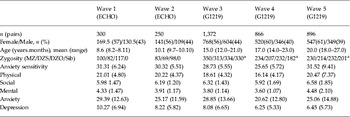
The present analyses combined data from two longitudinal twin and sibling datasets: the Emotions, Cognitions, Heredity and Outcome (ECHO) and Genesis G12-19 (G1219) studies. ECHO is a spin-off of a larger population sample with most of the twin pairs being selected for heightened parent-report anxiety at 7 years. G1219 is an unselected twin and sibling study. Full recruitment details are provided elsewhere (Eley et al. Reference Eley, Gregory, Clark and Ehlers2007; McAdams et al. Reference McAdams, Gregory, Rowe, Zavos, Barclay, Lau, Maughan and Eley2013). Both studies were approved by the appropriate ethics committees (Research Ethics Committee, Institute of Psychiatry, King's College London and Goldsmiths, University of London). Informed consent was obtained from parents of all children aged under 16 years and from participants over 16 themselves. Zygosity was determined using parent-rated questionnaires (Cohen et al. Reference Cohen, Dibble, Grawe and Pollin1975; Price et al. Reference Price, Freeman, Craig, Petrill, Ebersole and Plomin2000) and DNA sequencing in uncertain cases. The current report focuses on five waves of data collected during childhood, adolescence and adulthood: wave 1 (mean age = 8 years) and wave 2 (mean age = 10) from ECHO, and waves 3 (mean age = 15), 4 (mean age = 17) and 5 (mean age = 20) from G1219. Sample characteristics are shown in Table 1. There were wide age ranges for waves 3–5, reflecting the inclusion of siblings in G1219. However, the majority of the sample at each wave conferred much narrower age ranges (e.g. > 90% 18–22 years at wave 5)Footnote 1 Footnote †.
Sample characteristics and descriptive statistics for anxiety sensitivity dimensions, anxiety and depressive disorder symptoms in childhood, adolescence and adulthood

ECHO, Emotions, Cognitions, Heredity and Outcome; MZ, monozygotic; DZS, dizygotic, same-sex pairs; DZO, dizygotic, opposite-sex pairs; Sib, siblings.
a The numbers of twin pairs do not add up to totals because some of the twins were of unknown zygosity (wave 3 = 45, wave 4 = 11, wave 5 = 19). These pairs were excluded from the genetic analyses.
Summary statistics are presented on untransformed and unregressed variables for comparison with other published samples.
Different measures of anxiety sensitivity, anxiety and depression were used at different waves, thus the means cannot be compared across some waves.
The wider age ranges at waves 3–5 reflect the inclusion of siblings. The majority of the sample at each time point confer much narrower age ranges (e.g. > 90% 18–22 at wave 5).
Measures
Anxiety sensitivity
Anxiety sensitivity was assessed using the Children's Anxiety Sensitivity Index (CASI; Silverman et al. Reference Silverman, Fleisig, Rabian and Peterson1991) at waves 1–4 and the Anxiety Sensitivity Index (ASI; Reiss et al. Reference Reiss, Peterson, Gursky and McNally1986) at wave 5. Both involve participants completing items reflecting fear of anxiety sensations and have sound psychometric properties. Anxiety sensitivity dimensions representing physical, social and mental concerns were defined based on previous factor analyses in the G1219 study (Brown et al. Reference Brown, Trzaskowski, Zavos, Rijsdijk, Gregory and Eley2012). Physical concerns consisted of 12 items assessing worries regarding physical symptoms of anxiety. Social and mental concerns dimensions each contained three items relating to publicly observable symptoms of anxiety and worries about cognitive control respectively. At wave 5, physical and social concerns dimensions had 11 and two items respectively because the ASI had fewer overall items than the CASI. Dimension scores were calculated by summing constituent items for each subscale.
Anxiety
DSM-based anxiety symptoms were assessed using the Screen for Child Anxiety Related Emotional Disorders (SCARED; Birmaher et al. Reference Birmaher, Brent, Chiappetta, Bridge, Monga and Baugher1999) at waves 1 and 2 (mean ages 8 and 10) and the Spence Children's Anxiety Scale (SCAS; Spence, Reference Spence1998) at waves 3 and 4 (mean ages 15 and 17). At wave 5 (mean age 20), an adult variant (Gregory et al. Reference Gregory, Buysse, Willis, Rijsdijk, Maughan, Rowe, Cartwright, Barclay and Eley2011) of the anxiety items from the Revised Children's Anxiety and Depression Scales (RCADS; Chorpita et al. Reference Chorpita, Yim, Moffitt, Umemoto and Francis2000) was used. All measures represent self-report questionnaires tapping common anxiety symptoms and show sound psychometric properties. Responses were summed across items on each measure to create total anxiety scores.
All analyses at waves 1 and 2 were repeated removing one item from the SCARED that overlapped with the CASI: ‘When I get frightened, I feel like I am going crazy’. However, the results did not differ meaningfully so analyses with full measures are reported here.
Depression
DSM-based depressive disorder symptoms were assessed using the Children's Depression Inventory (CDI; Kovacs, Reference Kovacs1985) in ECHO (waves 1 and 2) and the Short Mood and Feelings Questionnaire (SMFQ; Angold et al. Reference Angold, Costello, Messer, Pickles, Winder and Silver1995) in G1219 (waves 3–5). Both self-report measures demonstrate sound psychometric properties. Total depression scores were created by summing response across all items.
Analyses
Phenotypic analyses
Phenotypic associations between anxiety sensitivity dimensions, anxiety and depression were examined at each wave using full correlations. Owing to substantial covariance between anxiety sensitivity dimensions and co-occurrence of anxiety and depressive disorders symptoms, partial correlations were used at each wave to tease apart phenotypic specificity. Pair-wise partial correlations controlled for associations with other variables (e.g. associations between physical concerns and anxiety controlled for the other anxiety sensitivity dimensions and depression).
Genotypic analyses
Aetiological associations between anxiety sensitivity dimensions, anxiety and depressive disorders symptoms were examined at each wave using structural equation twin modelling. By comparing the degree of similarity of monozygotic (MZ) twins (sharing all of their segregating genes) to dizygotic (DZ) twins (sharing half of their segregating genes on average), the twin design decomposes the variance within a variable into additive genetic influences (A), common environmental influences that make family members more alike (C) and non-shared, individual-specific environmental influences (E). The genetic and environmental overlap between multiple measures can be examined by comparing the MZ:DZ ratio of cross-twin, cross-trait covariances.
Prior to twin analyses, all variables were regressed for the effects of age and sex to meet twin modelling assumptions and mapped onto a standard normal distribution using the rank-based van der Waerden transformation to correct for skew. Twin models were fitted using the OpenMx program (Boker et al. Reference Boker, Neale, Maes, Wilde, Spiegel, Brick, Spies, Estabrook, Kenny and Bates2011) in R (RDC Team, 2010), a structural equation modelling package for the analysis of genetically informative data that controls for the non-independence of family members. Sampling weights were incorporated in ECHO twin models to account for the selected nature of the sample (Lau et al. Reference Lau, Gregory, Goldwin, Pine and Eley2007). Model fit to a saturated model was assessed for both univariate and multivariate models at each wave using minus twice the log likelihood (−2LL) of the observations and the Akaike information criterion (AIC). Univariate analyses assessing the influences of A, C and E on all variables were conducted at each wave. Sex differences were examined to inform multivariate modelling. Because of the sample size, sex differences were only examined in the G1912 sample to inform twin modelling. Scalar (i.e. variance) sex differences were found for all variables except for social concerns. Therefore, variance differences were included in the model-fitting analyses.
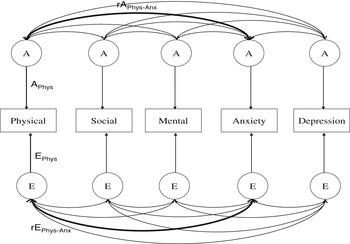
Multivariate correlated factors solutions examined the genetic and environmental relationships between anxiety sensitivity dimensions, anxiety and depression at each wave. The correlated factor solution (Fig. 1) assumes that each variable has unique genetic and environmental influences (e.g. APhys, CPhys, EPhys) but that these are correlated with one another (e.g. rAPhys-Anx, rCPhys-Anx and rEPhys-Anx respectively for genetic, shared environment and non-shared environment correlations between physical concerns and anxiety). Thus, the curved arrow from the A term above the physical anxiety sensitivity subscale to the A term above the anxiety scale represents the genetic correlation between these two variables.
Correlated factors solution showing genetic and environmental associations between anxiety sensitivity subscales (physical, social and mental concerns) and anxiety and depressive disorder symptoms. Phys, Physical concerns; A, additive genetic; E, non-shared environment; rA, genetic correlation; rE, non-shared environmental correlation. Paths in bold are highlighted and labelled for descriptive purposes only. For example, the path labelled APhys represents the genetic effects on the physical concerns dimension of anxiety sensitivity and the path labelled rAPhys-Anx depicts the degree to which genetic influences on the physical concerns dimensions of anxiety sensitivity are correlated with genetic effects on anxiety symptoms. Similarly, rEPhys-Anx represents the degree to which non-shared environmental factors influencing physical concerns are correlated with those influencing anxiety symptoms. Shared environmental estimates (C) and correlations (rC) were also calculated. However, these were non-significant so for simplicity are not shown in the figure. Estimates for C and rC are reported in Tables S1 and S3 respectively.

The relative strength of genetic and non-shared environmental estimates for each variable and for correlations between variables was compared using likelihood-based confidence intervals (CIs). Non-overlapping CIs indicate significant differences.
Finally, the focus of the current results was on associations between different anxiety sensitivity subscales and anxiety and depressive symptoms. Phenotypic and genetic associations among anxiety sensitivity subscales, and also between anxiety and depression, are presented elsewhere (Zavos et al. Reference Zavos, Rijsdijk, Gregory and Eley2010; Brown et al. Reference Brown, Trzaskowski, Zavos, Rijsdijk, Gregory and Eley2012).
Ethical standards
All procedures contributing to this work complied with the ethical standards of the relevant national and institutional committees on human experimentation and with the Helsinki Declaration of 1975, as revised in 2008.
Results
Descriptive statistics
Descriptive statistics of all measures are presented in Table 1. Descriptive statistics results are reported on raw untransformed data to facilitate comparisons with other studies. The majority of variables demonstrated substantial internal consistency at all waves (α = 0.79–0.94 for anxiety and depression; α = 0.25–0.86 for anxiety sensitivity subscales). Estimates were somewhat lower for social and mental concerns dimensions because there were fewer items within those subscales. However, estimates were comparable to other samples (Walsh et al. Reference Walsh, Stewart, McLaughlin and Comeau2004; Joiner et al. Reference Joiner, Schmidt, Schmidt, Laurent, Catanzaro, Perez and Pettit2002).
Phenotypic results
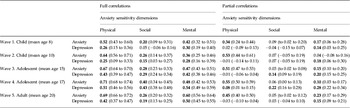
Full and partial Pearson correlations are presented in Table 2. For the physical concerns dimensions of anxiety sensitivity, full correlations indicated significantly stronger associations with anxiety than depressive disorder symptoms at all waves (r Phys-Anx = 0.52–0.71, r Phys-Dep = 0.25–0.51). This was confirmed by partial correlations. The association between physical concerns and anxiety remained significant whereas partial correlations with depression became non-significant and near-zero at most waves.
Full and partial correlations between anxiety sensitivity dimensions and anxiety and depression across childhood, adolescence and early adulthood

95% Confidence intervals (CIs) are presented in parentheses. CIs not inclusive of zeros indicate significant correlations (in bold). Non-overlapping CIs mean significant difference between the values. Partial correlations controlled for all other variables within time (e.g. anxiety with physical concerns controlling for covariance with depression and social and mental concerns).
Results are presented for untransformed and unregressed variables for comparison with other published samples. Correlations were conducted on a random selection of one twin from each twin pair to ensure that the relatedness between pairs within the sample did not influence the associations between variables.
Social concerns were associated with both anxiety and depression to a similar extent at all ages (r Soc-Anx = 0.20–0.40, r Soc-Dep = 0.05–0.43), although associations with depression were weaker at waves 1 and 2 (mean ages 8 and 10 respectively). Partial correlations revealed no association between social concerns and either anxiety or depression at waves 1, 2 and 5 but significantly stronger associations with depression than anxiety at the time points covering adolescence (waves 3 and 4).
Finally, full correlations for mental concerns revealed similar associations with anxiety and depressive disorder symptoms at all waves (r Ment-Anx = 0.36–0.60, r Ment-Dep = 0.28–0.54). Partial correlations showed a tendency for stronger associations with depression than anxiety, which reached significance at wave 4 [0.28 (95% CI 0.22–0.34) and 0.10 (95% CI 0.03–0.17) for depression and anxiety respectively].
Genetic associations
Univariate estimates
Univariate genetic and environmental estimates indicated small to moderate genetic effects (0.12–0.46), small but non-significant shared environmental influences (0.00–0.12) and large non-shared environmental influences (0.49–0.84) on all variables (see online Supplementary Table S1). Depression at wave 2 was an exception, being influenced by moderate shared environmental factors with no genetic influence (see note to Table S1 for further details).
Multivariate estimates
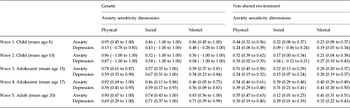
Genetic and non-shared environmental correlations between the variables at each wave are shown in Table 3 (fit statistics in Supplementary Table S2). Because of small non-significant shared environmental estimates on all variables, shared environmental correlations were modelled but were non-significant and thus are not interpreted further (see Supplementary Table S3).
Genetic and non-shared environmental correlations between anxiety sensitivity dimensions and anxiety and depression across childhood, adolescence and early adulthood

95% Confidence intervals (CIs) are presented in parentheses. CIs not inclusive of zeros indicate significant correlations. Non-overlapping CIs mean significant difference between the values.
Because of small non-significant shared environmental estimates on all variables, shared environmental correlations could not be reliably estimated. These are reported in the supplementary material (see Table S4) for the interested reader but cannot be meaningfully interpreted.
Genetic correlations between the physical concerns dimensions of anxiety sensitivity and anxiety and depression are given in the first column of Table 3. Physical concerns showed substantial genetic overlap with anxiety symptoms at all ages (rAPhys-Anx = 0.78–0.96) whereas genetic correlations between physical concerns and depression symptoms were weaker at all time points (rAPhys-Dep = 0.15–0.87). Non-shared environmental correlations for physical concerns were also stronger for anxiety than depression (rEPhys-Anx = 0.44–0.55, rEPhys-Dep = 0.18–0.39). These latter differences were significant at waves 3 and 5 [e.g. rEPhys-Anx = 0.51 (95% CI 0.45–0.58), rEPhys-Dep 0.24 (95% CI 0.15–0.32) at wave 3, mean age 15 years].
Social concerns had moderate to large genetic correlations with both anxiety and depression at all time points (rASoc-Anx = 0.32–0.74, rASoc-Dep = 0.43–0.71). Non-shared environmental correlations with anxiety and depression were comparable at all time points (rESoc-Anx = 0.12–0.39, rESoc-Dep = 0.19–0.41). Similarly, mental concerns generally showed moderate to large genetic (rAMent-Anx = 0.46–0.86, rAMent-Dep = 0.04–0.71) and modest to moderate non-shared environmental correlations (rEMent-Anx = 0.21–0.41, rEMent-Dep = 0.19–0.41) with both anxiety and depression at all waves. An exception was the lack of genetic correlation between mental concerns and depression at wave 2 (see footnote to Table S1).
Discussion
The current study reports cross-sectional analyses of shared and specific cognitive distortions in anxiety and depression at different development stages. This is the first study to investigate both phenotypic and genetic associations between anxiety sensitivity dimensions and anxiety and depressive disorder symptoms and to examine cross-sectional associations at five waves during childhood, adolescence and adulthood.
Partial correlations showed that the physical concerns dimension of anxiety sensitivity was associated with anxiety but not depression and shared greater genetic influences with anxiety than depression at all waves. Mental concerns were independently related to both anxiety and depression symptoms across development, with a tendency for stronger associations with depression than anxiety. Social concerns were not specifically associated with anxiety or depression in childhood and adulthood but tended to have stronger associations with depression than anxiety symptoms in adolescence. Genetic and non-shared environmental influences on mental and social concerns were moderately correlated with both anxiety and depression symptoms at all waves, although genetic correlations tended to be higher than non-shared environmental correlations. The results were similar at the three developmental periods, suggesting continuity over time in the patterns of associations between anxiety sensitivity dimensions and anxiety and depressive disorder symptoms. However, longitudinal research is needed to explore stability in the relationships between anxiety sensitivity dimensions, anxiety and depression.
Phenotypic results were largely in agreement with previous studies, finding stronger associations between physical concerns and anxiety, and between mental concerns and depression (Muris, Reference Muris2002). However, they are in contrast to those suggesting that anxiety sensitivity is primarily associated with anxiety, and that associations with depression are driven by the co-occurrence between depression and anxiety (Joiner et al. Reference Joiner, Schmidt, Schmidt, Laurent, Catanzaro, Perez and Pettit2002). Differential associations between anxiety sensitivity dimensions, anxiety and depression partially supported the CCS hypothesis, that anxiety and depression can be differentiated by divergent cognitive themes (Beck & Perkins, Reference Beck and Perkins2001), and support a multifaceted model of anxiety sensitivity, consisting of distinct but related dimensions that play different roles in anxiety and depression. Future research should use anxiety sensitivity subscale scores, in addition to global scores, to clarify the broad associations identified between anxiety sensitivity and a range of anxiety and depressive disorders.
Our genetic results were largely in line with previous twin studies exploring aetiological associations between global anxiety sensitivity and anxiety and depression (Zavos et al. Reference Zavos, Rijsdijk, Gregory and Eley2010). Moderate to substantial genetic overlap and modest non-shared environmental correlations between anxiety sensitivity dimensions and anxiety and depression symptoms are in accordance with the generalist genes hypothesis (Eley, Reference Eley1997), highlighting that similarities between these constructs are driven by genetic rather than environmental factors. Furthermore, broad genetic associations are in line with high rates of co-occurrence between anxiety and depression (Seligman & Ollendick, Reference Seligman and Ollendick1998) and between cognitive risk factors for both sets of symptoms (Zavos et al. Reference Zavos, Rijsdijk, Gregory and Eley2010). Evidence for shared genetic effects has implications for molecular genetic studies, supporting the persuasive argument that including cases with anxiety and depression disorders would lead to increasing power to detect shared susceptibility loci (Hettema, Reference Hettema2008).
Conversely, evidence for phenotypic specificity in associations between anxiety sensitivity, anxiety and depression and unique environmental influences acting on these symptoms has clinical implications for therapeutic interventions. Identifying disorder-specific cognitive concerns, and also those shared between co-morbid disorders such as anxiety and depression, could continue to inform the tailoring of CBT programmes to a given diagnosis. For example, the physical concerns dimension of anxiety sensitivity relates to fear of biological symptoms of distress. These symptoms are central to anxiety but not so typical of depression, which is characterized more by sadness than fear. Conversely, mental and social concerns showed independent associations with both anxiety and depression, especially at later waves, suggesting there may be shared cognitive concerns in both sets of symptoms; for example, fear of losing mental control is captured in the mental concerns subscale and symptoms regarding control and distractibility are common in both anxiety and depressive disorders.
Associations between all anxiety sensitivity dimensions and anxiety suggest general modifications of anxiety-related cognitive concerns may be useful in CBT for anxiety disorders. However, anxiety represents a heterogeneous phenotype. Although beyond the scope of the current paper, future research would benefit from exploring specificity of associations between anxiety sensitivity dimensions and a range of anxiety disorder symptoms, independent of depression symptoms, to tailor cognitive interventions more precisely to specific anxiety disorders.
Associations between depression symptoms and mental and social concerns but not physical concerns dimensions of anxiety sensitivity are in line with current practice in CBT for depressive disorders, which focuses on modifying concerns surrounding cognitive and social symptoms rather than physical symptoms. Importantly, stronger associations in adolescence than in childhood and adulthood suggest that targeting social concerns may be most useful in adolescent depression. This developmental difference may be attributable to the fact that depression tends to emerge later than anxiety (Cohen et al. Reference Cohen, Cohen, Kasen, Velez, Hartmark, Johnson, Rojas, Brook and Streuning1993) and fits with normal developmental trajectories of fears, which suggest that fears relating to social themes emerge later in young people than those relating to biological symptoms (Gullone, Reference Gullone2000). However, depression-specific research has implicated several other cognitive distortions in the development of depressive symptoms (Nolen-Hoeksema et al. Reference Nolen-Hoeksema, Wisco and Lyubomirsky2008). Future research should aim to explore the content of depressive cognitions in more detail by combining multiple cognitive distortions within a single study.
Limitations
The genetically informative samples and multiple points are considerable strengths of the current study. However, the limitations of the study warrant consideration.
First, to ensure that age-appropriate inventories were used, measures differed across some waves. However, as all selected measures have previously been validated in similar samples and current analyses were not longitudinal, this should not limit the interpretation of our results (for longitudinal analyses of anxiety sensitivity, anxiety and depression, see Zavos et al. Reference Zavos, Gregory and Eley2012a ). Second, the extent to which young children can understand and report on internalizing symptoms is debated (Chorpita et al. Reference Chorpita, Albano and Barlow1996). Nevertheless, children as young as age 8 can make valid reports of internalizing symptoms (Michael & Merrell, Reference Michael and Merrell1998; Merrell et al. Reference Merrell, McClun, Kempf and Lund2002) and interpretations of anxiety symptoms (Muris et al. Reference Muris, Hoeve, Meesters and Mayer2004). Given the internal replication of the results at all waves, in two different samples, our findings seem broadly applicable across development. Nonetheless, reliance on self-report data may be associated with shared method variance that could inflate the correlations. Third, measurement of anxiety sensitivity dimensions was limited by social and mental concerns dimensions containing only three items, resulting in lower internal consistency. However, the ASI and CASI are the only currently available self-report measures of anxiety sensitivity. Given the considerable evidence for a multifaceted construct, expanding measures of anxiety sensitivity to better capture social and mental concerns would be beneficial. Fourth, overlapping age ranges for waves 3 to 5 because of the inclusion of siblings could be argued to limit our ability to draw conclusions about patterns of associations across development. However, the majority of the sample fell within more discrete, non-overlapping age ranges at each wave, and when analyses were run without siblings the findings were very similar. We retained the siblings in our final models as their inclusion enhances the generalizability of our findings to non-twin populations.
With regard to twin analyses, the child sample was somewhat smaller than the adolescent/adult sample. Although considered large for phenotypic analyses, the paediatric sample had reduced power to detect shared environmental influences and parameter estimates resulted in larger CIs. It will be important to replicate the current results in larger paediatric twin studies. Additionally, there are some limitations inherent to the twin design, comprehensively discussed elsewhere (Plomin et al. Reference Plomin, DeFries, Knopik and Neiderhiser2012). These limitations have minimal and contrasting effects but parameter estimates should be taken as indicative rather than absolute values.
Conclusions
The results of the current study support and extend previous research examining specificity in associations between anxiety sensitivity dimensions, anxiety and depression and add to our growing understanding of co-morbidity between anxiety and depressive disorder symptoms. Specifically, anxiety sensitivity is a multifaceted construct. Distinct dimensions of anxiety sensitivity are differentially associated with anxiety and depression, indicating that anxiety and depressive disorder symptoms are characterized by both shared and symptom-specific cognitive distortions. Hence, the results from the current study are in agreement with the current DSM-5 classification that conceptualizes depression and anxiety as two separate, yet highly co-morbid, disorders. Furthermore, identifying specific and shared cognitions in anxiety and depression can inform the design of more precise clinical interventions for anxiety and depressive disorders across development.
Supplementary material
For supplementary material accompanying this paper visit http://dx.doi.org/10.1017/S0033291714000828.
Acknowledgements
We thank the families for their participation in this study and numerous staff and students from the Social Genetic Developmental Psychiatry Centre, Institute of Psychiatry, London and Goldsmiths, University of London.
Both the ECHO and G1219 studies were supported by a Medical Research Council Training Fellowship and a Career Development Award (T.C.E.). Waves 1–3 of G1219 were also funded by the W. T. Grant Foundation, the University of London Central Research fund (T.C.E.). Wave 4 of G1219 was supported by the Economic and Social Research Council (ESRC; RES-000-22-2206) and the Institute of Social Psychiatry (A.M.G.). H.M.B. and M.A.W. were supported by Ph.D. studentships awarded by the ESRC (ES/I010858/1ES/I010858/1) and the Alexander von Humboldt Foundation respectively.
Declaration of Interest
None.