Introduction
Modern liberal democracies are based on two competing visions of the democratic ideal. On the one hand, the majoritarian principle emphasizes democracy as government by the majority of the people, based on a concentration of power. The consensus principle, on the other hand, promotes the idea that democracy should represent as many people as possible and provide for multiple checks and balances – thereby limiting the power of the central government while providing for the representation of a broader array of interests. Although these democratic types have been criticized by many scholars on conceptual, empirical, and normative grounds (Kaiser, Reference Kaiser1997; Bogaards, Reference Bogaards2000; Schmidt, Reference Schmidt2000; Armingeon, Reference Armingeon2002; Tsebelis, Reference Tsebelis2002; Taagepera, Reference Taagepera2003), Lijphart’s (Reference Lijphart1984, Reference Lijphart1999) ground-breaking distinction between consensus and majoritarian democracies (based on his 10 features of democracy) undoubtedly represents the most influential and prominent typology of modern democracies (Mainwaring, Reference Mainwaring2001).
Using Lijphart’s fundamental distinction between majoritarian and consensus democracy as a starting point, this article aims to further develop its base in three respects:
• In conceptual terms, our study encompasses a broader range of democratic institutions. In addition to the executive–parties and federal–unitary dimensions of democracy, we also include direct democracy, thus taking into account power relations between the governing elite and the population. This aspect has hitherto been neglected, but is becoming progressively more important.
• In methodical terms, we aim for a higher validity and reliability of Lijphart’s (Reference Lijphart1999)democratic features. Both for reasons of comparability and due to the strong significance of Lijphart’s types of democracy, our study focuses on achieving a more valid and reliable measurement of those variables which have been particularly strongly criticized in Lijphart (Reference Lijphart1999).
• Empirically, we perform an up-to-date examination of Lijphart’s dimensions of democracy on the basis of the individual political institutions. We examine the most recent period, which was not taken into account by Lijphart (Reference Lijphart1999) (i.e., the decade from 1997 until 2006) using a most-similar cases design. Our empirical analysis concentrates on 23 advanced industrial democracies that display a comparable degree of economic wealth.
According to Lijphart (Reference Lijphart1984, Reference Lijphart1999), the two types of democracy ideally are diametrically opposed with regard to power distribution. Majoritarian democracy, with its bare majority cabinet, two-party system, disproportional system of elections, unitary and centralized government, as well as additional elements, is, as a basic principle, centered on the concentration of power. Consensus democracy, on the other hand, stresses power sharing on the basis of a broad coalition cabinet, a proportional electoral system, a multi-party system, federal, and decentralized government, strong bicameralism, and other institutions. Although Lijphart’s (Reference Lijphart1999) choice and measurement of individual features of democracy have recently been disputed, Taagepera (Reference Taagepera2003: 14) rightly states that Lijphart’s (Reference Lijphart1999) prominent typology of democracy and his empirical analysis of modern democracies ‘sets a standard for work to come’. Therefore, in accordance with Lijphart’s terminology of comparative institutional analysis (1999: 3) and following recent theoretical thought on new institutionalism (Hall and Taylor, Reference Hall and Taylor1996; Kaiser, Reference Kaiser1997; Rothstein, Reference Rothstein1998; Grofman, Reference Grofman2000), the ‘institutional rules and practices’ of the advanced democracies lie at the heart of our research interest.Footnote 1 However, we expand the scope of these rules and practices by examining a pivotal element in empirical democracy research: direct democracy. Although often neglected, it forms the most democratic of decision mechanisms and has increasingly gained importance at the beginning of the 21st century. Today, more and more important questions are being decided by referendum (e.g., recent constitutional changes in Australia, Denmark, Ireland, and Italy, as well as ratifications of international treaties in the European Union), while institutional provisions for referendums are increasingly being added to constitutions in many countries (Scarrow, Reference Scarrow2001; LeDuc, Reference LeDuc2003; Hug, Reference Hug2004; Qvortrup, Reference Qvortrup2005).
Lijphart’s (Reference Lijphart1999) factor analysis on the constitutional features and electoral outcomes of 36 different democracies, produces two dimensions. The horizontal dimension, he identifies, is the executive–parties (or joint-power) dimension, comprising the degree of electoral disproportionality, the effective number of parties, the frequency of single-party government, the average cabinet length, and the interest group system. The vertical dimension, which Lijphart calls the federal–unitary (or divided-power) dimension, encompasses bicameralism, federalism, judicial review, constitutional rigidity, and central bank independence. Lijphart’s (Reference Lijphart1984, Reference Lijphart1999) finding, that the concept of direct democracy cannot be linked systematically with his two dimensions of democracy, has been recently confirmed by Grofman (Reference Grofman2000: 53). However, to date, there have been very few conceptual attempts to connect Lijphart’s two models of democracy with direct democracy (see, Jung, Reference Jung1996; Vatter, Reference Vatter2000). Even recent research on direct democracy (Suksi, Reference Suksi1993; Butler and Ranney, Reference Butler and Ranney1994; Gallagher and Uleri, Reference Gallagher and Uleri1996; Hug and Tsebelis, Reference Hug and Tsebelis2002; LeDuc, Reference LeDuc2003; Qvortrup, Reference Qvortrup2005; Setälä, Reference Setälä2006) has only helped to confirm the conclusions reached by Arend Lijphart (Reference Lijphart1984: 31) in his pioneering study: ‘the concept of direct democracy cannot be regarded as either typically majoritarian or typically consensual’. There has not yet been a successful connection of the basic concept of direct democracy, both theoretically and empirically, with Lijphart’s two important models of democracy in an international comparison. This paper aims to fill this gap and to provide a convincing answer to the question raised by Lijphart (Reference Lijphart1999: 217), as to whether referendums should ‘be seen mainly as majoritarian instruments or rather as incentives for seeking consensus?’
The paper is organized in six sections. The following section develops a theoretical connection between the most important features of Lijphart’s models of consensus and majoritarian democracy on the one hand, and the main instruments of direct democracy on the other. In the third section, our main hypothesis concerning the relationship between Lijphart’s institutional variables and direct democracy will be presented. The research design and the variable measurements can be found in the fourth section. The fifth section focuses on the empirical analysis of 23 OECD democracies, with a summary of our theoretical arguments and empirical findings to follow in the sixth and final section.
Theoretical connections between majoritarian, consensus, and direct democracy
Before delving into the investigation, it should be noted that there is no definitive answer to the question of possible connections between direct democracy and the two basic dimensions of democracy. This is due to the reality that the numerous forms of direct democracy are too manifold and oppositional with regard to their functions and effects. It is therefore necessary to first disaggregate referendums, as they have both majoritarian and consensual characteristics. A convincing answer can only be found if we attempt to classify the direct democratic institutions in theoretical terms, subsequently connecting them to Lijphart’s two basic principles of power sharing and power concentration (Jung, Reference Jung1996; Vatter, Reference Vatter2000, Reference Vatter2002). Although a number of classifications have recently been proposed (e.g., Suksi, Reference Suksi1993; Butler and Ranney, Reference Butler and Ranney1994; Hamon, Reference Hamon1995; Uleri, Reference Uleri1996; Setälä, Reference Setälä1999, Reference Setälä2006; Qvortrup, Reference Qvortrup2000; Hug, Reference Hug2004), most of these attempts come close to Smith’s (Reference Smith1976) basic classification. In light of this fact, it seems reasonable to apply Smith’s first criterion (Reference Smith1976), albeit in a slightly more specific form (i.e., to ask the question, who has the right to launch a referendum). Using this criterion, we can derive two basic types of referendums (see also, Jung, Reference Jung1996; Vatter, Reference Vatter2000):
• Type 1: ‘Controlled (passive) referendums’: The government or a parliamentary majority may launch a referendum.
• Type 2: ‘Uncontrolled (active) referendums’: Non-governmental actors, a minority of voters or a parliamentary minority may initiate a referendum.
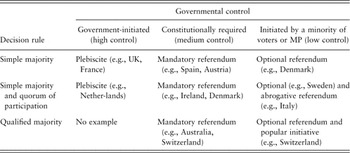
While plebiscites,Footnote 2 and in some cases mandatory referendums,Footnote 3 can be assigned to the first direct democratic type which Hug (Reference Hug2004: 323) calls ‘passive referendums’, optional referendumsFootnote 4 and popular initiativesFootnote 5 correspond to Type 2. The latter can be also designated ‘active referendums’ because of the active role played by non-governmental actors (e.g., citizens) in launching them (Hug, Reference Hug2004: 323). Given this basic distinction, it is now possible, at least in theoretical terms, to establish an initial connection to Lijphart’s two concepts of democracy: as the ruling majority has an exclusive right to call for plebiscites, these can be thought of as having the typical features of majoritarian democracy. By contrast, we have popular initiatives and optional referendums: these can be launched from the bottom-up by a small minority of voters or parliamentarians, either to overturn decisions made by the parliamentary majority (optional referendums), or to refer to voters’ propositions for laws or constitutional reforms (popular initiatives), thereby circumventing the parliamentary and government majority. The mandatory referendum, which is constitutionally required on a particular type of decision, is located between these two types of direct democracy: on one hand, the government can control the agenda of the mandatory referendum and grant considerable leeway in interpretation, if the terms of the proposal are suitably vague, while on the other hand, the government does not have much control over the initiation of a referendum if the constitution automatically provides for a vote on a range of specified issues.Footnote 6 Therefore, following Setälä (Reference Setälä2006: 711), we can place the different forms of direct democracy on a continuum from high (plebiscites), to medium (mandatory referendums), to low (optional referendums and popular initiatives) ‘governmental control’.
In order to achieve a more accurate taxonomy of the numerous forms of direct democracy, we need to ask not only who initiates the referendum, but also who has ultimate decision-making authority. So far, we have considered the potential influence of governmental majority and non-governmental minorities only in terms of the initial stages of the decision-making process. We therefore need to continue by considering the rights of majorities and minorities during the final decision phase. In concrete terms, this raises the question of whether the consent of specific quorums is required for the acceptance of a referendum proposal. In this respect, Jung (Reference Jung1996: 633) and Vatter (Reference Vatter2000: 174) emphasize the substantial difference between referendum decisions requiring qualified majorities, and those which can proceed on the basis of a simple majority.
Provisions for required referendums frequently stipulate not only simple majorities, but also the consent of qualified majorities. For example, in the federal system of Switzerland, constitutional changes require a majority not only among voters, but also among the cantons, which make up the Federation. As a result of this ‘double majority requirement’ for constitutional referendums, a citizen’s vote in the smallest canton Appenzell Inner Rhodes carries approximately 40 times more weight than a citizen’s vote in the canton of Zurich. Therefore, the federalist protection of minorities effectively means that small cantons ‘can organize a veto to block democratic majorities’ (Linder, Reference Linder1998: 159). In Australia, there is also a ‘double majority’ rule: a national majority of voters and a majority of voters in a majority of the States (more than half of the voters in more than half of the States) must vote in favor of a constitutional (mandatory) referendum proposal. In Italy, however, a referendum outcome is only valid if the voter-turnout exceeds 50%. In Denmark, a rejection of a bill transferring some aspects of national sovereignty to an international organization is only valid if at least 30% of the eligible voters reject the bill. If less than 30% vote against a proposal, the proposal is deemed to have been accepted (Hug and Tsebelis, Reference Hug and Tsebelis2002: 479).
By considering majority–minority dimensions in terms of both the initiation and decision phase of a referendum proposal, we are able to trace connections between the most important forms of direct democracy and Lijphart’s two models of democracy, as well as develop a ‘majoritarian-consensus’ classification of different forms of direct democracy (see Table 1). While plebiscites with simple majority rules belong to the majoritarian type of democracy, optional referendums and popular initiatives requiring supermajorities display distinct consensus characteristics. The latter are effective instruments that enable non-governmental actors to enforce popular votes which may go against the will of the governmental majority, and which may be regarded as typical power sharing instruments of consensus democracies. Initiatives and optional referendums (for which a simple majority rule applies) are intermediate formsFootnote 7: at the crucial stage of initiation, these instruments display typical consensus features, whilst final decisions are made according to a simple majority principle.
A ‘Majoritarian-Consensus’ classification of different forms of direct democracy with concrete examples

Main hypothesis
Following the logic of veto players theory (Hug and Tsebelis, Reference Hug and Tsebelis2002; Tsebelis, Reference Tsebelis2002; Hug, Reference Hug2004), we can argue that the possibility of referendums introduces an additional veto player, which makes significant changes in the status quo for the government more difficult. In particular, as barriers for the restraint of the executive, optional referendums and popular initiatives take on the function of powerful veto players, which can delay or prevent governmental decisions, thereby serving to shape the executive’s context of action in a significant way. Generally speaking, ‘uncontrolled’ forms of direct democracy introduce a new veto player – the median voter of the population – into the political game and thus block the choices of the ruling government (optional referendum) or upset their priorities (popular initiative). Consequently, we can assume that the government will do its best to reduce the uncertainty caused by uncontrolled referendums. A rational strategy to lessen risks arising from the optional referendum and popular initiative, is to widen the executive formula in order to encompass all parties likely to make efficient use of the referendum, if not co-opted as partners in the governing coalition (Neidhart, Reference Neidhart1970). We therefore presume that the threat of direct democracy from below leads to a boosting of executive power sharing. In summation, we hypothesize a strong relationship between the type of government cabinet and the consensual strength of direct democracy: more institutional provisions of uncontrolled referendums lead to a more inclusive government coalition in terms of party composition, which in turn leads to more oversized cabinets. In other words, contrary to Lijphart’s (Reference Lijphart1984, Reference Lijphart1999) and Grofman’s (Reference Grofman2000) assumptions, we postulate the hypothesis that direct democracy – alongside the horizontal and vertical dimensions – does not form an absolutely independent third dimension of democracy; the individual forms of direct democracy (in accordance with their majority-consensus characteristics) exist in a systematic relationship with the type of cabinet, which was one variable of Lijphart’s first dimension of democracy (executive–parties). On the other hand, we do not assume any connections between direct democracy and Lijphart’s second dimension of democracy (federal–unitary). In the following sections, we will examine this hypothesis.
Research design and measurements of variables
Our empirical research is based on a cross-sectional analysis of relationships between the main political institutions in 23 advanced industrial democracies, between 1997 and 2006. We start by using factor analysis to inquire into the most important dimensions underlying political institutions in the 23 most established democracies. Second, a graphic representation of a multi-dimensional matrix (‘conceptual map of democracy’) of the 23 democracies further depicts the OECD countries’ politico-institutional characteristics.
Drawing on Armingeon’s (Reference Armingeon2002) and Schmidt’s (Reference Schmidt2000: 348) criticism of Lijphart’s (Reference Lijphart1999) selection of countries, we concentrate our analysis on economically similar countries, namely, the 23 most developed OECD countries. In particular, Armingeon (Reference Armingeon2002: 88) criticized Lijphart’s selection of 36 democracies with very different levels of socio-economic development: ‘Botswana and Costa Rica are compared with the USA and Switzerland’. This is problematic since political institutions and public policies are shaped by the wealth of a nation. Consequentially, many more of the 36 selected countries with strong consensual elements belonged to the group of socially and economically advanced democracies, whereas among the majoritarian democracies there were only few economically advanced countries. Thus, it seems ‘a much more prudent procedure to concentrate only on economically similar countries – the OECD countries’ (Armingeon, Reference Armingeon2002: 88). The systematic comparison of the most advanced and wealthiest democracies not only has the advantage that it meets the requirements of the most-similar systems research design (Przeworski and Teune, Reference Przeworski and Teune1970; Lijphart, Reference Lijphart1971), and therefore avoids ‘mixing up most similar and most dissimilar case designs’ (Armingeon, Reference Armingeon2002: 88), it also enables us to ensure that our empirical findings are based on reliable data, which is often not available for less developed countries (Lijphart, Reference Lijphart2002: 109).
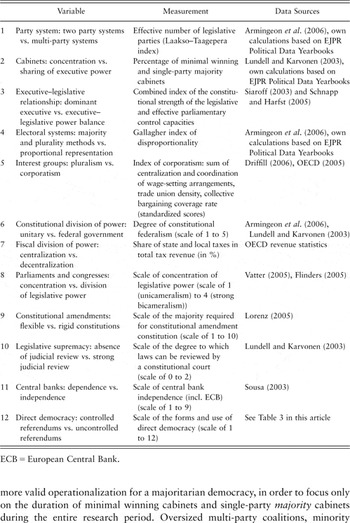
Table 2 lists the institutional variables, which we will consider in depth. Taking Lijphart’s (Reference Lijphart1999) 10 attributes of majoritarian and consensus democracies as a point of departure, we will now briefly introduce the variables used in our empirical analysis. Keeping our theoretical considerations in mind, we pay special attention to the measurement of direct democracy.
Variables, measurement and data sources

ECB = European Central Bank.
Party system
Like Lijphart (Reference Lijphart1999), we use the Laakso-Taagepera index (Reference Laakso and Taagepera1979) to measure the effective number of political parties in the respective parliaments. The Laakso–Taagepera index takes into account the number as well as the strength of the legislative parties and is one of the most widely used indicators for this purpose (Armingeon, Reference Armingeon2004). Systems with fewer legislative parties tend to be more majoritarian.
Cabinets
Lijphart (Reference Lijphart1999) measures the concentration of executive power in terms of the proportion of governments during a given period that were either minimal winning or single-party cabinets. A greater proportion of minimal winning or single-party cabinets increases the likelihood of a greater concentration of executive power and, therefore, tends toward a more majoritarian political system. It should be noted that Lijphart’s category of single-party cabinets includes both single-party minority cabinets and single-party majority cabinets:
However, these are very different types of cabinets in terms of the consensus-majoritarian logic. A minority government must share power with parliament, as the opposition controls a majority of seats and can unseat the government at any time. In order to pass legislation, a majority of MPs must vote in favor of the government’s legislative proposals. A single-party majority cabinet can largely neglect parliament, as long as the parliamentary party is disciplined and MPs support their leaders in cabinet unconditionally (De Winter, Reference De Winter2005: 10).
Therefore, combining cabinets that work according to a consensual pattern with those that work according to a majoritarian logic into a single variable, is devoid of meaning. Starting from this criticism, we slightly modify the measure of the concentration of executive power. In the case at hand, we aim to achieve a more valid operationalization for a majoritarian democracy, in order to focus only on the duration of minimal winning cabinets and single-party majority cabinets during the entire research period. Oversized multi-party coalitions, minority coalitions, and single-party minority cabinets are regarded as merely characteristics of a consensus democracy.Footnote 8
Executive–legislative relationship
Lijphart (Reference Lijphart1999) measures this variable in terms of the average cabinet duration, in days, for the period in question. A more durable cabinet tends to increase the likelihood of a more dominant executive (vis-à-vis the legislature), and therefore tends toward a more majoritarian system. However, it is obvious that the relationship between executive and legislative powers is theoretically, but not logically related to Lijphart’s indicator. While an executive can be very stable and a loyal delegate of the parliamentary majority, short-lived governments do in fact probably indicate weak governments, but not necessarily strong parliaments (De Winter, Reference De Winter2005: 11). Their instability may be due to many other factors (see, Müller and Strom, Reference Müller and Strom2000). Furthermore, there are many formal and informal rules that contribute to the power relations between executives and legislatures (agenda-setting power, the rights of the parliamentary committees, etc.), and also tend to serve as appropriate indicators for the executive–legislative relationship (Siaroff, Reference Siaroff2003). Therefore, it is not surprising that Lijphart (Reference Lijphart2003: 20) comes to the conclusion that, of his 10 institutional variables, ‘the variable that gave me the most trouble […] was executive dominance’, and frankly admits: ‘I am not at all sure that the operational indicator I develop in Patterns of Democracy is satisfactory’ (Lijphart, Reference Lijphart2002: 110).Footnote 9
Due to the strong criticism of Lijphart’s operationalization, we introduce a new measurement of the power relationship between the executive and the legislative. A valid measurement of the relationship between the executive and the legislature must take both the constitutional position of the legislative vis-à-vis the executive, and the legislature’s actual possibilities of control into account. The variable chosen to determine the relationship between the executive and the legislative is based on a combined index, incorporating both the formal legal features of Siaroff’s (Reference Siaroff2003) ‘executive dominance’ index and Schnapp and Harfst’s (Reference Schnapp and Harfst2005) effective parliamentary control capacities. Siaroff’s (Reference Siaroff2003) index pools 11 indicators, which Siaroff defines as the factor ‘executive dominance over the legislature’ on the basis of factor analysis. These indicators include, for example, the degree of government control of plenary agendas, the initiation of legislation, the ability of committees to rewrite legislation, and the power of the prime minister.Footnote 10 The Schnapp and Harfst (Reference Schnapp and Harfst2005) index is based on an extensive examination of the effective control possibilities and information resources of the parliaments in two dozen industrial democracies.Footnote 11 Schnapp and Harfst (Reference Schnapp and Harfst2005) combine the information and control capacities measured for each parliament to form an additive index, taking factors such as the number of staff at the disposal of members of parliament, the size of the parliamentary scientific service departments, and the number of permanent parliamentary committees into account. Our combined index for the determination of the power relation between government and parliament is formed by the standardized scores of the sum of Siaroff’s (Reference Siaroff2003) and Schnapp and Harfst’s (Reference Schnapp and Harfst2005) indices.
Electoral system
Like Lijphart, we use the Gallagher index of disproportionality to measure the degree to which the electoral systems skew the relationship between votes and seats in parliament: the greater the disproportionality, the more majoritarian the electoral system.Footnote 12
Interest groups
Lijphart (Reference Lijphart1999) uses an index of interest group pluralism developed by Siaroff (1999) based on eight indicators and generates a comprehensive score for 24 countries ranging from 1 (highly pluralist) to 5 (highly corporatist). While some of Siaroff’s indicators (1999: 195ff.) refer to formal and informal rules – such as the recognition of peak organizations as social partners at trilateral negotiations and as parties which are integrated into policy-making – others are clearly outcomes of such rules, in particular the number of days lost by strikes. Moreover, the latter are used, as such, by Lijphart (Reference Lijphart1999: 266ff.) in his analysis of the consequences of institutional arrangements for economic outputs. As such, causes and consequences are based to some extent on identical indicators, which clearly creates a problem of endogeneity (De Winter, Reference De Winter2005: 11). Consequently, it seems advantageous to use an indicator of corporatism, which does not rely on economic output indicators. However, to date, corporatism researchers have been unable to agree on a broadly accepted quantitative measurement concept; rather, there exists a multitude of very different quantitative indicators of corporatism ‘which have grown so numerous as to perhaps overwhelm even seasoned researchers in the field’ (Kenworthy, Reference Kenworthy2003: 11). Nevertheless, a systematic comparison of 42 indicators of corporatism shows that all these indicators can at least be grouped into four categories according to their main focus: (1) interest group organization, (2) wage-setting arrangements, (3) interest group participation in policy-making, and (4) political economic consensus (Kenworthy, Reference Kenworthy2003). To avoid the endogeneity problem, we use a narrowly defined measure of corporatism that includes the first three categories, but excludes the fourth (political economic consensus), which is usually operationalized by strike rates (Kenworthy, Reference Kenworthy2003: 16). Our corporatism index is comprised of the sum of the following standardized indicators: trade union density (percentage of labor force consisting of members of trade unions), the collective bargaining coverage rate (percentage of labor force covered by collective agreement), and the centralization and coordinationFootnote 13 of the wage formation process.
Constitutional division of territorial power
With reference to the recent debate on how to measure the territorial division of power (Elazar, Reference Elazar1997; Watts, Reference Watts1998; Castles, Reference Castles1999; Keman, Reference Keman2000; Rodden, Reference Rodden2004), and in order to avoid confusing different concepts of vertical power sharing, we depart from Lijphart’s (Reference Lijphart1999) one-dimensional measurement of federalism and decentralization. Instead, we use two different scales to highlight this dimension – namely, the federal–unitary scale, representing the constitutional indicators for the ‘right to decide’, and the central–decentral scale, which indicates the extent to which non-central agencies, in fact, have the ‘right to act’ (Keman, Reference Keman2000: 199).Footnote 14 The federal–unitary indicator measures the territorial distribution of power between different levels of government forms embraced by the constitution, ranging from 1.0 (unitary) to 5.0 (federal), and also takes the recent institutional changes of territorial power in our sample of countries into consideration (Armingeon, Reference Armingeon2004).
Fiscal division of territorial power
We measure the degree of decentralization by means of an indicator of fiscal decentralization developed in analogy to Lijphart (Reference Lijphart1984: 178) and also used by Armingeon (Reference Armingeon2004), Castles (Reference Castles1999), Keman (Reference Keman2000), Schmidt (Reference Schmidt2000), and many others. ‘This measure […] is the simplest and most unambiguous measure of the territorial decentralization of the fisc’ (Castles, Reference Castles1999: 33). Fiscal decentralization is equivalent to the proportion of state and local taxes in total tax revenue. The tax-share measure is based on the reasonable assumption that the scope of the activities of the central–state and non-central government can be measured in terms of their revenues.
Parliaments and congresses
For his measurement of the distribution of power within the legislature, Lijphart (Reference Lijphart1999) uses three features (bicameral vs. unicameral; symmetrical vs. asymmetrical; congruent vs. incongruent) in order to derive an index of bicameralism. Lijphart’s scale ranges from 1.0 (unicameral), a majoritarian characteristic, to 4.0 (strong bicameralism), a consensus attribute. Here, we use an updated version of Lijphart’s bicameralism index based on Vatter (Reference Vatter2005).Footnote 15
Constitutional amendments
According to Lijphart (Reference Lijphart1999: 219), the great variety of constitutional provisions can be reduced to four basic types: approval of a constitutional reform by an ordinary majority (1.0); approval by more than an ordinary but less than a two-thirds majority or ordinary majority plus referendum (2.0); approval by a two-thirds majority or equivalent (3.0); and approval by more than a two-thirds majority or a two-thirds majority combined with other requirements (4.0). The major problem with Lijphart’s index is the unsystematic consideration of referendums (see, Lorenz, Reference Lorenz2005: 342ff.).Footnote 16 In her index of constitutional rigidity, Lorenz (Reference Lorenz2005) combines Lijphart’s scale with the systematic consideration of different voting arenas, implying that non-parliamentary actors must be considered in a systematic way when they explicitly have to consent to an amendment. Therefore, for the following analysis we use Lorenz’s sophisticated index of amendment procedures (ranging from 1.0 to 9.5), which takes the different majority requirements, as well the different voting arenas into consideration.
Judicial review
In order to measure the strength of judicial review, Lijphart (Reference Lijphart1999: 225) uses a four-fold classification based first on the distinction between the presence and absence of judicial review and second, on three degrees of activism in the assertion of this power by the courts. In the case at hand, we use an updated version of Lijphart’s scale, ranging from 1.0 (no judicial review), a majoritarian trait, to 2.0 (strong judicial review), a consensual characteristic based on Lundell and Karvonen (Reference Lundell and Karvonen2003).
Central bank
To measure the independence of central banks, Lijphart (Reference Lijphart1999: 235) uses the mean value of the Cukierman–Webb–Neyapti, the Grilli–Masciandaro–Tabellini and Central Bank Governors’ turnover rate indices, all of which are coded from 0 to 1 (i.e., from the lowest to the highest independence). However, Lijphart’s overall index for the measurement of central bank independence displays a number of weaknesses. For instance, it is partially based on out-dated data, does not include the Grilli–Masciandaro–Tabellini index for half of the countries examined, and does not take recent developments into account – particularly the formation and strong influence of the European Central Bank (ECB). The following analysis is therefore based on an up-to-date analysis of central bank independence for all OECD states, which also records the degree of independence of the ECB. Sousa (Reference Sousa2003), in his new study, considers the staff-related, political, economic, and financial dimensions of central bank independence and pools the total of nine indicators in an overall index of the independence of each of the central banks examined. For those countries which have joined the European Monetary Union and where the national central banks have accordingly decreased in importance, the value of the independence of the ECB is measured from the time of the countries’ accession.Footnote 17
Direct democracy
On the basis of our theoretical considerations, it is possible to compile an index of direct democracy corresponding to the majority-consensus logic. In doing so, the following applies: the more points awarded, the more consensual the direct democracy in a country. Three criteria are decisive for the determination of the direct democracy index:Footnote 18
Governmental control: what instruments of direct democracy are provided for by the constitution?
To answer this first question, we award one point for each basic form of ‘uncontrolled referendums’ (optional referendums, initiatives) provided for in the constitution. No points, however, are awarded for the plebiscite – the most majoritarian popular right – which is by definition an ad hoc referendum, can be initiated at the discretion of the head of government, and is often non-binding. The intermediate form, the mandatory referendum, is valued at 0.5 points according its medium level of governmental control. All in all, a maximum of 2.5 points is possible if a country provides for the mandatory referendum (0.5) and the optional referendum (1.0) as well as the popular initiative (1.0). An attenuated form of the popular initiative in practice is known as the popular petition, or the agenda-setting initiative (valued at 0.5 points), a petition, which must be processed by parliament but does not lead to a referendum. This form of citizen participation exists in AustriaFootnote 19 and Spain.Footnote 20 A further specific direct democratic feature is the Italian abrogative referendum, which can be initiated by 500,000 citizens or five regional councils. ‘There are no time limits between passing the decision and submitting it to a referendum, Italian voters may veto other than recent parliamentary decisions. The Italian abrogative referendum has in fact many characteristics similar to popular initiatives, as it allows the electors to influence the political agenda’ (Setälä, Reference Setälä2006: 707; see also Uleri, Reference Uleri1996, Reference Uleri2002). For this reason, in the case at hand, we treat the Italian abrogative referendum as a popular initiative. Finally, special forms of optional referendums exist in Iceland and Greece, where the President can initiate them if she or he refuses to ratify a project of bill (Uleri, Reference Uleri1996: 228). Due to this majoritarian feature, the optional referendum in Iceland and Greece is not valued in our index.
Decision rule: how are decisions regarding the acceptance or rejection of a referendum reached?
This question involves distinguishing whether a simple popular majority is sufficient for the acceptance of a referendum, or whether qualified majorities or the fulfillment of additional criteria are required. Here, one point is awarded for each form of direct democracy if a qualified majority (‘quorum of consent’) is required. The intermediate form of voter-turnout requirement (‘quorum of participation’) is valued at 0.5 points.
Practical use: which instruments of direct democracy were effectively used in practice over the course of last 10 years?
In line with Lijphart’s ‘institutional rules and practices’ approach, we will not only examine the constitutional provisions, but also the practical significance of direct democracy as well. Whether a popular right is prescribed by the constitution but never exercised (e.g., due to overly restrictive barriers regarding signature thresholds or circulation constraints), or whether referendums are actually held and the population is able to regularly influence governmental constitutional and legislative decisions directly is an important distinction to make. In our index, we award one point for the effective use, during the period from 1997 to 2006, of each basic direct democratic form stipulated in the constitution (criterion: at least one referendum issue). Here, a maximum of three points is possible if decisions were made via mandatory and optional referendums, as well as via popular initiatives.
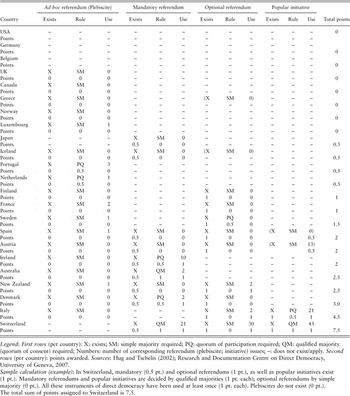
Table 3 provides an overview of the allocation of points for the 23 democracies examined based on the index of direct democracy presented above.
Index of direct democracy for 23 advanced democracies, 1997–2006

Legend: First rows (per country): X: exists; SM: simple majority required; PQ: quorum of participation required; QM: qualified majority (quorum of consent) required; Numbers: number of corresponding referendum (plebiscite; initiative) issues; –: does not exist/apply. Second rows (per country): points awarded. Sources: Hug and Tsebelis (Reference Hug and Tsebelis2002); Research and Documentation Centre on Direct Democracy, University of Geneva, 2007.
Sample calculation (example): In Switzerland, mandatory (0.5 pt.) and optional referendums (1 pt.), as well as popular initiatives exist (1 pt.). Mandatory referendums and popular initiatives are decided by qualified majorities (1 pt. each); optional referendums by simple majority (0 pt.). All these instruments of direct democracy have been used at least once (1 pt. each). Plebiscites do not exist (0 pt.). The total sum of points assigned to Switzerland is 7.5.
Empirical results
The main question that now arises is whether relationships can be observed between the most important political institutions in the advanced democracies. The appropriate method for investigating a set of variables with an ordering structure is factor analysis. Factor analysis allows individual variables, by virtue of their correlations, to be classified into independent groups. This statistical procedure allows us to isolate one or more underlying dimensions of the different variables (Kim and Mueller, Reference Kim and Mueller1978).
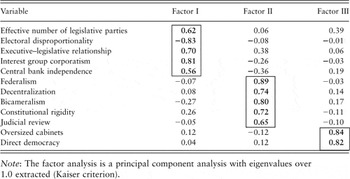
Table 4 presents the results of the factor analysis with our 12 variables.Footnote 21 The research period covers the years 1997 to 2006; the units examined are the 23 most advanced democracies. The values specified for each variable indicate the factor loadings, which can be interpreted as correlation coefficients between the variable and the first, the second, and the third factors.
Varimax orthogonal rotated factor matrix of the 12 institutional variables in 23 advanced democracies, 1997–2006

Note: The factor analysis is a principal component analysis with eigenvalues over 1.0 extracted (Kaiser criterion).
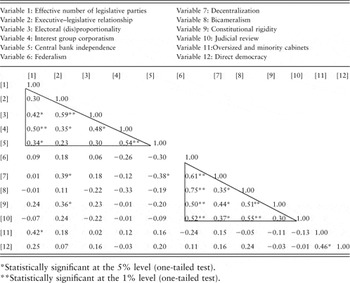
The central outcome of the factor analysis is the emergence of three unrelated factors, each of which encompasses a group of variables. The three groups of variables exhibit high factor loadings within, as well as low loadings outside their own group. The strongest variable in the first factor dimension is the disproportionality of the electoral system, which correlates very highly with the first factor, followed by interest group corporatism and the executive–legislative relationship. The number of parties and the degree of central bank independence stand in a somewhat less, but still comparatively strong relation to the first factor. In the second dimension, the federalism and bicameralism variables prove to be the strongest features, followed by the decentralization indicator, the rigidity of constitutional provisions, and the strength of judicial review.Footnote 22 The third and smallest factor encompasses two variables, namely, the percentage of oversized multi-party cabinets and the consensual strength of direct democracy. With 0.84 and 0.82, respectively, both variables correlate strongly with the third cluster. It is worth mentioning that the results are not driven by the special case of Switzerland. When Switzerland is dropped from the factor analysis, the factor loadings between type of cabinet, direct democracy, and the third factor are still 0.80 and 0.77, respectively. Further robustness tests (Scree-Test, test on linearity, tests on further outliers) show that the results proved in fact to be very robust. Finally, the correlation matrix for all 12 variables (see Appendix 2) reveals overall patterns, which generally correspond to the findings of the factor analysis. Not surprisingly, there are exceptions such as a statistically significant correlation between the effective number of parliamentary parties and the (oversized and minority) type of government cabinet (0.42). In fact, its correlation with direct democracy is only slightly higher (0.46).
What can be interpreted from the findings? The most evident result is the fact that if we take direct democracy into account, not only two, but three dimensions in established democracies emerge. Nevertheless, in contrast to the findings of earlier research (Lijphart, Reference Lijphart1984, Reference Lijphart1999; Grofman, Reference Grofman2000), the empirical results seem to confirm that direct democracy is not a variable that is independent of all other political institutions, but rather connected to the type of the cabinet government, and – to a lesser extent – to the number of parties. In short, the more developed the institutions and the use of direct democracy, the more likely there are to be broadly supported multi-party coalitions in the countries examined.
In the case of the horizontal dimension of democracy, two results are of particular interest. First, it has been shown that even a completely different (and hopefully more valid) measurement of the power relationship between the executive and the legislature reveals results similar to Lijphart’s (Reference Lijphart1999). A balanced relationship between the executive and the legislature corresponds to a proportional electoral system and a high number of parties in parliament. The second notable result is the positioning of central bank independence in the horizontal dimension of democracy, whereas in Lijphart’s (Reference Lijphart1999) factor analysis it was allocated to the federal–unitary dimension. As such, the present result is also more consistent with Lijphart’s original conception of the two democratic dimensions:
My own initial view of the differences between the two dimensions, reflected in the labels that I attached to them, was that the first is a horizontal dimension of institutions operating at the central level, and that the second is a vertical dimension having to do with central–regional–local government relations. Because central banks operate at the central level and appear to have little to do with the vertical dimension, my expectation was that central banks would belong to the executives–parties. But the empirical analysis showed a strong relationship with the cluster of four federal–unitary characteristics instead (Lijphart, Reference Lijphart2003: 23).
The present analysis makes clear that Lijphart’s initial theoretical considerations in this respect can be empirically confirmed for the most recent data, albeit with an important amendment: besides a horizontal institutional structure on the central–state level and a vertical, that is federal dimension, modern democracies also include a third, top-to-bottom power relation dimension, that is the relationship between the government and the population.
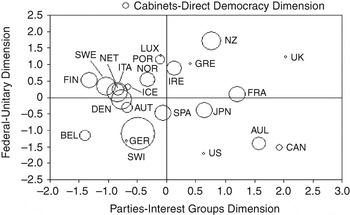
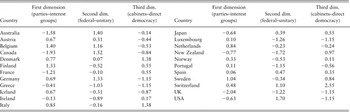
The factor analysis which we have carried out, affords us profound insights into the different dimensions of advanced democracies and conveys much information concerning the latter’s most important characteristics. However, the analysis does not yet show the exact location of each country (relative to the others) on the three mutually independent dimensions of democracy. A precise and appropriate way of answering this question would be to graphically represent the three dimensions on a conceptual map of democracy – as Lijphart (Reference Lijphart1999: 248) has already done.Footnote 23Figure 1, in the form of a so-called bubble plot (Jacoby, Reference Jacoby1998), represents the countries’ locations on a conceptual map formed by the 12 variables along with the three dimensions. The characteristics of the five variables of the horizontal and the vertical dimension can thus be used to place each of the 23 democracies on the conceptual map of democracy shown in Figure 1. The first dimension of horizontal power (‘parties–interest groups dimension’) is located on the abscissa, the vertical power dimension (‘federal–unitary dimension’) on the ordinate. Both axes vary between strongly majoritarian (positive values) and strongly consensual (negative values).Footnote 24 The third dimension (the ‘cabinets–direct democracy’ dimension) is represented by the size of each bubble, which shows the data point’s relative importance. A large bubble represents high values in the third dimension and corresponds to an active direct democracy and oversized multi-party cabinets, whereas a small bubble corresponds to a purely representative democracy and minimal winning cabinets in the given period. The exact (z-transformed) scores of each of the 23 countries on the three dimensions can be found in Appendix 1.
The three-dimensional conceptual map of democracy

What new insights does Figure 1 afford us compared to Lijphart’s (Reference Lijphart1999) two-dimensional map of democracy? Despite recent devolutionary processes in the UK, the UK continues to be a pure example of the Westminster model, while New Zealand (the only more unitary country than the UK) has, due to the introduction of the proportional electoral system in 1996, progressively become a mixed-type in the horizontal dimension, encompassing both majoritarian and consensus elements (Nagel, Reference Nagel2000). In terms of the first two dimensions, the prime example of a consensus democracy within Lijphart’s (Reference Lijphart1999) concept is Belgium, which has in recent years further developed its already exceptional position as a strongly federal state. However, in contrast to Lijphart (Reference Lijphart1999), Switzerland no longer corresponds to the prototype of a consensual-federal democracy in the first two dimensions. In the horizontal dimension, eight (of 23) countries achieve higher consensus values than Switzerland, while in the vertical dimension, five countries achieve higher values. An important reason for this result is that the present study, with its focus on direct democracy, includes a very important institutional arrangement of Swiss democracy, which, together with the type of cabinet, forms a third dimension. Although Switzerland is an average case of a consensus democracy in the first two dimensions, it represents a prime example of a direct democratic power sharing democracy. The relevant antipodes in the third dimension are purely representative democracies (at the national level) with minimal winning cabinets such as Germany, the USA, and the UK.
Conclusions
Two conclusions can be drawn from our analysis of the most important political institutions in advanced democracies:
First, our empirical results suggest that in consolidated democracies, there exist more than the two well-known dimensions of Lijphart’s model of democracy. Strikingly, the central outcome of our factor analysis is the emergence of three largely unrelated factors. The (first) horizontal dimension of democracy comes close, but is not identical to Lijphart’s executive–parties dimension. This dimension includes an entirely new measurement of the executive–legislative relationship, as well as central bank independence, and excludes the type of cabinet government. Because central banks operate at the national level, this result is more consistent with Lijphart’s initial distinction of a horizontal–vertical contrast (Lijphart, 2000: 236). The second factor is almost identical to Lijphart’s federal–unitary dimension and includes federalism, decentralization, bicameralism, constitutional rigidity, and judicial review. We can thus label the second factor the vertical dimension of democracy, as it deals with central–regional government relations. Finally, the most interesting result is the existence of a third factor, which we call the top-to-bottom dimension of democracy. This third dimension comprises two political institutions, the type of cabinet government and the strength of direct democracy. In contrast to the findings of other studies to date (Lijphart, Reference Lijphart1984, Reference Lijphart1999; Grofman, Reference Grofman2000), our study reveals that direct democracy is not a political institution independent of all other features of democracy; rather, it exists in relation to the type of the government cabinet, and – to a lesser extent – to the number of parties.
In line with the neo-institutional approach, it seems that with the increased veto potential of direct democracy and the ensuing unpredictability for the respective government, the increased institutional provisions for referendums in advanced democracies and their growing use by non-governmental actors in recent years, created institutional pressures towards more power sharing in the executive. In the case of Switzerland, the development of popular rights has admittedly led to the continuous integration of the main political parties into a government coalition and weakened the parliament. In the quest to minimize the risks harbored by direct democracy, the informal search for a broadly supported compromise has required the formation of broadly supported multi-party governments, which make the important decisions. Extensive power sharing in the Swiss government is intended to produce solutions acceptable to a sufficiently large majority in parliament, for the risk of optional referendums and popular initiatives to be reduced (Neidhart, Reference Neidhart1970; Steiner, 1974, Reference Steiner2002; Linder, Reference Linder1998). In short, the co-optation strategies over the years by the political actors in order to minimize the risks harbored by direct democracy, gradually transformed the Swiss referendum democracy into a consensus democracy with broadly supported multi-party government coalitions. However, we should be cautious suggesting a strong causal relationship between direct democracy and cabinet type in general. While the causal relation between direct democracy and oversized coalitions appears a valid explanation especially for Switzerland (and Liechtenstein), the frequency of oversized coalition in Italy and Denmark may be more explained by the fragmentation of the party system. Nevertheless, according to country experts, the recent integration into government of such parties as the Partito Radicali, Lega Nord, and Verdi in Italy (2005/06) as well as the Conservative Party and the Radical-Liberals in Denmark in the 1980s, occurred especially in order to prevent these opposition parties from their growing and effective use of referendum campaigns to block government legislation (Svensson, 1996; Uleri, 2002).
Second, how can the present results be integrated into the current findings of empirical democracy research? Initially, our results underline, for the most recent period, the continuing theoretical and empirical relevance of the horizontal and vertical power sharing dimensions in established democracies as described by Arend Lijphart (Reference Lijphart1984, Reference Lijphart1999). At the same time, our results make clear that the inclusion of a direct democracy can lead to an extension and differentiation of Lijphart’s concept of representative majoritarian and consensus democracy. Such an extension and differentiation not only accounts for new developments, such as the increased significance of referendums in modern democracies, but also counters certain researchers’ criticism of Lijphart that consensus democracies are de facto oligarchical elitist democracies without any direct influence by the people. Evidently, in reality there exist two different prototypes of consensus democracies with different power sharing strategies: on one hand, the parliamentary-representative type, which is decisively influenced by the search for compromises by the elected party leaders in the parliamentary arena (e.g., Belgium); and on the other hand, there is the direct democratic type, which is characterized by the broad integration of political forces into the government due to the pressure exercised by instruments of direct democracy (e.g., Switzerland). In this sense, we agree with Kaiser’s (Reference Kaiser1997), Kaiser et al. (Reference Kaiser, Lehnert, Miller and Sieberer2002) critiqueFootnote 25 of Huber, Ragin, and Stephens (Reference Huber, Ragin and Stephens1993) and Schmidt’s (Reference Schmidt2000) one-dimensional frameworks of counter-majoritarian institutions. In the present case, it seems similarly unwise simply to tally up the institutional veto points, as this would cause a practical disappearance of the different dimensions of power sharing and the specific interaction of institutions in the advanced democracies. Theoretically, as well as empirically, it seems more useful to allow for the variety of institutional arrangements in the advanced OECD countries by differentiating between at least three different dimensions of democracy. Taking these different dimensions into account provides us with a more complex, but also an overall more realistic picture of the diversity of modern democracies.
Acknowledgments
I am indebted to Markus Freitag, Arend Lijphart, Theo Schiller, Maija Setälä, Jürg Steiner, and the anonymous reviewers for their advice and criticism. An earlier version of this article was presented at the ECPR-Joint Sessions of Workshops 2007 in Helsinki.
Appendix 1
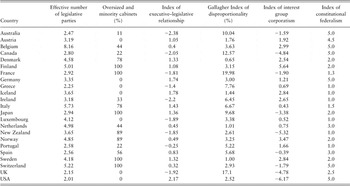
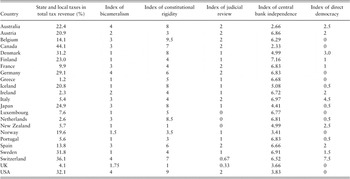
Twelve institutional variables of 23 Advanced Democracies, 1997–2006

(Continued)

(Continued)

Appendix 2
Correlation matrix for 12 institutional variables in 23 advanced democracies, 1997–2006

*Statistically significant at the 5% level (one-tailed test).
**Statistically significant at the 1% level (one-tailed test).